When Do Babies Sit Up? A Complete Guide to the Sitting Milestone
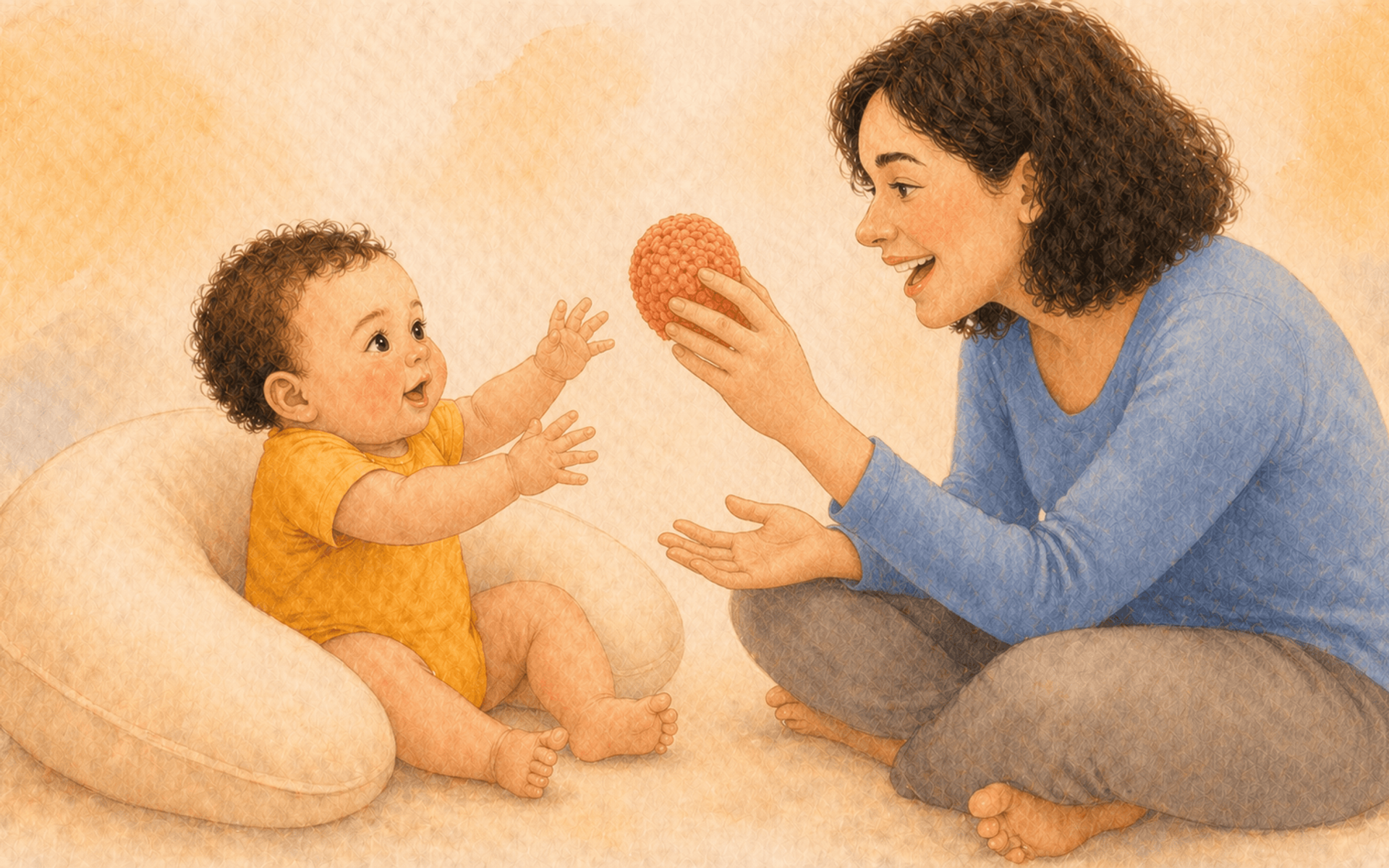
For weeks, your baby could almost sit. The head held up, the spine straightened, both hands reached forward — and then came the slow tip sideways, every single time. Until today, when the almost tipped into actual. Three wobbly seconds on the playmat, one hand grounded like a tripod, the other already pointing at a toy across the rug. That's the week the question starts feeling urgent, because the skill has obviously begun arriving and you want to know what's coming next.
- Why "sitting" is two different milestones — and which one pediatricians mean at the 6-month visit
- The WHO percentile data that makes sitting the most predictable gross motor milestone — and what cross-cultural research confirms
- The three stages of sitting (Harbourne and Stergiou 2003) — why sitting jumps rather than gradually improving
- What four systems must converge for sitting to work — and what actually builds them
- The Bumbo and exersaucer question: what Abbott and Bartlett's 2001 study found about container use and motor scores
- Specific red flags that warrant a pediatric evaluation — vs. variation that's completely normal
If the one-sentence answer is enough, you’ve got the gist. If you want the mechanism behind each piece, keep reading.
Sitting Is Actually Two Milestones, Not One
This is the first source of confusion, and almost no article about sitting mentions it. When a baby is described as "sitting unassisted," that can mean one of two different things. In the earlier version, a parent places the baby in a sitting position and the baby stays upright without tipping — this is what pediatricians usually mean when they ask "can your baby sit?" at the six-month visit. In the later version, the baby gets into a sitting position independently, pushing up from the floor or from hands and knees, without anyone providing help. Those two skills are separated by roughly three months.
The WHO study used the first definition, which is why the mean age came out at 6.0 months with the 50th percentile at 5.9 months. Getting into a sitting position from lying down typically happens closer to 8 or 9 months, and the CDC's revised 2022 milestone checklists, published in Pediatrics, reflect this distinction — the 9-month checklist includes "gets to a sitting position by themselves," which is the later, more demanding version.
So if you're searching for when babies sit up on their own, the answer depends on which version you mean. Sitting when placed: 4 to 9 months, with most babies solid by 7. Sitting from lying down: roughly 7 to 10 months, with most babies there by 9.
The Narrow Window Means Sitting Is Remarkably Predictable
The WHO dataset deserves a closer look, because it's the single most detailed picture of infant motor development that exists. The research team enrolled healthy, full-term infants from Ghana, India, Norway, Oman, and the United States, and tracked each one through six gross motor milestones: sitting without support, hands-and-knees crawling, standing with assistance, walking with assistance, standing alone, and walking alone. For sitting without support specifically, the percentile curve looked like this: 1st percentile at 3.8 months, 10th at 4.6, 50th at 5.9, 90th at 7.5, and 99th at 9.2 months.
What that range tells you is that sitting really does happen, for nearly all healthy babies, within a predictable window. A 2018 study published in The Lancet Global Health by Ertem and colleagues reinforced this across very different parenting cultures. Researchers tracked development in 4,949 healthy children in Argentina, India, South Africa, and Turkey — four cultures with dramatically different ideas about how much to carry babies, when to place them on the floor, whether to use infant seats, and how much interaction adults should provide during play. Across 16 gross motor milestones, 14 (88 percent) had equivalent median ages of attainment across all four countries. The cultural differences changed everything except the biological timetable.
This is worth holding onto when Reddit threads pit European "let the baby figure it out" philosophy against American "help the baby practice" philosophy. Both approaches produce healthy children who sit within the normal range. The skill follows the body's readiness more than the parenting choice.
The Three Stages of Sitting
Sitting doesn't improve gradually the way you might expect. It jumps.
A 2003 study by Harbourne and Stergiou, published in Developmental Psychobiology, tracked five infants longitudinally through the emergence of sitting using force sensors that measured exactly how each baby balanced. What they found is that sitting moves through three distinct stages with clear transitions between them. Stage one: the baby can hold the head and upper trunk upright but cannot sit without support. Stage two: brief independent sitting — a few seconds, a wobble, a fall. Stage three: steady independent sitting for extended periods.
The difference between stages is mostly a change in how the nervous system solves the balance problem. In stage one, the baby can't yet recruit the small, rapid postural adjustments that keep an upright body from falling. In stage two, the baby is attempting those adjustments but producing them unreliably — hence the dramatic sideways tips. In stage three, the adjustments have become automatic and the baby has both hands free because no hand is required for balance.
Parents sometimes assume the tripod position — baby leaning forward with hands planted on the floor like a tripod — is a failure to sit. It's not. It's a normal transitional stage that appears somewhere between five and six months for most babies, and it does important work. A baby in tripod is practicing trunk control while keeping a safety net. Expect to see it for a couple of weeks before the hands lift off.
What Actually Builds Sitting
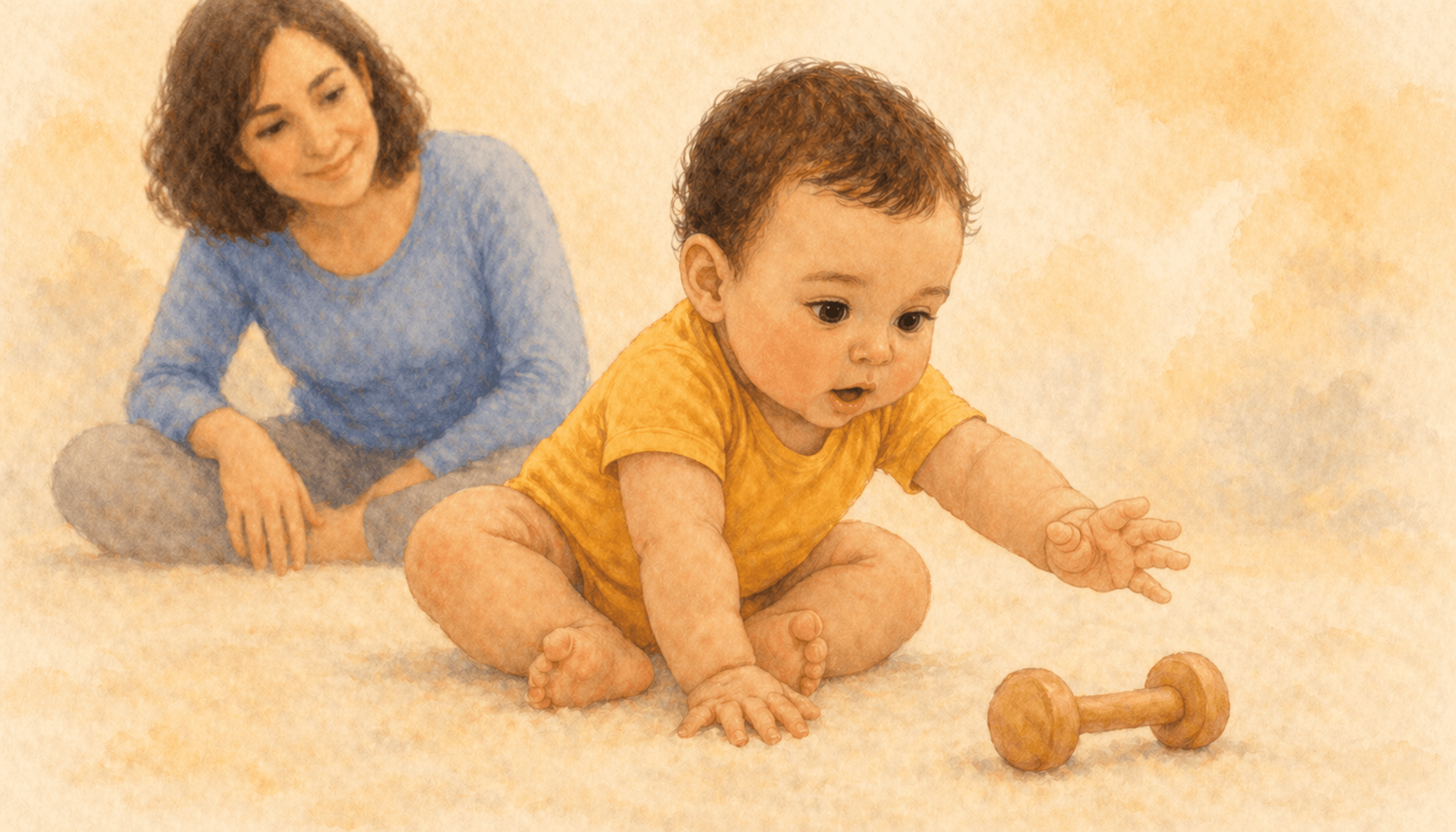
Sitting requires four systems to come online at roughly the same time. First, core and back muscles strong enough to hold a curved spine upright against gravity. Second, a vestibular system — the inner-ear balance sensors — accurate enough to feed the brain real-time information about tilt and position. Third, visual input stable enough to provide a horizon reference. Fourth, the neural wiring that turns those three feeds into automatic postural corrections before the baby starts to fall.
A 2017 review by Adolph and Franchak in WIREs Cognitive Science describes posture as the foundation on which every other motor skill is built. Once the baby has a stable upright base, both hands become available, the visual field widens, and the work of manual exploration — turning objects, transferring between hands, bringing them to the mouth and back — becomes possible for the first time. This is why the month a baby starts sitting often coincides with a leap in play: the skill unlocks a new category of learning.
Tummy time is the single most cited way to build the muscles and coordination sitting requires, though the evidence is more nuanced than most articles make it sound. A 2020 systematic review by Hewitt and colleagues, published in Pediatrics, pooled 16 studies covering 4,237 infants from 8 countries. The review found that tummy time is positively associated with prone skills, rolling, crawling, and overall gross motor development — but specifically for sitting, the pooled evidence was inconclusive. This is not the same as saying tummy time doesn't help sitting. It means that across the particular studies in the review, the data on sitting alone wasn't strong enough to conclude either way.
A subsequent longitudinal study by Carson and colleagues in 2022, published in the International Journal of Behavioral Nutrition and Physical Activity, followed 411 infants from two months to eighteen months and reached a clearer conclusion. Babies who spent more time on their tummies across the early months achieved every major gross motor milestone earlier — rolling, sitting, crawling, assisted standing, assisted walking, and independent walking. When researchers directly tracked individual babies over time rather than pooling older cross-sectional studies, the connection to sitting showed up.
The practical implication is simple. Tummy time is not a punishment to endure until your baby can finally sit. It's the preparation that makes sitting possible.
How to Help Baby Sit Up
The single best thing you can do is create opportunities for practice on the floor. Research by Harbourne and Adolph repeatedly points to variety of positions and exposure to the task itself as the drivers of postural control. A baby who spends most of the day reclined in a bouncer or car seat has fewer opportunities to engage the muscles that sitting requires; a baby with floor time gets them by default.
Once your baby has head control and some trunk strength, usually around four to five months, try short sessions of supported sitting. Your own legs make an excellent support — place your baby between them, facing outward, with your hands near the hips or on the lower back for steadying. A nursing pillow around the back and sides works the same way. Place a couple of interesting objects within reach at eye level or slightly higher, which encourages your baby to reach, twist, and strengthen the trunk in the process. A floor-to-ceiling mirror is unusually effective here — babies lean and track their own reflection in ways that activate balance muscles without it feeling like work.
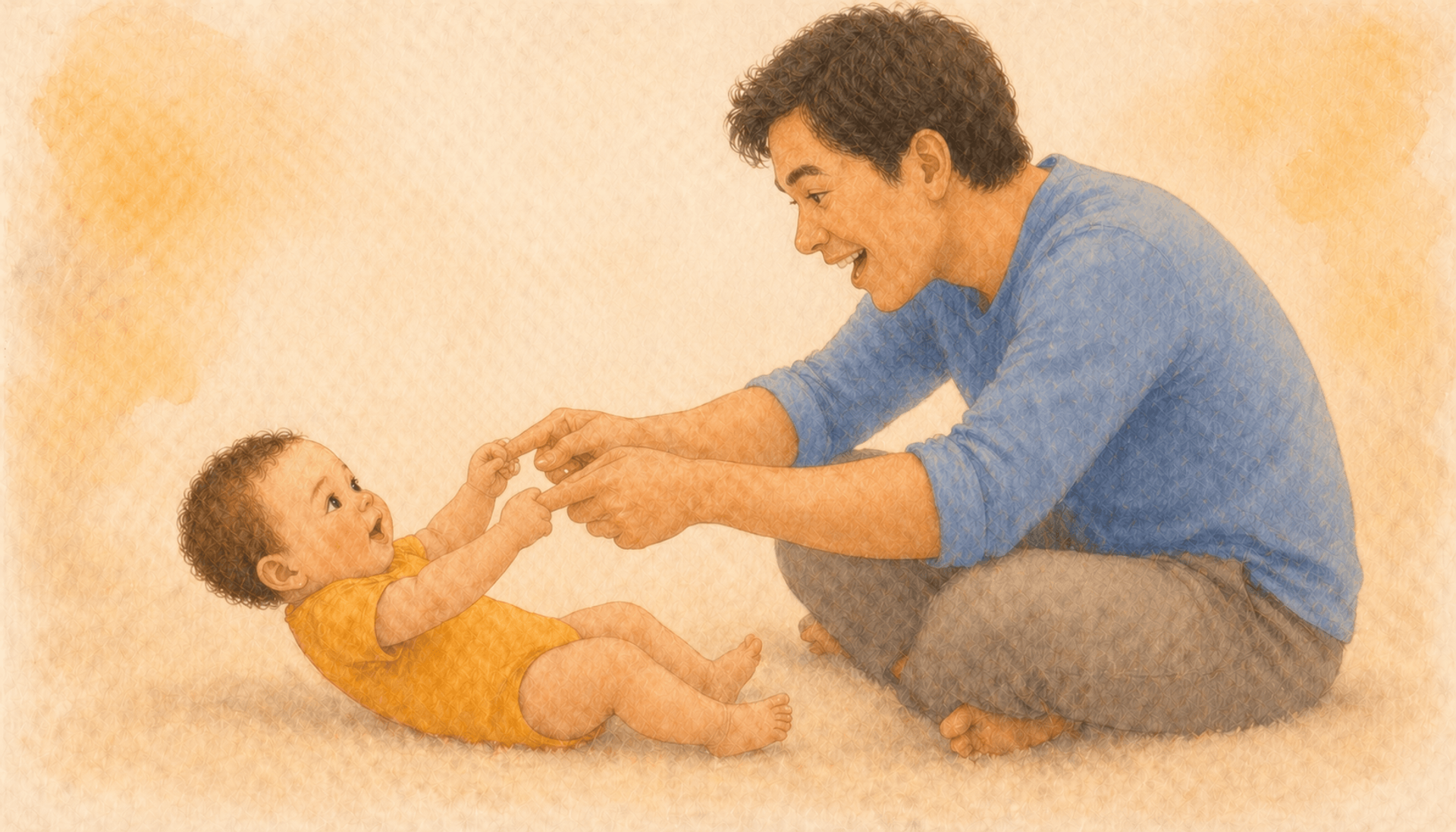
Pulling to sit is another useful practice. With your baby lying on the back, offer both of your index fingers and let your baby grasp them, then gently pull upward. The key is waiting for your baby to do the work — if you see the head and shoulders curl forward and the core muscles engage, that's a pull-up your baby is participating in. If your baby is limp and the head lags behind, your baby isn't ready for this exercise yet, and you can come back to it in a few weeks.
A note on safety: always stay within arm's reach during sitting practice. Falls happen fast, and at this age a sideways tip can put a baby's head against a hard surface in less than a second. Practice on a rug, play mat, or firm padded surface — never on a bed, couch, or elevated surface. Never prop a baby in a sitting position and walk away, even briefly, even with cushions around. Our guide to activities for 5 month old babies covers the pre-sitting preparation stage in more detail, and activities for a 6 month old walks through the early sitting window.
What About Bumbo Seats, Floor Seats, and Activity Centers
This is where parenting communities divide sharply, and the research is more nuanced than either side tends to acknowledge.
Abbott and Bartlett's 2001 study, published in Child: Care, Health and Development, recruited 43 mother-infant pairs and measured two things at the eight-month mark: how much each baby had used various pieces of infant equipment — car seats, bouncers, swings, infant seats, exersaucers, high chairs, jumpers — and how each baby scored on the Alberta Infant Motor Scale, a standardized developmental assessment. Higher total equipment use correlated with lower motor scores, with a correlation of −0.50 — a strong negative association in developmental research. The strongest single contributor was exersaucer use, with a correlation of −0.58.
Exersaucers, which are called stationary activity centers in some countries, are the circular seats with a ring of toys that allow a baby to stand supported while rotating. The Bumbo seat is a sculpted foam floor seat that props a non-sitting baby upright. Jumpers let a baby bounce on the feet while supported in a harness. Pediatric physical therapists often group these together under "containers" because they share the same feature: they hold a baby in a position the baby can't yet achieve or leave independently.
None of this means any of these products are inherently dangerous. The Abbott and Bartlett data is about total time, not occasional use. The distinction pediatric PTs typically draw is between a few minutes of supervised use while a parent does something that genuinely needs both hands, and hours per day across multiple devices. Short stretches don't appear to cause measurable developmental effects; sustained use across multiple devices does.
One specific point worth knowing: if your baby uses an exersaucer, the feet should rest flat on the base, not dangle on tiptoes. Sustained tiptoe positioning can shorten the calf muscles in ways that affect later walking, and pediatric physical therapists frequently recommend stacking a book or two under the feet if the seat is too tall. The American Physical Therapy Association uses the term "container baby syndrome" to describe the cluster of motor delays, flat head shape, and neck stiffness that can appear when infants spend too much of their waking time restrained.
The most balanced read of the evidence is this: equipment is a tool, not a developmental strategy. Floor time builds the skills; containers don't.
When Sitting Doesn't Arrive on Schedule
Most questions about late sitting have reassuring answers. A baby who is not sitting unassisted at seven months but is showing steady progression — better head control, more trunk strength, stage two wobbles getting longer — is usually on a normal if slower trajectory. The WHO data is clear that 9.2 months is within the 99th percentile, which means a meaningful fraction of completely healthy babies don't sit independently until nearly their first birthday.
However, there are specific patterns that do warrant a pediatric conversation. A baby who was born prematurely should be assessed using corrected age — subtract the weeks of prematurity from the chronological age. A baby who shows significant asymmetry while attempting to sit — always falling to one side, using one hand more than the other, holding the head tilted — may be working around an underlying issue worth investigating. A baby who has lost a skill that was previously present is a flag for the pediatrician regardless of which skill it is. And a baby who shows no sitting progress by nine months — no tripod, no brief independent seconds, no attempts to push up — warrants a pediatric evaluation.
If a pediatrician does recommend further assessment, the earlier it happens, the better. Early intervention programs exist in every state, and your pediatrician can walk you through what's available locally.
Sitting Unlocks Everything That Comes Next
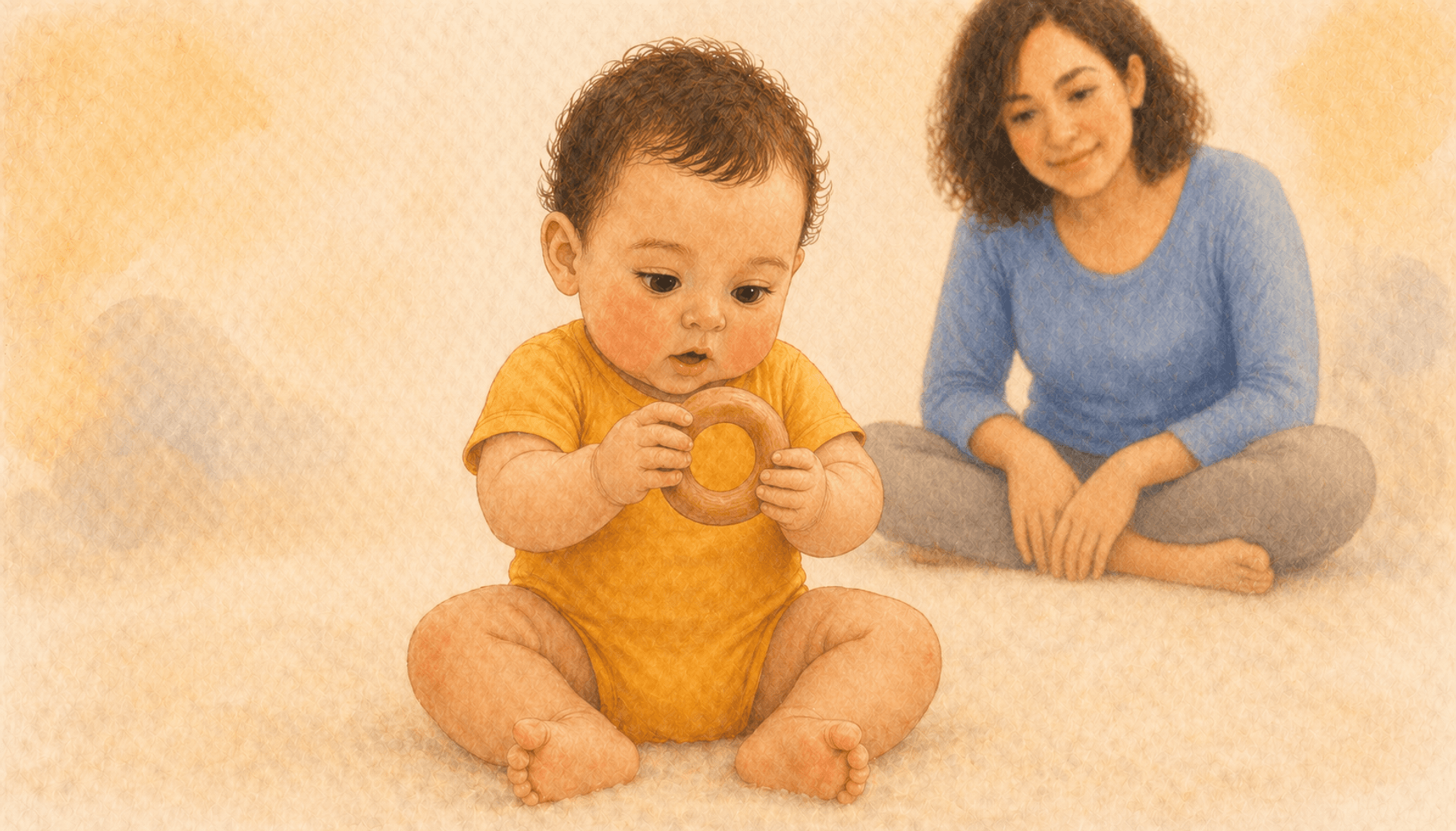
This is the part most milestone articles leave out. Sitting is a prerequisite for almost every cognitive and social development of the second half of the first year. Once a baby can sit, both hands are free for object manipulation, which means the kind of detailed visual study that supports object recognition. The view of the room shifts from ceiling-and-parent's-face to the whole environment, which expands what there is to attend to. The possibility of face-to-face social interaction at the baby's level opens up in ways that reclined or prone positioning doesn't allow.
Work by Soska and Adolph at NYU, published in Infancy in 2014, tracked how independent sitting changed object exploration in 29 infants at five and seven months. Babies who could sit independently handled objects in ways their non-sitting peers simply couldn't — more rotation, more transfer between hands, more bringing objects to the mouth and out again for another look. The researchers framed sitting not as a standalone achievement but as the unlock point for a new category of learning.
In practice, this means the month your baby starts sitting reliably is also the month when toys become more interesting, mirror play gets more intense, and your baby starts watching you eat with noticeably new concentration. All of that is connected. The posture is the scaffold.
What About Crawling First Versus Sitting First
Many parenting resources describe sitting as a prerequisite for crawling, but the order is less fixed than it used to be presented. The CDC's revised 2022 milestone checklists removed crawling from the list entirely, on the evidence that a meaningful fraction of typically developing infants skip hands-and-knees crawling altogether — they scoot, roll, or go directly to cruising and walking. The WHO study found that 4.3 percent of healthy infants never crawled.
So if your baby sits confidently but shows no interest in crawling, that's well within the range of normal. If your baby has started army-crawling or scooting but hasn't settled into traditional hands-and-knees, also fine. The destination is independent movement; the path is variable.
Frequently Asked Questions
Most babies sit without support somewhere between 4 and 9 months, with a mean age of 6 months. The WHO Motor Development Study found a 5.4-month window between the earliest and latest healthy babies, which is the narrowest window of any major gross motor milestone in the first year. Getting into a sitting position independently — pushing up from the floor — happens later, typically between 7 and 10 months.
At three months most babies don't yet have the head and trunk control needed for even supported sitting. What you can do at this age is hold your baby on your lap with full back support, which is different from placing a baby upright without support. Forcing a seated position before head control is established isn't helpful and can cause your baby to slump in ways that strain the neck. The right time to begin short supported-sitting practice is usually around 4 to 5 months, once your baby holds the head steady.
Floor time with opportunities to reach, roll, and practice supported sitting is the foundation. Tummy time builds the muscles; supported sitting sessions with objects to reach for build the balance. Pulling to sit from lying down — with your baby's own core doing the work — adds trunk strength. The one consistent finding across the research is that variety of positions during awake time matters more than any single exercise. Containers like Bumbos, jumpers, and exersaucers don't appear to build the same skills.
Not by itself. The WHO data shows that the 90th percentile for sitting without support is 7.5 months and the 99th percentile is 9.2 months — meaning a substantial fraction of healthy babies sit later than 6 months. What matters is the trajectory. A baby who is making steady progress through the stages — better head control, tripod sitting, increasingly long independent wobbles — is usually on a normal path even if the timing runs a little later. A baby who shows no progress at all by 9 months, or who has lost a skill that was previously present, warrants a pediatric evaluation.
The research doesn't support this use. Bumbo seats prop a baby in a position the baby hasn't yet built the muscles to maintain, which means the seat is doing the work instead of the core muscles. Short supervised use — 10 or 15 minutes while you need both hands — doesn't appear to cause measurable harm. Using one as a default parking spot, or using multiple containers throughout the day, is associated with lower motor scores in the research.
Most babies sit without support between 4 and 9 months. If your baby isn't sitting unassisted at all by 9 months, talk to your pediatrician — early intervention services can be very effective and are often free for eligible families.
This article is for educational and entertainment purposes only. Not a substitute for professional medical or developmental advice. Always supervise your baby during sitting practice and never leave a baby propped in a seated position unattended. If you have concerns about your baby's development, consult your pediatrician.
- World Health Organization Multicentre Growth Reference Study Group (2006). "WHO Motor Development Study: Windows of Achievement for Six Gross Motor Development Milestones." Acta Paediatrica, 95(S450), 86–95.
- Harbourne, R. T., & Stergiou, N. (2003). "Nonlinear Analysis of the Development of Sitting Postural Control." Developmental Psychobiology, 42(4), 368–377.
- Soska, K. C., & Adolph, K. E. (2014). "Postural Position Constrains Multimodal Object Exploration in Infants." Infancy, 19(2), 138–161.
- Hewitt, L., Kerr, E., Stanley, R. M., & Okely, A. D. (2020). "Tummy Time and Infant Health Outcomes: A Systematic Review." Pediatrics, 145(6), e20192168.
- Carson, V., Zhang, Z., Predy, M., Pritchard, L., & Hesketh, K. D. (2022). "Longitudinal Associations Between Infant Movement Behaviours and Development." International Journal of Behavioral Nutrition and Physical Activity, 19(1), 10.
- Adolph, K. E., & Franchak, J. M. (2017). "The Development of Motor Behavior." WIREs Cognitive Science, 8(1-2), e1430.
- Abbott, A. L., & Bartlett, D. J. (2001). "Infant Motor Development and Equipment Use in the Home." Child: Care, Health and Development, 27(3), 295–306.
- Ertem, I. O., Krishnamurthy, V., Mulaudzi, M. C., Sguassero, Y., Balta, H., Gulumser, O., Bilik, B., Srinivasan, R., Johnson, B., Gan, G., Calvocoressi, L., Shabanova, V., & Forsyth, B. W. C. (2018). "Similarities and Differences in Child Development from Birth to Age 3 Years by Sex and Across Four Countries." The Lancet Global Health, 6(3), e279–e291.
- Zubler, J. M., Wiggins, L. D., Macias, M. M., et al. (2022). "Evidence-Informed Milestones for Developmental Surveillance Tools." Pediatrics, 149(3), e2021052138.
- American Academy of Pediatrics (2022). HealthyChildren.org — Developmental Milestones Resources.
- Centers for Disease Control and Prevention (2022). "Learn the Signs. Act Early." CDC.gov.
- American Physical Therapy Association. "Physical Therapy Guide to Container Baby Syndrome." ChoosePT.com.
Related Products

More Articles
Parallel Play in Toddlers: Why Side-by-Side Is the Social Work
Your toddler spent the entire playdate building separate towers, and nobody shared a single block. That counted — more than it looked. A 2025 longitudinal study found that playing beside a specific child consistently predicted later social play with that same child, but not the other way around. Here's what parallel play in toddlers actually is, why the science calls it strategic rather than passive, and what it means for how you run a playdate.
When Do Babies Point: Why It Matters for Language
Most milestone articles treat pointing as a box to check around 12 months. The research tells a different story — one that starts months earlier, runs through the infant brain, and traces back to how much the parent is pointing. Here's what the last fifteen years of research actually found, and what it means for everyday interactions.
When Do Babies Wave Bye-Bye: Why Your Baby Needs You to Wave First
Most baby milestones unfold on a biological schedule — waving isn't one of them. A 2023 study found that babies develop imitation ability because their caregivers imitate them first, and waving is named directly as a cultural gesture learned through that loop. Here's what the research says about the 9–12 month window, why the first wave looks nothing like a wave, and what helps it arrive.