Activities for a 5 Month Old: The Month That Changes How Your Baby Learns
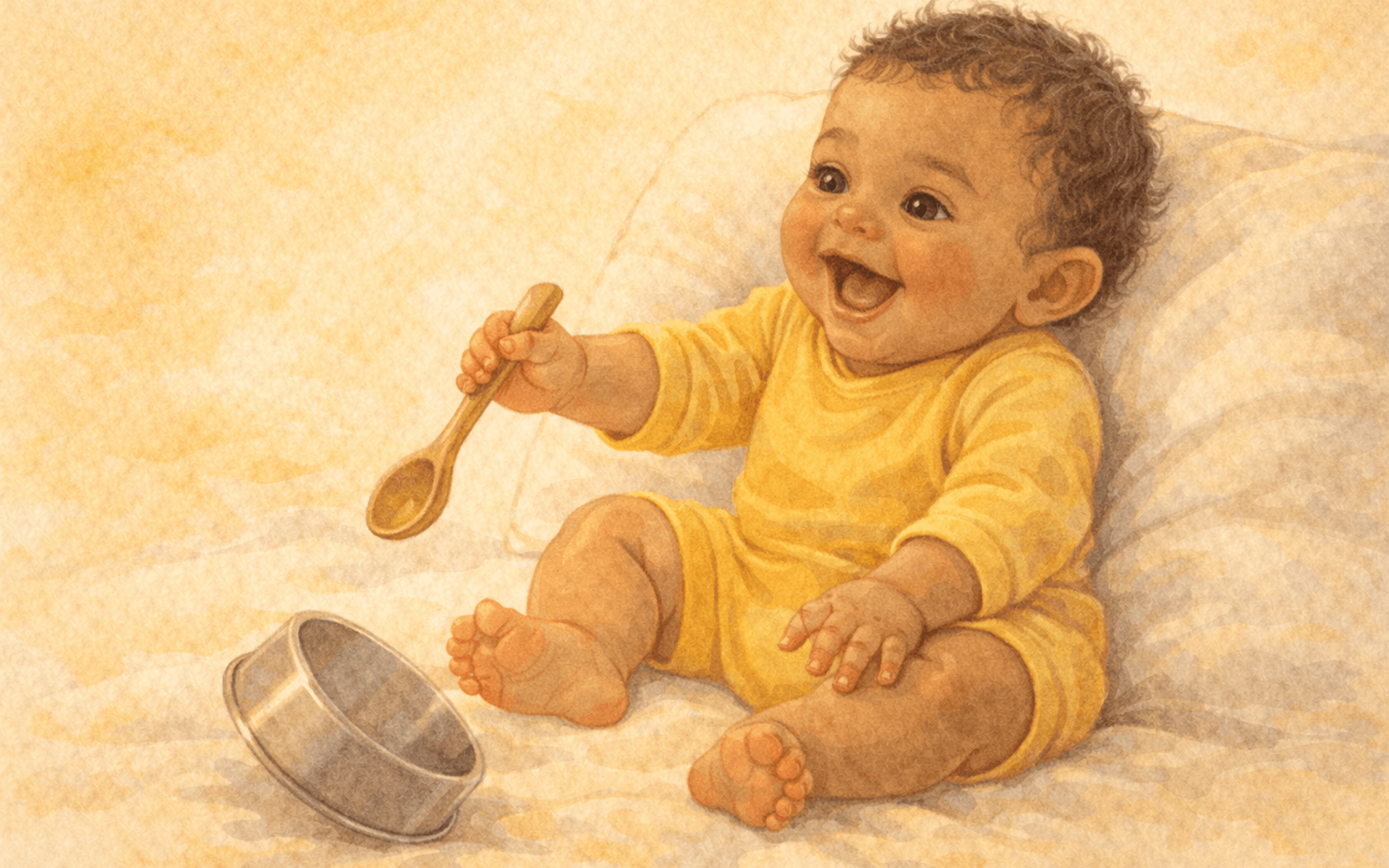
Your baby just knocked a spoon off the high chair tray, watched it hit the floor, looked at you, and then — very deliberately — reached for the next spoon and did it again. And again. And you're standing there thinking this is going to be a long dinner while your baby conducts a physics experiment with the kind of single-minded focus that graduate students would envy. Welcome to five months. Your baby has discovered cause and effect, and nothing in your house will ever stay on a surface again.
Most lists of activities for a 5 month old focus on what's physically new — sitting with support, grabbing everything, babbling more. Those matter. But the real shift this month is cognitive: your baby has figured out that actions produce results.
- What secondary circular reactions are — and why 5 months is the shift from acquiring objects to investigating them
- Why sitting position physically determines how much the brain can learn from the same objects — the Soska and Adolph 2014 data
- How a baby's own name acts as an attention key — and how to use it during every activity
- How babbling becomes structural at 5 months — and why pause-and-respond is the highest-value language activity
- The one supported-sitting session that runs six developmental systems simultaneously
If the one-sentence answer is enough, you’ve got the gist. If you want the mechanism behind each piece, keep reading.
What Actually Changed Between Month Four and Month Five
At five months, three systems are converging in a way that creates something new. The motor system has progressed from reaching to grasping-with-intent — your baby doesn't just close a hand around whatever touches the palm, but reaches for a specific object, grabs it, brings it to the mouth, pulls it out, looks at it, and mouths it again. The CDC doesn't have a specific five-month milestone checklist (the 2022 revision by Zubler and colleagues in Pediatrics covers four months and six months), but the AAP's HealthyChildren.org developmental guide for this age describes a baby who "reaches for toys with one hand," "uses hands and eyes together," and "begins to sit without support for short periods."
Wake windows at five months stretch to roughly two hours, which means 5 month baby activities can now fill genuine play sessions of 20 to 30 minutes. But what fills that time matters differently now than it did a month ago, because the brain has developed the capacity to notice that its own actions produce results — and to repeat those actions on purpose.
Your Baby Just Discovered That Actions Have Consequences
Piaget described this shift in The Origins of Intelligence in Children (1952) as secondary circular reactions — the stage, beginning around four to five months, when a baby who accidentally produces an interesting result starts deliberately repeating the action to make it happen again. The spoon hits the floor and makes a sound. The baby drops another spoon. Same sound. The rattle shakes and jingles. The baby shakes it again. Same jingle. This looks like play, and it is — but it's also the foundation of scientific reasoning. The baby is running experiments: if I do X, does Y happen? What about again? What about harder?
What makes this different from the reaching that started at four months: at four months, the goal was to get the object. At five months, the goal is to see what the object does. The shift is from acquisition to investigation, and it changes what counts as a meaningful activity. Handing your baby a rattle at four months was about grasping practice. Handing your baby a rattle at five months is about giving the brain a cause-and-effect laboratory.
Practical activities for a 5 month old at home that leverage this: offer objects that respond to actions in different ways. A crinkly fabric square makes a sound when squeezed. A soft ball rolls when pushed. A rattle jingles when shaken. A wooden spoon bangs when it hits a surface. Each one teaches a different cause-and-effect relationship, and the brain at five months is hungry to catalogue as many of these as possible. Our Sensory Play Cards 0–12 Months include cause-and-effect activities organized by age, using household objects that respond to baby's actions in ways that are interesting enough to sustain the repetition cycle.
Sitting Up Changes How the Brain Learns — and the Research Is Specific
Here's the finding that reframes how you think about activities for a 5 month old baby: in 2014, researchers Soska and Adolph at New York University placed 5-to-7-month-old infants in three positions — lying on the back, lying on the tummy, and sitting with support — and recorded every exploratory action. The results, published in Infancy, were striking. When sitting, babies produced significantly more manual exploration (fingering, rotating, transferring objects between hands), more oral exploration (mouthing), and more visual examination than in either lying position. More importantly, sitting was the only position where babies consistently combined these actions — looking at an object while simultaneously fingering it, or alternating between mouthing and visual examination in a way that builds multimodal understanding.
The researchers estimated that over a full day, the difference between sitting and lying adds up to over 400 additional manual exploratory actions and 22 extra minutes of visual examination. That's not a small effect. It means the posture your baby is in during a play session physically determines how much the brain can learn from the same set of objects.
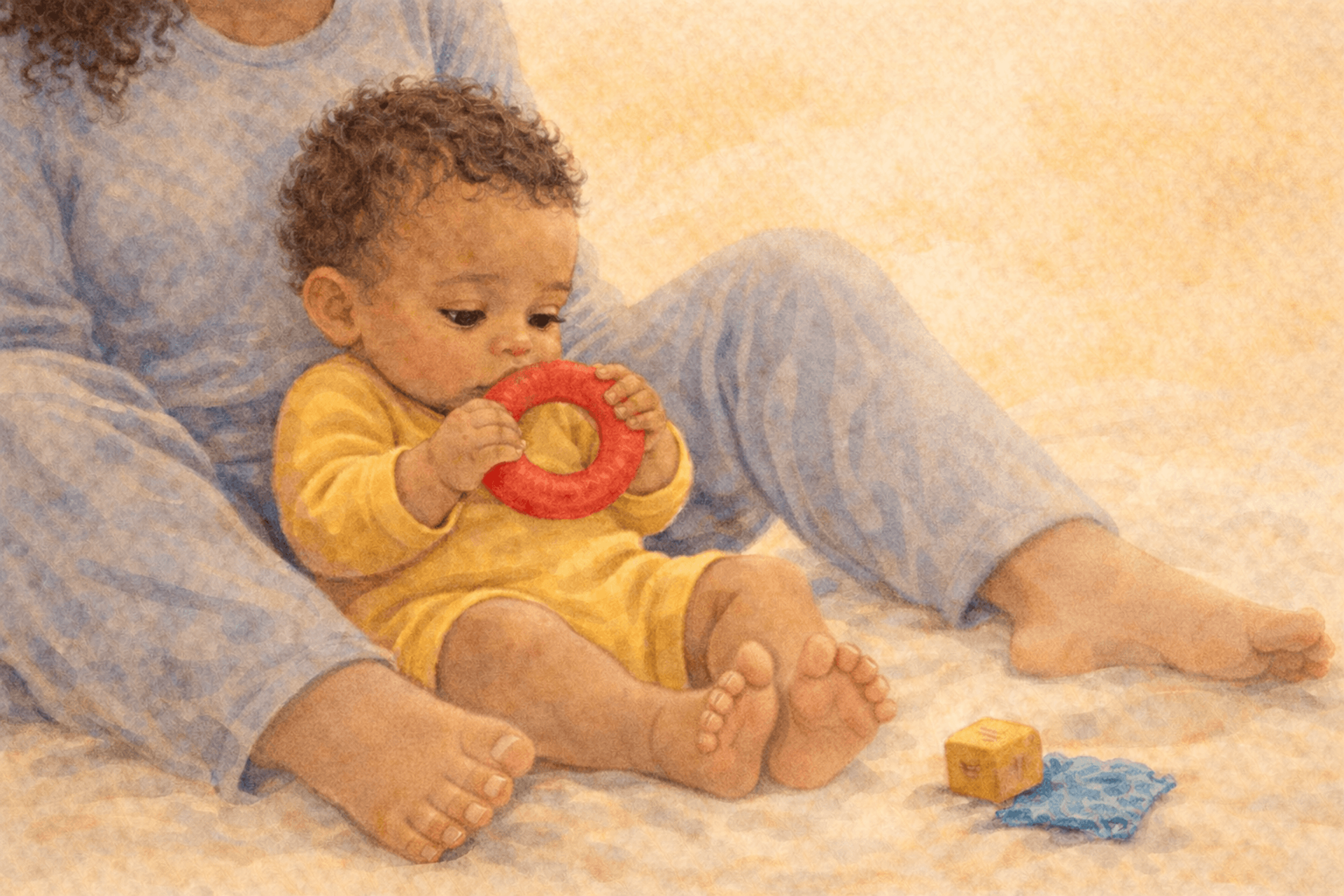
Why this happens is biomechanical: when lying on the tummy, the arms are busy holding the body up. When lying on the back, the arms fight gravity to lift objects into the visual field. When sitting, the arms are free, the head is upright and stable, the visual field expands to a 180-degree panorama, and eye-hand coordination works with gravity instead of against it. Sitting with support at five months isn't just a motor milestone on the way to independent sitting — it's a cognitive accelerator.
What to do with this: prop your baby in a supported sitting position (between your legs, in a Boppy pillow, or against a firm cushion) and place two or three objects within reaching distance. A reclined infant floor seat can also work for supervised play — it keeps the baby at a slight angle with the spine supported, leaving both hands free to explore. Important: at five months, independent sitting isn't here yet, and propping a baby fully upright without back support can strain the developing spine. Always make sure the back is supported, the position is slightly reclined rather than bolt-upright, and you're within arm's reach. This is supported sitting, not a balancing exercise.
You'll see exploration that looks noticeably different from what happens during tummy time — more rotating of objects, more transferring between hands, more of those mouthing-then-looking sequences that build understanding through multiple senses at once. That's the Soska and Adolph effect in action.
Your Baby's Name Is a Learning Tool — and Science Explains Why

A 2010 study in PLOS ONE by Parise, Friederici, and Striano measured brain activity in 30 five-month-old infants while they heard either their own name or a stranger's name, followed by images of new objects on a screen. The babies who heard their own name before seeing the object showed enhanced brain processing of that object — their neural response to the new visual information was measurably stronger. Hearing a stranger's name didn't produce the same effect.
This built on earlier work by Mandel, Jusczyk, and Pisoni, published in Psychological Science in 1995, which showed that babies as young as 4½ months already recognize the sound pattern of their own name and prefer it over other names — even names with the same stress pattern and number of syllables. By five months, this recognition isn't just passive: the brain actively uses the name as an attention signal that opens a channel for processing whatever comes next.
What this means for how to spend time with a 5 month old: when you want your baby to notice something — a new toy, a picture in a book, a dog walking past the window — say the baby's name first. Not "look at that!" but "Emma, look at that!" The Parise study suggests that the name primes the attention system in a way that generic cues don't. It's a one-word hack that makes every interaction slightly more effective for learning, and it costs nothing.
Use the name before showing a new object during play, before pointing at something interesting during a walk, before offering a new food or texture. You're not teaching the baby their name (they already know it). You're using it as a key that opens a door the brain built specifically for this purpose.
Babbling Gets Structural
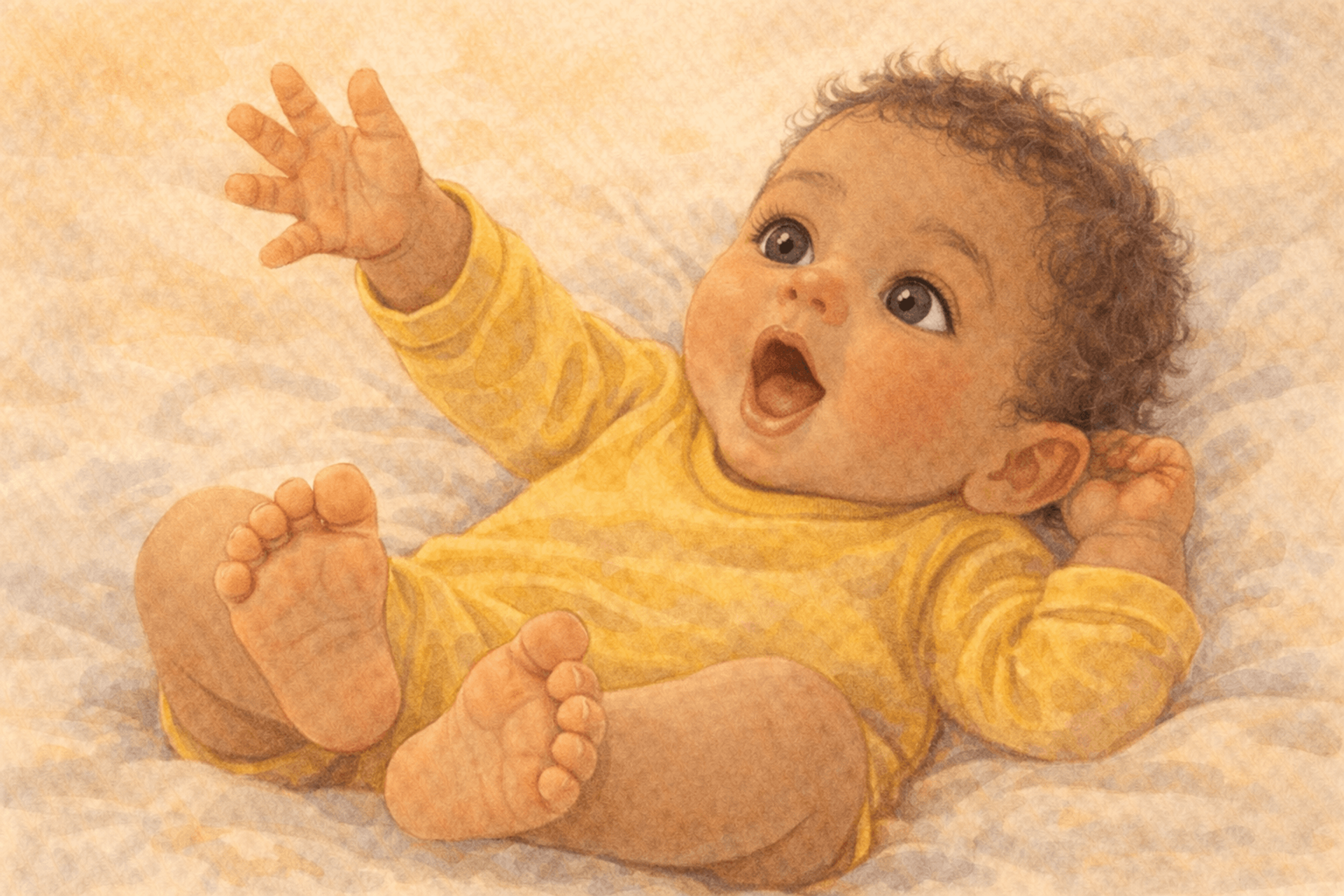
At five months, the babbling has shifted from single vowel sounds ("aaah," "oooh") to longer chains that start including consonant-like elements — "babababa," "dadadada," repeated rhythmically, sometimes for minutes at a time. This is the beginning of what speech researchers call canonical babbling, and a 2018 MIT study by Romeo and colleagues showed that these back-and-forth vocal exchanges between parent and baby — not just the number of words a baby hears — are what actually build language wiring in the brain.
At five months, the turns are richer than before because the baby's responses last longer, are more varied, and are more clearly aimed at you. When your baby produces a string of "babababa" and pauses, that pause is an invitation. Mirror the sound, answer with a sentence, or extend it with a question — "babababa? Tell me more!" — then wait again. Every completed loop is a rep for the language architecture.
Johnson and colleagues demonstrated that infants at this age track faces with smooth, sustained attention, so face-to-face positioning during these exchanges delivers the input through the strongest channel the brain has. Get close, make eye contact, and talk directly to your baby's face — this is how the conversational turn framework produces its developmental effect.
Color Vision and Visual Exploration Are Fully Online
By five months, color vision is essentially working. Atkinson and Braddick's research shows that between three and five months, the brain's ability to process color catches up to something close to adult levels. The world your baby sees now is full-color, detailed, and three-dimensional — a completely different visual experience from three months ago. Our guide to when babies see color covers the full timeline of which colors arrive first and why.
This means activities that leverage color are genuinely effective now, not just decorative. Our Color Contrast Cards for 3–6 Months introduce bold, saturated colors in sequences matched to the visual system's progression — and at five months, the baby can process the full range. Combined with the sitting-enhanced exploration from the Soska and Adolph research, a simple activity like holding up a colorful card while the baby sits supported can produce multimodal engagement: the baby sees the color, reaches for the card, grasps it, mouths the edge, pulls it back, looks at it again — visual, tactile, and oral processing all working together.
Fantz showed in 1963 that babies prefer novel and complex stimuli, and at five months that preference is strong enough to sustain several minutes of focused engagement with a single interesting object. If you rotate objects between sessions — different colors, textures, weights — you're feeding the novelty preference that drives continued exploration.
Touch Is Now Intentional Investigation
At five months, the hands have shifted from raking grasp (whole-hand grab) toward something more deliberate. Your baby may not have a pincer grip yet, but the fingers are starting to work independently — poking, prodding, scratching surfaces, squeezing soft things to feel them compress. A 2017 study in Current Biology by Maitre and colleagues showed that the quality and variety of early touch experiences directly shape how the brain's sensory processing areas develop. At five months, every new texture the hands encounter is literally building neural architecture.
Our Sensory Play Cards 0–12 Months include texture exploration activities for this exact stage — pairing different materials (smooth wood, rough fabric, cool metal, squishy silicone) with prompts that guide you through a structured sensory session. The variety matters more than the duration: Maitre's data showed it was the range of touch experiences, not the total amount, that predicted stronger brain organization.
The Session That Ties Everything Together
Here's how to spend time with a 5 month old in a way that covers the most developmental ground in a single wake window: prop your baby in supported sitting with three or four objects arranged within reaching distance. Say your baby's name — "Emma" — then hold up one object and let the baby track it. Place it within reach. Watch the cause-and-effect cycle begin: grasp, mouth, pull out, look, shake, bang, repeat. Narrate what you see — "you're squeezing it! It crinkles!" — then pause and wait for a babbling response. When the baby drops an object (and the baby will drop an object), resist the urge to immediately hand it back. Pause. Let the baby look for it, reach toward where it fell, or vocalize in a way that communicates I want that back. That pause is cause-and-effect learning in real time — the baby is discovering that dropping produces disappearance, and that a vocalization can produce the return.
In a single session: supported sitting amplifies all exploration (Soska and Adolph), the name primes the attention system for new objects (Parise), cause-and-effect drives the repetition cycle (Piaget's secondary circular reactions), babbling turns build language circuits (Romeo), color and texture feed the visual and tactile systems (Atkinson and Braddick, Maitre), and the novelty preference sustains engagement (Fantz).
If you read our article on sensory play ideas, you'll recognize many of these elements — the difference at five months is that the baby is now an active investigator rather than a passive receiver, and every activity listed above takes on a different character because of it.
A five-month-old can sustain this kind of session for ten to fifteen minutes. Watch for the signals: gaze aversion, arching, fussiness, or the glassy-eyed stare that means the brain has hit its processing ceiling. When those appear, the session is done.
Frequently Asked Questions
Most five-month-olds stay awake for about 1.5 to 2.5 hours between naps, with wake windows gradually lengthening over the course of the day. The longest wake window is typically before the last nap. This gives enough time for a full play session of 15 to 25 minutes after feeding and a diaper change. Watch for sleep cues — yawning, rubbing eyes, turning away — rather than the clock.
The best objects at five months are ones that respond to the baby's actions: rattles that make sound when shaken, crinkly fabric that rewards squeezing, soft balls that roll when pushed, and textured rings that feel different in the mouth than in the hand. The cause-and-effect system is online and hungry for input, so objects that produce a visible or audible result when manipulated are more developmentally valuable than objects that just sit there looking interesting.
Independent sitting typically develops between five and seven months, with most babies achieving it closer to six or seven months. At five months, sitting with support — between your legs, in a Boppy, or propped against a firm surface — is developmentally appropriate and, as Soska and Adolph's research shows, already provides the cognitive benefits of upright posture. If your baby isn't sitting independently at five months, that's well within the normal range. If you have concerns, the CDC recommends discussing developmental questions at every well-child visit.
This article is for educational and entertainment purposes only. Not a substitute for professional medical or developmental advice. If you have concerns about your baby's development, consult your pediatrician.
- Soska, K. C. & Adolph, K. E. (2014). "Postural Position Constrains Multimodal Object Exploration in Infants." Infancy, 19(2), 138–161.
- Parise, E., Friederici, A. D., & Striano, T. (2010). "Did You Call Me? 5-Month-Old Infants Own Name Guides Their Attention." PLoS ONE, 5(12), e14208.
- Mandel, D. R., Jusczyk, P. W., & Pisoni, D. B. (1995). "Infants' Recognition of the Sound Patterns of Their Own Names." Psychological Science, 6(5), 314–317.
- Piaget, J. (1952). The Origins of Intelligence in Children. New York: International Universities Press.
- Zubler, J. et al. (2022). "Evidence-Informed Milestones for Developmental Surveillance in the First 3 Years of Life." Pediatrics, 149(3).
- Romeo, R. et al. (2018). "Beyond the 30-Million-Word Gap: Children's Conversational Exposure Is Associated With Language-Related Brain Function." Psychological Science, 29(5), 700–710.
- Maitre, N. et al. (2017). "The Dual Nature of Early-Life Experience on Somatosensory Processing in the Human Infant Brain." Current Biology, 27(7), 1048–1054.
- Atkinson, J. & Braddick, O. (2012). "Visual Development." In Cambridge Encyclopedia of Child Development.
- Fantz, R. (1963). "Pattern Vision in Newborn Infants." Science, 140(3564), 296–297.
- Johnson, M. et al. (1991). "Newborns' Preferential Tracking of Face-like Stimuli and Its Subsequent Decline." Cognition, 40(1–2), 1–19.
- Hewitt, L. et al. (2020). "Tummy Time and Infant Health Outcomes: A Systematic Review." Pediatrics, 145(6).
- American Academy of Pediatrics (2022). HealthyChildren.org — developmental guidance by month.
- Centers for Disease Control and Prevention (2022). "Learn the Signs. Act Early." CDC.gov.

More Articles
Parallel Play in Toddlers: Why Side-by-Side Is the Social Work
Your toddler spent the entire playdate building separate towers, and nobody shared a single block. That counted — more than it looked. A 2025 longitudinal study found that playing beside a specific child consistently predicted later social play with that same child, but not the other way around. Here's what parallel play in toddlers actually is, why the science calls it strategic rather than passive, and what it means for how you run a playdate.
When Do Babies Point: Why It Matters for Language
Most milestone articles treat pointing as a box to check around 12 months. The research tells a different story — one that starts months earlier, runs through the infant brain, and traces back to how much the parent is pointing. Here's what the last fifteen years of research actually found, and what it means for everyday interactions.
When Do Babies Wave Bye-Bye: Why Your Baby Needs You to Wave First
Most baby milestones unfold on a biological schedule — waving isn't one of them. A 2023 study found that babies develop imitation ability because their caregivers imitate them first, and waving is named directly as a cultural gesture learned through that loop. Here's what the research says about the 9–12 month window, why the first wave looks nothing like a wave, and what helps it arrive.