Activities for a 6 Month Old: The Month Sitting and Real Babbling Arrive
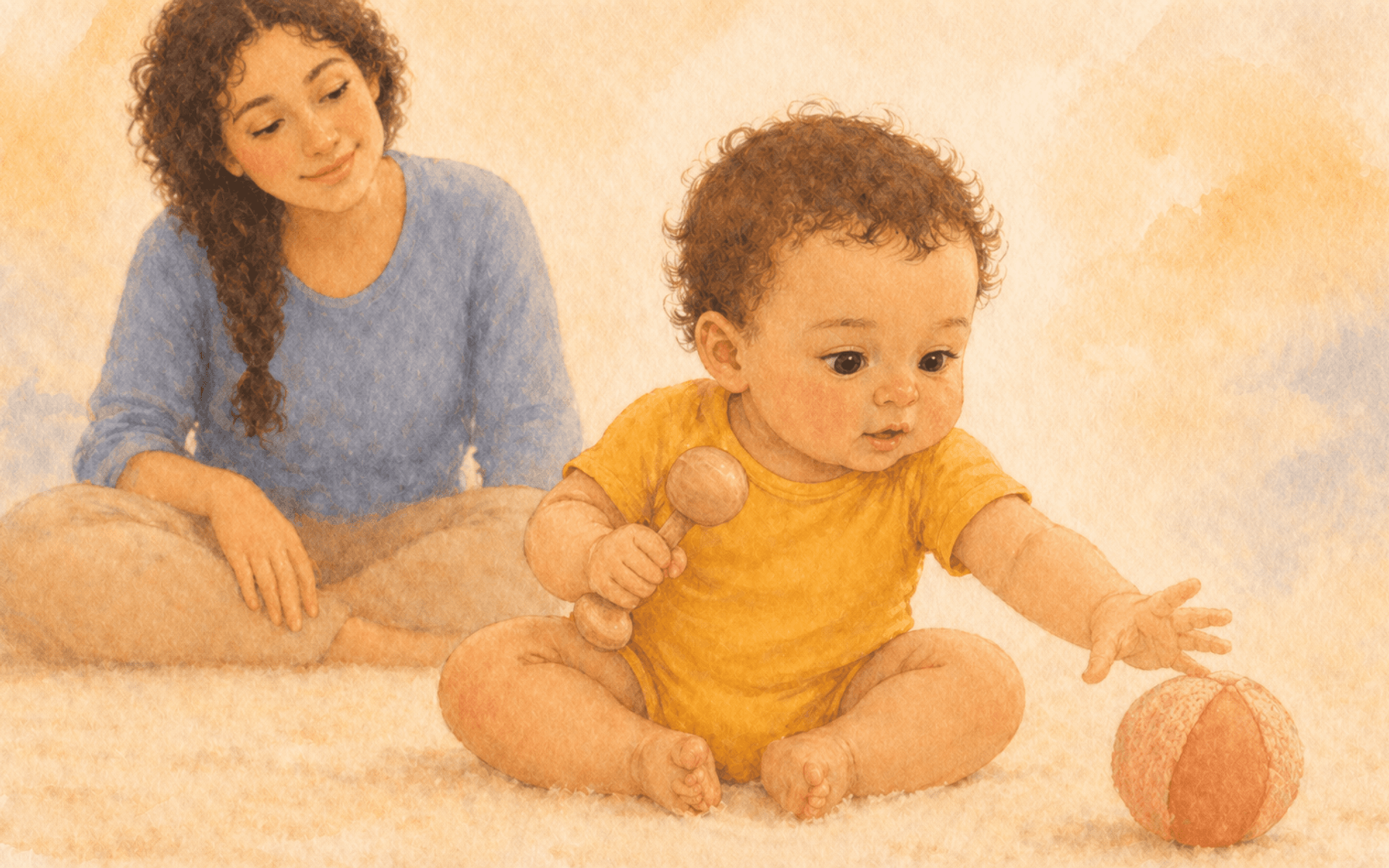
The nursing pillow is still in the corner where you left it, but it's starting to look optional. Your six-month-old can sit for three seconds, then five, then briefly without any cushion at all — before tipping sideways with an expression somewhere between triumph and mild surprise. Meanwhile, something that actually sounds like ba-ba-ba has started echoing from the car seat on the way home from daycare pickup, and you've been replaying the clip on your phone for your partner, your mother, and the woman at the pharmacy who did not ask.
If you're searching for activities for a 6 month old, two shifts are the reason the last few weeks feel different.
- What sitting independently unlocks — and why two free hands change how much the brain can learn from the same objects
- Why "ba-ba-ba" is an actual developmental checkpoint — and what the 1994 Eilers and Oller research on hearing loss reveals about its importance
- How hidden-object games change at 6 months — from funny surprise to active memory-and-prediction
- What stranger anxiety signals about secure attachment — and how to handle new people without pushing through
- What a complete 6-month activity session looks like — and why 8 minutes of close, responsive attention beats 30 distracted ones
If the one-sentence answer is enough, you’ve got the gist. If you want the mechanism behind each piece, keep reading.
What Changed Between Five Months and Six Months
At five months, your baby could sit with support, grab things, and produce long babbling chains of mostly vowel sounds. At six months, each of those abilities graduates. The support disappears, sometimes. The grab gets deliberate and two-handed. Real consonants show up in the babbling now, forming the raw material of speech.
The AAP's HealthyChildren.org developmental guide for six months highlights this shift: babies begin to push up with straight arms during tummy time, roll in both directions, reach with a single hand, and pass objects from one hand to the other. The transfer is small but telling — it means the two sides of the body are coordinating in a way they weren't a month ago. The CDC's revised 2022 milestones, developed by Zubler and colleagues and published in Pediatrics, don't include a six-month list specifically, but the behaviors typical of 6 month old development — supported sitting, varied babbling, responding to name, showing emotions with facial expressions — are bridges between the four-month and nine-month checklists.
Wake windows have also lengthened. Most six-month-olds now stay awake between 2 and 2.5 hours at a stretch, up from 90 minutes to 2 hours a month ago. That extra half hour is what makes a genuine play sequence possible — a feeding, a floor session, a book or two, and still enough time left to notice sleepy cues before meltdown mode sets in.
Independent Sitting Changes What Play Can Do
The single most consequential thing about six months is that sitting starts to work — and once a baby can sit without using both hands for balance, those hands become available for exploration. A five-month-old propped in a sit has one hand on the ground and one hand free; a six-month-old sitting independently has two hands free and a stable view of the room. That shift turns almost every activity into a richer experience.
Work by Kasey Soska and Karen Adolph at NYU documented the effect with striking precision: infants who could sit independently handled objects in ways that infants who couldn't sit simply couldn't match — more rotation, more shifting between hands, more bringing toys to the mouth and back out for another look. The payoff of independent sitting is a new category of learning — one that had been unavailable for six months.
The activity this invites is almost comically low-effort. Put your baby in a supported or independent sit on the floor — a nursing pillow behind the back, a rolled blanket, your own legs in a V — and set two or three interesting objects within reach on different sides. Two objects, not one. The point is the transfer: your baby will pick one up, look at it, drop it, reach for the other, discover that both hands can pass objects between themselves, and spend ten minutes on what adults would consider a rather boring problem. Parents familiar with Montessori principles will recognize this setup — child-led exploration with real, open-ended materials and no adult interruption. The goal is exploration, not endurance.
A note on sitting safely: always keep your baby within arm's reach during supported sitting, with back cushioned and the surface soft enough that a sideways tip lands gently. A rug or play mat with cushions behind works better than a hard floor or a couch near an edge. Never prop a baby in a sitting position and walk away, even for a moment. Tips happen fast at this age.
The objects themselves matter less than you'd think. Wooden spoons, silicone teethers, cloth squares, lightweight rattles — anything that's safe to mouth, too large to be a choking hazard, and responds in some way to being shaken or squeezed. Nothing smaller than your baby's fist, and nothing with small detachable parts. Our Color Contrast Cards for 3–6 Months are sized for this window — bold enough to hold attention, light enough to grab and transfer between hands, and designed to match the color vision that's now essentially complete. Our full guide to when babies see color walks through why red registers first and how the system fills in by roughly six months.
That "Ba-Ba-Ba" Is an Actual Language Milestone
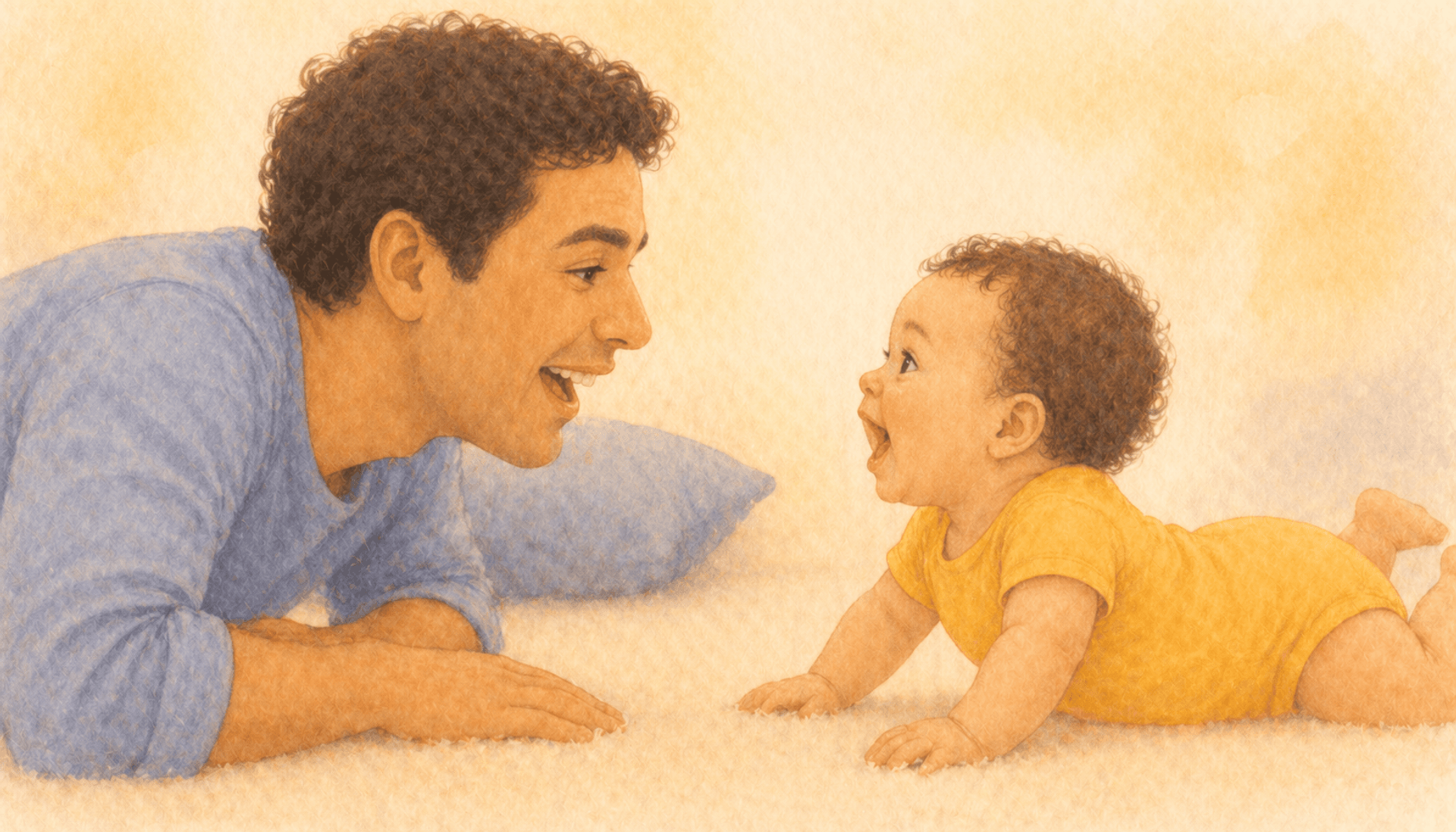
You've been listening to cooing and babbling chains for months, but somewhere this month the sounds change. Consonants show up — real ones, with a proper closure of the lips or tongue behind them, followed by a fully resonant vowel. That's canonical babbling, and it's one of the most reliable predictors of typical speech development in the entire pediatric literature.
The linguist D. Kimbrough Oller laid out the framework for this in the 1980s. Before canonical babbling, babies produce what he called protophones — coos, squeals, growls, raspberries. These are practice runs for the vocal apparatus, but they aren't yet speech-like. A true canonical syllable requires a consonant and a vowel with a rapid transition between them; ba qualifies, and aaah doesn't. The shift usually happens between 6 and 8 months.
What makes this milestone more than a cute phase is the consistency of what comes next. A 1998 longitudinal study by Oller and colleagues followed 42 infants from early infancy through toddlerhood, tracking the age when canonical babbling began and the age when each child reached a vocabulary of five spoken words. The mean age of babbling onset was 6 months. The mean age of five words was 14.5 months. The gap between those two milestones was never shorter than four months for any individual child, regardless of family income, language exposure, or birth circumstance. That remarkable stability is the reason pediatric speech researchers treat canonical babbling as a developmental checkpoint — the first reliable signal that the speech-building system is online.
The opposite also holds. Research by Eilers and Oller published in the Journal of Pediatrics in 1994 compared 94 infants with normal hearing and 37 infants with severe hearing impairment. The hearing infants all produced canonical syllables before 11 months, with the most common onset around 7 months. The hearing-impaired group frequently didn't reach this milestone until well into the second year. Persistent absence of canonical babbling beyond 10 months is now recognized as an early risk marker for speech and language delays and a reason to raise the conversation with your pediatrician.
What you can do at home is treat babbling like the half of a conversation it is. When your baby says ba-ba, say ba-ba back, then wait. When the sound comes again, try ba-ba-ball with the object in view. Our guide to when babies start talking covers the full arc from babbling to first words, including why exchange matters more than sheer word count.
The Hidden-Object Game Is Now a Real Game
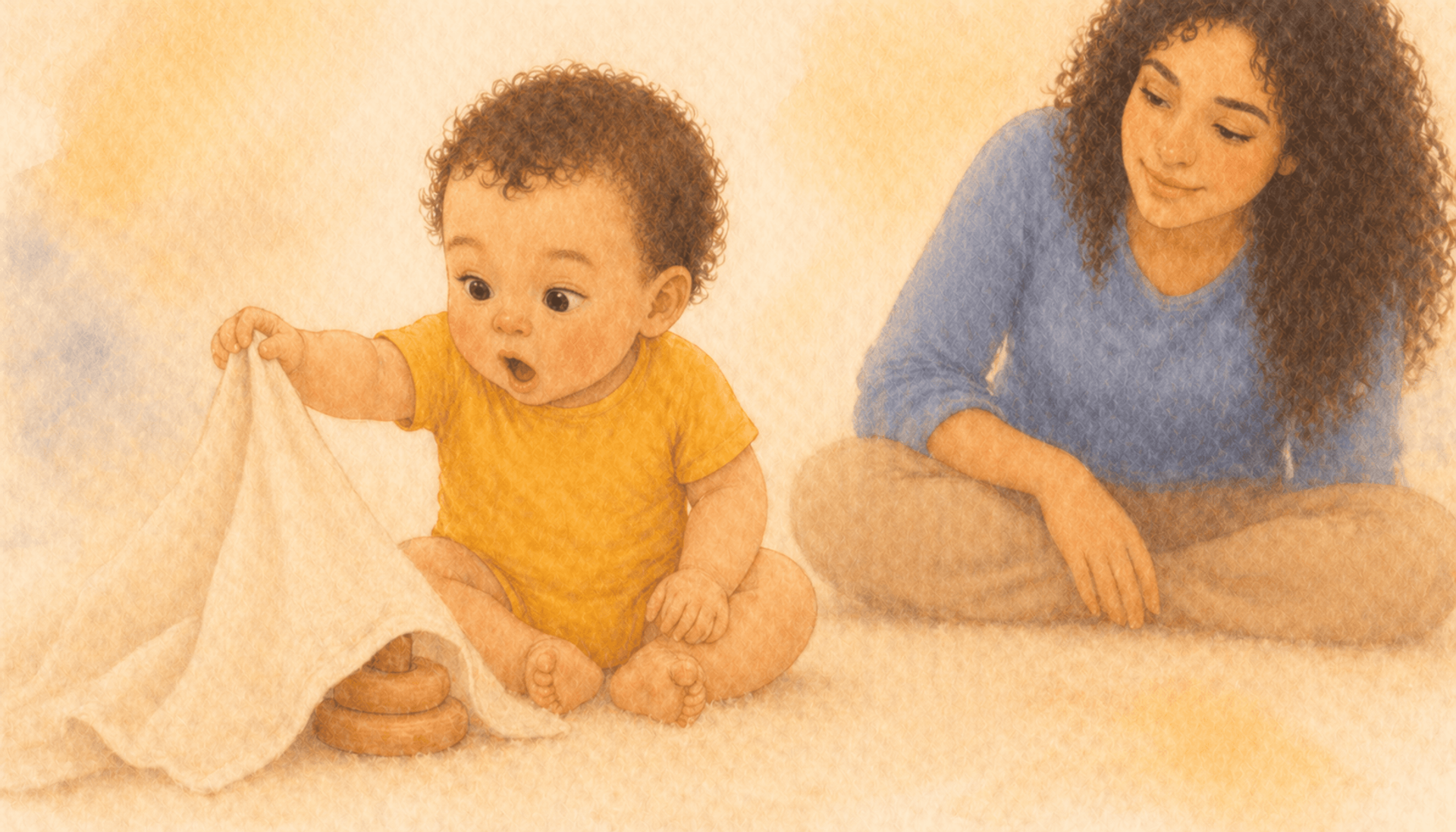
At four months, your baby already understood that hidden objects continued to exist — the research of Renée Baillargeon at the University of Illinois demonstrated this with the famous drawbridge studies in 1987. What's new at six months is the behavior that follows from that understanding. Your baby will now actively lift a cloth to find the toy underneath, lean over the edge of the high chair tray to search for a dropped spoon, and turn to follow your footsteps when you walk out of the room.
The play this enables is simple to the point of absurdity and produces disproportionate delight. Partially cover a favorite toy with a light cloth while your baby watches, then let the cloth get pulled off. Once that's mastered, cover the toy fully. Hide a rattle under a cup and ask, where did it go? Each retrieval is a tiny working-memory rep — your baby's brain held the idea of the toy in mind just long enough to go looking for it.
Peekaboo also changes meaning at six months. At four months, peekaboo worked because the reveal was funny. At six months, it works because your baby starts to predict the reveal — the laugh sometimes shows up before your face reappears. That anticipatory laugh is memory and prediction holding hands. Simple materials, huge return.
Keep the materials baby-safe. The cloth should be breathable and larger than a face-cover hazard — a muslin swaddle or a soft cotton scarf works well, and should never be left over your baby's face unattended. Cups, rattles, and anything else used for hiding games must pass the standard safety check: too large to swallow, no small pieces, nothing breakable.
Our Sensory Play Cards for 0–12 Months include a set of activities built around this principle — one card, one prompt, five minutes — so that during a long wake window you're not staring at the ceiling fishing for ideas.
When Your Friendly Baby Isn't So Friendly Anymore
Around six months, many babies develop a strong preference for their primary caregivers and start to look wary around everyone else. Grandparents who were received with smiles last month now get a suspicious stare and a face buried in your shoulder. Friends reach out and your baby arches away. This is stranger anxiety, and it's a normal developmental phase, not a behavioural problem.
The pattern has been studied for decades, starting with John Bowlby's attachment theory in the 1960s and Mary Ainsworth's research in the 1970s. Before six months, babies generally accept comfort from most warm adults. Between six and nine months, as the cognitive system matures enough to tell specific faces apart and hold them in memory, that changes. Jerome Kagan's work on temperament at Harvard placed the peak of stranger wariness between 8 and 10 months, with gradual softening through the second year.
The behavior can feel alarming — especially if you've been excited to introduce your baby to a new person and the baby wants nothing to do with them. But it's a sign that your baby has formed a secure, specific bond with primary caregivers and has developed the sophistication to distinguish them from everyone else. The best response is not to push through. Let new people approach slowly, keep your baby in your arms, and let your baby lead the interaction. Usually, within a few minutes, a look, then a reach, then a tentative hand will follow. If that doesn't happen today, that's also fine.
Wake Windows, First Solids, and a Word About Screens
Two practical things shift this month. Wake windows of 2 to 2.5 hours mean a real routine is now possible — a feed, a floor session, a short book or card activity, and you'll still catch your baby before the overtired spiral kicks in. Naps usually consolidate into two or three daytime stretches totaling about three to four hours.
The second shift is food. The American Academy of Pediatrics recommends introducing complementary foods around six months, alongside continued breastmilk or formula. Readiness signs include sitting with support, good head control, loss of the tongue-thrust reflex, and visible interest in what you're eating. Whether you go with purees, baby-led weaning, or a mix, the first month of solids is more about exploration than nutrition — most calories are still coming from milk, and the mess is the learning. Always introduce solids while your baby is supported in a secure seated position, never reclined, and never leave a baby unattended while eating.
As for screens: the AAP's position for babies under 18 months is to avoid screen media, with one exception — video calls with family, which count as social interaction rather than passive watching. For older babies and toddlers, the 2026 guidelines moved away from strict time limits toward a framework built around quality, context, and co-viewing. The important thing is what the research actually shows, which is that patterns matter far more than individual incidents. Our screen time and babies article walks through what that looks like in practice — including why a few minutes while you shower is not the same thing as a daily habit of passive viewing.
What a Six-Month Activity Session Actually Looks Like
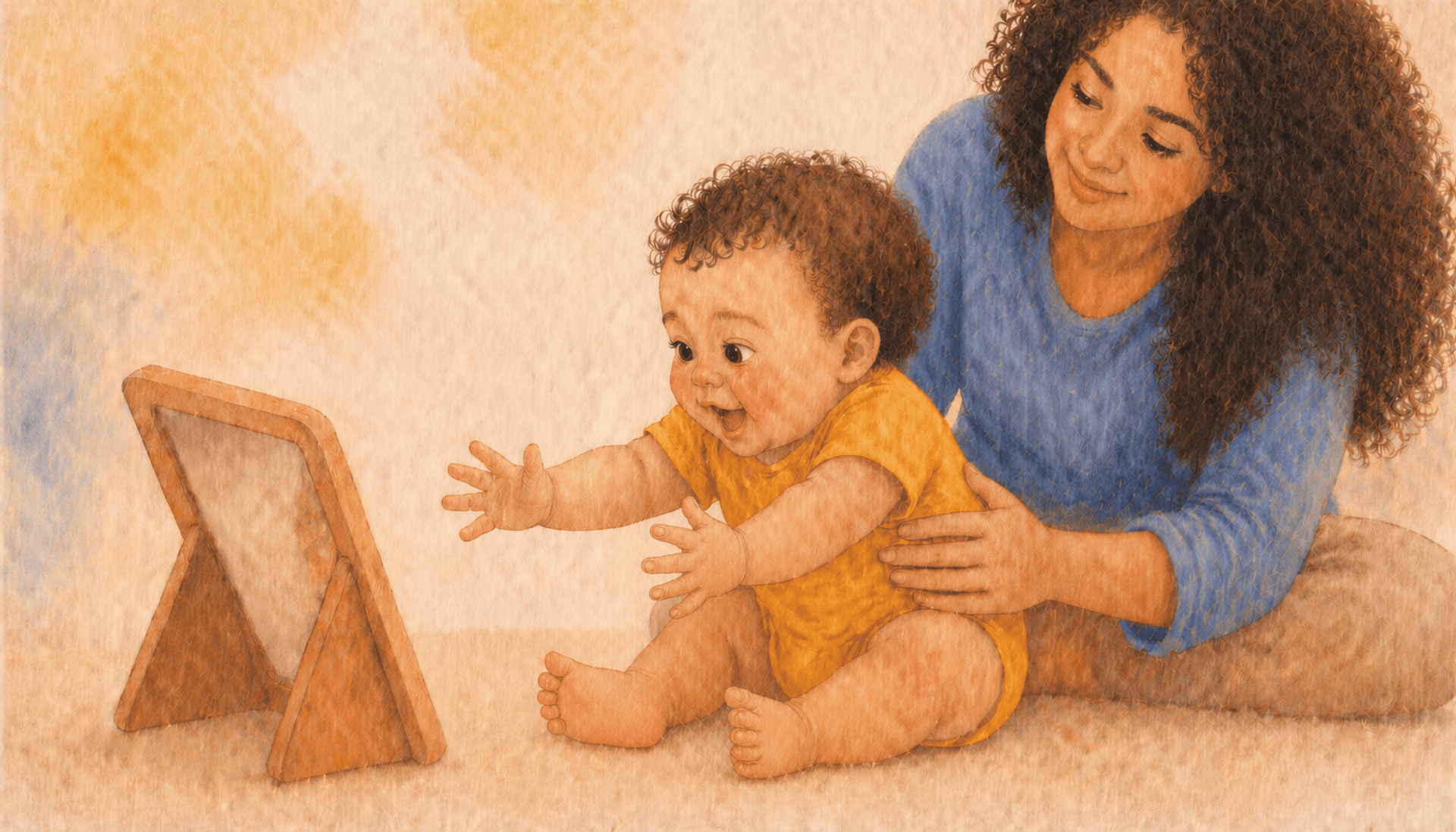
A full wake window doesn't need to be filled with structured activities. One thirty-minute sequence that covers most of what's developing this month: start on the floor with your baby in supported sitting, two or three textured objects within reach on each side, and a mirror propped at eye level. Narrate what you see — the color of the toy, the texture, the way it moves when dropped. When an object falls out of reach, cover it with a cloth and ask where it went. Switch to tummy time when interest in sitting fades — still relevant at six months, and our tummy time guide walks through seven evidence-based approaches if that continues to be a fight. End with a face-to-face conversation — a babble from your baby, a response from you, another babble. Ten minutes of genuine back-and-forth feeds language development in a way that passive input simply cannot match.
Throughout, stay within arm's reach. Six-month-olds move in sudden, unpredictable ways. The tip sideways, the pitch forward, the unexpected roll off a cushion — all of these happen in the half-second you look at your phone. The floor is safer than any elevated surface, and a firm flat surface with padding nearby is safer than a couch or bed.
If the whole session lasts only eight minutes before your baby is done, that's also fine. Short, responsive, close-up attention beats long sessions with distracted input every time.
Frequently Asked Questions
The WHO Multicentre Growth Reference Study places the 90th percentile for sitting without support at 7.5 months and the 99th percentile at 9.2 months. A baby who isn't sitting with any support at 6 months, or who isn't sitting unassisted by 9 months, warrants a conversation with your pediatrician. Before those points, wide variation is normal.
Both — and that's the point. Canonical babbling is the practice that makes speech possible. The 1998 Oller longitudinal study found that the gap between babbling onset and first words was consistently four months or more, across every infant studied. By 10 months, canonical babbling should be well established.
The most effective activities at home involve two-handed object transfer, hidden-object search games, back-and-forth babbling, tummy time with reaching, and mirror play during supported sitting. None of these require special equipment, and all of them target specific developmental shifts happening this month. Safety basics apply: supervised play only, nothing small enough to be a choking hazard, and a soft surface within arm's reach.
Most six-month-olds sleep a total of 12 to 16 hours per 24-hour period, with wake windows of 2 to 2.5 hours between two or three daytime naps. Daytime sleep typically totals 3 to 4 hours.
The American Academy of Pediatrics recommends introducing complementary foods at around 6 months, alongside continued breastmilk or formula. Readiness signs include sitting with support, good head control, loss of the tongue-thrust reflex, and interest in the food you're eating.
This article is for educational and entertainment purposes only. Not a substitute for professional medical or developmental advice. Always supervise your baby during play and sensory activities. If you have concerns about your baby's development, consult your pediatrician.
- World Health Organization Multicentre Growth Reference Study Group (2006). "WHO Motor Development Study: Windows of Achievement for Six Gross Motor Development Milestones." Acta Paediatrica, 95(S450), 86–95.
- Oller, D. K., Levine, S., Cobo-Lewis, A., Eilers, R. E., & Pearson, B. Z. (1998). "Vocal Precursors to Linguistic Communication: How Babbling Is Connected to Meaningful Speech." In R. Paul (Ed.), Exploring the Speech-Language Connection. Baltimore: Paul H. Brookes.
- Oller, D. K. (1980). "The Emergence of the Sounds of Speech in Infancy." In G. H. Yeni-Komshian, J. F. Kavanagh, & C. A. Ferguson (Eds.), Child Phonology, Vol. 1: Production. New York: Academic Press.
- Oller, D. K., Eilers, R. E., Neal, A. R., & Schwartz, H. K. (1999). "Precursors to Speech in Infancy: The Prediction of Speech and Language Disorders." Journal of Communication Disorders, 32(4), 223–245.
- Oller, D. K., Eilers, R. E., Neal, A. R., & Cobo-Lewis, A. B. (1998). "Late Onset Canonical Babbling: A Possible Early Marker of Abnormal Development." American Journal on Mental Retardation, 103(3), 249–263.
- Eilers, R. E., & Oller, D. K. (1994). "Infant Vocalizations and the Early Diagnosis of Severe Hearing Impairment." Journal of Pediatrics, 124(2), 199–203.
- Soska, K. C., & Adolph, K. E. (2014). "Postural Position Constrains Multimodal Object Exploration in Infants." Infancy, 19(2), 138–161.
- Baillargeon, R. (1987). "Object Permanence in 3½- and 4½-Month-Old Infants." Developmental Psychology, 23(5), 655–664.
- Ainsworth, M. D. S., Blehar, M. C., Waters, E., & Wall, S. (1978). Patterns of Attachment: A Psychological Study of the Strange Situation. Erlbaum.
- Zubler, J. et al. (2022). "Evidence-Informed Milestones for Developmental Surveillance in the First 3 Years of Life." Pediatrics, 149(3), e2021052138.
- American Academy of Pediatrics (2022). HealthyChildren.org — "Your Baby By Six Months."
- American Academy of Pediatrics (2016). "Media and Young Minds." Pediatrics, 138(5).
- Centers for Disease Control and Prevention (2022). "Learn the Signs. Act Early." CDC.gov.


More Articles
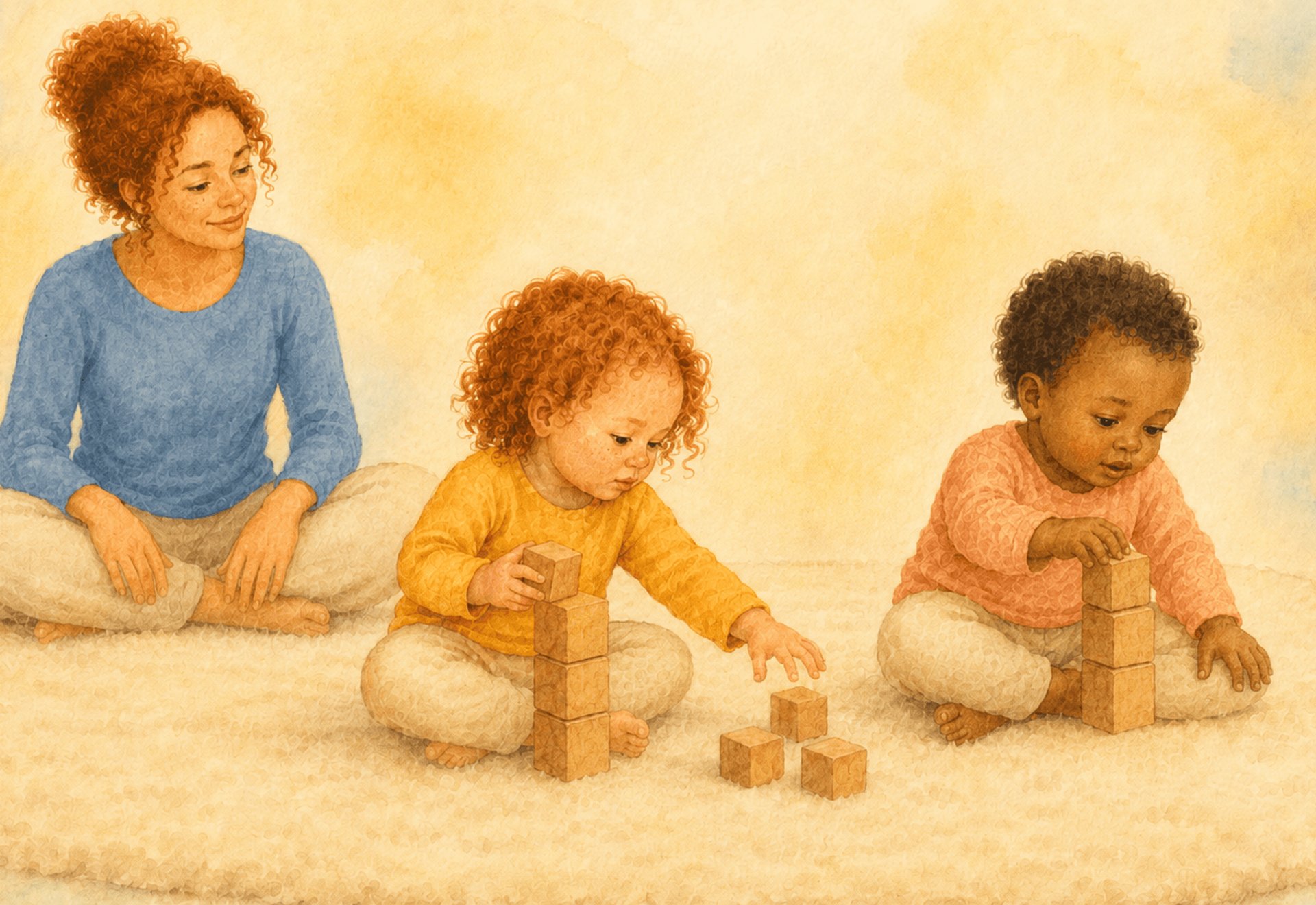
Parallel Play in Toddlers: Why Side-by-Side Is the Social Work
Your toddler spent the entire playdate building separate towers, and nobody shared a single block. That counted — more than it looked. A 2025 longitudinal study found that playing beside a specific child consistently predicted later social play with that same child, but not the other way around. Here's what parallel play in toddlers actually is, why the science calls it strategic rather than passive, and what it means for how you run a playdate.

When Do Babies Point: Why It Matters for Language
Most milestone articles treat pointing as a box to check around 12 months. The research tells a different story — one that starts months earlier, runs through the infant brain, and traces back to how much the parent is pointing. Here's what the last fifteen years of research actually found, and what it means for everyday interactions.

When Do Babies Wave Bye-Bye: Why Your Baby Needs You to Wave First
Most baby milestones unfold on a biological schedule — waving isn't one of them. A 2023 study found that babies develop imitation ability because their caregivers imitate them first, and waving is named directly as a cultural gesture learned through that loop. Here's what the research says about the 9–12 month window, why the first wave looks nothing like a wave, and what helps it arrive.