Activities for a 7 Month Old: The Month Everything Starts Working Together
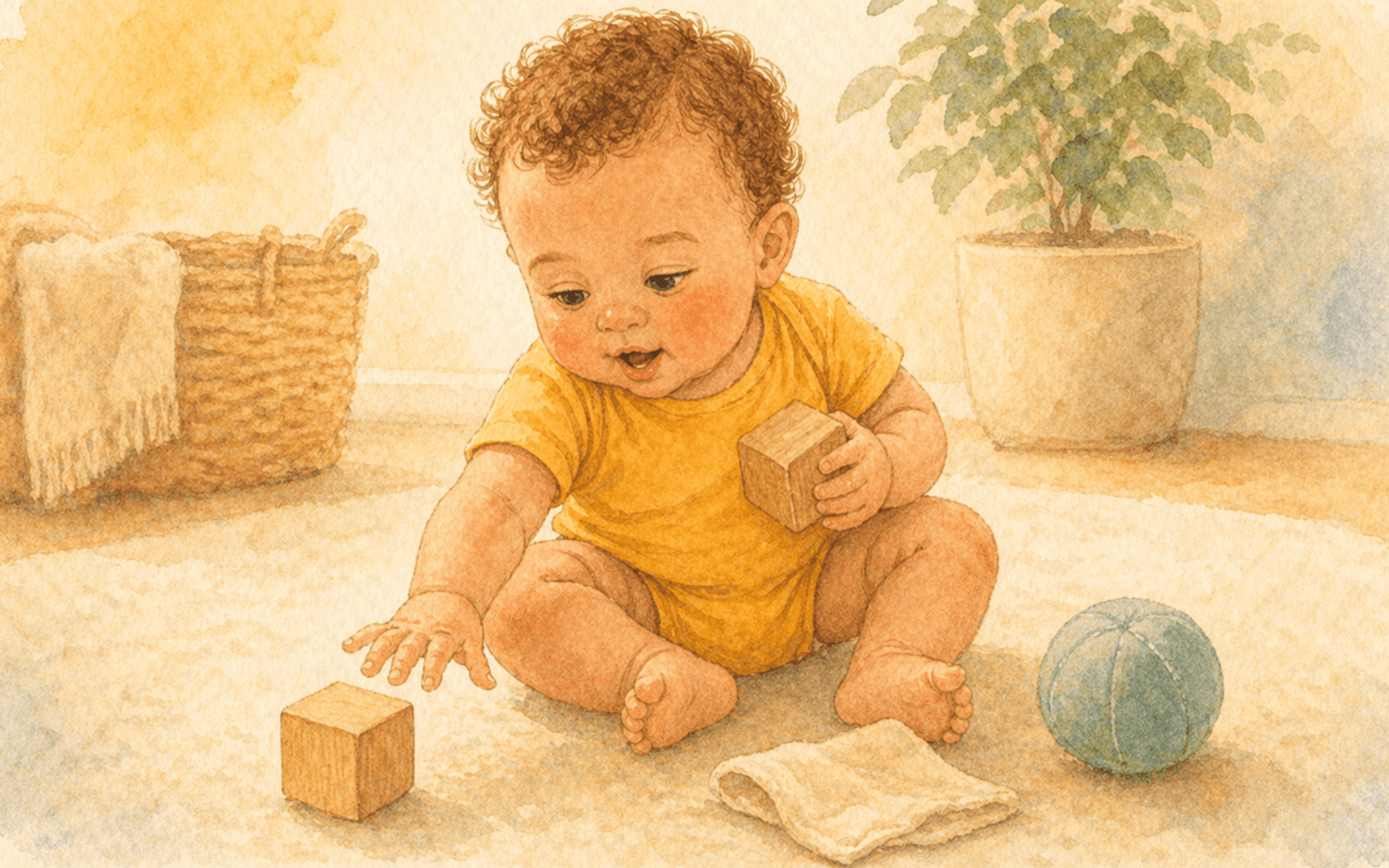
Your seven-month-old is sitting on the living room rug with a block in each hand, banging them together, watching the result, and then — very deliberately — passing the block in the right hand over to the left so the right hand can grab a third block. You're watching this and realizing that a month ago, this would not have happened. Sitting required effort. Now it's just where the baby lives. And because sitting is no longer a full-time job, the hands have been promoted to permanent exploration duty.
Most guides to activities for a 7 month old treat this as a quiet month — sitting is old news by now, crawling hasn't arrived yet, and no single flashy milestone makes it onto the parenting Instagram circuit. That's exactly what makes seven months interesting. It's the month your baby stops learning individual skills and starts combining them.
- Why 7 months is a consolidation window, not a quiet one — what changes when sitting becomes the default posture
- How babbling picks up prosody this month — and why naming objects during babbling builds word-meaning wiring
- Why peekaboo changes from reaction-based to anticipation-based — and when babies start running the game themselves
- Separation anxiety as a cognitive milestone — what it signals about attachment and memory
- The single floor session that covers free-handed manipulation, object permanence, and conversational turns simultaneously
If the one-sentence answer is enough, you’ve got the gist. If you want the mechanism behind each piece, keep reading.
What's New at Seven Months
The CDC's 2022 revised milestones cover the six-month and nine-month checkpoints, not seven months specifically. That's not a gap in the research — it reflects the reality that month seven is a consolidation window. Nothing brand new debuts. Instead, everything that arrived around six months gets stronger, more coordinated, and more intentional.
A typical seven-month-old sits independently for long stretches without the tripod hand-down-for-balance posture you saw a month ago. Both hands are free to work on objects at the same time. The raking grasp (pulling small items toward the palm with all four fingers curled) is refining toward a real thumb-and-forefinger pincer, though true pincer grasp usually arrives closer to eight or nine months.
Babbling is louder, longer, and starts to carry tone variation — rising at the end like a question, falling like a statement. Object permanence, which your baby already understood cognitively at four months, is now behavioral: your baby will actively search for a toy that disappeared, not just register that it should still be there. Many seven-month-olds are rocking on hands and knees, the classic pre-crawl pattern, though plenty of babies skip this step entirely.
And somewhere in this month, for roughly half of seven-month-olds, something new appears that isn't a motor or cognitive milestone at all: separation anxiety. The baby who didn't mind being handed to grandma two weeks ago now clings, arches, and cries the second you walk away. It's uncomfortable for everyone involved, and it's also a good sign.
Sitting Is Now the Default — and That Changes Everything
This is the shift that most activity lists miss. At five and six months, the baby was learning to sit. At seven months — for many babies, though not all — sitting becomes the platform from which everything else gets explored.
Work by Soska and Adolph at New York University, published in Infancy in 2014, tracked exactly what happens when sitting becomes stable. The researchers placed infants between five and seven months in three positions — lying on the back, lying on the tummy, and sitting — and recorded every manual, oral, and visual exploration. Sitting produced dramatically more of all three. When a baby is sitting, the arms aren't holding up the body, the head is upright and steady, and the visual field expands to a full panorama. The researchers estimated that over the course of a day, sitting adds 400 or more manual exploratory actions and 22 extra minutes of visual examination compared to lying positions.
Our article on activities for a 6 month old introduced this research because supported sitting is where the effect begins. By seven months, babies who are already sitting independently spend much of the day in that position — not because it's a requirement, but because they've found the posture that gives them the most access to everything around them. The WHO Multicentre Growth Reference Study established that the normal window for independent sitting runs from four to nine months, and a baby still working on it at seven months is well within that range. For babies who are already sitting reliably, though, that 400-action boost isn't a sometimes-bonus; it's what the brain is receiving during every propped-up wake window.
A 2017 review by Adolph and Franchak in WIREs Cognitive Science describes this more broadly: posture is the foundation on which every action system gets built. Stable sitting unlocks manual exploration. Manual exploration unlocks object learning. Object learning drives categorization, cause and effect, and eventually language. Your baby isn't sitting instead of doing things. Sitting is the platform.
The practical takeaway: anywhere you used to do floor play with your baby on the back — the activity gym, the high-contrast cards, the crinkly fabric — now do it in front of your baby. On a firm, flat surface, with you close by for balance spotting. For a full breakdown of this milestone, our guide to when do babies sit up walks through the timeline and what to expect if independent sitting arrives late.
Show Image
The Babbling Picks Up a Melody
At six months, canonical babbling arrived — the real consonant-vowel syllables like ba and da that speech researchers use as a reliability marker for typical language development. D. Kimbrough Oller's longitudinal work, published in 1998, tracked 42 infants from early infancy through toddlerhood and found that once canonical babbling starts, children consistently reach a spoken vocabulary of five words about four months later. That gap didn't vary by family income, language exposure, or birth circumstance.
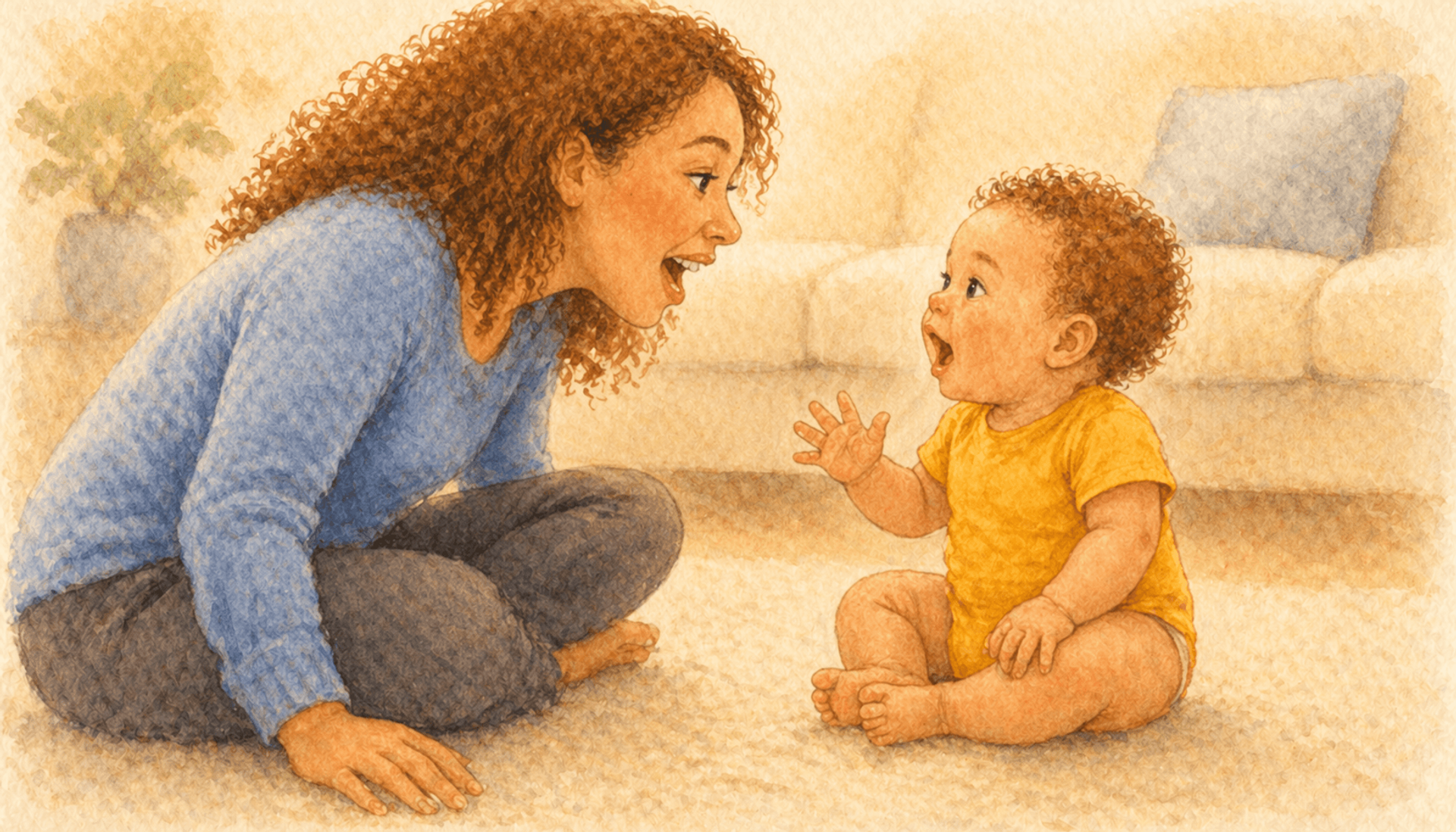
What changes at seven months is the rhythm. Your baby's ba-ba-ba is no longer a flat, repeated string. It goes up at the end. It stretches out. Some syllables get emphasized. Long chains alternate between different consonants — ba-da-ba-ga — and some of them come back when you pause and wait. The baby is starting to play with the prosody of speech: the melody and stress pattern that carries meaning before the actual words arrive.
The right response is still the conversational-turn model. MIT researchers Romeo and colleagues demonstrated in a 2018 Psychological Science study that back-and-forth vocal exchanges — not sheer volume of words a baby hears — correlated with brain activity in the language network and with language outcomes at age five. At seven months, those turns can be longer on both sides. Your baby produces a rhythmic string, you mirror and extend it ("ba-da-ba-ga, you're telling me a story!"), and then you wait. The pause is where the loop completes.
A practical hack: when your baby babbles while looking at a specific object, name it. If the babble comes out while staring at the dog, say "dog — yes, that's a dog." You're not teaching the baby to say dog — most babies produce a recognizable first word somewhere between ten and fourteen months, and the specific words each baby picks up depend on exposure. What you're doing at seven months is wiring the sound-to-meaning association that every future word depends on. For the full arc of how babbling turns into first words, our article on when babies start talking covers what comes next.
Hide and Seek Becomes a Real Game
At seven months, what changes isn't understanding — your baby already knew at four and a half months, per Baillargeon's 1987 drawbridge studies, that hidden objects continue to exist. What changes is the ability to act on that knowledge, and more importantly, to anticipate the reveal.
This is the difference between peekaboo at six months and peekaboo at seven months. At six months, the game mostly works because the reappearance surprises your baby — the laugh comes after your face emerges from behind the hands. At seven months, many babies start laughing before the reveal. The brain is now holding the pattern (hide → reveal → repeat) across the pause, predicting what's coming, and finding the prediction itself funny. That's a meaningful cognitive step up — anticipation-based play rather than reaction-based play.
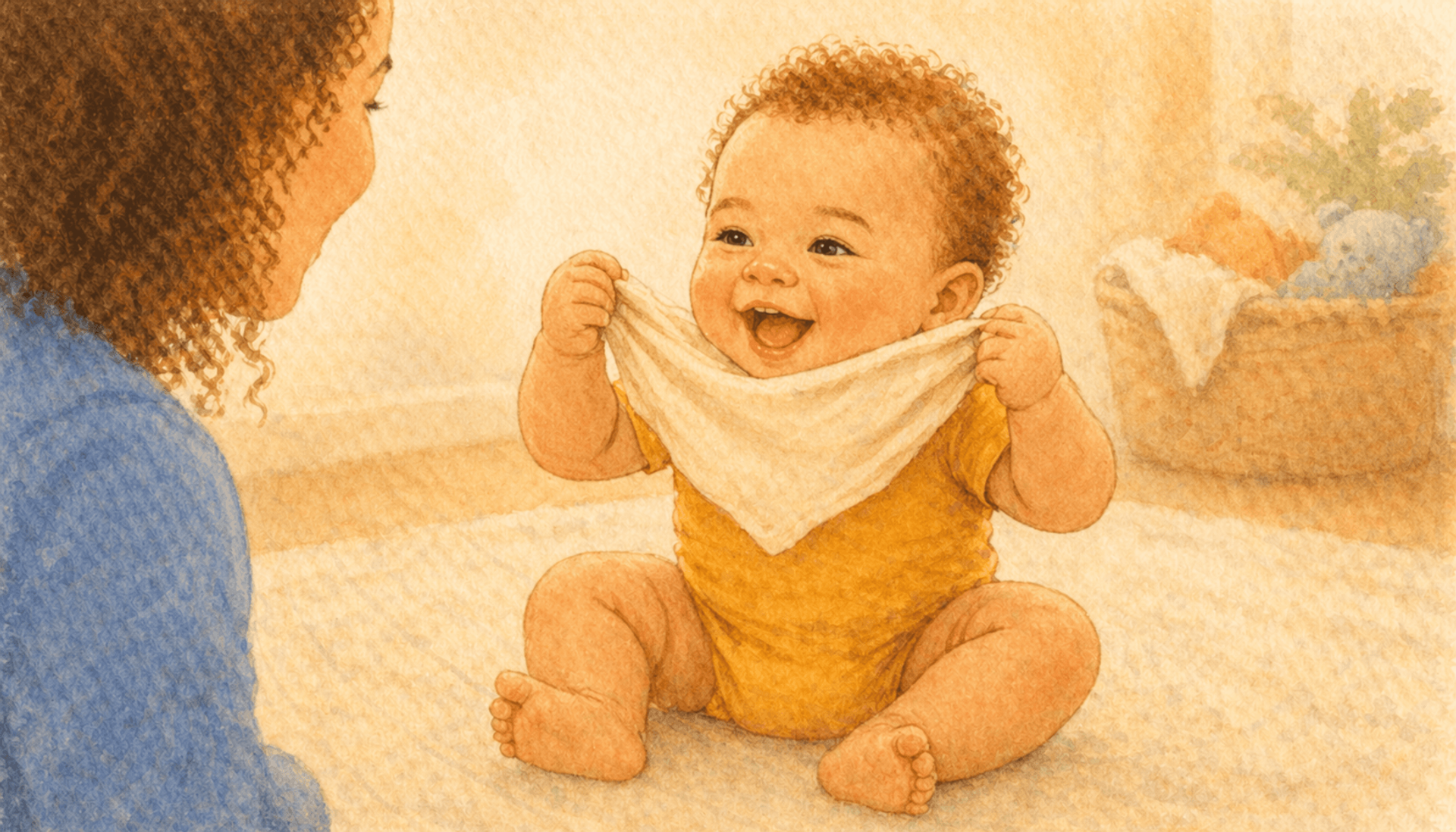
The second shift is initiation. A six-month-old plays peekaboo by participating; a seven-month-old often starts doing the hiding. Your baby pulls a blanket up to cover the face, waits a beat, yanks it down, and grins expectantly at you. At that point, the baby isn't playing with you — the baby is running the game.
What this means for activities: hiding games are now genuinely two-sided. Put a favorite toy under a scarf and let your baby pull it off. Cover the whole toy (not just half) and watch your baby figure out where it went. When your baby tries to initiate peekaboo, play along every single time — the back-and-forth is where the learning happens. Your baby will sustain this kind of play for longer than you expect, because the predictive loop is intrinsically rewarding to a brain that just built the machinery for it.
Why Your Baby Suddenly Clings to You
If you've ever handed your seven-month-old to a well-meaning relative and watched the baby's face crumple like you just left for a year, you've met separation anxiety. It's often confusing because it can seem to appear overnight, and it usually coincides with a developmental window parents expect to be the easier part of infancy — the sitting, smiling, babbling sweet spot.
The timing is actually predictable. Classic research by Jerome Kagan and colleagues, building on Mary Ainsworth's attachment work in the 1970s, identified separation anxiety as a universal developmental phase that typically emerges around six to eight months, peaks between ten and eighteen months, and gradually fades into the toddler years. It shows up in babies across cultures, across parenting styles, and across attachment configurations. The onset isn't a response to anything you did wrong. It's evidence that your baby has finally built the cognitive architecture needed to know that you exist even when you're not in the room and to care about that fact.
Handling it well doesn't mean preventing it. It means not forcing through it. Give your baby a few seconds to adjust when someone new holds them. Narrate short separations ("I'm going to the kitchen, I'll be right back") even though the baby doesn't fully understand the words — the tone and the predictable return do the work. Keep handoffs to other caregivers brief, warm, and confident rather than prolonged and apologetic.
Our article on sensory play for babies covers activities that work well in proximity — the ones where your baby can explore independently while you stay close and visible. That's the sweet spot at seven months.
Rocking, Wriggling, and the Many Ways Babies Move
This is where most parents get anxious. A seven-month-old who isn't crawling yet doesn't mean anything is wrong. The CDC's 2022 revised milestones, published by Zubler and colleagues in Pediatrics, explicitly removed crawling as a developmental milestone. The reasoning was straightforward: crawling is not universal, not reliably timed, and not a precondition for walking. The milestone was causing unnecessary parent worry without improving developmental surveillance.
Research by Adolph, Vereijken, and Denny, published in Child Development in 1998, documented this directly. Infants use a wide range of locomotor strategies before they walk — classical hands-and-knees crawling, belly-crawling (commando style), bear-crawling on hands and feet, scooting on the bottom, rolling, and cruising along furniture. Some babies use one strategy exclusively. Others switch. A meaningful minority skip crawling entirely and go straight from sitting to pulling up to cruising to walking.
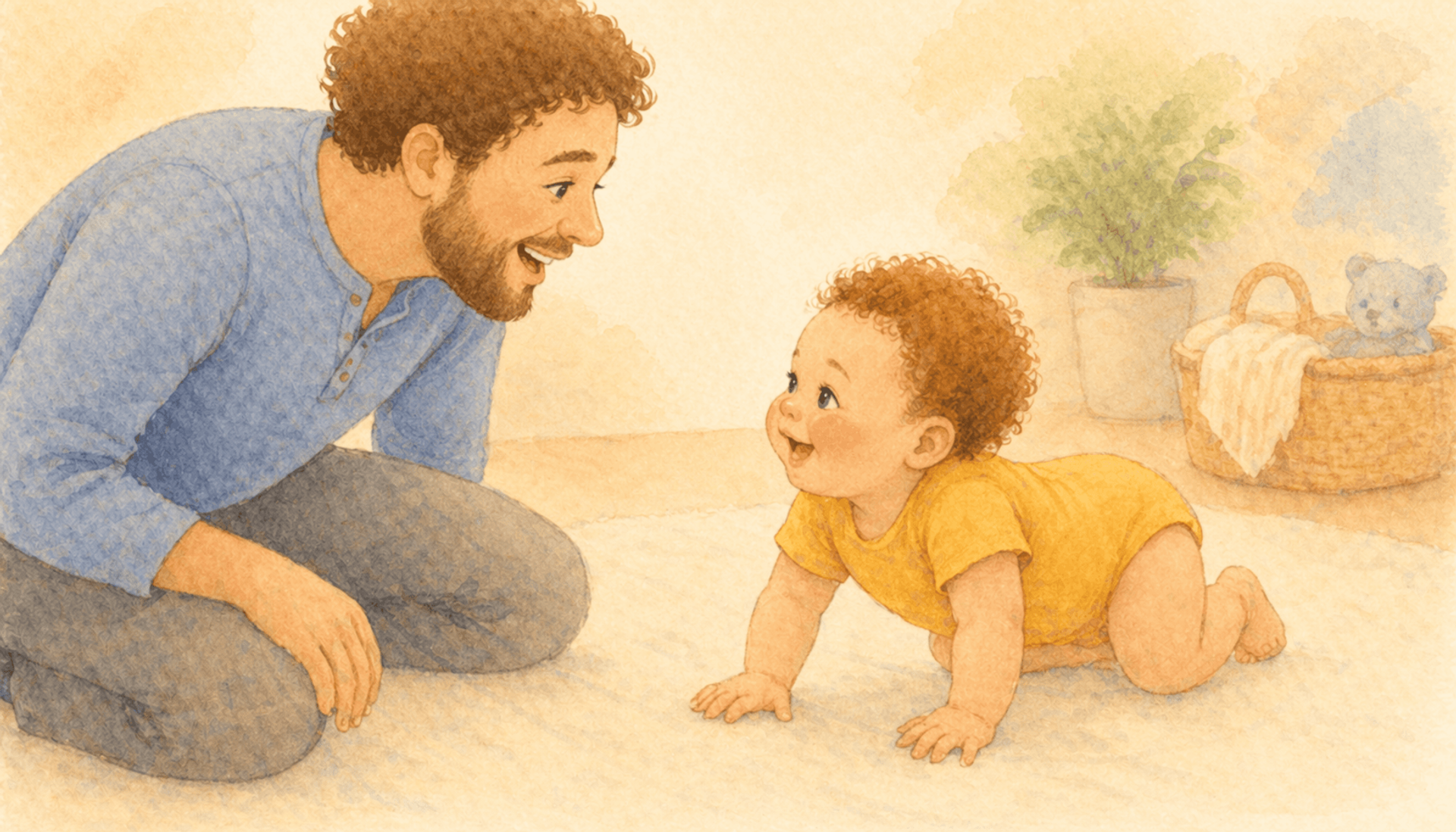
What most seven-month-olds are doing is experimenting. Rocking on hands and knees without going anywhere. Planting the palms and pushing the bottom up into a near-downward-dog. Lunging forward and ending up on the belly. Pivoting in place. Some babies belly-crawl backward for a month before figuring out forward. All of this counts as progress, and none of it is predictive of whether or when your baby will crawl in the conventional sense.
For activities that support motor development at seven months at home: floor time on a clear, firm, flat surface. Toys placed just out of reach to motivate forward movement. An enthusiastic audience when your baby manages to pivot or lunge. Outdoor blanket time on a patch of grass once the weather allows — new textures under the palms and a wider visual field give the vestibular and proprioceptive systems input they don't get indoors.
Safety note: always supervise floor time and keep the play surface clear of small objects and cords. Never leave a seven-month-old unattended — even for a few seconds — on any elevated surface such as a changing table, bed, sofa, or chair. Babies this age can twist, roll, or lunge faster than parents expect, and the floor is the only safe surface to leave them on briefly. Also check that furniture your baby might pull toward is stable and anchored.
Show Image
Practical Activities for a 7 Month Old
Here's what works specifically at seven months, organized by where you are:
On the floor. Set up a small cluster of objects within reach — a wooden block, a crinkly fabric square, a soft ball, a board book. Let your baby sit in the middle and explore. The magic happens when your baby picks up one object, puts it down, and chooses another without help. This is real executive function at seven months: the brain deciding what to focus on, then switching.
In the high chair. Now that solid foods have been going for about a month, high-chair time is fertile activity ground. Offer a few different food textures on the tray — a soft banana piece, a cooked pea, a small shred of soft cheese (if introduced) — and let your baby pick them up with the raking grasp. Every pickup is pincer-grasp practice in slow motion. Drop a silicone suction bowl onto the tray with a small amount of water and show how a finger can make ripples. The high chair is a contained sensory laboratory.
Outside. Outdoor activities for a seven-month-old don't need to be elaborate. A blanket on the grass under a tree gives your baby dappled light, a breeze, ambient sound, and a completely new surface to explore with the palms. A stroll in the stroller at eye-level with bushes, flowers, or a sidewalk garden gives the visual system input it can't get from the living room. Mama narrating what you're both seeing turns the walk into a vocabulary session.
With you. The most powerful activity at seven months is still face-to-face interaction, because the conversational turn research makes clear that responsive exchange builds language wiring no toy can replicate. Get at eye level, mirror your baby's sounds, respond to babbling strings as if they were profound observations, and let the back-and-forth stretch out. Ten minutes of this is developmental gold.
Our Sensory Play Cards 0–12 Months include activities organized by age that match what's developmentally current at seven months — multimodal play that uses the free hands, the stable sitting position, and the growing attention span in the way the research suggests is most productive.
Putting It Together in One Session
A good seven-month wake window: after a feed and diaper change, set your baby in a stable sitting position on a firm play surface. Place three or four different-textured objects within arm's reach — a wooden rattle, a crinkly square, a small fabric ball, a teething ring. Sit in front of your baby, at eye level.
Wait. Let your baby pick up something first. When one hand grabs an object, wait for the other hand to reach for a second object. That moment of transferring — object in the right hand crossing to the left so the right can grab something new — is seven months in action. When the babbling starts, mirror it. When your baby looks at you, pause long enough for the baby to vocalize again. When an object is dropped off the edge of the mat (and it will be), wait to see if your baby searches for it before you hand it back.
In a single session, this covers everything that's developing right now: free-handed manipulation (Soska and Adolph), object permanence acting (Baillargeon), conversational turns (Romeo), and the sheer practice time that consolidates each of these systems into the reliable defaults your baby will carry into month eight. A seven-month-old can sustain this kind of play for fifteen to twenty minutes before the processing ceiling hits. When the gaze goes glassy or the fussing starts, the session is done.
Frequently Asked Questions
Most seven-month-olds stay awake between naps for about two to three hours, with the longest window typically before the last nap of the day. That's enough time for a feeding, a diaper change, a 15-to-20-minute focused play session, and quieter floor time before sleep cues appear. Watch for the usual signs — yawning, eye rubbing, staring off, fussiness — rather than the clock. Wake windows at this age are more reliable than at five months but still vary from baby to baby.
Yes. Crawling was removed from the CDC's official milestones in the 2022 revision because it's not universal and not required for typical motor development. Many seven-month-olds rock on hands and knees without crawling. Many skip crawling entirely and go from sitting to pulling up to cruising to walking. As long as your baby is making progress on floor mobility — rolling, pivoting, lunging, army-crawling, or anything else — the motor system is on track. Talk to your pediatrician if your baby isn't pushing up during tummy time, isn't rolling, or seems to have asymmetric motor patterns (using one side much more than the other).
Separation anxiety typically emerges between six and eight months, peaks between ten and eighteen months, and gradually fades through the second and third years. It's not a behavior problem and it's not caused by anything you did. It's a cognitive milestone — evidence that your baby now understands you exist when out of sight and has formed strong attachment to you specifically. Short, predictable separations, warm handoffs to other caregivers, and a confident tone on your part help your baby build tolerance for brief absences without forcing the issue.
Objects that reward two-handed exploration: wooden blocks that can be banged together, silicone stacking cups that nest and fit inside each other, soft balls that transfer hand to hand, board books with different textures to explore, teething rings with multiple shapes and surfaces. Simple beats complex at this age. A household object like a metal mixing bowl with a wooden spoon often out-entertains a battery-powered toy, because the baby's own actions produce all the interesting results — the definition of what cognitive scientists call contingent feedback, which is what the seven-month brain is tuned to learn from.
This article is for educational and entertainment purposes only. Not a substitute for professional medical or developmental advice. If you have concerns about your baby's development, consult your pediatrician.
- Zubler, J.M., Wiggins, L.D., Macias, M.M., et al. (2022). Evidence-Informed Milestones for Developmental Surveillance Tools. Pediatrics, 149(3), e2021052138.
- World Health Organization Multicentre Growth Reference Study Group. (2006). WHO Motor Development Study: Windows of achievement for six gross motor development milestones. Acta Paediatrica Supplement, 450, 86–95.
- Soska, K.C., & Adolph, K.E. (2014). Postural Position Constrains Multimodal Object Exploration in Infants. Infancy, 19(2), 138–161.
- Adolph, K.E., & Franchak, J.M. (2017). The development of motor behavior. WIREs Cognitive Science, 8(1–2), e1430.
- Adolph, K.E., Vereijken, B., & Denny, M.A. (1998). Learning to crawl. Child Development, 69(5), 1299–1312.
- Oller, D.K., Eilers, R.E., Neal, A.R., & Schwartz, H.K. (1999). Precursors to speech in infancy: The prediction of speech and language disorders. Journal of Communication Disorders, 32(4), 223–245.
- Eilers, R.E., & Oller, D.K. (1994). Infant vocalizations and the early diagnosis of severe hearing impairment. Journal of Pediatrics, 124(2), 199–203.
- Baillargeon, R. (1987). Object permanence in 3½- and 4½-month-old infants. Developmental Psychology, 23(5), 655–664.
- Ainsworth, M.D.S., Blehar, M.C., Waters, E., & Wall, S. (1978). Patterns of Attachment: A Psychological Study of the Strange Situation. Lawrence Erlbaum.
- Kagan, J. (1984). The Nature of the Child. Basic Books.
- Romeo, R.R., Leonard, J.A., Robinson, S.T., West, M.R., Mackey, A.P., Rowe, M.L., & Gabrieli, J.D.E. (2018). Beyond the 30-Million-Word Gap: Children's Conversational Exposure Is Associated With Language-Related Brain Function. Psychological Science, 29(5), 700–710.
- American Academy of Pediatrics. (2024). Developmental milestones: 7 months. HealthyChildren.org.
Related Products

More Articles
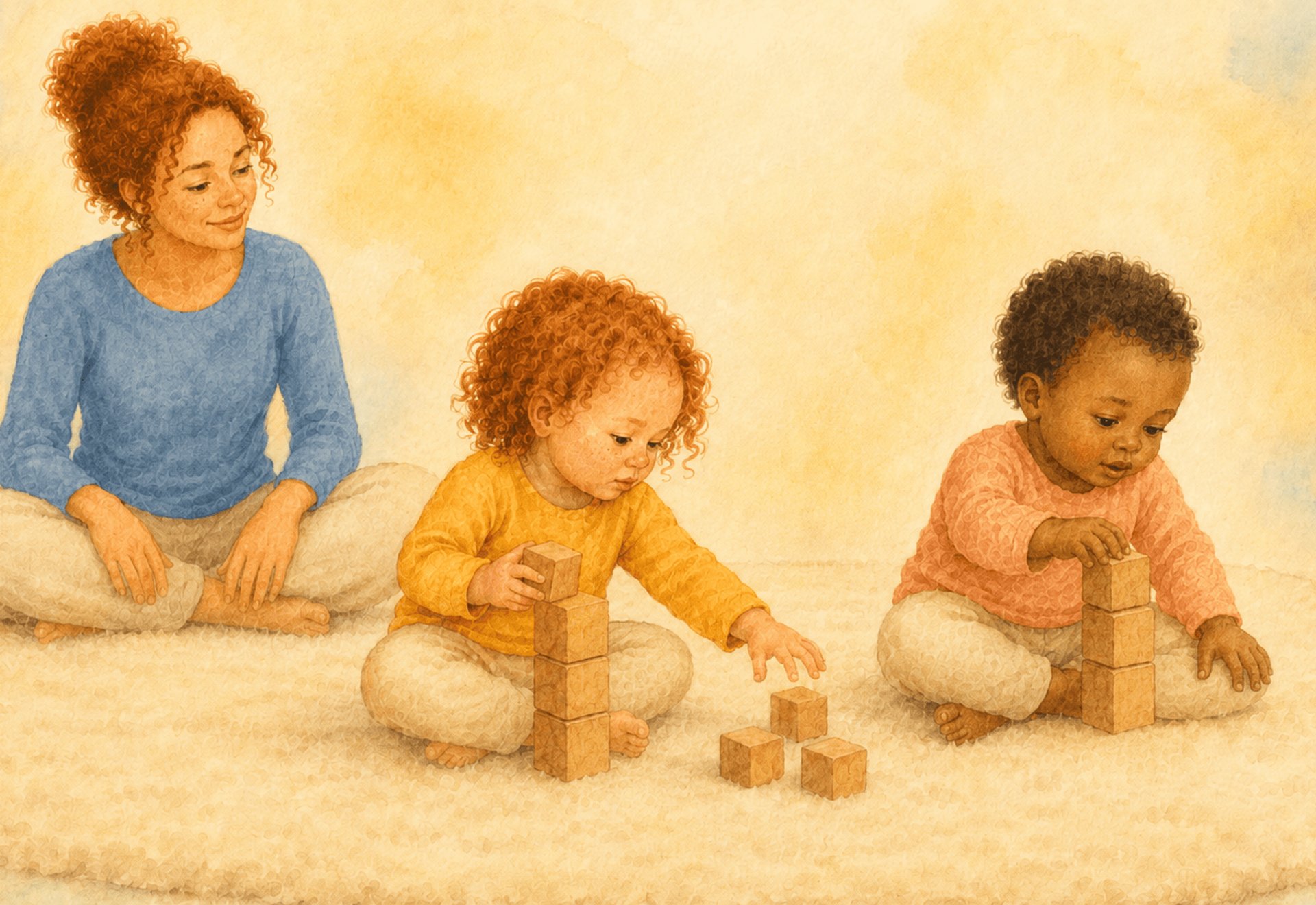
Parallel Play in Toddlers: Why Side-by-Side Is the Social Work
Your toddler spent the entire playdate building separate towers, and nobody shared a single block. That counted — more than it looked. A 2025 longitudinal study found that playing beside a specific child consistently predicted later social play with that same child, but not the other way around. Here's what parallel play in toddlers actually is, why the science calls it strategic rather than passive, and what it means for how you run a playdate.
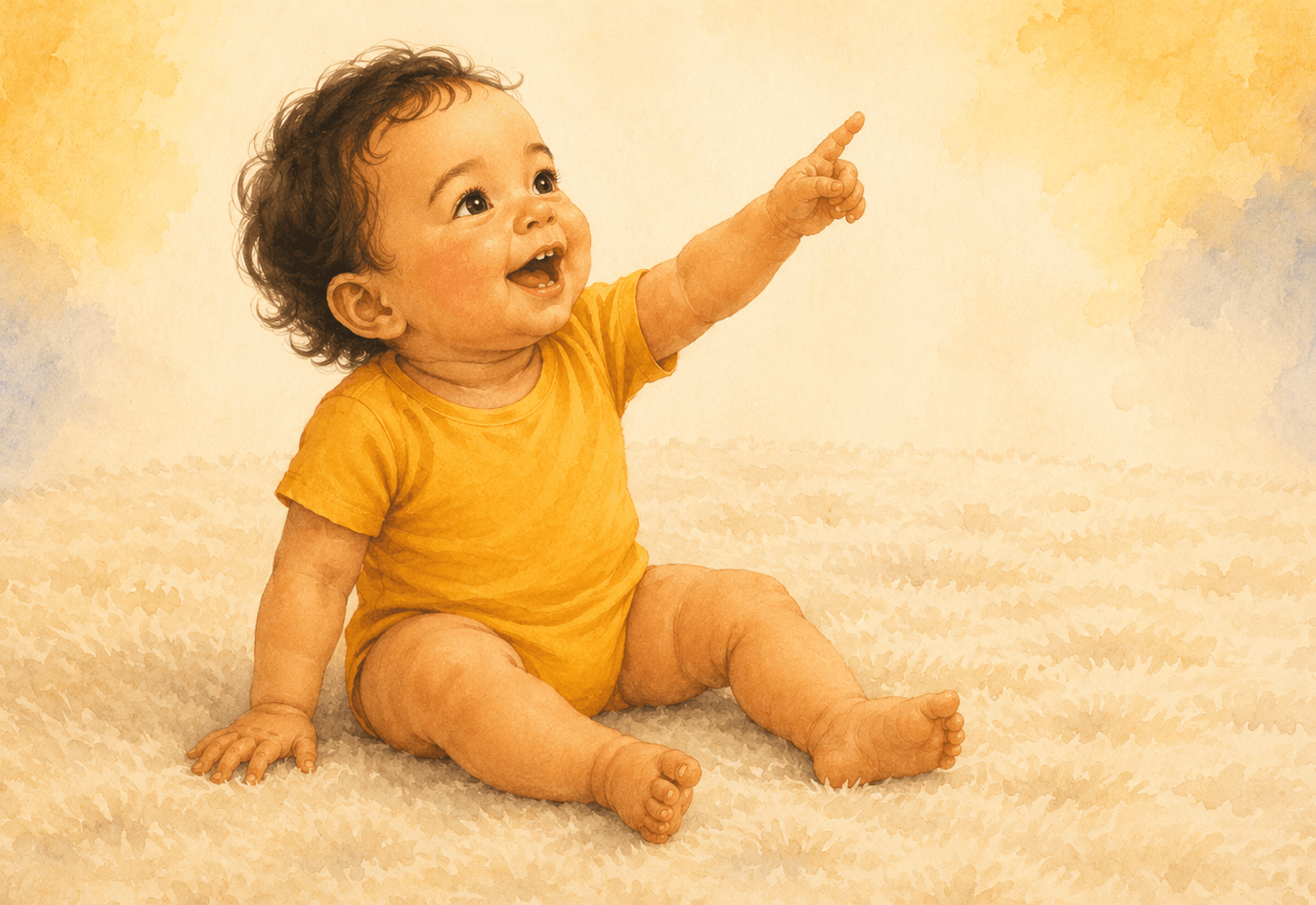
When Do Babies Point: Why It Matters for Language
Most milestone articles treat pointing as a box to check around 12 months. The research tells a different story — one that starts months earlier, runs through the infant brain, and traces back to how much the parent is pointing. Here's what the last fifteen years of research actually found, and what it means for everyday interactions.
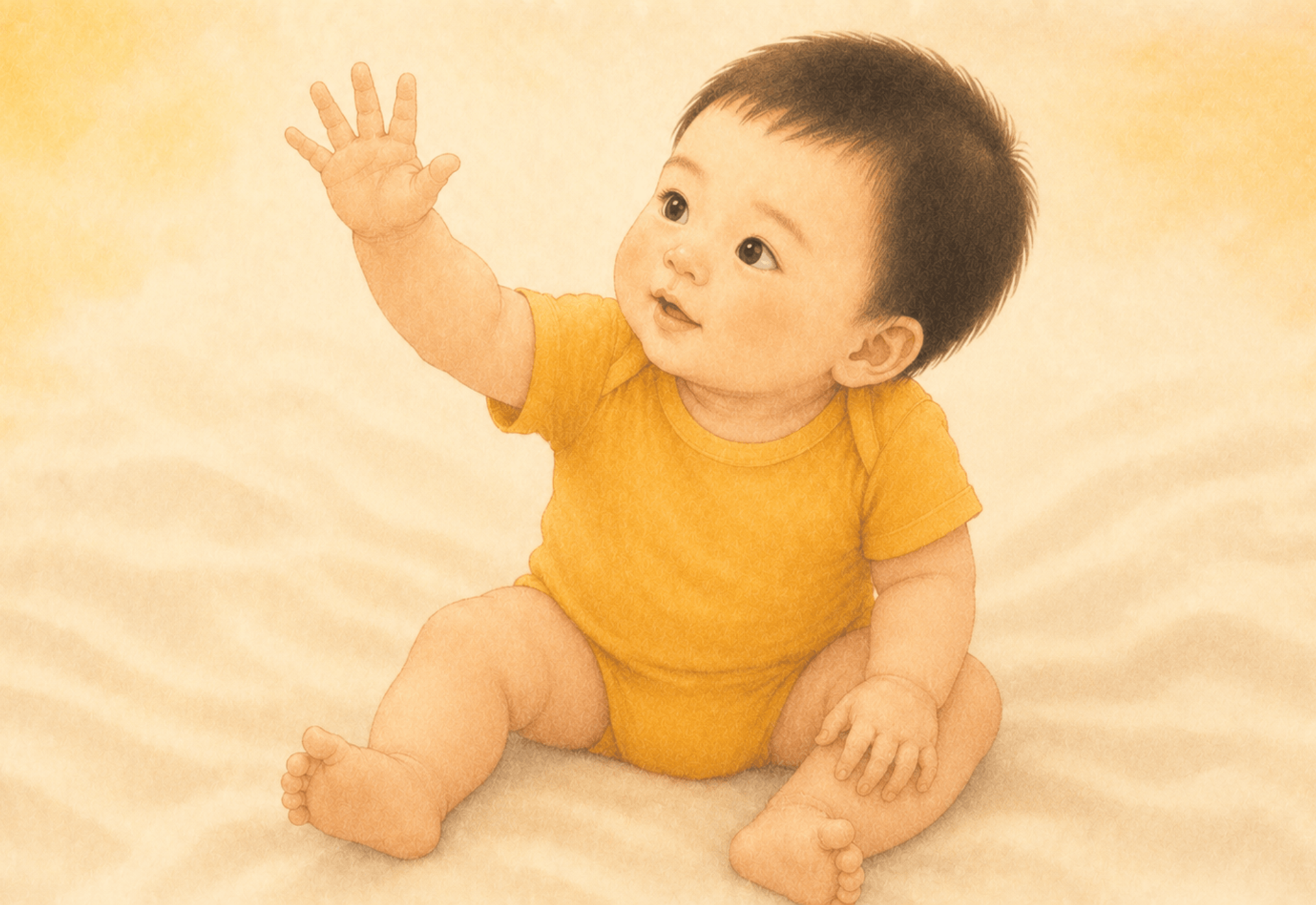
When Do Babies Wave Bye-Bye: Why Your Baby Needs You to Wave First
Most baby milestones unfold on a biological schedule — waving isn't one of them. A 2023 study found that babies develop imitation ability because their caregivers imitate them first, and waving is named directly as a cultural gesture learned through that loop. Here's what the research says about the 9–12 month window, why the first wave looks nothing like a wave, and what helps it arrive.