Activities for a 10 Month Old Baby: What Actually Changes This Month
By 10 months, the cabinet with the plastic containers is no longer safe. One Tuesday afternoon your baby pulls open the door, takes out a yogurt tub, takes out another, takes out another, and after twenty minutes seventeen lids and seventeen containers are spread across the kitchen floor. Not one has gone back in. Your baby is sitting in the middle, perfectly content, dropping a lid into a bowl, picking it up, dropping it again — until you say "uh-oh," and the whole face changes, like those two syllables just landed somewhere they didn't last month. That landing is one of the developmental shifts of month 10 that almost no activity list mentions, and it's where activities for 10 month old babies start to look genuinely different from what worked at nine.
- The single 2013 study that puts a date stamp on when "uh-oh" actually starts to mean uh-oh
- Why the Tupperware cabinet beats every developmental toy on the shelf this month
- Cruising, pulling-to-stand, and the falls that look scarier than they are
- Why your favorite people suddenly aren't, and what that has to do with object permanence
- A real wake-window plan for at home, the car, and the plane (yes, the plane)
If the one-sentence answer is enough, you’ve got the gist. If you want the mechanism behind each piece, keep reading.
The language threshold no one mentions
Ten months is when the meaning of words like "uh-oh" and "all gone" actually clicks into place, and that shift changes what counts as a productive 10 month old activity. A 2013 study by Elika Bergelson and Daniel Swingley in the journal Cognition tested 6-to-16-month-olds with paired video clips while parents named one of the events. Six- to nine-month-olds did not look reliably at the named clip when the word was abstract. Ten-month-olds did. The cross-over happened, on average, at exactly 10 months — for words like "uh-oh," "all gone," and "eat."
This is a different cognitive achievement than understanding "banana" or "feet." Bergelson and Swingley had already shown, in a 2012 paper in PNAS, that 6-to-9-month-olds recognize plenty of concrete nouns — foods and body parts especially. By 10 months your baby has had that pathway open for months. The new thing is the layer on top: words that don't point to a single physical thing on a table, but to events, transitions, and shared reactions. You can label a banana for a six-month-old. You can say "all gone" to a ten-month-old and watch the face change.
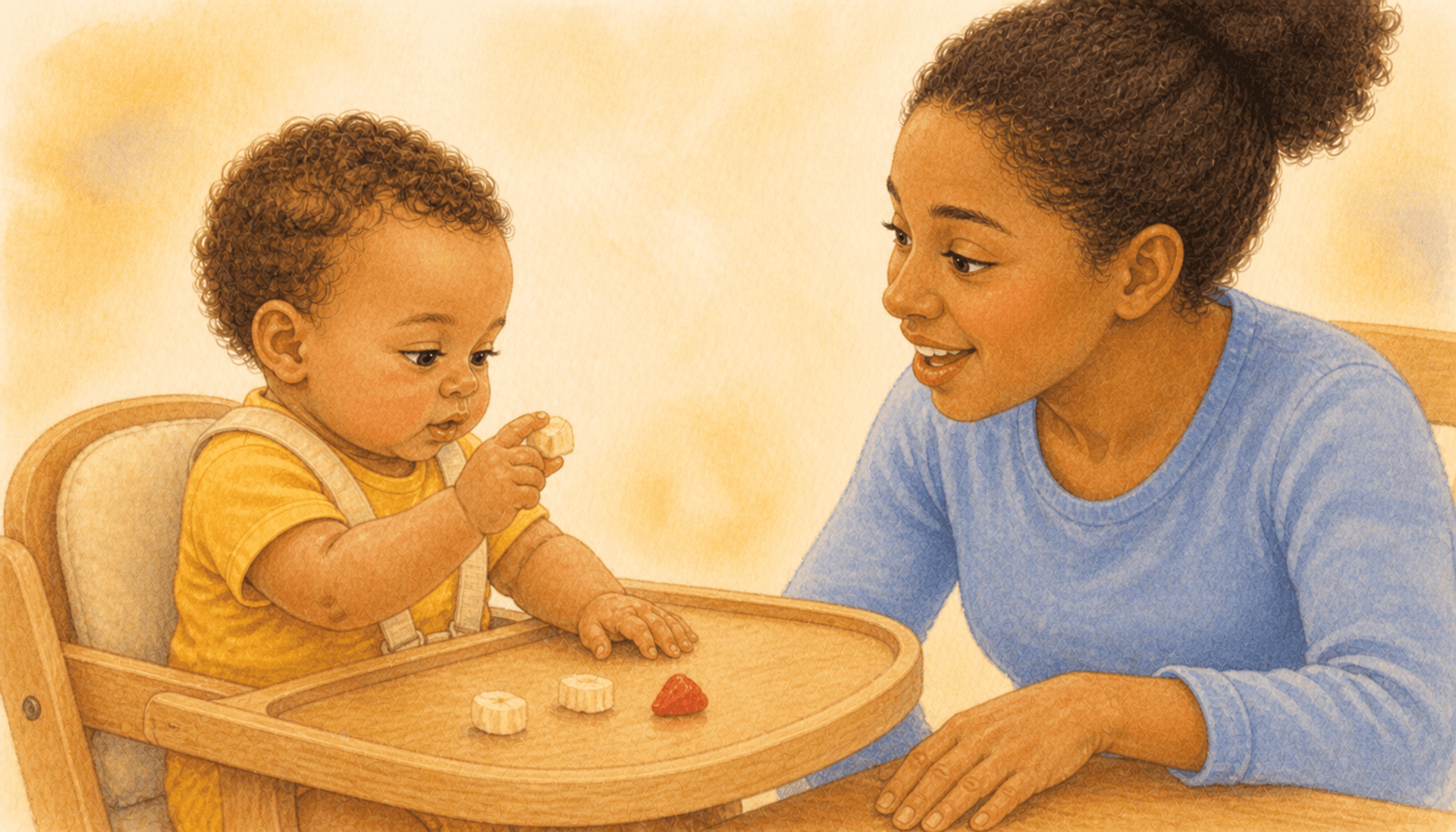
What this means for activities is concrete: narrate with the abstract words, deliberately, while the referent is still in front of you. "Uh-oh" the moment something falls. "All gone" when the puree dish is empty. "Bye-bye" with a wave at the door, every time. These are exactly the words the research shows your baby is mapping right now, and meal time is one of the highest-density opportunities of the day.
This is also where food nouns earn their place again. A 10-month-old has been understanding "apple" and "banana" since six months, and is about to start producing a few of those words in the next two to three months. Concrete vocabulary stays the foundation. Our Fruits & Vegetables First Words flashcards work with this exact age window — twelve foods your baby is also probably starting to actually eat, named the same way you'd name them at the table. A few minutes of pointing and naming, paired with the food itself in the high chair, is more efficient than any standalone "language toy." For a fuller picture of when babies start talking and how the first words emerge, the language curve continues well past this month, but month 10 is the receptive cliff. Production is the lagging indicator.
In-out play and the Tupperware cabinet
The reason your baby will not stop pulling things out of containers is that the conceptual machinery for inside finally has the motor system to act on it, and that combination is one of the most efficient cognitive workouts of the first year. Susan Hespos and Renée Baillargeon, then at MIT and the University of Illinois, showed in a 2001 paper in Psychological Science that infants do not reason correctly about height in containment events until about 7.5 months, even though they handle the same physics in occlusion events ("behind") much earlier. By 10 months, the containment understanding has been quietly settling for two to three months. What's new this month is that the hands and the planning to act on it are finally caught up.

Watching a 10-month-old dump a basket of plastic spoons looks like the opposite of learning. It is not. Each cycle (pick up object, hold it over container, release, watch it land, pick it back up) practices fine motor precision, working memory ("where did I put the lid?"), spatial reasoning, and means-end planning, all at once. The repetition is not boredom. The repetition is consolidation.
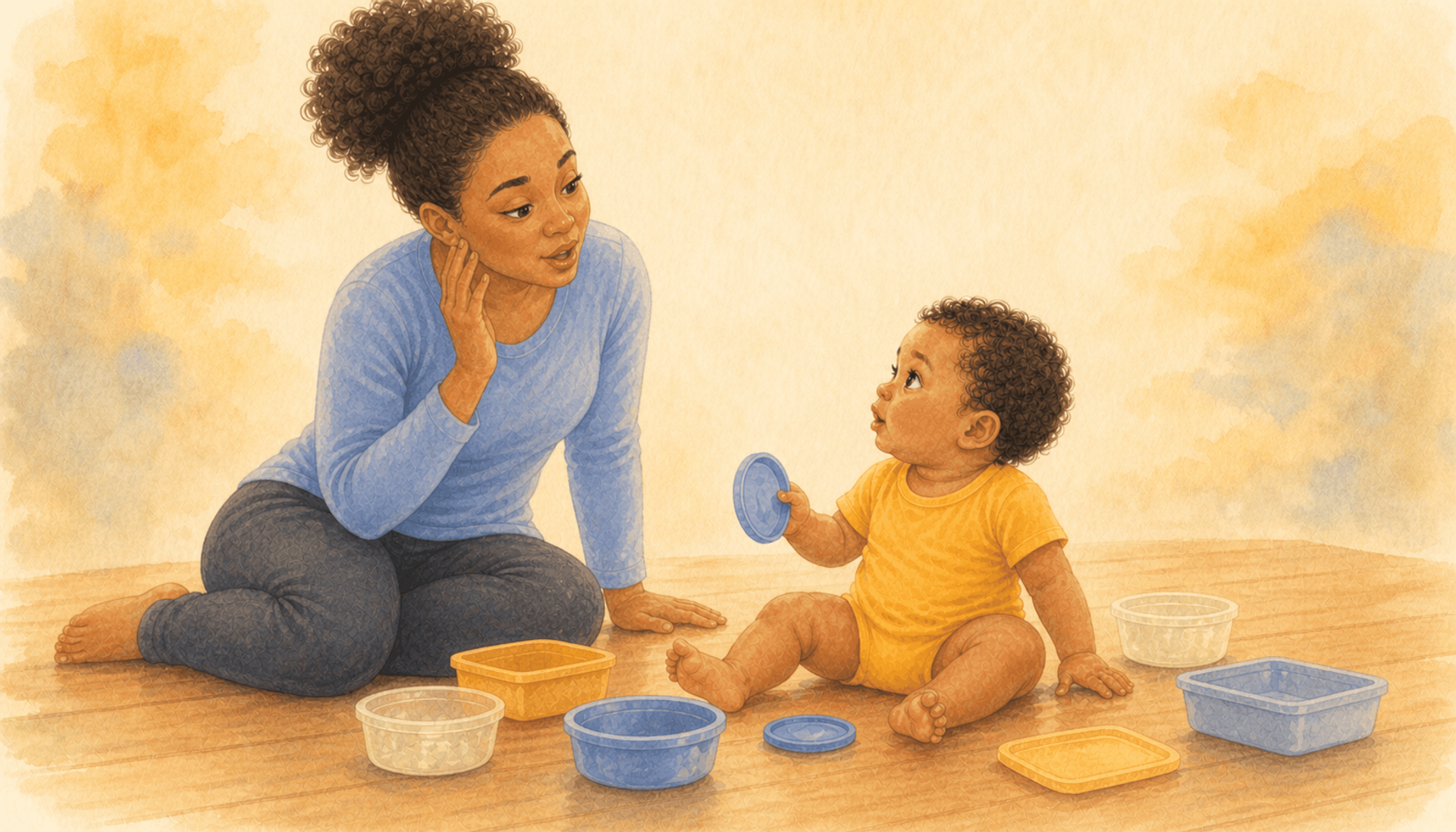
The most useful 10 month old activity at home is therefore not a toy but an arrangement. Sit on the floor with a small basket of five or six different objects (a wooden ring, a soft fabric ball, a silicone teether, a measuring cup, a smooth rock from a walk) and two or three empty containers in different sizes (a yogurt tub, a cottage-cheese tub, a small mixing bowl). Any object can go into any container; the variation in container size is itself part of what your baby is working out. Demonstrate putting one object into one container exactly once, then leave the rest alone. Your baby will dump first, fill second, dump third, and somewhere in that loop will start choosing which container to fill rather than just filling the nearest one. That deliberate placement, when it appears, is the moment to celebrate quietly without interrupting.
Real-world household objects beat dedicated toys in this stage almost every time, because the variation in weight, texture, and edge shape is what's training the system. Empty yogurt tubs, an old wallet, a small wicker basket, a wooden spoon, a clean silicone ice tray — better and cheaper than most things sold for this. If you do want a structured set, our Sensory Play Cards 0–12 Months include the 9-to-12-month activities organized by what's developmentally current, and the in-out station setup is one of them. We've also pulled together a longer list of sensory play ideas with no prep if you want zero-effort variations using what's already in the kitchen.
Cruising, pulling-to-stand, and the falls that look scarier than they are
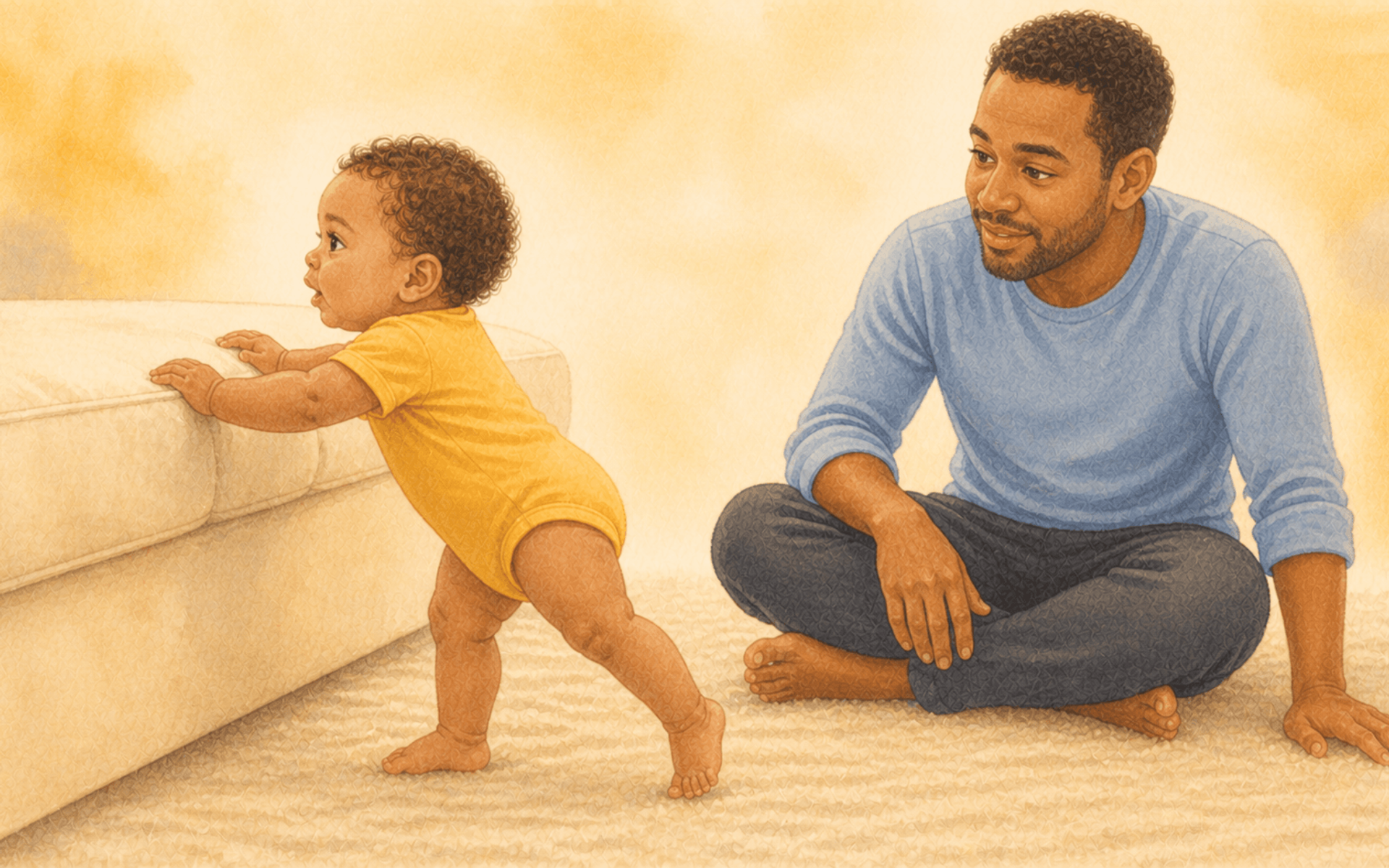
By 10 months most babies are pulling to stand and many are starting to cruise — taking sideways steps along furniture while holding on. The WHO Study found that the usual window for unassisted standing runs from about 7.5 to 13.5 months, and walking with assistance from about 7.5 to 13.5 months as well. There is, in other words, a six-month band of normal here, and where your baby falls inside it is mostly information about your baby, not a referendum on anything.
The falls deserve a separate paragraph because they look alarming and are mostly fine. Karen Adolph's lab at NYU tracked 12-to-19-month-olds in spontaneous play and recorded an average of 17 falls per hour during active locomotion (Adolph and colleagues, Psychological Science, 2012). That number is genuinely high, and almost all of those falls produced no injury. A 2023 review in Integrative and Comparative Biology by Whitney Cole and Karen Adolph explained why: babies are small, low to the ground, and slow, so the impact energy of an infant fall is roughly 18 times less than the equivalent fall would be at adult size and adult speed. They also produce automatic protective behaviors (flexing knees, bracing on nearby surfaces, throwing out their arms) almost from the first wobbles. The system that produces falling and the system that absorbs it are developing together.
Meanwhile, your job is to make the environment safe before your baby's mobility outpaces your reaction time. Anchor any furniture your baby could conceivably pull on, including bookshelves, dressers, and the TV stand. Use the floor as the primary play surface — bare wood or a thin firm rug gives better feedback to the feet than thick padded play mats, which are for younger babies. If you have stairs, gates go in this month. Lower the crib mattress to the lowest setting if you haven't already; this is the month babies figure out how to pull themselves up to standing inside it, and a fall from the top edge of an unlowered crib is the one fall in this season that is not trivial.
For more on the timing of crawling and walking specifically, our pieces on when babies start crawling and when babies start walking walk through the WHO data and what each window actually predicts. Cruising sits squarely between them.
Why your favorite people suddenly aren't
Stranger anxiety and separation anxiety both peak across a window that includes month 10, and a baby who handed easily to a grandparent at five months may now arch and cry at the same person across the kitchen. This is a feature, not a regression. A 2014 study in Developmental Science led by Rebecca Brooker followed a large twin sample and described the normative trajectory of stranger fear: low at six months, rising through the first birthday, peaking somewhere across the 8-to-15-month range depending on the individual, and gradually fading through the second year. Around 75 percent of infants in their sample showed the standard rising-then-falling shape. Roughly a quarter started higher and stayed there longer.
The mechanism is, in a sense, the success story of the previous several months. Working memory is now reliable enough to hold "known faces" as a category, the comparison machinery is fast enough to flag the unfamiliar, and the attachment system is mature enough to use the familiar caregiver as a base. The clinginess at the door is what a securely attached 10-month-old does. It is not, despite how it can feel, a verdict on you or a referendum on whether grandma should have visited more often.
What helps in practice is slowing down the social interactions. New people are easier when they approach slowly, and easier still when the trusted adult is the one holding the baby for the first minutes of any new social setting. Letting the baby move toward the new person rather than the other way around almost always works better than the reverse, and anything that looks like a snatch-and-hand-off, even for a quick goodbye photo, sets the next visit back. The same logic applies to nursery drop-offs, daycare transitions, and the first reunion with anyone the baby hasn't seen for a few weeks. None of this requires a developmental toy; it mostly requires patience and a slightly slower pace at the start of every social interaction for a few months.
If clinginess is so intense that your baby cannot tolerate any familiar non-parent caregiver, or if the distress lasts well beyond the transition, that pattern is the kind of thing worth raising at the next pediatric visit — not because it usually means anything is wrong, but because pediatricians like to see the developmental picture as a whole. Most of the time, this is the month doing its job.
Activities at home, on the road, and on a plane
The honest answer to "what activities are best for a 10 month old at home" is not a list of fifty things — it's a wake-window structure that uses the in-out cabinet, narration during meals, and floor time for cruising practice, in roughly that order, across the usual two-to-three-hour awake stretch. A productive rhythm starts with the feed and diaper, then about twenty minutes in the in-out station while you're nearby and engaged (not on phone, not on the other side of the kitchen, but narrating, naming, occasionally handing in a new object), then ten minutes of cruising practice along a stable couch or coffee table with you a few feet away, then quieter floor time with one favorite book before sleep cues appear. That covers the developmental priorities of the month with no special equipment beyond what you already own.
In the car, the rule is "things that are interesting and cannot become projectiles." Soft fabric books, a silicone teether on a clip attached to the seat, a small empty water bottle (taste-safe and impossible to choke on at this size). Anything you'd hate to fish out of the foot well at sixty miles an hour, leave at home. A useful trick: rotate two or three "car-only" objects that don't appear in the house, so the novelty refreshes each ride.
The flight is the hardest setting and the one almost no parenting article addresses honestly. What works on a flight is mostly about pacing. First, pack a bag of small objects your baby has never seen (masking tape, a sleeve of plain post-it notes, a clean silicone muffin liner, a fabric measuring tape rolled into a coil), with a total cost under five dollars and twenty minutes of attention each. Second, pace the bag to the wake window structure: give one object every ten minutes during a fussy stretch, not the whole bag at takeoff. Third, snacks are the workhorse, and they too need pacing; a long stretch of pincer-grasping single puffs into the mouth covers a remarkable amount of cruising altitude. None of this is glamorous and all of it works. Save the new picture book for landing, when boredom peaks and there's nothing left to dump.
The wake windows themselves shift this month. Most 10-month-olds stay awake between naps for about two and a half to three and a half hours, with the longest stretch usually before the last nap of the day. Watch for the cues (eye rubbing, glassy stare, sudden fussiness) rather than the clock. Cruising and the in-out station are tiring in a way that surprises new parents. A baby practicing standing burns a real number of calories doing it. Naps may shift this month for that reason alone.
Frequently Asked Questions
By 10 months, most babies are crawling (in some style — hands-and-knees, commando, or scooting are all common), pulling to stand, beginning to cruise along furniture, using a refined pincer grasp to pick up small foods, and understanding many concrete words plus the first abstract ones like "uh-oh" and "all gone." The World Health Organization places the usual window for standing with assistance between 7.5 and 13.5 months, so wide variation inside that band is normal. Receptive language (what your baby understands) is well ahead of expressive language at this stage.
The three highest-yield activities at home are an in-and-out station (a basket of safe objects plus a few containers of different sizes), narrated meals with abstract words like "uh-oh," "all gone," and "more," and floor time with cruising opportunities along stable, anchored furniture. These cover the cognitive, language, and motor developments specific to month 10. A 2013 study by Bergelson and Swingley in Cognition found that 10 months is roughly when infants begin to understand abstract words, which is why narration during everyday transitions is unusually productive at this age.
Pack a small bag of low-cost novel objects your baby hasn't seen at home (masking tape, a silicone muffin liner, post-it notes, a fabric tape measure) and dispense them one at a time across the flight rather than all at once. Pace pincer-grasp snacks (puffs, soft fruit pieces) to fill long fussy stretches. Save any new book for the descent, when boredom peaks and there's the least left to do. The full strategy is in the at-home, car, and plane section above.
Yes — far more than they can say. Bergelson and Swingley showed in a 2012 PNAS paper that 6-to-9-month-olds already know the meanings of many concrete nouns (foods, body parts), and a follow-up 2013 paper in Cognition found that the comprehension of abstract words like "all gone," "uh-oh," and "eat" comes online around 10 months. Most babies will not produce real words for another two to four months, but the comprehension gap is the productive place to invest your attention.
Stranger anxiety and separation anxiety peaking somewhere between 8 and 15 months is the developmentally normal pattern — about three quarters of infants in a large 2014 Developmental Science sample (Brooker and colleagues) followed exactly that rising-then-falling curve. The kind of pattern worth raising at the next pediatric visit is when the distress is severe enough that no familiar non-parent caregiver (grandparent, partner, longtime friend) can hold the baby at all, or when the intensity does not begin to ease across the second year. Most of the time, the clinginess is doing its job.
For educational and entertainment purposes only. Not a substitute for professional medical or developmental advice. If you have concerns about your baby's development, consult your pediatrician.
- Adolph, K. E., Cole, W. G., Komati, M., Garciaguirre, J. S., Badaly, D., Lingeman, J. M., Chan, G. L. Y., & Sotsky, R. B. (2012). How do you learn to walk? Thousands of steps and dozens of falls per day. Psychological Science, 23(11), 1387–1394.
- Bergelson, E., & Swingley, D. (2012). At 6–9 months, human infants know the meanings of many common nouns. Proceedings of the National Academy of Sciences, 109(9), 3253–3258.
- Bergelson, E., & Swingley, D. (2013). The acquisition of abstract words by young infants. Cognition, 127(3), 391–397.
- Brooker, R. J., Buss, K. A., Lemery-Chalfant, K., Aksan, N., Davidson, R. J., & Goldsmith, H. H. (2013). The development of stranger fear in infancy and toddlerhood: Normative development, individual differences, antecedents, and outcomes. Developmental Science, 16(6), 864–878.
- Cole, W. G., & Adolph, K. E. (2023). Learning to move in a changing body in a changing world. Integrative and Comparative Biology, 63(3), 653–663.
- Hespos, S. J., & Baillargeon, R. (2001). Infants' knowledge about occlusion and containment events: A surprising discrepancy. Psychological Science, 12(2), 141–147.
- Hodel, A. S. (2018). Rapid infant prefrontal cortex development and sensitivity to early environmental experience. Developmental Review, 48, 113–144.
- Liszkowski, U., Carpenter, M., Henning, A., Striano, T., & Tomasello, M. (2004). Twelve-month-olds point to share attention and interest. Developmental Science, 7(3), 297–307.
- Tomasello, M., Carpenter, M., & Liszkowski, U. (2007). A new look at infant pointing. Child Development, 78(3), 705–722.
- WHO Multicentre Growth Reference Study Group. (2006). WHO Motor Development Study: Windows of achievement for six gross motor development milestones. Acta Paediatrica, 95(S450), 86–95.

More Articles
Parallel Play in Toddlers: Why Side-by-Side Is the Social Work
Your toddler spent the entire playdate building separate towers, and nobody shared a single block. That counted — more than it looked. A 2025 longitudinal study found that playing beside a specific child consistently predicted later social play with that same child, but not the other way around. Here's what parallel play in toddlers actually is, why the science calls it strategic rather than passive, and what it means for how you run a playdate.
When Do Babies Point: Why It Matters for Language
Most milestone articles treat pointing as a box to check around 12 months. The research tells a different story — one that starts months earlier, runs through the infant brain, and traces back to how much the parent is pointing. Here's what the last fifteen years of research actually found, and what it means for everyday interactions.
When Do Babies Wave Bye-Bye: Why Your Baby Needs You to Wave First
Most baby milestones unfold on a biological schedule — waving isn't one of them. A 2023 study found that babies develop imitation ability because their caregivers imitate them first, and waving is named directly as a cultural gesture learned through that loop. Here's what the research says about the 9–12 month window, why the first wave looks nothing like a wave, and what helps it arrive.