5 Sensory Play Ideas You Can Do Right Now: no Prep, no Stress
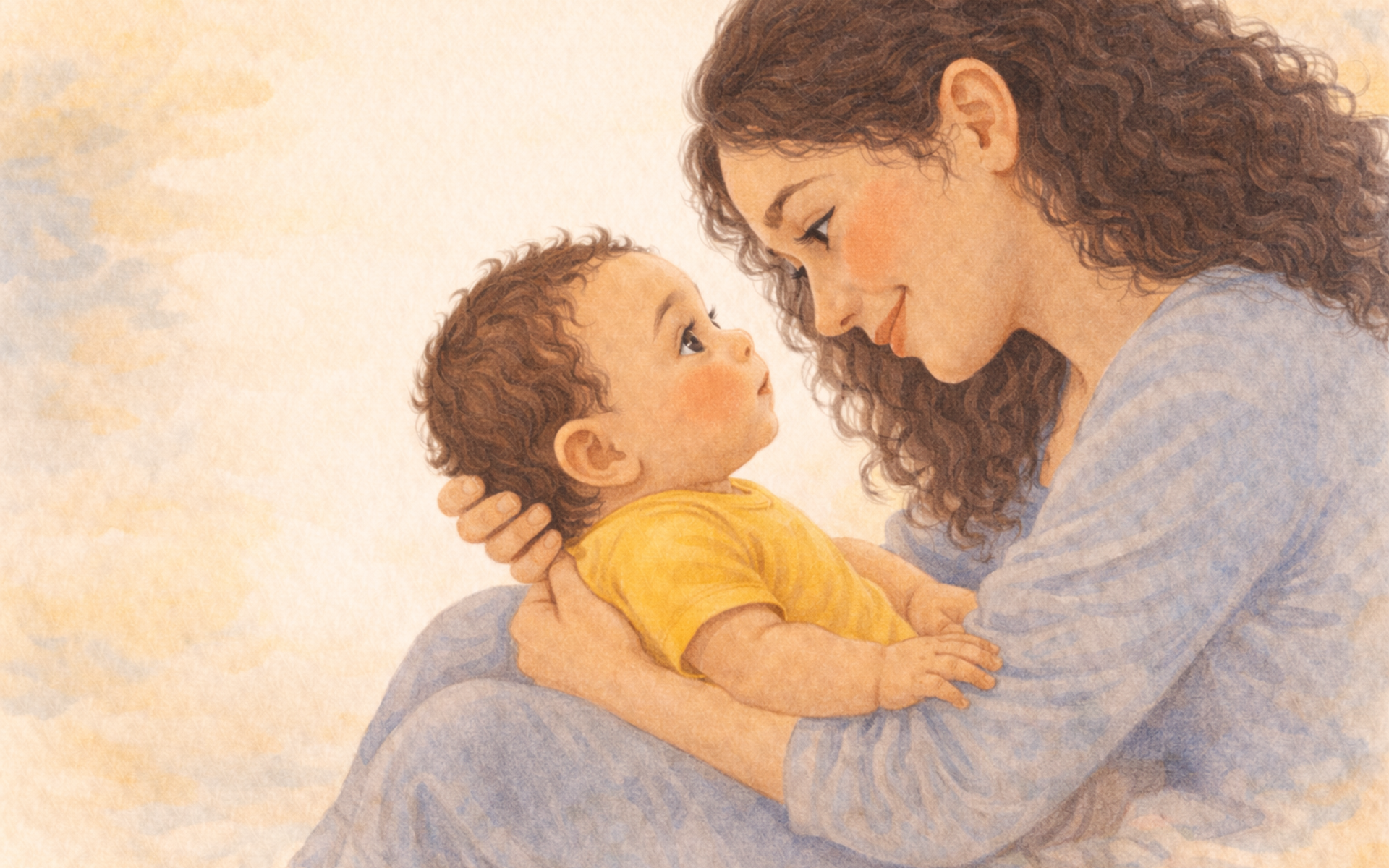
Your baby is awake in your arms, staring at you with that wide-eyed alertness that means sleep isn't coming back anytime soon. There's nothing within reach — no toys, no rattles, no carefully curated sensory bin from that Pinterest board you saved three weeks ago and never opened. Just you, your baby, and the vague guilt of I should probably be doing something developmental right now.
You already are. Or rather — you're about to be, in about sixty seconds, with nothing but what's already in the room.
- Why your face outperforms every toy on the market — and what newborn tracking research actually shows
- How narrating ordinary moments builds language architecture before babies have a single word
- Three-texture touch activity: what the tactile system is mapping in the first six months
- Why changing your baby's position counts as sensory play — and what the vestibular system gets from it
- The 30-second outdoor reset: why a scent and temperature shift does more than it seems
If the one-sentence answer is enough, you’ve got the gist. If you want the mechanism behind each piece, keep reading.
Your Face Is the First Toy
Hold your face about 8 to 12 inches from your baby's — roughly elbow to wrist. Now move slowly to the left. Pause. Back to the right. Pause.
Watch the eyes. If they follow you — even a little, even jerkily — that's the connection between retina and visual cortex firing in real time. Johnson and colleagues found that newborns track a face-like pattern with both eyes and head further than any other visual stimulus, from the very first hours of life. Not a card. Not a mobile. A face. Your face, specifically, because it combines contrast, movement, and the one scent your baby already knows.
This works from day one and stays effective for months, because the brain doesn't get tired of processing the most complex visual object in its environment. And unlike every toy in the store, your face responds — which makes it not just a visual stimulus but a social one.
Talk About Nothing
Pick up whatever's closest. A blanket, a sock, your water bottle. Describe it. "This is soft. Feel that? Now I'm putting it down. And picking it up again." Slowly. With pauses between phrases, like you're leaving space for someone to answer.
Speech-language pathologists call this parallel talk, and it's a core technique for early language input — linking real sensory experiences to sounds, which is how the brain starts building language architecture before it has a single word to show for it. And here's the part that might surprise you: an MIT study by Romeo and colleagues found that it's not how many words your baby hears that matters most — it's the back-and-forth. You say something, you pause, your baby coos or blinks, you respond. That rhythm of taking turns, even tiny ones, builds language circuits more powerfully than a constant stream of talking ever could.
You can do this during a diaper change, a feed, a walk to the kitchen. Am I really just narrating how I'm folding a towel? Yes. And it's one of the most effective sensory play activities that exist, because it costs nothing, takes no setup, and the research is unusually clear on why it works.
Three Textures, Thirty Seconds
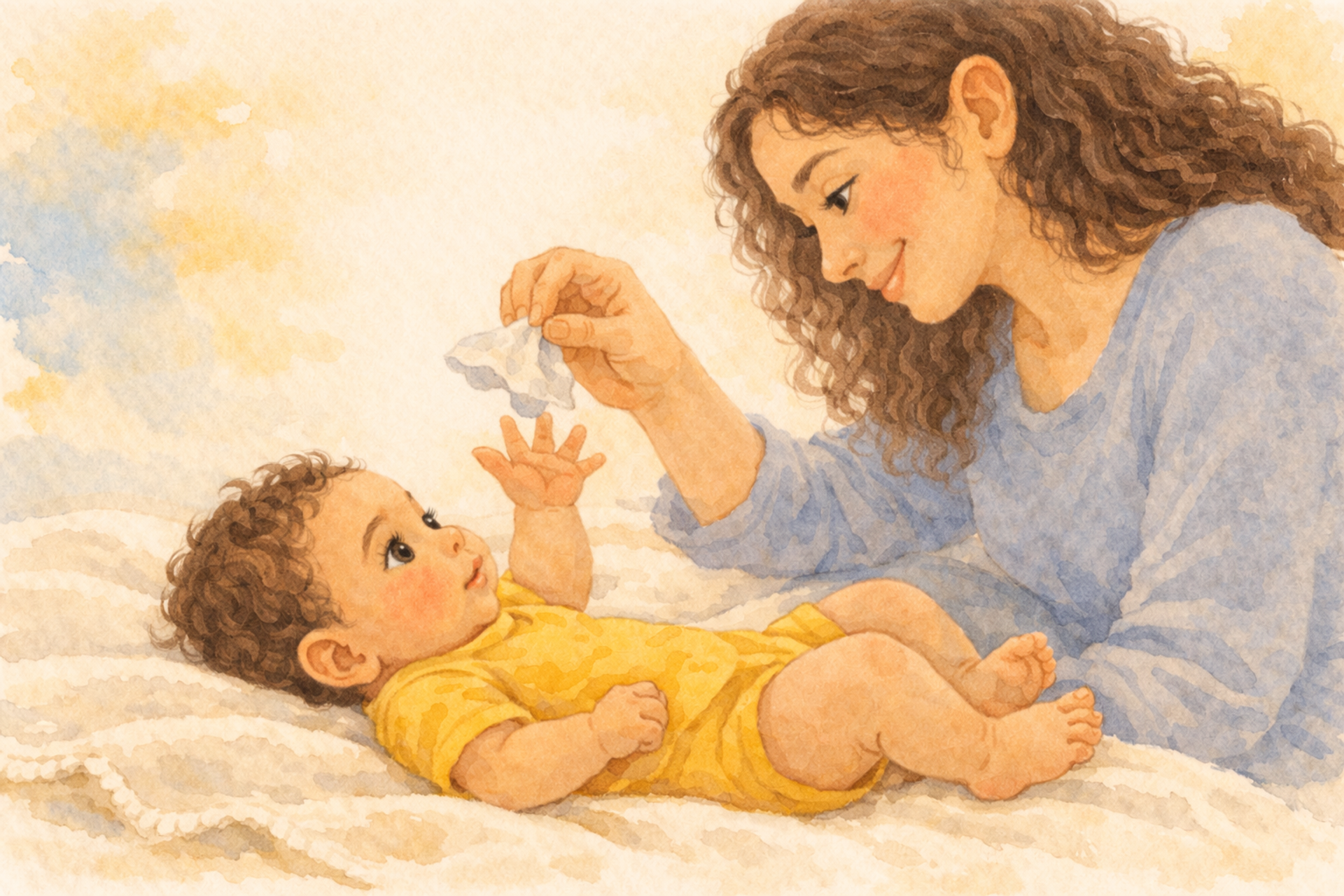
Look around. Your shirt sleeve. The edge of a blanket. The back of your own hand. Gently touch each one to your baby's open palm or the inside of the wrist.
Each surface feels different because the skin has thousands of tiny sensors — some respond to pressure, some to stretch, some to vibration. The firm back of your hand sends a completely different signal than the soft nap of fleece. All of that information travels to the part of the brain that builds a touch map — a growing catalog of what things feel like that will eventually let your child tell rough from smooth, wet from dry, warm from cool, without even looking.
Keep touches gentle, brief, and varied. A hand closing, eyes widening, a change in breathing rhythm — that's the signal arriving. This works at any age in the first year, but the tactile system is developing fastest in the first six months, which makes this window especially responsive to variety.
Always keep objects within your control during any tactile activity, and remove them when finished.
Shift the View
If your baby is lying on the back, pick up and hold upright against your chest. Already upright? Try a gentle side-lying cradle in your arms. Awake and alert? A brief stretch of tummy time on your chest counts — and for many babies, it's the only version of tummy time that doesn't end in protest.
Each position change sends new data to the vestibular system — the one that processes movement, balance, and spatial orientation. The AAP recommends varied positioning throughout the day both for motor development and to help prevent flat spots. You don't need a special mat. Your body is the surface. A different angle on the world is a different sensory experience, and the brain treats it that way.
And yes, we know we say this in almost every article, but we'd rather be the slightly annoying science friends than the ones who forgot to mention it: when placing your baby on the tummy, always use a firm, flat surface, and never leave your baby unsupervised in this position.
Step Through the Door
Pick your baby up and walk to a window. Or step outside for thirty seconds — literally thirty seconds.
The temperature shift on skin. The movement of air. A new set of sounds. A completely different scent profile. Each one activates a different sensory channel simultaneously, and research on early olfactory development shows that newborns are sensitive enough to scent that they can identify their own mother within hours of birth. A new smell environment, even briefly, gives the brain a set of signals it wasn't processing ten seconds ago.
This one is quietly effective during fussy stretches, too. The sudden sensory shift can redirect attention and reset the emotional state — yours included.
The Shortest Version
Five ideas. Each takes under a minute. None require anything you don't already have. And every one of them does what the research consistently says matters most in the first year: a sensory experience that happens while your baby is alert, responsive, and connected to a real person — not a screen, not a toy, not an app.
If you want to understand which sense to focus on at which age and how it all fits together month by month, our full guide walks through the first twelve months with research at each stage: Sensory Play for Babies: A Month-by-Month Guide.
And if you want sixty more ideas like these — with illustrated activities, step-by-step instructions, and vocabulary prompts designed by a speech-language pathologist — that's exactly what our Sensory Play Cards were built for: Sensory Play Cards 0–12 Months.
Frequently Asked Questions
Sensory play is any activity that engages a child's senses — sight, sound, touch, taste, or smell. It supports neural connections in the developing brain, strengthens motor skills, and helps with cognitive growth, language development, and emotional regulation.
Household items work well for sensory play: crinkly paper, wooden spoons, fabric scraps with different textures, water play in the sink, and letting babies touch safe foods like cooked pasta. No special toys or kits are needed.
For educational and entertainment purposes only. Not a substitute for professional medical advice. Always supervise your baby during play and sensory activities.
- Fantz, R. L. (1963). Pattern vision in newborn infants. Science, 140, 296–297.
- Johnson, M. H., Dziurawiec, S., Ellis, H., & Morton, J. (1991). Newborns' preferential tracking of face-like stimuli and its subsequent decline. Cognition, 40(1–2), 1–19.
- Farroni, T., Johnson, M. H., Menon, E., Zulian, L., Faraguna, D., & Csibra, G. (2005). Newborns' preference for face-relevant stimuli: Effects of contrast polarity. PNAS, 102(47), 17245–17250.
- Romeo, R. R., Leonard, J. A., Robinson, S. T., West, M. R., Mackey, A. P., Rowe, M. L., & Gabrieli, J. D. E. (2018). Beyond the 30-million-word gap: Children's conversational exposure is associated with language-related brain function. Psychological Science, 29(5), 700–710.
- American Academy of Pediatrics. (2022). Back to sleep, tummy to play. HealthyChildren.org.
Related Products
More Articles
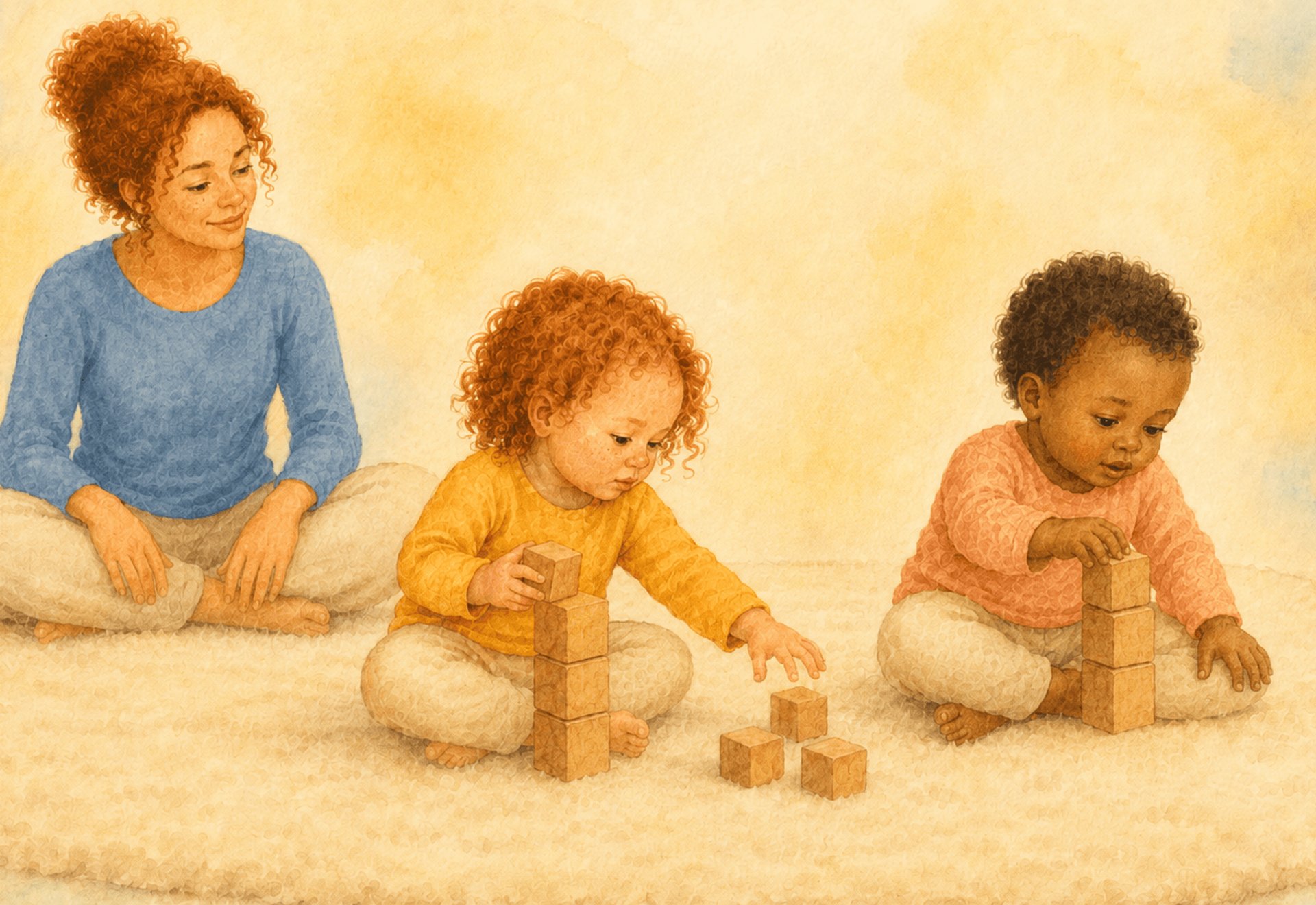
Parallel Play in Toddlers: Why Side-by-Side Is the Social Work
Your toddler spent the entire playdate building separate towers, and nobody shared a single block. That counted — more than it looked. A 2025 longitudinal study found that playing beside a specific child consistently predicted later social play with that same child, but not the other way around. Here's what parallel play in toddlers actually is, why the science calls it strategic rather than passive, and what it means for how you run a playdate.

When Do Babies Point: Why It Matters for Language
Most milestone articles treat pointing as a box to check around 12 months. The research tells a different story — one that starts months earlier, runs through the infant brain, and traces back to how much the parent is pointing. Here's what the last fifteen years of research actually found, and what it means for everyday interactions.

When Do Babies Wave Bye-Bye: Why Your Baby Needs You to Wave First
Most baby milestones unfold on a biological schedule — waving isn't one of them. A 2023 study found that babies develop imitation ability because their caregivers imitate them first, and waving is named directly as a cultural gesture learned through that loop. Here's what the research says about the 9–12 month window, why the first wave looks nothing like a wave, and what helps it arrive.