When Do Babies Roll Over? The Three Answers, and Why Direction Matters

The first roll usually arrives by mistake. A baby on the floor lifts a leg a little too far, the weight tips, and there's a soft thud and a startled face that says I had no part in this. Then nothing happens for two weeks. So when do babies roll over — the accidental version, the deliberate version, or the both-directions-on-demand version? The real answer has three different timelines, and most of the standard advice gives only one.
- Why "rolling over" is really three milestones, and why most parents end up tracking the wrong one
- The biomechanical reason back-to-tummy is harder than tummy-to-back, and what an EMG study of 38 babies showed about it
- A quiet 2022 update to the official US milestone almost no parent has heard about
- What 240 Hong Kong infants revealed about the textbook "tummy-to-back first" rule, and why it's not a rule at all
- The four practices the research actually supports for helping a baby roll
- Why the first reliable roll is the moment to retire the swaddle, even if your baby still loves it
If the one-sentence answer is enough, you’ve got the gist. If you want the mechanism behind each piece, keep reading.
Rolling is really three milestones, not one
The phrase "rolling over" covers three quite different events that don't arrive at the same age. The first is the accidental half-flip, which often shows up between three and four months: a baby kicks too hard, the leg crosses the midline, and the weight pulls the trunk along. There's no plan behind it. The second is the deliberate one-direction roll, which most Western babies do tummy-to-back somewhere between four and six months. The third is the on-demand roll in either direction, which usually settles in around six to seven months and is the version pediatricians have in mind when they ask "is your baby rolling?" at the well-baby visit.
The World Health Organization's six-country motor study tracked the major gross motor milestones in healthy infants from Ghana, India, Norway, Oman, and the United States, and the data confirmed something most parenting articles compress into a single number: the windows are wide. For sitting without support, the 1st-percentile baby was 3.8 months and the 99th-percentile baby was 9.2 months — over five months apart, both healthy. Rolling shows the same wide-window pattern. Two babies the same age can be on opposite ends of the rolling timeline and both be exactly where they should be.
The variability is not noise. It reflects differences in temperament, body proportions, and time spent on the floor versus carried or seated. Karen Adolph and Justine Hoch, in a 2019 Annual Review of Psychology review, framed motor development as shaped by the body, the environment, the culture, and what the baby is actually trying to do in a given moment. A baby who spends alert hours on a play mat encounters different rolling problems than one who spends them in a carrier, and the timing reflects that.
The accidental flip, the first deliberate roll, and reliable two-way rolling are not the same milestone in slow motion. They're three. If your baby has done one of them and not the others, that's the developmental sequence working as expected, not a delay.
Why one direction is harder than the other
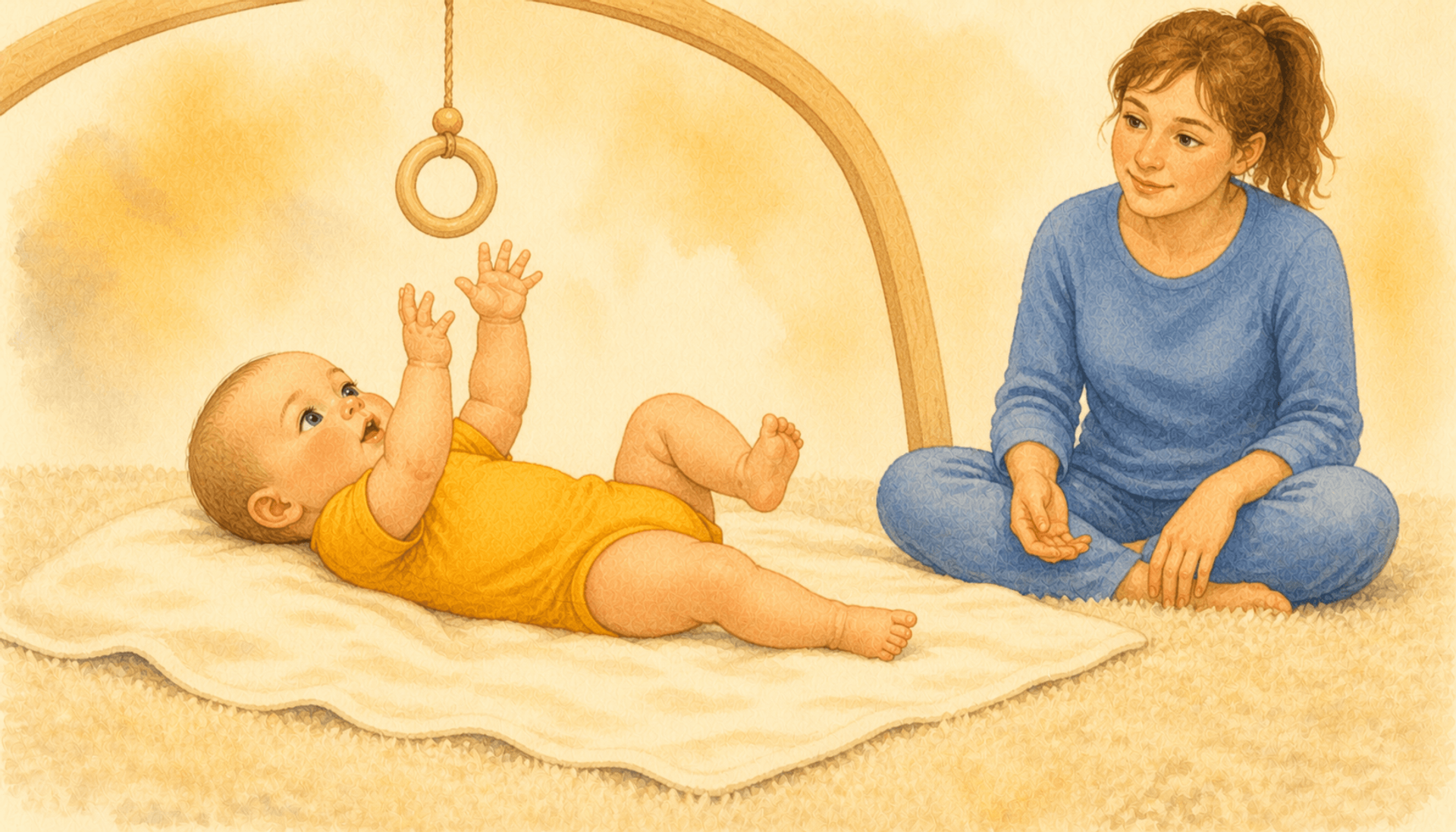
Tummy-to-back tends to come first in Western infants because gravity does most of the work, while back-to-tummy requires the baby to actively generate the rotation. From the prone position, even a small head lift can shift enough weight past the shoulder to start a flip. From supine, the baby has to recruit the abdominals and obliques to fold the trunk, push off with one foot, and pull the lower body across the midline. It's a different physical problem.
A 2024 study from the Mannen biomechanics lab at Boise State University, published in the Journal of Biomechanics, used surface electromyography on 38 healthy six-month-olds to map muscle activity during rolling. Instead of the textbook two roll types, the researchers identified six distinct movement patterns. Some rolls led with the back muscles, twisting the trunk first. Others led with the belly muscles, folding the body forward. Some used the legs to push off the floor; others to swing across the body. Rolling, in other words, is a small family of related movement strategies a baby chooses from depending on body position, momentum, and what looks worth reaching toward.
The same lab also found that the surface a baby is on changes the muscle pattern itself. Babies in inclined seats (bouncers, rockers, swings) used a spinal-extension-and-pelvic-thrust pattern that wasn't observed at all on a flat floor. The inclined position pre-supplied the trunk flexion that rolling biomechanically requires, which is why a baby may "roll" in a swing weeks before the same skill shows up on the carpet. The skill in the seat is a different skill from the one on the floor; the chair is doing part of the work.
This explains a real frustration moms describe: "she rolled in the bouncer at four months, but she still hasn't done it on the floor at five." That's not a regression. It's a different motor problem. The floor is the surface on which the full skill develops, which is why pediatric occupational therapists keep recommending floor time. Our tummy time troubleshooting article gets into the specifics if floor time is currently a fight.
The CDC quietly moved the rolling milestone in 2022
In February 2022, the CDC updated its "Learn the Signs. Act Early." developmental milestone checklists for the first time in nearly two decades, and rolling was one of the items that shifted. Most parents and a fair number of websites haven't caught up.
The old checklist listed rolling as a 4-month milestone, set at the 50th percentile — the age at which roughly half of all babies could do it. The 2022 update moved "rolls from tummy to back" to the 6-month checklist and raised the threshold to the 75th percentile, meaning it now reflects what most babies (about three out of four) can do by that age. The change was published in Pediatrics in early 2022 by Jennifer Zubler, Lisa Wiggins, Michelle Macias, and colleagues, who built the revisions on a literature review of normative data and developmental screening tool benchmarks. The reasoning was practical: when "rolling by four months" describes only half of babies, missing it isn't very informative. When "rolling by six months" describes most babies, missing it becomes a clearer signal that a conversation with the pediatrician is worth having.
For a parent whose five-month-old isn't rolling yet, this matters. By the older standard — half of all babies were rolling by four months — that baby looks late. By the current standard — three out of four babies are rolling by six months — the same baby is comfortably inside the expected range. Both numbers describe the same babies; they just answer slightly different questions. The new standard gives every baby an extra two months of room before "behind" enters the conversation at all.
The other change worth knowing: the CDC's current 6-month checklist lists "rolls from tummy to back" but does not list rolling in both directions. Rolling back to tummy isn't formally tracked at the six-month visit, even though most babies are working on it. A pediatrician will still want to know about it during the visit; it just isn't a check-the-box item in the same way. Our activities for a 3-month-old covers what to be doing during the run-up — most of it overlaps with what helps rolling.
What 240 Hong Kong infants taught us about rolling direction
The textbook "tummy-to-back first, back-to-tummy second" is so consistent across Western parenting books that it reads like biology. The 240-baby study below shows it's actually a fact about parenting environment, not about babies.
In 2004, Edmund Nelson and colleagues at the Chinese University of Hong Kong tracked 240 Hong Kong Chinese infants through their first nine months of rolling, using mother-completed charts with telephone reminders at four and eight months. The result, published in Developmental Medicine & Child Neurology, was the opposite of what every Western pediatric text would predict. The Hong Kong infants rolled supine-to-prone — back-to-tummy — first, at a mean of 5.1 months. The "easier" prone-to-supine roll came later, at a mean of 5.7 months. The researchers tested whether usual sleep position explained the difference and it didn't; the supine-to-prone age was unrelated to whether the baby slept on the back, side, or stomach.
The natural follow-up — is this a difference in babies, or a difference in environments? — was answered five years later. A 2009 study in the Journal of Early Intervention by Mayson and colleagues at the University of British Columbia compared 335 infants of Asian and European ethnic origins growing up in Canada and found no significant difference in motor screening scores between the two groups. When the parenting environment was the same, the babies looked the same.
Together, those two findings reframe a question every Western parenting site treats as settled. The reason most Western babies roll tummy-to-back first comes down to the alert-hour environment — a play mat, a propped-up cushion, a back-down view of the ceiling fan — which makes that direction the easier next step. Change the daily ecology and the easier direction changes too. The Hong Kong mechanism isn't fully pinned down in the published data, but the cleanest interpretation is that rolling direction follows where a baby's body spends its alert hours.
For a US-based parent, the practical version is short: if your baby rolls back-to-tummy first, that's not late or out-of-order. The daily floor environment is what shapes which direction comes first.
What actually helps a baby roll
The single intervention with the strongest evidence is also the simplest: supervised floor time on the tummy while the baby is awake. A 2022 longitudinal study of 411 infants from the University of Alberta, published in the International Journal of Behavioral Nutrition and Physical Activity, found that more daily tummy time across the first six months tracked with higher gross motor scores, higher Alberta Infant Motor Scale scores at six months, and earlier acquisition of every major gross motor milestone.
A 2024 randomized clinical trial from Brazil, published in Frontiers in Psychology, found a similar pattern in preemies: babies who got daily structured tummy time after hospital discharge scored measurably higher on standardized motor assessments at two and four months of corrected age. The takeaway for a full-term baby is the same and a little easier: more time on the floor, on the tummy, more often.
The second practice cuts against modern convenience: keep time in inclined infant seats, swings, bouncers, and car seats outside the car to the minimum the day actually requires. The American Academy of Pediatrics and the American Physical Therapy Association have both flagged that infants now spend, on average, close to six hours a day in some kind of seated or reclined product. As the Mannen biomechanics work above showed, an inclined seat changes which muscles a baby uses, so a baby who spends most alert hours in that geometry doesn't accumulate the floor practice the full rolling skill needs. The practical version is simple: when a seat is being used as a holder rather than a transport, swap it for the floor.
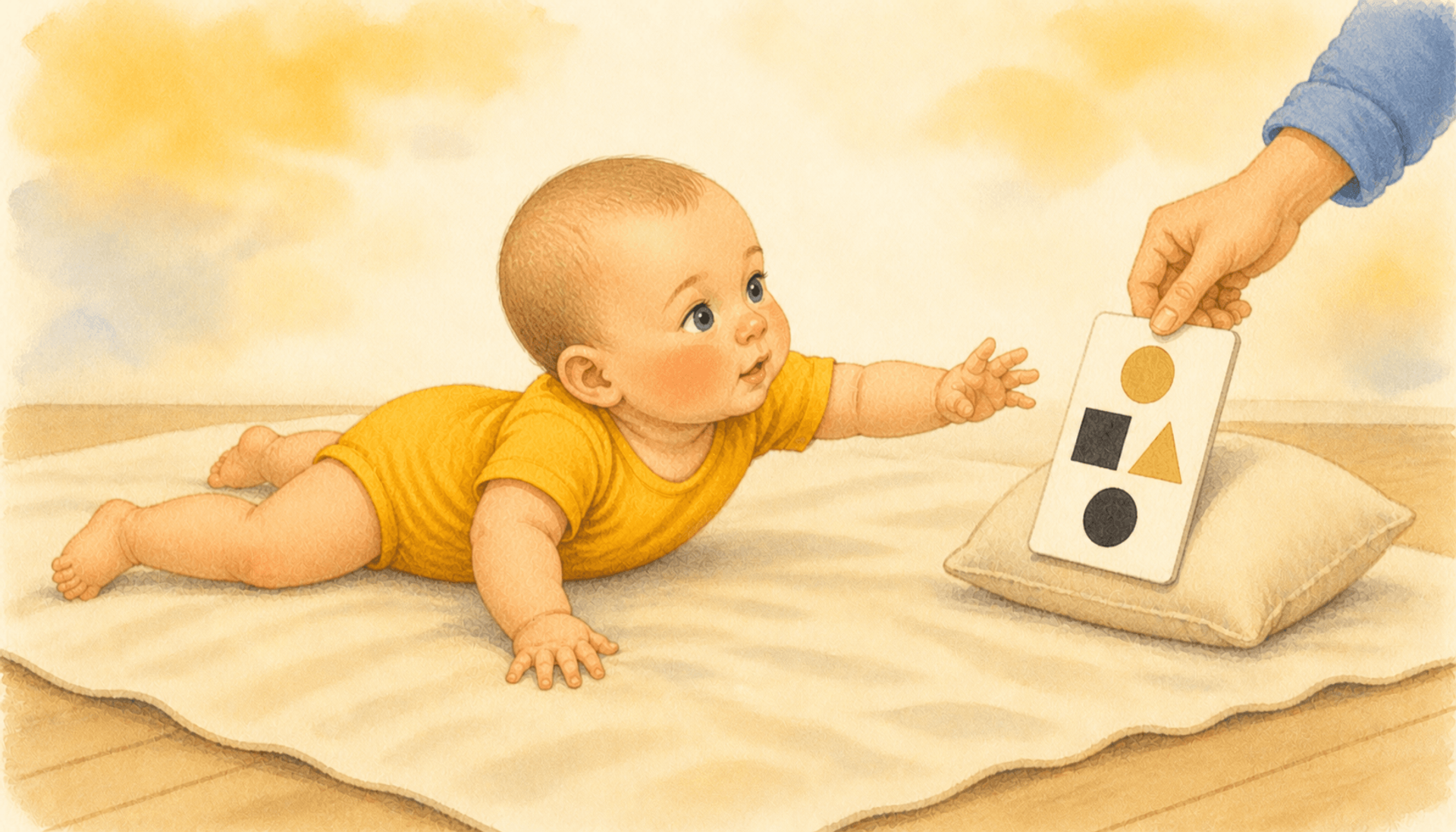
The third practice is the one most parents already half-do: place a visually interesting target just past the shoulder line, on the side opposite the baby's preferred head turn. The CDC's own 6-month tip sheet says exactly this — "put toys just out of reach, encourage rolling toward them" — and the underlying mechanism is that the cross-body reach pulls the trunk into the half-twist that initiates the roll. A bold black-and-white pattern works at the early end of this window, and a high-contrast color image works once the baby's color vision has matured around four to five months. Our Color Contrast Flashcards for 3–6 months are built for this use, propped at floor level, one card length past the baby's shoulder, on the less-preferred side. (More on what's developing visually in when do babies see color.)
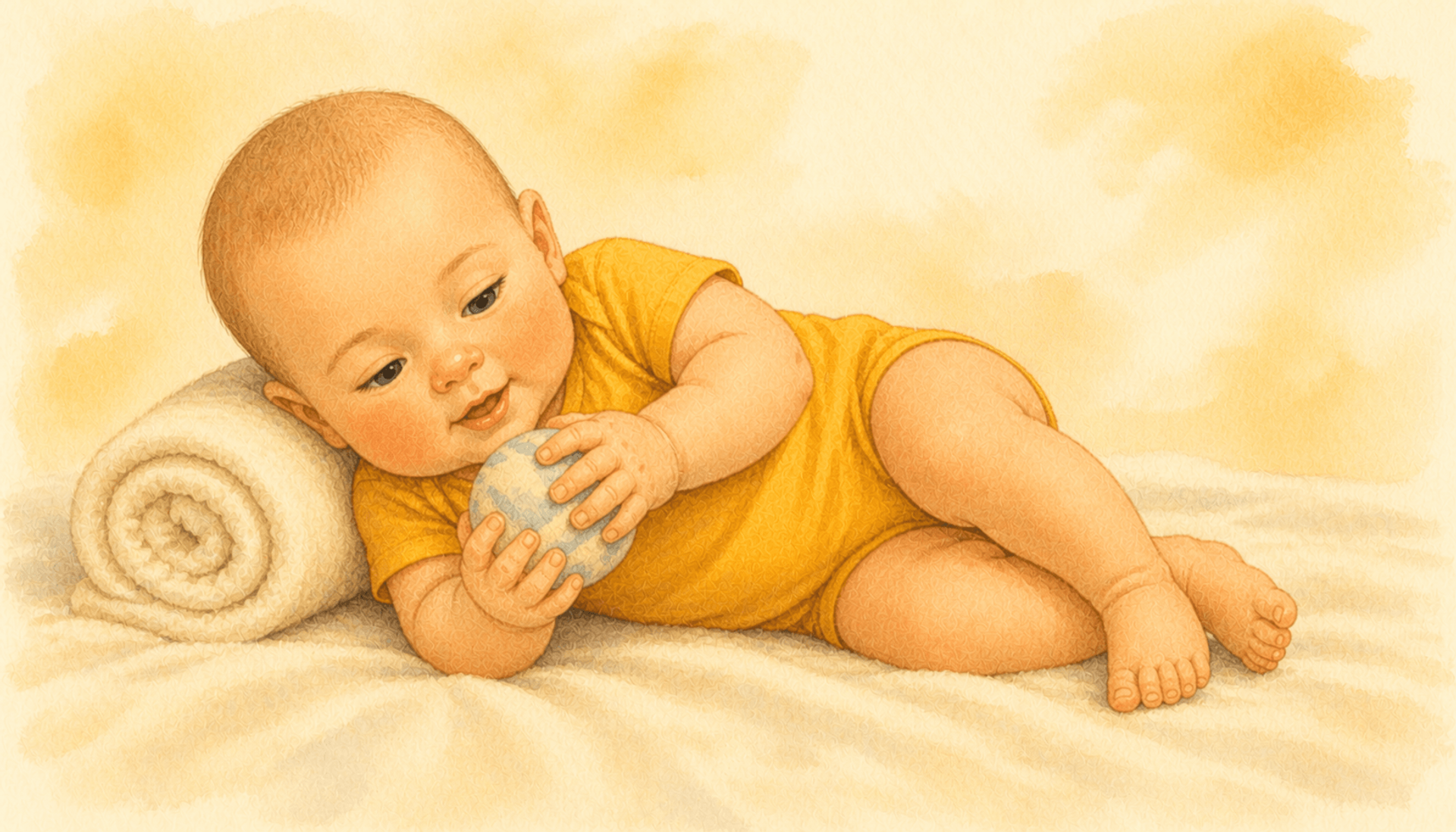
The fourth practice is supported side-lying play, which a pediatric physical therapist will often recommend before a baby has the strength for a full roll. A rolled-up towel placed lengthwise behind the back keeps the baby gently propped on one side, so the baby gets to play in the half-roll position without having to hold it. Hands come together at the midline, eyes track across the body, and the trunk muscles get the input the full roll will need. As with all floor-time setups, this is supervised, awake play only, on a firm flat surface.
None of this is rolling "training." The point is to give the baby the conditions where the skill emerges: the right surface, enough practice time, and reasons to twist.
When rolling changes sleep
The first time a baby rolls during sleep is usually the moment the swaddle has to go. The American Academy of Pediatrics' 2022 safe-sleep recommendations are direct: stop swaddling at the first signs of rolling, even if rolling has only happened once or only goes one direction. A swaddled baby who rolls onto the tummy can't push up to clear the airway with the arms restrained, which raises the risk of a sleep-related death. The roll is the trigger to switch to a sleep sack with the arms free, or no wrap at all.
The other half of the safe-sleep guidance stays the same. Babies should still be placed on the back to sleep, on a firm flat surface, in their own space, with no soft bedding. The AAP Task Force on Sudden Infant Death Syndrome addressed the rolling-during-sleep question directly in its 2022 update in Pediatrics (Moon and colleagues): keep placing the baby on the back at the start of every sleep until rolling is reliable in both directions, and once both-way rolling is established, the AAP allows the baby to remain in whatever position is reached. For a baby who's only rolling one way, the safer call is to place down on the back and check with your pediatrician about the specifics.
A reassurance worth offering: a 2012 study in Early Human Development compared rolling timing in a contemporary cohort with the original Alberta Infant Motor Scale dataset collected just before the 1992 Back-to-Sleep guidelines. Despite twenty years of supine-sleeping, the actual age at which the average baby started rolling was essentially unchanged. The CDC's 2022 shift to a six-month milestone reflects a stricter percentile cutoff (three out of four babies, not half), not new evidence that babies are rolling later. If you've heard that supine sleep "delays" motor development, the rolling milestone doesn't show that effect once enough waking-hour floor time is in place.
When to mention rolling at the pediatrician visit
Most concerns about rolling resolve once parents see the actual range, but a few patterns are worth flagging at the next well-baby visit. A baby who isn't rolling at all in either direction by six months is the clearest reason to mention it; the CDC's current standard puts that age at the point when most babies are already rolling, which makes it the right moment for a conversation rather than the wrong moment to wait. A baby who consistently uses one side of the body more than the other while moving — same arm reaching, same leg pushing, head turning only one direction — is also worth flagging, because asymmetry sometimes points to muscle tightness or a tight neck (torticollis) that responds well to early physical therapy. A baby who had been rolling and stops, or loses other skills already gained, is the clearest situation to raise sooner rather than at the scheduled visit.
What pediatricians don't need to hear is whether the baby is rolling exactly on schedule with the cousin or the daycare classmate. The window is wide on purpose, and the new benchmark is more forgiving than the older one a lot of websites still echo.
The next milestone in this cluster is sitting, which most babies start working on around the same time rolling becomes reliable. Our sitting milestone guide covers what's coming and what to watch for. After that comes crawling, which is its own messy timeline.
Frequently Asked Questions
Most Western babies roll back-to-tummy somewhere between five and seven months, usually a few weeks after rolling tummy-to-back. The back-to-tummy roll is biomechanically harder because the baby has to actively recruit the abdominals and obliques to fold the trunk and push off with one foot, instead of relying on gravity. A 2004 study of 240 Hong Kong Chinese infants in Developmental Medicine & Child Neurology found the opposite order — back-to-tummy first, at an average of 5.1 months — which is some of the cleanest evidence that rolling direction reflects daily environment, not a fixed developmental sequence.
The first roll is often a surprise, and it usually happens between three and five months. It's typically a half-flip from the back, when a kick crosses the midline and the weight pulls the trunk along, or a topple from the tummy when the head lifts past the balance point. Many babies look startled by it and don't repeat it for a couple of weeks. That gap is normal — the first roll is partly accidental, and a baby needs time to figure out which muscles produced it before doing it on purpose. Some babies also "roll" earlier in inclined infant seats than on the floor, because the seat pre-supplies some of the trunk flexion that rolling requires.
Yes. In the CDC's revised "Learn the Signs. Act Early." checklist, published in 2022 by Zubler and colleagues in the journal Pediatrics — a major update to the CDC's developmental surveillance framework — "rolls from tummy to back" appears as a six-month milestone, set at the age by which most babies (about three out of four) can do it. The previous checklist listed rolling at four months, set at the age by which only half of babies could do it. Rolling in both directions is not formally listed as a checkbox milestone at six months on the current checklist, even though most babies are working on it.
A five-month-old who isn't rolling yet is comfortably inside the current US milestone range. The active CDC standard is "rolls from tummy to back" by six months, set at the age when most babies (about three in four) are already rolling. Watch for steady progress in the building blocks instead — head control during tummy time, pushing up on the forearms, rocking on the side, reaching across the body during play. If those are developing, rolling is usually a few weeks away. If your baby isn't rolling at all in either direction by six months, or always favors one side of the body, that's the moment to mention it at the next visit.
The four practices with the strongest evidence are daily supervised tummy time on a firm flat surface, keeping time in swings, bouncers, and other inclined seats to the minimum the day actually requires, visually interesting targets placed just past the shoulder line to invite a cross-body reach, and supported side-lying play with a rolled towel. The 2022 Carson study at the University of Alberta found that babies who got more daily tummy time hit every major gross motor milestone earlier. None of this is rolling drill — it's setting up the conditions where the skill emerges on its own.
For educational and entertainment purposes only. Not a substitute for professional medical or developmental advice. If you have concerns about your baby's development, consult your pediatrician.
- Adolph, K. E., & Hoch, J. E. (2019). Motor development: Embodied, embedded, enculturated, and enabling. Annual Review of Psychology, 70, 141–164.
- Carson, V., Zhang, Z., Predy, M., Pritchard, L., & Hesketh, K. D. (2022). Longitudinal associations between infant movement behaviours and development. International Journal of Behavioral Nutrition and Physical Activity, 19(1), 10.
- Centers for Disease Control and Prevention. (2024). Important milestones: Your baby by six months. Learn the Signs. Act Early. Retrieved from https://www.cdc.gov/act-early/milestones/6-months.html
- Mayson, T. A., Backman, C. L., Harris, S. R., & Hayes, V. E. (2009). Motor development in Canadian infants of Asian and European ethnic origins. Journal of Early Intervention, 31(3), 199–214.
- Mei, H., Chen, J. F., Cui, D. J., Li, H., Yu, H. F., & Wang, R. H. (2012). Infant rolling abilities — the same or different 20 years after the back to sleep campaign? Early Human Development, 89(1), 51–53.
- Moon, R. Y., Carlin, R. F., & Hand, I.; Task Force on Sudden Infant Death Syndrome. (2022). Sleep-related infant deaths: Updated 2022 recommendations for reducing infant deaths in the sleep environment. Pediatrics, 150(1), e2022057990.
- Nelson, E. A. S., Yu, L. M., Wong, D., Wong, H. Y. E., & Yim, L. (2004). Rolling over in infants: Age, ethnicity, and cultural differences. Developmental Medicine & Child Neurology, 46(10), 706–709.
- Sampaio, S. S. S., Amorim Rodrigues, N. A., Souza, T. L. G., Moura, J. R., Azevedo, I. G., Lima-Alvarez, C. D., & Pereira, S. A. (2024). Cognitive and motor improvement by tummy time practice in preemies from low-income settings: A randomized clinical trial. Frontiers in Psychology, 15, 1289446.
- WHO Multicentre Growth Reference Study Group. (2006). WHO motor development study: Windows of achievement for six gross motor development milestones. Acta Paediatrica, Supplement 450, 86–95.
- Wilson, C., Ogle, M., Siegel, D., & Mannen, E. M. (2024). Muscle activation and coordinated movements of infant rolling. Journal of Biomechanics, 162, 111898.
- Zubler, J. M., Wiggins, L. D., Macias, M. M., Whitaker, T. M., Shaw, J. S., Squires, J. K., Pajek, J. F., Wolf, R. B., Slaughter, K. S., Broughton, A. S., Gerndt, K. L., Mlodoch, B. J., & Lipkin, P. H. (2022). Evidence-informed milestones for developmental surveillance tools. Pediatrics, 149(3), e2021052138.
- Zubler, J. M., & Whitaker, T. M. (2022). CDC's revised developmental milestone checklists. American Family Physician, 106(4), 370–371.
Related Products

More Articles

Parallel Play in Toddlers: Why Side-by-Side Is the Social Work
Your toddler spent the entire playdate building separate towers, and nobody shared a single block. That counted — more than it looked. A 2025 longitudinal study found that playing beside a specific child consistently predicted later social play with that same child, but not the other way around. Here's what parallel play in toddlers actually is, why the science calls it strategic rather than passive, and what it means for how you run a playdate.

When Do Babies Point: Why It Matters for Language
Most milestone articles treat pointing as a box to check around 12 months. The research tells a different story — one that starts months earlier, runs through the infant brain, and traces back to how much the parent is pointing. Here's what the last fifteen years of research actually found, and what it means for everyday interactions.

When Do Babies Wave Bye-Bye: Why Your Baby Needs You to Wave First
Most baby milestones unfold on a biological schedule — waving isn't one of them. A 2023 study found that babies develop imitation ability because their caregivers imitate them first, and waving is named directly as a cultural gesture learned through that loop. Here's what the research says about the 9–12 month window, why the first wave looks nothing like a wave, and what helps it arrive.