When Do Babies Start Crawling? A Guide to the Most Variable Milestone
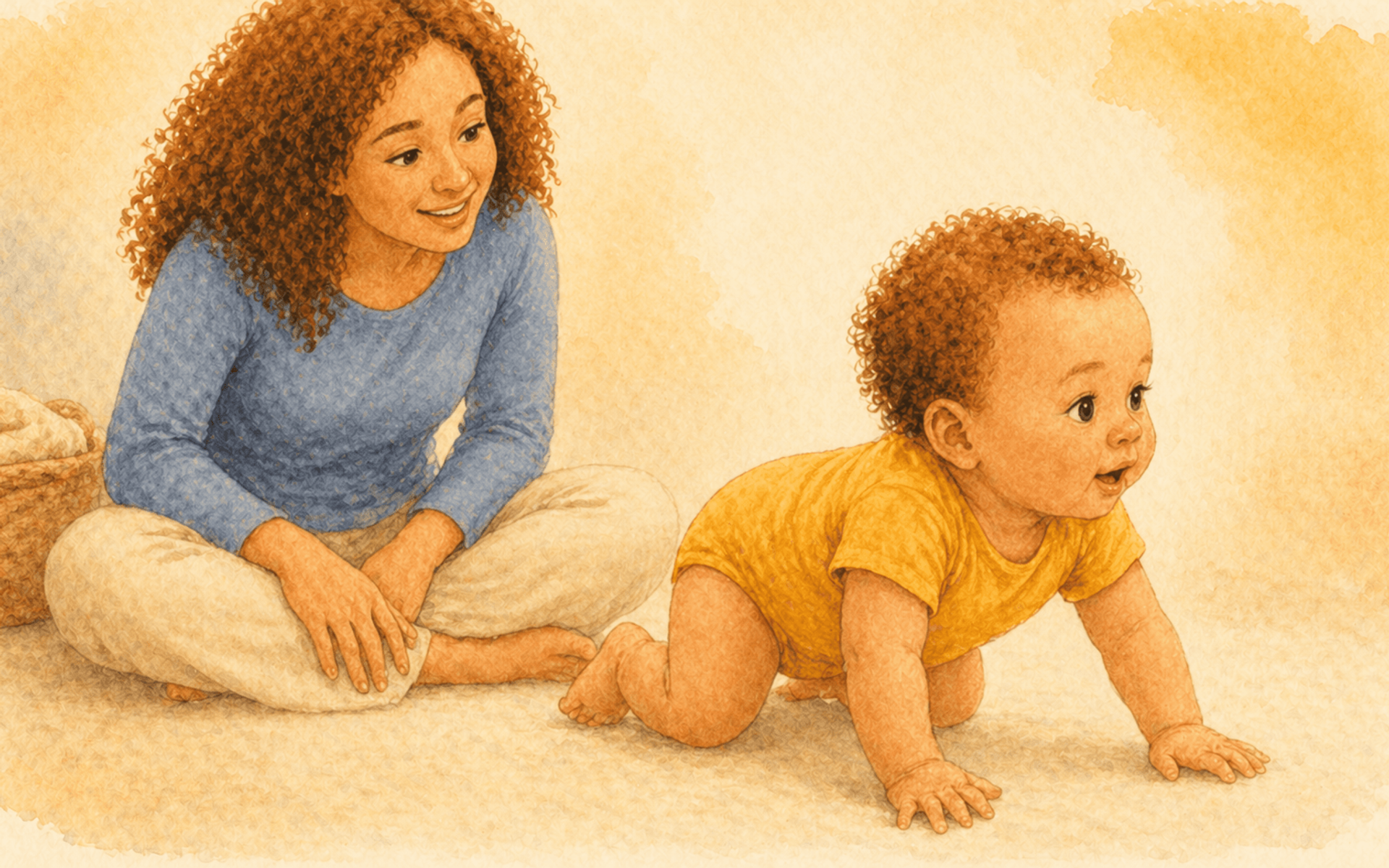
In February 2022, the CDC quietly removed crawling from its developmental milestone checklists. Three weeks later, the American Physical Therapy Association called an emergency meeting with the agency. The CDC's explanation, when it came, was unusually candid: the scientific literature could not even agree on what crawling is, or when 75% of babies should be expected to do it. So they stopped asking parents to track it.
When do babies start crawling, then? Anywhere between five and thirteen months, in nearly a dozen documented styles, including the version where babies travel in reverse for two weeks before figuring out forward.
- Why the CDC removed crawling from milestone checklists in 2022 — and what the scientific literature actually shows about timing
- The nine documented crawling styles — and the biomechanical reason most babies initially crawl backward
- The pre-crawling sequence: tummy time → push-ups → rocking on hands and knees → first locomotion
- What crawling actually builds that walking doesn't — the edge perception and visual world research from Adolph's NYU lab
- How to support crawling without forcing it — and what the Doman-Delacato "patterning" approach shows doesn't work
- When skipping crawling is a normal variation vs. when to raise it with a pediatrician
If the one-sentence answer is enough, you’ve got the gist. If you want the mechanism behind each piece, keep reading.
Crawling Has Always Been More Variable Than Parents Think
The first comprehensive study of infant locomotion in the United States was published in 1900 by August Trettien in the American Journal of Psychology. Trettien tracked how American babies actually got from one place to another in the months before walking, and what he found does not match the textbook image. Babies belly-crawled, bum-shuffled, log-rolled, hitched on one hip, scooted, pivoted in circles, and combined those styles in idiosyncratic ways that did not look much like the storybook hands-and-knees crawl. A meaningful fraction of his sample skipped crawling altogether and went directly from sitting to pulling up to walking.
What changed between 1900 and the parenting checklists most American mothers grew up with is that pediatric medicine, in the middle decades of the twentieth century, made hands-and-knees crawling the developmental default. The variability that Trettien had documented stopped being normal and started being a possible problem. Then, in 1992, the American Academy of Pediatrics launched the Back to Sleep campaign, which dramatically reduced infant sleep deaths but also dramatically reduced how much time babies spent in the prone position. By the late 1990s, pediatricians had noticed something measurable.
Davis and colleagues tracked 351 healthy term infants from two months until walking, recording sleep position and milestone ages, and published the results in Pediatrics in 1998. Babies who slept supine reached rolling, supported sitting, crawling, and pulling to stand a few weeks later than babies who slept prone. Every infant in the study eventually achieved every milestone within the normal range, so the headline finding was the one that mattered most: Back to Sleep was working, and infant sleep deaths had fallen sharply. The smaller, quieter finding was that the broader timing curve had shifted. Lives saved came with a few weeks added to the path toward crawling. A trade most pediatricians would make a thousand times over.
Cross-cultural research has been pushing in the same direction. The anthropologist David Tracer has documented infants among the Au people of Papua New Guinea who do not crawl at all because they are carried until they walk, with no apparent developmental cost. Earlier work by Charles Super in Kenya described similar patterns in cultures that discourage floor time. Tracer's own explanation, reported by the U.S. National Science Foundation, is that Au parents discourage crawling for a perfectly rational reason: keeping a baby off the ground reduces exposure to parasites and diarrheal disease in an environment where both are common. The cultural practice is not arbitrary. It is a sensible adaptation to a particular set of risks.
The conclusion that emerges from the historical record, the cross-cultural record, and the post-Back to Sleep American record is the same: the milestone "8 months, hands and knees" was an artifact of a particular set of parenting practices in a particular place during a particular three or four decades. It is not a universal of human development. It is a cultural average that has already moved twice in living memory.
This is the reasoning behind the CDC's 2022 decision. The agency was not arguing that crawling does not matter. It was acknowledging that the literature could no longer pin down a window in which 75% of typically developing American babies achieve hands-and-knees crawling, because the underlying behavior has become too variable to fit on a checklist. Independent mobility of any kind, by twelve months, is the milestone that survived. Pulling to stand at twelve months is on the new list. Walking along furniture is on the new list. The specific verb "crawl" is not.
The practical takeaway for the parent of a six-month-old who is rolling everywhere but not yet up on hands and knees: this is well within normal. The practical takeaway for the parent of a ten-month-old who has begun army-crawling but never quite reaches the textbook crawl: also well within normal. And the practical takeaway for the parent whose baby seems to be skipping crawling altogether and heading for walking: that is one of the most-documented variations in the whole literature, and it is not a sign of a problem.
What Counts as Crawling, Exactly
This is the second source of confusion. Karen Adolph's lab at NYU, which has spent more time looking at infant locomotion than almost anyone, has documented at least nine distinct patterns plus a long tail of idiosyncratic combinations that get called crawling in everyday speech. They are not minor variations on a single theme. They involve different muscles, different limb sequences, and different demands on balance.
The classic hands-and-knees crawl uses an alternating diagonal pattern: right hand and left knee forward, then left hand and right knee. Belly crawling, sometimes called commando or army crawling, keeps the abdomen on the floor and is mostly powered by the arms, with the legs trailing or pushing intermittently. Inchworm crawling involves raising and lowering the entire body in a wave, with brief moments of belly contact between each push. Bear crawling, where hands and feet contact the floor and knees stay lifted, is what some babies do for a few weeks, and what others use as their primary mode for months. Bum-shuffling is a buttocks-on-the-floor scoot powered by one leg or both. Crab crawling moves sideways. Backward crawling is its own brief stage that most babies pass through. And then there are the idiosyncratic combinations that are unique to specific babies: the one-arm drag, the rotational pivot, the roll-and-push.
A 2002 paper in the Archives of Disease in Childhood with possibly the funniest title in the literature, "Do 'Shufflebottoms' bottom shuffle?", found that bum-shuffling appeared in roughly one in five families surveyed in their British sample, both among the surname Shufflebottom and a control group with the surname Walker. So the surname does not predict the gait, but the gait itself is far more common than the textbook would suggest. Earlier work by Robson in the 1970s established that bum-shuffling tends to run in families and follows what looks like an autosomal dominant inheritance pattern. So if the baby's father bum-shuffled and the baby is now bum-shuffling, that is a piece of family genetics expressing itself, not a deviation from a norm.
What unites all of these patterns, biomechanically, is that they share an extraordinarily ancient piece of wiring. The rhythmic alternation of limbs in a crawl, a walk, or for that matter a fish's swim, does not come from the conscious brain. It comes from a small set of nerve circuits in the spinal cord that produce rhythm on their own. Biologists call these locomotor rhythm generators, and the same basic design has been doing this job in vertebrate animals for hundreds of millions of years, long before there were primates, much less humans. When the baby crawls, the conscious brain provides the goal — the toy across the rug — and a much older piece of the nervous system handles the actual rhythm of how the limbs move. The baby is not building this circuit from scratch. The baby is learning to use a circuit that arrived with the body.
The Stages Most Babies Actually Pass Through
Crawling does not appear from nowhere. It emerges, with a fair amount of overlap and individual variation, from a sequence of pre-crawling behaviors that begin around three or four months. Recognizing the stages is more useful than fixating on the calendar.
The foundation is tummy time. A 2020 systematic review by Hewitt and colleagues, published in Pediatrics, pooled sixteen studies covering 4,237 infants from eight countries and found that tummy time was positively associated with prone, supine, crawling, and rolling development. Carson and colleagues' 2022 longitudinal study of 411 infants in the International Journal of Behavioral Nutrition and Physical Activity tracked the same babies from two months to eighteen months and found that more cumulative tummy time predicted earlier achievement of every major gross motor milestone, including crawling. The mechanism is not subtle: babies build the neck, shoulder, and trunk strength they need to push up onto hands and knees by spending time pushing up onto their hands. For the baby who simply does not tolerate it, our guide on what to do when baby hates tummy time walks through specific strategies.
Push-ups appear next, usually somewhere between four and six months. The baby plants both hands, lifts the chest off the floor, and looks around. This stage often coincides with the rolling explosion that follows the four-month mark and is well-covered in our guide to activities for a 6 month old. Around the same time, many babies discover the "swimmer" pose, where the belly stays down and all four limbs lift off the ground with the head and chest extended, and seem genuinely puzzled that this does not produce forward motion.
Rocking on hands and knees usually begins between six and eight months. The baby gets up onto the new four-point support, finds it unfamiliar, and rocks forward and back as the trunk and shoulders adjust to bearing weight in this position. Some babies stay in this stage for a couple of weeks, others for a couple of months. Both are normal.
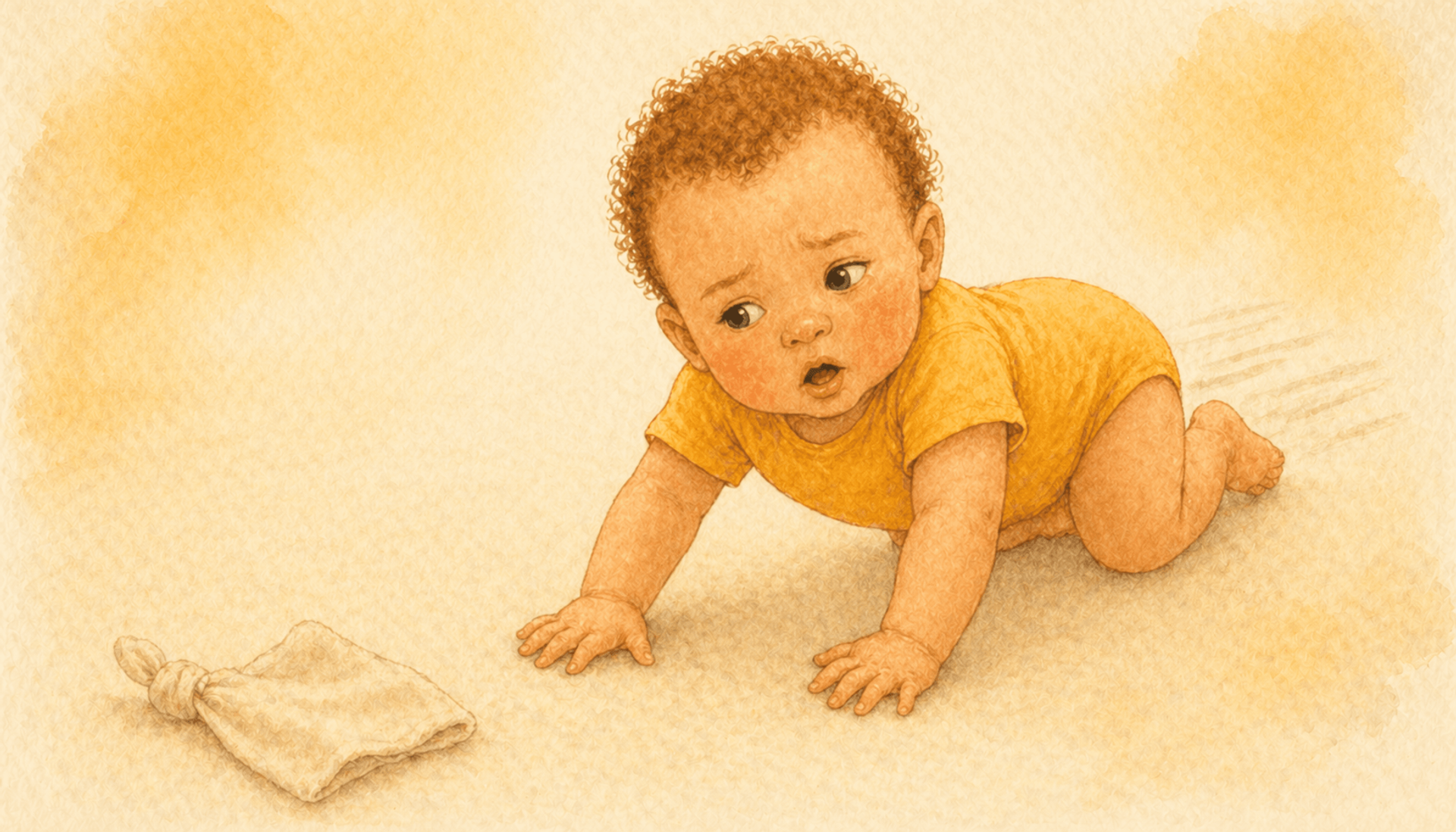
The first locomotion is, for many babies, backward. The reason is biomechanical. Arm strength matures earlier than leg strength, and the hip flexors required to drive the knees forward are still catching up. So the first time a baby pushes off from a hands-and-knees position, the arms produce more force than the legs, and the result is reverse motion. The baby is genuinely confused. The toy that started this whole project is now further away. A frustrated cry usually follows. This stage is brief, with most babies figuring out the forward direction within two to four weeks, and it is one of the most reliable signs that crawling proper is imminent. Our guide to activities for a 7 month old covers this transition stage in more detail.
Forward crawling, when it arrives, often does not look like the textbook diagonal pattern at first. Most babies start with whatever their body is currently capable of (a same-side advance, a sequential one-limb-at-a-time shuffle, a brief bear-crawl burst) and refine into the alternating diagonal over weeks of practice. The diagonal is the most efficient pattern, and most babies converge on it eventually, but a meaningful fraction never do.
What Crawling Actually Builds
If crawling is so variable, and a meaningful fraction of healthy babies skip it, why do pediatric physical therapists feel so strongly that babies should not be encouraged to skip it? The answer is that crawling does specific developmental work, and the work is not interchangeable with the work that walking does.
A 2021 study published in Infancy by Burnay and colleagues at the University of Otago tested how 12- to 15-month-olds responded to a water drop-off, a tub set into the floor with the surface positioned just below the baby's level so a baby crawling or walking forward could fall in (with safety provisions in place). The babies who had spent more months crawling before the test fell into the water less often. The protective effect of crawling experience persisted even after the babies had transitioned to walking. The interpretation the authors proposed is that the crawling stage is when babies build perceptual judgment about edges, drop-offs, and risky transitions, judgment that does not arrive automatically with the more mature gait.
Earlier work by Kretch, Franchak, and Adolph at NYU, published in Child Development in 2014, used head-mounted eye tracking on 13-month-old crawlers and walkers in matched conditions. The two groups were physically in the same room, doing the same task, but their visual worlds were different. Crawlers spent most of their time looking at the floor. Walkers spent most of their time looking at the room and at caregivers' faces. When a parent held an interesting object out for a crawler to see, the crawler often had to crane the neck up or sit up first to make eye contact. None of this is a deficit, since crawlers compensate efficiently, but it has implications for what the baby happens to see, including how much they see of the parent's face. The visual diet of a crawler is genuinely different from the visual diet of a same-aged walker.
These two findings stack on top of an older but well-replicated body of work by Joseph Campos and colleagues showing that crawling experience changes how infants perceive heights, distance, and self-motion. The aggregate picture from this research is consistent: getting around under one's own power, in any form, reorganizes the developing brain. Babies who crawl for several months before walking arrive at walking with skills they would not otherwise have. Babies who skip the crawling stage achieve those skills through other paths, which is why the long-term outcome data is reassuring rather than alarming. But the paths are not identical, and the experience matters.
This is also why pediatric physical therapists tend to recommend against pieces of equipment that bypass crawling. Bouncers, jumpers, exersaucers, and walkers all hold a baby in a position the baby cannot yet achieve or leave independently. A few minutes a day of supervised use does not appear to cause measurable harm. Hours per day across multiple devices does, and the displacement is the issue. Time in a container is time not on the floor. Floor time builds the perceptual and motor skills crawling produces. Containers do not.
How to Help Without Forcing
The single highest-leverage thing parents can do, by every line of evidence we have, is provide more floor time. This is not a trick. It is true because the underlying mechanism (exposure to the prone position, opportunity for trunk strengthening, opportunity for self-directed problem-solving) is mechanical, not magical.
Practical floor time looks like a clear, safe surface, an object the baby finds interesting placed slightly out of reach, and the parent close enough to provide a face but not so close that the baby is being entertained continuously. The interesting object can be almost anything: a wooden spoon, a measuring cup, a high-contrast card, a board book, an older sibling's discarded sock. Babies are not picky about the prop. They are picky about whether the prop is currently within reach, which is the entire engine of pre-crawling motivation.
Variety of position matters more than length of any single session. A baby who spends fifteen minutes prone, then twenty minutes sitting, then ten minutes on the back kicking at a play arch is doing more developmental work than a baby who spends an hour in any single position. The Adolph lab's longitudinal data on locomotor variability suggests that babies who experiment with more pre-crawling positions and styles tend to be more proficient when they settle into hands-and-knees crawling. Pivoting, scooting, log-rolling, belly-crawling: every one of these counts as practice for the underlying motor systems, even if the parent does not recognize it as crawling yet.
A note on what does not help: structured "crawling exercises" performed on the baby. Pushing, pulling, manipulating the baby's limbs into alternating patterns, or attempting to move the baby through a crawling motion does not appear to accelerate crawling, and it can be uncomfortable for the baby. The Doman-Delacato "patterning" therapy of the 1960s, which was based on this idea, has been formally repudiated by the American Academy of Pediatrics multiple times. The baby's nervous system needs to do its own work. The parent's job is to set up the conditions.
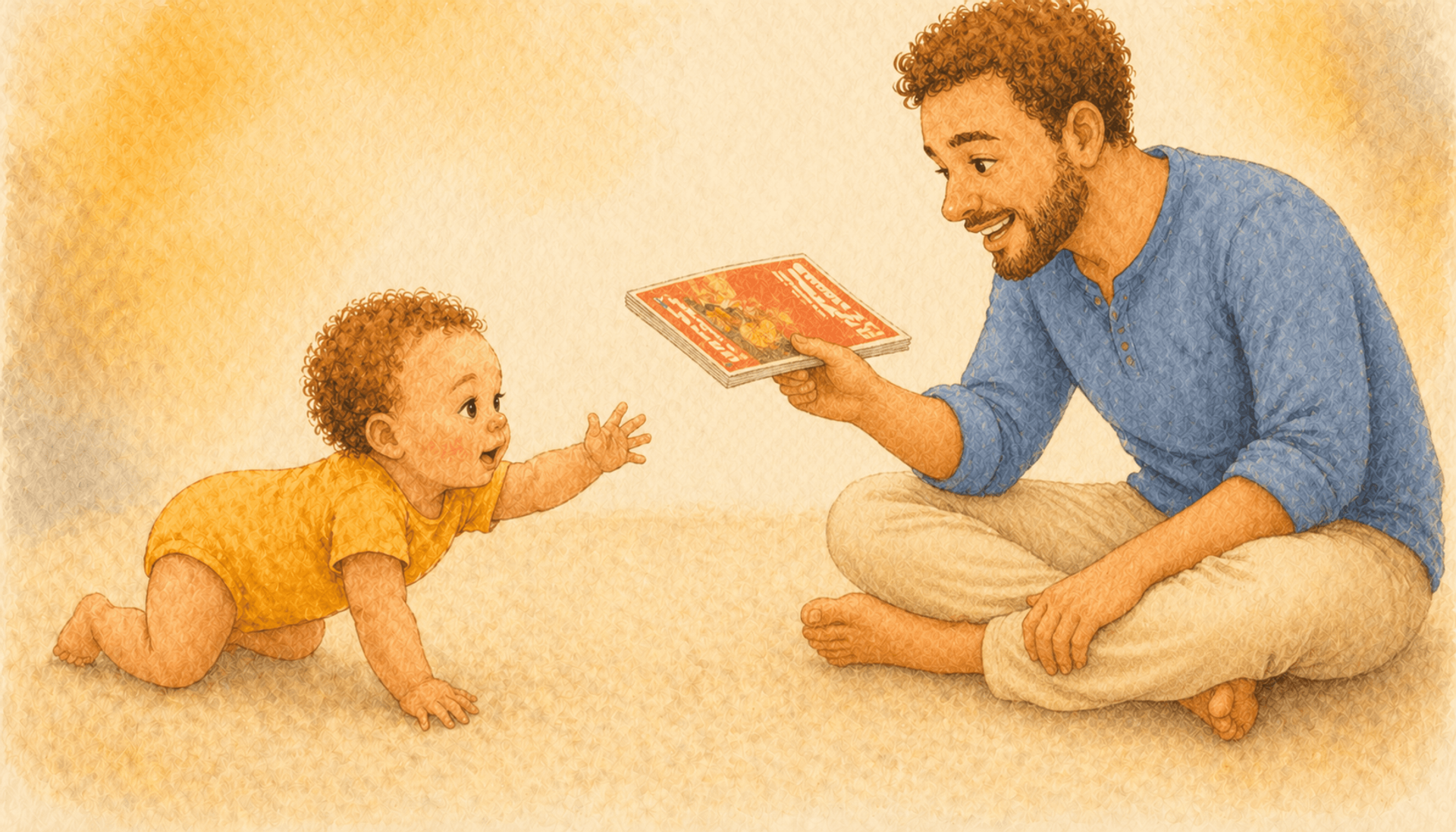
One condition worth setting up deliberately: notice which of your personal belongings the baby finds the most fascinating, the one item the small hands keep reaching for whenever the baby has the chance. A glossy magazine with a bright cover is a classic. A set of car keys works too. A phone, of course, but most parents are reasonably attached to those. During floor time, place that object in the baby's line of sight and slightly out of reach. Then, when the baby starts protesting, hold the line. No handing it over in response to the outstretched arms, the small whining sound, the pointed grunting. Once the easy methods of acquiring the treasure have failed, something else will start. A focused, slightly determined process of pulling, shifting, rolling, scooting in the direction of the prize. This is the small launch from which the great age of crawling tends to begin in most families. Tested across millennia by the simple expedient of dangling a carrot.
For the baby who has solid head control and is starting to push up but does not yet rock, having the parent get on hands and knees and demonstrate is unexpectedly effective. Babies imitate posture and movement long before they imitate language. A baby who watches a parent rock back and forth on hands and knees often tries the same motion within minutes. This is not a magic technique. It is a way to give the baby a clearer model of the position the body is reaching toward.
When Sitting and Crawling Don't Arrive Together
A frequent question in our sitting milestone guide comes up here too: how do these milestones relate? The standard order in older textbooks was sitting, then crawling, then standing, then walking, with crawling depending on prior sitting competence. The current data are messier. Babies who sit confidently sometimes show no interest in crawling for two or three months. Babies who army-crawl reliably sometimes do so before they sit unassisted. Sitting and crawling tap related but separate skill sets. Both require trunk control, but they require different patterns of trunk control, and they can develop on independent timelines within the same baby.
The implication for parents: the order is suggestive, not predictive. A baby who has been sitting for a month with no crawling progress is not necessarily falling behind on crawling. A baby who is crawling without yet sitting unassisted is not necessarily skipping a step. Both of these are observed routinely in healthy babies and reflect normal individual variation in how the underlying motor systems mature.
The 9-month checkup is the first formal pediatric visit specifically designed to evaluate motor development, and it is the right place to raise specific concerns. Your pediatrician will be looking at independent mobility of any kind, head control, the baby's ability to transition between positions, and overall trajectory. The pediatrician will not be asking whether the baby crawls in the textbook sense, because that question is no longer on the CDC checklist.
When to Talk to Your Pediatrician
Most questions about late or unusual crawling have reassuring answers. The WHO data show that the 99th-percentile age for hands-and-knees crawling is 13.5 months, and the data on babies who skip hands-and-knees entirely are consistent across multiple decades and multiple cultures: skipping is not, by itself, a sign of anything wrong.
There are, however, a few specific patterns where it makes sense to bring up the question with your pediatrician at the next visit, regardless of what the calendar says.
A baby who is not showing any form of independent mobility at nine months — no rolling for distance, no scooting, no army-crawling, no pivoting, nothing that gets the baby from one location to another under their own power — is worth raising with the pediatrician. Independent mobility of any kind, not crawling specifically, is the relevant developmental signal.
A baby who shows pronounced asymmetry while attempting to crawl — consistently pushing off one side, dragging one leg, using one arm preferentially, holding the head tilted to one side — is also worth flagging. Mild asymmetry in the early stages of any new motor skill is normal. Persistent and pronounced asymmetry, where one side seems to be doing much more work than the other across many days, is the kind of pattern a pediatrician will want to look at.
A baby who has lost a skill that was previously present — who was rocking on hands and knees and stopped, or who was rolling for distance and stopped — is the clearest reason to call. Regression in motor development is uncommon and is one of the few things in early development that warrants a conversation sooner rather than later.
A baby born prematurely should be evaluated using corrected age, meaning chronological age minus the weeks of prematurity, for all motor milestones. A baby born at 33 weeks who is six months old chronologically is, developmentally, closer to four-and-a-half months. The crawling timeline applies to corrected age, not to the calendar.
Frequently Asked Questions
Most babies who crawl on hands and knees do so somewhere between six and ten months, with substantial variation on both ends of that range. The WHO Multicentre Growth Reference Study found a 99th-percentile range from 5.2 months to 13.5 months, meaning a meaningful fraction of healthy babies start as early as five months and a meaningful fraction not until past their first birthday. The "average" age depends heavily on which population is being studied and how crawling is defined; the most-cited single number is 8.3 months.
Backward crawling almost always reflects an arm-leg strength imbalance. By the time a baby first attempts to push off from hands and knees, the arms have typically been doing push-ups and bearing weight for two or three months. The legs and hip flexors are still catching up. So the first push produces more force from the arms than from the legs, and the baby moves in reverse. This stage is brief, usually two to four weeks, and is one of the most reliable signs that forward crawling is close.
By every available line of evidence, no. The WHO study found that 4.3% of healthy babies never went through hands-and-knees crawling. Cross-cultural research has documented entire populations whose babies are carried until they walk, with no apparent developmental cost. Long-term studies have not consistently identified differences between babies who crawled in the textbook way and babies who did not. The CDC removed crawling from its milestone checklist in 2022 partly on this evidence. What matters is that the baby achieves some form of independent mobility, not that the baby uses any particular form of it.
Hands-and-knees crawling typically follows several weeks of pre-crawling behaviors such as push-ups, rocking, belly-crawling, or backward crawling. Most babies who do hands-and-knees as their primary crawl reach it between seven and ten months, though the WHO range extends from 5.2 to 13.5 months. Many babies use other forms first and arrive at hands-and-knees later, and some skip it entirely.
The research does not support this use. Pediatric physical therapists generally recommend against sustained time in walkers, jumpers, exersaucers, and similar containers. A 2001 study found a measurable negative association between total container time and motor scores, and exersaucer use specifically had the strongest negative association of any single piece of equipment studied. Short, supervised use during specific tasks is unlikely to cause harm; sustained use across multiple devices is associated with delayed crawling and other motor milestones.
The single highest-leverage intervention is more floor time, with a varied surface, an interesting object placed slightly out of reach, and a parent close enough to provide a face but not entertaining continuously. Tummy time, started early and gradually extended, builds the muscles. Variety of position matters more than length of any single session. Structured "crawling exercises" performed on the baby do not appear to help and have been formally repudiated by major pediatric organizations.
This article is for educational and entertainment purposes only. Not a substitute for professional medical or developmental advice. If you have concerns about your baby's development, consult your pediatrician.
- World Health Organization Multicentre Growth Reference Study Group (2006). "WHO Motor Development Study: Windows of Achievement for Six Gross Motor Development Milestones." Acta Paediatrica, 95(S450), 86–95.
- Trettien, A. W. (1900). "Creeping and walking." American Journal of Psychology, 12(1), 1–57.
- Davis, B. E., Moon, R. Y., Sachs, H. C., & Ottolini, M. C. (1998). "Effects of sleep position on infant motor development." Pediatrics, 102(5), 1135–1140.
- Zubler, J. M., Wiggins, L. D., Macias, M. M., et al. (2022). "Evidence-Informed Milestones for Developmental Surveillance Tools." Pediatrics, 149(3), e2021052138.
- Hewitt, L., Kerr, E., Stanley, R. M., & Okely, A. D. (2020). "Tummy Time and Infant Health Outcomes: A Systematic Review." Pediatrics, 145(6), e20192168.
- Carson, V., Zhang, Z., Predy, M., Pritchard, L., & Hesketh, K. D. (2022). "Longitudinal Associations Between Infant Movement Behaviours and Development." International Journal of Behavioral Nutrition and Physical Activity, 19(1), 10.
- Burnay, C., Cordovil, R., Button, C., Croft, J. L., & Schofield, M. (2021). "The Behaviour of 12- to 15-Month-Old Infants on Real Cliffs and Water Cliffs." Infancy, 26(5), 770–789.
- Kretch, K. S., Franchak, J. M., & Adolph, K. E. (2014). "Crawling and walking infants see the world differently." Child Development, 85(4), 1503–1518.
- Adolph, K. E., Vereijken, B., & Denny, M. A. (1998). "Learning to crawl." Child Development, 69(5), 1299–1312.
- Hill, P. D., Ellis, S. S., & Davies, J. (2002). "Do 'Shufflebottoms' bottom shuffle?" Archives of Disease in Childhood, 87(6), 504.
- Tracer, D. P. (2009). "Infant carrying and prewalking locomotor development." American Journal of Physical Anthropology, 48, 257.
- Abbott, A. L., & Bartlett, D. J. (2001). "Infant Motor Development and Equipment Use in the Home." Child: Care, Health and Development, 27(3), 295–306.
- American Academy of Pediatrics (2022). HealthyChildren.org: Developmental Milestones Resources.
- Centers for Disease Control and Prevention (2022). "Learn the Signs. Act Early." CDC.gov.
Related Products

More Articles
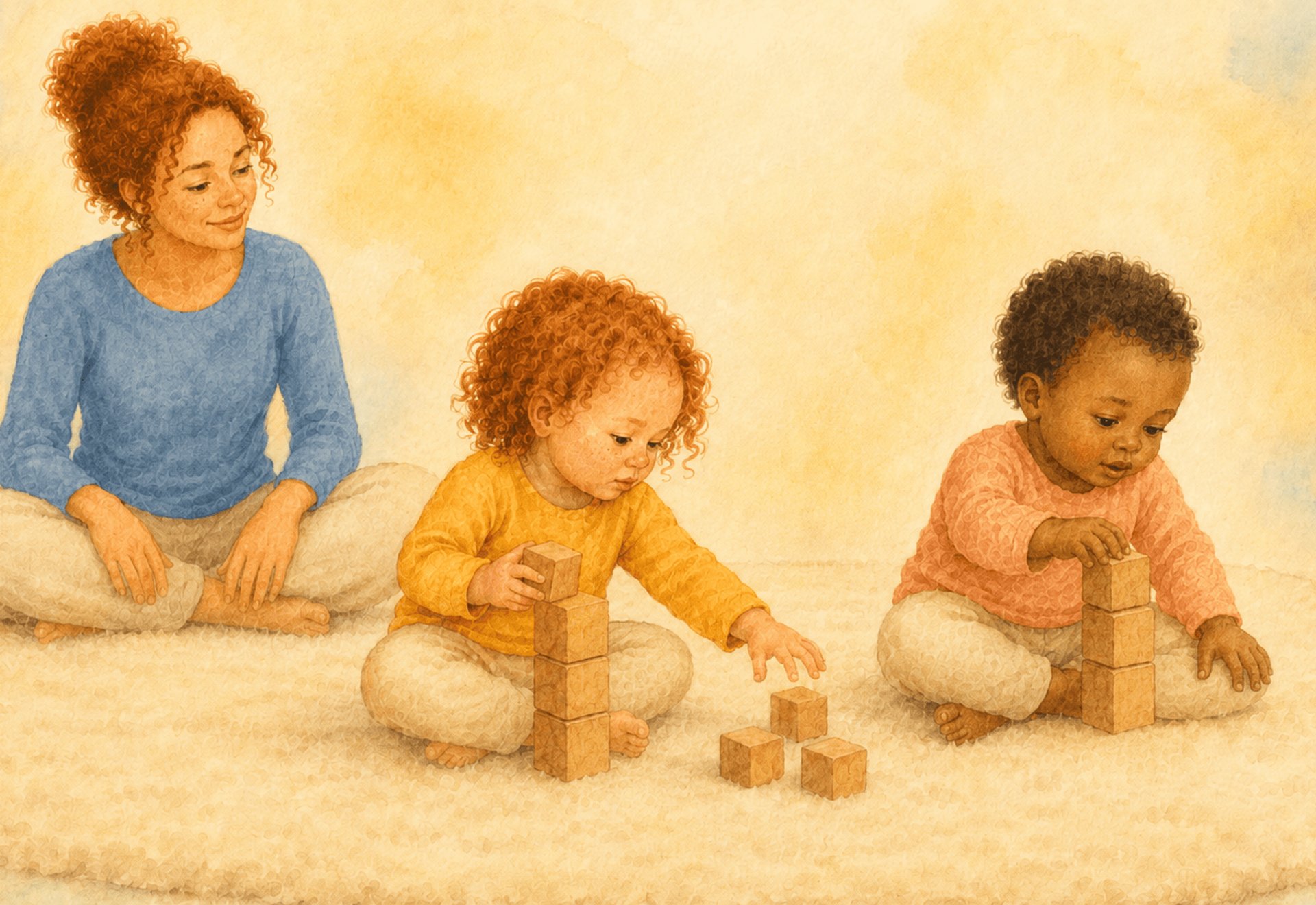
Parallel Play in Toddlers: Why Side-by-Side Is the Social Work
Your toddler spent the entire playdate building separate towers, and nobody shared a single block. That counted — more than it looked. A 2025 longitudinal study found that playing beside a specific child consistently predicted later social play with that same child, but not the other way around. Here's what parallel play in toddlers actually is, why the science calls it strategic rather than passive, and what it means for how you run a playdate.
When Do Babies Point: Why It Matters for Language
Most milestone articles treat pointing as a box to check around 12 months. The research tells a different story — one that starts months earlier, runs through the infant brain, and traces back to how much the parent is pointing. Here's what the last fifteen years of research actually found, and what it means for everyday interactions.
When Do Babies Wave Bye-Bye: Why Your Baby Needs You to Wave First
Most baby milestones unfold on a biological schedule — waving isn't one of them. A 2023 study found that babies develop imitation ability because their caregivers imitate them first, and waving is named directly as a cultural gesture learned through that loop. Here's what the research says about the 9–12 month window, why the first wave looks nothing like a wave, and what helps it arrive.