When Do Babies Start Walking? Why the Weeks After Matter More
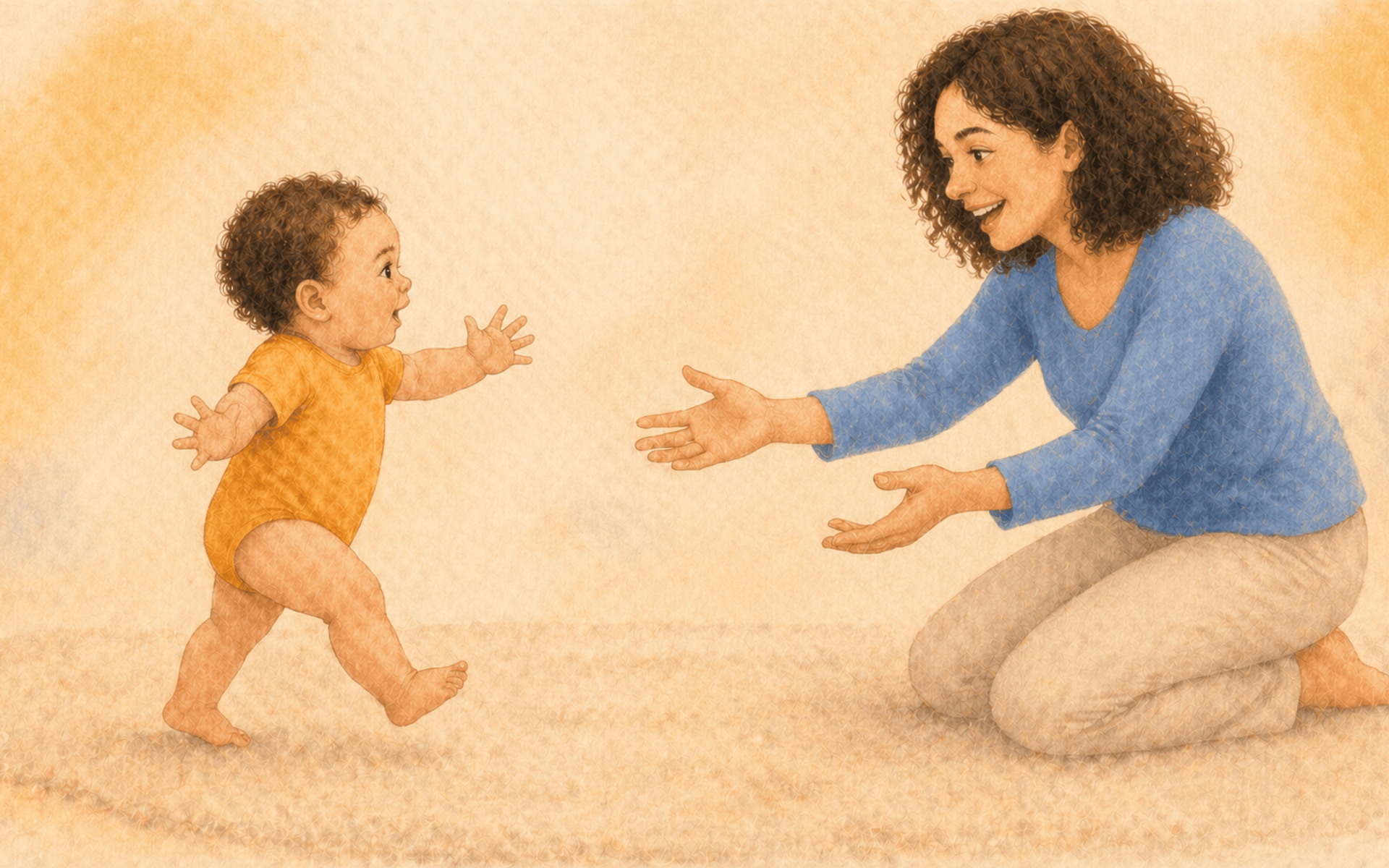
There is one finding about walking that the parenting books almost never mention, and it does not concern feet at all. Walking onset, independent of age, predicts a measurable jump in baby vocabulary. Twelve-month-old walkers know more words than twelve-month-old crawlers. So when do babies start walking? The textbook answer is around twelve months. The more interesting answer is what happens in the three or four weeks after that, when the babbling gets louder, the pointing acquires a verb, the cabinet doors stop being safe, and the baby who could already see is suddenly also a person who notices.
- Why "around twelve months" is technically right and practically misleading
- The 2014 study that flipped the standard frame on what walking does
- The 2,400-steps-per-hour finding that nobody puts in parenting articles
- How walking changes what mothers actually say to their toddlers
- What helps and what mostly gets in the way (without the usual list of push toys)
- The short, specific list of patterns that genuinely warrant a pediatrician visit
If the one-sentence answer is enough, you’ve got the gist. If you want the mechanism behind each piece, keep reading.
The Window Is Wider Than Most Books Suggest
The honest answer to when do babies start to walk on their own is a range, not a date, and the range is unusually wide. The World Health Organization's Multicentre Growth Reference Study, the largest dataset on infant motor development ever assembled, tracked 816 healthy children across six countries from birth through walking. The 1st percentile for walking alone came in at 8.2 months. The 99th percentile came in at 17.6 months. The mean was 12.1 months. The window between earliest and latest was 9.4 months, the second-widest of any first-year milestone the study measured.
That width is the part that gets buried in most parenting articles, which tend to fold the data into a confident "around twelve months" and move on. Twelve months is the median, which is to say the middle of the range, which is to say roughly half of healthy babies will not have taken an independent step yet on their first birthday. A baby who walks at fourteen months is exactly as common, statistically, as a baby who walks at ten. Both are well inside the WHO's window. Neither is "late" or "early" in any meaningful sense.
The width has a reason. Walking is the most physically demanding skill a baby has ever attempted, and it requires three separate systems to converge. Leg and hip strength sufficient to bear full body weight on one foot at a time. A vestibular system, the inner-ear balance organ, mature enough to detect sway and correct for it. And enough voluntary brain control to override the older reflexive stepping pattern babies are born with and replace it with deliberate, goal-directed steps. Each of those three systems matures on its own schedule, and the baby starts walking when the slowest of the three is ready. Which one is slowest varies by baby, which is most of why the window is so wide.
Before that first independent step, several pre-walking skills emerge in a fairly stable order, even though their timing varies. Pulling to stand typically arrives between eight and ten months, around the same time as solid crawling on hands and knees, though many babies pull up before they crawl. Cruising, the side-stepping shuffle along furniture, follows by a few weeks. Standing without support tends to arrive between ten and sixteen months. The WHO data put walking with assistance (parent's hands, push toy) at a 1st-to-99th-percentile range of 5.9 to 13.7 months, and standing alone at 6.9 to 16.9 months. None of these are deadlines. They are stages most babies pass through, in roughly the same order, on a timetable that varies by months.
The CDC kept walking on its 2022 milestone update for exactly this reason. Unlike crawling, which the agency removed because it had become too variable to define, walking shows enough consistency in its 75th-percentile age (around fifteen months) to remain a useful screening point. Independent walking by fifteen months is the new CDC indicator for the 18-month checkup.
What Walking Actually Does to a Baby's Mind
The interesting question about walking is not when. The interesting question is what changes once walking starts.
In 2014, Eric Walle and Joseph Campos published a study in Developmental Psychology with a finding that has not made it into parenting books in the decade since, despite being replicated in two countries and broadly accepted in developmental research. They tracked 44 American infants every two weeks from ten to thirteen and a half months. They measured both walking onset and vocabulary growth. The walking-onset effect on vocabulary was statistically significant and substantial, and it held up after controlling for age. A 12.5-month-old walker, on average, knew meaningfully more words than a 12.5-month-old crawler. The same baby's vocabulary curve bent upward in the weeks after the first step, and the bend was steep enough to see clearly in graphs.
A 2015 study by He, Walle, and Campos in Infancy did the obvious follow-up. They asked whether the effect was American, or about English, or something more general. They ran the same comparison in urban Shanghai, with infants exposed to Mandarin and walking onset that arrives, on average, six weeks later than in U.S. samples. The walking-vocabulary link replicated cleanly. Walking infants in both countries had bigger vocabularies than same-aged crawling infants. The effect appears to be about walking itself, not about a particular culture or language.
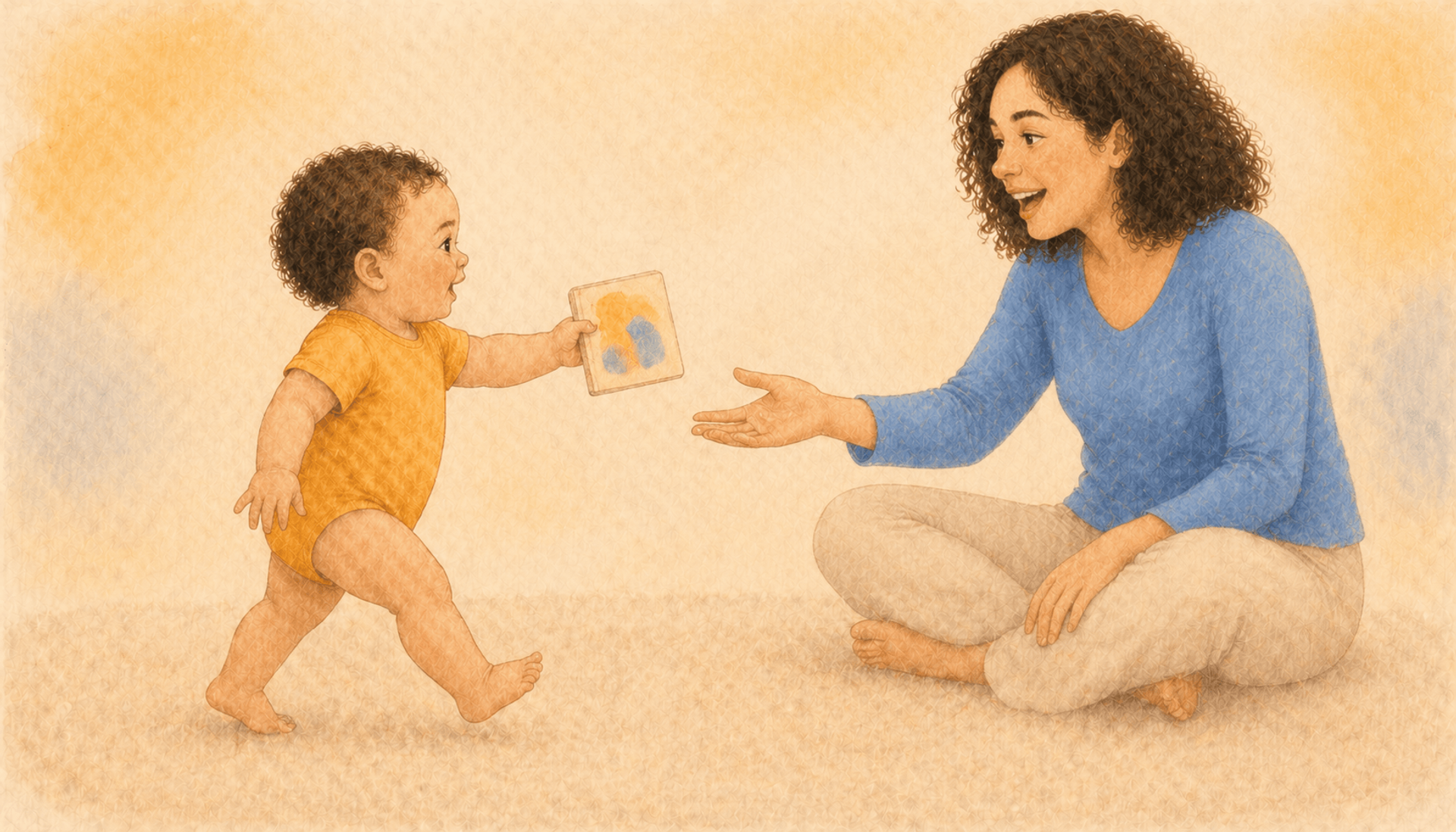
The mechanism turns out to be social, not motor. Walking changes what the baby does, what the baby sees, and what mothers say in response. Lana Karasik and colleagues at NYU documented this in detail. Their 2011 paper in Child Development observed fifty babies at home across the transition. Crawlers, they found, retrieve distant objects roughly four times an hour. Novice walkers, of identical age, retrieve them twelve times an hour. Walkers carry objects across rooms. Walkers approach mothers with things they have found. Crawlers tend to bring mothers to the object, instead.
A 2014 follow-up in Developmental Science by the same group focused on what mothers said in return. When a baby brings something across the room, the mother does not say "thank you" and stop there. She says "read the book," or "throw the ball," or "where do these go?" The verbal response to a moving baby contains action words, prepositions, sequences. The verbal response to a stationary baby asking for a thing tends to be shorter and more naming-based. The walking infant is, mechanically, in a different conversation.
The most useful nuance arrived in 2023. Kelsey West and colleagues tracked mothers' language minute by minute and found something that flips the standard interpretation. Mothers' use of locomotor verbs (come, go, bring, walk) was dense when their infants were moving and sparse when their infants were stationary, regardless of whether the infant happened to be a crawler or a walker. The same study found that when a 13-month-old crawler did approach a mother carrying an object, the mother responded with action directives at the same rate as the mothers of walkers did. The variable driving the language input is movement, not gait. Walking onset is not magic. It is a reliable trigger for more movement, which is a reliable trigger for the kind of maternal language that grows vocabulary.
The practical version of this is the takeaway most parents actually need. A crawling baby who is being carried around all day, parked in containers, or kept in one room is a baby whose mother is producing fewer action verbs in response. A crawling baby who is encouraged to move across rooms, who is invited to bring things to a parent across the kitchen, who hears "come find me" as a normal part of everyday play, is getting much of the language input that the walking literature attributes to walking itself. The mother who walks alongside her cruising baby, hands held low at chest height for balance, narrating each step ("we're going to the cabinet, the cabinet has the cups, can you bring one"), is running the developmental loop early. Parents do not need to wait for the first independent step to start the conversation. The conversation begins the day the baby first moves with intent. This is the same loop appearing in the first-words timeline we covered separately — talking and walking are in cahoots, but only because both are downstream of the same underlying shift in what the baby is doing all day.
The Steps-Per-Hour Finding That Nobody Mentions
The other study that almost never appears in parenting articles is Karen Adolph's 2012 paper in Psychological Science, which produced one of the most striking numbers in the developmental literature. Adolph and colleagues recorded 12- to 19-month-olds in unstructured free play and counted everything. The average toddler in that age range took 2,368 steps per hour. The average toddler also fell 17 times per hour. Across an average waking day, that works out to roughly 14,000 steps and around 100 falls.
Those are not laboratory numbers. They are real-house, real-living-room, real-rug numbers, captured by trained observers in actual homes. The figure most adults find hard to believe on first hearing is the falls. A new walker who falls a hundred times a day sounds like a baby who would be miserable, but the data show the opposite. Han and Adolph documented in 2021 that babies typically return to their feet within two seconds of a fall, that they rarely cry, that caregivers rarely react with alarm, and that fall rates do not predict whether a baby walks more or less the following day. Falling is a low-cost feature of the system, not a bug. The toddler treats it as routine and so should the parent.
What this finding reframes is the parental anxiety about whether the baby is "really walking yet." The Adolph data show that the new walker is not gradually accumulating clean, forward steps. The new walker is producing a chaotic, omnidirectional cloud of steps and falls in short bursts of fewer than twenty steps each, separated by rests, and gradually getting better at it through the sheer volume of practice. Better walking is not the goal a parent can engineer. Better walking is the byproduct of more practice, and more practice happens when the baby has uncluttered floor space, the freedom to fall safely, and an interesting reason to cross the room.
This is why floor time keeps appearing as the single most useful parental intervention across the entire first-year motor literature, including in our tummy time guide for the much-earlier stage. The mechanism is the same throughout. The baby needs hours of self-directed practice in conditions that let practice happen. The parent's job is to set those conditions.
How to Help Without Forcing
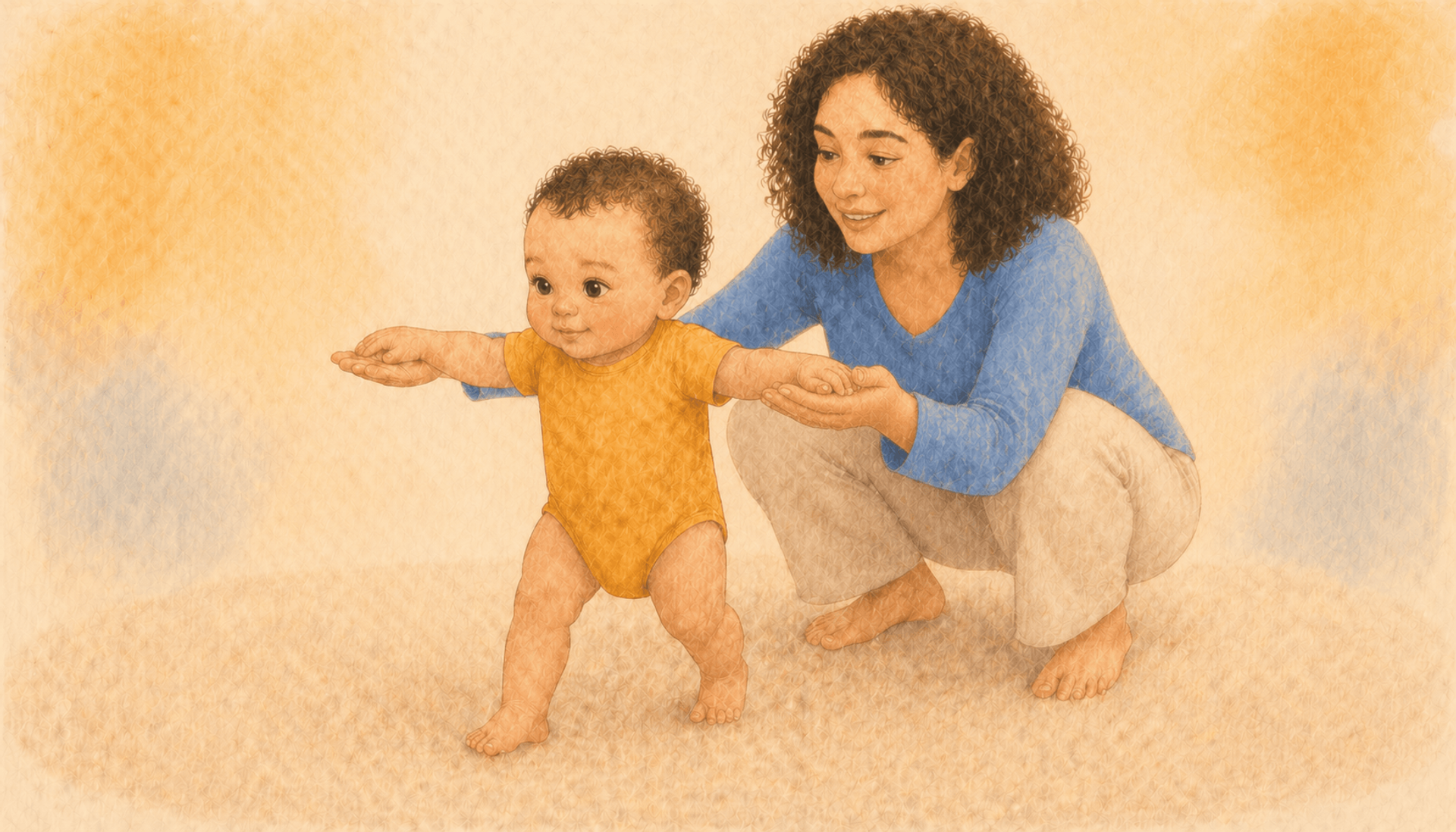
The parental impulse around walking is to teach. The research supports a different role: arrange the environment, then get out of the way.
Floor space is the single biggest variable. Babies in homes with more accessible, uncluttered floor area walk more steps per day, and more steps per day predicts faster gait improvement. This is a direct, mechanical relationship and not subtle. A baby who has six square meters of clear carpet to wobble across will accumulate the practice volume that builds walking. A baby who lives in a contained twenty-four-square-foot playpen most of the day will not. Neither extreme matches most American living rooms, but the principle scales: clearing the toys off the rug at the end of the day, pushing the coffee table back during morning play, leaving the hallway open from kitchen to living room — these create the floor area where the practice actually happens.
Barefoot is better than shoes for new walkers. The sole of the foot is dense with sensory receptors that send information about the floor to the balance system, and shoes (especially stiff ones with thick soles) blunt that signal. A baby learning to walk barefoot on a textured rug is getting more information about each step than a baby in cushioned cribs shoes is getting from the same step. Indoor barefoot for the new walker, with shoes saved for outside or for safety, is the gear-related recommendation with the strongest evidence behind it.
Cruising opportunities matter more than push toys. A push toy is fun but it provides external balance, which means the baby practices the foot-and-leg pattern of walking without practicing the balance system that walking actually requires. Cruising along a sturdy piece of furniture, by contrast, requires the baby to balance unaided while moving sideways. Two pieces of furniture parallel to each other, with a small gap between them, gives a baby a runway for the cross-the-gap moment that often produces the first independent step. This is not a technique that needs a special product. A couch and a coffee table will do it.
What walkers, jumpers, and exersaucers do is hold a baby in a posture the baby cannot yet achieve unaided, and the time spent in that posture is time not spent on the floor producing the chaotic cloud of practice steps that walking actually requires. Short, occasional use is unlikely to cause measurable harm. Sustained use across multiple devices is associated with delayed walking, and the American Academy of Pediatrics has formally recommended against infant walkers since 2001, citing both the developmental concern and a long history of injuries from falls down stairs.
What walking does for language develops a different angle on what to surround the new walker with. If the four-to-six-week window after the first step is when vocabulary is accelerating, this is the right moment for language-rich, around-the-room props. A set of first-words flashcards placed on the floor in a different room, with the baby walking over to retrieve one and bring it back to the parent, runs the exact loop the Karasik research describes: walking to a distant object, carrying it, presenting it, hearing the parent say a word and an action. This is the loop that produces the vocabulary acceleration in the literature, scaled down to one room and one parent. The flashcards are the prop, but any object the baby finds interesting will do the same job. The walking does most of the work.
For the soon-to-walk stage, our activities for a 9 month old guide covers the cruising-to-first-step transition in more depth, and our sit-up milestone article walks through the trunk-control foundations the walking system is built on. Once the baby is walking competently, the next phase is the long, busy stretch of toddlerhood, where the same moving-and-narrating loop keeps producing vocabulary if the parent keeps showing up.
When the Calendar Genuinely Matters
When do babies start walking late enough to call the pediatrician about? Most questions about late walking turn out to have reassuring answers. The 99th-percentile age for walking alone is 17.6 months, which means a baby who is fourteen months old and not yet walking is well inside the normal range, statistically speaking. A baby who is sixteen months old and not yet walking is at roughly the 90th percentile, still inside the normal range, though it is the point at which most parents have started to worry, regardless of what the data say.
There are, however, a few specific patterns where it makes sense to bring up the question with the pediatrician at the next visit, regardless of what the calendar says.
A baby who is not walking independently by eighteen months is the standard pediatric threshold, and the CDC's own indicator for the 18-month visit. Eighteen months is past the WHO's 99th percentile, and at that point the question is worth raising directly with the pediatrician, who will look at the broader picture: independent mobility of any kind, head and trunk control, the baby's overall trajectory, and any specific concerns the family has noticed.
A baby who has lost a skill that was previously present is the clearest reason to call. A baby who was cruising along furniture and has stopped, or who was standing alone briefly and no longer attempts it, falls into the category of motor regression, which is uncommon and is one of the few patterns in early development that warrants a conversation sooner rather than later.
A baby whose walking attempts are markedly asymmetric is worth flagging. Mild asymmetry in the early days of any new motor skill is normal. Persistent and pronounced asymmetry — one leg consistently bearing weight while the other drags, the same hand always reaching for support, a body that consistently lists to one side while attempting to stand — is the kind of pattern a pediatrician will want to look at.
For a baby born prematurely, the walking timeline is read against corrected age, meaning chronological age minus the weeks of prematurity. A baby born at thirty-three weeks who is fifteen months old chronologically is, developmentally, closer to thirteen and a half months. The walking timeline applies to corrected age, not to the calendar.
Frequently Asked Questions
The honest answer to when do babies start walking on their own is between nine and eighteen months, with the median falling at almost exactly twelve. The World Health Organization's 2006 multi-country study found a 1st-to-99th-percentile range of 8.2 to 17.6 months for walking alone, the second-widest window among all first-year motor milestones the study measured. A baby walking at ten months and a baby walking at fourteen months are equally common, and both are inside the normal range.
Walking and first words tend to cluster, but not because they cause each other directly. A 2014 longitudinal study by Eric Walle and Joseph Campos in Developmental Psychology found that walking onset, independent of age, predicts a measurable acceleration in both receptive (understood) and productive (spoken) vocabulary. The mechanism is social: walkers cross rooms, carry objects to mothers, and elicit longer, action-richer sentences in response. The vocabulary growth is downstream of the new social routine that walking creates, not of the walking itself.
The average is approximately twelve months in U.S. samples, which is also the WHO median across six countries. Cultural variation is real, however: urban Chinese infants walk roughly six weeks later than U.S. infants on average, with no developmental cost. The average is a useful summary for population-level data and a much less useful summary for any one baby, because the spread on either side of the average is so wide. The shorter answer to when do babies walk: the median is twelve months, the normal window stretches from nine to eighteen.
In the absence of other concerns, walking later than the median does not predict anything about long-term outcomes. The WHO study followed only the timing of milestone achievement, not later cognitive or physical results, but other longitudinal data have not consistently identified differences between early and late walkers once both groups are walking competently. The pediatric threshold for evaluation is eighteen months without independent walking, which puts the baby past the WHO's 99th percentile. Before that, late walking is, statistically, just walking.
The research does not support this use, and the American Academy of Pediatrics has recommended against infant walkers since 2001, citing both injury risk and a measurable association with delayed motor milestones. A walker holds a baby in a posture the baby cannot yet achieve unaided, which means time in the walker is time not spent on the floor producing the chaotic, omnidirectional practice that actually builds walking. Push toys, used briefly and on flat surfaces, are a different category and are not associated with the same concerns, though they do not appear to accelerate walking either.
This article is for educational and entertainment purposes only. Not a substitute for professional medical or developmental advice. If you have concerns about your baby's development, consult your pediatrician.
- Adolph, K. E., Cole, W. G., Komati, M., Garciaguirre, J. S., Badaly, D., Lingeman, J. M., Chan, G. L. Y., & Sotsky, R. B. (2012). How do you learn to walk? Thousands of steps and dozens of falls per day. Psychological Science, 23(11), 1387–1394.
- Adolph, K. E., Vereijken, B., & Shrout, P. E. (2003). What changes in infant walking and why. Child Development, 74(2), 475–497.
- American Academy of Pediatrics Committee on Injury and Poison Prevention (2001). Injuries associated with infant walkers. Pediatrics, 108(3), 790–792.
- Burnay, C., Cordovil, R., Button, C., Croft, J. L., & Schofield, M. (2021). The behaviour of 12- to 15-month-old infants on real cliffs and water cliffs. Infancy, 26(5), 770–789.
- Han, D., & Adolph, K. E. (2021). The impact of errors in infant development: Falling like a baby. Developmental Science, 24(5), e13069.
- He, M., Walle, E. A., & Campos, J. J. (2015). A cross-national investigation of the relationship between infant walking and language development. Infancy, 20(3), 283–305.
- Karasik, L. B., Tamis-LeMonda, C. S., & Adolph, K. E. (2011). Transition from crawling to walking and infants' actions with objects and people. Child Development, 82(4), 1199–1209.
- Karasik, L. B., Tamis-LeMonda, C. S., & Adolph, K. E. (2014). Crawling and walking infants elicit different verbal responses from mothers. Developmental Science, 17(3), 388–395.
- Kretch, K. S., Franchak, J. M., & Adolph, K. E. (2014). Crawling and walking infants see the world differently. Child Development, 85(4), 1503–1518.
- Walle, E. A., & Campos, J. J. (2014). Infant language development is related to the acquisition of walking. Developmental Psychology, 50(2), 336–348.
- West, K. L., Saleh, A. N., Adolph, K. E., & Tamis-LeMonda, C. S. (2023). "Go, go, go!" Mothers' verbs align with infants' locomotion. Developmental Science, 26(6), e13397.
- World Health Organization Multicentre Growth Reference Study Group (2006). WHO Motor Development Study: Windows of achievement for six gross motor development milestones. Acta Paediatrica, 95(S450), 86–95.
- Zubler, J. M., Wiggins, L. D., Macias, M. M., Whitaker, T. M., Shaw, J. S., Squires, J. K., Pajek, J. A., Wolf, R. B., Slaughter, K. S., Broughton, A. S., Gerndt, K. L., Mlodoch, B. J., & Lipkin, P. H. (2022). Evidence-Informed Milestones for Developmental Surveillance Tools. Pediatrics, 149(3), e2021052138.
Related Products

More Articles
Parallel Play in Toddlers: Why Side-by-Side Is the Social Work
Your toddler spent the entire playdate building separate towers, and nobody shared a single block. That counted — more than it looked. A 2025 longitudinal study found that playing beside a specific child consistently predicted later social play with that same child, but not the other way around. Here's what parallel play in toddlers actually is, why the science calls it strategic rather than passive, and what it means for how you run a playdate.
When Do Babies Point: Why It Matters for Language
Most milestone articles treat pointing as a box to check around 12 months. The research tells a different story — one that starts months earlier, runs through the infant brain, and traces back to how much the parent is pointing. Here's what the last fifteen years of research actually found, and what it means for everyday interactions.
When Do Babies Wave Bye-Bye: Why Your Baby Needs You to Wave First
Most baby milestones unfold on a biological schedule — waving isn't one of them. A 2023 study found that babies develop imitation ability because their caregivers imitate them first, and waving is named directly as a cultural gesture learned through that loop. Here's what the research says about the 9–12 month window, why the first wave looks nothing like a wave, and what helps it arrive.