When Do Babies Start Talking? What First Words Look Like
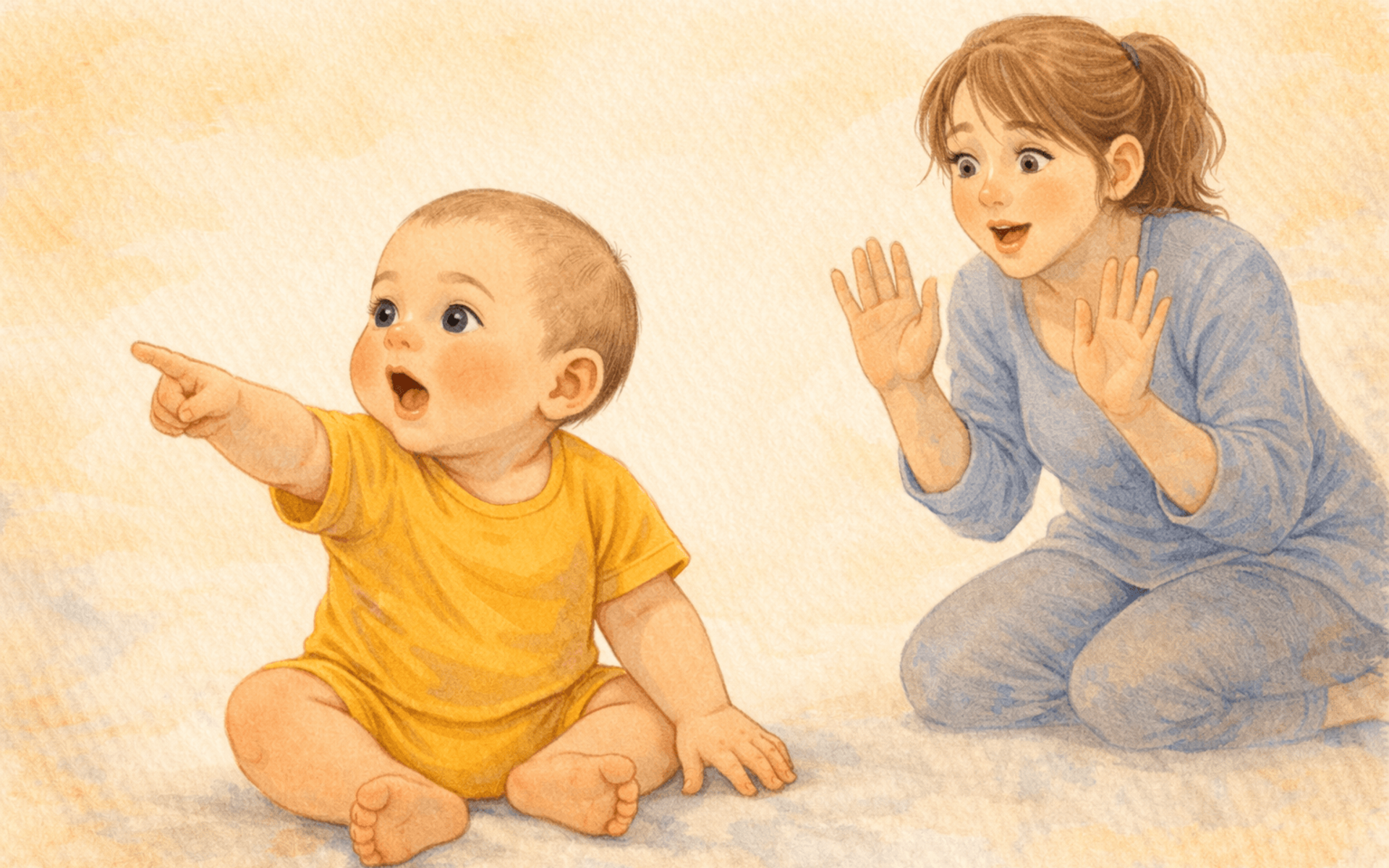
Your baby just pointed at the dog and said something that might have been "dah." Or "gah." Or possibly a burp with ambition. Somewhere across the room, another adult catches your eye with a face that says was that a word? Neither of you is sure whether that was a first word or a digestive event, but both of you feel oddly emotional about it.
Welcome to the most thrilling and confusing phase of language development: the period when sounds start becoming words, and nobody hands you a certification that it's happened.
- The pre-word timeline: what cooing, babbling, and jargon each signal about what the brain is building
- When first words typically arrive — and why the range of normal is wider than most parents expect
- What actually counts as a word — the speech-language pathologist definition that resolves most parent anxiety
- Parentese: why the exaggerated sing-song voice is acoustically engineered for infant learning, not just cute
- Why conversational turns beat word count — and what doesn't work as well as people assume
- Red flags worth raising with a pediatrician — and why early evaluation is information, not alarm
If the one-sentence answer is enough, you’ve got the gist. If you want the mechanism behind each piece, keep reading.
Language Starts Long Before Words
The road to a first word is months long, and it begins with sounds that don't resemble language at all. Between 2 and 4 months, babies start cooing — soft vowel sounds like "aaah" and "oooh" that are as much about experimenting with the vocal cords as they are about communicating. It sounds like contentment. It's actually practice.
Around 6 to 8 months, cooing gives way to babbling — the repetitive consonant-vowel chains that sound like "ba-ba-ba" and "da-da-da." This is a significant shift. Babbling requires coordinating the lips, tongue, and breath in a way that cooing doesn't. It's the vocal equivalent of learning to crawl: not the destination, but proof that the system is coming online.
By 9 to 12 months, babbling becomes what researchers call "jargon" — strings of sounds delivered with the rhythm, intonation, and emotional contour of real sentences. A baby in the jargon phase sounds like someone having a very important conversation in a language you don't speak. That's because the baby is practicing the melody of speech before filling in the actual words. And that melody — the rise and fall, the pauses, the emphasis — is something the brain started learning before birth, from the filtered sound of a mother's voice through the walls of the womb.
If you're curious about what your baby was picking up during pregnancy, we wrote about that here.
When the First Word Shows Up
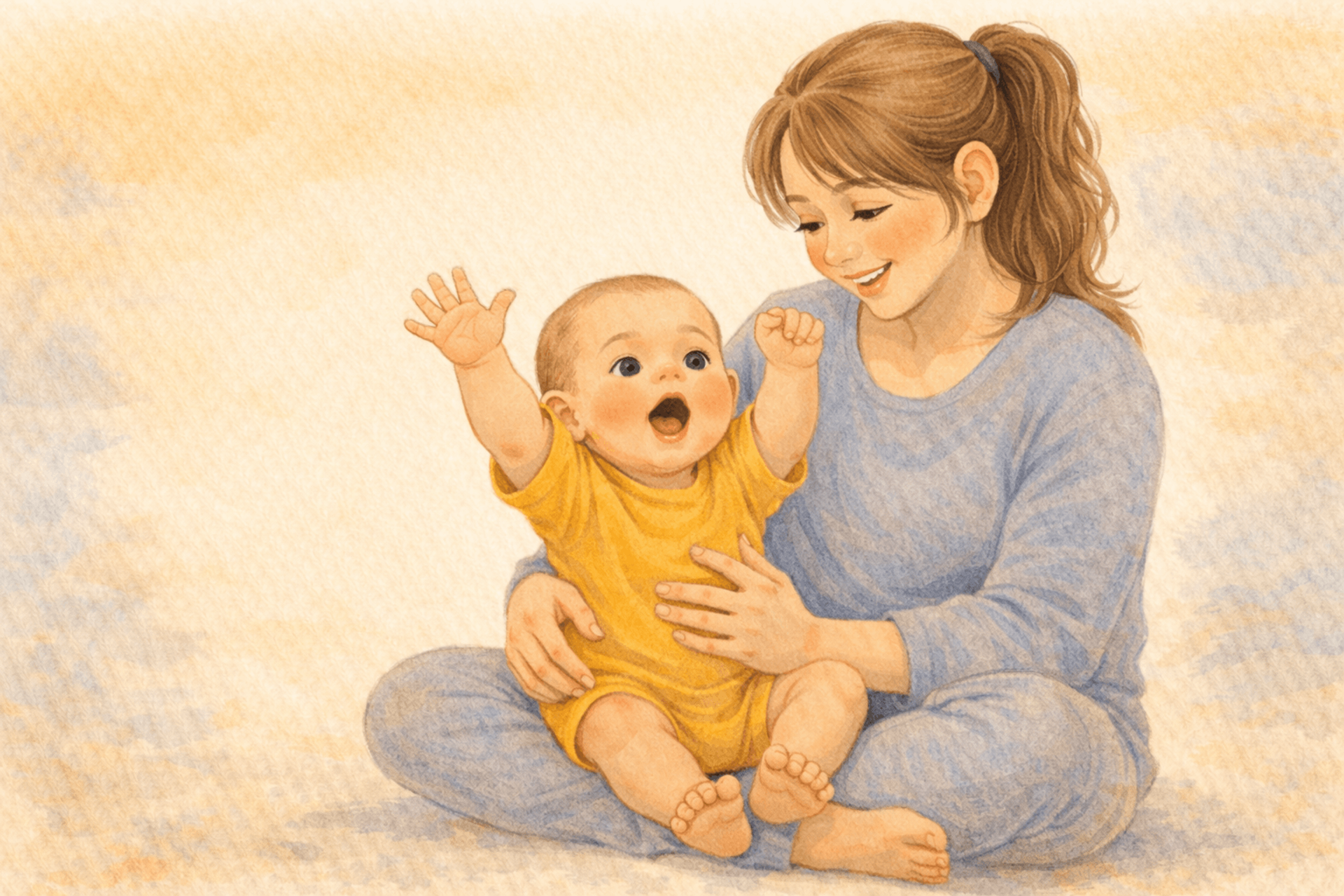
Most babies say a recognizable first word somewhere between 10 and 14 months. Large-scale research on children's early vocabularies found that more than 75% of children produce a first word before their first birthday. By 18 months, a typically developing child understands around 150 words and can produce about 50.
But here's the part that matters most: the range of normal is wide. Some babies say a clear "mama" at 9 months. Others are still working on it at 15 months and catch up completely by age 2. A child who says nothing at 12 months but babbles constantly, responds to sound, and understands simple instructions is on a very different trajectory from a child who is silent and unresponsive. The timeline varies. The underlying pattern of growth is what pediatricians watch for.
The most common first words across languages tend to fall into a few predictable categories: names for caregivers (mama, dada), social routines (hi, bye-bye, uh-oh), and objects the baby sees every day (ball, dog, milk). Research from Stanford's Language and Cognition Lab found that the words children say first are predicted by two factors: how often the baby hears the word, and how easy it is to pronounce. "Ball" shows up early because it's short, common, and starts with a sound babies have been practicing since the babbling phase. "Refrigerator" does not show up early.
What Counts as a "Word"
This is where parents get quietly anxious. A first word doesn't need to be pronounced perfectly. It doesn't need to match the dictionary spelling. What makes a sound a word is consistency and intent.
If your baby says "ba" every time the ball appears — and only when the ball appears — that's a word. If "nah-nah" reliably means banana, that's a word. Speech-language pathologists look for a stable sound that the child uses intentionally and repeatedly to refer to a specific thing. The pronunciation can be approximate. The connection between sound and meaning is what matters.
What doesn't count: babbling that includes "mama" syllables but without any directed intent. A baby saying "mamamamama" while staring at the ceiling fan is practicing motor sequences. A baby saying "mama" while reaching toward you with outstretched arms is using language.
The Voice That Teaches
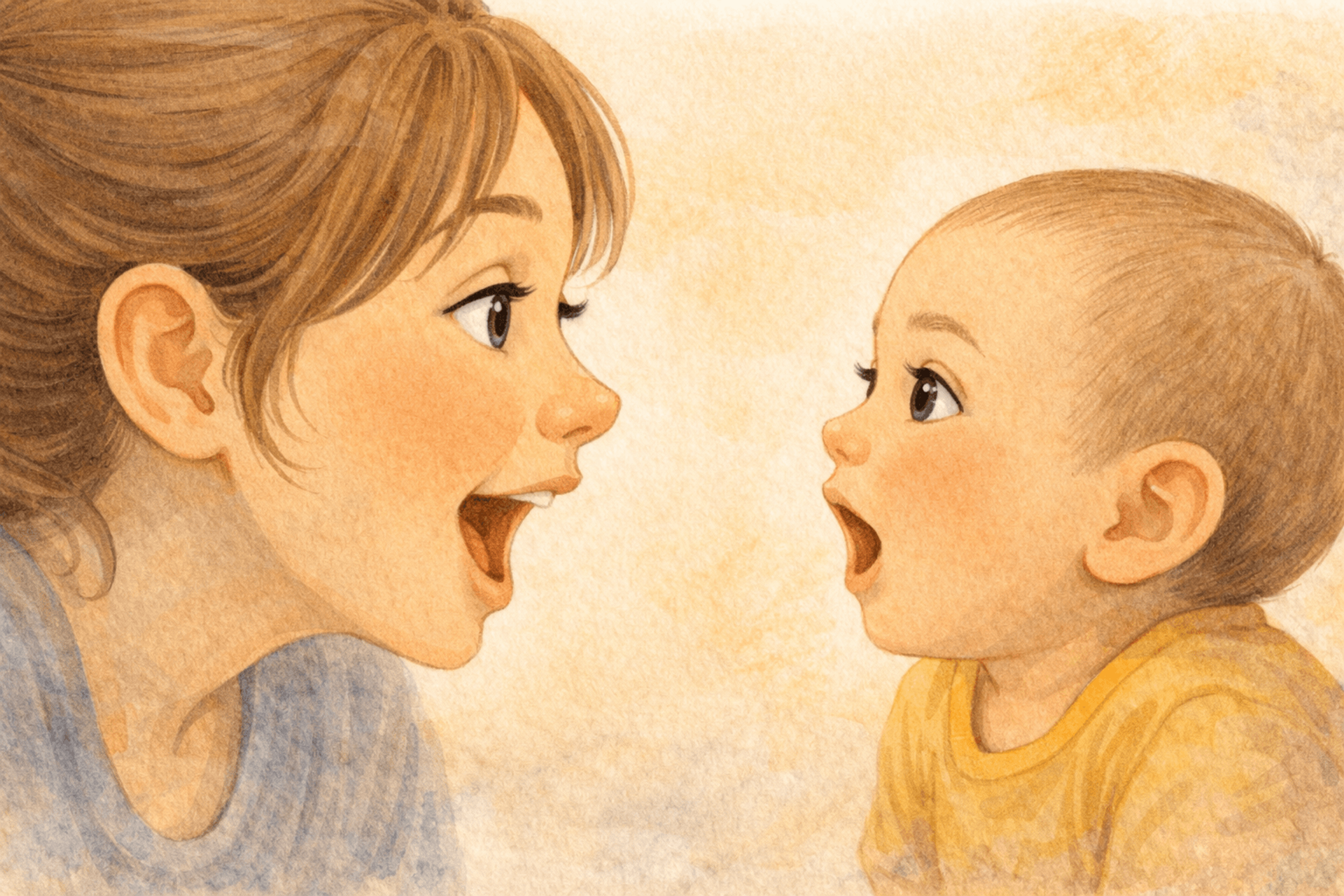
There's a specific way adults talk to babies. Slower pace, higher pitch, longer vowels, exaggerated intonation. Researchers call it parentese — and despite what it sounds like, it's not the same thing as "baby talk." Parentese uses real words in grammatically correct sentences. It just delivers them in a way that's acoustically engineered for infant attention.
A randomized controlled trial from Patricia Kuhl's lab at the University of Washington tested whether coaching parents to use more parentese would affect language outcomes. Families of 6-month-old babies were randomly assigned to a coaching group or a control group. The coached parents received feedback on their speech patterns at 6, 10, and 14 months. By 18 months, children in the coaching group produced significantly more words and engaged in more conversational turns — the back-and-forth exchanges that are the foundation of real communication.
A follow-up study from the same lab tracked the same families all the way to age 5 and found that consistent parentese use in infancy predicted vocabulary size, sentence complexity, and conversational skill years later. The effect wasn't small. Parents who consistently used parentese in the first year had children who were measurably more advanced in language at school entry.
Why does it work? Parentese exaggerates exactly the acoustic features that help babies distinguish between speech sounds. When a mother stretches the vowel in "Hiiii, babyyyy," the baby's brain gets a clearer signal about what English vowels sound like. Cross-cultural research across multiple languages showed that mothers everywhere stretch vowels when speaking to babies — and the degree of stretching predicted how well the baby could discriminate between speech sounds.
So that instinct to talk to your baby in a slightly ridiculous sing-song voice? Backed by research across languages and continents.
It's Not About How Many Words You Say
For years, the dominant message in parenting was about word count — the idea that children from language-rich homes hear millions more words than children from less talkative families, and that this gap predicts later outcomes. The number "30 million" became iconic.
The picture turns out to be more nuanced than that. Researchers at MIT gave families day-long audio recorders and then scanned the children's brains while they listened to stories. They wanted to know: what matters more — how many words a child hears, or how many actual back-and-forth exchanges happen between adult and child?
The answer was clear. The back-and-forth exchanges — what researchers call conversational turns — predicted both language skills and brain activation in Broca's area (the region that handles language processing) more strongly than the sheer number of words a child heard. This held true regardless of family income or education. A child from any background who experienced more conversational ping-pong showed stronger language wiring in the brain.
The practical implication is significant: it's not about narrating every moment of the day in a constant monologue. What matters more is the exchange. Baby babbles, you respond. You say something, baby vocalizes back. That turn-taking — which can happen during a diaper change, a meal, or a walk around the block — is the mechanism through which language wires itself into the brain.
What Actually Helps (and What Doesn't)
The research converges on a few things that genuinely support early language development, and a few things that don't work the way people assume.
What helps: responding to babbles as if they're real conversation (because for the brain, they are). Narrating what you're doing — "Now we're putting on your socks, these are the blue socks" — during everyday routines. Reading together, even before the baby understands the words, because books provide a concentrated source of varied vocabulary in a shared-attention context. Naming objects the baby is already looking at, which combines joint attention with a new word at exactly the right moment. And if you want a shortcut — our Sensory Play Cards were designed as a three-in-one tool: each card has an activity, an illustration, and age-matched vocabulary prompts on the back, so you already know what to say and when to say it.
What helps less than expected: passive audio exposure. In a landmark study, 9-month-old American babies were exposed to Mandarin Chinese in 12 lab sessions. The group that heard Mandarin from live speakers maintained their ability to distinguish Mandarin speech sounds. A second group heard the exact same speakers and materials through a television or audio recording. The TV group showed no learning at all — their results were identical to a control group that never heard Mandarin. The statistical information in the audio was identical in both conditions. What differed was the social context.
This doesn't mean screens are inherently harmful. It means that for very young children, the brain appears to treat language delivered by a person fundamentally differently from language delivered by a machine. Social cues — eye gaze, timing, emotional responsiveness — seem to act as a gate that either opens or closes the door to phonetic learning.
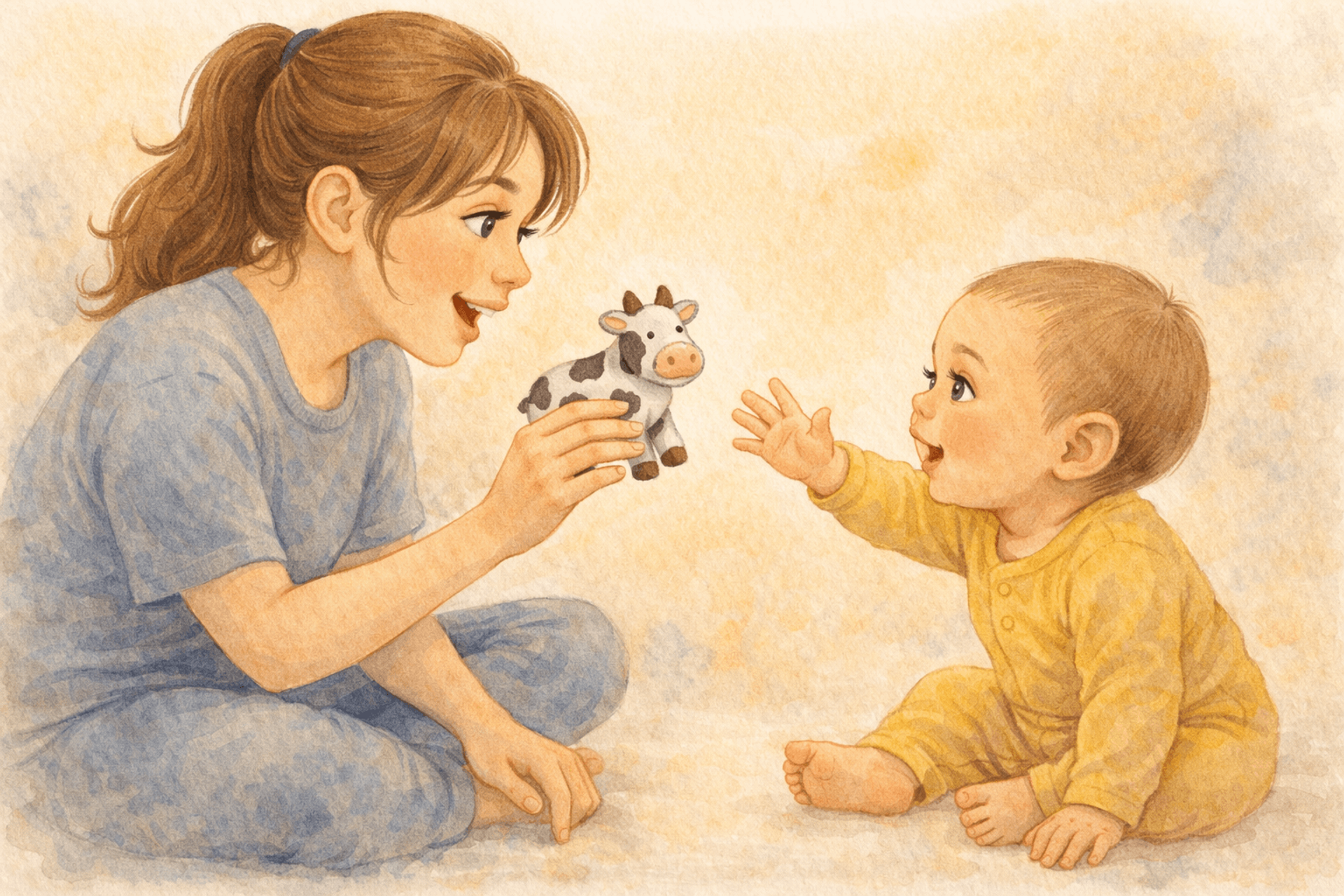
And what about flashcards? They work — when used as a naming tool in a conversational context. Holding up a picture, saying "cow," waiting for the baby to respond, then saying "Yes! Cow. The cow says moo" — that's a conversational turn wrapped around visual input. It's the interaction, not the card, that does the heavy lifting. The card just gives you both something specific to talk about.
When to Pay Attention
Every child follows a unique timeline, and variability is normal. But there are a few markers that pediatricians and speech-language pathologists flag as worth checking:
If a baby isn't babbling or making varied sounds by 7 months. If there are no words by 15 months. If a child has fewer than 50 words by age 2, or isn't combining two words into short phrases by 30 months. If at any age, a child suddenly loses words or skills previously acquired.
None of these necessarily indicate a problem. Some children are late talkers who catch up entirely on their own. But early evaluation — typically through a speech-language pathologist — can identify whether support would help, and early intervention consistently produces better outcomes than waiting.
If something feels off, trust that feeling. Getting an evaluation is not an overreaction. It's information.
The Shortest Version
Language doesn't start with a first word. It starts with a first coo, a first babble, a first time your baby's brain recognizes the melody of your voice. Every sound is a step in a sequence that researchers have mapped from birth through the first year and beyond. Most babies say a first word between 10 and 14 months. The range of normal is wider than most parents expect. And the single most powerful thing you can do to support the process is also the simplest: talk with your baby, not just to your baby. Respond when your baby responds. Make it a conversation, even when the other side of the conversation is "gah."
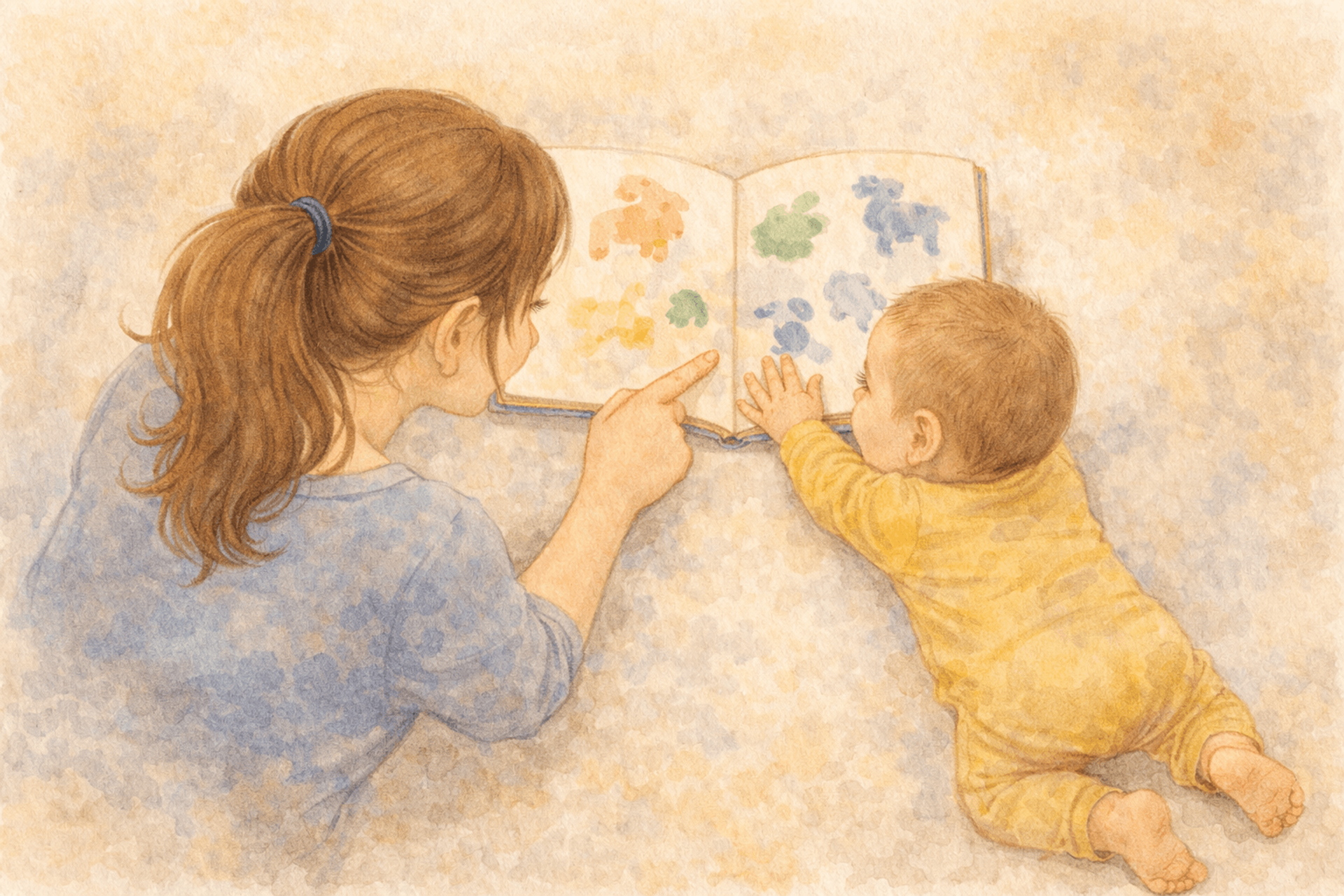
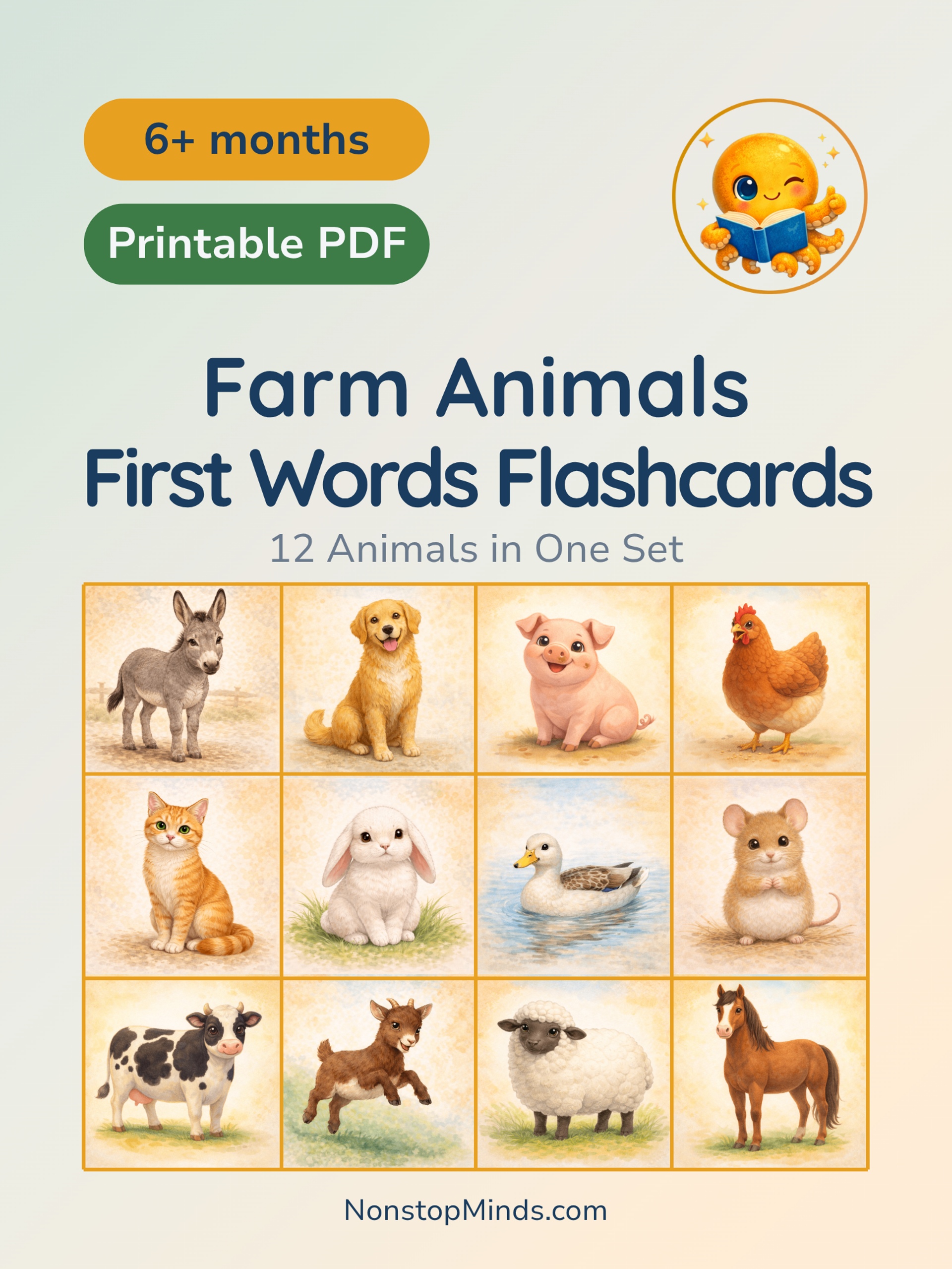
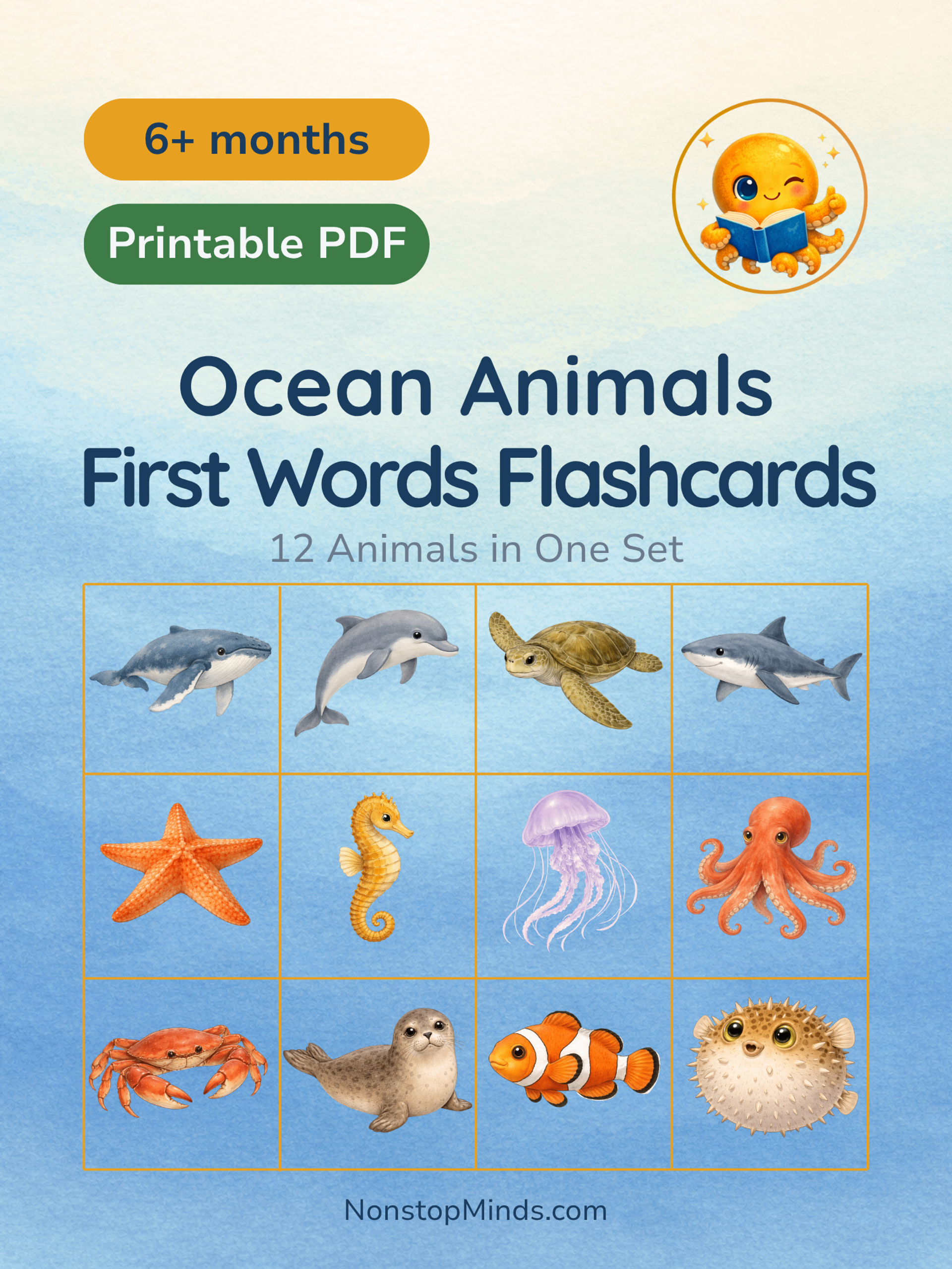
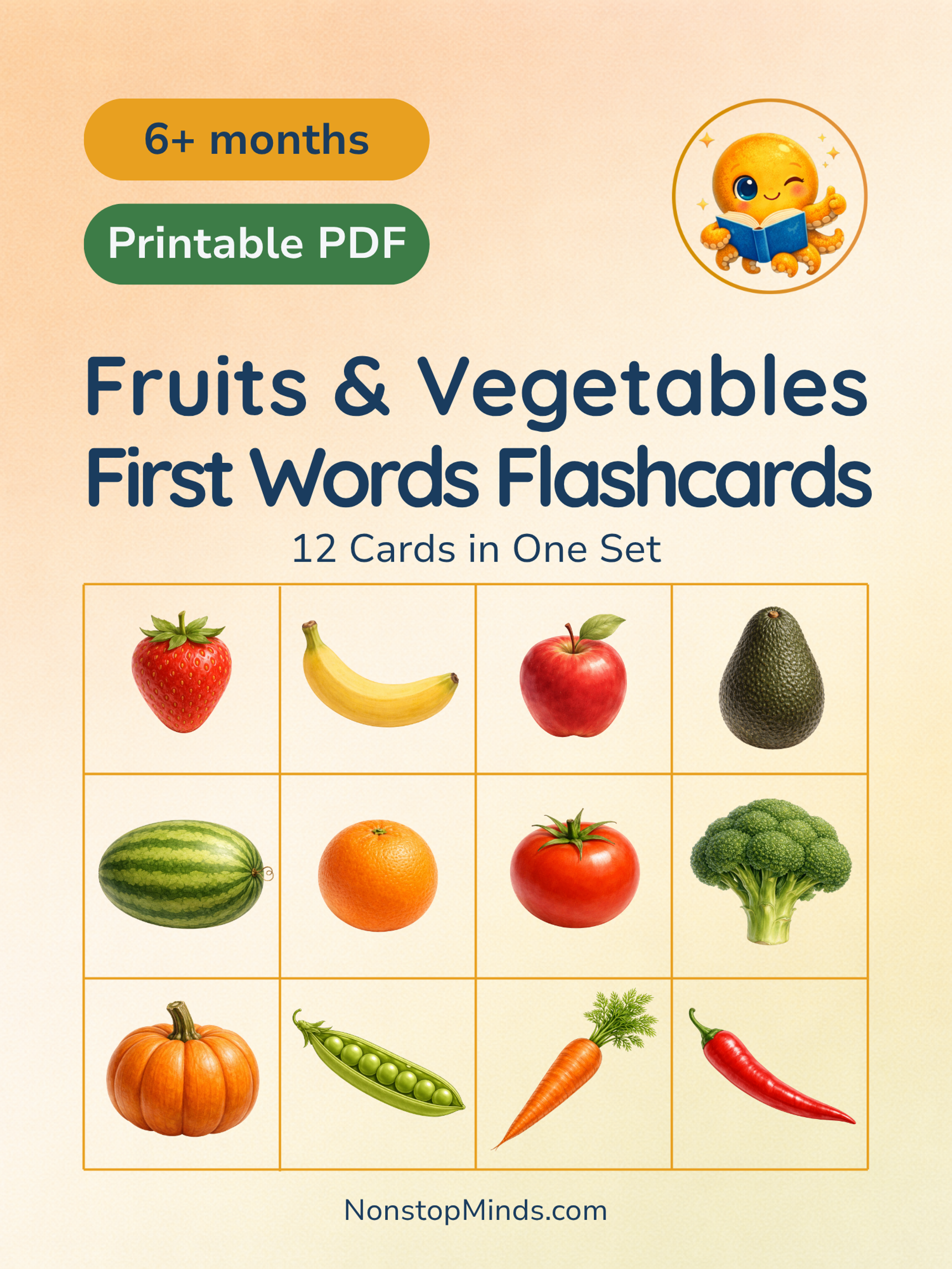
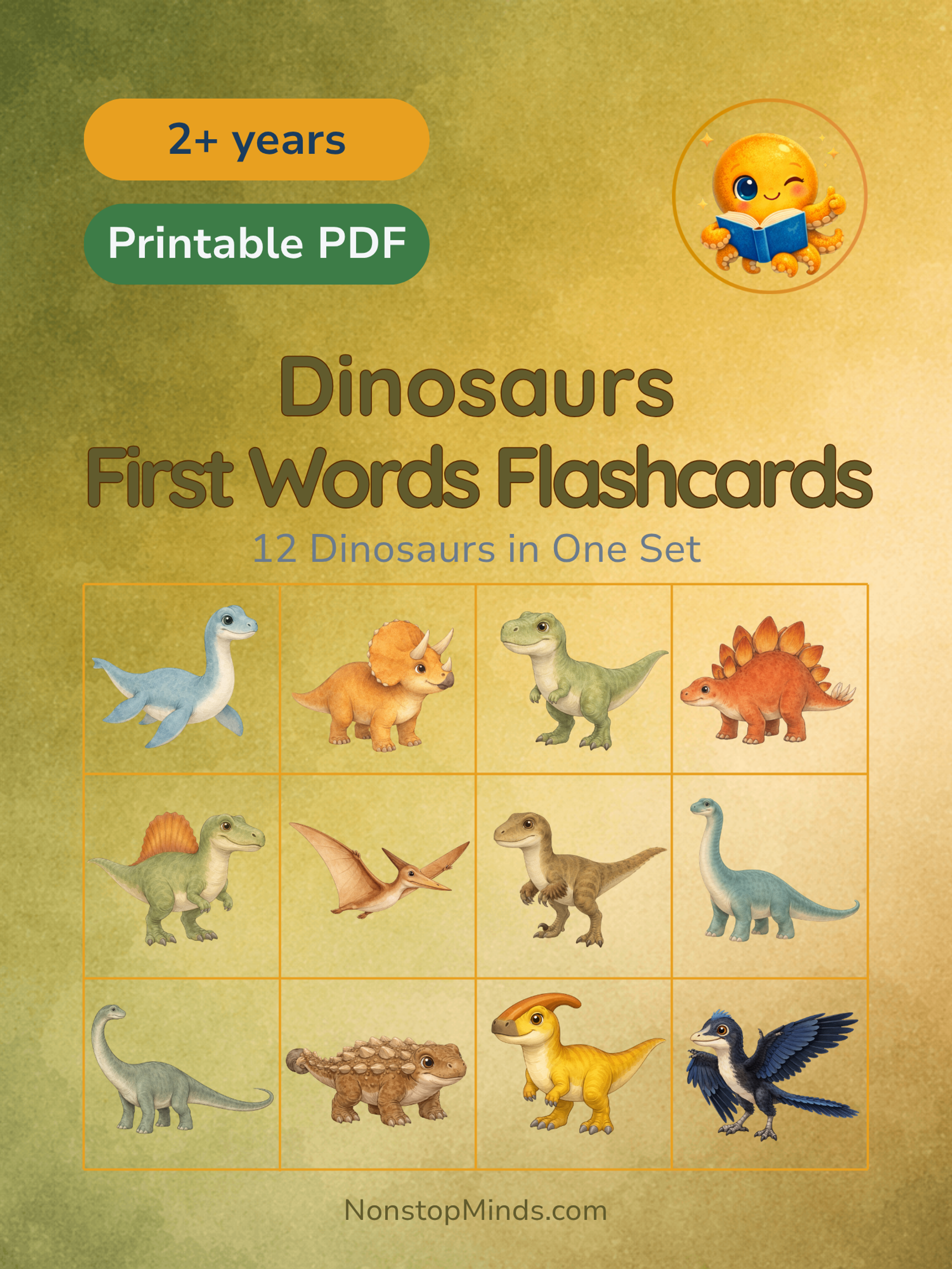
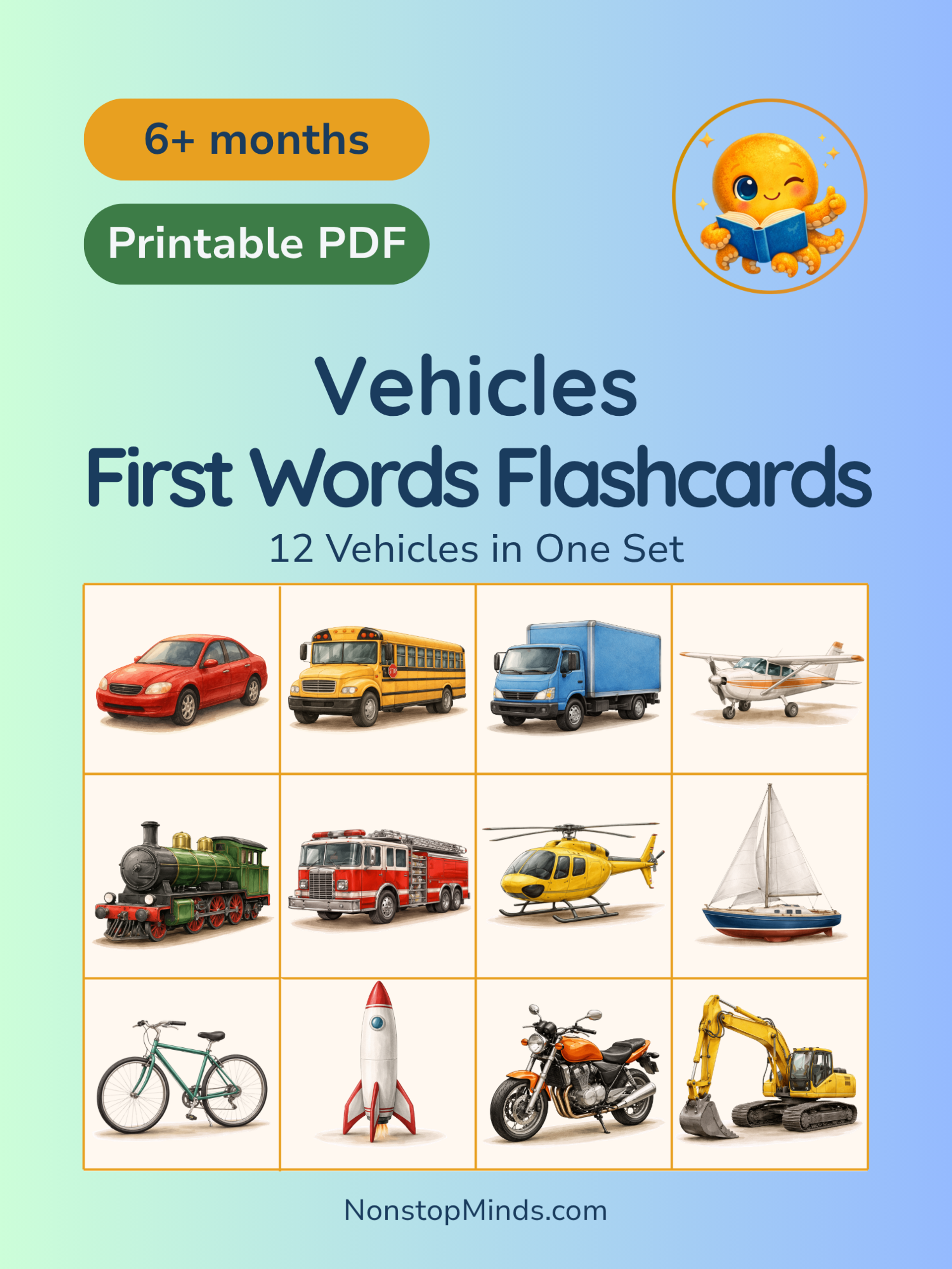
If you're looking for a simple way to build naming and vocabulary into your daily routine, our First Words flashcard sets cover five themes — farm animals, ocean animals, dinosaurs, fruits and vegetables, and vehicles — designed for exactly the kind of point-name-respond interaction the research supports. And for the full picture of how hearing, touch, and all the other senses develop alongside language from birth through the first year, our sensory development guide walks through each system month by month.
Frequently Asked Questions
Most babies produce their first recognizable word between 11 and 14 months. However, the range is wide — some babies say a word at 9 months while others wait until 18 months. Gestures, babbling with intent, and animal sounds all count as early communication milestones.
Narrate your daily activities ("Now we're putting on your socks"), respond to babbling as if it were conversation, read books together daily, and pause to give your baby time to respond. Research shows that the quantity and quality of language a baby hears directly predicts vocabulary development.
Disclaimer: This article is for educational and entertainment purposes only. It is not a substitute for professional medical advice. If you have concerns about your child's speech or language development, consult your pediatrician or a speech-language pathologist.
- Ferjan Ramírez, N., Lytle, S. R., & Kuhl, P. K. (2020). Parent coaching increases conversational turns and advances infant language development. Proceedings of the National Academy of Sciences, 117(7), 3484–3491.
- Ferjan Ramírez, N., Weiss, Y., Sheth, K. K., & Kuhl, P. K. (2023). Parentese in infancy predicts 5-year language complexity and conversational turns. Journal of Child Language, 50(6), 1319–1340.
- Romeo, R. R., Leonard, J. A., Robinson, S. T., West, M. R., Mackey, A. P., Rowe, M. L., & Gabrieli, J. D. E. (2018). Beyond the 30-million-word gap: Children's conversational exposure is associated with language-related brain function. Psychological Science, 29(5), 700–710.
- Kuhl, P. K. (2004). Early language acquisition: Cracking the speech code. Nature Reviews Neuroscience, 5, 831–843.
- Kuhl, P. K., Tsao, F.-M., & Liu, H.-M. (2003). Foreign-language experience in infancy: Effects of short-term exposure and social interaction on phonetic learning. Proceedings of the National Academy of Sciences, 100(15), 9096–9101.
- Kuhl, P. K., et al. (1997). Cross-language analysis of phonetic units in language addressed to infants. Science, 277(5326), 684–686.
- Liu, H.-M., Kuhl, P. K., & Tsao, F.-M. (2003). An association between mothers' speech clarity and infants' speech discrimination skills. Developmental Science, 6(3), F1–F10.
- Fenson, L., et al. (1994). Variability in early communicative development. Monographs of the Society for Research in Child Development, 59(5).
- National Institute on Deafness and Other Communication Disorders (NIDCD). Speech and Language Developmental Milestones.
- Centers for Disease Control and Prevention (2022). Learn the Signs. Act Early. Milestone Checklists.
Related Products
More Articles
Parallel Play in Toddlers: Why Side-by-Side Is the Social Work
Your toddler spent the entire playdate building separate towers, and nobody shared a single block. That counted — more than it looked. A 2025 longitudinal study found that playing beside a specific child consistently predicted later social play with that same child, but not the other way around. Here's what parallel play in toddlers actually is, why the science calls it strategic rather than passive, and what it means for how you run a playdate.
When Do Babies Point: Why It Matters for Language
Most milestone articles treat pointing as a box to check around 12 months. The research tells a different story — one that starts months earlier, runs through the infant brain, and traces back to how much the parent is pointing. Here's what the last fifteen years of research actually found, and what it means for everyday interactions.
When Do Babies Wave Bye-Bye: Why Your Baby Needs You to Wave First
Most baby milestones unfold on a biological schedule — waving isn't one of them. A 2023 study found that babies develop imitation ability because their caregivers imitate them first, and waving is named directly as a cultural gesture learned through that loop. Here's what the research says about the 9–12 month window, why the first wave looks nothing like a wave, and what helps it arrive.