Activities for an 11 Month Old: When the Body Starts Doing the Talking
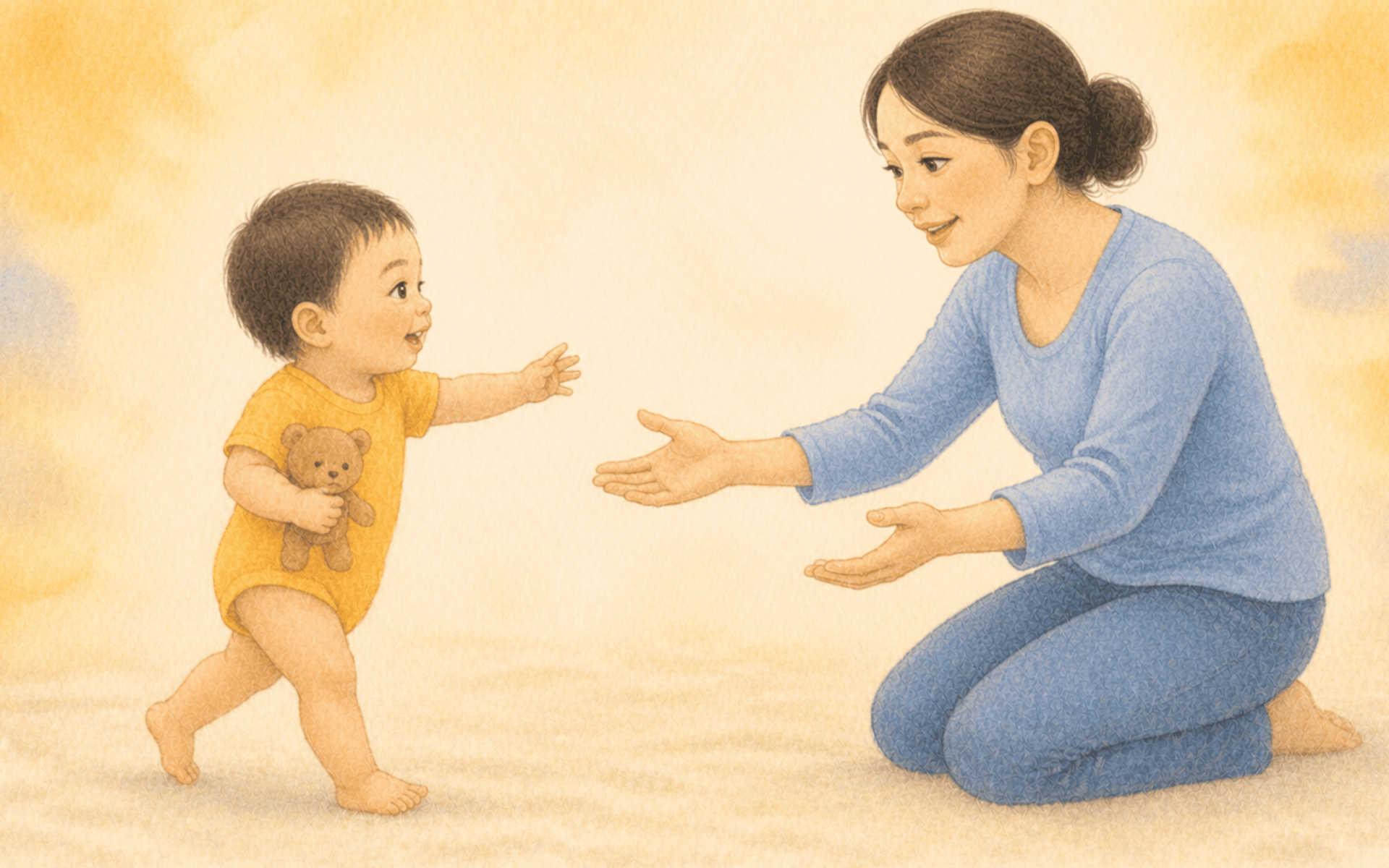
Most lists of activities for an 11 month old will tell you to start working on pointing. The research from the last few years says that's a month early, and the gesture you actually want to notice is the one your baby already does forty times a day, handing you things. A study tracking British infants from ten to twelve months found that the babies who handed objects to a parent most often at eleven months were the same ones pointing with an index finger by twelve. Pointing arrives on its own, once the gesture underneath it has had its month.
- The hand-out gesture that researchers now call the precursor to first words — and what to actually say when your baby does it
- The 2023 brain study that explains why your gesturing back changes more than your baby's mood
- Why the first steps are louder than they look — and what shifts in your kitchen the day they start
- A wake-window day that fits a body suddenly capable of carrying its own opinions across a room
- The single sign of silence that's worth gently mentioning at the next checkup
If the one-sentence answer is enough, you’ve got the gist. If you want the mechanism behind each piece, keep reading.
The hand-out gesture nobody warns you about
Eleven months is the month of the holdout. Your baby comes toward you somehow, with a wooden spoon, a sock, a half-chewed teething ring, and pushes it into your hand. Two seconds later it's reclaimed. The cycle repeats. Researchers call this show-and-give, and a 2015 study in Infancy by Cameron-Faulkner, Theakston, Lieven and Tomasello followed British infants across the second half of the first year and found that the frequency of show-and-give gestures at ten and eleven months predicted how often the same infants pointed with an index finger at twelve. The gestures everyone celebrates at the first birthday are built on the gestures most parents barely notice a month earlier. Our activities for a 10 month old piece picks up the language thread one step earlier, when abstract words like uh-oh and all gone first begin to mean something.
A 2021 replication by Choi, Wei and Rowe, published in Developmental Psychology, followed 47 American infants from ten to sixteen months. The researchers tested which gestures predicted vocabulary at eighteen months. Show-and-give at the early end of the window mattered. The pattern held across diverse socioeconomic backgrounds, which the original British sample had not. Show-and-give is a developmental move that travels.
What this means in practice is small and concrete. When your baby holds out the spoon, take it with both hands, look at it, name it, and hand it back. Not "thank you." Name what's there. That's the wooden spoon. The big wooden spoon. When your baby brings a sock, name the sock. When your baby pushes a banana piece toward you, take it, say banana, and let your baby see your face while you do. The full conversational unit is gesture–pause–label–return, and it lasts about four seconds. A handful of those exchanges across a meal is real developmental work. The interaction is the activity, and it is the engine that almost every credible list of 11 month old activities is trying to build around.
Naming what your baby hands you is also where vocabulary builds fastest right now. A 2022 PNAS study by Spriet and colleagues at the CNRS lab in Lyon mapped how the visual brain (the part of the cortex that processes what the eyes see) sorts objects across the first year in one hundred infants. Between four and ten months, infants sort the world by animate and inanimate. By eleven months, the categories begin to look like the adult brain: small natural objects, faces, bodies, and vehicles each pull their own cluster of activity. Your baby is now sorting the spoon, the banana, and the sock into separate mental drawers. Naming the object the baby hands you puts the right label on the right drawer at exactly the moment the drawer is being built.
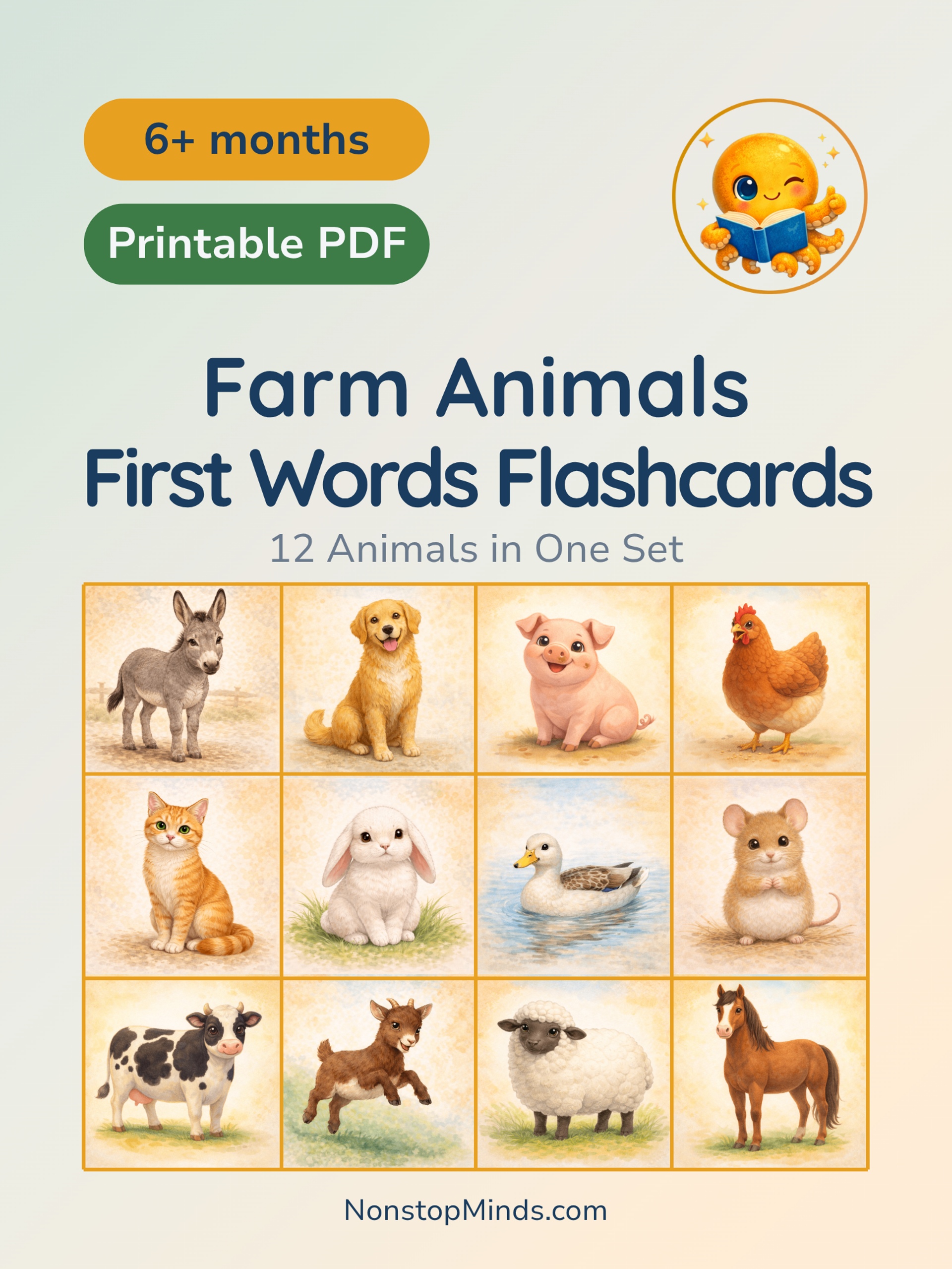
Sets like our Farm Animals First Words flashcards work with this stage on purpose: twelve concrete nouns your baby is also seeing in books and in the high chair, named the same way each time. The card is a prop for the gesture. You hold it out, your baby reaches, you let go, you say cow. You take it back, your baby reaches, you say cow again. The card is doing the same job as the wooden spoon, which is why our Sensory Play Cards 0–12 Months include a treasure-basket activity in the nine-to-twelve-month block that turns the whole thing into a station.
What changes in the brain when you gesture back
The reason your gesturing back matters is not motivational. It is sensorimotor. A 2023 study in Developmental Psychology by Salo, Debnath, Rowe and Fox enrolled 81 infants between ten and twelve months and randomly assigned half of their parents to a short coaching session on using more pointing gestures during everyday play. The other half got the same toys but no instructions. Several weeks later, the researchers measured the babies' brain activity using EEG (small sensors on the scalp that pick up brain-wave patterns) while each baby watched an experimenter either point at an object or grasp one. The babies whose parents had been doing more pointing at home showed stronger sensorimotor brain activity (more pronounced mu rhythm desynchronization, the electrical signature of the motor cortex, the brain area that plans and controls movement, coming online) when watching someone else's gesture. And here is the line that earned the paper its place in the field: the size of that brain change predicted the size of the babies' receptive vocabulary growth. Not the parental pointing itself, but the brain shift it produced inside the baby.
In plain terms: when your baby watches you point at the dog and say dog, the part of the baby's brain that handles its own future pointing lights up. Watching gesture rehearses doing gesture, and that rehearsal is what speeds up the comprehension side of language. The Salo finding specifically locates the effect in the eleven-month window, when the motor system is mature enough to mirror what it sees.
The pattern this connects to is older. In a 2005 paper in Psychological Science, Iverson and Goldin-Meadow tracked which objects babies first identified with a pointing gesture and found that those same objects predictably appeared as the babies' spoken words about three months later. For most eleven-month-olds, who are not yet pointing themselves but are deep in the show-and-give phase, what's being built right now is the precursor to that whole loop. You're rehearsing it for them every time you point and name.
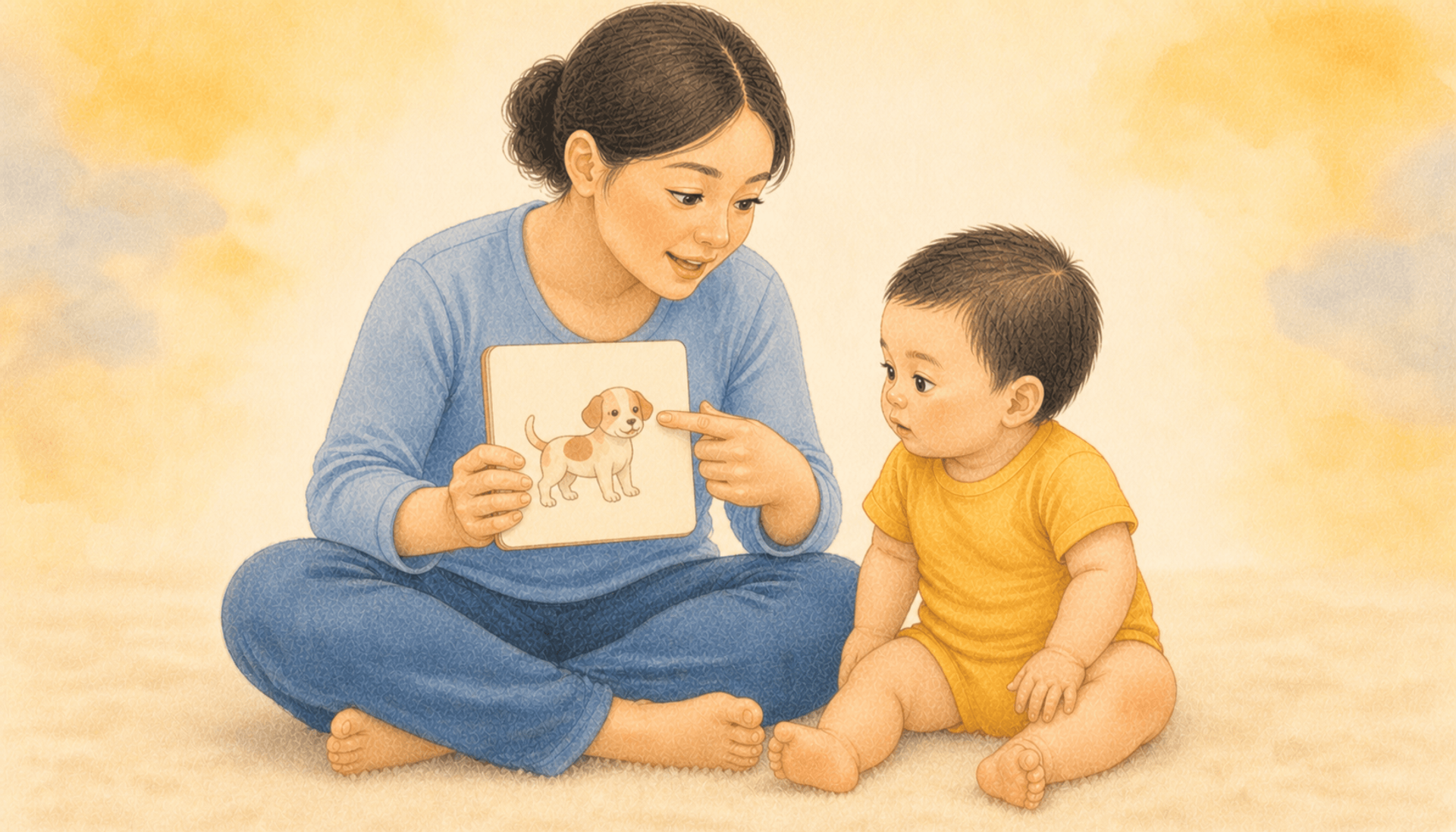
The actionable shift this month is to gesture deliberately at the things you're already naming. Not constantly. Specifically: when you say a noun, point to its referent. There's the cat. (Point.) Look, a bus. (Point.) Where are your shoes? There they are. (Point.) Two or three deliberate points per minute during an ordinary conversation are plenty. Small movements, clear hand, your baby's eyes following from your finger to the object. That's the loop the brain is wiring.
This is also one of the few moments where books out-perform almost any other activity. Reading together with simple, named pictures gives you a stable, repeatable target for pointing, and your baby has both hands free to do something other than crawl away. A 2008 study by Brooks and Meltzoff in the Journal of Child Language found that infants who reliably followed a parent's gaze and point by their first birthday went on to have meaningfully larger vocabularies through the second year. The book is not magic. The pointing-while-looking-at-the-same-thing is.
Walking is louder than it looks
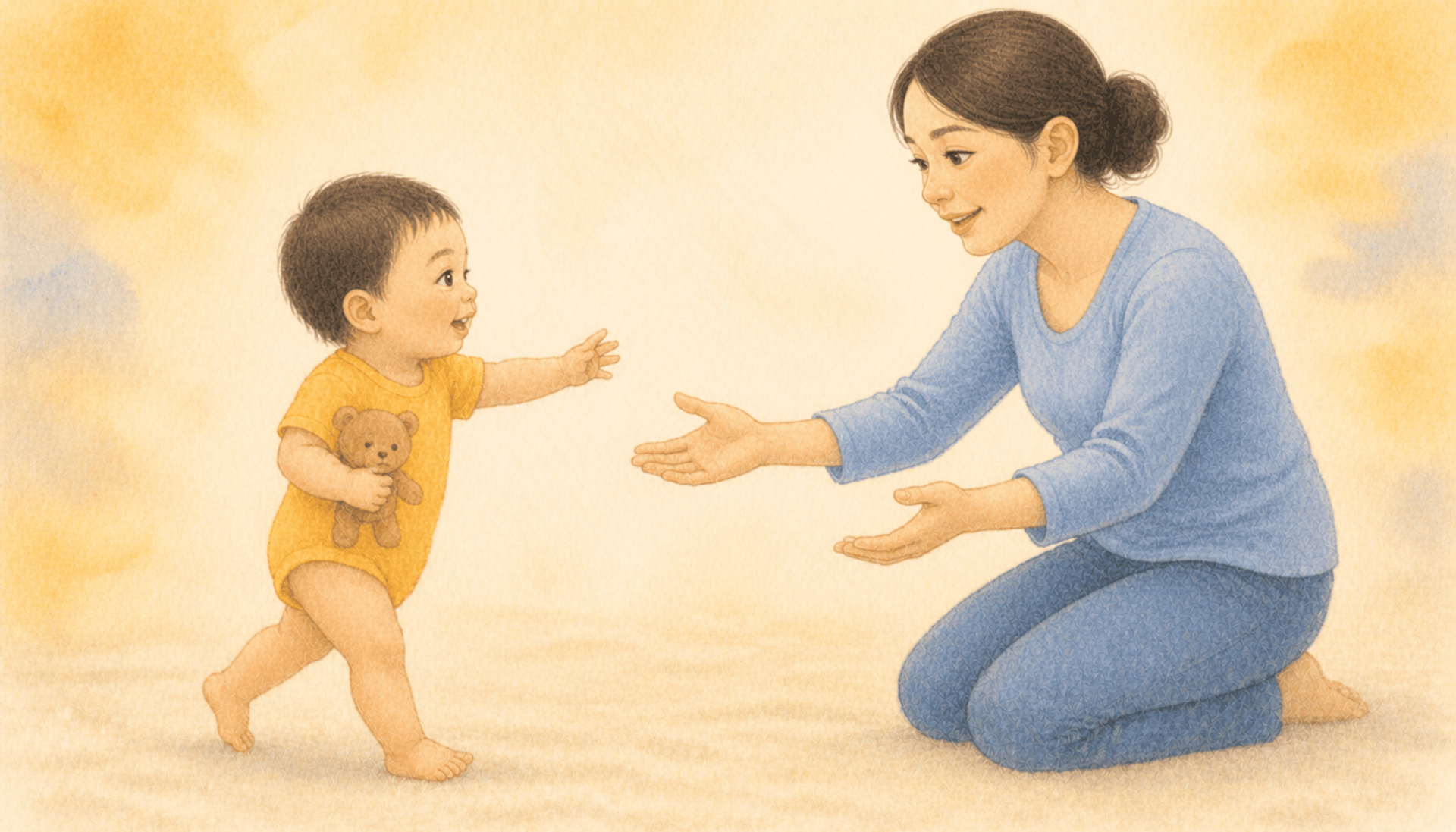
The last big developmental change of the eleventh month, in babies who get there on the early end, is the first independent step. The mean age of walking onset in a longitudinal sample of 25 infants studied by West and Iverson and published in Developmental Science in 2021 was 11.76 months. That number sits squarely inside the band most pediatricians watch, and it disguises something important. The same study found that the first independent steps marked an inflection point in communication, not just locomotion. After babies began to walk, the pace of gesture growth jumped sharply, while vocalization growth stayed on the same trajectory. Walking did not make babies louder. It made them gesture more.
The reason is geometric. Crawling babies bring objects to mom or dad from across a kitchen, but they tend to do it close to the floor and close to the parent. Walking babies do something different: they pick something up across the room, walk it over with one hand, present it from full standing height, often while also looking up and vocalizing. The whole exchange becomes more visible. Parents, in turn, respond to more of these communicative bids. The same study found that parents had measurably more chances to give a contingent verbal reply ("what did you find?", "is that yours?") when their baby was walking than when the baby was crawling. The rich linguistic input that everyone wants for their baby is partly determined by how easy the baby is to see and hear at any given moment, and walking changes that overnight.
Jana Iverson's 2022 review in WIREs Cognitive Science sets this finding inside a larger pattern. New motor skills (sitting, crawling, walking) each open a developmental cascade in which what a baby can do reorganizes what a baby gets back from the people around. Iverson's term is cascading effects. Walking is among the loudest of these cascades because it changes both what your baby brings to the conversation and what you, without trying, end up saying back.
If your baby has just started taking steps, the most useful thing you can do is get out of the way. Let the new walker carry small, safe objects from one end of the room to the other and back. Wide floor space, low furniture cleared of breakables, and you positioned at the far end of an open route is a better activity setup right now than any structured play scheme. When your baby brings something across, react. Name it. Ask a real question, not a leading one. Where did you find that? and What is it? are conversational openings the brain wires hardest into. If your baby is still cruising or only briefly letting go of the couch, the same logic applies on a smaller scale. Let the baby cover the available distance independently before you scoop in.
For a fuller account of when the first independent steps usually arrive and what the WHO data actually predict, our piece on when babies start walking walks through the usual window. The transition from when babies start crawling is also worth a separate read if your baby is still firmly in that phase. Most eleven-month-olds are, and the developmental work of crawling is not over just because cruising has started.
A wake-window day that fits the new shape
Most eleven-month-olds stay awake for about three to four hours between naps, with the longer stretch usually before the last sleep of the day. The most productive activities for an 11 month old spread across the day rather than stacking into one long session. The structure that uses all the developmental work above looks something like this, adapted to your baby's sleep cues, not the clock.
After a feed and diaper change, the most productive twenty to thirty minutes are gesture-heavy and floor-based. Sit in arm's reach with a small basket of safe, varied objects (a wooden spoon, a fabric ball, a silicone teether, a clean measuring cup, a board book or two). Let your baby pull them out, hand them to you, take them back, drop them, retrieve them. Your job is to name what comes into your hand and ask real questions in response. This is the show-and-give station, and it's where the work of the month happens. Each round is itself a sensory activity for an 11 month old: weight, texture, temperature, and the surprise of every object's edges all come through the hands while the language layer is added on top. A baby in the middle of this loop usually does not need entertainment from a screen, an adult-led "lesson," or a new toy.
The next block is best spent vertical and mobile. Cruising along a couch, walking with one hand held, a push-toy on a flat surface: anything that gives the body practice carrying its own weight while moving. If your baby is taking independent steps, clear an honest twelve-by-twelve-foot path and stand at one end. The point is the round trip, not the destination. Walking with an object in hand is one of the highest-yield activities of the month, because it bundles motor practice, gesture (the carrying), and your verbal response (the naming) into one activity.
If the day includes time with a non-parent caregiver (grandparent, partner, sitter, daycare drop-off), the eleventh month is when transitions need to slow down. A 2021 study in PLOS ONE by Liu, du Toit and Weidemann tested how Australian eleven-month-olds responded to facial expressions from mothers of two different cultural backgrounds. Eleven-month-old babies were already reliably picking up on the cultural cues in the expressions. Your baby is reading faces with more nuance than even a few months ago, including the faces of people the baby does not see every day. Slow handoffs, you holding the baby first, the new person approaching slowly while talking to you (not to the baby): all of this matches the level of social sensitivity the baby now actually has. None of it is fussiness on your part. It is the activity matched to the brain.
The outing or outdoor piece, however brief, is its own activity. A walk in the carrier through unfamiliar streets exposes the baby to new categorical input (buses, dogs, leaves, trash trucks, neighbors) at exactly the age the visual brain is building those categories. You don't need a script. Naming what passes is enough. That's a bus. There's a dog. Big dog. Look at the leaves. If you'd rather not improvise the script every time you sit down for the indoor version of this, the back of each card in our Sensory Play Cards 0–12 Months gives you the words to lean on, with the ones from the first-year receptive vocabulary in bold.
Three or four minutes of narrated walking outdoors is a real activity. So is sitting on a blanket in a backyard while your baby investigates grass and twigs with you naming what gets picked up. Skip the structured outing if it's a short or hard day. The unstructured ones do most of the developmental work anyway.
The last short block before the next nap is the time to bring it down. Soft music, one favorite book, low light, a feed if it fits. Watch for the cues (the eye rub, the glassy stare, the sudden fussiness) rather than the clock. Cruising, carrying, and the gesture work above are tiring in a way that surprises new parents, and naps may shift around the eleventh month for that reason alone.
When the silence is worth a quiet check-in
The pattern across the research above is that eleven-month-olds are usually doing more than one form of communication at once: they hand things to you, they look toward what they want, they reach with intent, they make sounds with the rhythm of conversation, they react to the change in your face. If by fourteen or fifteen months your baby is still not doing any of those things (no holdouts, no reaching to be picked up, no protest sounds, no following your point or your gaze), that is the kind of pattern worth raising at the next regular pediatric visit. Most late-emerging communicators catch up on their own. The developmental picture is just easier for a pediatrician to read with a few notes than to reconstruct from memory months later.
The same goes for any sudden loss of skills your baby was already doing reliably: words that have disappeared, a baby who used to wave but no longer does, a baby who used to respond to a familiar name and stopped. Those changes are also the kind of thing pediatricians genuinely want to hear about. Bring it up. Information is not alarm.
What is not a reason to worry: a baby who is enthusiastically gesturing but has not yet said a clear word, a baby still firmly crawling at the end of the eleventh month, a baby who points sometimes but not on demand, or a baby who is suddenly more clingy with new people than a month ago. All of these are well inside the usual range. For the underlying timeline of how spoken language emerges from this exact gesture-rich phase, our piece on when babies start talking and what first words actually look like walks through the next stage of the same story.
Frequently Asked Questions
Four activities cover most of what an 11 month old needs at home: a show-and-give station (a small basket of varied safe objects you and your baby pass back and forth while you name them), book time with simple labeled pictures so you have a stable target to point at, flashcards with single themes like animals, food, or vehicles that your baby can hand back to you while you name the picture, and an open floor route for cruising or early walking with a carried object. Together these cover the gesture, language, and motor work specific to the month. A 2015 study in Infancy by Cameron-Faulkner and colleagues found that the frequency of show-and-give gestures at ten and eleven months predicted index-finger pointing at twelve, which is why the simple handoff loop matters more than the specific object you put in your baby's hand.
Most 11-month-olds stay awake between naps for about three to three and a half hours, with the longest stretch usually before the last nap. The day usually includes two naps that together total about two and a half to three hours of sleep. Watch for cues (eye rubbing, a glassy stare, sudden fussiness) rather than the clock. Cruising and carrying objects across the room burn real calories, and naps may shift around the eleventh month for that reason. Some early walkers begin transitioning toward one nap a day in the next month or two, but most are still firmly on two.
Some do, some don't. Index-finger pointing typically emerges between ten and thirteen months, with the most reliable wave of new pointers showing up around the first birthday. A longitudinal study by Choi, Wei and Rowe, published in Developmental Psychology in 2021, followed 47 infants from ten to sixteen months and found that show-and-give gestures (handing or holding out objects) usually appear before index-finger pointing and predict its emergence. If your eleven-month-old is enthusiastically handing things over but not yet pointing, the developmental work is on track; pointing is the next gesture in the same sequence.
The American Academy of Pediatrics and the CDC publish a formal milestone checklist for 12 months rather than 11, but most eleven-month-olds are doing some combination of: pulling to stand, cruising along furniture, taking a few steps with one hand held or briefly without support, picking up small foods with a refined pincer grasp, handing objects to a parent, responding to their name, understanding a handful of common words and short phrases, and producing strings of babble that sound like the rhythm of real sentences. There is wide normal variation. A baby firmly in one category and just emerging in another is the rule, not the exception.
The current AAP guidance, updated in early 2026, has shifted from strict time limits toward a framework built around quality, context, and what the screen is replacing. For babies under 18 months, the core line is still to avoid screen media, with one carved-out exception: video calls with family members, which the AAP treats as social interaction rather than passive viewing because the person on the other end actually responds in real time. The reason behind that line is the video deficit effect: babies consistently learn less from a screen than from the same content delivered live, even when the audio is identical. A few minutes of incidental screen time while you take a shower or finish a phone call is not the issue. Heavy, prolonged, unsupervised use is, mostly because of what it displaces. Our full breakdown, including what background TV does to baby attention, is in our screen time for babies piece.
For educational and entertainment purposes only. Not a substitute for professional medical or developmental advice. If you have concerns about your baby's development, consult your pediatrician.
- Brooks, R., & Meltzoff, A. N. (2008). Infant gaze following and pointing predict accelerated vocabulary growth through two years of age: A longitudinal, growth curve modeling study. Journal of Child Language, 35(1), 207–220.
- Cameron-Faulkner, T., Theakston, A., Lieven, E., & Tomasello, M. (2015). The relationship between infant holdout and gives, and pointing. Infancy, 20(5), 576–586.
- Choi, B., Wei, R., & Rowe, M. L. (2021). Show, give, and point gestures across infancy differentially predict language development. Developmental Psychology, 57(6), 851–862.
- Iverson, J. M. (2022). Developing language in a developing body, revisited: The cascading effects of motor development on the acquisition of language. WIREs Cognitive Science, 13(6), e1626.
- Iverson, J. M., & Goldin-Meadow, S. (2005). Gesture paves the way for language development. Psychological Science, 16(5), 367–371.
- Liu, L., du Toit, M., & Weidemann, G. (2021). Infants are sensitive to cultural differences in emotions at 11 months. PLOS ONE, 16(9), e0257655.
- Salo, V. C., Debnath, R., Rowe, M. L., & Fox, N. A. (2023). Experience with pointing gestures facilitates infant vocabulary growth through enhancement of sensorimotor brain activity. Developmental Psychology, 59(4), 676–690.
- Spriet, C., Abassi, E., Hochmann, J.-R., & Papeo, L. (2022). Visual object categorization in infancy. Proceedings of the National Academy of Sciences, 119(8), e2105866119.
- West, K. L., & Iverson, J. M. (2021). Communication changes when infants begin to walk. Developmental Science, 24(5), e13102.
- American Academy of Pediatrics. (2024). Developmental milestones: 12 months. HealthyChildren.org.
More Articles
Parallel Play in Toddlers: Why Side-by-Side Is the Social Work
Your toddler spent the entire playdate building separate towers, and nobody shared a single block. That counted — more than it looked. A 2025 longitudinal study found that playing beside a specific child consistently predicted later social play with that same child, but not the other way around. Here's what parallel play in toddlers actually is, why the science calls it strategic rather than passive, and what it means for how you run a playdate.
When Do Babies Point: Why It Matters for Language
Most milestone articles treat pointing as a box to check around 12 months. The research tells a different story — one that starts months earlier, runs through the infant brain, and traces back to how much the parent is pointing. Here's what the last fifteen years of research actually found, and what it means for everyday interactions.
When Do Babies Wave Bye-Bye: Why Your Baby Needs You to Wave First
Most baby milestones unfold on a biological schedule — waving isn't one of them. A 2023 study found that babies develop imitation ability because their caregivers imitate them first, and waving is named directly as a cultural gesture learned through that loop. Here's what the research says about the 9–12 month window, why the first wave looks nothing like a wave, and what helps it arrive.