Sensory Play for Babies: A Month-by-Month Guide (0–12 Months)
Your baby is born with every sense already working — just not at full power. Over the first twelve months, those senses sharpen at a speed that will never be matched again in your child's lifetime, and the fuel for that process is surprisingly ordinary: everyday sensory experiences.
Sensory play is one of those terms that sounds more complicated than it is. At its core, it means any activity that engages one or more of a baby's senses — sight, sound, touch, movement, or body awareness. You don't need special equipment or a Pinterest-worthy play station, just intentional moments woven into the day you're already having.
- What experience-dependent synaptogenesis means — and why everyday moments count more than special activities
- Months 0–3: why high contrast, touch, and your voice are the only sensory tools the newborn brain can use
- Months 3–6: how color vision, mouthing, and active grasping change what sensory play should look like
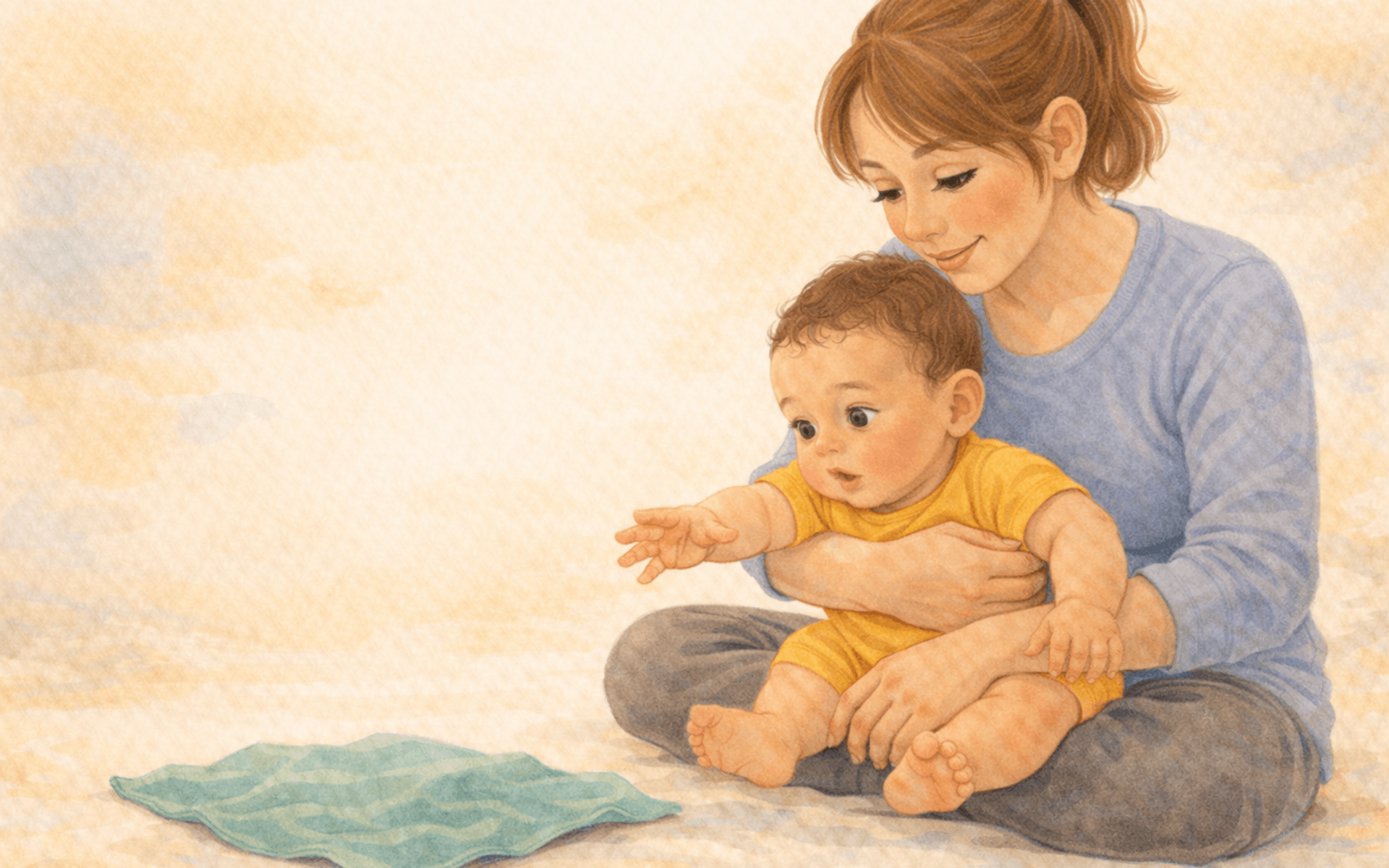
- Months 6–9: why banging, dropping, and messy eating are proprioceptive development in action
- Months 9–12: how purposeful exploration, pointing, and object permanence games reflect maturing brain architecture
- How to read overstimulation signals — and why stopping at the right moment is as important as starting
If the one-sentence answer is enough, you’ve got the gist. If you want the mechanism behind each piece, keep reading.
What Happens in the Brain During Sensory Play
In the first few years of life, a baby's brain forms more than one million new neural connections every second. Some people assume that's a beautiful metaphor, but it's actually a real measurement from researchers at Harvard's Center on the Developing Child. Each sensory experience — a texture under small fingers, a familiar voice from across the room, a bold pattern catching the eye — helps strengthen the pathways the brain will keep and prune the ones it won't use.
This process is called experience-dependent synaptogenesis, and it's the reason the first years matter so much. The brain doesn't develop on autopilot — it builds itself based on what it receives from the world around it.
The good news is that you don't need flashy toys or a curated sensory bin to make it work. Research consistently shows that responsive, varied sensory input from a caring adult is the single strongest driver of healthy brain development in infancy. So congratulations — you've just been named the most important piece of sensory equipment in the house.
0–3 Months: A World of Contrast and Closeness
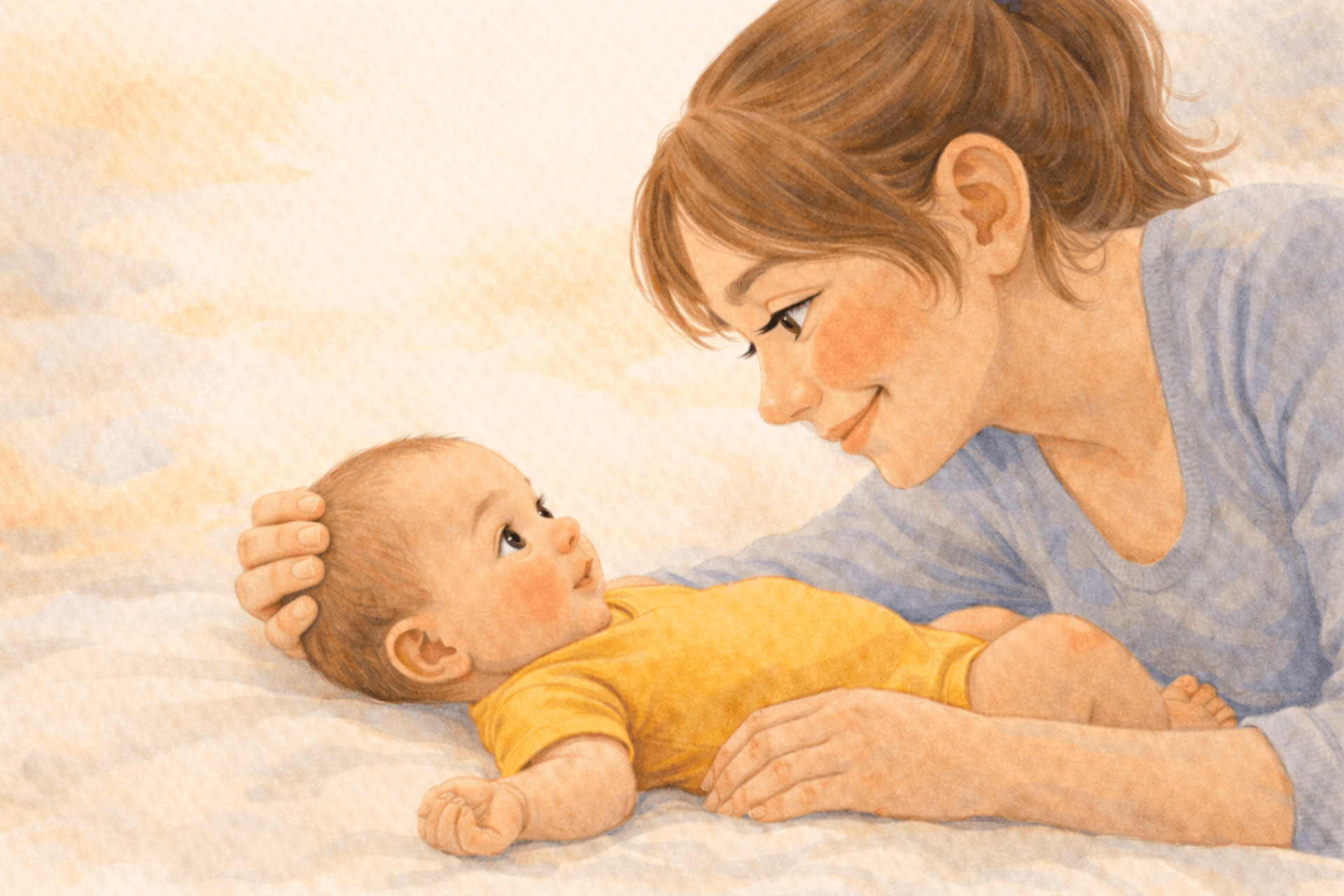
A newborn's senses are online, but the volume is turned way down. Vision is blurry beyond 8–12 inches, hearing is tuned to the pitch of the human voice, and touch — the most developed sense at birth — is the primary way a baby understands safety long before other senses catch up.
What's developing: The visual system is the star of this stage. The retina is still maturing, which means high-contrast patterns (bold black and white) are the easiest thing for the brain to process. By 6–8 weeks, most babies begin tracking a moving object with both eyes — a milestone called smooth pursuit that marks a real leap in visual coordination. We wrote a detailed week-by-week guide to what newborns actually see and when — it covers exactly how and why this works. Our High Contrast Flashcards for 0–3 Months are designed around this exact developmental window.
What sensory input supports this stage:
Vision: High-contrast images held at 8–12 inches, slow side-to-side movement for tracking practice, and your face — which remains the most fascinating "pattern" a newborn knows.
Touch: Skin-to-skin contact, gentle stroking during diaper changes, and varied textures against tiny hands and feet — a soft blanket, a cool washcloth, the warmth of your palm. Even these small contrasts help the brain start mapping the tactile world.
Sound: Your voice narrating what you're doing, singing (pitch doesn't matter — familiarity does), and gentle environmental sounds like rain, a fan, or a heartbeat recording.
Movement: Gentle rocking, being carried in different positions, and supervised tummy time on your chest — all of which feed the vestibular system that will eventually help with balance, sitting, and independent movement. And if tummy time feels like a battle, these seven positions can help.
At this age, sensory play isn't a separate activity you schedule between naps. It's embedded in feeding, changing, holding, and talking — which means if you're doing those things, you're already doing it.
3–6 Months: Reaching, Grasping, and the Discovery of Hands
Around three months, something shifts. A baby's hands open up — literally. The palmar grasp reflex fades, intentional reaching begins, and touch goes from passive (being touched) to active (touching things on purpose), which changes everything about how the world gets explored.
What's developing: Color vision matures significantly between 3 and 5 months, depth perception begins to emerge, and babies start bringing objects to the mouth — not out of hunger, but because the lips and tongue have more nerve endings per square centimeter than almost any other body part. Mouthing is one of the most efficient ways for a developing brain to gather information about shape, texture, and temperature.
What sensory input supports this stage:
Vision: This is the time to introduce color. If you're wondering about the timeline — when babies start seeing color and which colors come first — we covered the science in a separate guide. Colorful objects against simple backgrounds help the brain practice figure-ground separation — the ability to distinguish an object from what's behind it. Moving a toy slowly through the visual field and watching a baby's eyes and head follow together is both a play activity and a developmental exercise happening simultaneously.
Touch: Texture variety matters more now than at any other point in the first year. Soft, bumpy, smooth, crinkly, cool, warm — offering objects of different weights and sizes gives the tactile system a richer vocabulary to work with. Even something as simple as wet hands on a tray introduces a completely new sensory category.
Sound: Rattles and crinkle toys let a baby discover cause and effect — "I moved my hand and something happened." Responding to coos and babbles with conversation creates what researchers call "serve and return" — a back-and-forth exchange that builds the foundation for both language and social-emotional development.
Movement: Supported sitting, gentle bouncing, and rolling from back to tummy all feed the vestibular system — the sense of where the body is in space — which is quietly building the balance architecture needed for sitting, crawling, and eventually walking.
6–9 Months: The Explorer Arrives

If the first six months were about "what is this?", the next three are about "what can I do with this?" A baby who can sit (with or without support), transfer objects between hands, and develop the pincer grasp brings a level of curiosity that's nothing short of relentless.
What's developing: The proprioceptive system, which tells the brain where the body is without looking, is maturing rapidly. This is why a 7-month-old suddenly wants to bang, drop, throw, and squish everything in reach — each of those actions sends feedback to the brain about force, distance, and weight, and that feedback loop is how the brain learns to calibrate movement.
What sensory input supports this stage:
Touch: Messy play enters the picture, and mealtimes become the ultimate multisensory experience. Mashed banana, yogurt, cooked pasta — every new food texture involves temperature, smell, taste, and fine motor practice all at once, and if it feels chaotic, that's because it is. That chaos is the point.
Sound: Banging a spoon on a pot, clapping hands, babbling back and forth with you. Babies at this age are beginning to understand that sounds carry meaning, and every "conversation" — even one built entirely from "ba-ba-ba" — strengthens the auditory processing that speech will depend on.
Movement: Crawling, pulling to stand, cruising along furniture. Every new position gives the vestibular and proprioceptive systems another data point, and honestly, the best gym for a 7-month-old is a living room with a couch to pull up on. Free movement — on the floor, over cushions, through safe spaces — does more than any structured activity.
Vision: Object permanence is developing, which means games like peek-a-boo are doing more than just getting a laugh — a baby is learning that things continue to exist even when hidden. Partially covering a toy with a cloth and letting a little one "find" it supports both visual memory and early problem-solving.
9–12 Months: Purposeful, Coordinated, and Determined
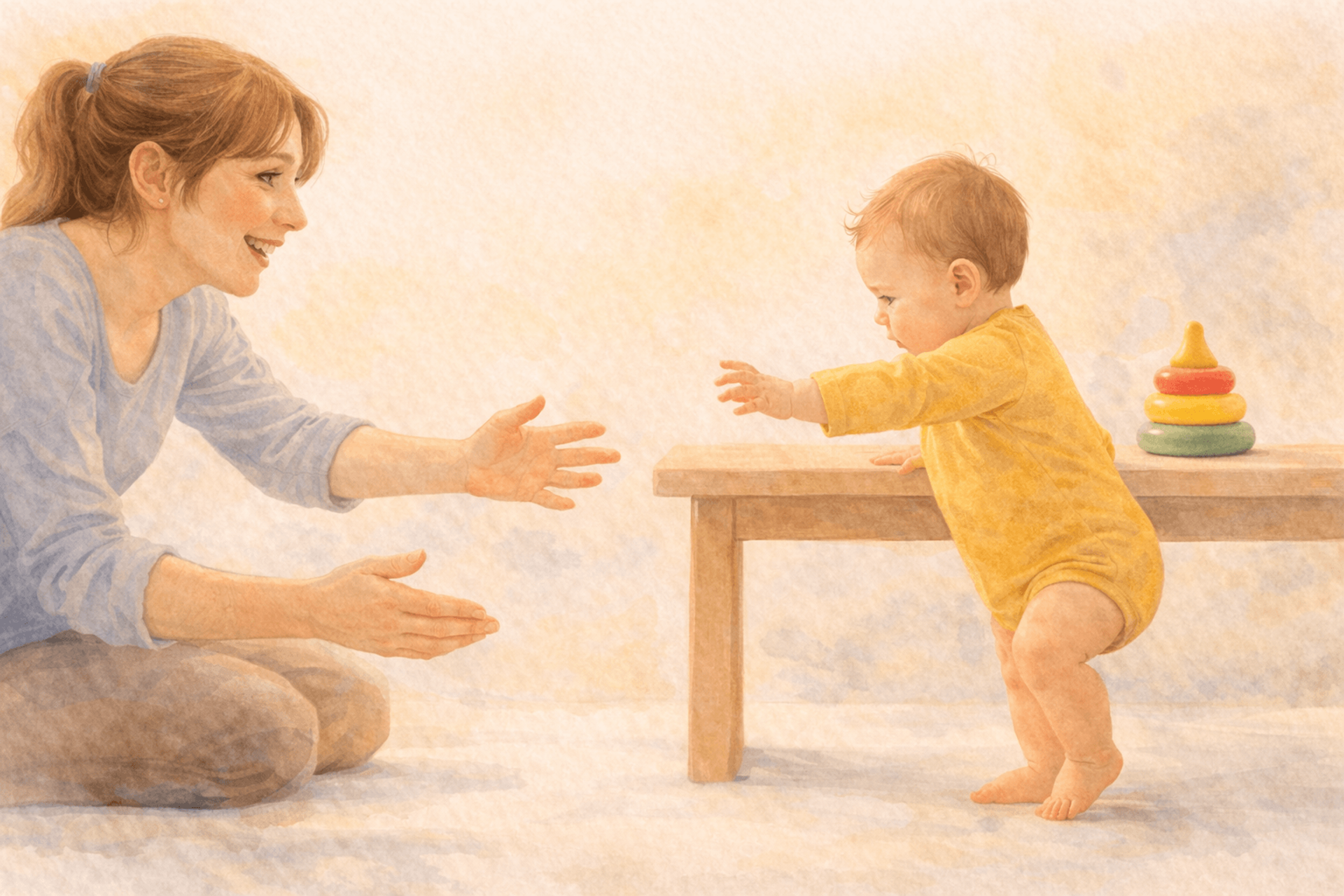
By now, a baby doesn't just react to sensory input — the seeking is active and deliberate. A 10-month-old will open a drawer, pull everything out, put one thing back, take it out again, and look at you to see if you're watching. This is advanced sensory-motor integration, and it's exactly the kind of purposeful exploration the brain needs at this stage.
What's developing: The prefrontal cortex — responsible for planning and attention — is becoming more active, which means a baby can now hold a goal in mind ("I want that toy on the shelf") and sequence actions to achieve it (crawl over, pull up, reach). Fine motor control is refining: stacking, nesting, pointing, turning pages. And while spoken words may still be few, comprehension is running far ahead of production — by the first birthday, most children understand significantly more words than they can say.
What sensory input supports this stage:
Touch and fine motor: Stacking cups, nesting toys, putting objects into containers and dumping them out (repeatedly — that's the whole game), finger foods of varied textures, and turning board book pages. Anything that gives interesting tactile and proprioceptive feedback when poked, prodded, or squeezed.
Sound and language: Singing songs with hand motions (the movement-sound pairing strengthens memory), naming objects as a baby points to them, and reading together while pointing at pictures. This combination of joint attention and naming is one of the most powerful vocabulary-building tools available — and it costs nothing.
Movement: Walking with or without support, climbing low steps, dancing to music. The vestibular system is nearly mature, but it needs practice across varied contexts — spinning slowly on your lap, going down a gentle slide, rocking in a chair all help calibrate the balance system in different ways.
Vision and cognition: Simple cause-and-effect toys (press a button, something pops up), shape sorters, and pointing at distant objects and naming them. A baby's visual world has expanded from 8 inches to the entire room, and every new target is an opportunity for the brain to connect what it sees with what it knows.
How to Tell If a Baby Is Overstimulated
More sensory input isn't always better. Every baby has a threshold — a point where stimulation becomes overwhelming instead of enriching — and the signs are fairly consistent across ages: turning the head or arching away, sudden fussing during play, yawning when not tired, a glazed "checked out" expression, or splayed fingers and a stiffened body.
When you see these, it's not a failure — it's clear communication. Pause the activity, reduce the input, and offer calm: a quiet hold, a dimmer room, a gentle voice. The AAP recommends following a baby's lead during play, stopping when the signals say "enough" and resuming when interest returns. Learning to read these cues is one of the most important parenting skills you'll build in the first year, and it gets easier week by week.
You Don't Need a Lot — You Need the Right Things at the Right Time
The research is remarkably consistent on one point: what matters isn't how many toys you have or how elaborate the setup is. What matters is whether the sensory experiences match a baby's current developmental window, and whether a responsive adult is part of the equation.
A crinkly fabric square is meaningless sitting on a shelf. In your hands, while you narrate what your little one is touching and feeling, it becomes a language lesson, a tactile experience, and a moment of connection — all at once.
That's the principle behind everything we create at NonstopMinds: the right input, at the right time, with the right support. Our Sensory Play Cards for 0–12 Months were designed as three tools in one deck — a sensory play guide, an illustrated picture-talk library, and an SLP-based vocabulary builder — so every card gives you the activity, the words, and the science in one place.
Frequently Asked Questions
Sensory experiences begin from birth. In the first weeks, high-contrast images and gentle touch provide appropriate sensory input. As the baby grows, activities can gradually increase in complexity — different textures at 3 months, water play at 6 months, and messy play closer to 12 months.
Yes, when supervised and age-appropriate. For babies under 6 months, sensory play focuses on visual stimulation (high-contrast patterns, colored objects), auditory input (music, voice), and gentle touch (fabric textures, skin-to-skin). Avoid small objects and anything that could be a choking hazard.
This article is for educational purposes only and is not a substitute for professional medical advice.
- Atkinson, J. (2000). The Developing Visual Brain. Oxford University Press.
- Corbetta, D., & Snapp-Childs, W. (2009). "Seeing and Touching: The Role of Sensory-Motor Experience on the Development of Infant Reaching." Infant Behavior and Development, 32(1), 44–58.
- Fenson, L., Dale, P. S., Reznick, J. S., Bates, E., Thal, D. J., & Pethick, S. J. (1994). "Variability in Early Communicative Development." Monographs of the Society for Research in Child Development, 59(5), 1–173.
- Harvard Center on the Developing Child. (2007). "The Science of Early Childhood Development." National Scientific Council on the Developing Child.
- Kolb, B., & Gibb, R. (2011). "Brain Plasticity and Behaviour in the Developing Brain." Journal of the Canadian Academy of Child and Adolescent Psychiatry, 20(4), 265–276.
- Teller, D. Y. (1997). "First Glances: The Vision of Infants." Investigative Ophthalmology & Visual Science, 38(11), 2183–2203.
- Yogman, M., Garner, A., Hutchinson, J., Hirsh-Pasek, K., & Golinkoff, R. M. (2018). "The Power of Play: A Pediatric Role in Enhancing Development in Young Children." Pediatrics, 142(3), e20182058.

More Articles
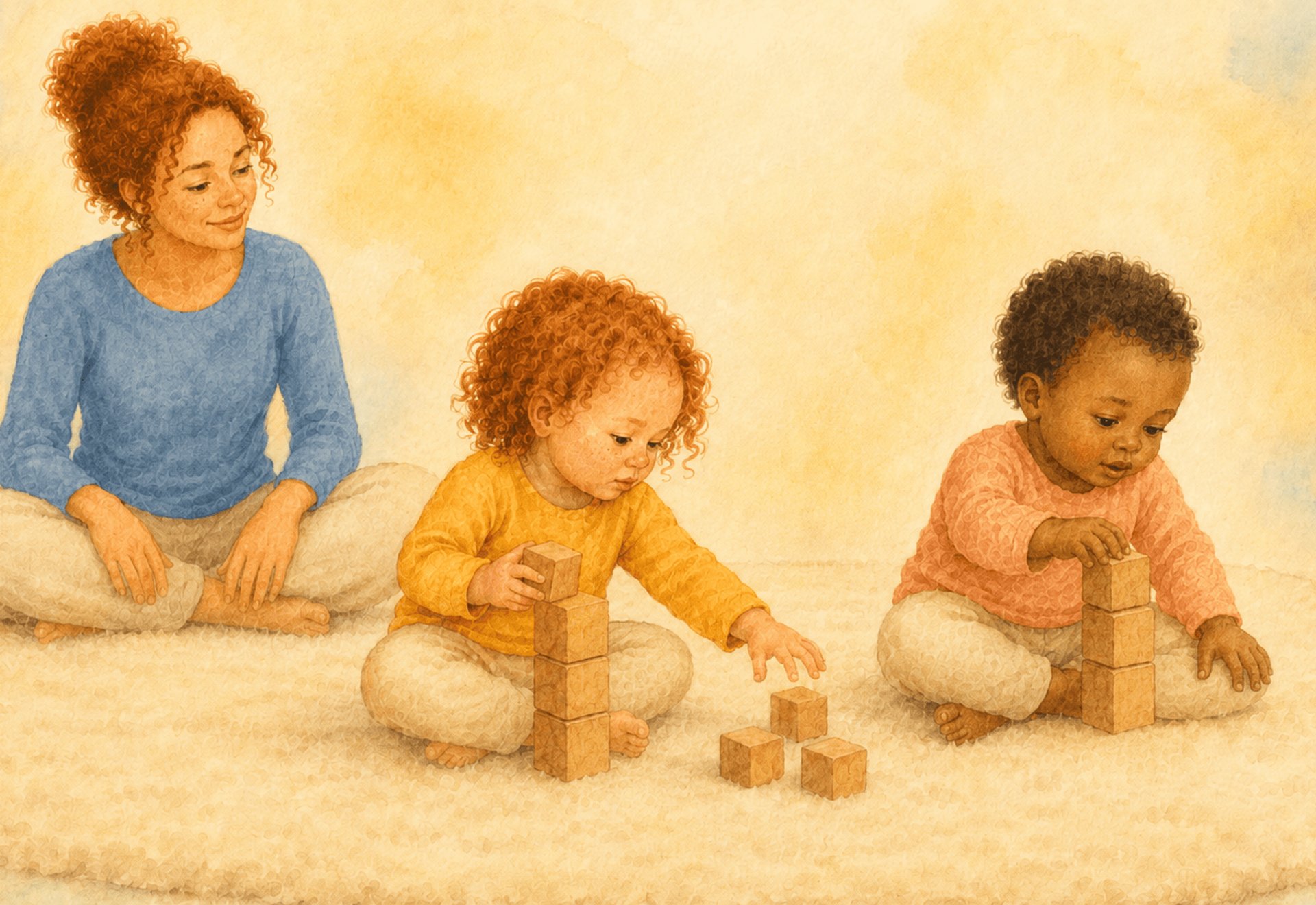
Parallel Play in Toddlers: Why Side-by-Side Is the Social Work
Your toddler spent the entire playdate building separate towers, and nobody shared a single block. That counted — more than it looked. A 2025 longitudinal study found that playing beside a specific child consistently predicted later social play with that same child, but not the other way around. Here's what parallel play in toddlers actually is, why the science calls it strategic rather than passive, and what it means for how you run a playdate.

When Do Babies Point: Why It Matters for Language
Most milestone articles treat pointing as a box to check around 12 months. The research tells a different story — one that starts months earlier, runs through the infant brain, and traces back to how much the parent is pointing. Here's what the last fifteen years of research actually found, and what it means for everyday interactions.
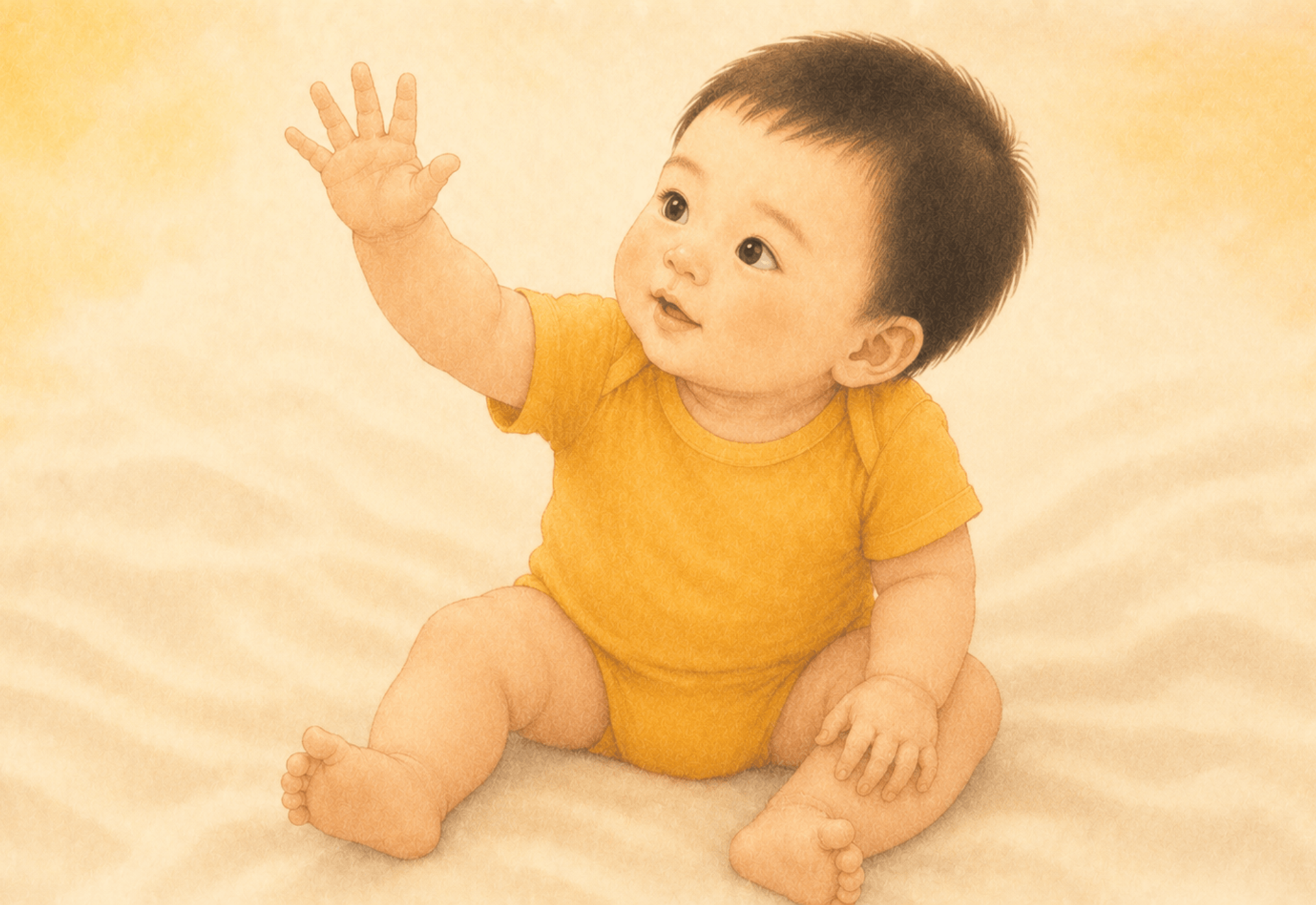
When Do Babies Wave Bye-Bye: Why Your Baby Needs You to Wave First
Most baby milestones unfold on a biological schedule — waving isn't one of them. A 2023 study found that babies develop imitation ability because their caregivers imitate them first, and waving is named directly as a cultural gesture learned through that loop. Here's what the research says about the 9–12 month window, why the first wave looks nothing like a wave, and what helps it arrive.