Color Contrast Cards
$8.99
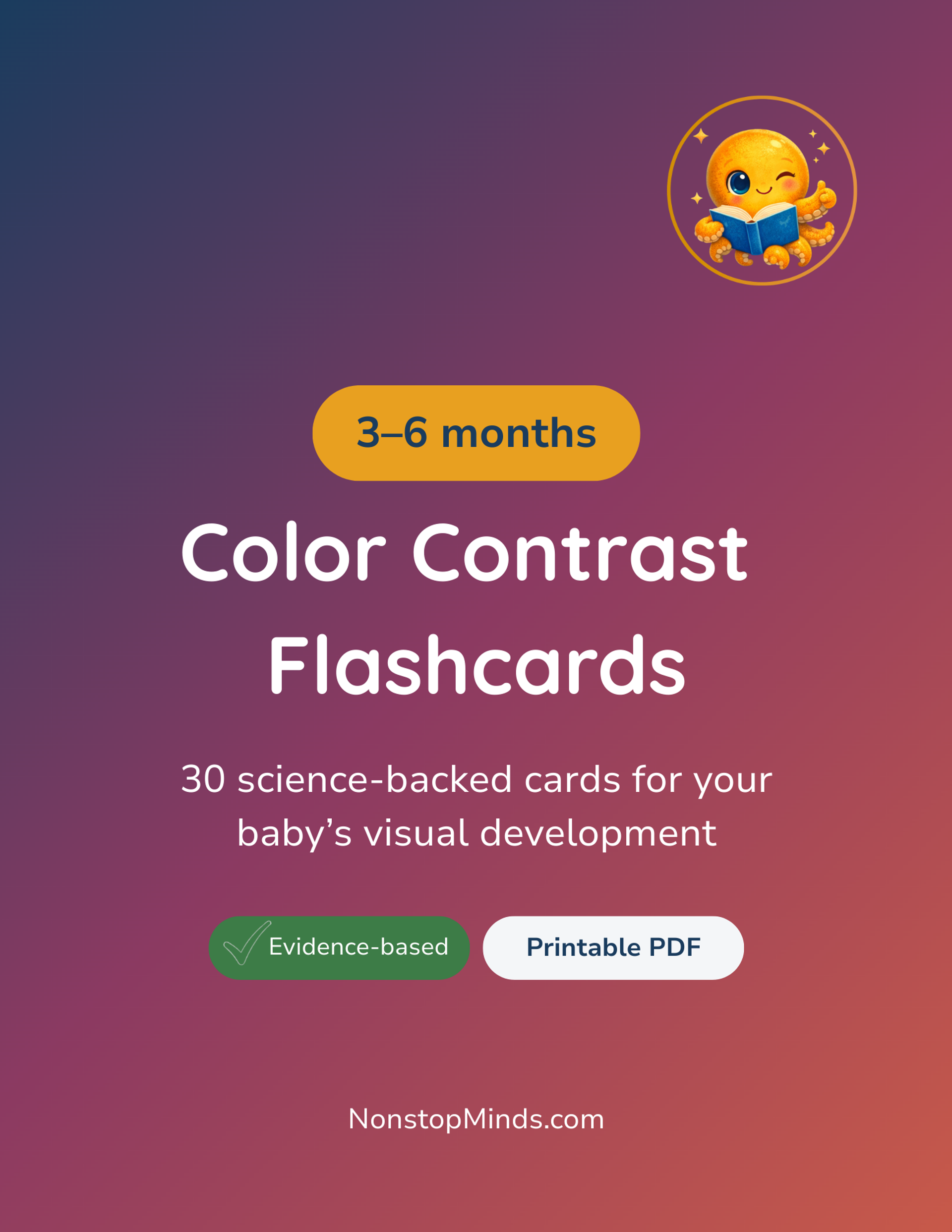
Get it on Payhip →Your baby can see color now – but the visual system is still building its strength.
These 30 cards follow the science of how color vision develops between 3 and 6 months: from bold primaries on high-contrast backgrounds to soft pastels and shade variations.
Four progressive series. Parent guide included.
Evidence-based, designed by NonstopMinds.
What's Inside
Parent Guide
What your baby's color vision looks like right now, how to use the cards, and what each card trains.
Series 1: Hello, Color (Month 3)
Bold primaries on black and white backgrounds — the strongest color signal for a newly trichromatic brain.
Series 2: Color Meets Color (Month 3–4)
Green, purple, and the first color-on-color combinations. No more black-and-white safety net.
Series 3: A Colorful World (Month 4–5)
Warm tones, cool tones, multi-color patterns, and simple real-world shapes in color.
Series 4: Shades & Pastels (Month 5–6)
Light and dark versions of the same color. Pastels. The brain is learning that blue comes in many shades.
Milestone Tracker
Track your baby's color vision development with a simple checklist based on CDC 2022 milestones.
Our First Moments
A keepsake page to capture your baby's earliest reactions to color.
Why It's Different
- ✓Not random colors – a structured progression from bold to subtle
- ✓4 series that follow the science of how color vision develops
- ✓Based on peer-reviewed research (Skelton, Teller, Bornstein, Knoblauch)
- ✓Parent Guide explains the science in plain English
- ✓Designed by NonstopMinds with Nomi 🐙
- ✓Works on its own – no need to buy our 0–3 month set first
How to Use
- Print at home on cardstock (or regular paper works too)
- Read the Parent Guide – it takes about 5 minutes
- Start with Series 1 – hold cards 10–14 inches away
- Move through the series as your baby grows
- Use the Milestone Tracker to see progress
All content is for educational and entertainment purposes only and is not a substitute for professional medical, developmental, or psychological advice.