Activities for an 8 Month Old: Two Kinds of Reach, and What to Do About Them
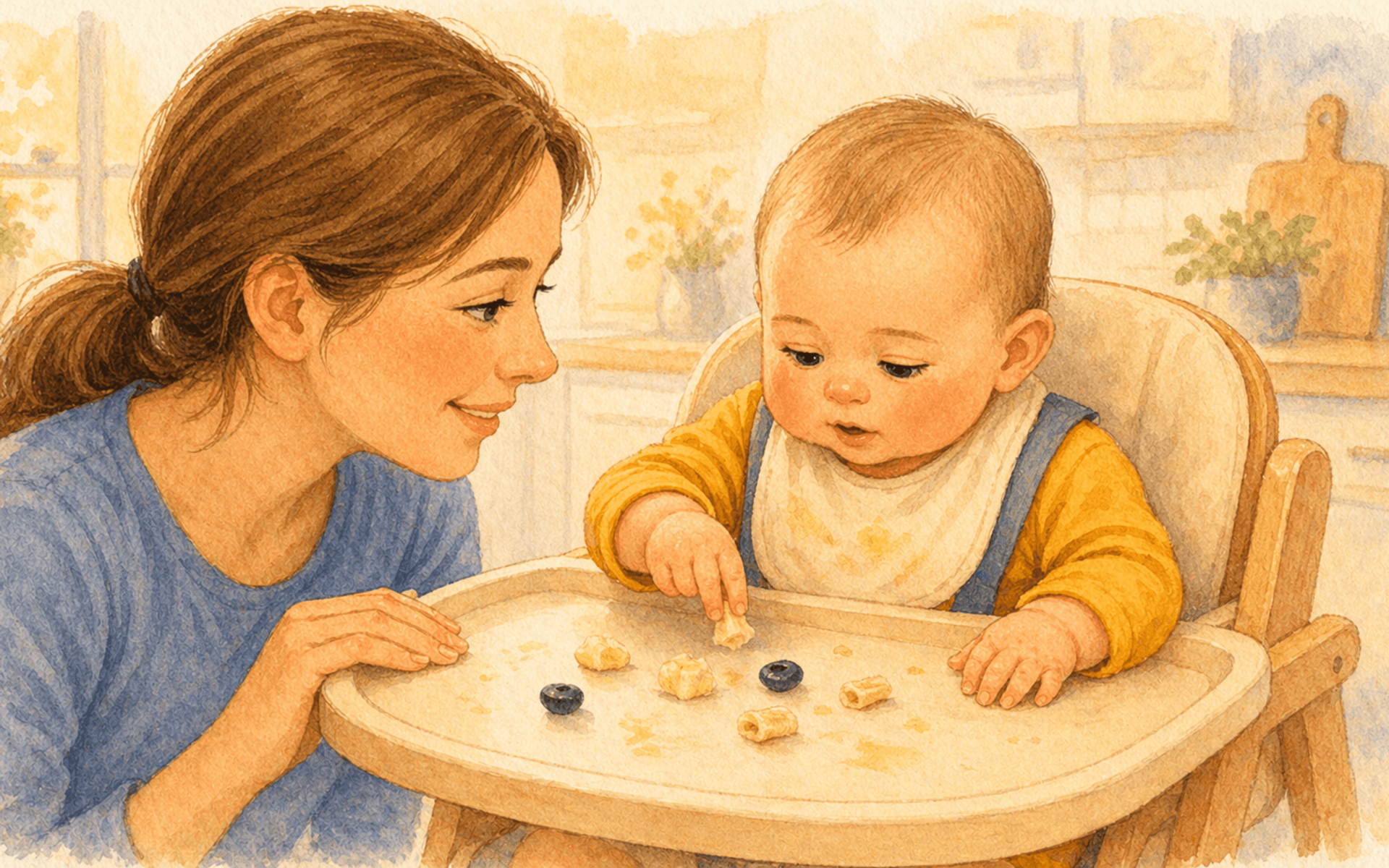
A crumb on the rug. The coffee table across the room. By eight months, both are suddenly within your baby's reach — one because the thumb and index finger can now team up for tiny precision, the other because your baby has figured out how to cover floor distance on their own. Two different kinds of reach, arriving in the same month, and they rearrange what the house looks like from the floor up.
The good activities for an 8 month old make use of both. The unhelpful ones default to whatever worked at six months — as if sitting on the play mat with a wooden block is still the most interesting thing on offer. Your baby has outgrown that setup.
- Why the high chair is the most underrated developmental workspace at 8 months — and why mealtimes run 30 language turns
- What's changing this month: the CDC's 9-month milestones that begin arriving at 8
- Why floor mobility looks nothing like the textbook — and what the 1998 Adolph study found about locomotor variability
- How the inferior pincer changes what counts as reachable — and why an 8-month floor audit matters
- How stranger and separation anxiety peaks at this age — and the response that works vs. the one that doesn't
If the one-sentence answer is enough, you’ve got the gist. If you want the mechanism behind each piece, keep reading.
The High Chair Is Where Half the Work Happens Now
Most activity guides skip this, which makes no sense once you look at the situation. By eight months, solid foods have been going for somewhere between a few weeks and a couple of months. Your baby is strapped into an upright seat for thirty to forty minutes, three times a day, with a tray at the exact right height for hand work, your face two feet away, and zero ability to crawl off toward the stairs. From a developmental standpoint, it's the cleanest workspace in the house.
Pincer-grasp practice is the obvious one. Scatter small pieces of soft food on the tray — cooked pea halves, small banana chunks, shreds of soft cheese, slivers of well-cooked pasta. Every single pickup is an inferior-pincer rep, with the edible reward at the end. Research on motor skill acquisition has consistently found that high-frequency, self-initiated practice is how fine-motor skills consolidate, and the high chair delivers dozens of reps per meal without any effort from you beyond chopping.
Cause and effect fits just as naturally. Drop a silicone suction cup on the tray. Put a small amount of water in it. Show your baby how a finger makes ripples. Offer a single ice cube on a cold day and watch your baby explore cold as its own sensory category. Clip a suction-cup toy to the tray and let your baby figure out that pulling doesn't remove it but poking still gets a satisfying response. These are the moments parents jokingly call physics experiments, and that's close to accurate — the eight-month brain is exactly tuned to notice that my action produced that result.
The quieter reason the high chair works: your face is at the baby's eye level, you can't leave, and neither can the baby. That's prime conditions for the conversational back-and-forth that MIT researchers Romeo and colleagues identified in 2018, in Psychological Science, as the strongest predictor of later language outcomes — not word counts, but turns. Pea. You got a pea. Now another pea. That's two. The baby looks, babbles, you respond, the baby tries again. Fifteen minutes of lunch can run thirty loops.
Safety note: never leave a baby unattended in a high chair, always use the harness, avoid choking-hazard foods (whole grapes, whole nuts, popcorn, raw apple chunks, hot-dog rounds), and keep small hard objects like metal utensils or loose plastic parts off the tray.
Our article on why toddlers refuse to eat covers how feeding interactions that start warm now tend to stay warm later — the short version is that responsive feeding practices laid down at eight months carry forward for years.
Show Image
What's Changing This Month
The CDC's 2022 revised milestones, published by Zubler and colleagues in Pediatrics, place the next formal checkpoint at nine months. That checkpoint includes sitting without support, bringing a thumb and finger together to pick up small items, and searching for a partially hidden object. Most of those skills begin showing up around eight months in some form — which is exactly what makes this month feel like so much is happening without any single thing "arriving."
Sitting is rock-solid. Your baby transitions in and out of sitting independently, uses both hands while seated without toppling, and can swivel the upper body to track something without losing balance. Floor locomotion is actively in progress, in whatever form suits the baby — belly-crawling (commando style), rocking on hands and knees, bottom-scooting, or pulling up on furniture. The hands are more precise than a month ago: the raking grasp is giving way to an inferior pincer, where the thumb presses against the side of the index finger to trap something small. The mature thumb-and-fingertip pincer usually arrives closer to nine or ten months.
Babbling is established, varied, and imitative in a new way that matters. Socially, stranger anxiety often intensifies this month — the wariness you may have noticed at seven months sharpens into something more vocal. All three of these threads — mobility, precision, attachment — are part of the same story, which is that your baby now has enough control over movement and enough recognition of who belongs to start actively making choices about where to go and with whom. If last month felt more like consolidation — stable sitting, fuller babbling, anticipatory peekaboo — our guide to activities for a 7 month old covers what was laying the groundwork for all of this.
Mobility Looks Nothing Like the Textbook Says
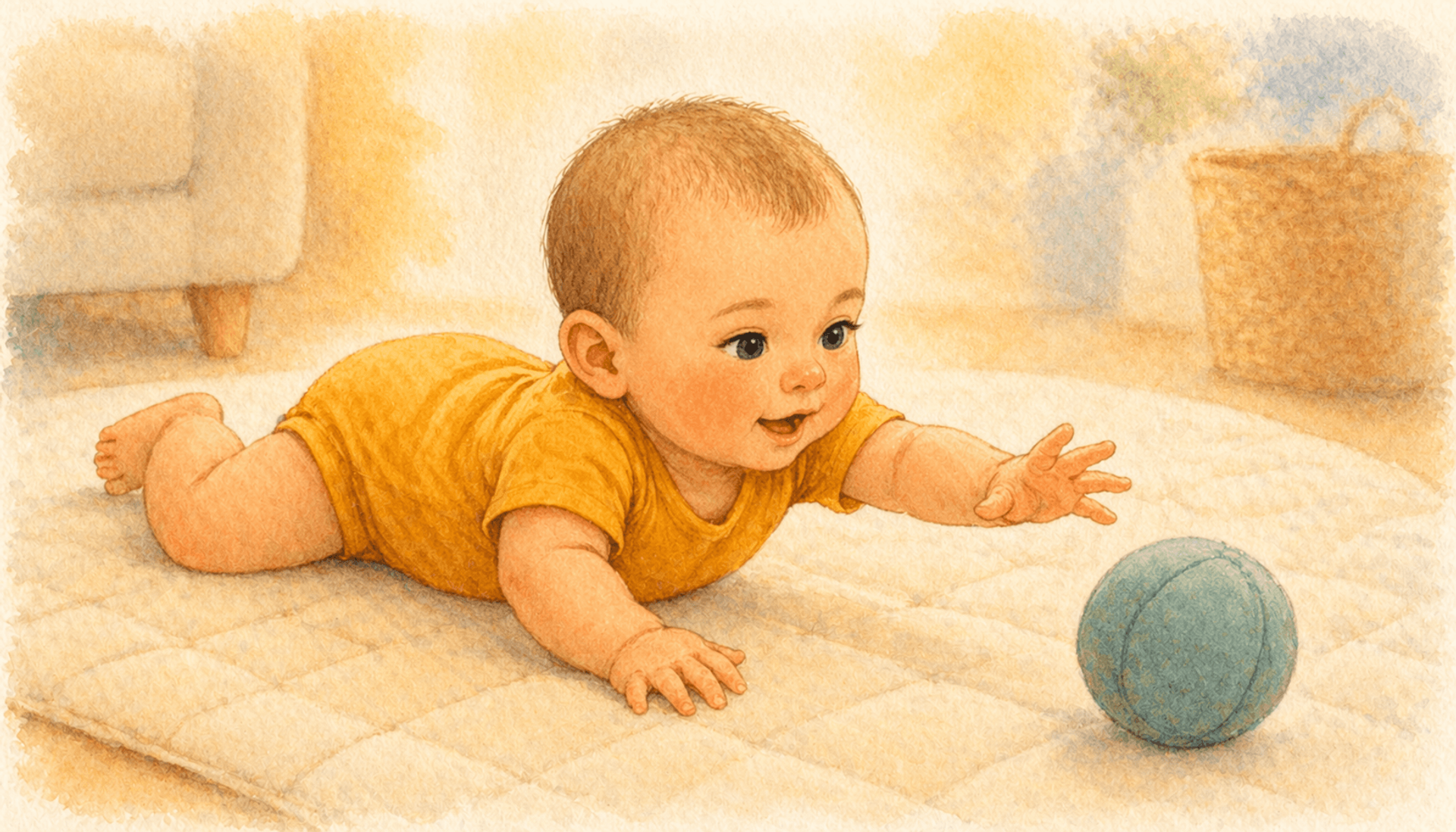
A landmark study by Karen Adolph, Beatrix Vereijken, and Mark Denny, published in Child Development in 1998, tracked how 28 infants actually moved in the months before walking. The researchers catalogued every locomotor strategy each baby used. The result was a much messier picture than most parenting books describe — belly-crawling, hands-and-knees crawling, hands-and-feet (bear) crawling, scooting, rolling, cruising along furniture. Most babies cycled through several strategies. Some skipped traditional crawling altogether.
At eight months, this variability is on full display. Your baby might belly-crawl backward for a week before figuring out forward. The arms learn to push before the legs know what to do with themselves, and reverse is what happens when the arms win the argument. Some babies go from sitting to pulling up to cruising and never crawl the way the baby book shows. All of this is within the range of typical motor development, and the CDC's 2022 revision formally removed crawling as a milestone for exactly this reason. Our cornerstone guide on when babies sit up goes into why milestone-by-age-limit thinking has been replaced with milestone-with-range thinking in the current developmental literature.
What makes a difference now is floor time that lets the experimentation happen. A toy placed just out of reach. Two cushions arranged into a low slope the baby can wriggle over. A rolling soft ball that keeps moving when the baby gets close, which turns a simple object into a moving target. Every new surface angle and every new failed-and-recovered attempt is proprioceptive data the brain files away.
Safety note: once your baby is moving in any form — rolling, scooting, commando-crawling — the household environment changes. Small objects on the floor are now reachable and will go straight to the mouth. Never leave your baby unattended on an elevated surface like a changing table, a bed, or a sofa, because transitions happen fast at this age. Anchor furniture your baby might pull up on, and gate stair access before the cruising starts.
Precision Quietly Changes the Room
The raking grasp — where a baby pulls a small object toward the palm with all four fingers curled — gives way at around eight months to the inferior pincer, where the thumb presses against the side of the index finger to trap small items. It happens gradually. One day you notice your baby has picked up a single piece of dry cereal without the usual whole-hand sweep, using the thumb and finger with something that almost looks like intent. A week later it's the default.
Precision expands what counts as a reachable object. A month ago, anything smaller than the palm was effectively invisible to the hands. Now the smallest interesting things in the visual field — a crumb on the tray, a piece of lint on the rug, the fringe on a pillow — are targets. The baby's attention follows the hands, and the hands follow the new skill. This is why eight months is the age most household safety guides recommend a floor-level audit. Anything small enough for the new pincer to grip is also small enough to go straight to the mouth — buttons, coins, beads, small magnets, stray Lego pieces from an older sibling.
On the play side, precision opens up a whole category of activities that simply weren't workable before. Putting dry cereal pieces one at a time into a shallow silicone cup. Poking at a texture page in a board book. Turning a thick board-book page (the baby will still grab a few pages at once, but the intent is there). Picking up a small block with one hand while holding another block in the other. Precision work takes more focused attention than gross-motor play, which means a baby will often concentrate harder and quieter on pincer activities than on anything involving crawling.
Babbling Becomes Deliberate Imitation
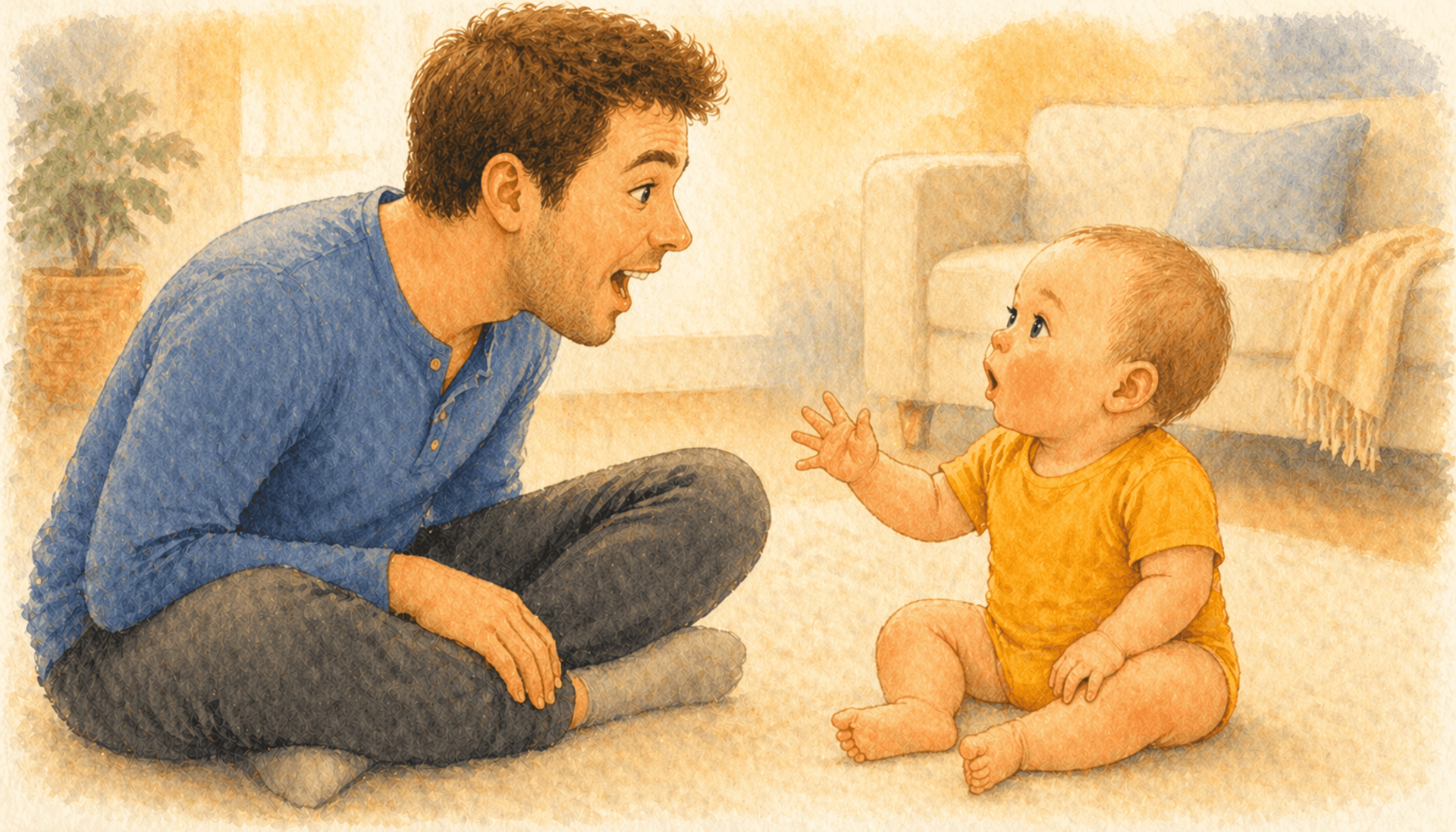
At six and seven months, the babbling strings were mostly self-directed — the consonant-vowel syllables were the baby's own practice, with whatever melody the brain's rhythm sensitivity happened to layer on. At eight months, something different shows up: deliberate copying. You say ba-ba, your baby says ba-ba. You say da, your baby produces something close to da. The imitation is imperfect, the vowel sometimes drifts, but the intent is unmistakable.
Imitation requires the baby to hold a sound in short-term memory, map it onto a motor plan, and execute that plan — four coordinated steps that weren't linked a month ago. D. Kimbrough Oller's longitudinal research established canonical babbling (the true CV syllables like ba and da) as one of the most reliable markers of typical speech development. Active imitation at eight months is where babbling becomes conversational rather than rehearsal.
The useful game is short back-and-forth. You say a syllable, wait, your baby produces something, you answer. Keep turns short. Mirror the rhythm. When your baby produces something that sounds almost like a real word — a syllable string that happens to land near ball or dog — reply with the real word naturally: Yes! Ball. That's a ball. You're not correcting. You're just reinforcing the sound-to-meaning loop that starts making first words possible in the months ahead. Our article on when babies start talking walks through the full arc from here to first words.
Show Image
When Your Baby Cries at People Who Love Them
If your previously sociable baby has started crying when grandparents visit, burying the face in your shoulder when the neighbor says hello, and refusing the arms of anyone who isn't you or your partner — your baby has moved into the peak of stranger anxiety. The wariness that may have shown up at six or seven months is intensifying this month.
Classic attachment research by Mary Ainsworth in the 1970s and by Jerome Kagan's longitudinal work on infant temperament placed the peak of stranger and separation anxiety between roughly eight and twelve months. It's universal across cultures and parenting styles, it doesn't reflect anything you did or didn't do, and it's cognitively meaningful: your baby now has a clear internal map of who belongs in the inner circle and who doesn't, and the brain treats violations of that map as alarming by default. From an evolutionary standpoint, a baby who's newly capable of crawling away from safety benefits from being very clear about who counts as safe.
The response that works is patience, not prevention. When a new person arrives, let your baby observe from your arms for a few minutes before any handoff. Ask grandma to hold off on the direct face-engagement for a minute or two — the intensity of an unfamiliar face at close range is the part that usually triggers the crying. Keep brief separations predictable and warm. The anxiety softens on its own through the second year as the cognitive architecture catches up with the new awareness.
What to Offer an 8-Month-Old

Treasure basket on the floor. Gather five or six safe, interesting household objects — a wooden spoon, a silicone whisk, a small metal bowl, a scarf, a short cardboard tube, a smooth wooden ring — and put them in a low basket. Sit beside it with your baby. Let the baby pull objects out one at a time and explore each one at the baby's own pace. The variety of textures, weights, and sounds keeps the session interesting, and the baby-led pacing does the developmental work. For more on how sensory input maps onto specific months, our guide to sensory play by month covers what each age window is actually tuned to process.
A small stand-up opportunity. If your baby is gripping things and trying to haul upward, a firm ottoman, a sturdy low bench, or the lower edge of a couch cushion works as a practice surface. Position yourself on the floor close by. Don't coach — the motor system does its own problem-solving.
Time outside. A blanket on the grass in a shaded spot gives the palms a new surface, the ears a wider soundscape, and the visual system a bigger field than the living room offers. A stroll at the baby's eye level — in a carrier where the baby can see things up close, or a stroller positioned so the baby can actually look out — lets the visual and vestibular systems work together on motion in a way that no indoor activity replicates.
Twenty minutes of you, at eye level. Face-to-face is still the most powerful activity in the house. Sit on the floor, get at your baby's height, and spend the time mirroring babbling, playing simple imitation games (you clap, baby claps; baby claps, you clap), and reading a board book while pointing at the pictures and naming them. Language wires through this kind of exchange.
Our Sensory Play Cards 0–12 Months include eight-month-appropriate activities organized around treasure-basket play, textural work, cause-and-effect games, and language pairing — the skills consolidating this month, presented so you don't have to build the session from scratch.
Frequently Asked Questions
Most eight-month-olds stay awake between naps for about two and a half to three and a half hours, with the longest window before the last nap of the day. That's enough time for a feeding, floor play, a high-chair meal, and some outdoor or book time before sleep cues appear. Watch for yawning, eye rubbing, loss of coordination, or fussiness rather than the clock. At this age most babies are transitioning from three naps to two.
Yes. Crawling was removed from the CDC's official milestones in the 2022 revision because it isn't universal and isn't required for typical development. Many eight-month-olds rock on hands and knees, army-crawl, scoot, or roll to get where they want to go. A meaningful minority skip conventional crawling entirely. What matters is that your baby is making progress on floor mobility in some form — rolling, pivoting, lunging, belly-crawling. Talk to your pediatrician if your baby isn't pushing up during tummy time, isn't sitting independently, or shows strong left-right asymmetry in movement.
Offer small, soft pieces that can be squashed between your fingers easily — cooked pea halves, small banana chunks, small pieces of well-cooked pasta, shreds of soft cheese, flakes of well-cooked fish with bones removed, small pieces of ripe avocado. The goal isn't caloric intake — milk is still the main source at this age — it's practice. Every pickup is pincer-grasp training. Supervise the whole meal, sit the baby fully upright in the high chair with the harness secured, and avoid choking hazards (whole grapes, whole nuts, popcorn, raw apple chunks, hot-dog rounds).
This is stranger anxiety, a normal phase that peaks between about eight and twelve months. It reflects your baby's growing cognitive ability to recognize primary caregivers as specifically safe, combined with a newfound awareness that the unfamiliar exists. It doesn't mean your baby has been overprotected or that other caregivers are doing anything wrong. The response that works best: let your baby warm up to new people from the safety of your arms, keep handoffs brief and confident, and trust that the phase softens on its own through the second year.
This article is for educational and entertainment purposes only. Not a substitute for professional medical or developmental advice. If you have concerns about your baby's development, consult your pediatrician.
- Zubler, J.M., Wiggins, L.D., Macias, M.M., et al. (2022). Evidence-Informed Milestones for Developmental Surveillance Tools. Pediatrics, 149(3), e2021052138.
- World Health Organization Multicentre Growth Reference Study Group. (2006). WHO Motor Development Study: Windows of achievement for six gross motor development milestones. Acta Paediatrica Supplement, 450, 86–95.
- Adolph, K.E., Vereijken, B., & Denny, M.A. (1998). Learning to crawl. Child Development, 69(5), 1299–1312.
- Adolph, K.E., & Franchak, J.M. (2017). The development of motor behavior. WIREs Cognitive Science, 8(1–2), e1430.
- Oller, D.K., Eilers, R.E., Neal, A.R., & Schwartz, H.K. (1999). Precursors to speech in infancy: The prediction of speech and language disorders. Journal of Communication Disorders, 32(4), 223–245.
- Romeo, R.R., Leonard, J.A., Robinson, S.T., West, M.R., Mackey, A.P., Rowe, M.L., & Gabrieli, J.D.E. (2018). Beyond the 30-Million-Word Gap: Children's Conversational Exposure Is Associated With Language-Related Brain Function. Psychological Science, 29(5), 700–710.
- Ainsworth, M.D.S., Blehar, M.C., Waters, E., & Wall, S. (1978). Patterns of Attachment: A Psychological Study of the Strange Situation. Lawrence Erlbaum.
- Kagan, J. (1984). The Nature of the Child. Basic Books.
- American Academy of Pediatrics. (2024). Developmental milestones: 9 months. HealthyChildren.org.
- American Academy of Pediatrics. (2022). Starting Solid Foods. HealthyChildren.org.
Related Products

More Articles
Parallel Play in Toddlers: Why Side-by-Side Is the Social Work
Your toddler spent the entire playdate building separate towers, and nobody shared a single block. That counted — more than it looked. A 2025 longitudinal study found that playing beside a specific child consistently predicted later social play with that same child, but not the other way around. Here's what parallel play in toddlers actually is, why the science calls it strategic rather than passive, and what it means for how you run a playdate.
When Do Babies Point: Why It Matters for Language
Most milestone articles treat pointing as a box to check around 12 months. The research tells a different story — one that starts months earlier, runs through the infant brain, and traces back to how much the parent is pointing. Here's what the last fifteen years of research actually found, and what it means for everyday interactions.
When Do Babies Wave Bye-Bye: Why Your Baby Needs You to Wave First
Most baby milestones unfold on a biological schedule — waving isn't one of them. A 2023 study found that babies develop imitation ability because their caregivers imitate them first, and waving is named directly as a cultural gesture learned through that loop. Here's what the research says about the 9–12 month window, why the first wave looks nothing like a wave, and what helps it arrive.