Baby Led Weaning: The Honest Guide to Safety and Real Risks
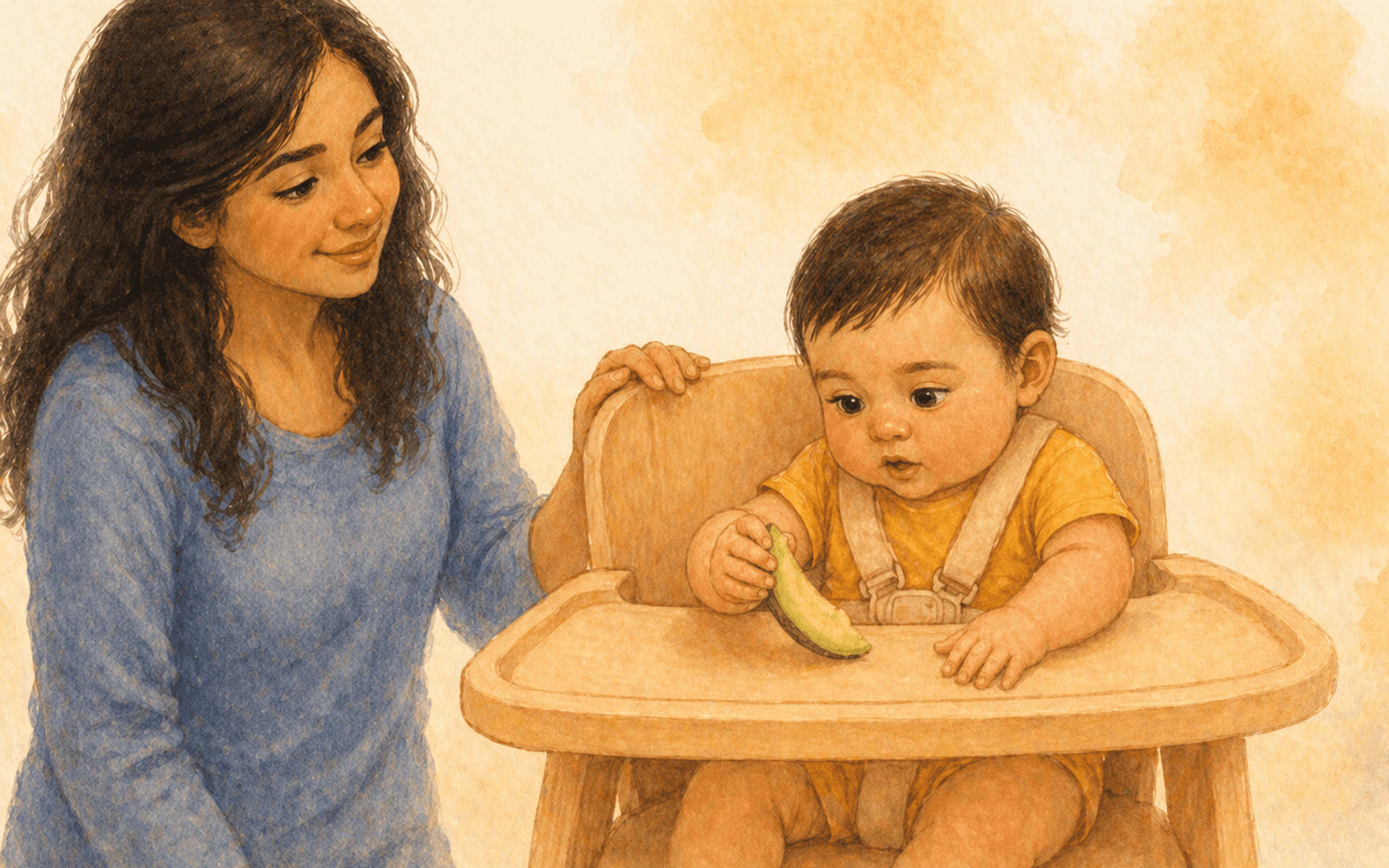
The strip of avocado sits on the high-chair tray, peeled and cut to roughly the length of an adult finger because that is what every baby led weaning Instagram account told you to do. What follows looks less like eating and more like the prototype of a very small juice factory: the avocado is squeezed, gummed, dropped, and partially relocated to the eyebrows, the wall, and an unfortunate dog who just wanted to be near snacks. Whether any of it was actually swallowed remains, frankly, classified. The internet has decided this method is either life-changing or alarming depending on whose reel you watched most recently, and the research, when you go looking for it, says the truth is quieter and more useful than either headline.
- The single randomized trial that has actually tested this method, and why most articles you have read are paraphrasing it without saying so
- What the choking data show when researchers count events instead of vibes
- The obesity-prevention claim that quietly fell apart between 2017 and 2021
- The one outcome where babies in the trial did measurably better, and what that means for picky-eating later
- Why the dichotomy between "BLW families" and "puree families" is largely a social-media artifact
- The safety practices the trial babies' parents actually followed, separate from anything the method itself prescribes
If the one-sentence answer is enough, you’ve got the gist. If you want the mechanism behind each piece, keep reading.
What the only randomized trial of baby led weaning actually tested
Almost everything written about baby led weaning traces back, eventually, to one randomized clinical trial, which most parenting articles cite without ever saying so. It is called the BLISS trial — Baby-Led Introduction to Solids — run out of the University of Otago in New Zealand, with results published across several papers between 2016 and 2018. The full report on growth and feeding behavior appeared in JAMA Pediatrics in 2017, led by Rachael Taylor and colleagues. Two hundred and six women were randomized in late pregnancy and followed for two years.
The trial enrolled mothers and randomly assigned them to either a BLISS group or a control group (the comparison group, which received standard well-child care without the special baby-led training). Mothers in the BLISS group got eight extra contacts from pregnancy through nine months: three home visits with a researcher and five with an international board-certified lactation consultant. They received written resources, food ideas, and specific safety guidance about choking risk.
That last point matters more than it sounds. BLISS is not unmodified BLW. The researchers built in three departures from the popular version: stronger encouragement to delay solids until six months, explicit guidance to offer iron-rich and energy-dense foods at every meal, and a printed list of foods to avoid because of choking risk. The trial tested the approach with safety scaffolding, not the version a parent might piece together from a few hours of internet research.
This distinction is the first place most online summaries quietly mislead. When you read that "studies show BLW is safe," the study is BLISS, and the version of BLW that was studied came with a built-in choking-prevention curriculum. The researchers themselves were careful about this. Their conclusion, stated plainly in the discussion section, was that their findings "should not be extrapolated to unmodified versions of BLW."
The trial measured infant body mass index z-scores at 12 and 24 months as the primary outcome, with secondary outcomes covering choking, gagging, satiety responsiveness, food fussiness, and energy intake. There was attrition (80.5% of the original sample was still in the analysis at 24 months), but this is well within typical bounds for a two-year infant trial. The data on this trial is the cleanest evidence we have. There is no comparable second RCT in English. A 2021 systematic review in Nutrients by Martinón-Torres and colleagues searched four databases and turned up just two randomized trials of BLW worldwide.
The choking question, with actual numbers
If there is one thing parents fear about starting solids, it is choking, and the fear scales sharply when babies are the ones in charge of putting food in their mouths. The data are more reassuring than the worry, and also more sobering in a different direction.
In the BLISS trial, 35% of all infants choked at least once between 6 and 8 months, with no significant difference between the BLISS and control groups at any age measured. This is the headline finding from the choking paper, published in Pediatrics in 2016 by Louise Fangupo and colleagues. Most infants who choked in any given month did so just once or twice. When the researchers compared the rates side by side, neither group came out clearly safer than the other. Whatever else you take from the trial, the modified BLW approach with proper safety guidance did not produce more choking than traditional spoon-feeding.
What the data also show, however, is that choking happens to a lot of babies regardless of method, and that some of the assumptions in the popular discourse do not survive contact with the numbers.
Here is the part that gets buried. By 7 months of age, 52% of infants in the trial (across both groups) had been offered at least one food classified as a choking risk during a three-day weighed diet record. By 12 months, that figure was 94%. There was no meaningful difference between BLISS and control families on this. Furthermore, only 23% of the foods involved in the parent-reported "most serious" choking episodes appeared on the researchers' list of choking-risk foods at all. The remaining 77% were everyday items.
The single variable that did differ between BLISS and control families was adult supervision. At 11 months, BLISS families were nearly twice as likely as control families to have a parent or other adult sitting with the baby during eating (65% versus 44%). The intervention had taught them, repeatedly, to do this. The researchers did not study supervision as a primary outcome, but their data are consistent with what mothers active in parent communities consistently say: choking can happen on any food, including a piece of orange with too much membrane attached, and it can be silent. The response that mattered was the parent knowing what to do.
Of all 199 reported choking events across the two-year study, exactly three involved any health-professional contact, and two of those three were related to milk rather than solid food.
Gagging is a separate phenomenon, and the trial captured it cleanly. BLISS babies gagged more often than control babies at 6 months (a relative risk of 1.56) but less often by 8 months (a relative risk of 0.60). Both differences were statistically significant. The pattern is consistent with babies learning the skill of moving food around in the mouth, and it tracks with what feeding therapists describe.
The obesity claim, examined
The most popular argument for self-feeding from the start, repeated in books, blog posts, and Instagram captions, is that letting babies self-regulate their food intake protects them against childhood obesity. The argument is intuitive. Babies who decide for themselves when to stop eating presumably stay better tuned to their own hunger and fullness signals over time. The data, when you look at them, do not support this claim.
In the BLISS trial, mean BMI z-score at 12 months was 0.44 in the BLISS group versus 0.20 in the comparison group, with the difference not statistically significant. At 24 months, the BMI z-score was 0.39 versus 0.24, again not significant. The number of overweight children at 24 months was slightly higher in the BLISS group, but the range of statistical possibility was wide enough on both sides of zero that the trial could not say with any confidence that the method either prevented or caused excess weight gain. The numbers trended in the opposite direction from the popular claim, though not enough to conclude that BLW causes higher BMI, either.
A 2021 systematic review in Nutrients by Martinón-Torres and colleagues pooled the available evidence — eight studies covering 2,875 infants, with two randomized trials and six observational studies. The review concluded that the results across studies were inconclusive, that risk of bias was moderate to high in every included study, and that "more clinical trials and longer prospective studies should be done." Translated out of the careful language of systematic reviews, this means: the obesity-protection claim has been tested, and the case for it is not currently supported by the strongest evidence we have.
There is one related finding from BLISS worth knowing about. At 24 months, infants in the BLISS group scored slightly lower on satiety responsiveness on the Children's Eating Behavior Questionnaire — meaning they were marginally less likely to stop eating in response to fullness cues. The difference was small and showed up at one timepoint on one measure, but it points in the opposite direction from the self-regulation theory that powers most BLW marketing. A 2017 commentary in JAMA Pediatrics summarized the finding plainly in its headline: "Safe and Effective but Not Preventive of Obesity."
Where the BLW approach does appear to help
The BLISS trial found one outcome that pointed clearly in BLW's favor, and it is worth taking seriously because it is the only effect that survived the full two-year analysis.
Mothers in the BLISS group rated their children as significantly less fussy about food on a standardized eating-behavior questionnaire at 12 months, with the difference clear enough that it was unlikely to be a fluke. They also rated their children as showing greater enjoyment of food. Both findings were statistically significant. The food-fussiness result is the strongest positive signal in the entire trial.

The reason this matters is that food fussiness is one of the most stress-inducing parts of feeding a toddler. Picky eating peaks somewhere between 18 months and three years, and the way parents respond, whether through pressuring, bargaining, restricting, or modeling, has been studied extensively. A 2018 paper in Appetite by Fu and colleagues, looking at New Zealand families separately, found similar patterns: BLW-style infants showed lower food fussiness scores than spoon-fed infants in cross-sectional data.
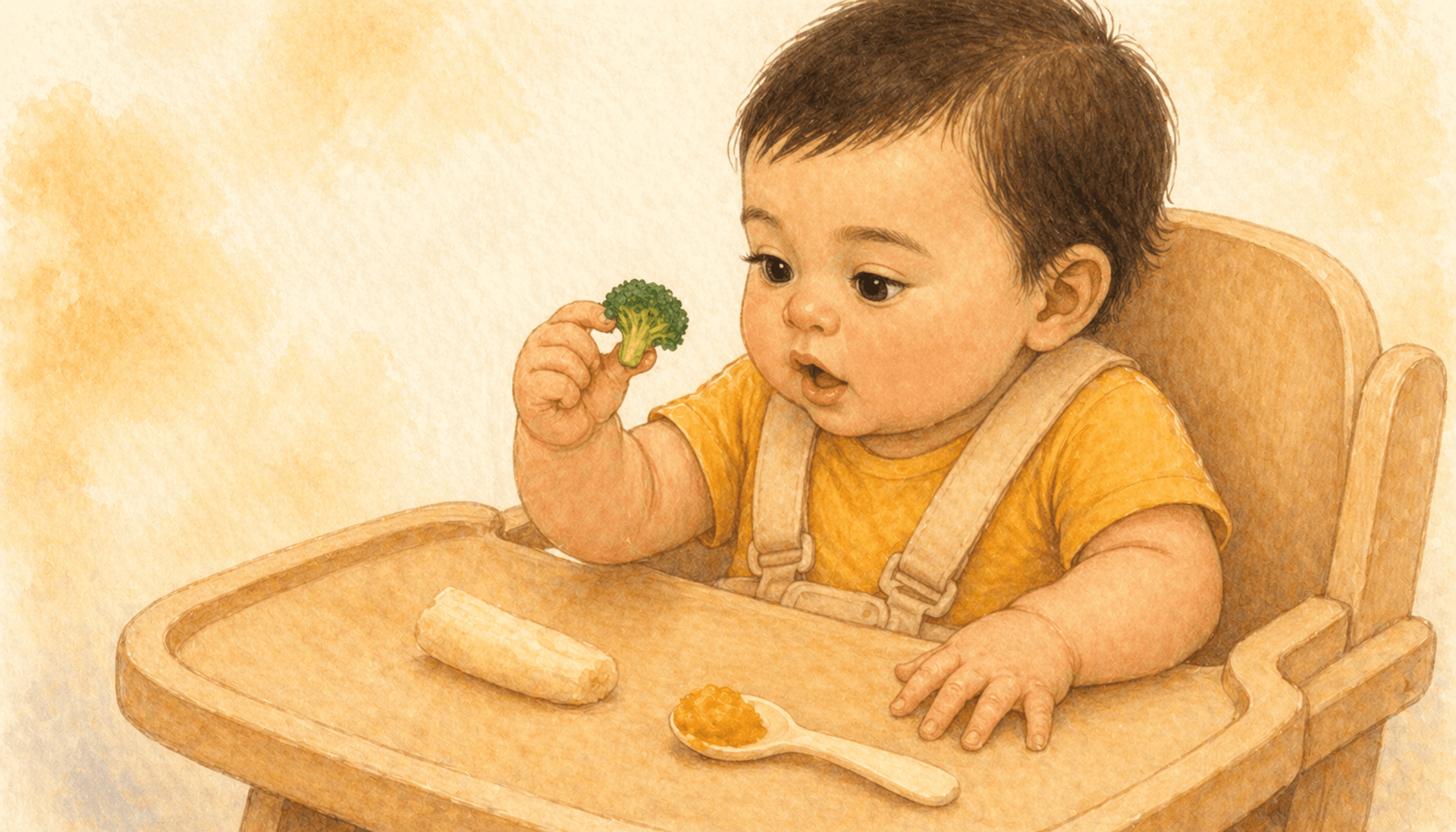
The mechanism most commonly proposed is exposure. When a baby is in charge of choosing what to put in their own mouth, they encounter more textures, more flavors, and more decision points than a baby being spoon-fed a measured portion of pre-mashed food. They also gum, drop, and reject more, which is part of what the texture-and-flavor exposure looks like in practice. The result, by 12 months, is a child who has done a lot of independent rehearsal of the question do I want this in my mouth?
This does not mean BLW is the only way to get there. Modeling, repeated low-pressure exposure, family meals, and avoiding the spoon-airplane routine are all associated with the same outcomes regardless of method. What BLW does, in this one specific case, is build the conditions for those mechanisms by default. The non-food version of the same exposure logic — letting babies handle, taste-test, and reject a wide range of safe textures during play — is something our Sensory Play Cards 0–12 months lean on heavily, and the underlying principle is the same one feeding therapists describe.
What real-world feeding actually looks like
The version of self-feeding that exists in research and in social media is much purer than the version most families practice, and this turns out to be one of the more useful things to know.
Even inside the BLISS trial, where parents had eight contacts with researchers and explicit instructions to follow a baby-led approach, adherence was incomplete. By 24 months, 99% of BLISS infants were feeding themselves most or all of their food, but so were 89% of infants in the comparison group whose families had been assigned to traditional spoon-feeding. At 12 months, the figure was 78% in BLISS versus 47% in the comparison group. Even families assigned to traditional spoon-feeding had nearly half their babies self-feeding most of their food by their first birthday. The neat division between method A and method B that organizes most online discussion does not really exist in the data.
Step out of the trial and into parent forums, and the picture is more striking. The dominant phrase in actual mother-to-mother conversations on Reddit and elsewhere is not "I do BLW" or "I do purees." It is some variant of we do a mix. Mothers describe loading spoons of yogurt and handing them to a baby who then feeds herself. They describe steamed vegetables eaten by hand alongside oatmeal eaten with a parent's help. The recurring theme across these threads is that babies fed with purees still progress to solid textures over time, and that no single method has been shown to be clearly superior to the others.
The wider range of normal also covers timeline. True independent self-feeding (the highlight-reel image of a baby calmly working through a plate of color-blocked finger foods) typically clicks somewhere between 12 and 15 months, not 7. Using utensils correctly and consistently is more often a 12-to-18-month skill, sometimes 18-to-24. The turning point at which babies actually chew food and reliably swallow it appears in trial data and in parent reports of the 9-month stage anywhere from about 7 months to past the first birthday.
If you have been comparing your baby to videos and feeling behind, the comparison is the problem. Babies are on their own timeline, the trial babies in BLISS were on their own timeline, and a steady mix of both methods is roughly what most families end up doing whether they planned to or not. The piece that holds the whole thing together as the baby grows older is a predictable rhythm — sitting down at meals together, doing them in roughly the same order most days — which is the same logic our My First Routine Cards build on for the toddler years that follow.
The safety practices the BLISS babies' parents actually followed
The BLISS results came from a population of babies whose parents had been specifically taught how to reduce choking risk. The trial does not tell you that self-feeding is safe in the abstract; it tells you that the modified BLW approach, with this set of safety practices, was no less safe than spoon-feeding. If you are considering the method, the safety practices are not optional — they are the part of the trial that produced the result.
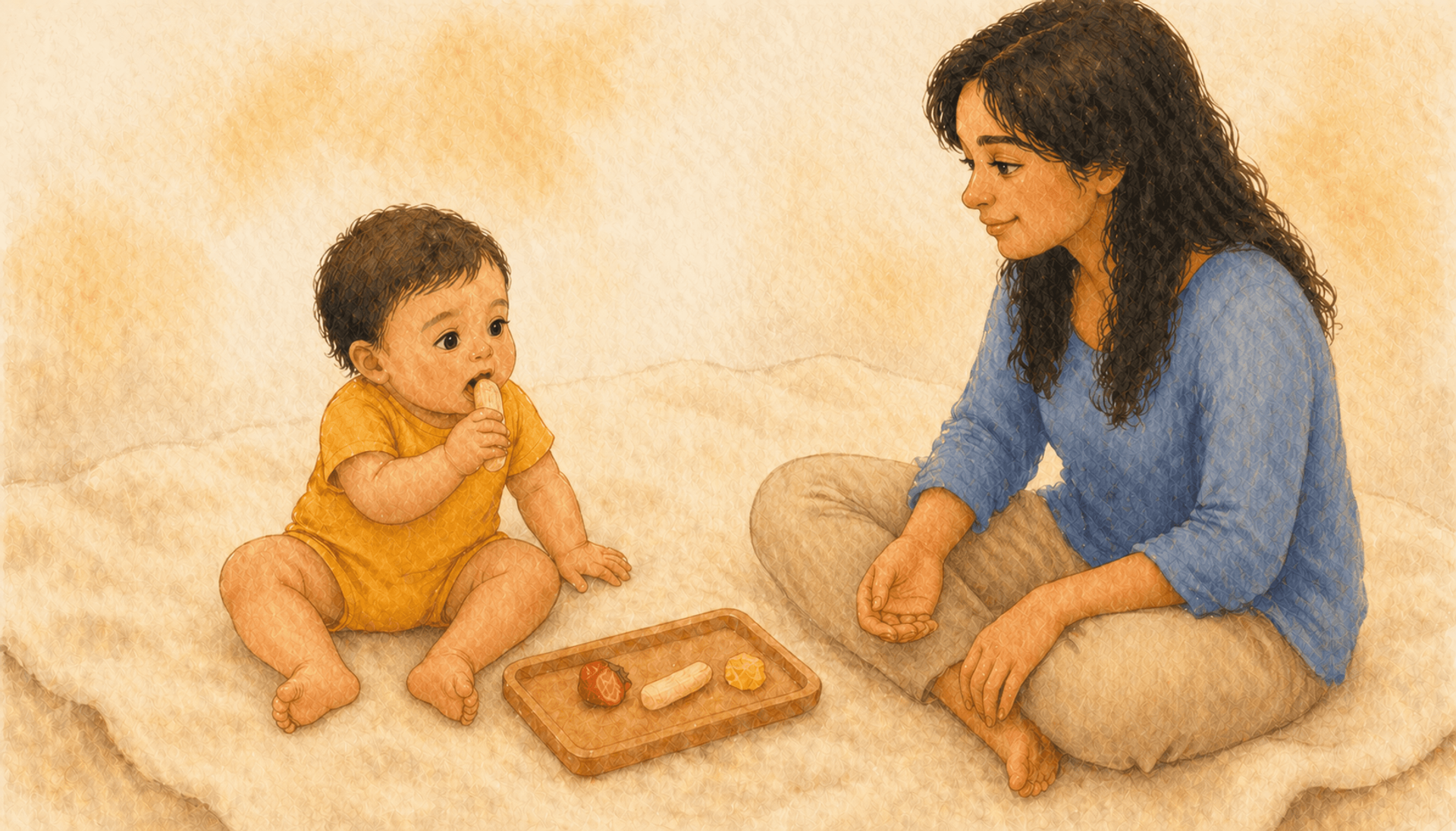
The first practice is direct supervision at every meal. The single measurable difference between BLISS and control families on a safety variable was that BLISS parents were more likely to be sitting with the baby during eating. This is unglamorous and obvious and remains the one thing the data point to most clearly.
The second is preparing for the possibility of a choking event before it happens. The 23% of choking-risk foods in the trial that were not on any official list, and the silent choking events that mothers describe in detail in parent forums, both point to the same takeaway: knowing how to respond is as important as choosing the right food. Mothers active in feeding-focused communities consistently mention infant CPR and first-aid courses as the single thing that lowered their own anxiety enough to actually proceed with self-feeding. The practical sequence is to take the course before starting solids, not after the first scary episode.
The third is knowing the difference between gagging and choking, because they look similar to a panicked parent and require opposite responses. Gagging is loud, often accompanied by coughing or red-faced effort, and is the body's protective mechanism for moving food away from the airway. Choking is often quiet, sometimes entirely silent, and signals that the airway is partially or fully blocked. Most pediatric first-aid resources cover the distinction. There are also specialized apps that walk parents through age-appropriate food sizing and preparation; finding one before solids start is reasonable practice.
None of this is medical advice. It is a description of what was different about the families in the trial whose data produced the safety conclusion, plus what the wider population of mothers feeding their babies daily report doing to feel safer. Your pediatrician is the right place for personalized food-introduction guidance, allergy-introduction questions, and any concerns about your specific baby's feeding development. Watching for the signs of readiness, including sitting upright with minimal support, bringing objects to the mouth, and showing interest in food, is the prerequisite to any of this regardless of method.
Frequently Asked Questions
According to the only randomized trial of a modified baby-led approach, infants did not choke more often than infants following traditional spoon-feeding. Both groups had similar rates: about 35% of all infants choked at least once between 6 and 8 months, with no significant group difference. The trial's safety conclusion depends on parents following specific guidance about food preparation, choking-risk foods, and adult supervision during all meals. Without that scaffolding, the results may not transfer.
The two largest research-quality data sources both point the same direction: most families end up mixing, and the comparative evidence does not show pure BLW outperforms a mixed approach on growth, energy intake, or long-term outcomes. Even within the BLISS randomized trial, half of the control babies were self-feeding most of their food by 12 months. Infant dietitians active in parent communities consistently describe the choice as a matter of family preference rather than scientific necessity.
The window is wider than social media suggests. Trial data and parent reports converge on a range from about 8 or 9 months for first real chewing-and-swallowing through 12 to 15 months for confident independent self-feeding. Using utensils correctly and consistently is often a 12-to-18-month skill. If your pediatrician is not concerned about your baby's growth or development, your timeline is likely well within the normal range, even if it does not match the videos.
Gagging at the start of solids is common and is part of how babies learn to manage food in the mouth. In the BLISS trial, the only randomized study of a modified baby-led approach, infants in the baby-led group gagged more often at 6 months but less often by 8 months, consistent with the pattern of learning a new motor skill. Gagging is loud and protective; choking is often silent and requires immediate response. If gagging is causing meaningful distress or your baby is consistently rejecting food, your pediatrician is the right place to bring it.
This article is for educational and informational purposes only and is not a substitute for professional medical, nutritional, or developmental advice. Every baby develops on their own timeline, and what is appropriate for one infant may not be appropriate for another. Please consult your pediatrician or a qualified pediatric feeding specialist for personalized guidance about introducing solids, identifying choking risk, and any concerns about your baby's feeding development.
- Brown, A., & Lee, M. D. (2015). Early influences on child satiety-responsiveness: The role of weaning style. Pediatric Obesity, 10(1), 57–66.
- Cameron, S. L., Heath, A.-L. M., & Taylor, R. W. (2012). How feasible is baby-led weaning as an approach to infant feeding? A review of the evidence. Nutrients, 4(11), 1575–1609.
- Cameron, S. L., Taylor, R. W., & Heath, A.-L. (2015). Development and pilot testing of Baby-Led Introduction to SolidS — a version of baby-led weaning modified to address concerns about iron deficiency, growth faltering and choking. BMC Pediatrics, 15, 99.
- Daniels, L., Heath, A.-L. M., Williams, S. M., Cameron, S. L., Fleming, E. A., Taylor, B. J., Wheeler, B. J., Gibson, R. S., & Taylor, R. W. (2015). Baby-Led Introduction to SolidS (BLISS) study: A randomised controlled trial of a baby-led approach to complementary feeding. BMC Pediatrics, 15, 179.
- Fangupo, L. J., Heath, A. M., Williams, S. M., Erickson Williams, L. W., Morison, B. J., Fleming, E. A., Taylor, B. J., Wheeler, B. J., & Taylor, R. W. (2016). A baby-led approach to eating solids and risk of choking. Pediatrics, 138(4), e20160772.
- Fewtrell, M., Bronsky, J., Campoy, C., Domellöf, M., Embleton, N., Mis, N. F., Hojsak, I., Hulst, J. M., & Indrio, F. (2017). Complementary feeding: A position paper by the European Society for Paediatric Gastroenterology, Hepatology and Nutrition (ESPGHAN) Committee on Nutrition. Journal of Pediatric Gastroenterology and Nutrition, 64(1), 119–132.
- Fu, X., Conlon, C. A., Haszard, J. J., Beck, K. L., von Hurst, P. R., Taylor, R. W., & Heath, A.-L. M. (2018). Food fussiness and early feeding characteristics of infants following baby-led weaning and traditional spoon-feeding in New Zealand: An internet survey. Appetite, 130, 110–116.
- Lakshman, R., Clifton, E. A. D., & Ong, K. K. (2017). Baby-led weaning — Safe and effective but not preventive of obesity. JAMA Pediatrics, 171(9), 832–833.
- Martinón-Torres, N., Carreira, N., Picáns-Leis, R., Pérez-Ferreirós, A., Kalén, A., & Leis, R. (2021). Baby-led weaning: What role does it play in obesity risk during the first years? A systematic review. Nutrients, 13(3), 1009.
- Morison, B. J., Taylor, R. W., Haszard, J. J., Schramm, C. J., Erickson Williams, L. W., Fangupo, L. J., Fleming, E. A., Luciano, A., & Heath, A.-L. M. (2016). How different are baby-led weaning and conventional complementary feeding? A cross-sectional study of infants aged 6–8 months. BMJ Open, 6(5), e010665.
- Taylor, R. W., Williams, S. M., Fangupo, L. J., Wheeler, B. J., Taylor, B. J., Daniels, L., Fleming, E. A., McArthur, J., Morison, B., Erickson, L. W., Davies, R. S., Bacchus, S., Cameron, S. L., & Heath, A.-L. M. (2017). Effect of a baby-led approach to complementary feeding on infant growth and overweight: A randomized clinical trial. JAMA Pediatrics, 171(9), 838–846.
- Williams Erickson, L., Taylor, R. W., Haszard, J. J., Fleming, E. A., Daniels, L., Morison, B. J., Leong, C., Fangupo, L. J., Wheeler, B. J., Taylor, B. J., Te Morenga, L., McLean, R. M., & Heath, A.-L. M. (2018). Impact of a modified version of baby-led weaning on infant food and nutrient intakes: The BLISS randomized controlled trial. Nutrients, 10(6), 740.
More Articles

Parallel Play in Toddlers: Why Side-by-Side Is the Social Work
Your toddler spent the entire playdate building separate towers, and nobody shared a single block. That counted — more than it looked. A 2025 longitudinal study found that playing beside a specific child consistently predicted later social play with that same child, but not the other way around. Here's what parallel play in toddlers actually is, why the science calls it strategic rather than passive, and what it means for how you run a playdate.

When Do Babies Point: Why It Matters for Language
Most milestone articles treat pointing as a box to check around 12 months. The research tells a different story — one that starts months earlier, runs through the infant brain, and traces back to how much the parent is pointing. Here's what the last fifteen years of research actually found, and what it means for everyday interactions.

When Do Babies Wave Bye-Bye: Why Your Baby Needs You to Wave First
Most baby milestones unfold on a biological schedule — waving isn't one of them. A 2023 study found that babies develop imitation ability because their caregivers imitate them first, and waving is named directly as a cultural gesture learned through that loop. Here's what the research says about the 9–12 month window, why the first wave looks nothing like a wave, and what helps it arrive.