Activities for a 9 Month Old: What Changes at the First Formal Checkup Age
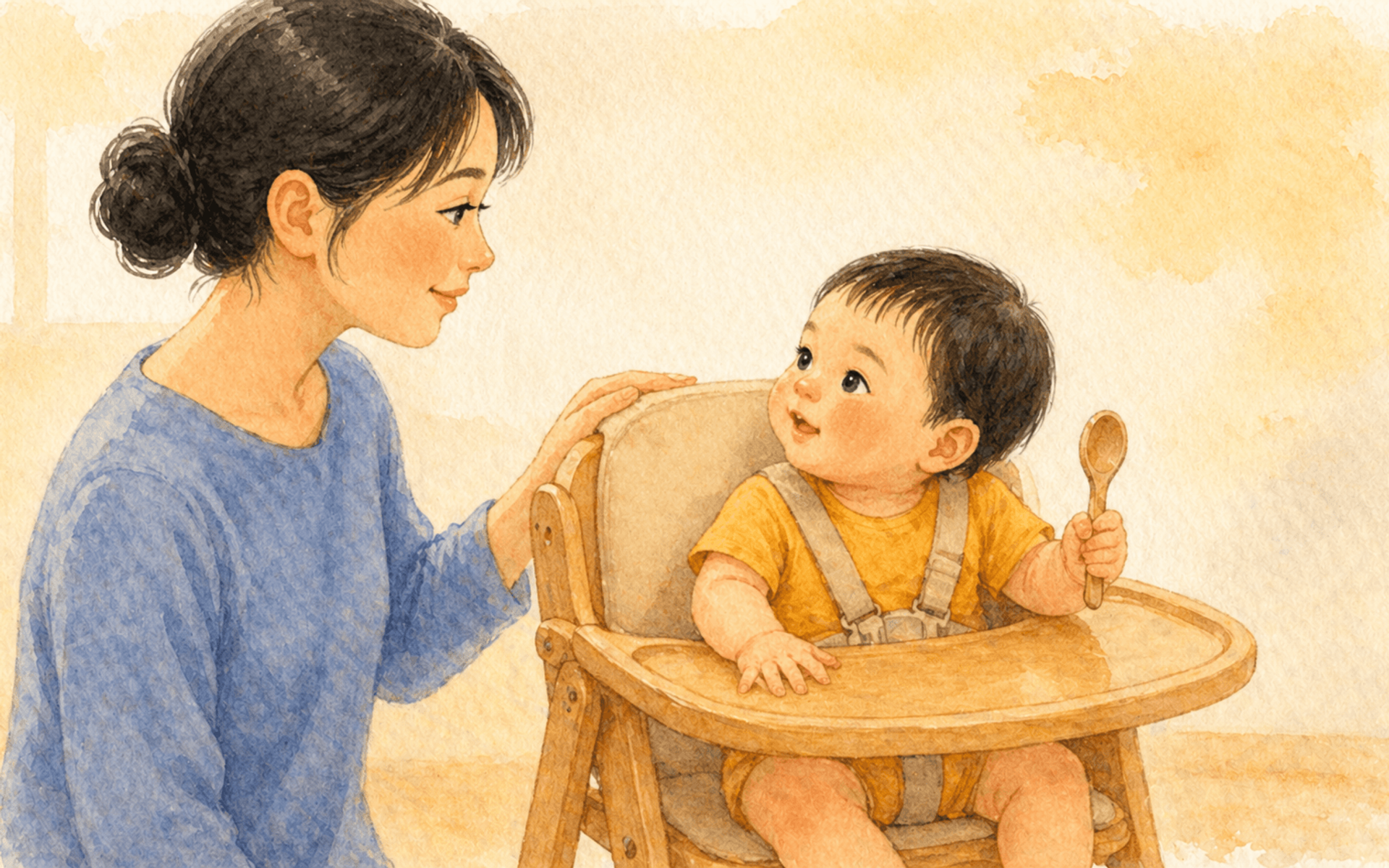
Nine months is when being a parent stops feeling like pure guesswork. Your baby picks up a spoon, bangs it on the high-chair tray, stops, looks at you, bangs it again, and you can actually tell an experiment is happening. This is also the month your pediatrician's office will hand you a developmental questionnaire for the first time. Most parenting blogs switch over around now from "what your baby can do" to "activities for a 9 month old," and that framing misses the interesting thing. By this age, the useful question isn't what to do. It's how much less of it you can get away with.
- Why the CDC promoted 9 months to its own formal milestone age in 2022, and what that actually changes
- The one study from the last few years that reframes how to play with a 9-month-old (and what "stop interrupting" looks like on a Tuesday morning)
- Why your baby's version of look at that isn't pointing yet, and what it is instead
- How to turn the A-not-B error (the thing where your baby reaches under the wrong cloth) into a game
- A pull-up and cruise setup that doesn't need any gear
- The babyproofing shift that lands the moment the pincer grasp clicks into place
If the one-sentence answer is enough, you’ve got the gist. If you want the mechanism behind each piece, keep reading.
Why the 9-month well-baby visit is actually a thing
Most parenting blogs treat the 9-month milestone list as a tick-box. The CDC's own document tells a more interesting story. When pediatrician Jennifer Zubler and her team rewrote the developmental surveillance milestones in 2022, published in Pediatrics, 9 months got promoted to its own formal age (it hadn't been on the list before). The previous version, built on the 1960s-era Denver Developmental Screening Test, skipped from 6 months straight to 12. What shifted in between those two editions was forty years of research showing that a specific cluster of intentional behaviors becomes reliably measurable at exactly 9 months: present in 75% of babies at this age, which is the benchmark the CDC chose when writing the new list.
So what's on it. Your baby probably sits upright without using the hands for support, looks for an object you hide while watching, reacts differently to familiar faces versus strangers, makes a few different consonant-vowel sounds (bababa, dadadada, mamamama), and lifts both arms up as a request to be picked up. The list is a snapshot of what commonly emerges at 9 months, not a test your baby passes or fails. If yours is hitting most of these things, that's the range the checklist was built around. If not yet, most babies pick up the remaining items in the next month or two, and if they don't, the earlier a pediatrician hears about it the easier early support is to arrange, which is the actual point of screening at 9 months rather than waiting until 12.
What the list is quietly filtering for, under the surface, is intention. Sitting matters less than sitting comfortably enough that your baby's mind can go somewhere else while doing it. Sounds matter less than sounds being used to get a specific response from you. Searching for a hidden toy counts most when your baby genuinely expects the toy to still be there. The difference is subtle, and it's what separates 9 months from 7 or 8. It's also why the sitting milestone matters so much in the months before, since sitting up unlocks the free hands and stable torso that make every deliberate thing your 9-month-old does possible.
The single most useful thing you can do less of
Here's the study. Chen Yu, Sumarga Suanda, and Linda Smith at Indiana University put tiny head-mounted eye-tracking cameras on 9-month-old babies and their parents during a few minutes of free toy play. The cameras captured, frame by frame, exactly where each person was looking. The researchers then came back when the babies were 12 and 15 months old to count how many words each of them understood and said.
Two things predicted later vocabulary. One was joint attention, the classic triangle where both baby and parent are looking at the same object (no surprise there). The other was sustained attention, meaning how long the baby kept looking at a single object regardless of whether anyone else was looking. When both predictors went into the same statistical model, sustained attention was the stronger signal. The length of the baby's own gaze was what mattered most.
The interesting part is the mechanism they uncovered. During shared moments, the baby's gaze tended to last longer than it otherwise would. Joint attention wasn't directly producing vocabulary, it was creating the conditions under which the baby's attention could hold. More shared looking time meant more protected staring, which meant more vocabulary six months later. What didn't matter much: how often the parent labeled the object, or how much talking the parent did. What mattered was the duration of the holding.
So what does that look like at the high-chair tray? When your baby is turning a plastic cup over and over and over, cataloguing every edge, the parent instinct is usually to introduce something new (a new toy, a new word, a new activity), anything to "keep baby interested." The study suggests the opposite. Let the moment finish. Name the cup a few times if your baby's still looking at it, and then maybe name what the cup is doing in your baby's hands. The 9-month brain is wired to stare, and staring is how the wiring gets built. As long as your baby's still looking, you're still on.
One of the more common 9 month baby activities checklist items is "rotate toys to keep baby interested." A more accurate version of that advice: rotate when your baby has genuinely stopped engaging with what's out, not on a weekly schedule. A toy that's still being turned over and examined hasn't run out of value. The same toy, pulled out again after a break, often gets the fresh-eyes enthusiasm that scheduled rotation is supposed to manufacture.
How your 9-month-old tries to tell you things before pointing arrives
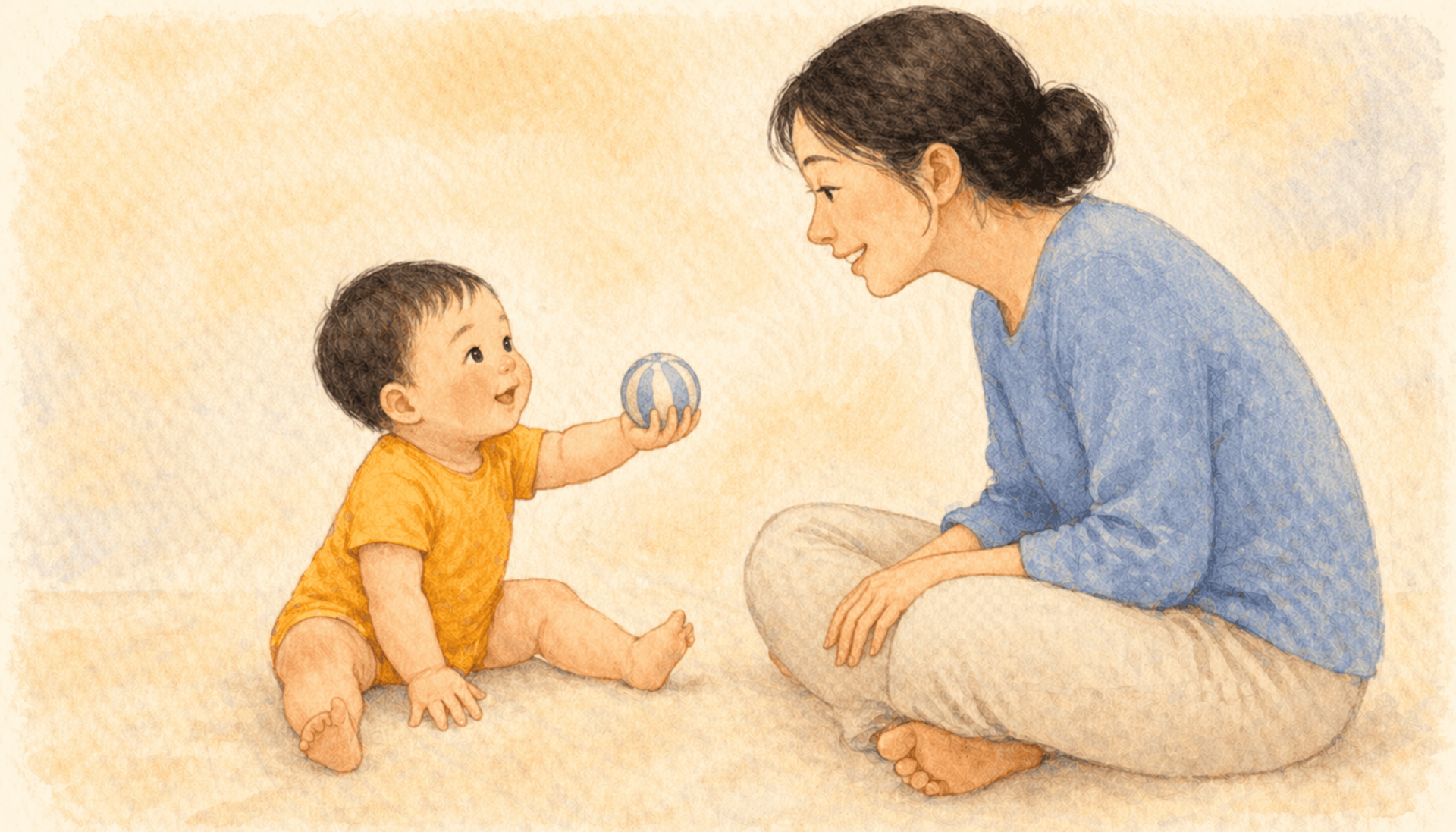
Real pointing, the index-finger look-at-that kind, usually shows up closer to 11 or 12 months, not 9. But by 9 months, most babies are already doing the pre-pointing versions of it, and those versions are how a lot of early communication actually happens. A longitudinal study of 9-to-15-month-olds by Carpenter, Nagell, and Tomasello in 1998 documented the classic pre-pointing behaviors: giving, showing, and reaching up. Your baby lifts a toy toward you, waits for you to take it, checks your face for a reaction, and then takes the toy back. That loop is a conversation.
A 2024 PNAS study by Phillips and colleagues extended this picture forward a few months. The researchers used EEG (small sensors that pick up brain-wave activity through the scalp) to record both 14-month-old babies and their parents simultaneously during free play, then coded who looked at each object first. Babies initiated 62% of the looks. Parents followed along 41% of the time, meaning the baby led more often than the adult did. And when the parent named an object during one of these infant-led moments, word learning was strongest. The takeaway for everyday play at 9 months: your baby is already picking what to pay attention to, and the job is noticing and narrating what's already in focus.
A small note on the live-presence thing, because it keeps coming up with 9-month-olds and screens. Patricia Kuhl's lab at the University of Washington showed back in 2003 that 9-month-old American babies who heard Mandarin phonemes from a live person could discriminate those sounds at nearly native levels a few weeks later. Babies who heard the exact same phonemes on video or audio (not a live person) couldn't discriminate them at all. The difference wasn't the sound. It was the social contingency. That's also why video-chatting with family works in a way that "educational" videos don't: grandma on FaceTime actually responds back to the babble, and a cartoon dinosaur can't. Our screen time guide goes deeper into what works and what doesn't.
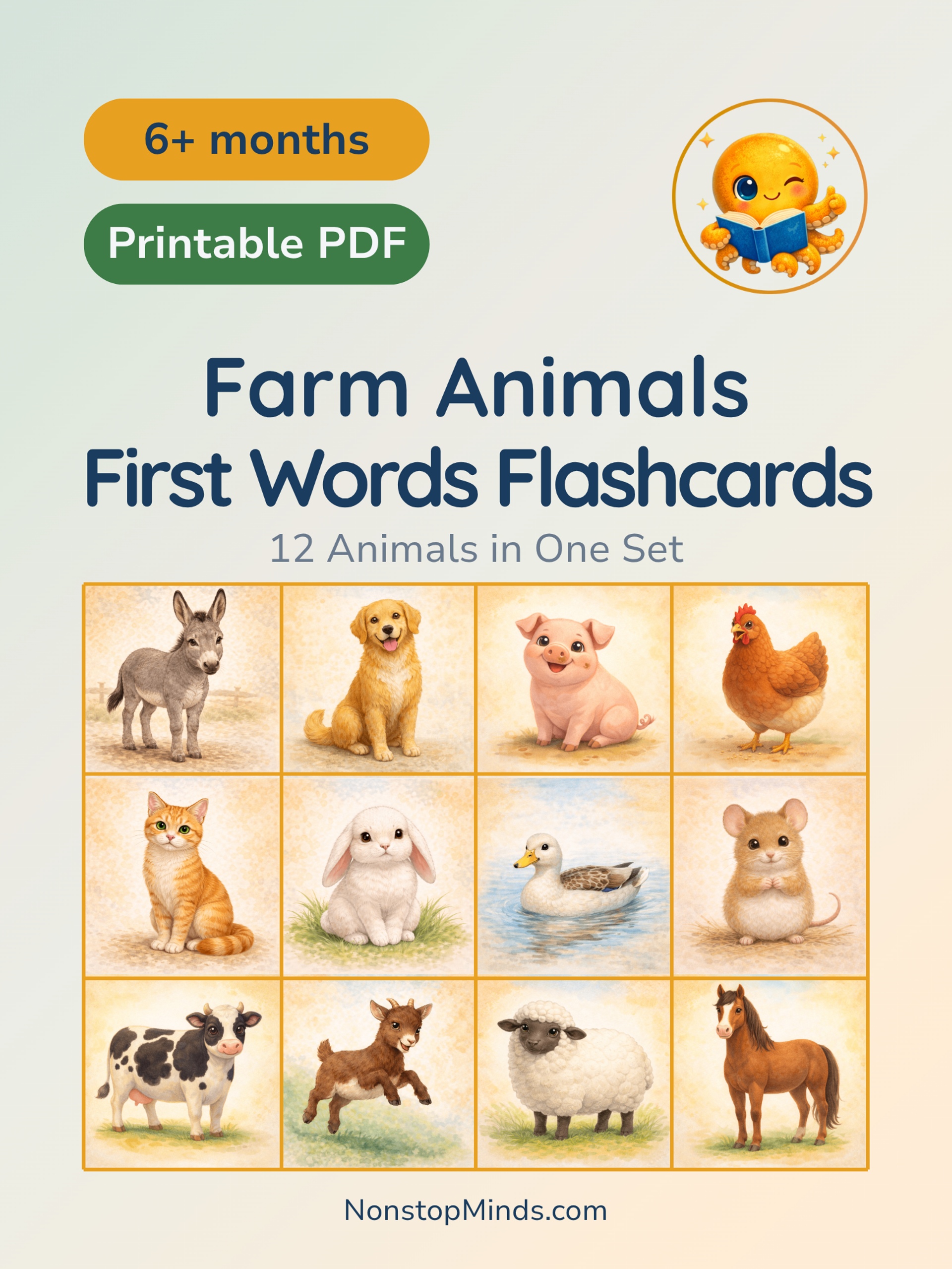
The everyday activities that work with this are almost embarrassingly simple. Sit where you and your baby are facing roughly the same direction. Name what your baby is already looking at, not what you want your baby to look at. Hand over a board book and let the page-slapping happen, and name what's being slapped. When your baby babbles, pause as if that babble was a real sentence, then answer. The first words guide goes deeper on the language part of this, and our Farm Animals First Words Flashcards were designed to give parents a concrete set of nouns to label during this kind of play, using words the research on early vocabulary shows most babies learn first.
Hiding games and the A-not-B brain
Here's a party trick. Sit across from your baby on the floor with two washcloths and a small toy. Hide the toy under washcloth A and let your baby find it, then do it again. Now, with your baby watching the whole time, slowly move the toy and hide it under washcloth B. More often than not, your baby reaches for washcloth A anyway.
This is the A-not-B error. Piaget first described it, and a 1987 meta-analysis by Wellman and colleagues, pulling data from hundreds of babies, confirmed it peaks between 8 and 12 months, with 9 months as the classic onset. The trick of the error is that it doesn't mean your baby doesn't understand objects are permanent. Work by Adele Diamond and others has shown that at 9 months, the baby genuinely knows the toy moved. What can't quite happen yet is overriding the motor pattern reinforced three times by successfully finding the toy at A. The hand keeps reaching back to where it worked before. That gap between knowing and doing lives in the brain's impulse-control circuitry, which is still getting wired in at 9 months.
Which makes hiding games at 9 months cognitive workouts disguised as fun, and you can scale the difficulty across the month. Start with partially hidden toys, where your baby just has to pull a cloth off (these are 9 month baby activities that look easy but are doing real cognitive work). Once that version is reliable, move to fully hidden toys in the same location, a few times in a row. Then try the A-and-then-B version slowly, narrating as you go: "under this one, now under that one." Container play with a lid belongs in the same category, since your baby drops small objects in, struggles with the lid, figures it out, and finds the objects again. That whole loop is an object-permanence workout.
Peekaboo still works, but the 9-month version is shifting. Your baby now predicts the reveal, which is why the pause before you reappear is funnier than the reveal itself. Our sensory play guide has more ideas calibrated by age, and the Sensory Play Cards 0–12 Months deck includes hiding and container prompts specifically calibrated to what the 9-month brain is ready for.
Pulling up, cruising, and a setup that works
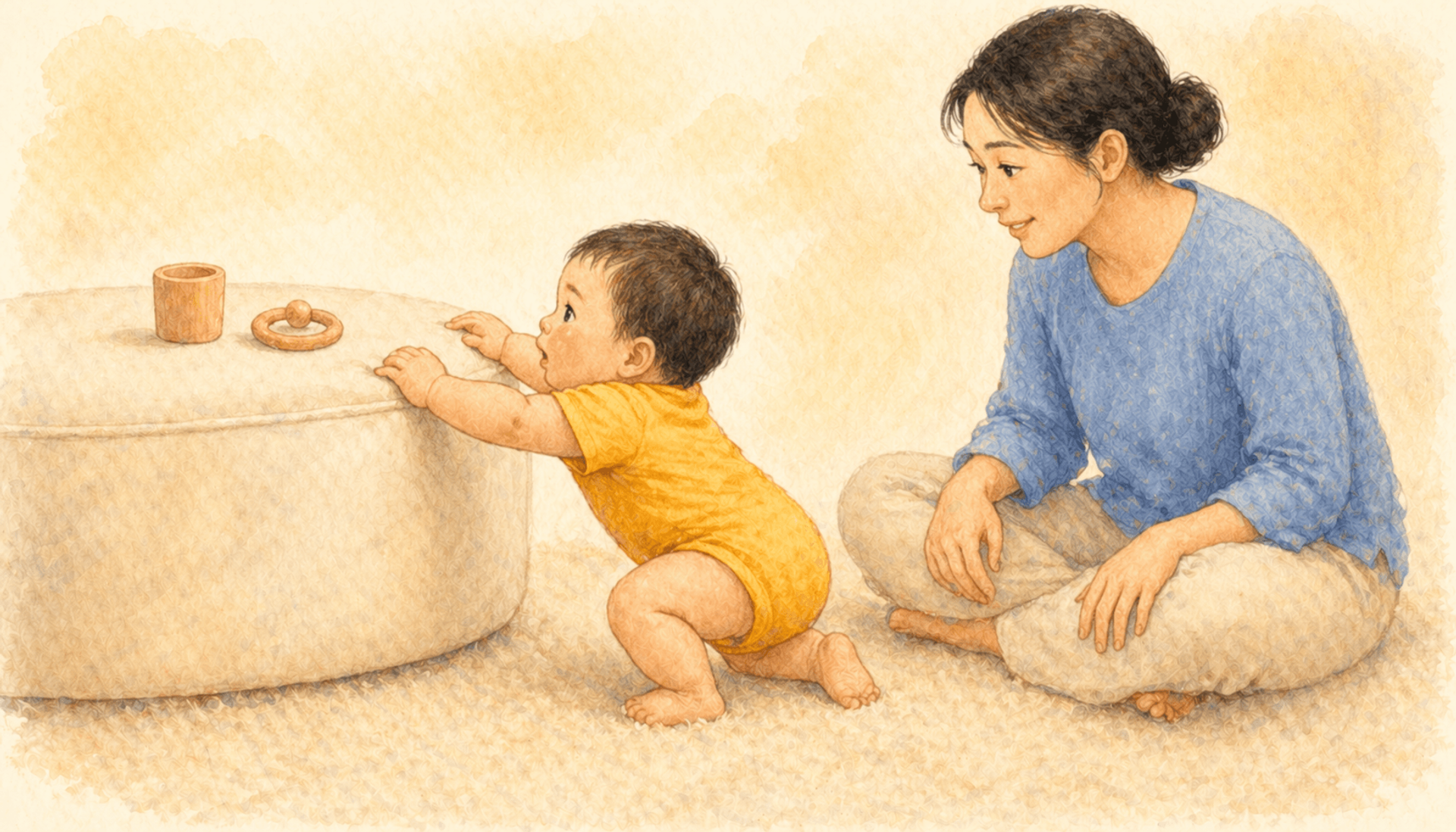
By 9 months, pulling up to stand on furniture is common. The WHO Multicentre Growth Reference Study, which tracked infants across five countries, puts the 50th-percentile window for "standing with assistance" at 7.4 to 10.2 months. Half of babies are there before 9 months, half after. Cruising (stepping sideways along furniture while holding on) often begins this month for the earlier movers and closer to 10 or 11 months for others. Both skills feed the same goal: gross motor practice that builds the core and leg strength for walking. The room around your baby is the gym.
The essentials, if you want to build one: a stable low surface for pulling up (a firm ottoman, a sturdy low couch, a coffee table with rounded or bumpered corners), and nothing on wheels, nothing that tips, nothing with a glass top. Softer flooring than hardwood where possible, or a thick rug, or a set of interlocking foam tiles, so the inevitable falls turn into non-events. And stair gates, installed before you think you need them. By 9 months, babies can reach and climb stairs without supervision, and stair falls at this age are among the most common preventable injuries in the pediatric literature, which is why a 1994 Pediatrics study on the topic is still the reference point cited in current guidelines.
Which brings up walkers. The American Academy of Pediatrics has recommended against infant walkers since 2001 and reaffirmed that position after a 2018 Pediatrics study by Sims and colleagues found that walker-related injuries still send more than 2,000 US children to emergency departments each year, mostly from falls down stairs. Walkers also don't speed up independent walking, and several observational studies have found they actually delay it slightly. Stationary activity centers, the kind without wheels, are a different product and are fine in moderation. The wheeled seat walker is what to avoid.
On the positive end, you don't need special equipment for wake window activity at this age. Arrange a horseshoe of firm surfaces around where your baby plays, with toys on top, and the pulling-up happens on its own. If your baby gets stuck in the standing position and starts to cry, try not to just swoop in for the lift, but model lowering one foot and sitting instead. Most babies figure out the controlled-sit-down version a few weeks after they figure out the standing-up version, and watching them work it out is its own kind of gym for the patient adult in the room.
The pincer grasp is ready for tiny things, which is a mixed blessing
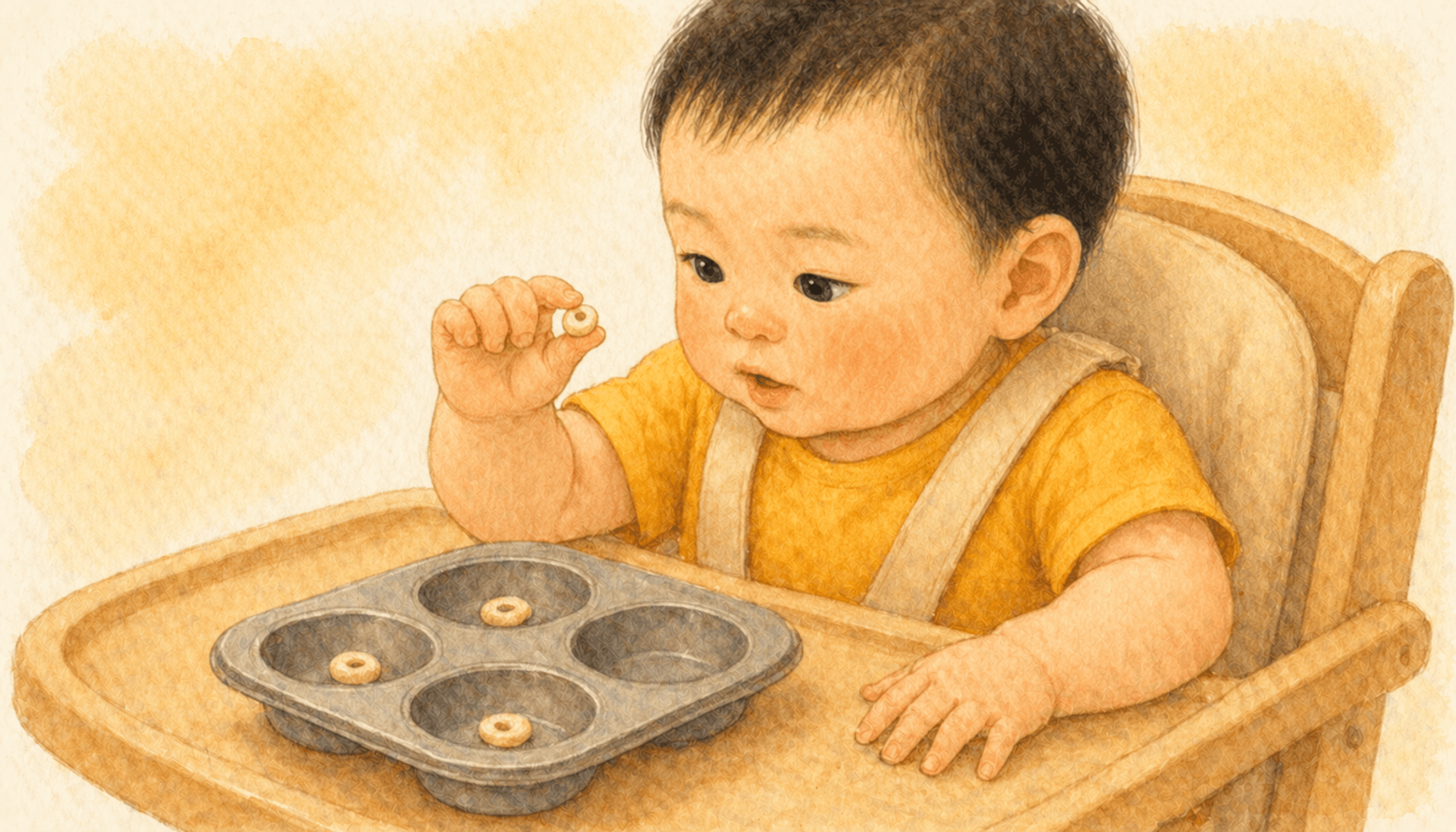
Fine motor finally catches up at 9 months. The inferior pincer grasp, where your baby uses the pad of the thumb against the pad of the index finger, is usually reliable by now, and the mature version (tip to tip) starts showing up this month for many babies, though it won't be polished until closer to a year. The practical consequence is that your baby can now pick up a single piece of cereal. Or a raisin. Or a bead, a loose pill, a piece of mulch, the head of a thumbtack. This is the month babyproofing stops being theoretical.
Get on your hands and knees and look across the floor of every room your baby has access to. Anything small enough to fit through a toilet paper tube (about 1.25 inches across) is a choking risk if a child under three puts it in the mouth, and at 9 months most babies will. Other parents on Reddit threads about 9-month-olds constantly post versions of "how did she find that?", which isn't a failure of attention on your part. It's a new capability on your baby's.
For activities that use the new grasp without the hazard, small soft finger foods on the high-chair tray work well: ripe banana, steamed carrot, soft watermelon, cooked pasta, very soft scrambled egg, all cut no larger than a pea, always supervised and seated upright. A muffin tin with a single puff or piece of cereal in each cup is great for isolating the pincer motion, since each piece has to be picked out one at a time. A shallow container plus lightweight objects to drop in and pull out (large wooden beads, silicone teething rings, the lids from stacking cups) is the classic container-play setup. Tearing soft paper also counts: a page of tissue or the end of a toilet paper roll can fill a whole activity block. And board books are chunky enough for the new grip and rugged enough to survive the enthusiasm.
These are screen-free activities for 9 month old development that work across almost any wake window, and they cost essentially nothing. Our Sensory Play Cards 0–12 Months include several prompts built around the pincer window (safe tweezer-style play, texture sorting, drop-in-container variations) if you want a deck of ideas rather than coming up with a new one every wake window. The month right before this one, covered in activities for an 8-month-old, was the warm-up, and 9 months is when the grasp actually starts doing what it's been building up to.
Frequently Asked Questions
The four that map most cleanly to what's developing this month are: joint-attention play where you name whatever your baby is already looking at, pincer-grasp practice with soft finger foods or a muffin tin, hiding games with two washcloths and a small toy, and a safe pull-up area with toys on a low firm surface. None require purchased equipment. Most work inside a 2–3 hour wake window without extra setup.
There's no required daily total. Most 9-month-olds have wake windows of about two and a half to three and a half hours, with one or two focused play stretches of 15 to 25 minutes inside each one. Outside of those, contingent interaction during feeding, diaper changes, and walking around the house counts. The research on sustained attention suggests fewer, longer moments beat a rotation of short ones.
Standing with support (pulling up on furniture, holding your fingers, briefly staying upright in a pulled-up position) is common at 9 months. The WHO reference study's 50th-percentile window for standing with assistance is 7.4 to 10.2 months. Independent standing without any support usually comes closer to 11 to 14 months. Not standing yet at exactly 9 months is well within the normal range.
Floor, basket of safe objects, low pull-up surface. Sit near your baby with a cup of coffee. Most 9-month-olds will self-direct through a 20-minute play stretch if nothing is chasing their attention. Not every play session has to be parent-led, and a 2014 Infancy study by Soska and Adolph at NYU found that independent exploration during sitting was a strong contributor to object learning. Quiet, near, and available is a full activity in itself.
For educational and entertainment purposes only. Not a substitute for professional medical or developmental advice. If you have concerns about your baby's development, consult your pediatrician.
- Carpenter, M., Nagell, K., & Tomasello, M. (1998). Social cognition, joint attention, and communicative competence from 9 to 15 months of age. Monographs of the Society for Research in Child Development, 63(4, Serial No. 255).
- Chiaviello, C. T., Christoph, R. A., & Bond, G. R. (1994). Stairway-related injuries in children. Pediatrics, 94(5), 679–681.
- Kuhl, P. K., Tsao, F. M., & Liu, H. M. (2003). Foreign-language experience in infancy: Effects of short-term exposure and social interaction on phonetic learning. Proceedings of the National Academy of Sciences, 100(15), 9096–9101.
- Phillips, E. A. M., Goupil, L., Whitehorn, M., Bruce-Gardyne, E., Csolsim, F.-A., Kaur, N., Greenwood, E., Haresign, I. M., & Wass, S. V. (2024). Leader–follower dynamics during early social interactions matter for infant word learning. Proceedings of the National Academy of Sciences, 121(37), e2321008121.
- Sims, A., Chounthirath, T., Yang, J., Hodges, N. L., & Smith, G. A. (2018). Infant walker-related injuries in the United States. Pediatrics, 142(4), e20174332.
- Soska, K. C., & Adolph, K. E. (2014). Postural position constrains multimodal object exploration in infants. Infancy, 19(2), 138–161.
- WHO Multicentre Growth Reference Study Group. (2006). WHO motor development study: Windows of achievement for six gross motor development milestones. Acta Paediatrica, 95(S450), 86–95.
- Wellman, H. M., Cross, D., & Bartsch, K. (1987). Infant search and object permanence: A meta-analysis of the A-not-B error. Monographs of the Society for Research in Child Development, 51(3), 1–67.
- Yu, C., Suanda, S. H., & Smith, L. B. (2019). Infant sustained attention but not joint attention to objects at 9 months predicts vocabulary at 12 and 15 months. Developmental Science, 22(1), e12735.
- Zubler, J. M., Wiggins, L. D., Macias, M. M., Whitaker, T. M., Shaw, J. S., Squires, J. K., Pajek, J. A., Wolf, R. B., Slaughter, K. S., Broughton, A. S., Gerndt, K. L., Mlodoch, B. J., & Lipkin, P. H. (2022). Evidence-informed milestones for developmental surveillance tools. Pediatrics, 149(3), e2021052138.

More Articles

Parallel Play in Toddlers: Why Side-by-Side Is the Social Work
Your toddler spent the entire playdate building separate towers, and nobody shared a single block. That counted — more than it looked. A 2025 longitudinal study found that playing beside a specific child consistently predicted later social play with that same child, but not the other way around. Here's what parallel play in toddlers actually is, why the science calls it strategic rather than passive, and what it means for how you run a playdate.

When Do Babies Point: Why It Matters for Language
Most milestone articles treat pointing as a box to check around 12 months. The research tells a different story — one that starts months earlier, runs through the infant brain, and traces back to how much the parent is pointing. Here's what the last fifteen years of research actually found, and what it means for everyday interactions.

When Do Babies Wave Bye-Bye: Why Your Baby Needs You to Wave First
Most baby milestones unfold on a biological schedule — waving isn't one of them. A 2023 study found that babies develop imitation ability because their caregivers imitate them first, and waving is named directly as a cultural gesture learned through that loop. Here's what the research says about the 9–12 month window, why the first wave looks nothing like a wave, and what helps it arrive.