Mother's Day Activities with Kids: Who's Actually Getting the Most Out of It
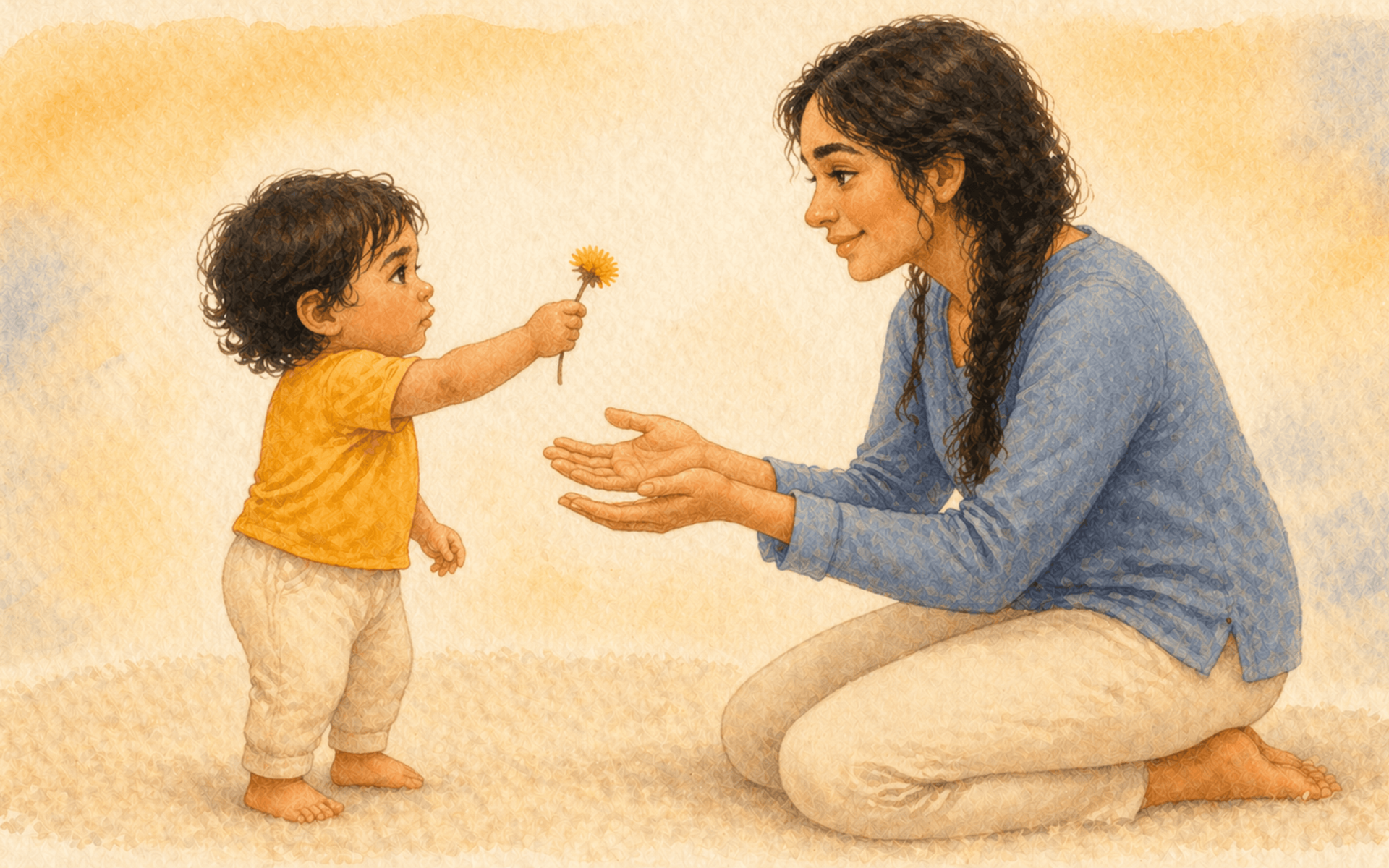
Whoever's typing 'mother's day activities with kids' into Google late on a weeknight is, almost certainly, mom herself. Mother's Day is one of those holidays where she's running a one-woman band: the activities planned so everyone has fun, the menu set so nobody cries over boiled broccoli, her own gifts somehow organized too. There's a kinder twist hiding in all this. Decades of developmental research keep finding that for toddlers and preschoolers, the giving part is what produces the emotional lift, not the receiving. Hard to believe? The researchers thought so too, and ran the same experiment three times across two cultures to be sure.
- The 2020 study that explains why the kid gets more out of giving than mom gets out of receiving
- What "participation" actually looks like at 0–12 months, before words
- The toddler dandelion sweet spot, and why ages 1–3 are the highest-payoff window
- A preschooler's gift, and what they're quietly rehearsing while making it
- The honest version of what mom usually wants vs. what she gets
If the one-sentence answer is enough, you’ve got the gist. If you want the mechanism behind each piece, keep reading.
The science behind a one-year-old's dandelion
There's a body of developmental research on why a one-year-old gives the flower in the first place, and why being thanked for it doesn't change the experience for them. Mother's Day listicles almost never cite it. The few that reach for science settle for vague claims about "bonding." What the actual literature says is more specific and a little inconvenient for the gift-list industry.
In 2012, Lara Aknin and her colleagues at the University of British Columbia ran a now-famous study with toddlers under two years old, published in PLoS ONE. The toddlers were given some Goldfish crackers, then asked to share with a puppet monkey. Coders rated the toddlers' faces frame by frame. Children showed measurably more happiness when they gave a treat than when they received one, and the most happiness when they shared from their own bowl rather than from a common pile. The original 2012 paper called this the "warm glow" of giving and proposed it as an evolved mechanism that sustains prosocial behavior despite its costs.
In 2020, Yue Song and colleagues at Utrecht University published a multi-study replication in Frontiers in Psychology. They ran the same paradigm three times: with Dutch toddlers (16–27 months), Dutch preschoolers around three, and Chinese preschoolers around four. The same finding appeared in all three samples. Children gave, then looked happier. The effect was independent of culture and independent of how many treats the child started with. One detail in the design matters most: in the helping conditions, the experimenter said "thank you" only after a deliberate three-second pause. The researchers compared each child's facial happiness before the thank you and after. Happiness did not increase. The reward had already arrived. Being thanked added nothing.
There's a neighboring finding that completes the picture. Felix Warneken and Michael Tomasello, working out of the Max Planck Institute, published a 2008 paper in Developmental Psychology showing that giving 20-month-olds material rewards for helping actually decreased how often they helped later. Toddlers who were never rewarded helped most. This sits alongside their 2006 Science paper showing that 14-to-18-month-olds spontaneously help adults retrieve dropped objects with no prompting and no reward — they just see the goal and toddle over.
This is what makes the Mother's Day asymmetry less unfair than it first feels. A toddler is not absorbing the meaning of giving by reading mom's face after the fact — by the time mom reacts, the toddler has already had her own experience of handing something over. The thank-you is a social skill she'll learn slowly over the next decade, and worth modeling. But it's not the part that makes the dandelion meaningful to her.
Babies under one: what "participation" looks like before words
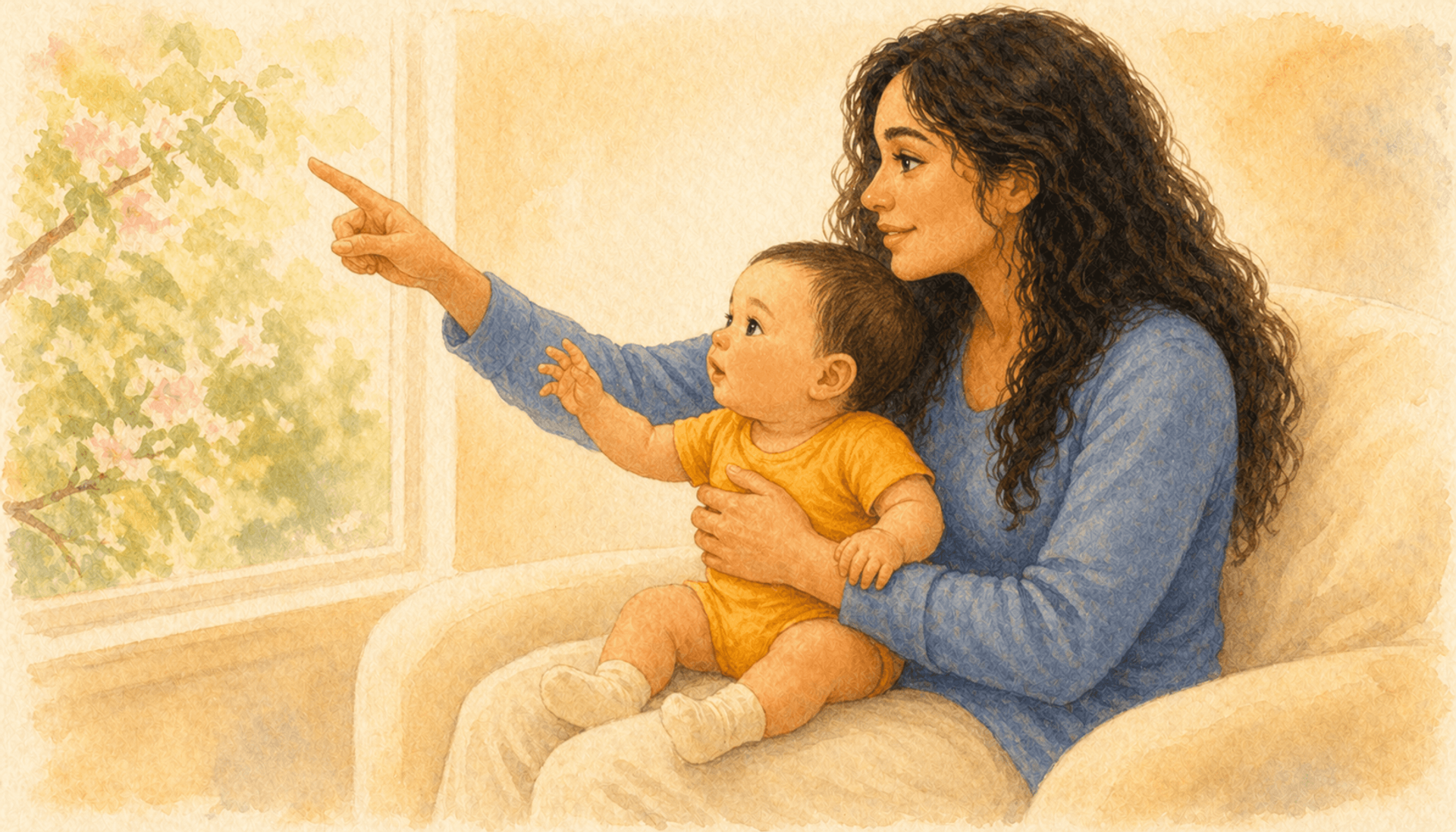
A baby under twelve months can't give a card or pick a flower. What the baby can do is something the developmental literature treats as the foundation of everything else: share attention with mom on a third thing. Most search results for mother's day ideas with baby skip past this and jump to footprint art. The footprint art is fine. It's just not where the actual development is happening at this age.
Sharing attention on a third thing — the building block researchers call joint attention — emerges gradually across the second half of the first year. Before nine months, most communication between mom and baby happens face-to-face, with no third object in the mix. After nine months, a triangle starts to form: mom, baby, and a thing they're both looking at. That triangle is the early scaffold of language and social understanding.
A 2025 study by Elena Capelli and colleagues at the University of Pavia, published in Frontiers in Psychology, followed 46 infants from 12 months to 24 months. Babies who initiated more of these shared-attention moments with their mothers at 12 months had richer vocabularies at 24 months. The pattern of looking at a thing, then back at mom, then at the thing again — that's the early scaffold doing its work.
On a Sunday morning, that translates to a simple thing. The baby's "participation" is being there, looking with you. There's no baking, no flower picking, no card making to attempt. What's available at this age is sitting on your lap while you look at something together and label what you see. That kind of looking-together is the same brain wiring the baby's language and theory of mind will eventually run on.
The most useful low-effort setups for under-one are the ones already on hand: a window with leaves moving outside, a board book read slowly enough for the baby to look back at your face between pages, a set of Sensory Play Flashcards one of you holds while the other narrates. If you're newly home with a four-month-old and unsure what to even attempt, the breakdown in our activities for 3-month-olds article covers what's actually working at that stage. The longer arc, month by month, is in our sensory play guide.
There's also the "what do I even do" mood that hits some moms hard in the first months. If that's the mood today, the what to do with a newborn all day piece is honest about how much of it is genuinely just being together.
Toddlers (1–3): the dandelion sweet spot
Between roughly 14 and 36 months, the toddler's helping system comes online with eerie reliability. Warneken and Tomasello's 2006 Science paper showed that nearly every 18-month-old in their sample helped a stranger retrieve a dropped clothespin without being asked, often within seconds. The researchers ran ten different scenarios — out-of-reach objects, cabinets the adult couldn't open, books that fell off a stack. The toddlers helped, again and again, with no reward and no praise.
What's happening cognitively is impressive. To help, the toddler has to track another person's goal, notice the obstacle, and select an action that solves it. A 2022 study by Elisa Brazzelli and colleagues at the University of Milano-Bicocca, also in Frontiers in Psychology, ran a battery of measures on 127 children aged 24 to 36 months. Emotion knowledge, theory of mind, and language each independently predicted prosocial behavior. The toddler who hands you a flower has spent a non-trivial amount of cognitive work figuring out that you want it.
Put those two pieces together — toddlers are reliably willing to help, and toddlers feel good giving without needing the thank-you — and the 1–3 stretch starts to look less like a developmental waiting room and more like the actual sweet spot. Wait, my toddler is the one with the warm glow here? Yes. The flower handed over with sticky hands is, biologically, more for her than for you. The pancake-batter stir is more for her than for the pancake. Whatever tearful-mom reaction does or doesn't come afterward is bonus material.
In practice this means the activity ledger should tilt heavily toward things the toddler can do crudely and lead. That can mean stirring batter with a spoon (you'll re-stir afterward; that's fine), picking flowers from the yard or from a vase you set within reach, choosing which book the two of you read together this morning, or putting one sticker on a card you started. The point is the doing, not the result.
One predictable wrinkle. A toddler's autonomy push and a parent's morning often disagree about which direction to walk. If today is one of those days, our piece on why your toddler says no to everything covers the mechanism. Mother's Day is a good day to choose the toddler's plan over yours, even when yours is objectively better. The development is in the choosing.
Preschoolers (3–6): real ritual vs. macaroni necklace
Around three, the script changes. The preschooler can rehearse, plan, and remember what mom said she liked last week. They begin to understand that other people have minds with contents different from their own — the developmental milestone called theory of mind. By four or five, a child can tell a coherent story about something that happened, refer back to it days later, and use the memory as the basis for a gift.
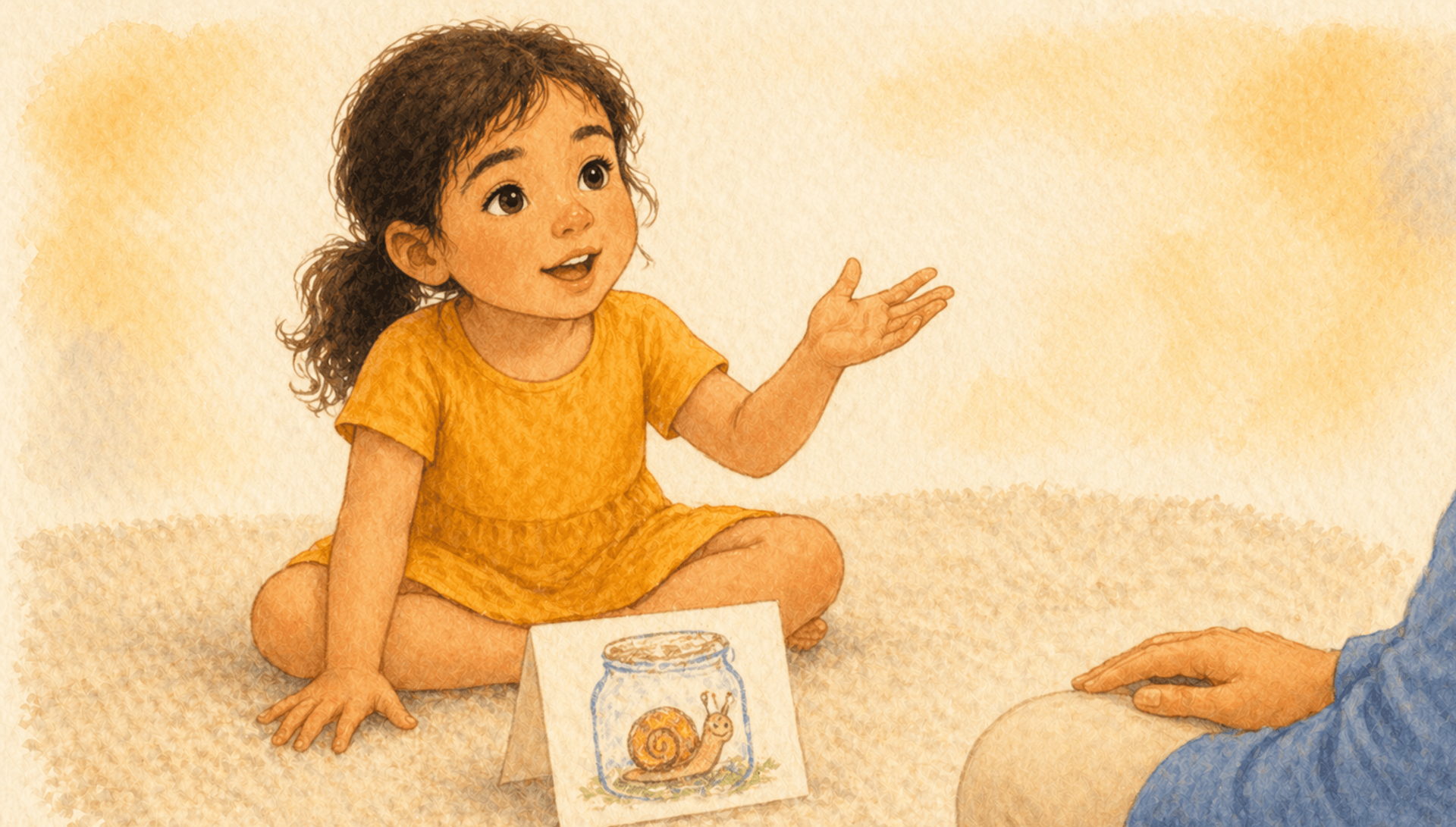
This is where the case for ritual gets concrete. A long line of research by Elaine Reese and Robyn Fivush — including a Reese and Newcombe 2007 paper in Child Development — has shown that mothers who use elaborative reminiscing with their young children ("remember when we found that snail and you put it in the jar?") raise children with richer autobiographical memory and better narrative skills years later. A Mother's Day where the preschooler is invited to retell the year ("what was the best part of last summer?") goes beyond sweet. It's exactly the practice that builds the autobiographical scaffolding, which makes retelling-based mothers day activities with kids the most underrated category for ages three and up.
Gratitude itself becomes a real cognitive event around this age. Anat Shoshani and her team at the Interdisciplinary Center Herzliya, in a 2020 paper in Developmental Psychology, ran three experiments with three-to-six-year-olds. Children who'd just been helped by an adult — and who registered that the help was deliberate — went on to help that adult more, help strangers more, and share their own resources more readily afterward. Put plainly: when a four-year-old notices mom doing something on purpose for her, she's quietly absorbing the shape of intentional giving, which feeds back into how she'll give next time.
What works in practice for this age looks different from the toddler list. Preschoolers can make a real card with a real memory, not a generic "I love mom" smear. They can choose breakfast from two options you offer and help assemble it. They can pick out a flower at the store on the way home from preschool the day before. They can be in charge of the morning routine — turning on a particular song, setting the table, putting out napkins — if there's already a rhythm they know.
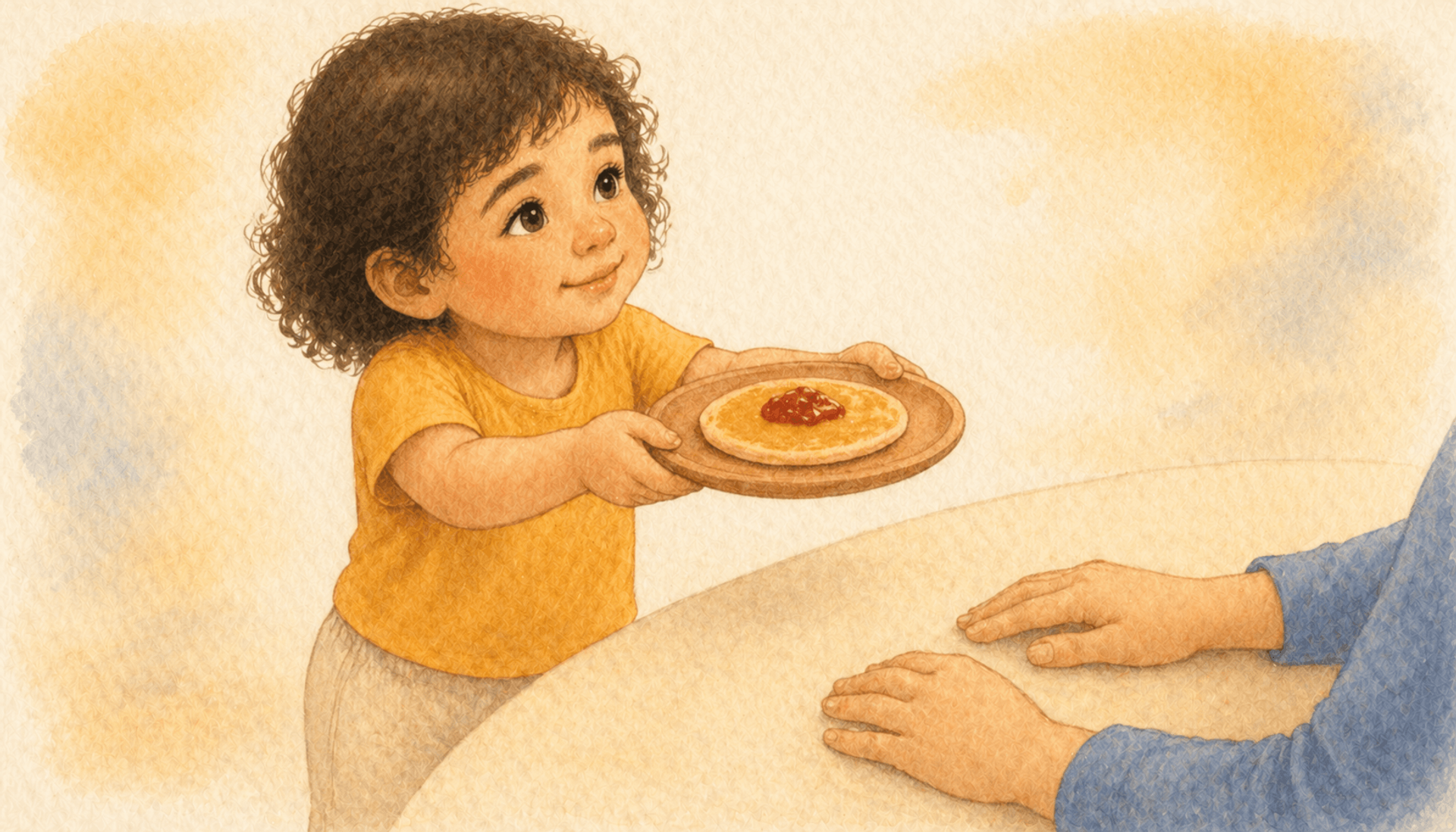
That last piece is where structure helps. Preschoolers who already have a familiar routine framework can slot a Mother's Day variation into it without the day collapsing into chaos. Our Big Kid Routine is built for this exact age and gives children visual cards they own and rearrange themselves. If routine is a sore spot in your house generally, the why daily routines reduce toddler tantrums piece covers the underlying mechanics. And if your preschooler is talking less to you lately than you'd like, the bedtime conversation angle is a quieter way back in.
What mom actually wants (and the asymmetry, named)
There's a real reason every list of mothers day activities with kids focuses on what kids do for mom: the asymmetry built into the day itself. The day designed around her is also, often, the day she's quietly choreographing. That's not new and it's not getting fixed by Sunday.
What the research above does is take the pressure off the production value of the day. The kids do not need a Pinterest-grade craft to get the developmental return. They do not need a tearful gratitude scene from mom. The 18-month-old gets the warm glow from handing over a single flower. The four-year-old gets the rehearsal of intentional giving from being allowed to choose breakfast. The newborn gets joint attention from being held while you look at the same window together. None of this requires a coordinator.
Lower the bar on the day's choreography. Pick one thing each child can do, not twelve. Sit through it. Resist the impulse to fix it mid-stream. Let the dandelion be soggy. Let the pancake be uneven. Let the card be unreadable. The cognitive work is happening on the child's side regardless.
For mom specifically, the most underused Mother's Day activity is the one nobody puts on a list: receiving without performing. It's a hard one. Many moms — especially first-time mothers, especially the ones with the loudest internal scorekeeper — flinch at sitting still while a small person attempts to honor them imperfectly. If that scorekeeper has been loud lately, our piece on whether you're doing enough with your baby is built for that exact knot. The shorter version: you almost certainly are.
Frequently Asked Questions
For ages three to six, the most meaningful Mother's Day activities are ones the preschooler can lead with real planning, rather than crafts assembled under adult supervision. Drawing a card based on a specific memory ("remember when we…"), choosing breakfast from two options and helping assemble it, picking a flower at the store, or reading a favorite book to mom all fit. Preschoolers in this age range can rehearse and remember what they want to do, so giving them a small choice the day before raises the meaning of the whole event for them.
Babies under twelve months can't give gifts in any traditional sense, but they can participate in shared attention, which is what their brain is actually working on at this stage. Holding a baby on your lap while you look at a board book together, showing them a flower while naming it, or letting them watch you do a slow simple task while you describe it all count. A 2025 study at the University of Pavia, the first to track this from 12 to 24 months, found that infants who initiated more shared-attention episodes with their mothers had richer vocabulary at age two.
Crafts are fine. They are not the point. A craft is a vehicle for a child to do something with their hands and hand it over, which is the part that matters developmentally. A toddler smearing finger paint on a card and a preschooler making a more careful drawing are both performing the same underlying act of giving. The 2020 multi-country research on "warm glow" found that the giving itself produces the emotional payoff for the child, regardless of the craft's quality or whether the recipient acts impressed. So pick a craft that's easy to start and easy to stop.
Yes, and arguably more meaningful than for any older age. Research from the University of British Columbia in 2012, using toddlers under two, found that children at this age were measurably happier giving treats than receiving them, and happiest of all when they had to give from their own resources. A one-year-old handing over a single flower is having a real internal experience, even if the child can't tell you about it for two more years.
For educational and entertainment purposes only. Not a substitute for professional medical or developmental advice. If you have concerns about your baby's development, consult your pediatrician.
- Aknin, L. B., Hamlin, J. K., & Dunn, E. W. (2012). Giving leads to happiness in young children. PLoS ONE, 7(6), e39211.
- Aknin, L. B., Broesch, T., Hamlin, J. K., & Van de Vondervoort, J. W. (2015). Prosocial behavior leads to happiness in a small-scale rural society. Journal of Experimental Psychology: General, 144(4), 788–795.
- Aknin, L. B., Van de Vondervoort, J. W., & Hamlin, J. K. (2018). Positive feelings reward and promote prosocial behavior. Current Opinion in Psychology, 20, 55–59.
- Brazzelli, E., Pepe, A., & Grazzani, I. (2022). Prosocial behavior in toddlerhood: The contribution of emotion knowledge, theory of mind, and language ability. Frontiers in Psychology, 13, 897812.
- Capelli, E., Grumi, S., Vercellino, L., & Provenzi, L. (2025). Joint attention and exogenous attention allocation during mother-infant interaction at 12 months associate with 24-month vocabulary composition. Frontiers in Psychology, 16, 1516587.
- Paz, Y., Davidov, M., Orlitsky, T., Hayut, M., Roth-Hanania, R., & Zahn-Waxler, C. (2023). Prosocial behavior in toddlerhood and early childhood: Consistency across subtypes and over time. Frontiers in Psychology, 14, 950160.
- Reese, E., & Newcombe, R. (2007). Training mothers in elaborative reminiscing enhances children's autobiographical memory and narrative. Child Development, 78(4), 1153–1170.
- Shoshani, A., De-Leon Lendner, K., Nissensohn, A., Lazarovich, G., & Aharon-Dvir, O. (2020). Grateful and kind: The prosocial function of gratitude in young children's relationships. Developmental Psychology, 56(6), 1135–1148.
- Song, Y., Broekhuizen, M. L., & Dubas, J. S. (2020). Happy little benefactor: Prosocial behaviors promote happiness in young children from two cultures. Frontiers in Psychology, 11, 1398.
- Warneken, F., & Tomasello, M. (2006). Altruistic helping in human infants and young chimpanzees. Science, 311(5765), 1301–1303.
- Warneken, F., & Tomasello, M. (2008). Extrinsic rewards undermine altruistic tendencies in 20-month-olds. Developmental Psychology, 44(6), 1785–1788.
More Articles
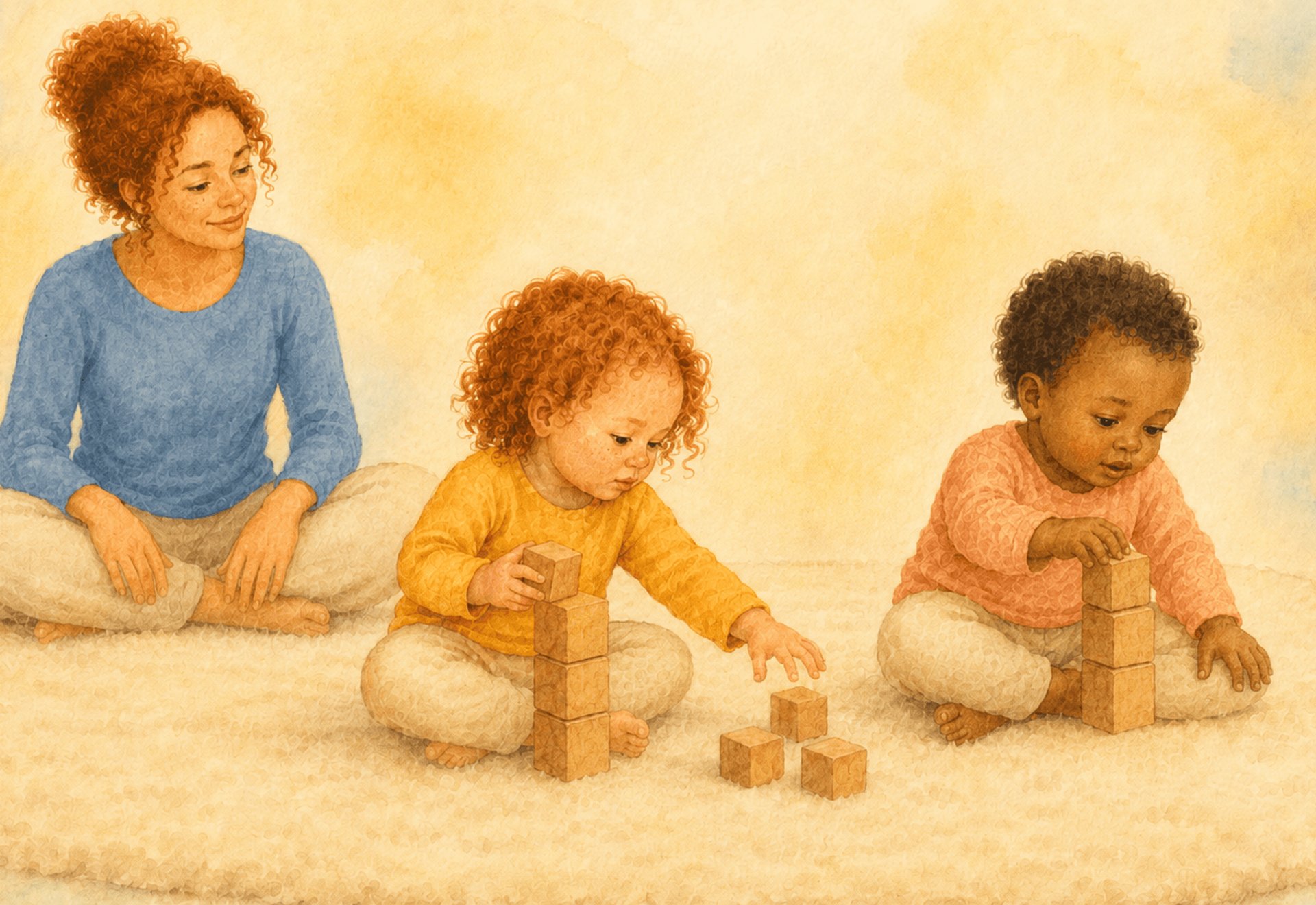
Parallel Play in Toddlers: Why Side-by-Side Is the Social Work
Your toddler spent the entire playdate building separate towers, and nobody shared a single block. That counted — more than it looked. A 2025 longitudinal study found that playing beside a specific child consistently predicted later social play with that same child, but not the other way around. Here's what parallel play in toddlers actually is, why the science calls it strategic rather than passive, and what it means for how you run a playdate.
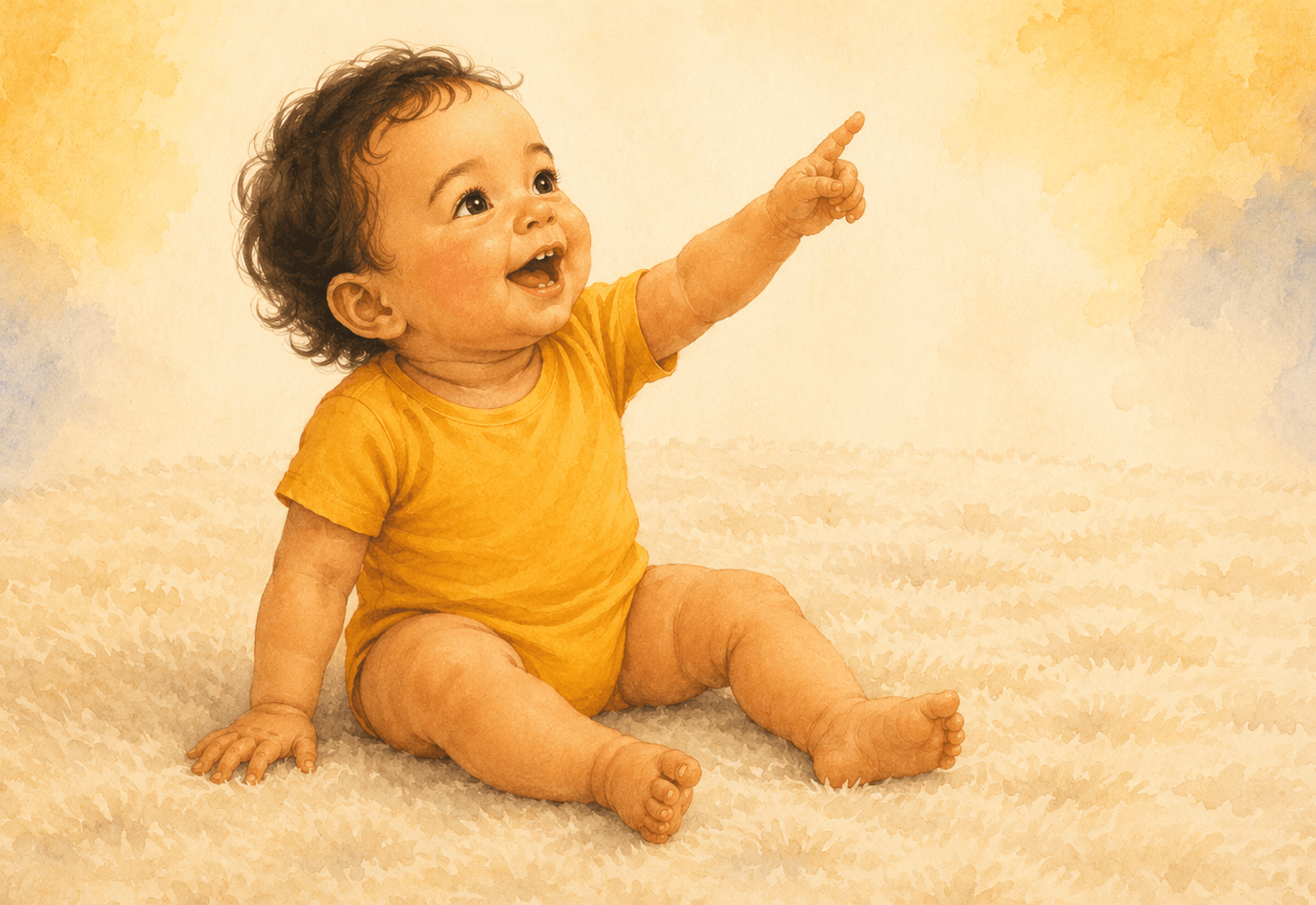
When Do Babies Point: Why It Matters for Language
Most milestone articles treat pointing as a box to check around 12 months. The research tells a different story — one that starts months earlier, runs through the infant brain, and traces back to how much the parent is pointing. Here's what the last fifteen years of research actually found, and what it means for everyday interactions.
When Do Babies Wave Bye-Bye: Why Your Baby Needs You to Wave First
Most baby milestones unfold on a biological schedule — waving isn't one of them. A 2023 study found that babies develop imitation ability because their caregivers imitate them first, and waving is named directly as a cultural gesture learned through that loop. Here's what the research says about the 9–12 month window, why the first wave looks nothing like a wave, and what helps it arrive.