Activities for a 1 Month Old: What Your Baby Can Do Right Now

Your baby is four weeks old and you're holding a tiny person who sleeps roughly sixteen hours a day, eats every two to three hours, and occasionally stares at you with an expression that could be deep love or just a digestive event in progress — and you honestly have no way of knowing. The wake windows last somewhere between 30 and 60 minutes, and half of that is feeding.
If you're searching for activities for a 1 month old, the honest answer is that the most effective ones look nothing like what you'd find in a toy catalogue. A 2017 study in Current Biology found that the amount of gentle touch a newborn receives in the first weeks of life directly shapes how the brain processes touch later — babies who got more skin contact in the early weeks showed stronger, better-organized touch responses when tested months afterward. Your arms, your voice, and your face are doing more developmental work right now than any product on the market, and the research behind that claim is unusually specific.
- What the one-month brain is actually building — and the hard limits on what it can process right now
- Why your face is the anchor activity, not one item on a list — and what makes it irreplaceable
- Why talking to a one-month-old builds language circuits even before words are possible
- How little tummy time still counts — and why chest-to-chest is a legitimate starting point
- The ceiling fan is not a parenting failure: why high-contrast contrast and movement in the environment count as visual input
- Wake window reality: how short the actual activity window is — and why that's enough
If the one-sentence answer is enough, you’ve got the gist. If you want the mechanism behind each piece, keep reading.
What a One-Month-Old Brain Is Doing
At one month, the brain is forming new synaptic connections faster than at any other point in the entire human lifespan — building a basic sensory map of how the world looks, sounds, feels, and moves. But the system has hard limits on what it can process. The visual system focuses clearly only at about 8 to 12 inches, roughly the distance from a feeding position to a parent's face. Color vision hasn't fully developed, so the visual cortex processes high-contrast black and white patterns far more effectively than pastels or complex images.
The auditory system, by contrast, is already surprisingly advanced. A one-month-old recognizes the mother's voice — the brain learned it prenatally, where it arrived at roughly 24 decibels above the amniotic baseline. Research shows that newborns can distinguish speech from non-speech, prefer human language over random noise, and will turn toward a familiar voice. If you read our article on things your baby can do in the womb, you already know this learning started months before birth.
What this means practically: the best activities for a one-month-old are the ones that deliver input through the channels the brain is actually equipped to receive — close-range vision, voice, touch, and movement. Everything else is noise the nervous system has to work to filter out rather than learn from.
Your Face Is the Most Powerful Developmental Tool at One Month
From the first days of life, babies would rather look at a face than at anything else — a finding first documented by Fantz in 1963 and confirmed in dozens of studies since. At one month, your face at 8 to 12 inches is the most complex, most responsive, most interesting object in your baby's visual world, and the brain comes pre-wired to seek it out.
Hold your face about 8 to 12 inches from your baby's — roughly elbow to wrist. Move slowly to the left, pause, then slowly to the right. If the eyes follow, even jerkily, even partway, that's the visual tracking system practicing in real time. Johnson and colleagues found that newborns tracked face-like stimuli further and more consistently than geometric patterns, abstract shapes, or scrambled features. This activity takes thirty seconds, requires nothing, and directly exercises the neural pathway between the retina and the developing visual cortex.
What makes this different from what every parenting website tells you: most sites list "face time" as one item in a list of ten activities. The research says it isn't one of ten — it's the anchor. The face combines contrast, movement, emotional expression, voice, and scent into a single stimulus that no toy, card, or mobile can replicate, because no toy responds to the baby's gaze by changing expression.
Why Talking to a One-Month-Old Matters More Than You Think
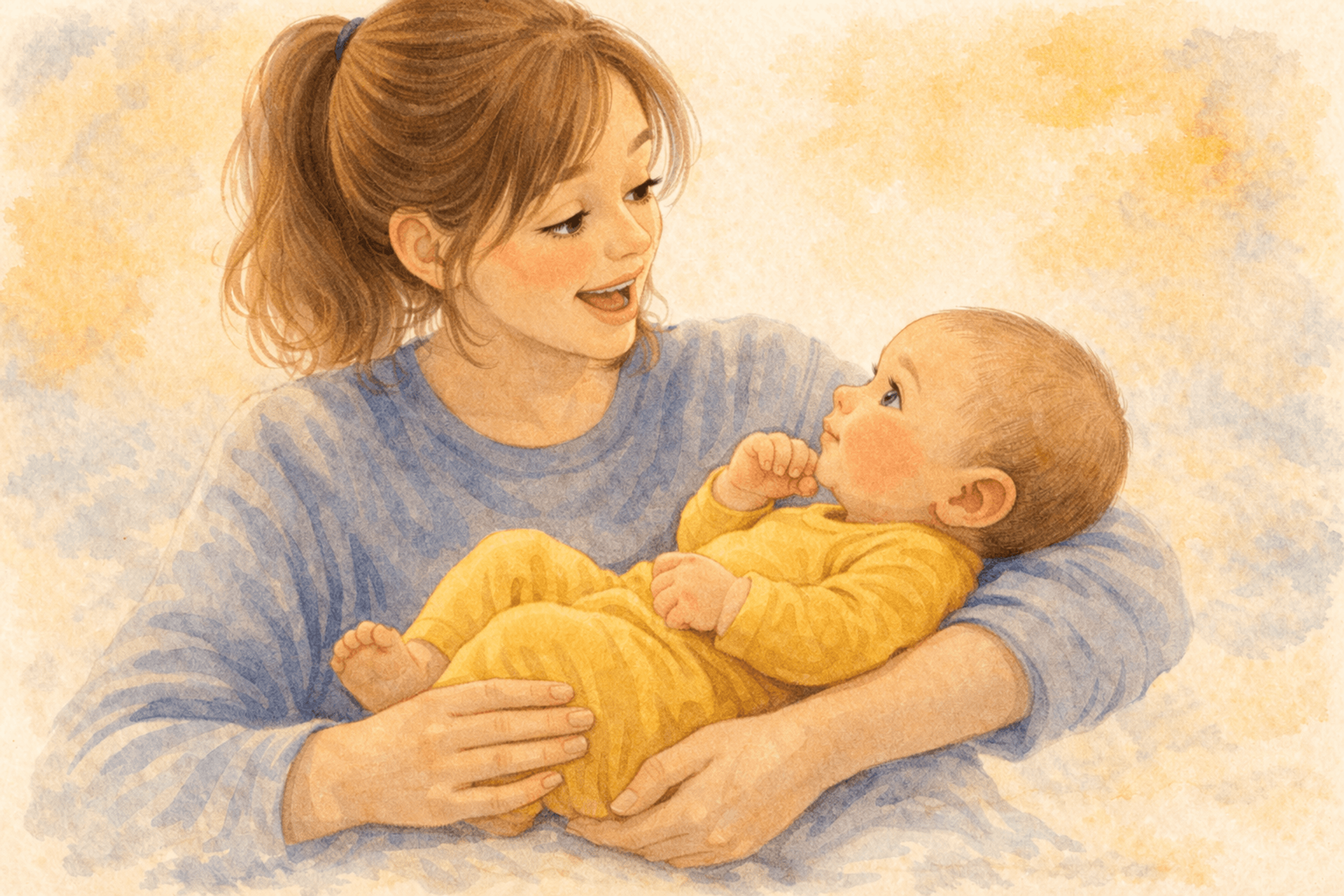
Researchers at MIT found that conversational turns — you speak, the baby pauses or coos, you respond — build language-related brain circuits more powerfully than the total number of words a baby hears. At one month, your baby can't respond with language, but the rhythm of turn-taking is already being encoded. A pause after your sentence and a response to any sound the baby makes — even a grunt or a sigh — counts as a turn, and the neural architecture for language begins here.
Talk during diaper changes, narrate what you're doing in the kitchen, describe the light coming through the window. Speech-language researchers call this parallel talk, and it works because it links real sensory experiences to speech sounds in real time. The content is irrelevant at one month — the baby cannot decode your words. But the melody, rhythm, and emotional warmth of your voice arrive intact, because the auditory system was tuned to these features prenatally. You could read your grocery list in a warm tone and the developmental value would be the same as reading a children's book, because at this age the brain is learning the music of language, not the meaning.
Tummy Time at One Month — How Little Still Counts
The AAP recommends tummy time from the first days at home. At one month, sessions are short — two to three minutes, two to three times a day, supervised, on a firm flat surface. A 2020 systematic review in Pediatrics found that infants who received regular tummy time showed earlier achievement of motor milestones including head control, rolling, and crawling readiness, compared to those with limited prone positioning.

A one-month-old will probably protest. The muscles that lift the head are just beginning to strengthen, and the position is unfamiliar and effortful. If your baby screams face-down on a mat, chest-to-chest tummy time on a reclined parent counts — and for many babies this is the only version that doesn't end in immediate crying. Our full guide to tummy time covers 7 evidence-based approaches for the baby who hates it, including positions that make it tolerable while the neck muscles develop enough for floor sessions.
The Ceiling Fan Is Not a Parenting Failure
If your one-month-old spends five minutes staring at a slowly rotating ceiling fan with the kind of rapt attention usually reserved for great art, that's not wasted time. A one-month-old sees fine detail only at 8 to 12 inches — but contrast and movement can be detected at much greater distances, because those are processed by a different part of the visual system. The dark blades of a fan spinning against a white ceiling create exactly the kind of bold contrast and slow movement that the early visual system is built to pick up, even from across the room. The baby isn't seeing the fan in sharp detail — the baby is detecting pattern, rhythm, and edge, which is precisely the work the visual cortex needs to practice.
This applies to any high-contrast element in the environment — the edge of a window frame against bright sky, shadow patterns on a wall, the contrast between a dark shirt and light skin. The visual cortex at one month is organized to detect edges, boundaries, and movement, and it will seek them out with or without your help. Fantz and later Atkinson and Braddick showed that newborn visual preferences follow a specific pattern — the system prioritizes the stimuli that drive its own development.
High-contrast cards held at 8 to 12 inches during alert moments give the visual system concentrated input in exactly the format it processes best — bold stripes, concentric circles, checkerboard patterns. Our High Contrast Flashcards 0–3 Months are sequenced to match how the visual system develops week by week, starting with the simple patterns a one-month-old can process and progressing as the brain is ready for more complexity. They're especially effective during tummy time, where a card placed at eye level gives the baby a visual reason to keep the head lifted. Our newborn vision guide covers the full developmental sequence in detail.
What Wake Windows Actually Mean for Activities at 1 Month Old
Wake windows at one month are typically 30 to 60 minutes total — and that includes feeding, diaper changes, and whatever interaction happens in between. After about 45 minutes of wakefulness, most one-month-olds start showing overstimulation signals: turning the head away, arching the back, fussing, getting a glassy distant stare, or hiccupping.
This means the actual window for activities is small. Five minutes of tummy time, two minutes of face tracking, a few minutes of talking during a diaper change — that might be the entire interactive window before the next nap, and that is genuinely enough. Research consistently shows that at this age, short responsive interactions embedded in caregiving routines do more for development than dedicated stimulation sessions. The brain doesn't need a curriculum. It needs a responsive person within focusing distance doing what parents naturally do — and then it needs sleep to consolidate what it just learned.
Signs your baby has had enough: gaze aversion (turning away from your face), back arching, sudden fussing after a calm stretch, hiccups, or a glazed distant stare. When you see these, the best activity is no activity — holding, rocking, or putting the baby down to rest. The brain processes and consolidates what it just experienced during sleep, and rest is not the absence of learning. It's the second half of it.
How Touch Physically Changes the Brain at One Month
A 2017 study published in Current Biology measured brain responses to gentle touch in newborns and found that babies who received more skin-to-skin contact and gentle handling in their first weeks of life showed stronger, more organized somatosensory cortex responses than babies who received less. The amount of early touch didn't just feel nice — it physically altered how the brain wired itself to process tactile information going forward.
Skin-to-skin contact against a parent's bare chest stabilizes heart rate, lowers cortisol, regulates body temperature, and supports breastfeeding — effects documented across hundreds of studies. But the Maitre 2017 finding adds a layer that's less well known: the quantity and quality of touch in the first month directly predicts how the brain responds to touch months later. This is one of the clearest demonstrations in developmental neuroscience that early sensory experience shapes brain architecture, not just behavior.
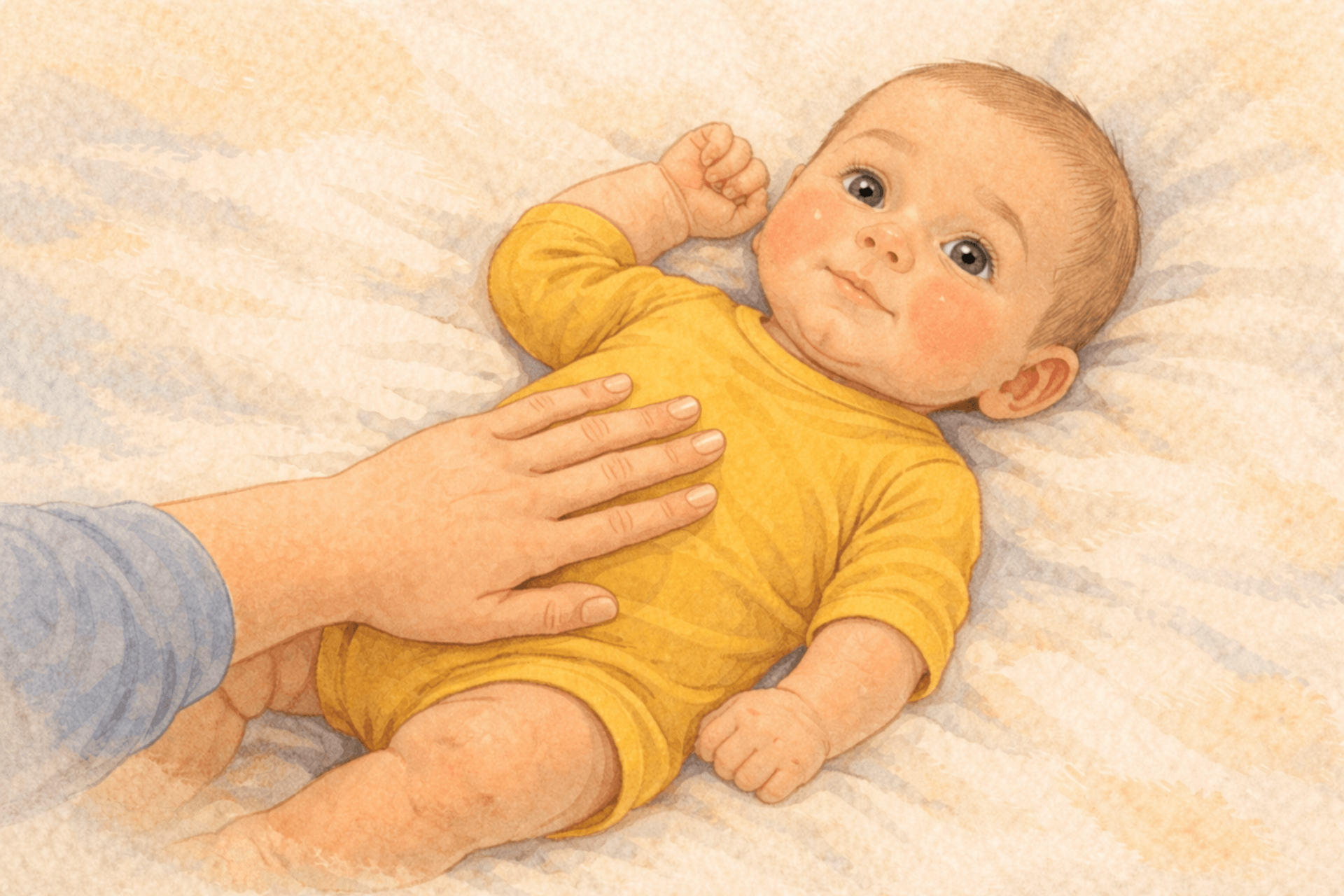
Practically, this means that holding your baby, changing a diaper while gently stroking the legs, doing skin-to-skin after a feed, or slowly running a soft cloth across the baby's open palm isn't a bonus — it's building the brain's ability to understand touch for months and years to come. You don't need a special technique. Varied, gentle, responsive touch throughout the day is what the research supports. If you want structured sensory activity ideas organized by sense and age — including touch, vision, sound, and movement — our Sensory Play Cards 0–12 Months give you sixty activities with the developmental science built into every prompt.
Frequently Asked Questions
Activities for a one-month-old work best in very short bursts of two to five minutes during alert, calm wake windows that typically last 30 to 60 minutes total. The bulk of that window is usually feeding and basic care. If your baby is engaged and calm, continue. If the baby turns away or fusses, the brain is saying "enough for now," and rest is the next developmental activity.
By one month, most babies can briefly lift the head during tummy time, move both arms and legs, bring hands toward the face, focus on objects 8 to 12 inches away, and turn toward familiar voices. The first social smile typically appears closer to six to eight weeks. The revised CDC milestone checklists (2022) begin at two months, so one-month markers are based on AAP developmental guidance and published normative data.
A one-month-old who stares at a ceiling fan, a window edge, or a pattern of light and shadow is doing exactly what the visual system needs at this stage — seeking and processing contrast and movement. Sustained visual attention to a fixed point is an early cognitive milestone, not a sign of understimulation.
The most effective visual stimulus at this age is your face at close range, and no toy replicates that. But a few things genuinely help: high-contrast cards held 8 to 12 inches from the baby during alert moments (our High Contrast Flashcards 0–3 Months are designed for exactly this), and a simple high-contrast mobile hung above the crib or play area where the baby can practice tracking movement. A mobile gives the visual system something to work with during those calm, awake moments when you're not holding the baby, and the research supports black-and-white or bold-pattern mobiles over pastel ones at this age.
This article is for educational and entertainment purposes only. Not a substitute for professional medical or developmental advice. If you have concerns about your baby's development, consult your pediatrician.
- Zubler, J. M., et al. (2022). Evidence-Informed Milestones for Developmental Surveillance Tools. Pediatrics, 149(3).
- Fantz, R. L. (1963). Pattern vision in newborn infants. Science, 140, 296–297.
- Johnson, M. H., et al. (1991). Newborns' preferential tracking of face-like stimuli and its subsequent decline. Cognition, 40(1–2), 1–19.
- Romeo, R. R., et al. (2018). Beyond the 30-million-word gap: Children's conversational exposure is associated with language-related brain function. Psychological Science, 29(5), 700–710.
- Maitre, N. L., et al. (2017). The dual nature of early-life experience on somatosensory processing in the human infant brain. Current Biology, 27(7), 1048–1054.
- Hewitt, L., et al. (2020). Tummy Time and Infant Health Outcomes: A Systematic Review. Pediatrics, 145(6).
- Atkinson, J., & Braddick, O. (2012). Visual development. In Oxford Handbook of Developmental Psychology.
- American Academy of Pediatrics. (2022). Back to sleep, tummy to play. HealthyChildren.org.
- CDC. (2022). Learn the Signs. Act Early. Milestone Checklists — 2 Months.
More Articles

Parallel Play in Toddlers: Why Side-by-Side Is the Social Work
Your toddler spent the entire playdate building separate towers, and nobody shared a single block. That counted — more than it looked. A 2025 longitudinal study found that playing beside a specific child consistently predicted later social play with that same child, but not the other way around. Here's what parallel play in toddlers actually is, why the science calls it strategic rather than passive, and what it means for how you run a playdate.

When Do Babies Point: Why It Matters for Language
Most milestone articles treat pointing as a box to check around 12 months. The research tells a different story — one that starts months earlier, runs through the infant brain, and traces back to how much the parent is pointing. Here's what the last fifteen years of research actually found, and what it means for everyday interactions.

When Do Babies Wave Bye-Bye: Why Your Baby Needs You to Wave First
Most baby milestones unfold on a biological schedule — waving isn't one of them. A 2023 study found that babies develop imitation ability because their caregivers imitate them first, and waving is named directly as a cultural gesture learned through that loop. Here's what the research says about the 9–12 month window, why the first wave looks nothing like a wave, and what helps it arrive.