What Can Newborns Actually See? A Week-by-Week Guide
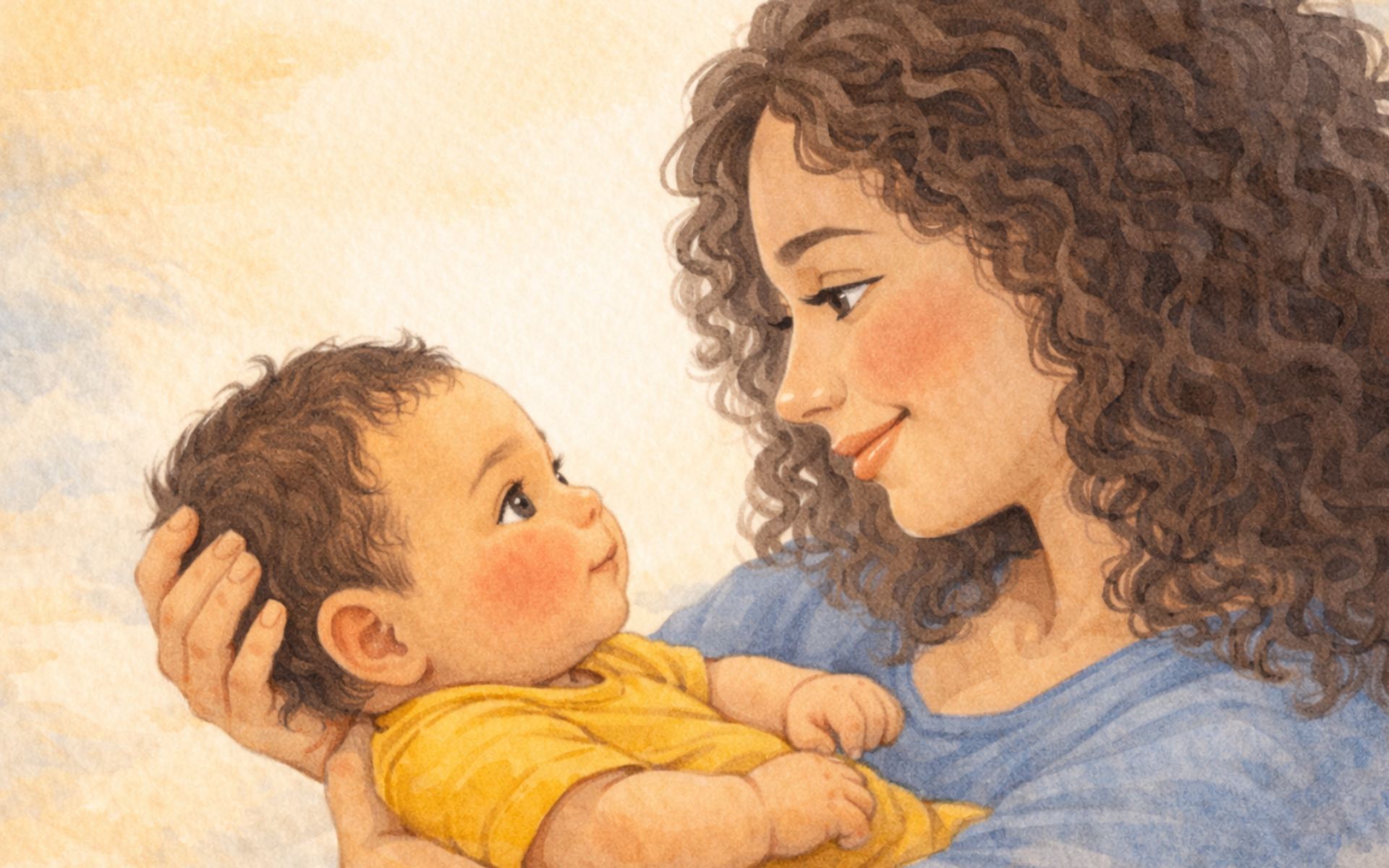
Your newborn is staring at something again. Maybe it's the ceiling fan. Maybe it's the edge of your shirt. Maybe it's nothing at all — and you're wondering if those little eyes are actually seeing anything.
The short answer: yes. But the world your baby sees right now looks nothing like the one you see.
Newborn vision is blurry, mostly colorless, and limited to about 8–12 inches — roughly the distance between your face and your baby's face during feeding. That's not a design flaw. It's a feature. Your baby's brain is building a visual system from scratch, and it's doing so faster than at any other point in life.
- What a newborn sees at birth — and why 20/400 acuity and high-contrast preference are a design feature, not a limitation
- Weeks 1–2: what bold patterns and face-like shapes do for the visual cortex
- Weeks 3–4: how tracking begins and why pattern variety (different angles) matters more than people expect
- Weeks 5–8: the peak synaptogenesis window — why what your baby looks at during this period genuinely matters
- Weeks 8–12: when red appears — and why first color is a real developmental milestone not found in baby books
If the one-sentence answer is enough, you’ve got the gist. If you want the mechanism behind each piece, keep reading.
At Birth: The Blurry Black-and-White Phase
When a newborn first opens those eyes, visual acuity sits at roughly 20/400. To put that in perspective: what you can see clearly from 400 feet, your baby can only make out from 20 feet. Everything beyond about a foot away is a blur.
But something remarkable is already happening. Research by Robert Fantz in the 1960s showed that even hours-old newborns consistently prefer looking at face-like patterns over random shapes. Your baby can't see your expression yet — but the basic configuration of eyes, nose, and mouth? The brain is already wired to look for it.
What registers clearly at this stage: high-contrast edges. Black against white. Bold shapes with strong boundaries. The retina is still developing, and the photoreceptors responsible for color (cones) aren't functional yet. The cells that process light and dark (rods) are more mature — so contrast is your baby's visual lifeline.
Weeks 1–2: Bold Shapes and Your Face
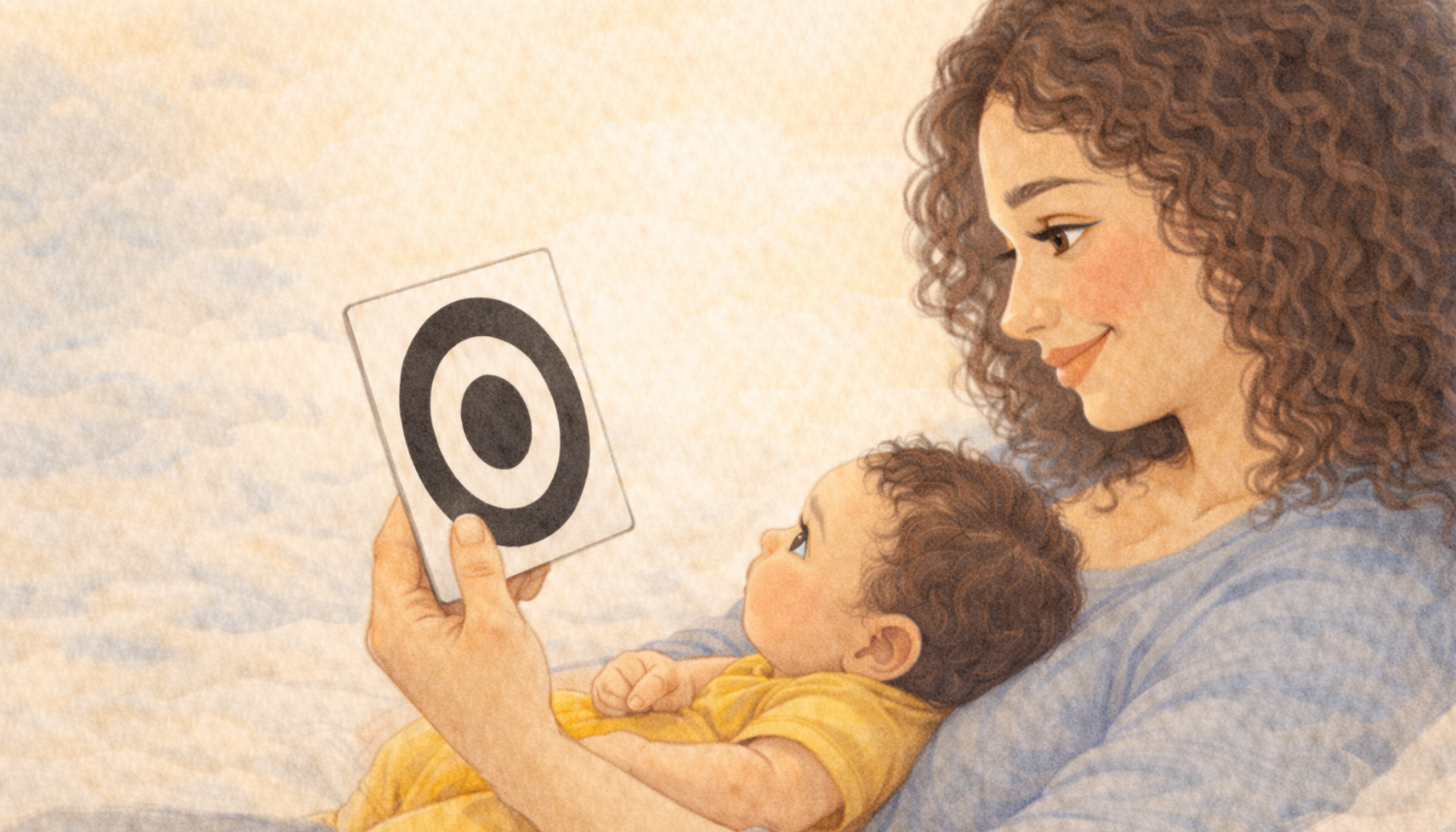
In the first two weeks, your baby's visual world is extremely narrow. Focus is possible at about 8–12 inches, and only on objects with strong contrast.
Simple, bold patterns — a solid black circle, thick stripes, a bull's-eye — register most clearly at this stage. Research on newborn visual preferences consistently shows that babies this age fixate longer on high-contrast patterns than on gray, low-contrast ones.
Your face is the most interesting thing in your baby's visual field right now. During feeding, you're at exactly the right distance, and the contrast between your eyes, hairline, and skin is enough for your little one to detect your presence. Your baby isn't seeing you yet — more like a high-contrast shape that smells familiar and sounds like comfort.
What you can do: Hold a simple black-and-white image 8–12 inches from your baby's face. Don't move it — just hold still. If your little one glances at it for even a second, that's a win. The brain just processed visual input and formed new neural connections.
Weeks 3–4: Tracking Begins
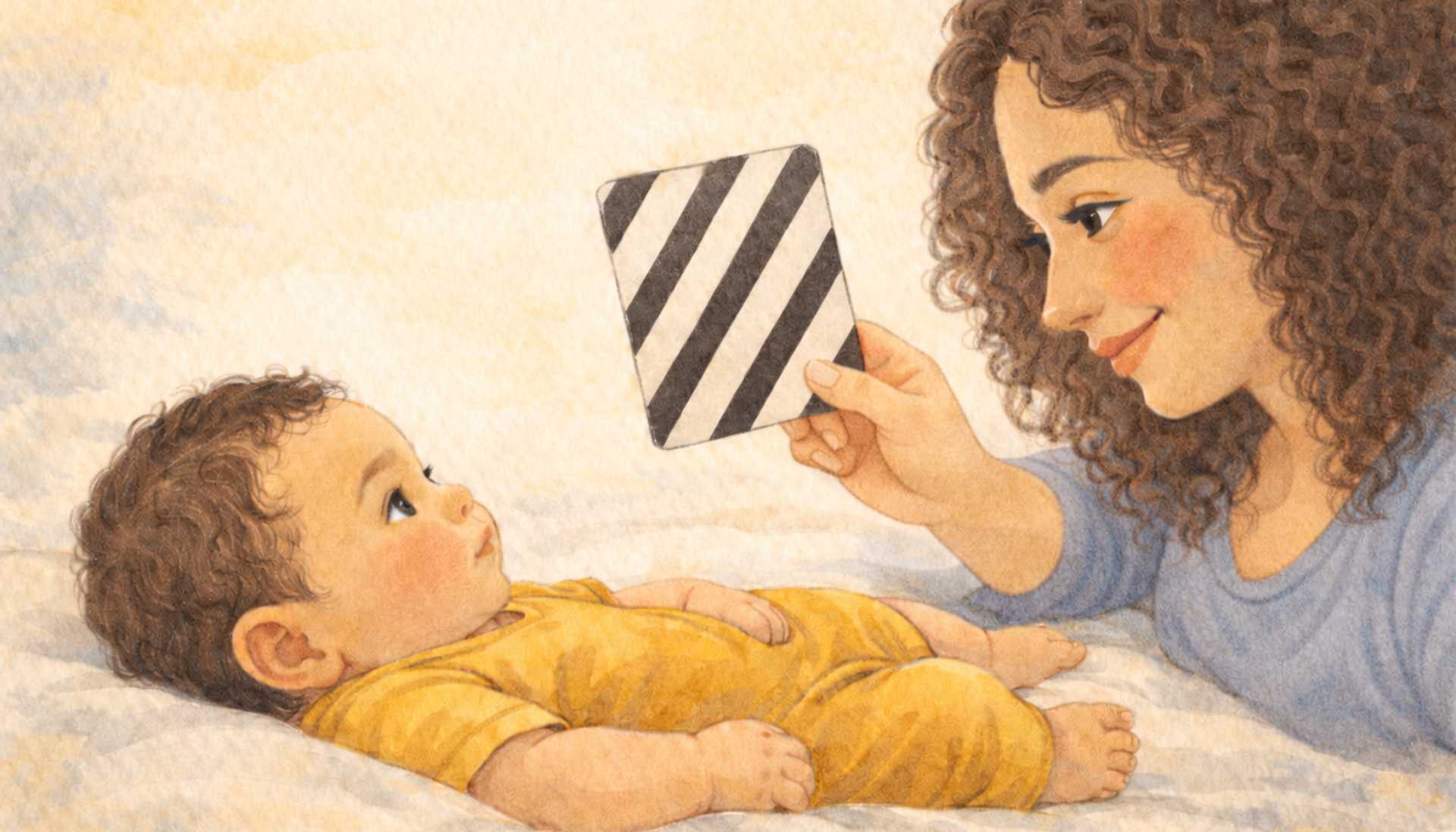
Around week three, something shifts. Your baby starts attempting to follow moving objects with those eyes — jerky and inconsistent at first. This is called visual tracking, and it's a sign that the neural pathways between the eyes and the brain are getting stronger.
At this stage, patterns with more visual information — a 4×4 checkerboard instead of a 2×2, diagonal stripes, zigzag lines — start becoming interesting. The visual cortex is ready for more complexity.
One detail worth knowing: the visual cortex processes each angle with separate neurons. Horizontal stripes, vertical stripes, and diagonal stripes are literally different experiences for your baby's developing brain. Variety in pattern orientation matters more than you'd expect.
What you can do: Slowly move a high-contrast card from side to side. Watch your baby's eyes — is there an attempt to follow it? Even a partial effort means the tracking system is coming online. Keep sessions short. If your little one looks away, the session is over.
Weeks 5–8: Vision Sharpens
This is a big transition period. Visual acuity improves noticeably — your baby can now see finer details and may start noticing things from farther away (though still not very far).
Engagement with patterns becomes more deliberate. You might notice your baby studying a pattern for several seconds, then looking away, then coming back to it. That's not distraction — it's the brain's way of processing in cycles.
The connections between the two eyes are also strengthening, which means depth perception is beginning to develop. Your little one may start swatting at objects — not accurately yet, but the intention is there.
Research by Atkinson and Braddick on visual cortex development shows that the period between 6 and 12 weeks is one of the most rapid phases of synaptogenesis in the visual areas of the brain. In plain English: the brain is wiring itself for vision at an extraordinary rate, and what your baby looks at during this window genuinely matters.
What you can do: If your baby has been looking at the same cards for a while and seems less interested, it may be time for slightly more detailed patterns. Placing cards in different positions and at varying distances can also keep things fresh. Your baby might start tracking more smoothly now, too.
Weeks 8–12: Hello, Color
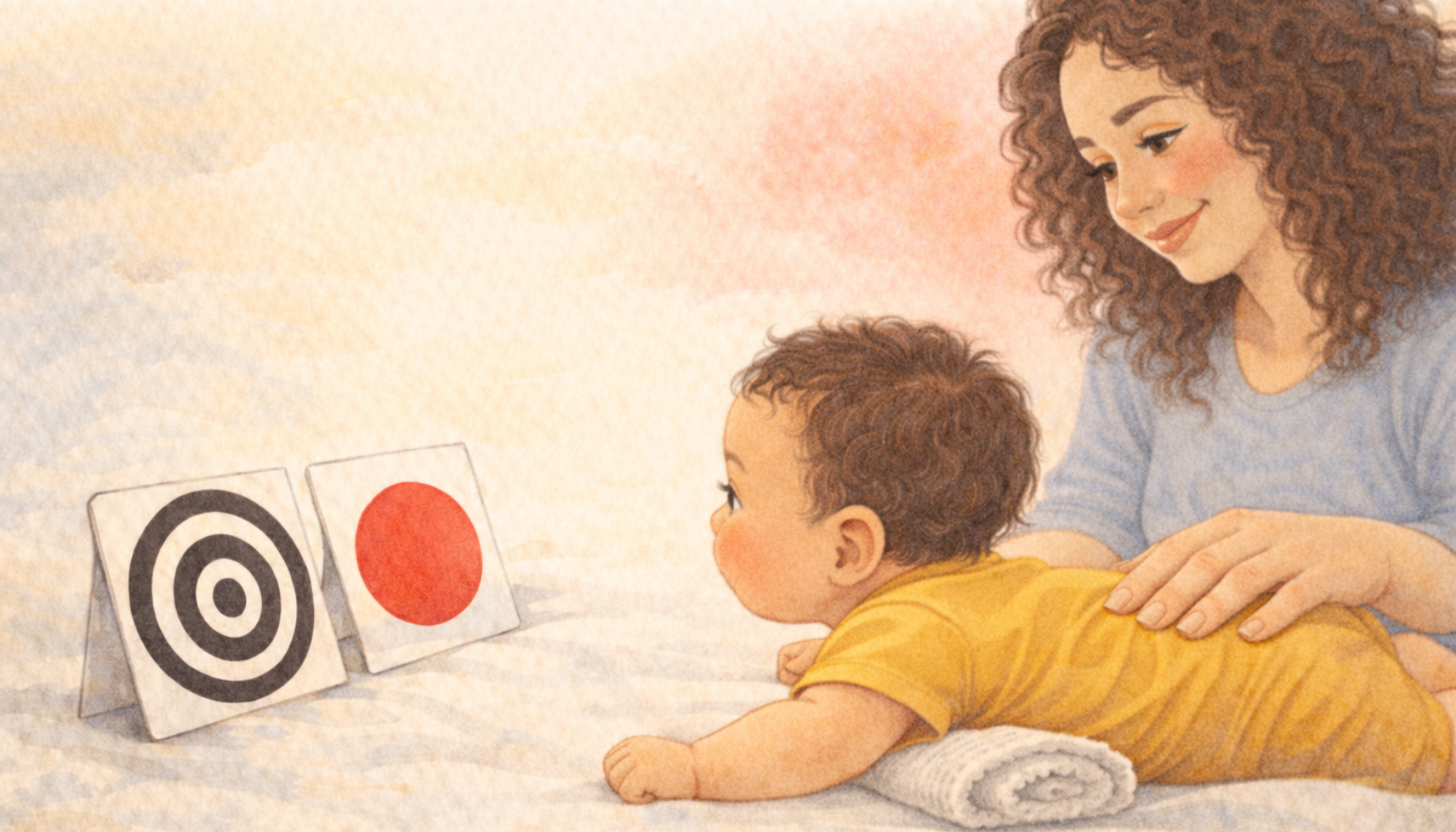
Here's something most parents don't realize: newborns are essentially color-blind for the first several weeks. The cone cells in the retina — the ones responsible for color vision — take time to mature.
Research by Davida Teller on infant color perception showed that red is the first color most babies can distinguish, typically around 8–12 weeks. It makes sense physiologically — long-wavelength cones (which detect red) tend to mature before medium and short-wavelength cones (green and blue).
So when your baby suddenly seems fascinated by a red toy or a red pattern amid black and white — that's not random. Your little one is literally seeing that color for the first time. It's as if someone turned on a new channel in the brain.
By 12 weeks, most babies can distinguish several colors, though color vision won't be fully adult-like until around 4–5 months. But that first red? That's a genuine milestone, even though it's not in any baby book.
And that's just the beginning. After red, your baby's color vision continues developing rapidly through six months — with a specific sequence that researchers have mapped in detail. We cover the full color timeline in When Do Babies See Color?.
What you can do: If you've been using black-and-white cards, this is around the time a touch of red becomes meaningful. Watch for a different kind of reaction — longer fixation, wider eyes, or reaching. If your baby seems indifferent, wait another week. There's no rush.
The Bigger Picture
Visual development in the first three months goes beyond just seeing clearly. Every time your baby focuses on a pattern, tracks a moving object, or notices a new color, new synapses form in the visual cortex. Huttenlocher and Dabholkar's landmark 1997 study on synaptogenesis showed that the visual cortex undergoes its most intense period of synapse formation in the first months of life.
This doesn't mean you need to run drills or create a rigid schedule. Your baby's brain is remarkably good at finding the stimulation it needs — your face, the play of light and shadow, the edges of objects around the room.
But providing intentional visual experiences — holding up a high-contrast card, slowly moving an object for your little one to track, introducing a splash of red at the right time — is like offering the brain exactly what it's hungry for, exactly when it can use it.
You don't need to do it perfectly. You just need to do it.
If you found this helpful, our guide to tummy time positions covers another way to support your baby's development in the first months — including how high-contrast cards make tummy time easier.
Quick Reference: Vision Milestones 0–3 Months
Birth to 2 weeks: Detects bold contrast, prefers face-like shapes, focuses at 8–12 inches.
Weeks 3–4: Begins tracking moving objects, engages with more complex patterns, variety in angles matters.
Weeks 5–8: Vision sharpens, longer focus sessions, early depth perception, brain wiring at peak speed.
Weeks 8–12: First color appears (red), visual tracking becomes smoother, starts reaching toward objects.
These are general ranges based on developmental research. Every baby progresses at a different pace. If you have concerns about your baby's vision, talk to your pediatrician.
Want to support your baby's visual development with purpose?
Our High Contrast Baby Flashcards for 0–3 Months include 30 science-backed cards sequenced to match exactly what your baby's brain is ready for — from bold shapes in week 1 to the first color by week 12. Plus a full parent guide and milestone tracker.
Already past the black-and-white stage? Our Color Contrast Cards for 3–6 Months pick up right where this set leaves off — introducing bold color in a progression that matches your baby's maturing vision.
Frequently Asked Questions
In the first week, newborns see high-contrast edges and shapes at a distance of 8–12 inches. Vision is blurry beyond that range. Faces are the most interesting visual stimulus — newborns will focus on the hairline-to-chin area, especially the eyes.
Newborns have limited color perception at birth. Red is typically the first color babies distinguish, around 8 weeks. Color vision develops gradually, with most babies seeing the full color spectrum by approximately 5 months of age.
This article is for educational purposes only and is not a substitute for professional medical advice. If you have concerns about your baby's vision or development, please consult your pediatrician.
- Fantz, R. (1961). "The origin of form perception." Scientific American, 204(5).
- Teller, D. (1997). "First glances: The vision of infants." Investigative Ophthalmology & Visual Science, 38(11).
- Huttenlocher, P. & Dabholkar, A. (1997). "Regional differences in synaptogenesis in human cerebral cortex." Journal of Comparative Neurology, 387(2).
- Atkinson, J. & Braddick, O. (2012). "Visual development." In Cambridge Encyclopedia of Child Development.
- American Academy of Ophthalmology (2024). "Vision development: Newborn to 12 months."
Related Products
More Articles
Parallel Play in Toddlers: Why Side-by-Side Is the Social Work
Your toddler spent the entire playdate building separate towers, and nobody shared a single block. That counted — more than it looked. A 2025 longitudinal study found that playing beside a specific child consistently predicted later social play with that same child, but not the other way around. Here's what parallel play in toddlers actually is, why the science calls it strategic rather than passive, and what it means for how you run a playdate.

When Do Babies Point: Why It Matters for Language
Most milestone articles treat pointing as a box to check around 12 months. The research tells a different story — one that starts months earlier, runs through the infant brain, and traces back to how much the parent is pointing. Here's what the last fifteen years of research actually found, and what it means for everyday interactions.

When Do Babies Wave Bye-Bye: Why Your Baby Needs You to Wave First
Most baby milestones unfold on a biological schedule — waving isn't one of them. A 2023 study found that babies develop imitation ability because their caregivers imitate them first, and waving is named directly as a cultural gesture learned through that loop. Here's what the research says about the 9–12 month window, why the first wave looks nothing like a wave, and what helps it arrive.