When Do Babies Start Laughing: The Question Behind the Question
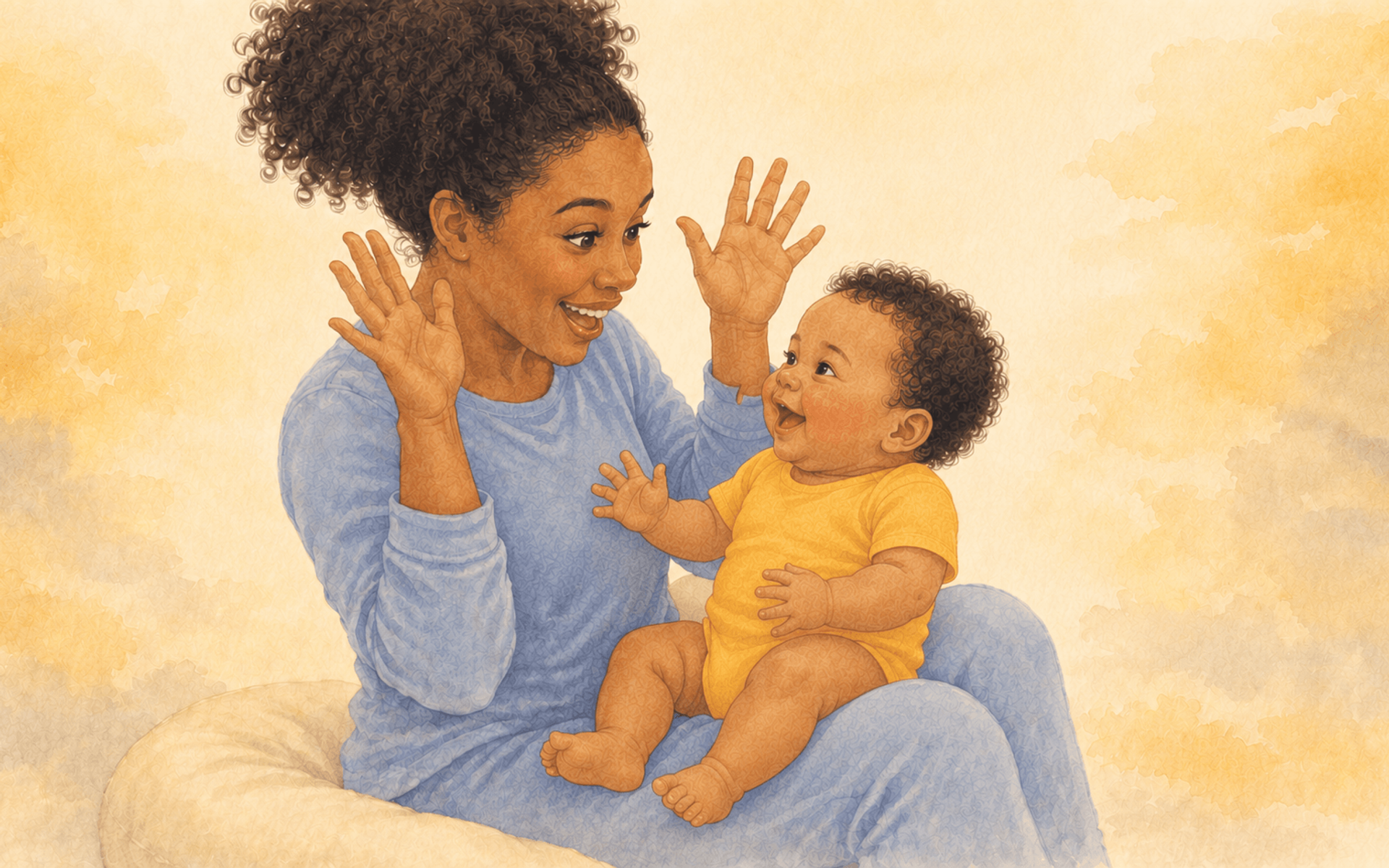
Your baby has been laughing at you for weeks, and you've been doing the silliest things to earn it — the voice, the face, the theatrical peel of a banana. The laughter has felt like a conversation. What the research suggests is that it wasn't quite one, not yet. When do babies laugh for the first time is a different question from when babies first find something funny, and the gap between those two milestones turns out to be surprisingly interesting.
- Why the "around four months" number is accurate but incomplete — and what it misses about how laughter develops
- The study that found four-month-olds laugh without independently getting the joke, and what five-month-olds can do that four-month-olds cannot
- How the things that make your baby laugh shift predictably over the first year — and why each shift is a readout of what the brain can now process
- Why babies laugh in their sleep, and what is happening when they do
- What the Navajo First Laugh Ceremony understands about this milestone that most parenting content does not
- When to mention laughter patterns to your pediatrician, and how to frame that conversation
If the one-sentence answer is enough, you’ve got the gist. If you want the mechanism behind each piece, keep reading.
Four Months Is When the Laugh Arrives — Five Months Is When It Means Something
Most babies first laugh between three and four months of age. This is well-established: Sroufe and Wunsch documented it in a landmark 1972 observational study of 150 infants, and Caspar Addyman's survey of more than 1,300 parents across 62 countries found an average first-laugh age of 3.5 months. The number is reliable. What it does not tell you is what that early laugh actually represents.
In 2018, Gina Mireault and Susan Crockenberg at Johnson State College ran two longitudinal studies to answer a more precise version of the question parents are asking when they search "when do babies laugh" — one following 60 infants at four, six, and eight months, the second following 53 infants at five, six, and seven months — to pinpoint exactly when babies stop just laughing and start genuinely understanding that something is funny. Each infant was shown a series of ordinary events and absurd versions of the same events, while a parent's facial expression was controlled as either laughing or completely neutral. The design separated two questions: does the baby find this funny on its own, or is the baby reading the parent's cue?
Four-month-olds laughed. But when the parent stayed neutral, they did not smile or laugh more at the absurd events than the ordinary ones. Something registered (their heart rates slowed measurably, an orienting response that signals "I noticed something is off") but they did not independently appraise the absurd event as humorous. Their laughter was still tied to the social context: to the parent's energy, to the playful voice, to the face doing something animated and warm.
Five-month-olds were different. In the second study, five-month-olds smiled and laughed at the absurd events even when their parent's face was completely neutral. They were no longer waiting for a cue. They were making their own assessment. The study, published in the British Journal of Developmental Psychology, is one of the very few to isolate this transition, and it changes what the milestone means: your baby's first real laughs at three to four months are a social act, a response to your warmth and playfulness. The laugh that emerges at five months and beyond is something more: evidence that your baby is building an internal model of how the world is supposed to work, noticing when it is violated, and deciding that is funny.
This is also the window where color vision kicks in. Our Color Contrast Cards are designed for exactly this stage — bold, progressively complex patterns built around how color processing develops between three and six months. A baby who was staring seriously at cards last month may start grinning at them now. Same cards, different brain.
What Makes Babies Laugh Changes Every Few Months — and That Is the Point
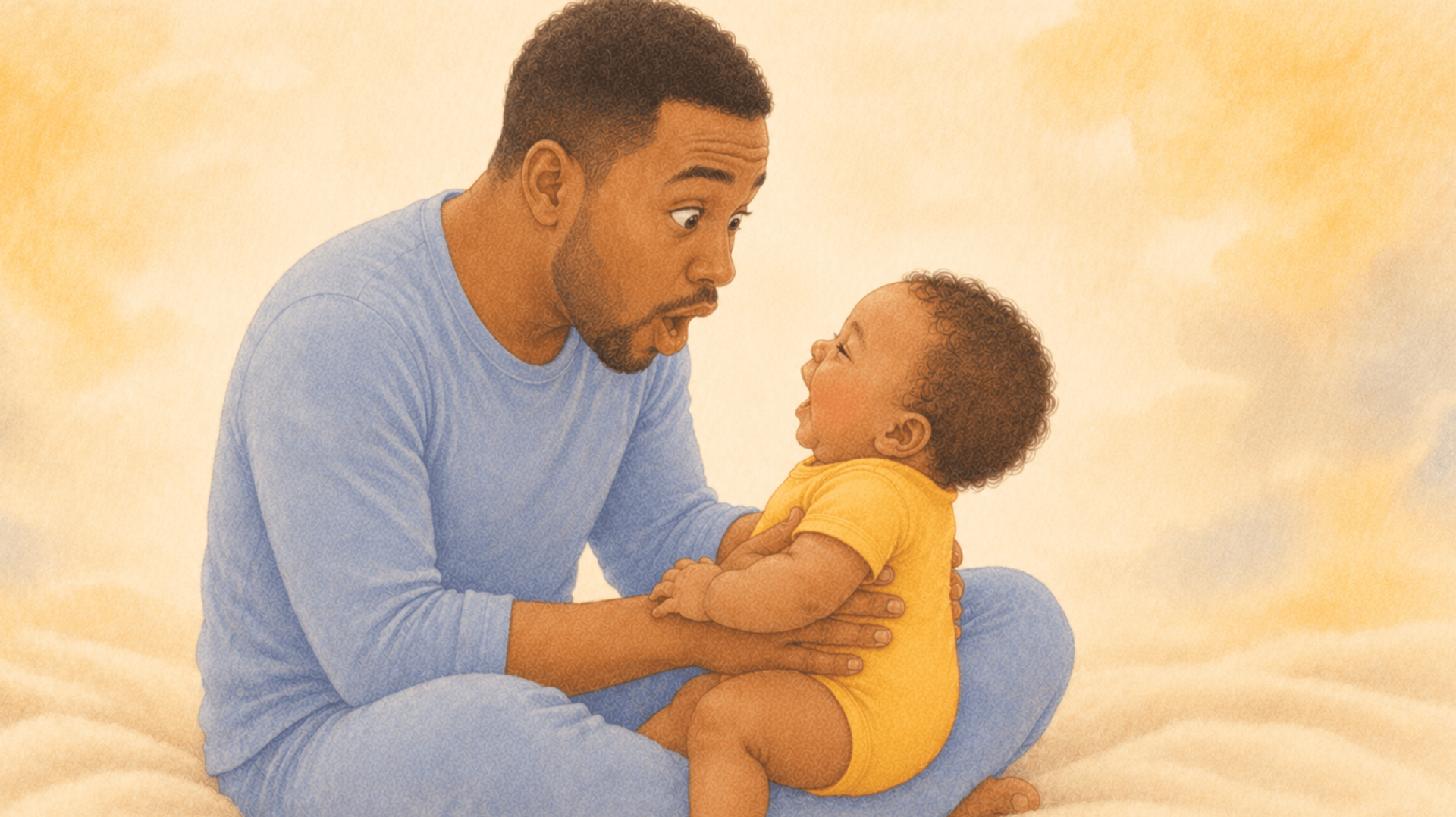
In 1972, Alan Sroufe and Joseph Wunsch observed 150 infants across their first year of life and documented a pattern that no parenting article since has fully described: the content of laughter changes on a roughly predictable schedule, and each change maps onto a new cognitive capacity the brain has just come online with.
At three to four months, the most reliable triggers are tactile and auditory. Tickling, gentle jiggles, raspberries blown on a belly, an exaggerated funny sound: these work because the nervous system is wired to respond to physical novelty, and the infant brain does not yet have the machinery to sustain a joke. The laughter here is partly reflex, partly the earliest version of social play. It feels like a conversation, and it is, but it is one where your baby is reading your energy rather than evaluating content.
Between five and seven months, visual and social incongruity starts working. Peekaboo becomes reliably funny at this stage not because the baby has "learned the game" but because the prefrontal circuits that hold a mental model of what should be there (your face) are now developed enough to register a mismatch when you hide. The laugh at the moment of reveal is the brain resolving a small prediction error in a safe, secure context. By six months, some babies begin producing what researchers describe as anticipatory laughter: they laugh just before you reappear, because they have already predicted it. That is a working memory event, and it is happening in the body of someone who cannot yet sit up unassisted.
Between seven and nine months, visual incongruity from familiar objects starts triggering laughter — the baby laughs when you put a cup on your head, or speak in a silly high voice, or hold a book upside down. Sroufe and Wunsch noted that these violations of familiar-object function are not funny before seven months, because the baby does not yet have a stable enough expectation about how the object should behave. Once that expectation forms, the violation is available as humor.
From nine to eleven months, babies begin making jokes. Vasu Reddy at the University of Portsmouth documented this phase in a series of observations: infants offering objects and then pulling them back, splashing deliberately when they have established a "no-splash" pattern, doing the thing you just told them not to do while watching your face for a reaction. This is proto-humor and it requires a rudimentary theory of mind, a sense that your expectation exists and can be deliberately violated. The same brain that figures out "if I drop this spoon, someone picks it up" is the brain that figures out "if I do the thing mom just said not to do, her face does something interesting." It all runs on the same wiring.
Now that you know what makes your baby laugh at each stage, you have a built-in cue for the five-month photo. All you need is this article and our Milestone Cards — the kind of designs that will make even you smile.
Why Babies Laugh in Their Sleep
"Baby first laugh in sleep" is one of the most common searches on this topic, and for good reason: newborns and young infants smile and sometimes laugh during sleep, often before any awake-state social laugh has appeared. Parents find this either charming or mildly unsettling and want to know what is happening.
The mechanism is not dreams. Babies in the first months of life lack the cognitive architecture for narrative dreaming. What they have is a dramatically different sleep structure than adults: where adults spend roughly 20 percent of sleep in REM, newborns spend closer to 50 percent. REM sleep in infants generates spontaneous neural activity in the brainstem and subcortical structures (regions that control facial muscle movement), producing the micro-expressions that look like smiles and, occasionally, brief laughs. This was documented by Maria Cecchini and colleagues in a 2011 paper in Infant Behavior and Development: neonatal smiles during active sleep (the infant precursor to adult REM) are endogenous expressions driven by internal neural firing, unrelated to social experience, unrelated to sensory input from the environment.
The sleep smiles and sleep giggles that appear in the first months are, in a very real sense, the nervous system rehearsing. The same motor programs that will later be deployed deliberately — in response to your face, in response to peekaboo, in response to a book held upside down — are being fired randomly during the heightened neural activity of REM sleep. The expression appears before the social use is available. For our guide to activities for a 3-month-old, we note that what you do during those first awake-window play sessions is providing the social scaffolding that will eventually make those same expressions available on demand.
The Navajo First Laugh Ceremony Understood Something Modern Research Confirms
The Navajo (Diné) have long marked a baby's first laugh as among the most significant early milestones, not the smile, not the first word, but the first genuine, unprompted laugh. The ceremony is called A'wee Chi'deedloh, loosely meaning "the baby laughed." Whoever is present and elicits that first laugh has the honor of hosting a small celebration, and the baby (with some assistance) distributes salt and small gifts to the gathered family. The gesture is understood as the baby's first act of generosity, and it symbolizes the child's full entry into the Diné community and into relationships of kinship and mutual responsibility.
Leighton and Kluckhohn documented this tradition in their foundational 1947 ethnography Children of the People, published by Harvard University Press. Caspar Addyman, who has spent years studying infant laughter at Goldsmiths, University of London, noted in a Teachwire interview that the Navajo tradition expects first laughs around three months — exactly where his worldwide survey placed the average.
The convergence is not coincidence. A tradition built across generations of close infant observation arrived at the same developmental window that controlled laboratory research later identified. And the meaning the Navajo assigned to it (the first laugh as the beginning of social reciprocity, the first evidence that the child has joined the human conversation) maps almost precisely onto what the research described above shows: the transition from reactive laughing to independent social evaluation. When do babies laugh in a way that means they have fully joined the social world? The Navajo ceremony says the same thing the Mireault data says: somewhere around five months, something shifts. Your baby's first laugh is not just adorable. It is, in the language of developmental science, the first sign that your baby is building the model of social expectation that everything else (humor, language, theory of mind) will eventually run on.
The activities for a 4-month-old guide covers what this window looks like in daily play, including why peekaboo is so effective precisely because it exploits prediction and violation — the same mechanism the Mireault research identified as the engine of infant humor.
Laughter Is Also 10 to 16 Million Years Old
Tickling is, by a wide margin, the most reliable method for producing infant laughter across cultures and across the first year. Addyman found it was the most common answer in his worldwide survey when parents were asked what is guaranteed to make their baby laugh. This is not accidental.
In 2009, Marina Davila Ross, Michael Owren, and Elke Zimmermann published a study in Current Biology in which they recorded tickle-induced vocalizations from 21 great apes — orangutans, gorillas, chimpanzees, and bonobos — and from three human infants being tickled by their mothers, then built a phylogenetic tree from the acoustic features. What they found was that the evolutionary branches of laughter-like vocalization diverge between humans and the other great apes roughly 10 to 16 million years ago. Tickle-laughter, in other words, is an ancient social-bonding signal shared across the great ape lineage, not a learned cultural behavior, but a deep-wired play communication that predates language, predates tools, predates essentially every distinctly human characteristic.
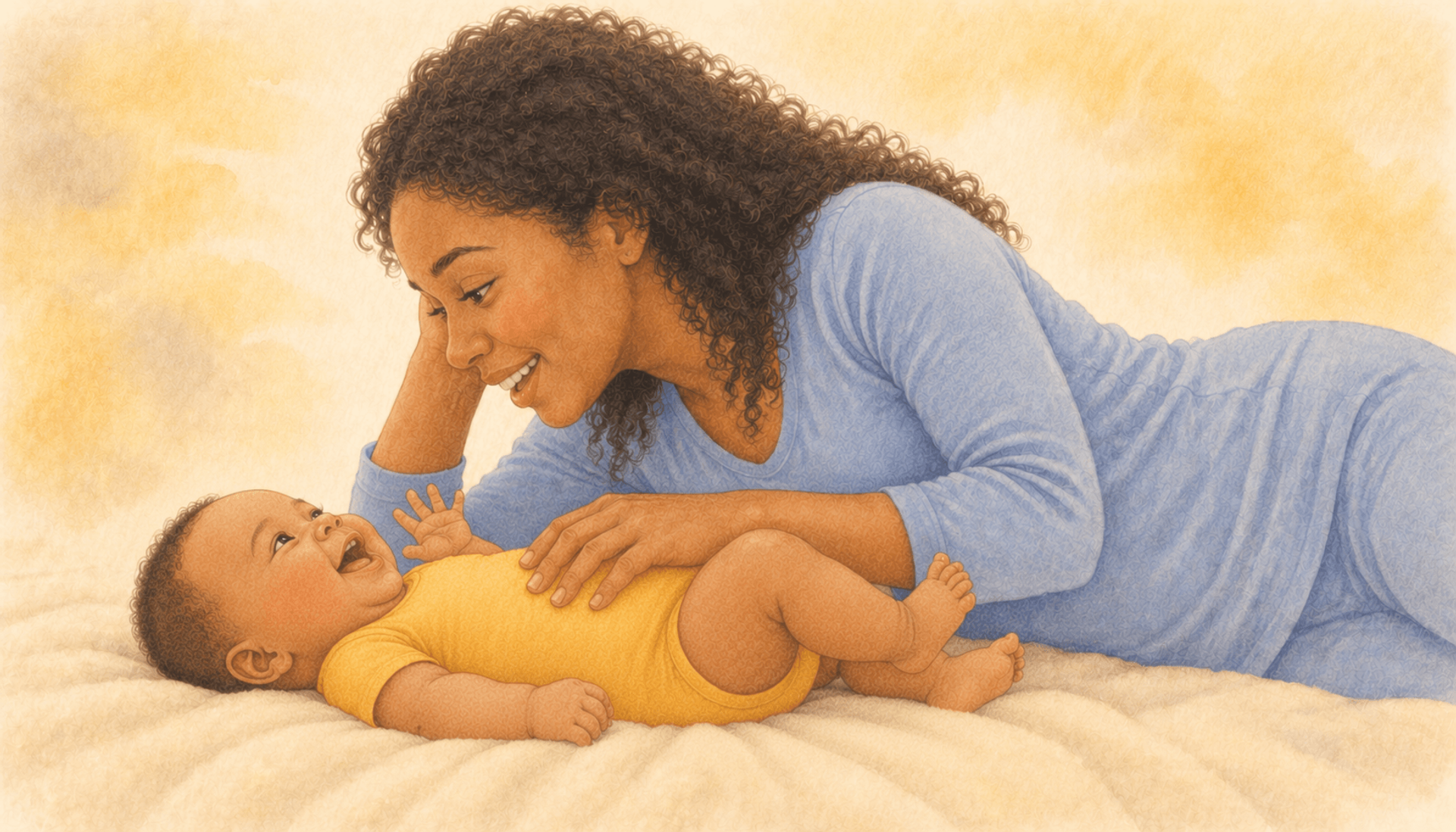
When you tickle your three-month-old and your baby folds into that first full-body laugh, you are activating a neural circuit that your common ancestor with chimpanzees already had. That does not make it less special. It makes it much more so. It means that laughing together (the parent making a silly face, the baby folding and laughing, the parent laughing back) is one of the most conserved social behaviors in primate evolution. For our full overview of what the first three to six months looks like developmentally, see the guide to when babies start smiling and our cluster on activities for a 6-month-old.
How to Make a Baby Laugh (Framed Through the Research)
The generic tips list here — peekaboo, tickles, silly faces — is accurate. What the research adds is a framework for why each one works at the age it works, which means you can calibrate your approach rather than just trying everything and hoping. Understanding when do babies laugh at different types of stimuli also helps you know when to escalate the complexity of play.
Before five months, laughter is most reliably triggered by your energy and physical play. Animated facial expressions, responsive cooing, tickles, and gentle jiggles work because the infant nervous system is tuned to the parent's emotional cues. Match your energy to what you see the baby tracking. If the baby is watching your face intently, a slow exaggerated smile often triggers a smile back; a sudden playful sound layered on top of that can tip it into a laugh. Our guide to activities for a 5-month-old goes deeper on the specific play structures that work best during the social-humor transition window.
From five months onward, add incongruity and violation-of-expectation. The same peekaboo game now has a second layer: your baby is not just responding to the reveal, but predicting it. You can test this: if the laugh comes just before you reappear, you are watching memory and anticipation in real time. A book held upside down, a spoon put in an unusual place, a funny sound at an unexpected moment — these start working here because the brain is now storing enough expectations to notice and enjoy violations.
From seven to nine months, the humor becomes more sophisticated. Babies this age laugh at violations of familiar-object function (what Sroufe and Wunsch described in 1972), enjoy causing their own silly moments, and begin to test whether causing a response in you is funny. When your baby does the thing you just gently discouraged and then looks at your face with what looks very much like a smirk, that baby is not being defiant. That is a joke.
One structural note from the Mireault research: parent laughter did not directly cause infant laughter at any age studied. What parent laughter did do was capture four-month-olds' attention. It signaled that something worth attending to had happened. The implication is that your enthusiastic reaction after the baby laughs is part of what teaches your baby that laughter is a communicative act, a joint event, something that goes between people. Responding to the laugh with warmth and attention, rather than performance, is what builds the social scaffolding a baby needs for humor to develop further.
When to Mention Laughing Patterns to Your Pediatrician
Most babies laugh by four months. By six to seven months, laughing in response to social play, faces, and simple games should be consistent. If your baby reaches six months without laughing, or does not consistently respond to sounds, it is worth mentioning at the next well visit — not as an emergency, but as a useful data point for your pediatrician. Laughter relies on hearing, on social awareness, and on visual tracking all working together, and a pediatrician who knows you've noticed an absence can make a more informed assessment.
Temperament matters here. Some babies are genuinely more serious. They observe, they analyze, they do not produce as many overt laughs as other babies the same age. As long as they are tracking faces, responding to social interaction with expressions and vocalizations, and meeting other milestones in the expected windows, a quieter laugh pattern is not a flag.
If a baby who was laughing stops, regresses, or stops responding consistently to social interaction, that is the clearest reason to call rather than wait for the next scheduled visit. Regression in any milestone is the kind of pattern a pediatrician will want to look at — not just in isolation, but alongside the full picture of development. See also our overview of when babies start talking, which covers the broader arc from early vocalizations to first words and why the connections between laughter, babbling, and language matter.
Frequently Asked Questions
Most babies produce their first laugh between three and four months, with an average of approximately 3.5 months based on a worldwide survey of more than 1,300 parents by developmental psychologist Caspar Addyman. When do babies laugh for the first time is one of the most reliably answerable developmental questions: the first laugh typically arrives four to eight weeks after the first social smile, and is most often triggered by a parent's animated face, funny sound, or light tickle. Premature babies may reach this milestone on their adjusted age timeline rather than their chronological one. A baby born six weeks early may laugh close to six weeks later on the calendar, but right on schedule by developmental brain age.
Babies, especially in the first months, spend around 50 percent of sleep time in active sleep — the infant equivalent of adult REM. During active sleep, spontaneous neural firing in the brainstem produces brief facial muscle movements including smiles and occasional laughs. This is not dreaming; infants lack the cognitive development for narrative dreams. The expressions are internally generated, unrelated to any sensory input, and represent the nervous system rehearsing the same motor programs that will later be used deliberately during social play. The frequency drops as sleep architecture matures and the proportion of active sleep decreases across the first year.
Early laughs at three to four months are often soft, breathy, and brief, closer to a chuckle or a squeak than a full laugh. Louder, more sustained laughing typically develops between five and seven months as the respiratory muscles gain coordination and babies begin producing the full exhalation-vocalization pattern of adult laughter. The shift also reflects the cognitive change documented in Mireault and Crockenberg's 2018 research: at five months, babies begin independently evaluating events as humorous, and that independent appraisal tends to produce more robust laughter than the social-cue-dependent responses of earlier months.
Social laughing — laughing in clear response to another person's face, voice, or actions — begins with those first reflexive laughs at three to four months. What the research distinguishes is a later stage, around five months, when babies begin independently assessing whether something is funny rather than reading the parent's cue. By six months, most babies are fully reciprocal: they laugh, the parent laughs back, and they laugh again in response. This back-and-forth is one of the earliest forms of conversational turn-taking, and researchers at MIT who study parent-infant vocal interaction describe these laugh exchanges as direct precursors to the conversational structure of language.
The triggers change across the first year in a predictable pattern. At three to four months: tickles, physical play, animated parent faces and voices, funny sounds. At five to seven months: peekaboo, visual incongruity, anticipation games, anything that builds and resolves a small expectation. At seven to nine months: violations of familiar-object function — a cup worn as a hat, a book held upside down, anything done with something the baby now knows how to use correctly. From nine months onward: the baby begins creating the humor as much as receiving it, testing reactions and repeating things that worked. The common thread is that what is funny at each stage exactly reflects what the brain can now hold in mind and violate.
For educational and entertainment purposes only. Not a substitute for professional medical or developmental advice. Always consult your healthcare provider with questions about your baby's development.
- Addyman, C., & Addyman, I. (2013). The science of baby laughter. Comedy Studies, 4(2), 143–153.
- Cecchini, M., Baroni, E., Di Vito, C., & Lai, C. (2011). Smiling in newborns during communicative wake and active sleep. Infant Behavior and Development, 34(3), 417–423.
- Davila Ross, M., Owren, M. J., & Zimmermann, E. (2009). Reconstructing the evolution of laughter in great apes and humans. Current Biology, 19(13), 1106–1111.
- Esseily, R., Rat-Fischer, L., Somogyi, E., O'Regan, K., & Fagard, J. (2016). Humour production may enhance observational learning of a new tool-use action in 18-month-old infants. Cognition and Emotion, 30(4), 817–825.
- Hoicka, E., Soy Telli, B., Prouten, E., et al. (2022). The Early Humor Survey (EHS): A reliable parent-report measure of humor development for 1- to 47-month-olds. Behavior Research Methods, 54(4), 1928–1953.
- Leighton, D., & Kluckhohn, C. (1947). Children of the People: The Navaho Individual and His Development. Harvard University Press.
- Messinger, D., & Fogel, A. (2007). The interactive development of social smiling. Advances in Child Development and Behavior, 35, 327–366.
- Mireault, G. C., Crockenberg, S. C., Sparrow, J. E., et al. (2018). Social, cognitive, and physiological aspects of humour perception from 4 to 8 months: Two longitudinal studies. British Journal of Developmental Psychology, 36(1).
- Mireault, G., Sparrow, J., Poutre, M., Perdue, B., & Macke, L. (2012). Infant humor perception from 3- to 6-months and attachment at one year. Infant Behavior and Development, 35(4), 797–802.
- Mireault, G. C., et al. (2015). Laughing matters: Infant humor in the context of parental affect. Journal of Experimental Child Psychology, 136, 30–41.
- Reddy, V., & Mireault, G. (2015). Teasing and clowning in infancy. Current Biology, 25(1), R20–R23.
- Sroufe, L. A., & Wunsch, J. P. (1972). The development of laughter in the first year of life. Child Development, 43(4), 1326–1344.
- Wolff, P. H. (1963). Observations on the early development of smiling. In B. M. Foss (Ed.), Determinants of Infant Behavior, Vol. 2. Wiley.


More Articles
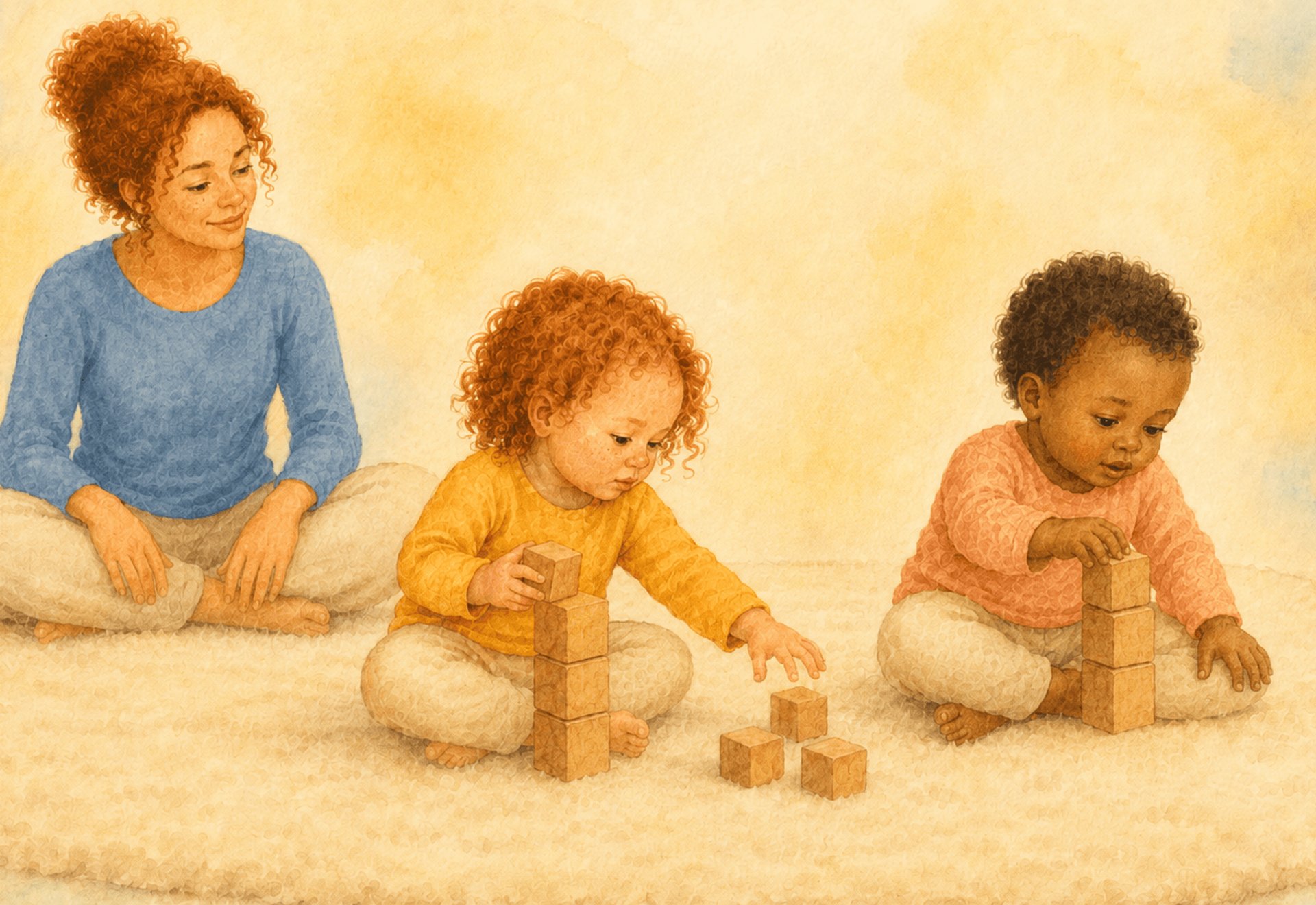
Parallel Play in Toddlers: Why Side-by-Side Is the Social Work
Your toddler spent the entire playdate building separate towers, and nobody shared a single block. That counted — more than it looked. A 2025 longitudinal study found that playing beside a specific child consistently predicted later social play with that same child, but not the other way around. Here's what parallel play in toddlers actually is, why the science calls it strategic rather than passive, and what it means for how you run a playdate.
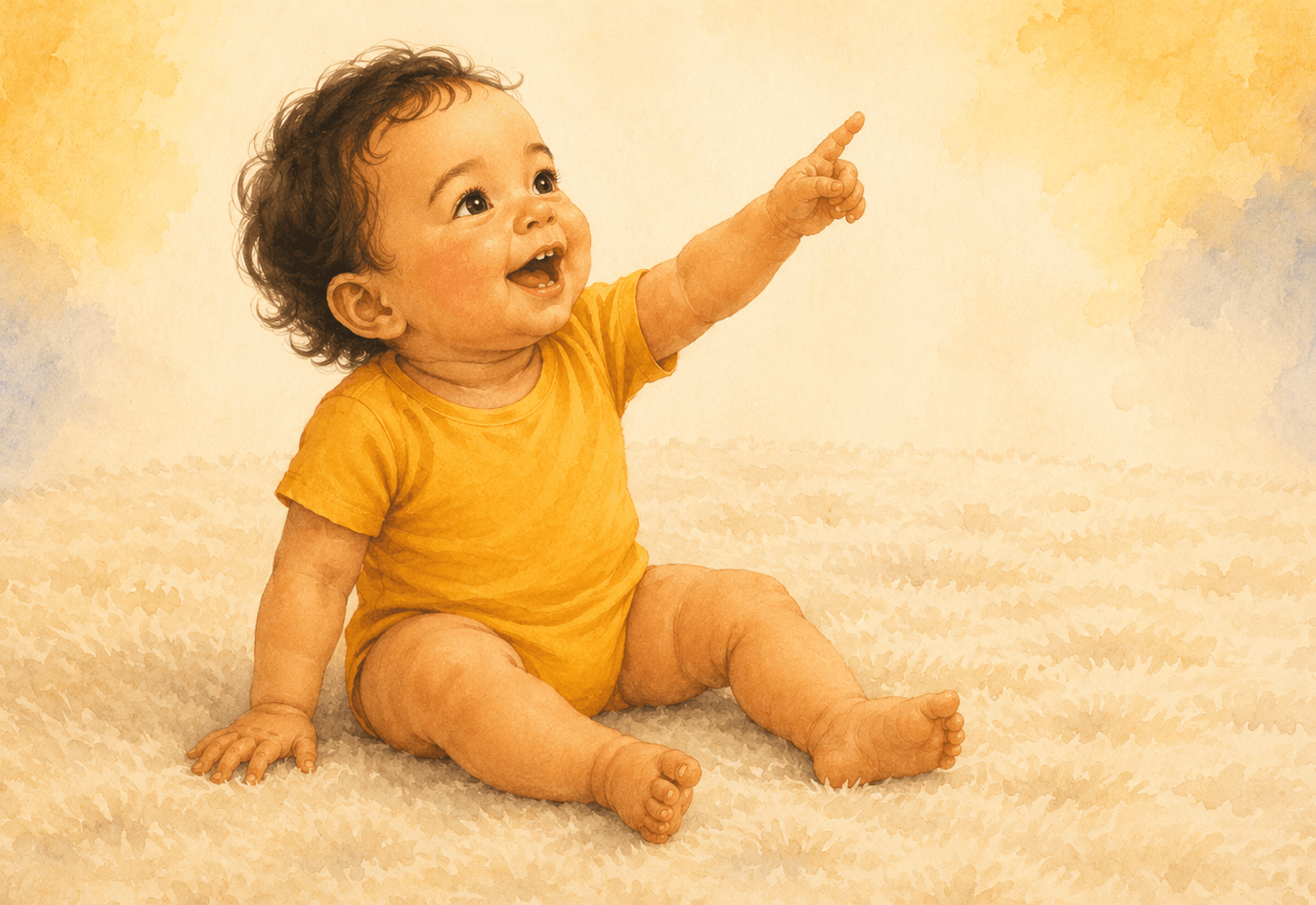
When Do Babies Point: Why It Matters for Language
Most milestone articles treat pointing as a box to check around 12 months. The research tells a different story — one that starts months earlier, runs through the infant brain, and traces back to how much the parent is pointing. Here's what the last fifteen years of research actually found, and what it means for everyday interactions.
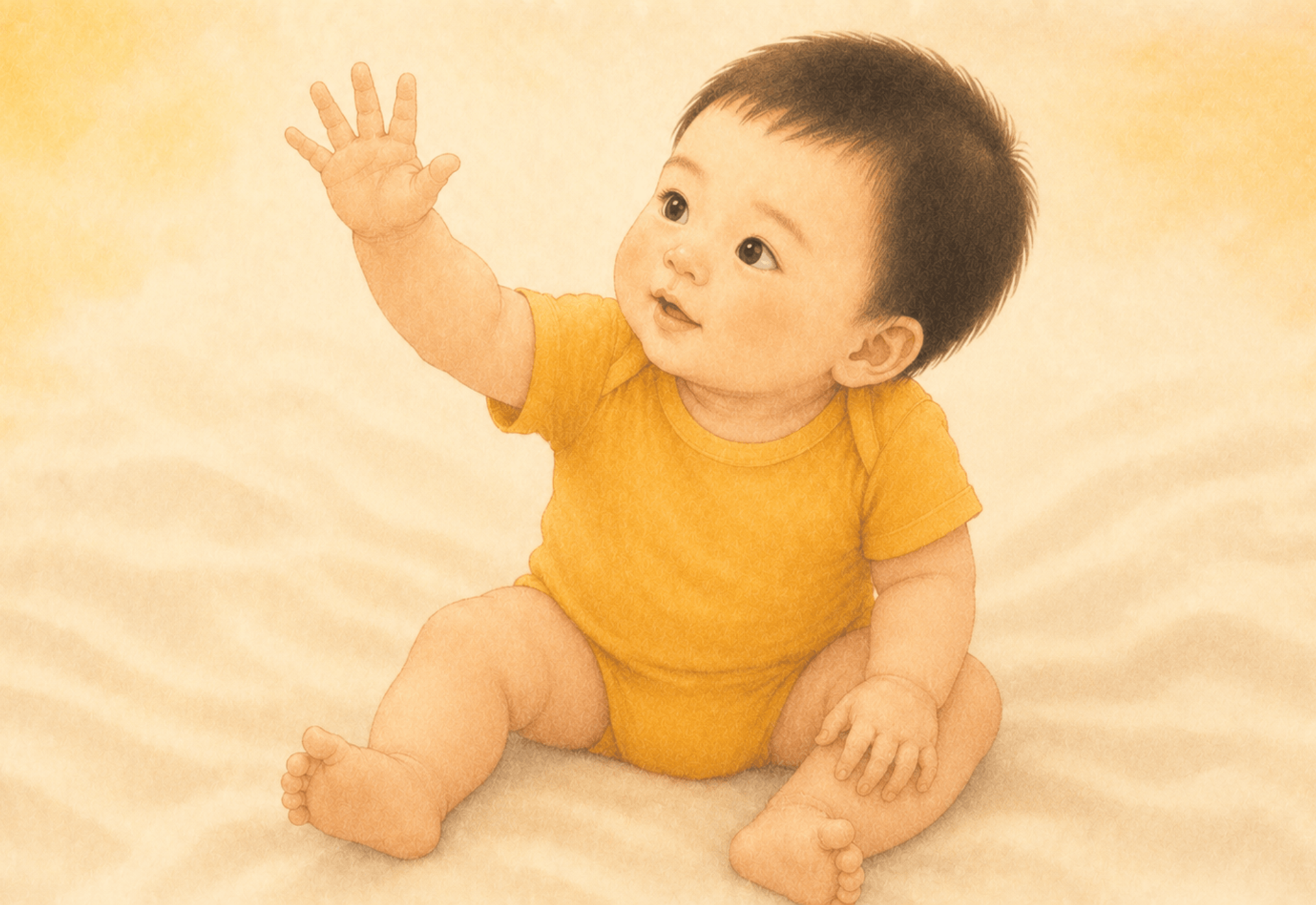
When Do Babies Wave Bye-Bye: Why Your Baby Needs You to Wave First
Most baby milestones unfold on a biological schedule — waving isn't one of them. A 2023 study found that babies develop imitation ability because their caregivers imitate them first, and waving is named directly as a cultural gesture learned through that loop. Here's what the research says about the 9–12 month window, why the first wave looks nothing like a wave, and what helps it arrive.