My Baby Hates Tummy Time: 7 Tips That Actually Work
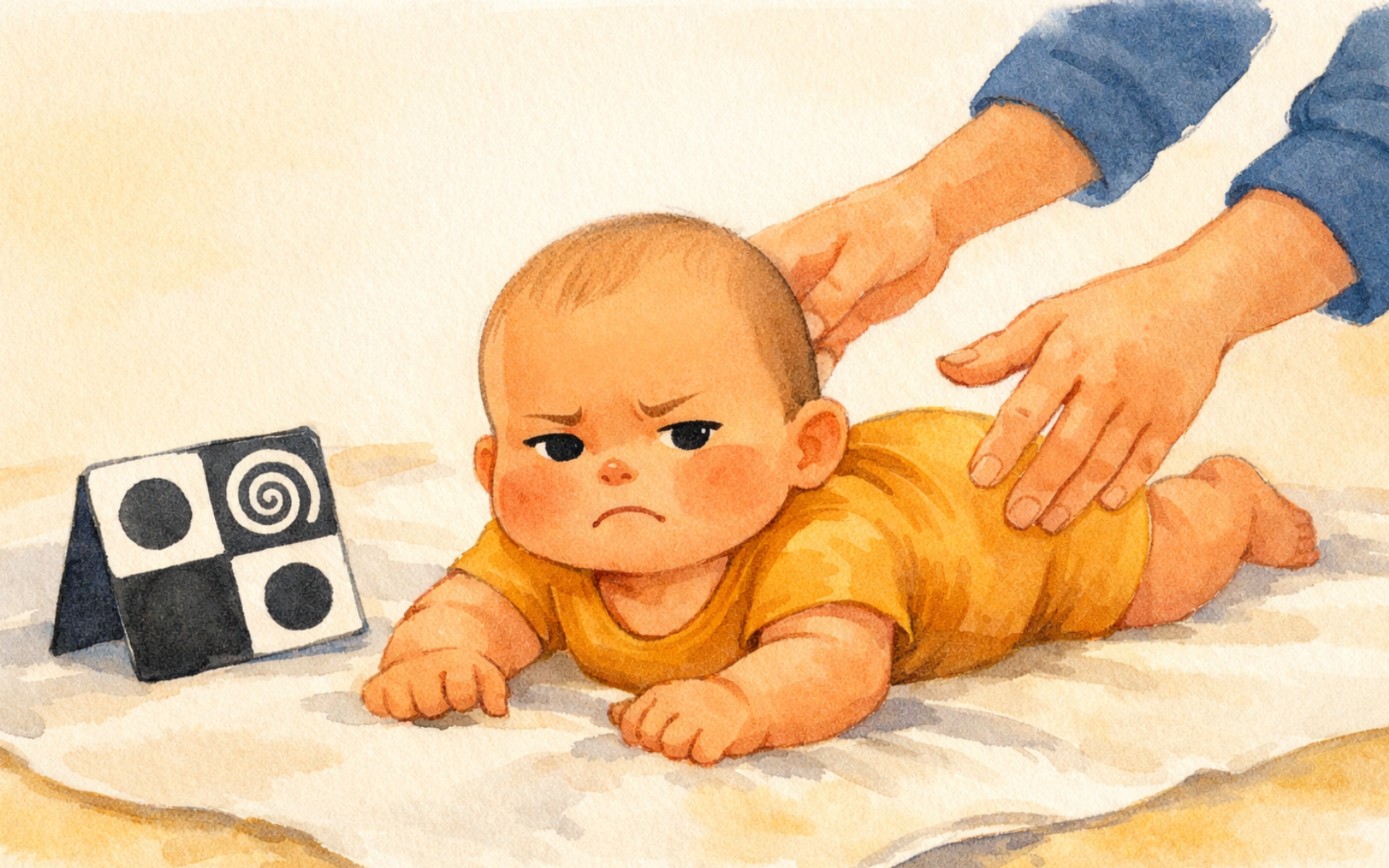
You lay a blanket on the floor, place your little one tummy-down, and step back to admire your good parenting. Four seconds later — full-volume protest against what clearly feels like inhumane treatment.
You scoop your baby back up, feeling guilty, and wonder: is this really supposed to help?
It is. But not the way you're probably doing it.
Here's what no one tells new parents: placing a newborn flat on the ground, face down, with nothing to look at, is the hardest version of tummy time. It's like asking someone who's never been to a gym to start with a deadlift. No wonder your little one has opinions about it.
The good news: there are easier approaches that count just as much — and research backs them up. Let's walk through what's actually going on, and seven ways to make tummy time work for your baby.
- Why tummy time actually matters — and what a 2025 study found about head flattening rates
- Why babies cry during tummy time (and why floor is the hardest version, not the default)
- Five positions that count as tummy time beyond lying flat on the floor
- How visual motivation (high-contrast cards and mirrors) changes tummy time outcomes
- When to schedule tummy time in your day to make consistency automatic
- Age-by-age reference: how much tummy time to aim for from newborn through 4 months
If the one-sentence answer is enough, you’ve got the gist. If you want the mechanism behind each piece, keep reading.
Why Tummy Time Matters (the Short Version)
The American Academy of Pediatrics recommends supervised tummy time starting from the first day home from the hospital. The guidelines are clear: 2–3 short sessions per day (3–5 minutes each), working up to a total of 15–30 minutes daily by about 7 weeks.
What's behind this recommendation? A 2020 systematic review published in Pediatrics (the AAP's own journal) analyzed 16 studies with over 4,200 infants across 8 countries. The findings: tummy time is positively associated with gross motor development, helps prevent flat spots on the back of the head, and supports the ability to roll, crawl, and move while prone.
That flat spot concern is worth a closer look. Since the Back to Sleep campaign (which correctly reduced SIDS rates by encouraging back sleeping), the incidence of cranial asymmetry in infants has risen significantly. A 2025 study in the Journal of Neonatal Nursing found that close to half of healthy infants develop some degree of head flattening by 3 months — mostly mild and often self-correcting, but preventable with regular tummy time. That's a big part of why pediatricians keep pushing tummy time even when your baby is clearly not a fan.
And here's a number that might take some pressure off: research shows that only about 30% of infants actually meet the recommended daily tummy time goals. Your little one is far from the only baby who'd rather be doing literally anything else.
Why Babies Cry During Tummy Time
Before we fix the problem, it helps to understand what's behind it.
When a baby is placed on the stomach, those tiny neck and back muscles have to work against gravity to lift what is, proportionally, a very heavy head. For a newborn, this is an enormous physical effort. Again, picture someone handing you a 45-pound barbell when the heaviest thing you've ever lifted is a TV remote. That's roughly the proportional challenge your baby is facing.
There's also a sensory component. In the flat-on-the-ground position, a baby's field of vision is limited to whatever's directly in front of the face — which is usually the floor or a blanket. Your baby can't see you. Can't see anything interesting. All effort, no reward.
That's where changing the position makes such a difference. We can't make the head lighter, but we can reduce the gravitational demand — and give your baby something worth looking at.
Tip 1: Chest-to-Chest (The Best Starting Point)

Lie back in a reclined position — on the couch, in bed, or on a pile of pillows on the floor. Place your baby tummy-down on your chest, facing you.
This is the easiest version of tummy time because the incline reduces the gravitational demand on your baby's neck muscles. Instead of lifting that heavy head straight up from a flat surface, your little one is working at a gentler angle. And the motivation is right there — your face, your voice, your heartbeat.
A 2020 study in the Journal of Applied Behavior Analysis evaluated exactly this approach. When mothers interacted with infants in a chest-to-chest position using a toy, researchers observed a significant reduction in crying and an increase in head elevation compared to other interventions. Mothers also rated this approach as more effective and more realistic than experimenter-led alternatives.
This is a legitimate, effective position that builds the same muscles as floor tummy time — just with less distress for everyone involved.
When to use it: From day one. Ideal for the very first days and weeks, especially if your baby resists the floor entirely. You can prop a high-contrast card nearby to give your little one an extra reason to look up.
Tip 2: Lap Soothe
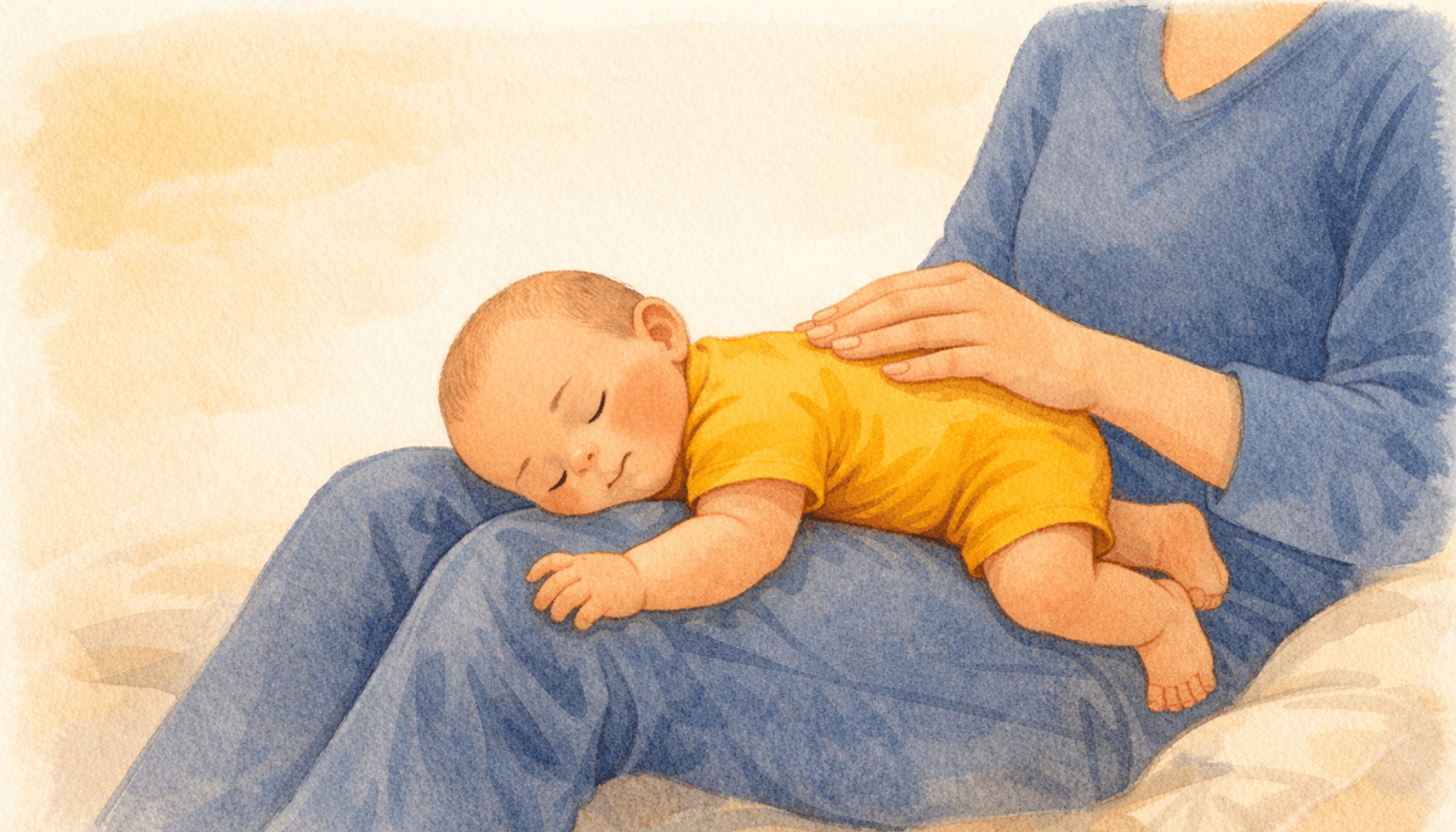
Sit comfortably and place your baby face-down across your lap. You can keep both knees level, or raise one knee slightly to create a gentle incline.
This position is recommended by Pathways.org, a nonprofit organization founded by pediatric neurologists and physical therapists. It gives your baby the physical contact of your body — which provides a sense of security — while still engaging the neck and back muscles needed for development.
You can gently pat or rub your baby's back during this position. It works especially well after a feed or when your little one is calm and drowsy.
When to use it: After a diaper change or when baby is calm. A great transition step before trying floor tummy time.
Tip 3: Football Hold (Tummy-Down Carry)
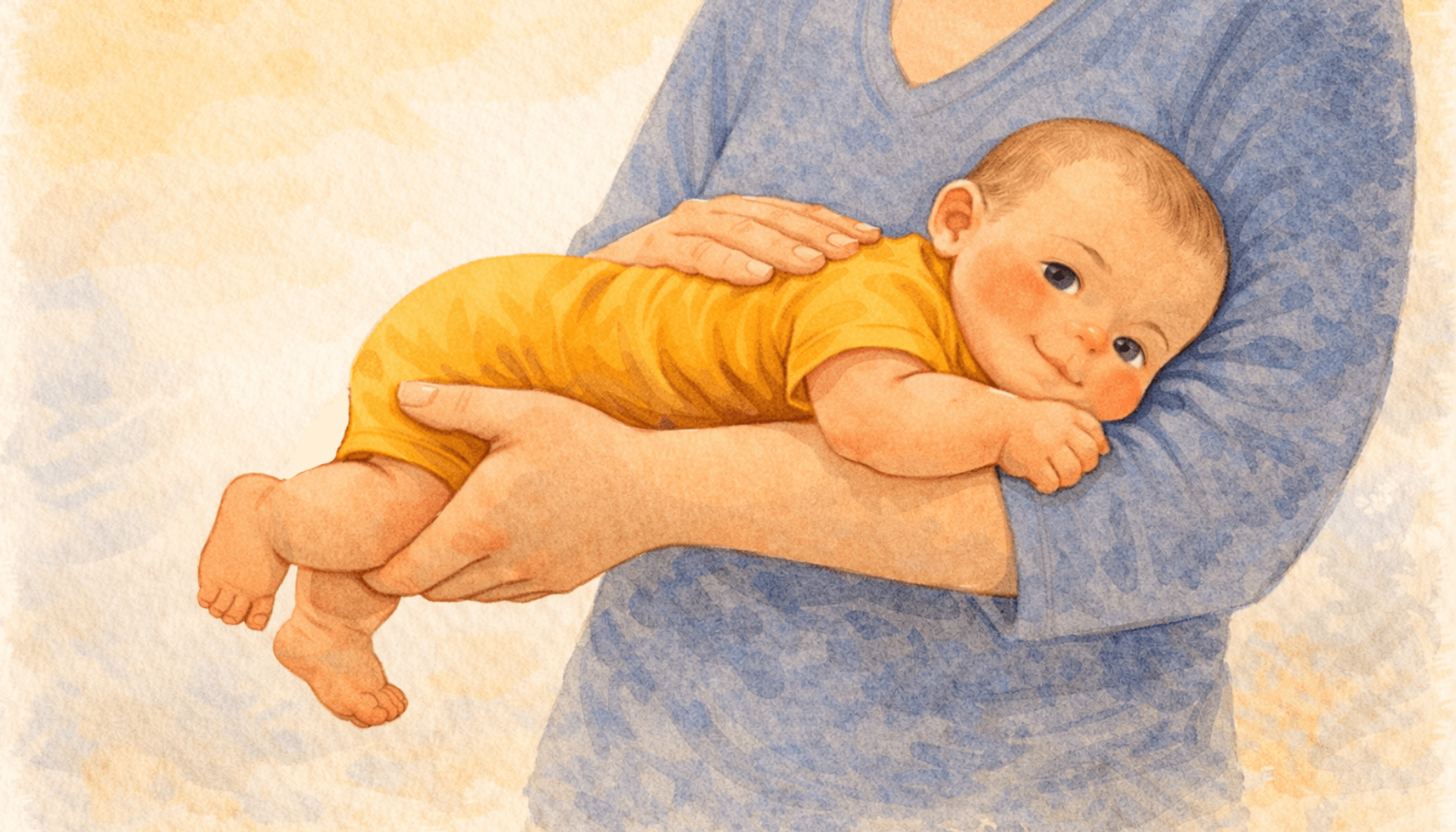
Hold your baby face-down along your forearm, with the head resting near your elbow and the body extending toward your hand. Your hand supports the chest and tummy. Make sure you have a firm, comfortable grip — your baby should feel secure against your body.
This is called the football hold or tummy-down carry, and it's one of the four core tummy time positions recommended by Pathways.org. Pediatric physical therapists at NAPA Center note that you can adjust the angle of the carry — holding the head slightly higher makes it easier, while lowering the angle increases the challenge as your baby's muscles get stronger.
This position has a bonus: many parents find it soothes a fussy baby. The gentle pressure on the abdomen can help with gas discomfort, and the rocking motion as you walk is naturally calming.
When to use it: Anytime you're carrying your baby from room to room. Instead of the usual upright hold, try the football carry for short stretches. The minutes add up.
Tip 4: Therapy Ball (or Pillow Roll)
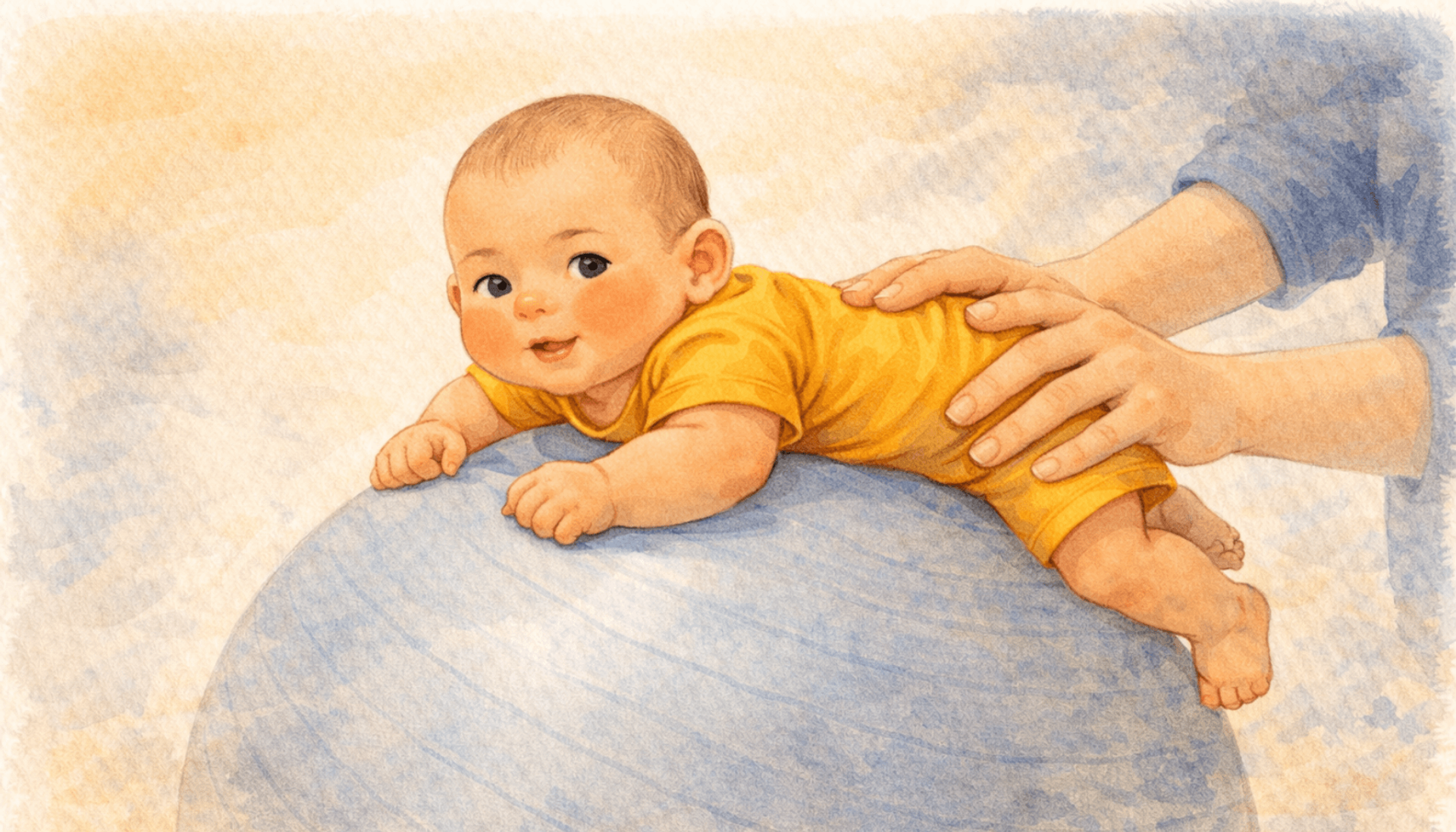
Place your baby tummy-down on an exercise ball (or a firm nursing pillow, or a rolled-up towel under the chest). Keep both hands on your baby at all times — one on the back or pelvis, one ready to support — so your little one is fully secure throughout.
The incline makes head-lifting much easier because gravity is working with your baby, not against. NAPA Center's pediatric physical therapists specifically recommend this for babies who are having a hard time lifting the head on a flat surface. If your baby gets upset, you can gently rock the ball forward and back — the vestibular input is often calming enough to extend the session.
No fancy therapy ball at home? No problem. A firm pillow or a rolled towel under the chest achieves a similar effect. The key is creating that slight incline so head-lifting feels more doable.
When to use it: When your baby handles some floor time but flat-on-the-ground is still a struggle. A solid "level two" progression.
Tip 5: Eye-Level Engagement

Place your baby on a blanket or play mat on the floor for tummy time — and then get down there too. Lie on your stomach, face to face, at your baby's eye level.
An unexpected suggestion, maybe — but we're guessing you haven't looked at this problem from quite this angle before. Literally and figuratively. Research consistently shows that infants are most engaged when a human face is visible. When you're standing above a baby on the floor, you're a blur at the edge of the visual field. When you're at the same level, you're the most interesting thing in the room.
Talk, make faces, sing — anything that motivates your little one to lift that head and look at you. Even a partial head lift counts. You can also slowly move your face or a toy from side to side to encourage head turning.
When to use it: Once your baby manages floor tummy time for at least 30 seconds without major protest. This is the approach that builds the most independence.
Tip 6: Floor with Visual Motivation
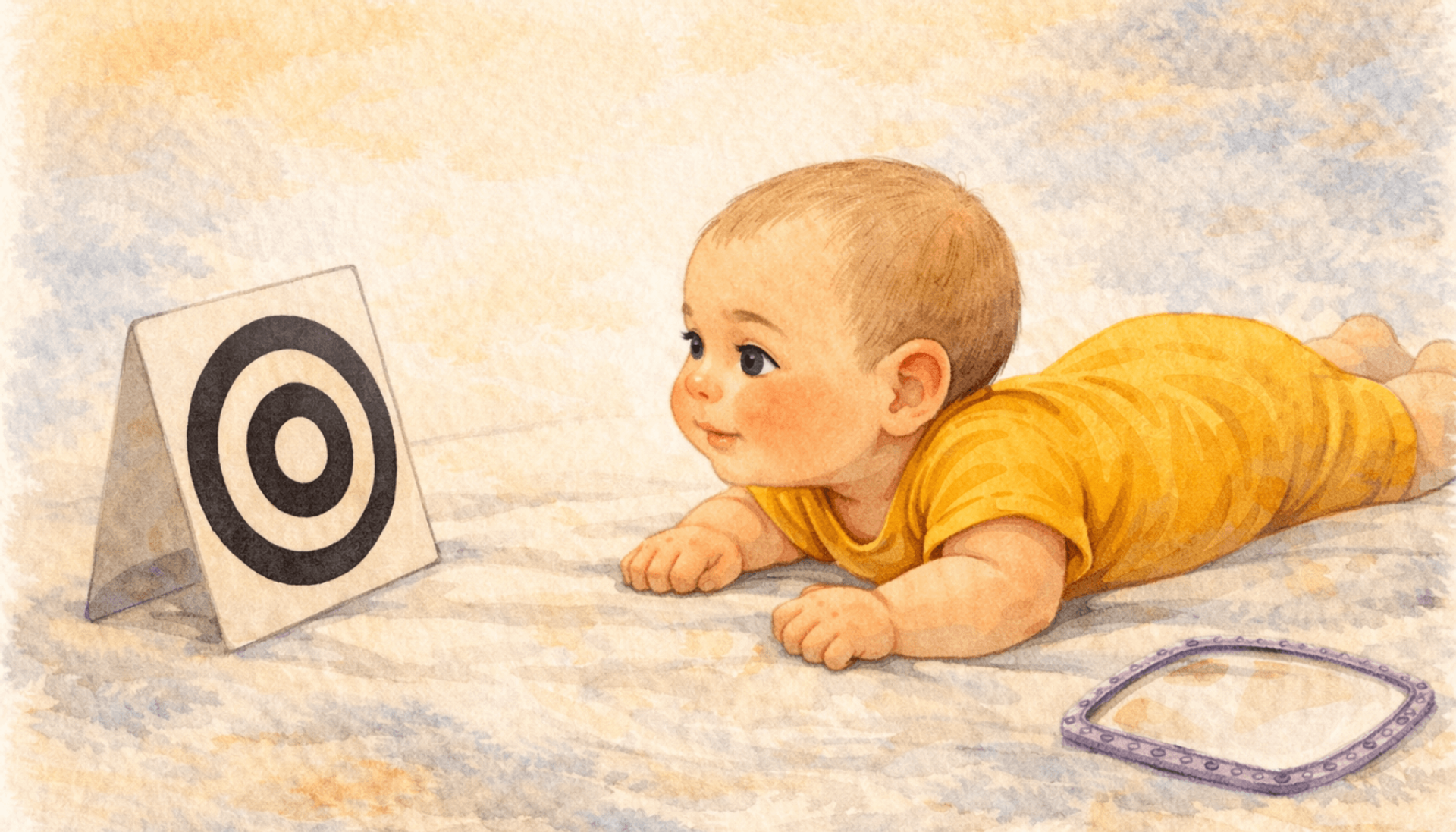
This is where high-contrast images earn their place. During tummy time, your baby needs something worth the effort of lifting that heavy head. A beige blanket isn't it.
Place a high-contrast card or a baby-safe mirror propped up about 8–12 inches from your baby's face during floor tummy time. Pediatric therapists — including NAPA Center's OT and PT teams — recommend high-contrast toys and mirrors as two of the most effective attention-grabbers for tummy time.
In the first three months, a baby's visual system responds most strongly to bold contrast — black against white, strong edges and patterns. A high-contrast card placed at the right distance gives your little one a compelling reason to hold the head up and look. Tummy time stops being an endurance exercise and turns into a visual exploration.
As your baby gets stronger and tummy time gets easier — usually around three months — visual motivation can evolve too. If your little one has outgrown the black-and-white cards, color becomes the next level of engagement. Bold, saturated hues give the developing visual system something new to focus on during floor time. Curious about when exactly your baby is ready for color and why the order matters? We break it down here: When Do Babies See Color?. And if you're looking for cards designed for this stage, our Color Contrast Cards for 3–6 Months pick up right where black and white left off.
When to use it: From the very first weeks — even during chest-to-chest or lap positions, a high-contrast card placed nearby adds visual stimulation. As your baby gets stronger and moves to floor tummy time, propping a card up at eye level becomes even more effective.
Tip 7: Build It into Daily Routines
This one is about timing, not positioning — and it matters just as much.
Research on tummy time patterns found that parents who built tummy time into existing daily routines — specifically after diaper changes and naps — were more consistent and had infants with better developmental outcomes. The AAP explicitly recommends these transition moments as ideal tummy time windows.
The logic is straightforward: after a diaper change, your baby is already on a flat surface and alert. After a nap, your little one is rested and more tolerant. Linking tummy time to these natural breaks removes the pressure of scheduling a separate "session" and makes the whole thing automatic.
One important note: avoid tummy time right after feeding. Pressure on a full stomach can cause discomfort and spit-up, which creates a negative association. Wait at least 20–30 minutes after a feed.
How to use it: After every diaper change, spend 1–2 minutes in any of the positions above. That alone can add 10–15 minutes of total tummy time per day.
How Much Is Enough?
The AAP recommends working up to a total of 15–30 minutes per day by about 7 weeks of age. But those minutes don't have to be consecutive. Short sessions — even one or two minutes at a time — count.
The 2017 systematic review by Hewitt and colleagues found that infants who spent more than 15 minutes per day in tummy time at 2 months old showed better motor outcomes than those who didn't. The research also found that parent education level and parents deliberately setting aside time for tummy time were both positively correlated with tummy time frequency — meaning awareness and intention matter.
Separately, Dudek-Shriber and Zelazny's study in Pediatric Physical Therapy found significant differences in motor milestone achievement between four-month-old infants who spent regular time in the prone position versus those whose prone time was limited. The infants with consistent tummy time were ahead on seven prone milestones, three supine milestones, and three sitting milestones.
In short: consistency matters more than duration. A little bit every day beats a long session once a week.
When to Talk to Your Pediatrician
Some resistance to tummy time is normal — especially in the first weeks. But there are situations where it's worth checking in with your doctor, just to be safe:
- Your baby consistently turns the head to one side and resists turning the other way.
- Your baby seems to be in pain rather than just uncomfortable.
- There's no improvement in head-lifting ability after several weeks of regular tummy time.
- You notice a flat spot developing on the back of the head.
Any of these may be completely normal — or they may benefit from a professional evaluation. A pediatrician or pediatric physical therapist can assess what's going on and guide you from there. When in doubt, it's always better to ask.
Quick Reference: Tummy Time by Age
Newborn (0–4 weeks): 3–5 minutes, 2–3 times per day. Chest-to-chest, football hold, and lap soothe are your go-to positions. A high-contrast card propped nearby adds visual motivation even during these early, gentle sessions. Don't expect floor tummy time to go smoothly just yet — your little one is still building the basics.
1–2 months: Gradually increasing to 15–30 minutes total per day (in short sessions). Start introducing floor tummy time on a blanket or play mat — with a high-contrast card or mirror at eye level. Get down on the floor with your baby.
3–4 months: Working toward longer sessions as strength builds. Your baby should be lifting the head with more control, pushing up on forearms, and starting to look around with curiosity. If floor tummy time still causes significant distress at this stage, talk to your pediatrician.
These are general guidelines based on AAP recommendations and developmental research. Every baby progresses at a different pace.
Want to make tummy time more engaging?
Our High Contrast Baby Flashcards for 0–3 Months were designed with tummy time in mind. The cards prop up at exactly the right distance and angle to give your baby a reason to look up — supporting visual development and tummy time in one simple tool. 30 sequenced cards, parent guide included.
Frequently Asked Questions
Most babies dislike tummy time because it requires significant effort from muscles that are still developing. The neck, shoulder, and core muscles needed to lift the head are among the last to strengthen. Crying is a normal response to physical challenge, not a sign that something is wrong.
Start with 1–2 minutes at a time, several times a day. Gradually increase as your baby builds strength. By 3 months, many babies can tolerate 10–20 minutes total per day spread across multiple sessions.
Tummy time can begin from day one. The AAP recommends supervised tummy time starting from the first day home from the hospital, even if sessions are very short.
This article is for educational purposes only and is not a substitute for professional medical advice. Always consult your pediatrician before starting any new activity with your baby, and never leave your baby unattended during tummy time.
- AAP (2022). "Back to Sleep, Tummy to Play." HealthyChildren.org.
- Hewitt, L. et al. (2020). "Tummy Time and Infant Health Outcomes: A Systematic Review." Pediatrics, 145(6).
- Hewitt, L. et al. (2017). "Correlates of tummy time in infants aged 0–12 months old." Infant Behavior and Development, 49.
- Mendres-Smith, A.E. et al. (2020). "Tummy time without the tears." Journal of Applied Behavior Analysis, 53(4).
- Dudek-Shriber, L. & Zelazny, S. (2007). "Prone Positioning and Developmental Milestones." Pediatric Physical Therapy, 19(1).
- Rodger, J. & Harvey, K. (2025). "Tummy time guidelines in rural primary care." Journal of Neonatal Nursing, 31(1).
- Pathways.org. "How To Do Tummy Time: 4 Positions to Help."
- NAPA Center. "My Baby Hates Tummy Time! Tips for Parents."
- NIH Safe to Sleep. "Benefits of Tummy Time."
Related Products

More Articles

Parallel Play in Toddlers: Why Side-by-Side Is the Social Work
Your toddler spent the entire playdate building separate towers, and nobody shared a single block. That counted — more than it looked. A 2025 longitudinal study found that playing beside a specific child consistently predicted later social play with that same child, but not the other way around. Here's what parallel play in toddlers actually is, why the science calls it strategic rather than passive, and what it means for how you run a playdate.

When Do Babies Point: Why It Matters for Language
Most milestone articles treat pointing as a box to check around 12 months. The research tells a different story — one that starts months earlier, runs through the infant brain, and traces back to how much the parent is pointing. Here's what the last fifteen years of research actually found, and what it means for everyday interactions.

When Do Babies Wave Bye-Bye: Why Your Baby Needs You to Wave First
Most baby milestones unfold on a biological schedule — waving isn't one of them. A 2023 study found that babies develop imitation ability because their caregivers imitate them first, and waving is named directly as a cultural gesture learned through that loop. Here's what the research says about the 9–12 month window, why the first wave looks nothing like a wave, and what helps it arrive.