5 Things Your Baby Can Already Do in the Womb
The pregnancy app says your baby is the size of a papaya. You're lying on your left side because the internet told you to, and you're wondering whether that conversation you had at full volume in the car today was too loud for someone who doesn't technically have a zip code yet.
Here's something the pregnancy apps don't always make clear: your baby has been busy in there. Not busy in the vague, poetic way people say when they want to sound reassuring. Busy in a measurable, published-in-peer-reviewed-journals, researchers-put-microphones-inside-the-uterus kind of way.
By the third trimester, the person you haven't met yet can do at least five things that would genuinely surprise most parents. Every single one of them has been documented.
- How sound travels into the womb — and why your baby already knows the rhythm of your voice
- Why what you eat during pregnancy shapes your baby's flavor preferences at solid food stage
- The neuron count that peaks before birth — and what "brain pruning" actually means
- What fetal REM sleep does for brain development (and what premature birth research reveals)
- Why every kick is a deliberate sensory experiment, not random movement
If the one-sentence answer is enough, you’ve got the gist. If you want the mechanism behind each piece, keep reading.
Your Baby Can Hear You — and Remembers What You Say
The auditory system starts forming early, but it's around 22 to 25 weeks when things get interesting. That's when researchers begin to detect consistent responses to sound — changes in heart rate, startles, shifts in movement patterns. By 28 weeks, the reactions are reliable and repeatable.
But what does your baby actually hear in there? Researchers at the University of Lille placed microphones directly inside the amniotic sac during labor and measured what makes it through. External conversations are audible, though muffled — sounds lose about 30 decibels passing through tissue and fluid, which is roughly equivalent to the difference between a normal conversation and a whisper. High-frequency sounds get filtered more than low ones. Music can be heard. Voices are recognizable.
Here's the detail that caught us: only about 30% of the phonetic content of speech reaches the amniotic cavity. But intonation — the melody, rhythm, and emotional contour of a voice — is transmitted almost perfectly. Your baby can't decode your words. But the tune of your voice arrives intact.
And that tune matters. In studies using non-nutritive sucking techniques — where researchers measure how a baby adjusts its sucking rhythm on a pacifier to "choose" one sound over another — three-day-old newborns consistently preferred a lullaby their mother had read aloud during the last five weeks of pregnancy over a new story — even when the familiar lullaby was read by a completely different woman. The melody of the language, not the specific voice, was what the baby recognized. The acquisition had to be prenatal because the babies had no contact with the story between birth and the test.

Your baby's voice also occupies a privileged position in the soundscape. Measurements show that the mother's voice reaches the amniotic cavity at roughly +24 decibels above the baseline noise — significantly louder than any external voice, because vocal vibrations transmit directly through the body. Your partner's voice, a friend's voice, background television — they all arrive. But yours arrives loudest.
So yes, talking to your belly is backed by research. But it's the rhythm and warmth that land, not vocabulary.
Your Baby Can Taste Your Dinner
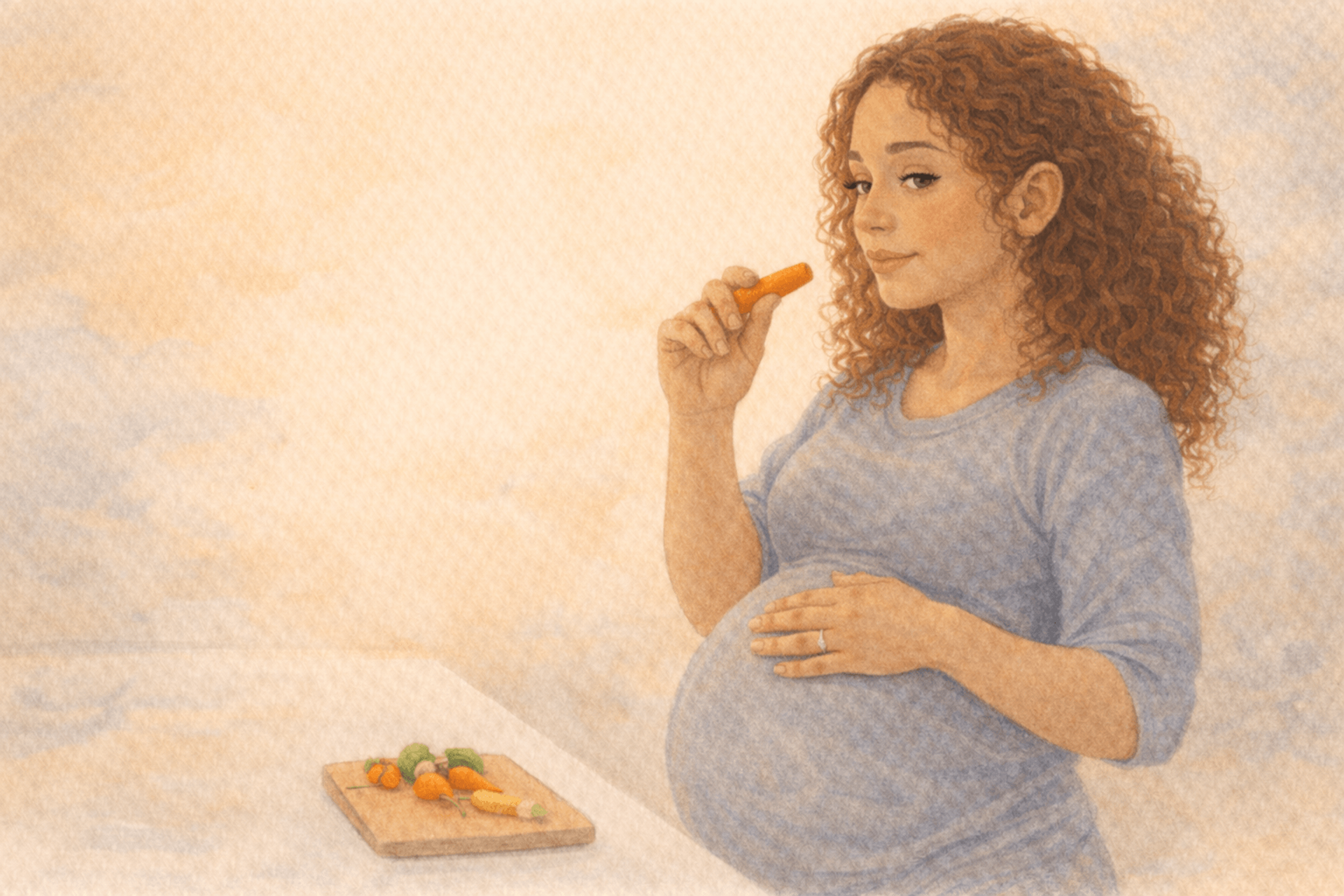
Taste buds begin forming anatomically around 8 weeks of gestation. By 14 weeks, those receptors can detect tastants in the surrounding amniotic fluid. By the third trimester, the fetus swallows several hundred milliliters of amniotic fluid each day — fluid that changes flavor depending on what the mother eats.
In a landmark study published in Pediatrics, Julie Mennella and colleagues at the Monell Chemical Senses Center randomly assigned pregnant women to one of three groups. One group drank carrot juice during pregnancy, one during breastfeeding, and one not at all. When the babies were old enough for solid food, the infants who had been exposed to carrot flavor — either through amniotic fluid or breast milk — showed fewer negative facial expressions when eating carrot-flavored cereal, compared to the unexposed group. The learning had started before birth.
This wasn't an isolated finding. Garlic ingestion by pregnant women was shown to alter the odor of amniotic fluid — adult panelists could identify which fluid samples came from mothers who had eaten garlic. Anise, vanilla, and other dietary compounds have been traced through the same pathway.
And in 2022, a research team at Durham University used 4D ultrasound to directly observe fetal facial expressions after mothers ingested either carrot or kale flavoring. Fetuses exposed to carrot showed more "laughter-face" movements. Fetuses exposed to kale showed more "cry-face" movements. At 32 to 36 weeks of gestation, your baby already has flavor opinions.
The research implication is straightforward. A varied diet during pregnancy exposes the developing baby to a wider range of flavors, which appears to increase acceptance of those flavors after birth. This isn't a guarantee — every child develops individual preferences — but the window of early familiarization is open well before the first spoonful of solid food.
Your Baby Is Building a Brain at Astonishing Speed
During the peak period of prenatal neurogenesis — the phase when the brain is generating new nerve cells — the developing brain produces neurons at a rate of approximately 250,000 per minute. That's not a rounded number for dramatic effect. It's the estimate from developmental neuroscience research on how fast new brain cells are created during this critical window.
By 28 weeks, the fetal brain contains more neurons than it will ever have again — over 100 billion. After that point, the process reverses. Neurons that don't form useful connections are gradually eliminated. The brain gets more efficient not by adding more cells, but by removing the ones that didn't find a job. Neuroscientists call this apoptosis — programmed cell death — and it's one of the most counterintuitive facts about brain development: less can mean more.
At the same time, the surviving neurons begin an explosive period of synaptogenesis — forming thousands of connections with neighboring cells, each connection a potential pathway for information. The connections that get used grow stronger. The ones that don't, deteriorate. This cycle of building, testing, and pruning will continue through childhood and adolescence, but the raw material — the sheer number of neurons — peaks before birth.
This is the reason sensory experience matters, even in utero. The sounds, flavors, and movements a fetus encounters aren't random background noise. They're the first inputs the developing brain uses to decide which connections to keep. It's also why the postnatal environment — touch, voice, eye contact, responsive caregiving — picks up where prenatal development leaves off. For a closer look at what happens after birth, our guide to what newborns can actually see covers the visual side of this story week by week.
Your Baby Sleeps — and the Brain Doesn't Stop
Around 26 to 28 weeks, the fetus begins cycling between identifiable sleep states. Researchers using real-time ultrasound to monitor eye movements in 30 pregnancies found that REM and non-REM periods become clearly distinguishable between 28 and 31 weeks of gestation. By the third trimester, the fetus spends most of its time asleep, with the brain alternating between the rapid-fire activity of REM sleep and the quieter resting state of non-REM sleep every 20 to 40 minutes.
REM sleep in adults is the phase associated with dreaming. Whether a fetus experiences anything resembling dreams remains an open question — there's no way to measure subjective experience before birth. Researchers at Friedrich Schiller University in Germany, working with animal models, found that brain patterns resembling a dreaming sleep state appear even before the first visible rapid eye movements — suggesting that sleep-like neural activity may begin earlier than previously thought. Direct evidence in human fetuses is still limited, but the timeline of brain development is consistent with these findings.
What is clear is that these prenatal sleep cycles serve a specific developmental purpose. REM sleep during fetal life is associated with the maturation of sensory and motor systems. It supports the creation of memory circuits and long-term brain plasticity. Some researchers have described it as a kind of self-stimulation program — the brain running its own rehearsal before the curtain goes up.
How important are these prenatal sleep cycles for later brain development? Research on premature infants offers an indirect but compelling answer. Babies born early — who miss the final weeks of in-womb sleep development — show measurable differences in auditory processing later in life, performing worse on tests of emotion classification compared to full-term peers. The womb environment, including its sleep-supporting conditions, appears to play a specific role in calibrating the brain's ability to process complex sensory input.
Every Kick Is a Brain Exercise
The kicks you feel in the third trimester are not random muscle contractions. Research from University College London found that fetal kicks during the later stages of pregnancy trigger fast brainwaves in the somatosensory cortex — the region of the brain that processes touch and body awareness. Each kick generates sensory feedback that helps the developing brain build a spatial map of the body.
This is how a baby begins to develop a sense of where the arms are, where the legs are, and what belongs to the body versus what doesn't. The process requires movement and the resulting feedback loop between muscles and brain. The brainwaves evoked by this movement disappear within a few weeks after birth, suggesting that fetal kicks serve a specific and time-limited developmental function.
The researchers noted that spontaneous movement and its sensory consequences during early development are known to be necessary for proper brain mapping — a finding consistent with animal models. Restricted fetal movement, whether from low amniotic fluid, uterine constraint, or other factors, may limit these mapping opportunities.
So the next time a kick interrupts your attempt to sleep: your baby is running a calibration test. Every limb that hits the uterine wall sends a signal back to the brain, and the brain uses that signal to refine its understanding of the body it's building. We know — not exactly comfortable. But there's a real reason behind every kick.
What This Means (and What It Doesn't)
None of this means you need to play Mozart through headphones strapped to your abdomen. (The research on passive classical music exposure and IQ has been thoroughly debunked.) And it doesn't mean that every meal, every conversation, or every moment of quiet is a developmental opportunity you're either capitalizing on or wasting.
What it does mean is that your baby's brain is not waiting for birth to start working. The sensory systems come online in a specific order, on a specific timetable, and they use the raw material available in the uterine environment to begin organizing themselves. Your voice. Your heartbeat. The flavors in your food. The rhythm of your daily life. These are the first inputs — and the research suggests they leave a measurable trace.
After birth, this process continues with new intensity. The visual system, which receives very little stimulation in the womb, becomes the next frontier — and it develops rapidly. If you're curious about how all five senses unfold across the first year, our complete guide to baby's sensory development covers each system with research at every stage. And for practical ideas matched to each month, our sensory play guide picks up right where the womb leaves off.
You're already doing more than you think. Your baby has been listening, tasting, moving, and learning — before the first breath, before the first cry, before the first moment you see each other face to face.
Frequently Asked Questions
Yes. By 25 weeks of gestation, the auditory system is developed enough for a fetus to detect and respond to sounds, including the mother's voice. Research shows that newborns recognize and prefer their mother's voice at birth.
REM sleep — the stage associated with dreaming — has been observed in fetuses starting around 28 weeks of gestation. By the third trimester, fetuses spend a significant portion of their time in REM sleep.
Taste buds become functional around 14 weeks, and by 21 weeks the fetus can detect flavors in the amniotic fluid that change based on the mother's diet. Studies show that prenatal flavor exposure influences food preferences after birth.
This article is for educational and entertainment purposes only. It is not a substitute for professional medical advice. Always consult your healthcare provider with questions about your pregnancy.
- Querleu, D., Renard, X., Versyp, F., Paris-Delrue, L., & Crépin, G. (1988). Fetal hearing. European Journal of Obstetrics & Gynecology and Reproductive Biology, 29(3), 191–212.
- Arabin, B. & van Straaten, H.L.M. (2005). Fetal and neonatal hearing. In A. Kurjak (Ed.), Textbook of Perinatal Medicine (2nd ed., pp. 955–972).
- Mennella, J. A., Jagnow, C. P., & Beauchamp, G. K. (2001). Prenatal and postnatal flavor learning by human infants. Pediatrics, 107(6), E88.
- Mennella, J. A., Johnson, A., & Beauchamp, G. K. (1995). Garlic ingestion by pregnant women alters the odor of amniotic fluid. Chemical Senses, 20(2), 207–209.
- Ustun, B., Reissland, N., Covey, J., Schaal, B., & Blissett, J. (2022). Flavor sensing in utero and emerging discriminative behaviors in the human fetus. Psychological Science, 33(10), 1651–1663.
- Stiles, J. & Jernigan, T. L. (2010). The basics of brain development. Neuropsychology Review, 20(4), 327–348.
- Inoue, M., Koyanagi, T., Nakahara, H., Hara, K., Hori, E., & Nakano, H. (1986). A study on the development of sleep-wakefulness cycle in the human fetus. Early Human Development, 14(3–4), 259–268.
- Schwab, K., Groh, T., Schwab, M., & Witte, H. (2009). Nonlinear analysis and modeling of cortical activation and deactivation patterns in the immature fetal electrocorticogram. Chaos, 19(1), 015111.
- Whitehead, K., Pressler, R., & Fabrizi, L. (2018). Characteristics and clinical significance of delta brushes in the EEG of premature infants. Clinical Neurophysiology Practice, 3, 12–18. (UCL study on fetal kicks and somatosensory mapping, reported in Scientific Reports.)
- Spahn, J. M. et al. (2019). Influence of maternal diet on flavor transfer to amniotic fluid and breast milk and children's responses: a systematic review. American Journal of Clinical Nutrition, 109(Suppl), 1003S–1026S.
- DeCasper, A. J. & Fifer, W. P. (1980). Of human bonding: Newborns prefer their mothers' voices. Science, 208(4448), 1174–1176.
- Spence, M. J. & DeCasper, A. J. (1987). Prenatal experience with low-frequency maternal voice sounds influences neonatal perception of maternal voice samples. Infant Behavior and Development, 10(2), 133–142.

More Articles

Parallel Play in Toddlers: Why Side-by-Side Is the Social Work
Your toddler spent the entire playdate building separate towers, and nobody shared a single block. That counted — more than it looked. A 2025 longitudinal study found that playing beside a specific child consistently predicted later social play with that same child, but not the other way around. Here's what parallel play in toddlers actually is, why the science calls it strategic rather than passive, and what it means for how you run a playdate.

When Do Babies Point: Why It Matters for Language
Most milestone articles treat pointing as a box to check around 12 months. The research tells a different story — one that starts months earlier, runs through the infant brain, and traces back to how much the parent is pointing. Here's what the last fifteen years of research actually found, and what it means for everyday interactions.
When Do Babies Wave Bye-Bye: Why Your Baby Needs You to Wave First
Most baby milestones unfold on a biological schedule — waving isn't one of them. A 2023 study found that babies develop imitation ability because their caregivers imitate them first, and waving is named directly as a cultural gesture learned through that loop. Here's what the research says about the 9–12 month window, why the first wave looks nothing like a wave, and what helps it arrive.