Activities for an 18 Month Old: What's Actually Happening Under the Hood
You've read this book enough times that you started testing whether you could narrate it with your eyes closed. (You can.) The bear still can't find his hat. Your toddler points to the hiding spot on page nine before you turn the page, and then — last page barely touched — produces the sound that means again, with the quiet confidence of someone who has strong opinions about activities for 18 month olds and exactly zero patience for variety.
The research agrees with them completely, as it turns out.
- What's different about the 18-month brain, and why this specific age shows up so consistently in language research as a turning point
- The interaction pattern that reorganizes how you talk to your toddler — and how to run it intentionally, whether your child is walking already or still crawling
- Activities for 18 month old at home, organized by the science behind why they work
- Why shape sorting does more cognitive work than color sorting at this age, and what that means for activity choices
- The controlled trial that explains why your toddler demanding the same book five nights in a row is, actually, optimal
- How the small pretend-play scenes beginning at 18 months lay the groundwork for kindergarten self-regulation
- What the CDC's 18-month checklist actually flags, framed without the anxiety spiral
If the one-sentence answer is enough, you’ve got the gist. If you want the mechanism behind each piece, keep reading.
What changes at 18 months (beyond the walking)
At 18 months, the CDC's 2022 milestone checklist expects toddlers to say at least 3 words beyond "mama" and "dada," point to things they find interesting to share that interest with you, follow a one-step instruction without a gesture, and recognize what common household objects are for. That's a shorter list than most milestone charts suggest, and for a reason: the same underlying capacity runs beneath nearly all of those checkboxes. Your toddler is learning that your mind and theirs are two separate things, and that they can do something about the difference.
The vocabulary picture at 18 months is worth understanding precisely. The CDC's "3 words" threshold is the point where a pediatrician wants a closer look — it sits near the bottom of the normal range, not in the middle of it. In practice, vocabulary at 18 months ranges enormously: some toddlers have a dozen words in active use, others have 40 or 50. The median figure from large normative studies, including MacArthur CDI data compiled by Fenson and colleagues, lands around 50 words for production, but there's no "most toddlers" number that means much at this age because the range is genuinely wide and the trajectory matters far more than any single point. The vocabulary explosion — the period when new words arrive at an accelerating rate — typically kicks in a few months later, once productive vocabulary crosses around 100 words, as described in research by Mervis and Bertrand in the Journal of Child Language in 1995. What's happening at 18 months is the cognitive setup for that acceleration. One piece of that setup is the shape bias.
Around this age, toddlers start extending new object names to other objects that share the same shape rather than the same color, texture, or material. A 2012 study in Frontiers in Psychology by Yee, Jones, and Smith found that between 18 and 24 months, toddlers reliably extend new object names to things that share the object's shape rather than its color or surface properties. Show a toddler a new object called a "dax" and then two alternatives (one that shares the dax's shape, one that shares its color), and toddlers in this window consistently choose the shape match as another "dax." The brain has organized itself to treat shape as the reliable cue for object category, which is correct across most of the physical world and turns out to matter directly for which activities work best right now.
Mirror self-recognition is another change consolidating in this window. The classic test places a dot of paint on a toddler's nose; toddlers who reach for the dot on their own face rather than the reflection are showing they recognize the mirror image as themselves. This capacity develops between 18 and 24 months and brings the first self-conscious emotions along with it: something recognizable as pride when things go right, and something recognizable as embarrassment when they don't. The company in this category is select — across the animal kingdom, only great apes, bottlenose dolphins, Asian elephants, and European magpies reliably pass the mirror test. The magpie detail is the one that tends to surprise people (and possibly the magpie).
A 2009 study at the University of Chicago by Rowe and Goldin-Meadow found that the variety of different meanings a toddler conveyed through gesture and pointing at 18 months predicted vocabulary size at age three and a half, independently of everything else researchers could measure in the home environment. Variety of gesture meanings mattered, not just frequency. Responding to each point with a label ("yes, that's the dog," "right, a truck") turns your toddler's attention signal into a vocabulary moment, and that loop, run across the day, compounds.
The interaction that speeds up language — and how to run it on purpose
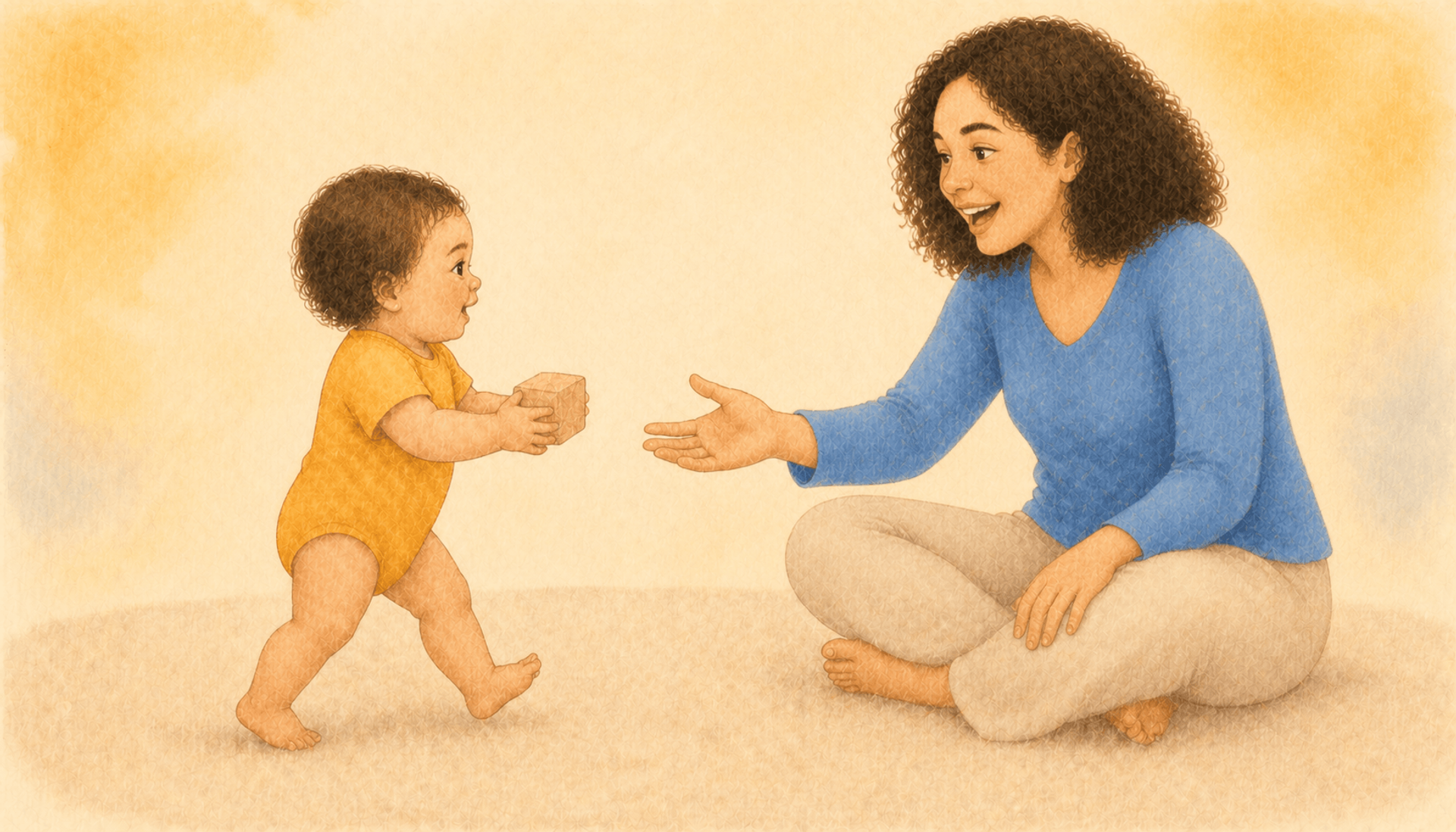
What a parent says when a toddler walks across the room carrying something and holds it out is the single thing researchers have most consistently found to speed up language at this age. No specific activity category and no toy type predicts this as reliably as the social context of that delivery.
A 2014 study in Developmental Science by Karasik, Tamis-LeMonda, and Adolph observed 50 mother-toddler pairs at home for one hour, coding every instance of a toddler bringing an object to the parent. When toddlers made what the researchers called a "moving bid" — walked over with an object in hand — mothers responded with action directives in about 45 percent of those interactions: "Stack it!", "Go give it to Daddy!", "Put it in the basket!" During stationary play, mothers used that kind of language about 16 percent of the time. The delivery triggered verb-rich, goal-directed language about three times more reliably than any other scenario.
A separate 2014 study in Developmental Psychology by Walle and Campos found that same-aged toddlers who had been walking longer had significantly larger receptive vocabularies than same-aged toddlers still crawling, about 1.8 times larger even after controlling for age. The relevant variable isn't the walking itself, and there are at least two reasons why. One is the moving-bid mechanism described above. The other is visual: walking changes what a toddler can actually see. A 2014 study in Child Development by Kretch, Franchak, and Adolph put head-mounted eye trackers on 13-month-olds and found that crawlers spent most of their gaze looking at the floor, while walkers directed their eyes straight ahead toward their caregivers and the room around them. A crawler's visual field is mostly floor and the undersides of furniture. A walker's visual field contains faces, objects at table height, and whole rooms worth of things to point at and name. The vocabulary boost that follows walking onset is partly a natural consequence of suddenly seeing much more to talk about.
This matters practically, because the mechanism isn't locked behind a milestone you wait for. A 2013 study by Fernald, Marchman, and Weisleder found that differences in vocabulary size and language processing speed between toddlers from higher- and lower-resource families were already measurable at 18 months, six months before most parents think of this as a school-readiness issue. Setting up the interaction intentionally is available to any parent once the pattern is visible.
In a 2017 randomized trial by McGillion and colleagues at the University of Liverpool, families coached to spend 15 minutes a day narrating what their toddler was already focused on showed measurable vocabulary gains by 15 and 18 months. The training itself took about 10 minutes. The active ingredient was direction: responding to the child's attentional focus rather than introducing new topics over it.
The practical extension is designing activities where your toddler has a reason to bring you something. Any carrying game runs the Karasik mechanism deliberately. The specifics matter less than the structure: a trip across the room, an object in hand, a moment of delivery. From there, the verb-rich language follows naturally. And if your toddler is still crawling: the visual field research suggests a simple intervention — place interesting objects, pictures, and vocabulary-rich materials lower, at floor and low-furniture level, where a crawler's eye level actually lands. Walking will come, but the visual vocabulary input doesn't have to wait for it.
Activities for an 18 month old at home: building the right kind of trip
The most evidence-backed activities for an 18 month old at home combine a physical trip across the room with a naming moment, because the delivery triggers the interaction pattern described above. Before any activity, though, the number of visible toys makes a substantial difference to what happens next.
A 2018 study by Dauch and colleagues placed toddlers aged 18 to 30 months in rooms with either 4 toys or 16 toys. In the 4-toy condition, children played with each toy about twice as long and found significantly more creative uses per object. The average number of toys visible in participants' homes was around 90. Rotating most toys into a closet and keeping 4 to 6 accessible at a time is supported by direct experimental evidence in exactly this age range, and it costs nothing except the initial sort.
For language-focused carrying games, put 6 to 8 familiar objects on one side of the room and a basket or container on the other. Ask your toddler to "bring mommy the spoon," respond with an action directive when it arrives ("great, now put it in the basket" or "go get the ball"), and keep requests to one object at a time. As receptive vocabulary grows, objects can become less familiar. As production develops, you can begin asking the toddler to name what they're carrying before handing it over. This runs the moving-bid mechanism deliberately and needs nothing more than what's already in most kitchens.
For naming activities with cards, the simplest version is holding up a card, saying the animal's name, and adding the sound — "cow, moooo" — then waiting for a reaction and doing it again. At 18 months this is already a full activity session. Our Farm Animals Match, Spell & Play starts here: 12 farm animal cards with clear watercolor illustrations, designed so you begin with simple naming now and grow into more complex activities as your child gets older. Around age 2, the matching activity kicks in (finding two cards that show the same animal in different colors — a cow is still a cow, even a blue one). From there the set progresses through baby animal matching, guided letter-tile spelling, and eventually free spelling from memory, all the way to age 5. At 18 months you're using maybe 20 percent of what's in the box, but that's the point: one set that doesn't age out. The sensory play by month guide covers how to layer a vocabulary component onto any tactile activity at this age, for sessions that work on both attention and language simultaneously.
For outdoor time, walking somewhere that has things to name — a parking lot full of vehicles, a garden, any place with a few distinct moving objects — runs the pointing-and-labeling loop in a setting where new vocabulary arrives naturally and there's enough to point at to sustain 10 to 15 minutes of back-and-forth. That's a full productive session at this age.
Why shape comes before color right now
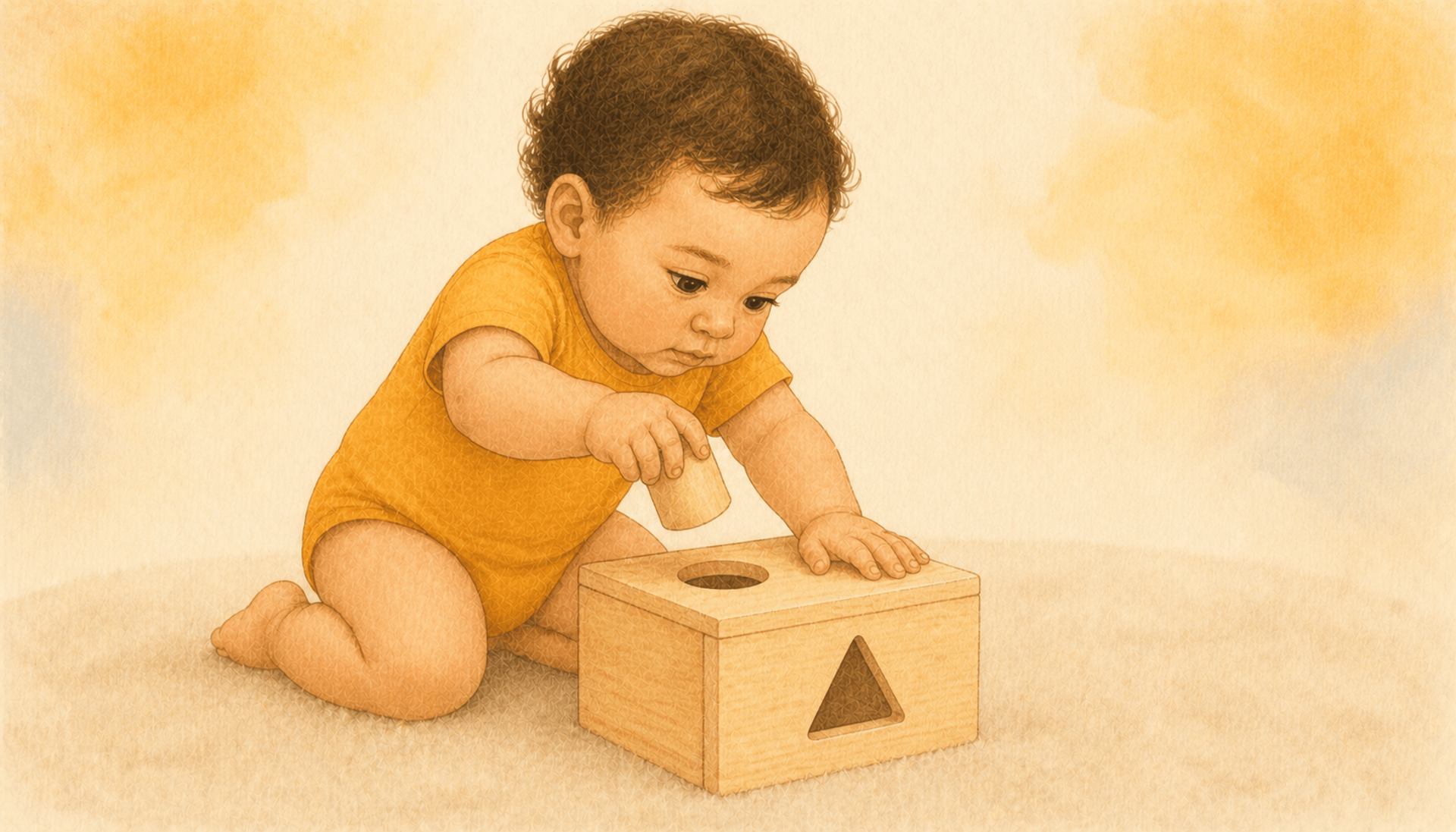
The gap between shape sorting success and color sorting difficulty at 18 months comes down to timing rather than difficulty. At this age, the brain has organized itself around shape as the main cue for recognizing objects, and color word acquisition follows on a separate, slower timeline.
As described above, around 18 months toddlers start extending new words to objects that share a shape (Yee, Jones & Smith, 2012; based on foundational research by Landau, Smith & Jones, 1988). A 2012 study in Frontiers in Psychology by Yee and colleagues found that changes in how toddlers visually recognize objects actually happen a few months before they start using shape to learn new words — the visual system reorganizes first, and the language pattern follows once enough vocabulary is in place to reveal it. The brain is ready for this.
Color words are different, and slower. In a 2020 study in Child Development, Forbes and Plunkett found that reliable color naming — correctly naming colors on new, unfamiliar objects — typically emerges across the third and fourth year. At 18 months, most toddlers can attach a color word to a specific familiar object (that particular red cup), but the generalization that makes color sorting useful as a vocabulary game hasn't clicked yet for most.
In practice, a shape sorter at this age does more than exercise fine-motor control. The matching and naming of what goes where lands in cognitive infrastructure the brain is actively building right now. Color activities aren't harmful; when choosing what to set out today, the shape-based option is doing more useful cognitive work for this particular window.
The case for reading the same book twelve times in a row

When an 18-month-old demands the same book for the fifth night in a row, the temptation is to rotate something new in. A controlled study says: read it again.
A 2011 study in Frontiers in Psychology by Horst, Parsons, and Bryan divided toddlers into two groups with the same target vocabulary words. One group heard the same storybook three times across three sessions. The other group heard three different storybooks, each containing the same target words, with identical total word exposure across both groups. A week later, children who heard the same book three times retained the new words at about 60 to 70 percent accuracy. Children who heard three different books retained the same words at around 20 to 30 percent, near chance level. Contextual repetition outperformed variety by a factor of about three. The study used three-year-olds; the word-consolidation mechanism it demonstrates is consistent with the broader literature on memory consolidation and contextual learning at younger ages, but the specific numbers come from that older group.
The reason is contextual anchoring. Every time a word appears in the same story, it arrives surrounded by the same illustrations, the same emotional beats, the same preceding sentence. Each repetition strengthens the same network of connections. Three different books give the same word three different surrounding contexts — more total information, but less reinforcement of any single path. Variety is good for many things. Locking in a new word isn't one of them.
By the fourth or fifth reading, the child anticipates what comes before you say it. The point before you turn the page, the small intake of breath before the surprise, the knowing look when the bear checks behind the chair — all of that shared anticipation is a form of joint attention between reader and toddler, and joint attention is its own vocabulary mechanism. The repetition signals consolidation, not limited curiosity.
For a fuller picture of how language develops from first words through the toddler years, that article covers the research on what drives vocabulary growth between 12 and 24 months and why the acceleration phase tends to follow a period of exactly this kind of repeated, context-rich reading.
What pretend play is actually training
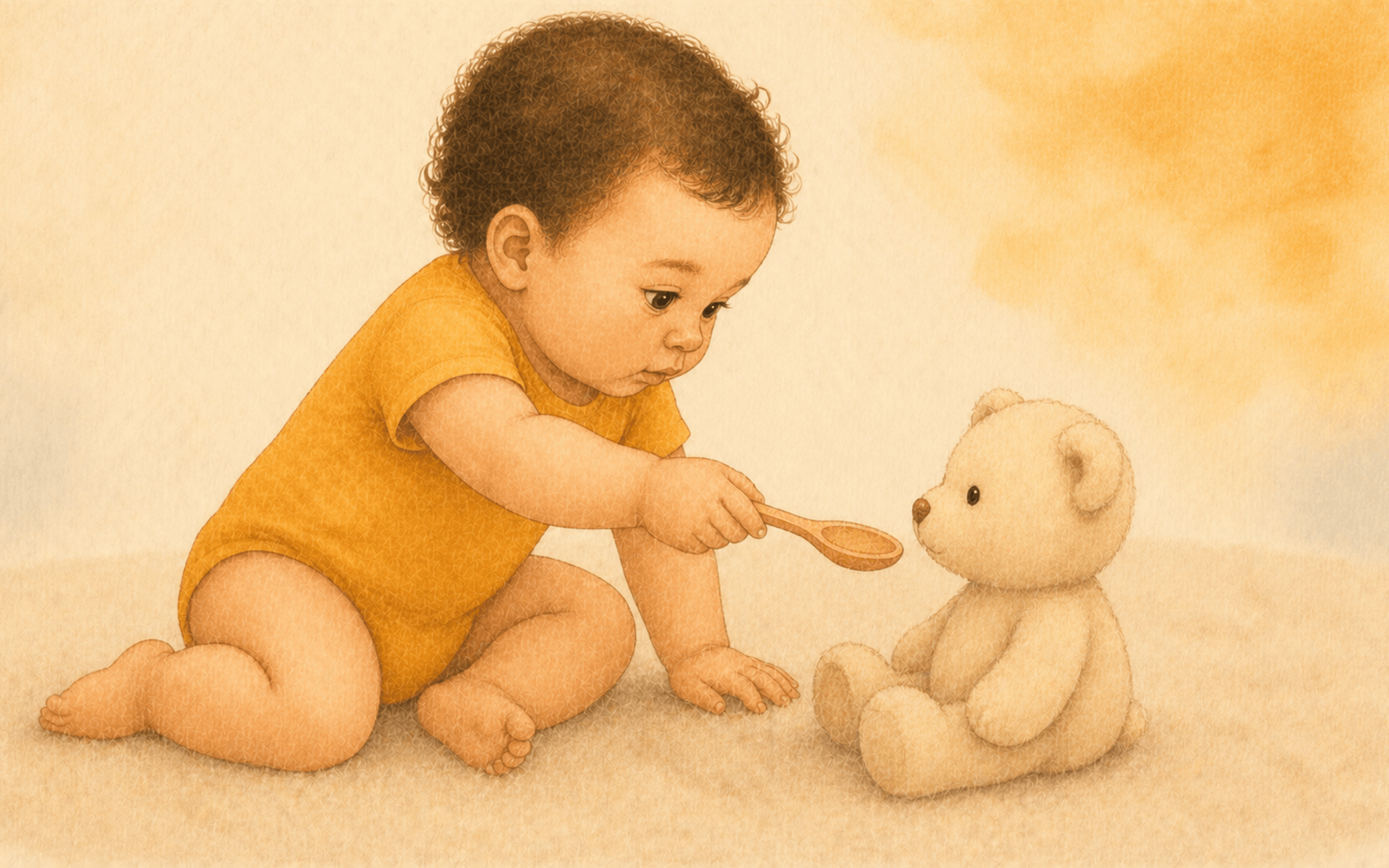
When a toddler picks up a spoon, extends it toward a stuffed bear, and waits to see what happens, it looks like imagination. The developmental evidence says it's also the beginning of executive function practice.
Pretend play begins emerging between 18 and 24 months, typically starting with deferred imitation (reproducing an action seen earlier), then functional play (using objects as they're used in real life: the spoon feeds the bear, the cup goes to the doll's mouth), then the first gestures toward symbolic play (the wooden block becomes a car). Each step requires the same cognitive operation: holding a rule in mind that isn't literally true and acting on it anyway. "This spoon is currently food for the bear" is a form of mental rule-holding, and mental rule-holding is inhibitory control in an early form.
A 2020 study by Thibodeau-Nielsen and colleagues found that engagement in social pretend play uniquely predicted growth in inhibitory control — the capacity to suppress an impulse in favor of a goal — across the preschool year, beyond what other forms of play predicted. The mechanism is the same one at work when a child follows classroom rules, waits in line, or stays with a task that doesn't immediately reward them: the brain is practicing holding a self-generated structure in mind and acting on it rather than on immediate stimulus.
At 18 months, the pretend play is simple: a spoon feeds a bear, a cup gets poured into another cup, a line of objects gets driven to a destination. Sequencing activities run along the same logic. Our My First Routine Cards are built for this window: picture cards showing daily sequences (wake up, wash hands, eat, brush teeth) that a toddler can lay out and act through. Playing a morning routine with picture cards is structured pretend play in the sense that matters developmentally, and the sequencing practice runs the same prefrontal circuits that show up as self-regulation when this toddler is five.
The why toddlers say no to everything article covers the "no" phase in full. The short version is that negation — representing a state that doesn't exist, pointing conceptually at the opposite of what's in front of you — is one of the most linguistically complex operations in early speech. When your toddler says "no" reflexively to things they would have wanted five minutes ago, they have just run that operation successfully. The "no" phase is developmentally correct, and it coexists with the pretend play emergence for the same reason: both require a mind that can hold alternative representations at once.
When to check in with your pediatrician
The CDC's 18-month milestone checklist is worth knowing, not as a performance target, but because a few specific absences are worth raising at the next well-child visit.
At 18 months, if your toddler isn't yet pointing to show you something they find interesting (pointing to share, not just to request), that's worth mentioning — this gesture is one of the earliest markers of joint attention development, and it's one your pediatrician will want to track. Not yet using at least 3 words beyond "mama" and "dada" is a pattern worth flagging. Not yet following a one-step direction without a gesture from you is worth noting. Not yet walking without support is another 18-month milestone to raise.
None of these absences is diagnostic on its own, and the CDC's 2022 revision set the concern threshold specifically to reflect when the large majority of children have a skill, not the early-reaching half. If one of the patterns above describes what you're seeing, your pediatrician can help you understand what options are available, and earlier conversations are generally more useful than later ones.
For the language side specifically, the activities for a 1 year old article covers what the research says about the 12-to-15-month language window and how it connects to the 18-month picture, including what a slower-starting vocabulary trajectory typically looks like and when it's worth acting on.
Frequently Asked Questions
The activities for an 18 month old that carry the strongest research support combine a physical trip across the room with a naming moment. Any carrying game works: put familiar objects on one side, ask your toddler to bring them to you or a basket, and respond with an action directive when they arrive. Research by Karasik, Tamis-LeMonda, and Adolph (2014, Developmental Science) found this kind of delivery interaction pulls verb-rich language out of parents at about three times the rate of stationary play. Before setting up anything, reduce visible toys to 4 to 6 at a time: a 2018 study by Dauch and colleagues found toddlers aged 18 to 30 months played nearly twice as long with each toy in a 4-toy condition compared to a 16-toy condition.
The CDC's 2022 milestone guidance for 18 months expects at least 3 words beyond "mama" and "dada." Most toddlers in this range have somewhere between 10 and 50 words they use with some consistency. The vocabulary explosion — the phase where word acquisition accelerates sharply — typically starts later, once productive vocabulary reaches around 100 words, which often happens across the 18-to-24-month window. A toddler at 18 months with 8 well-used words and clear pointing behavior is developing differently from a toddler with 50 words, not necessarily behind. If your toddler isn't yet using at least 3 words, that's worth raising with your pediatrician rather than waiting.
Short activity windows are developmentally appropriate for this age, and that isn't a pace problem to solve. Attention spans for directed play run 5 to 15 minutes per session. Three to four short activity periods across the day — a carrying game, a picture-book naming session, outdoor time, brief pretend play with a few household props — each running 10 to 20 minutes before interest naturally shifts, covers the day well. Rotating toys every few days (keeping 4 to 6 visible) adds novelty without new purchases. Brief unstructured time, with your toddler supervised but not directed, is the beginning of self-directed play, not a gap to fill.
A practical daily structure builds 3 to 4 short activity blocks into the day. Start with a language-focused session of 10 to 15 minutes — carrying games, picture-book naming, or card matching. Add an outdoor or movement period, even 15 minutes of walking somewhere with things to observe. Include a short pretend-play session with a few household props. Leave one stretch unstructured, where your toddler directs and you narrate from nearby. The sensory play by month guide covers how to add sensory activities into this kind of day. The routines article explains why the predictability of the sequence matters as much as any individual activity.
Small board books with one clear object per page work reliably on a plane at this age — and repeating the same book multiple times during the flight is, for the reasons described above, better for vocabulary retention than rotating through several different books. A sticker book offers independent fine-motor activity with minimal mess. A small bag with 4 to 5 familiar objects the toddler hasn't seen in a few days (a soft animal, a small car, a texture ball) provides novelty through rotation rather than quantity. Pointing-and-naming with a picture book of animals or vehicles keeps both attention and language active without requiring space.
For educational and entertainment purposes only. Not a substitute for professional medical or developmental advice. If you have concerns about your child's development, consult your pediatrician.
- Dauch, C., Imwalle, M., Ocasio, B., & Metz, A. E. (2018). The influence of the number of toys in the environment on toddlers' play. Infant Behavior and Development, 50, 78–87.
- Fenson, L., Dale, P. S., Reznick, J. S., Thal, D., Bates, E., Hartung, J. P., Pethick, S., & Reilly, J. S. (1993). MacArthur Communicative Development Inventories: User's Guide and Technical Manual. Singular Publishing Group.
- Fernald, A., Marchman, V. A., & Weisleder, A. (2013). SES differences in language processing skill and vocabulary are evident at 18 months. Developmental Science, 16(2), 234–248.
- Forbes, S. H., & Plunkett, K. (2020). Linguistic and cultural variation in early color word learning. Child Development, 91(3), 842–858.
- He, M., Walle, E. A., & Campos, J. J. (2015). A cross-national investigation of the relationship between infant walking and language development. Infancy, 20(3), 283–305.
- Horst, J. S., Parsons, K. L., & Bryan, N. M. (2011). Get the story straight: Contextual repetition promotes word learning from storybooks. Frontiers in Psychology, 2, 17.
- Karasik, L. B., Tamis-LeMonda, C. S., & Adolph, K. E. (2014). Crawling and walking infants elicit different verbal responses from mothers. Developmental Science, 17(3), 388–395.
- Kretch, K. S., Franchak, J. M., & Adolph, K. E. (2014). Crawling and walking infants see the world differently. Child Development, 85(4).
- Landau, B., Smith, L. B., & Jones, S. S. (1988). The importance of shape in early lexical learning. Cognitive Development, 3(3), 299–321.
- McGillion, M., Pine, J. M., Herbert, J. S., & Matthews, D. (2017). A randomised controlled trial to test the effect of promoting caregiver contingent talk on language development in infants from diverse socioeconomic status backgrounds. Journal of Child Psychology and Psychiatry, 58(10), 1122–1131.
- Mervis, C. B., & Bertrand, J. (1995). Early lexical acquisition and the vocabulary spurt: A response to Goldfield & Reznick. Journal of Child Language, 22(2), 461–468.
- Rowe, M. L., & Goldin-Meadow, S. (2009). Early gesture selectively predicts later language learning. Developmental Science, 12(1), 182–187.
- Thibodeau-Nielsen, R. B., Gilpin, A. T., Nancarrow, A. F., Pierucci, J. M., & Hicks, L. E. (2020). Pretend play and executive functions among preschoolers. Early Childhood Education Journal.
- Walle, E. A., & Campos, J. J. (2014). Infant language development is related to the acquisition of walking. Developmental Psychology, 50(2), 336–348.
- Yee, M., Jones, S. S., & Smith, L. B. (2012). Changes in visual object recognition precede the shape bias in early noun learning. Frontiers in Psychology, 3, 533.
- Zubler, J. M., Wiggins, L. D., Macias, M. M., Whitaker, T. M., Shaw, J. S., Squires, J. K., & Shapira, S. K. (2022). Evidence-informed milestones for developmental surveillance tools. Pediatrics, 149(3).
More Articles

Parallel Play in Toddlers: Why Side-by-Side Is the Social Work
Your toddler spent the entire playdate building separate towers, and nobody shared a single block. That counted — more than it looked. A 2025 longitudinal study found that playing beside a specific child consistently predicted later social play with that same child, but not the other way around. Here's what parallel play in toddlers actually is, why the science calls it strategic rather than passive, and what it means for how you run a playdate.

When Do Babies Point: Why It Matters for Language
Most milestone articles treat pointing as a box to check around 12 months. The research tells a different story — one that starts months earlier, runs through the infant brain, and traces back to how much the parent is pointing. Here's what the last fifteen years of research actually found, and what it means for everyday interactions.

When Do Babies Wave Bye-Bye: Why Your Baby Needs You to Wave First
Most baby milestones unfold on a biological schedule — waving isn't one of them. A 2023 study found that babies develop imitation ability because their caregivers imitate them first, and waving is named directly as a cultural gesture learned through that loop. Here's what the research says about the 9–12 month window, why the first wave looks nothing like a wave, and what helps it arrive.