Activities for a 1 Year Old: What the First Birthday Changes
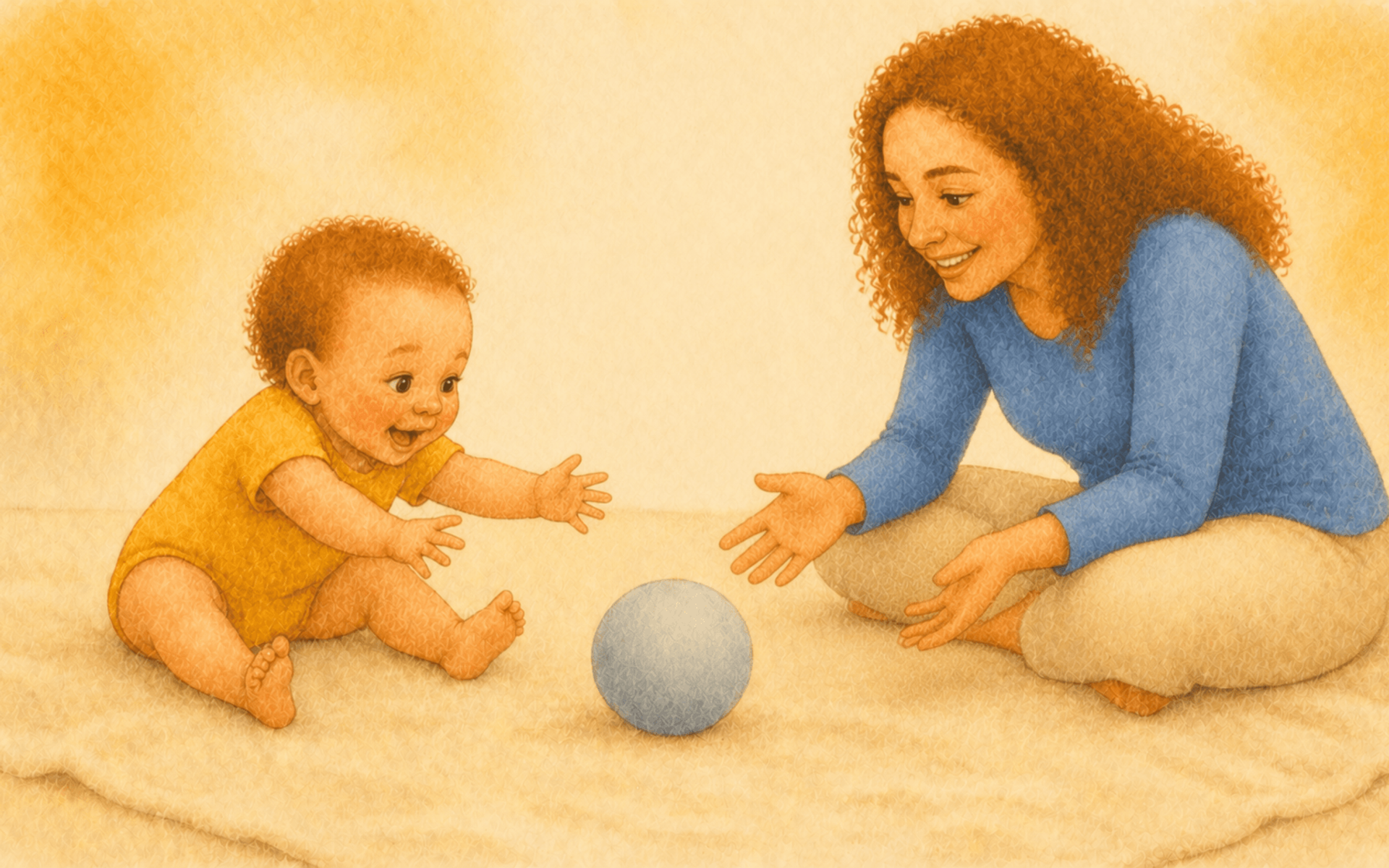
Every milestone checklist for a 1 year old arrives with an invisible comparison attached — is yours walking yet, saying words, performing on cue? The quiet competition starts early. What those lists rarely mention is that in 2022, the CDC moved both walking and first words to fifteen months, because that's when most children actually get there. Your one-year-old is right on track. And the checkboxes were never really the point anyway — what matters at twelve months is what's building quietly underneath them, and how the play you do together either supports that foundation or simply passes the time.
- What the 2022 CDC milestone revision means for your twelve-month-old, and why comparing developmental notes with other parents is genuinely unhelpful right now
- The cognitive shift that happens at exactly twelve months and changes how every activity you do together actually works
- Language and communication activities grounded in research most competitors skip entirely
- Motor activities (including one widely sold product that pediatricians have been warning about for decades)
- Sensory and outdoor play ideas, with a clear-eyed look at what Montessori activities are actually backed by data and what is mostly practitioner wisdom
- Red flags worth mentioning at the next well-child visit, framed without the anxiety spiral
If the one-sentence answer is enough, you’ve got the gist. If you want the mechanism behind each piece, keep reading.
Your one-year-old is probably right on track — here is what the CDC says now
The 2022 revision of the CDC developmental milestone checklist changed what counts as a concern: instead of flagging a skill that only half of kids have done by a certain age, the updated list now only raises a flag when the large majority of children have reached it and yours still hasn't. In practical terms, that shift moved both independent walking and first meaningful words from twelve months to fifteen. Crawling was removed from the checklist entirely, because the research on whether crawling predicts anything useful was never consistent enough to justify keeping it (if you want a full look at the crawling data, the when do babies start crawling article covers what the research actually shows). The revision was led by pediatrician Jennifer Zubler and colleagues, who updated the guidelines to reflect what most children actually do, not what a developmental textbook from decades ago suggested they should.
What the twelve-month checklist does include: pulling to stand and cruising sideways along furniture, a fingertip pincer grasp for small objects, drinking from an open cup held by a parent, looking for a toy after you have hidden it under a blanket, waving bye-bye, understanding the word "no," calling a parent "mama" or "dada" with or without full comprehension attached, and playing pat-a-cake. These are the benchmarks that matter this month, not independent steps, not a spoken word list.
The reason this is worth saying at the start of any guide to activities for a 1 year old is that parental anxiety about milestones changes how play actually unfolds. When a parent is watching for a performance, they stop noticing the learning that is already happening: the reaching, the checking your face, the tiny cause-and-effect experiments that occupy a twelve-month-old's entire day. Your job at this age is not to produce an early walker. It is to be present and responsive while the brain does its work, because the research on what actually predicts language and cognitive outcomes keeps pointing at exactly that.
The cognitive shift at twelve months that makes how you talk more important than what you do
At twelve months, something specific happens in the way a baby connects words to the world, and understanding it changes what every other activity in this article is actually for.
For most of the first year, infants benefit from language simply being present. Hearing a parent talk, narrate, and sing while they explore helps babies form object categories more successfully than silence alone. Then, right around the first birthday, that shifts. A longitudinal study at Northwestern University by Ferguson, Havy, and Waxman found that twelve-month-olds who had already established a precise link between a specific label and a specific category understood significantly more words at twelve months, and six months later produced more words at eighteen months. The change was from "language nearby is useful" to "the exact word you say about this exact thing is what gets stored."
The practical implication for a parent is smaller than it sounds. You do not need to add more activities or buy more materials. You need to name the thing your baby is already looking at, in the moment they are looking at it. A 2019 study from Indiana University by Yu, Suanda, and Smith found that it was infant sustained attention to an object (not joint attention as a general concept) that predicted vocabulary at twelve and fifteen months. When your baby is concentrated on something and you name that specific thing in that specific moment, the word-to-object connection forms. When you name it while the baby is focused on something else, it largely does not.
This is why coaching parents in "parentese" (real words, correct grammar, slower tempo, exaggerated intonation) has measurable effects on vocabulary outcomes. In a randomized study at the University of Washington published in PNAS in 2020, Ferjan Ramírez, Lytle, and Kuhl found that children whose families were coached in parentese had an average vocabulary of about 100 words at eighteen months, compared with 60 words in the control group. Parentese works because it naturally creates more turn-taking, which creates more moments where parent and baby are attending to the same thing together. The activity you are doing with your baby is the container. Your voice, directed at what they are already watching, is the actual learning.
Language and communication activities for a 1 year old
Shared book reading at twelve months has one of the better evidence bases in early childhood research. A 2024 study in the Journal of Child Language by Rosslund and colleagues, following 1,442 Norwegian infants, found that daily reading was positively associated with vocabulary at both twelve and twenty-four months, with the effect strongest for children from lower-resource families. The American Academy of Pediatrics has recommended reading aloud from birth since 2014, and the advice holds through toddlerhood for good reason.
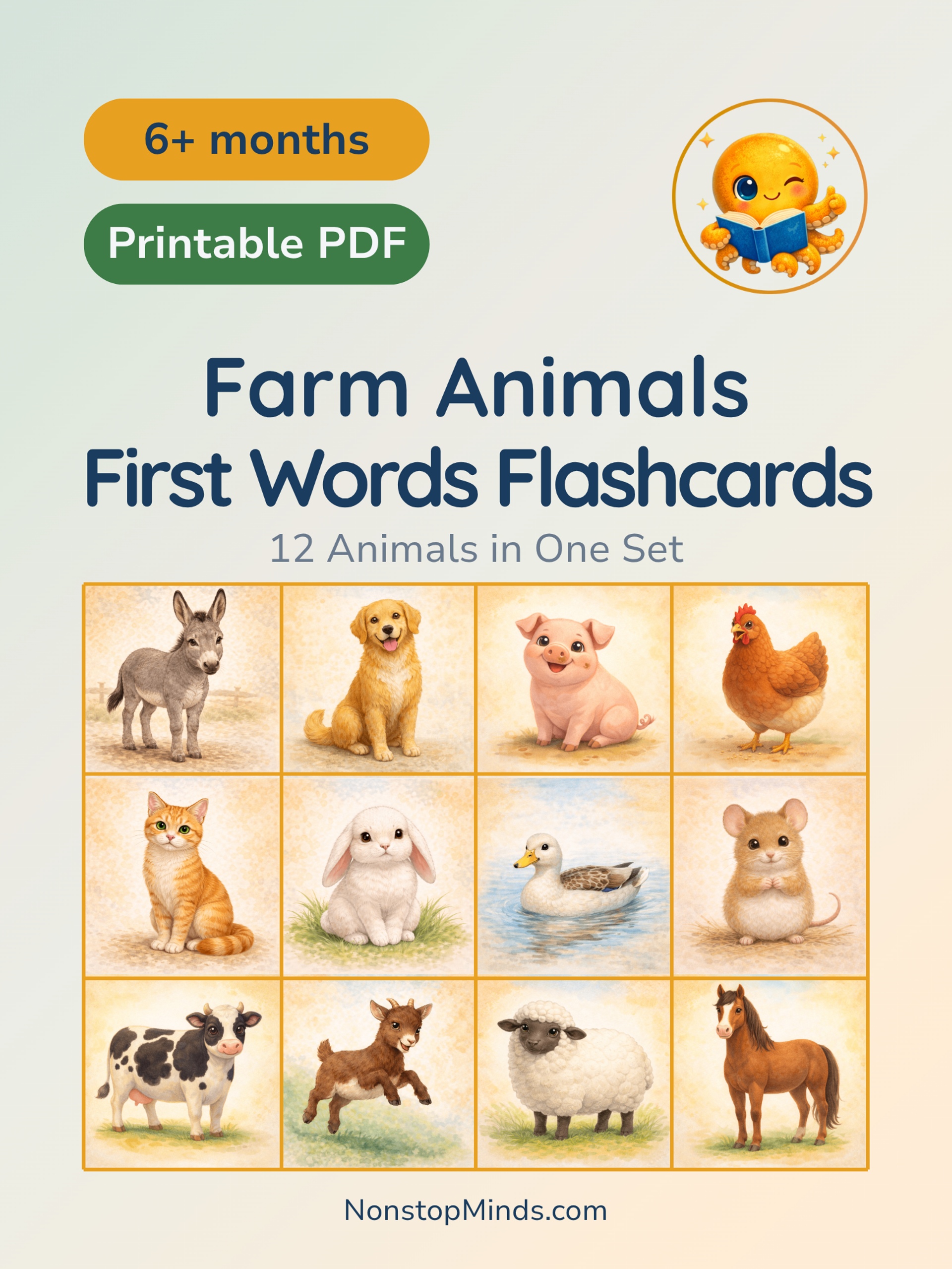
What makes book reading work at this age is not the reading itself but the conversation around the pages. Point to the dog. Say "dog." Wait. If your baby points, responds, or even just shifts focus to look, say "dog" again. This turn-taking loop is the mechanism the parentese research is measuring. Board books with one clear object per page, bold illustrations, and familiar subjects (animals, household objects, faces) are easiest to use this way because they make it simple to name what you both see at the same moment. Our Farm Animals First Words flashcards work on this same principle: one animal, one word per card, designed specifically for the naming window that opens at twelve months.
Imitation games are a second strong category. Klein and Meltzoff showed in 1999 that twelve-month-olds retain modeled actions for up to four weeks and reproduce them accurately with no reminder. When you show your baby how to put a block in a cup, pat a stuffed animal, or wave at their reflection in a mirror, and then move on to something else entirely, you may find the action reproduced later in a completely different context. The modeling is stored. Clapping games, peekaboo sequences, and simple action-and-response routines all draw on this capacity, and none of them require anything other than time and a willing parent.
Pointing deserves a mention because it is both a communication milestone at this age and a tool for shaping the naming practice described above. When your baby points at something and you follow the point and name what they are indicating, you are running the most basic vocabulary loop that exists. Research by Liszkowski, Carpenter, Striano, and Tomasello, published in 2006, showed that twelve-month-olds point not just to request objects but to share attention, a proto-declarative gesture that implies they already understand that you have a separate perspective worth influencing. Following a point with a name is one of the most evidence-aligned responses a parent can give.
For a fuller look at what the first words timeline actually looks like and how to support word production without pressure, the first words article in this series covers the research on productive versus receptive vocabulary development across the first eighteen months. And if you want to see how the language activities in this age window connect to what came just before, the activities for 9 month old article covers the pre-pointing and sustained-attention foundations that make twelve-month naming work.
Motor development activities at twelve months
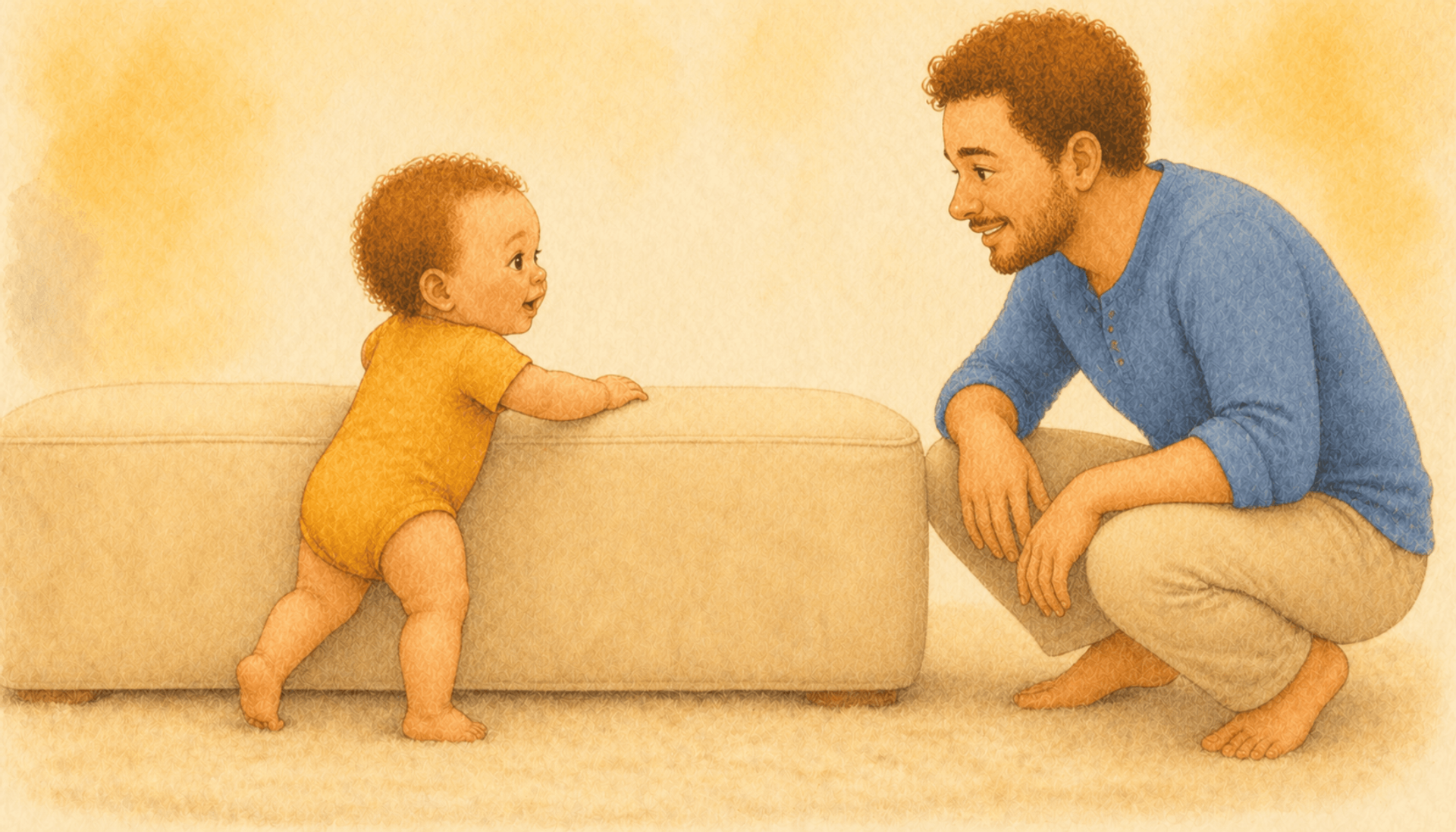
Cruising along furniture (stepping sideways while holding a stable surface) is the gross motor milestone the CDC identifies at twelve months. Activities that support this are simple: low furniture at the right height for your baby to grip, a clear path, and unstructured floor time where pulling up and stepping is self-initiated. If you want the full research on when independent walking typically arrives and what the normal range looks like, the when do babies start walking article covers the developmental timeline in detail. The baby's nervous system is calibrating balance in response to thousands of small challenges per day; the parent's role is mostly to make sure the environment allows it.
Push toys that provide forward support while the baby walks behind them are well-suited to this developmental stage. The baby controls the pace and takes breaks, which is impossible with a sitting walker device. A word about wheeled infant walkers specifically: the AAP recommendation against them is clear, and the data behind it is serious. A study by Sims and Smith published in Pediatrics in 2018 found that between 1990 and 2014, more than 230,000 U.S. children under fifteen months were treated in emergency departments for infant-walker injuries, with over 90% involving the head or neck and nearly 75% from falling down stairs. Beyond the injury risk, walkers delay the development of independent sitting, crawling, and walking by allowing babies to move without learning the balance adjustments the skill actually requires. A push toy works with development; a wheeled seat works around it.
Stacking blocks is one of the more thoroughly studied fine motor activities at this age. Research by Marcinowski and colleagues, published in Infancy in 2019, found that only about 15% of ten-month-olds can place one block on top of another, rising to roughly 45% by twelve months. The skill draws simultaneously on bimanual coordination, motor planning, grip precision, and an early understanding of spatial relationships. Fabric blocks, wooden stacking cups, or simple rounded blocks are all appropriate, since the stacking action rather than the material is what the brain is practicing.
Container play (putting objects in and taking them out of a cup, box, or bowl) exercises the same spatial reasoning in a simpler format that needs no special equipment. A kitchen container and a handful of baby-safe objects (nothing that fits inside a toilet paper roll, following the CPSC small-parts guideline) is sufficient. The pincer grasp, the cause-and-effect loop, and early object categorization all get practice in a single low-effort session. Rolling a ball back and forth introduces something container play does not: genuine turn-taking. When you roll to your baby and wait, then roll back when they push it toward you, you are running the same back-and-forth rhythm that the language research describes as predictive of vocabulary growth — a conversational loop that started before either of you knew any words.
Sensory and outdoor play at twelve months
By twelve months, the way a baby explores objects has shifted from the indiscriminate mouthing and banging that characterized earlier months toward something more intentional. (The baby five senses development guide covers how each sensory channel matures across the first year, which gives useful context for why the materials in a treasure basket work the way they do.) Research from Indiana University and elsewhere on exploratory play in this window, including a Frontiers in Psychology study by Schulz and colleagues in 2018 tracking infants over nine months, found that the efficiency of a baby's exploration at this age was the single most stable predictor of vocabulary size and IQ scores at age three. Efficient exploration means working through an object's properties systematically (turning it, inverting it, dropping it, pressing it) rather than repeating the same action on everything. This is precisely what a varied sensory material set supports.
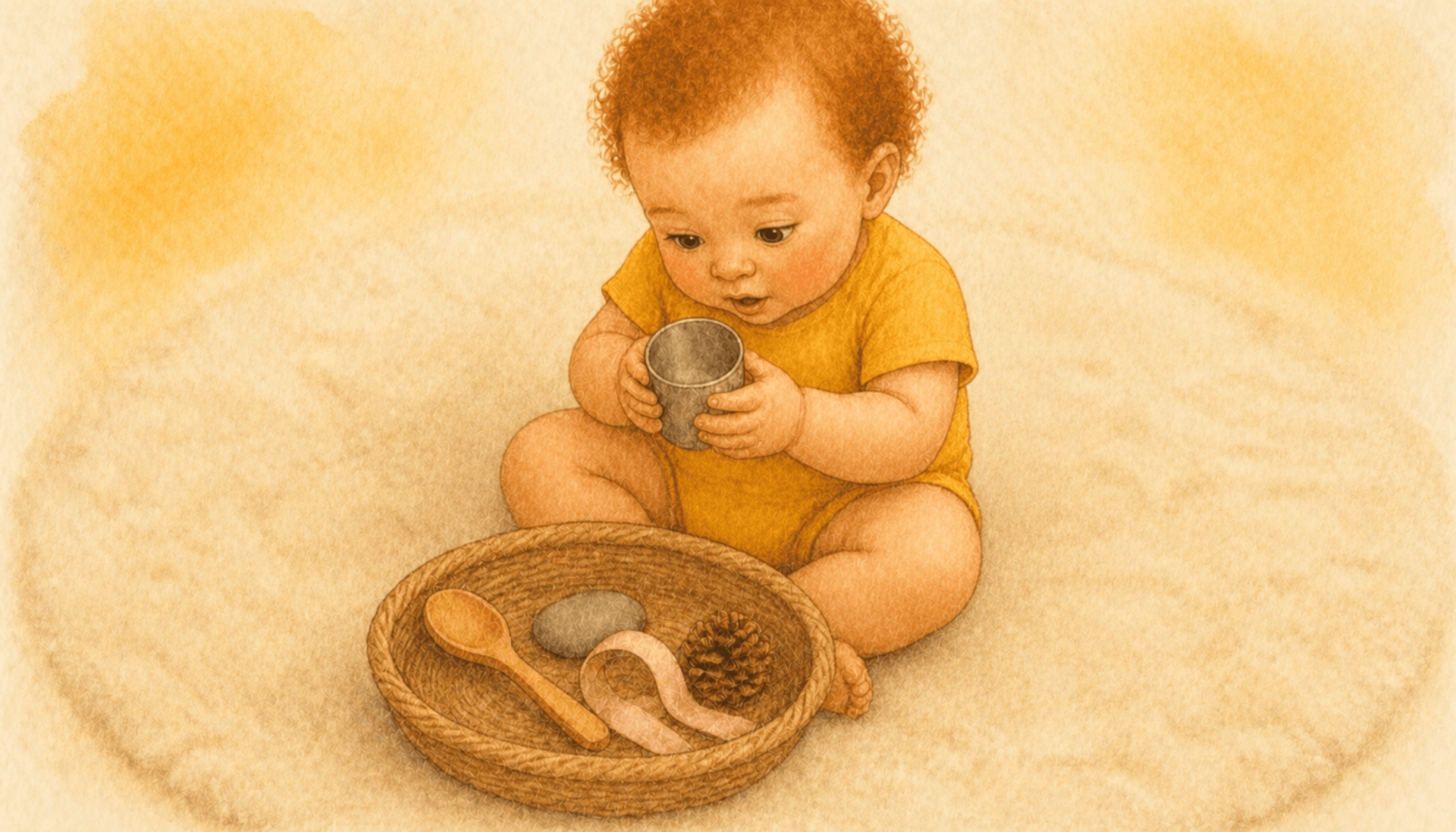
The treasure basket concept from British educator Elinor Goldschmied offers a low-cost framework: a wide, low container filled with natural and household objects of varied textures, weights, sounds, and shapes, offered without demonstration. No plastic toys, no instructions. A wooden spoon, a small metal cup, a smooth river stone, a piece of ribbon, a pine cone, a silicone spatula, all sourced from any kitchen or garden. The idea is that the baby selects what to explore and for how long, which builds the sustained-attention habits that the vocabulary research connects to language outcomes at twelve and fifteen months. Our Sensory Play Cards 0–12 months take a guided version of this approach, with activity prompts organized by sense and age block for parents who want more structure to each session. For a broader overview of how sensory play changes across the entire first year, the sensory play month-by-month guide maps out the progression from birth through twelve months.
Outdoor time at this age delivers something indoor play cannot fully replicate. Grass, gravel, sand, and uneven ground all demand different balance adjustments and send the feet different signals about where the body is in space than flat flooring does — the kind of input that trains the nervous system to handle uneven terrain. Research by Kwon and colleagues, published in BMC Public Health in 2022, found that measured outdoor time correlated with gross motor competency and physical activity levels in early childhood. Even ten or fifteen minutes outside per wake window, held in a parent's arms or exploring a patch of ground, is time that supports development across sensory, motor, and attention domains simultaneously.
Music rounds out this section because its connection to language learning is documented rather than intuitive. A 2023 review in Frontiers in Psychology found that rhythmic and musical processing share overlapping neural resources with language, and nursery rhymes specifically support early phonological awareness because the beat structure slows and segments speech into identifiable chunks. Songs with repeated hand gestures, like "Wheels on the Bus" and "Itsy Bitsy Spider" or anything with a consistent action-to-lyric map, combine rhythm, vocabulary, and the imitation mechanism in a single activity. A consistent daily singing routine costs nothing and builds on itself over months.
Montessori activities for a 1 year old: what the research supports
The phrase "Montessori activities for a 1 year old" shows up consistently in parent searches, and the philosophy behind it is largely consistent with the developmental research covered in this article. The emphasis on child-led exploration, simple uncluttered materials, low open shelves that allow a baby to choose independently, and a "yes space" that permits free movement without constant redirection all align with what the sensory exploration and sustained-attention research supports.
What does not have direct randomized trial evidence is the treasure basket as a standalone intervention, or most of the specific Montessori materials marketed for babies under eighteen months. The Montessori approach has strong theoretical grounding and solid practitioner consensus, and many of its principles are consistent with peer-reviewed developmental findings, but direct RCT data for the specific materials at this age does not currently exist. That is honest context, not a reason to avoid the approach.
The most research-aligned Montessori practice for a twelve-month-old is less about the right material and more about a particular quality of interaction: following your baby's attention rather than directing it, naming what they are already looking at, demonstrating a functional use of an object once and then stepping back without repeating the demonstration. The functional play research, from Belsky and Most's foundational 1981 developmental work through to more recent longitudinal studies, consistently shows that babies arrive at the conventional purpose of familiar objects on their own schedule, in their own sequence, as their cognitive system gets ready. Watching that happen without intervening is one of the harder things this age asks of a parent, and one of the more worthwhile ones.
Frequently Asked Questions
The most effective learning activities for a 1 year old are ones where a parent names a specific object at the moment the baby is already looking at it. Research by Ferguson, Havy, and Waxman (published in Frontiers in Psychology in 2015 by the Northwestern University child development lab) found that twelve-month-olds who had precise word-to-object connections understood and produced more words by eighteen months than those whose connections were still broad. Shared book reading with named illustrations, ball-rolling with narration, simple imitation games, and picture card naming sessions all work within this window. No special equipment is required. The timing and attention focus matter more than any specific toy.
Montessori activities for a 1 year old at home center on child-initiated exploration of varied materials rather than parent-directed play. A simple treasure basket (a wide bowl with ten to twenty natural objects of different textures, weights, and shapes — wooden spoon, small metal cup, smooth stone, piece of fabric, pine cone) offered without instructions is the most practical starting point. Low shelves with a few clearly visible toys that rotate regularly, a cleared floor space for free movement, and real-object experiences like pouring water between cups or placing objects into containers are all consistent with Montessori principles. These approaches also align with the broader developmental research on efficient exploratory play predicting later cognitive outcomes.
Indoor activities that work well for a 1 year old include block stacking, container in-and-out play, shared board book reading with object naming, songs with hand actions (Wheels on the Bus, Itsy Bitsy Spider), mirror games where you take turns making faces, supervised sensory play with household materials like dry pasta, fabric pieces, or kitchen tools without small parts, and simple imitation sequences like clapping, pausing for a response, then clapping back. Each works best when it follows the baby's existing attention rather than redirecting it, since the language research on this age shows that naming what a baby is already focused on is more effective than trying to steer focus to something new.
The American Academy of Pediatrics recommends against wheeled infant walkers. A study by Sims and Smith published in Pediatrics in 2018 documented over 230,000 U.S. walker-related emergency department visits in children under fifteen months across a 24-year period, with over 90% of injuries involving the head or neck, and nearly 75% from stair falls. Beyond injury risk, infant walkers delay independent walking by removing the balance challenges that actually teach the skill. Push toys (where the baby walks behind a handle-equipped toy) are the developmentally appropriate alternative and carry none of these risks.
The CDC's 2022 milestone checklist for twelve months focuses on: pulling to stand and cruising along furniture, using a fingertip pincer grasp to pick up small objects, waving bye-bye, understanding "no," calling a parent "mama" or "dada," and playing pat-a-cake. Independent walking and spoken words are not listed; both were moved to fifteen months in the 2022 revision by Zubler and colleagues, because that is when most children reach those benchmarks. If your baby has stopped doing something they used to do, or if babbling, eye contact, or responding to their name are absent, those patterns are worth raising at the next well-child visit, as patterns worth sharing with your pediatrician rather than emergencies.
This article is for educational and informational purposes only and is not a substitute for professional medical advice, diagnosis, or treatment. Always consult your pediatrician or a qualified healthcare provider with any questions about your child's development or health.
- Belsky, J., & Most, R. K. (1981). From exploration to play: A cross-sectional study of infant free play behavior. Developmental Psychology, 17(5), 630–639.
- CDC. (2022). Developmental milestones: By 1 year. Centers for Disease Control and Prevention
- Ferguson, B., Havy, M., & Waxman, S. R. (2015). The precision of 12-month-old infants' link between language and categorization predicts vocabulary size at 12 and 18 months. Frontiers in Psychology, 6, 1319.
- Ferjan Ramírez, N., Lytle, S. R., & Kuhl, P. K. (2020). Parent coaching increases conversational turns and advances infant language development. Proceedings of the National Academy of Sciences, 117(7), 3484–3491.
- Klein, P. J., & Meltzoff, A. N. (1999). Long-term memory, forgetting, and deferred imitation in 12-month-old infants. Developmental Science, 2(1), 102–113.
- Kwon, S., Tandon, P. S., O'Neill, M. E., & Becker, A. B. (2022). Associations of outdoor time with physical activity and gross motor competency in U.S. preschoolers. BMC Public Health, 22, 693.
- Liszkowski, U., Carpenter, M., Striano, T., & Tomasello, M. (2006). Twelve- and eighteen-month-olds point to provide information for others. Journal of Cognition and Development, 7(2), 173–187.
- Marcinowski, E. C., Nelson, E., Campbell, J. M., & Michel, G. F. (2019). The development of object construction from infancy through toddlerhood. Infancy, 24(3), 368–391.
- Rosslund, A., Kartushina, N., & Mayor, J. (2024). Associations between shared book reading, daily screen time and infants' vocabulary size. Journal of Child Language, 52, 971–983.
- Schulz, L. E., Gopnik, A., & Bonawitz, E. B. (2018). The efficiency of infants' exploratory play is related to longer-term cognitive development. Frontiers in Psychology, 9, 635.
- Sims, A., Chounthirath, T., Yang, J., Hodges, N. L., & Smith, G. A. (2018). Infant walker–related injuries in the United States. Pediatrics, 142(4), e20174332.
- Tamis-LeMonda, C. S., Kuchirko, Y., & Song, L. (2014). Why is infant language learning facilitated by parental responsiveness? Current Directions in Psychological Science, 23(2), 121–126.
- Yu, C., Suanda, S. H., & Smith, L. B. (2019). Infant sustained attention but not joint attention to objects at 9 months predicts vocabulary at 12 and 15 months. Developmental Science, 22(1), e12735.
- Zubler, J. M., Wiggins, L. D., Macias, M. M., Whitaker, T. M., Shaw, J. S., Squires, J. K., Pajek, J. A., Wolf, R. B., Slaughter, K. S., Broughton, A. S., Gerndt, K. L., Mlodoch, B. J., & Lipkin, P. H. (2022). Evidence-informed milestones for developmental surveillance tools. Pediatrics, 149(3), e2021052138.
More Articles
Parallel Play in Toddlers: Why Side-by-Side Is the Social Work
Your toddler spent the entire playdate building separate towers, and nobody shared a single block. That counted — more than it looked. A 2025 longitudinal study found that playing beside a specific child consistently predicted later social play with that same child, but not the other way around. Here's what parallel play in toddlers actually is, why the science calls it strategic rather than passive, and what it means for how you run a playdate.
When Do Babies Point: Why It Matters for Language
Most milestone articles treat pointing as a box to check around 12 months. The research tells a different story — one that starts months earlier, runs through the infant brain, and traces back to how much the parent is pointing. Here's what the last fifteen years of research actually found, and what it means for everyday interactions.
When Do Babies Wave Bye-Bye: Why Your Baby Needs You to Wave First
Most baby milestones unfold on a biological schedule — waving isn't one of them. A 2023 study found that babies develop imitation ability because their caregivers imitate them first, and waving is named directly as a cultural gesture learned through that loop. Here's what the research says about the 9–12 month window, why the first wave looks nothing like a wave, and what helps it arrive.