Screen Time for Babies: What the Research Really Says
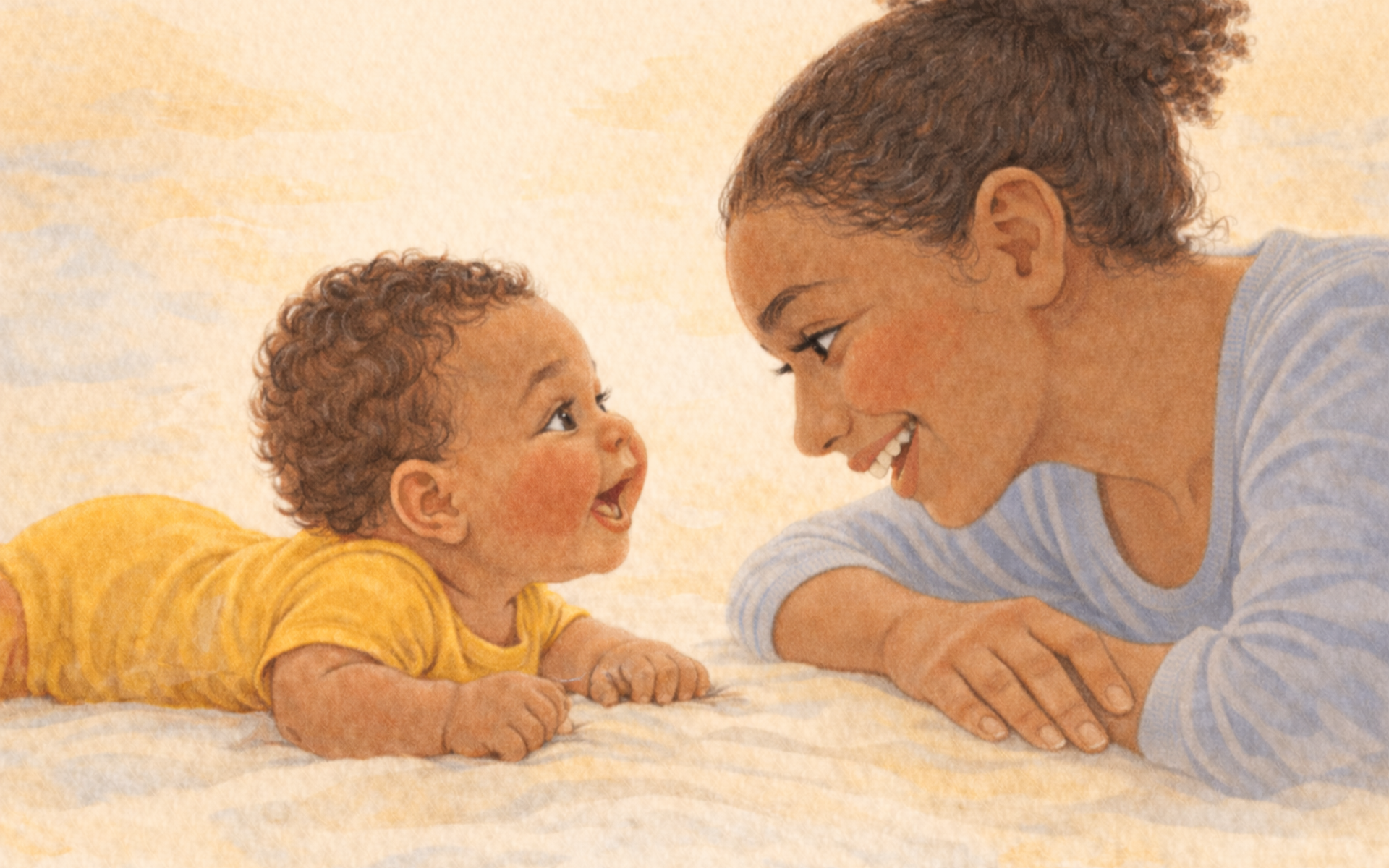
Of all the questions new parents Google in the first year, screen time might be the one that generates the most guilt. You handed your baby a phone for three minutes while you went to the bathroom. The TV was on in the background during dinner. Your toddler watched ten minutes of a cartoon while you made a phone call. And now you're wondering whether you've just derailed an entire developmental trajectory.
You haven't. But the research behind screen time and babies is more nuanced — and more interesting — than most headlines suggest. So instead of one more article that either shames you or tells you screens are fine, let's walk through what the science actually says, what the updated AAP guidelines recommend, and what all of this means for your family in practice.
- What the AAP's 2026 update actually changed — and what stayed the same for babies under 18 months
- The video deficit effect: why babies learn less from screens than from identical live interactions
- What background TV does to attention and play quality — even when a baby isn't watching
- The displacement problem: why the issue isn't toxicity, it's what screen time replaces
- When video works differently — the specific conditions that shift passive viewing toward a shared learning experience
If the one-sentence answer is enough, you’ve got the gist. If you want the mechanism behind each piece, keep reading.
What the AAP Actually Recommends (2026 Update)
In January 2026, the American Academy of Pediatrics released its most significant update to screen time guidance in a decade. The biggest shift: moving away from strict time limits and toward a framework built around quality, context, and conversation.
For babies under 18 months, the core recommendation hasn't changed: avoid screen media entirely, with one exception — video calls with family members. FaceTime with grandma counts as social interaction, not passive screen time, because the person on the other end is actually responding to the baby in real time.
For toddlers between 18 and 24 months, the AAP says parents can introduce small amounts of high-quality programming — but only while co-viewing and talking about what's on screen. The emphasis is on making it interactive, not passive.
For children 2 to 5, the previous one-hour-per-day limit is now framed more flexibly, with the focus shifting to content quality, how the child interacts with it, and whether it displaces sleep, physical activity, or face-to-face play.
The reason behind the under-18-month guideline hasn't changed either, and it comes down to how the baby brain actually processes information from a screen versus the real world.
The Video Deficit Effect: Why Babies Learn Differently from Screens
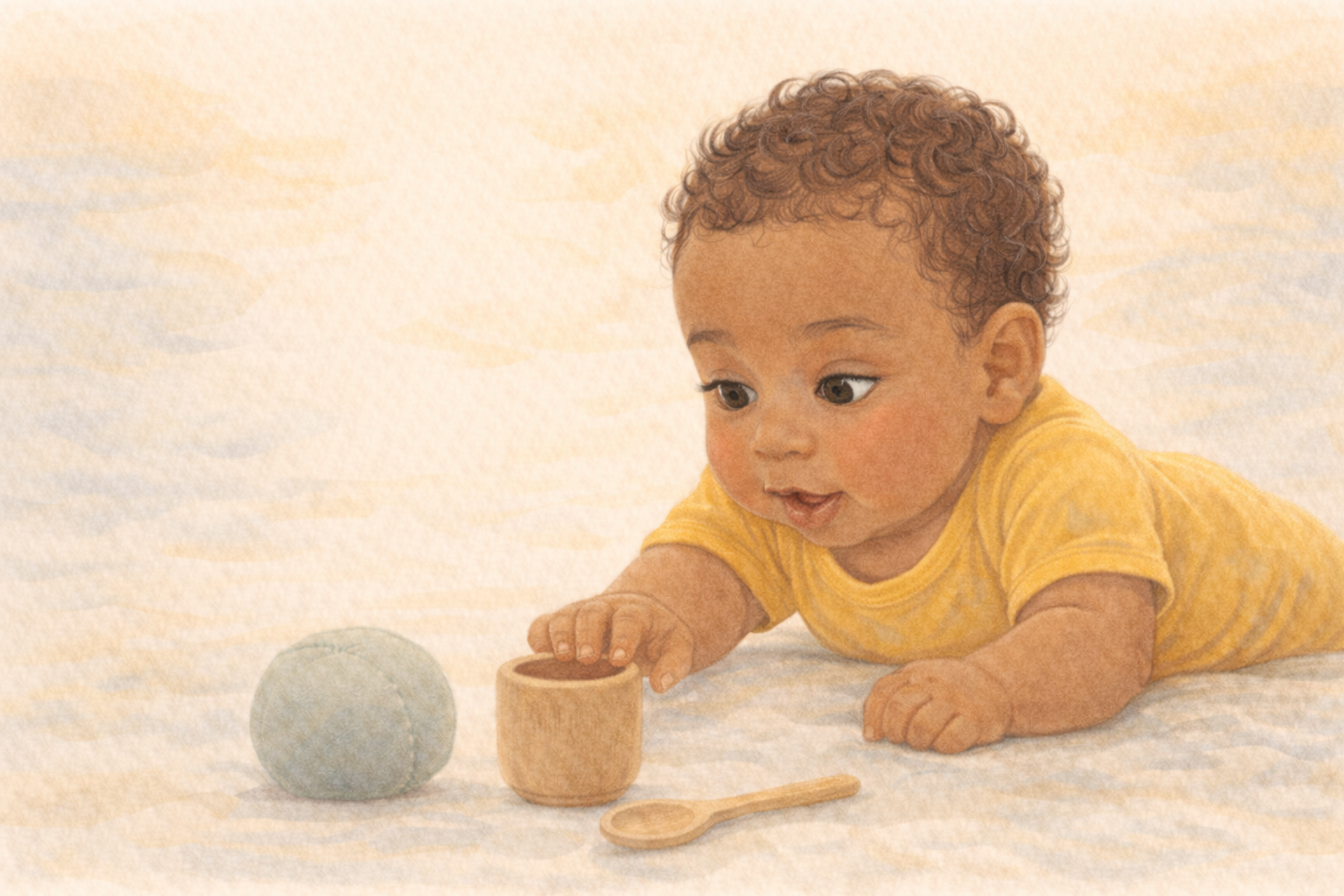
One of the most replicated findings in developmental psychology is something called the video deficit effect. In simple terms: babies and toddlers consistently learn less from watching something on a screen than from experiencing the same thing in real life.
In one well-known experimental setup, researchers showed 12-month-olds how to perform a simple action — like pressing a button to make a toy pop up. One group watched a live person demonstrate it. The other group watched the same demonstration on video. The babies who saw the live demonstration could reproduce the action afterward. The babies who watched the video needed twice as many demonstrations to do the same thing.
This effect holds across a wide range of tasks and ages. Between 12 and 30 months, babies consistently show reduced ability to transfer what they see on a screen to the real world. The brain treats a screen as a separate category of experience — something closer to imagination than reality — and doesn't automatically apply the information to physical objects or real situations.
Why? Researchers point to several factors. A screen is flat, two-dimensional, and doesn't respond to the baby's actions. There are no social cues — no eye contact, no pausing when the baby looks away, no adjusting based on the baby's reactions. And the sensory input is limited to just two channels (sight and sound), while real-world learning engages all of them — touch, movement, smell, spatial awareness, proprioception — simultaneously.
This is also why video calls with family are the one exception. A person on FaceTime responds to the baby in real time, adjusts their behavior based on the baby's reactions, and creates the back-and-forth interaction (serve and return) that the brain needs to build connections.
What Background Screens Do to Attention
Even when a baby isn't watching the screen, having it on in the background matters. Research shows that background television disrupts a baby's play patterns — reducing the duration and quality of focused play, even when the baby isn't looking at the TV. The constant shifts in sound and light pull attention away from whatever the baby is doing, fragmenting the natural concentration that floor play and object exploration require.
One study found that children in homes with heavy background TV had shorter play episodes and less sophisticated toy interactions than children in quieter environments. The mechanism is straightforward: the developing attention system is still learning how to filter irrelevant input, and a TV provides a steady stream of novel sounds and images that compete with everything else.
This doesn't mean you need to live in silence. Normal household sounds — cooking, conversation, music — don't have the same effect because they're predictable and part of the environment the brain is already learning to navigate. The problem is specifically with screen media designed to grab and hold attention, which competes with the kinds of sustained, self-directed exploration that build executive function.
The Displacement Problem
The strongest argument against screen time for babies isn't that screens are toxic — it's that screens take time away from the things that actually drive development. Every minute spent passively watching a screen is a minute not spent in face-to-face interaction, hands-on play, movement, or the kind of back-and-forth conversation that builds language.
Research on language development is particularly clear on this point. The quantity and quality of adult speech a baby hears in the first year is one of the strongest predictors of language outcomes later. But this only works when the speech is live and responsive — directed at the baby, responsive to the baby's cues, and embedded in shared attention. Speech from a screen, even from an "educational" program, doesn't produce the same effect in babies under 18 months because the serve-and-return loop is missing.
This is the core of why the AAP recommends no screens before 18 months. It's not that a few minutes of video will cause permanent harm — it's that those minutes could have been spent doing something the brain can actually use at that stage of development.
The Problem with "Brain-Building" Marketing
This is where a lot of parents feel confused, because the marketing is very convincing. Apps and video programs marketed to babies often promise to "boost brain development" or "teach your baby to read." But the research draws a clear line between these marketing claims and what actually happens in a baby's brain during passive screen viewing.
The problem is specifically with passive, unsupervised viewing. A baby watching a vocabulary-building video alone in a bouncer isn't absorbing words the way the product description suggests. The same baby hearing those same words from a real person — in context, with eye contact and back-and-forth interaction — learns them quickly and retains them.
What changes the equation is the adult in the room. When a parent watches alongside a baby and talks about what's on screen, points at things, asks questions, and connects the content to real life, the experience shifts from passive consumption toward something much closer to shared reading. The older the child, the more independently the brain can extract meaning from video, but the parent's voice and presence make a measurable difference from infancy through the preschool years.
So the real question to ask about any baby video product is: does this work because a parent is involved, or does it promise to work while the parent walks away? If it's the second one, be skeptical. The magic ingredient is always you.
When Video Works Differently
This is where the conversation gets more nuanced than most articles allow, and it's worth slowing down for — because the difference between harmful screen time and potentially beneficial screen time comes down to three things: what the content looks like, how long it lasts, and whether an adult is part of the experience.
Research consistently shows that the kind of video content that causes problems has a specific profile: fast-paced, overstimulating, algorithmically designed to keep a child watching as long as possible, and consumed passively without adult interaction. Think autoplay YouTube compilations with rapid scene changes, bright flashing visuals, and no narrative structure. This kind of content fragments attention and trains the brain to expect constant novelty rather than sustained focus.
But there's a different category of video that the research treats very differently: short, slow-paced, intentionally designed content — watched together with a parent who talks about what's on screen, points at things, asks questions, and connects the content to the real world. The AAP's 2026 update specifically acknowledges this distinction. Quality, context, and conversation are the new framework — not a blanket ban on anything with a screen.
What does "quality" look like in practice for the youngest viewers? Content that moves slowly enough for a baby's brain to process, has clear and simple visuals rather than chaotic scene changes, includes pauses that leave room for a parent to comment, and tells a story or explores a concept rather than just delivering stimulation. A three-minute video with gentle pacing, familiar characters, and a clear narrative arc is a fundamentally different experience from thirty minutes of algorithmic content designed to maximize watch time.
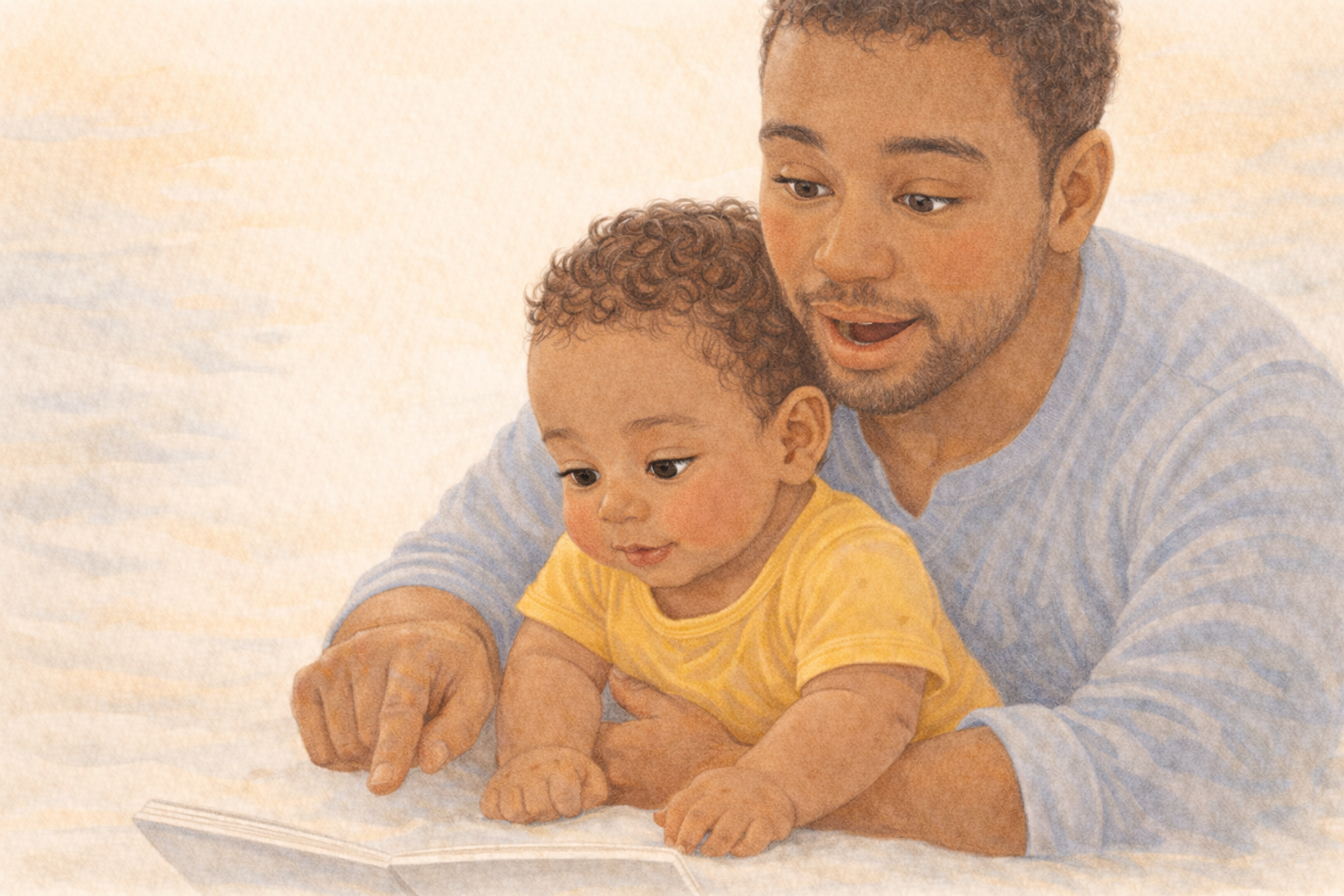
The key ingredient is always the adult in the room. When you watch a short video with your baby and narrate what's happening — "look, the octopus is swimming! Can you see the bubbles?" — you're turning a passive experience into an interactive one. You're providing the serve-and-return loop that the brain needs. The screen becomes a conversation starter, not a replacement for conversation.
This doesn't mean you should start scheduling daily video sessions for your 10-month-old. But it does mean that if you choose a short, well-made, educational video and watch it together — pointing, naming, pausing, discussing — the experience has more in common with reading a picture book together than with parking a baby in front of a TV.
Think of it this way: a good board book doesn't teach a baby anything by itself. It's a tool that works because you sit together, point at a dog on the page, and say "look, a dog! Can you see the dog? Woof woof!" The same principle applies to intentionally designed video content — short, slow-paced, with clear images and familiar characters. When you narrate what's on screen the way you'd narrate a picture book, the video becomes a moving illustration that you're bringing to life with your voice. The screen provides the visually engaging content, and you provide the language, the context, and the connection that make it meaningful. Without your voice, it's just moving colors. With your voice, it's a shared learning experience.
A Balanced Perspective (Without the Guilt)
Here's the part that most screen time articles skip: none of this research suggests that a few minutes of screen exposure will harm your baby. The studies that show negative outcomes are about heavy, prolonged, unsupervised screen use — hours per day, replacing interactive play, without adult involvement.
If your baby sees a phone screen while you check a text, or catches a few minutes of a show while you take a shower, or watches a video call with a relative — the developmental consequences of those moments are effectively zero. The research is about patterns, not incidents.
What matters is the overall balance of a baby's day. If the day includes plenty of face-to-face interaction, floor time, movement, and conversation — the things that build language, attention, and sensory-motor skills — then the occasional screen exposure isn't going to undo any of it.
The goal isn't perfection. The goal is making sure that the bulk of a baby's waking hours are filled with the kinds of experiences the brain is built to learn from: real people, real objects, real sounds, and real interactions. Everything we create at NonstopMinds is designed around exactly this principle — our sensory play guide covers what kind of input matters at each age, and our Sensory Play Cards give you 60 screen-free activities, organized by sense and developmental stage, that take five minutes and no prep.
And if you've read this far wondering whether you're doing enough — we wrote an article about that too. The short answer: you almost certainly are.
Frequently Asked Questions
The AAP and WHO recommend no screen time for babies under 18 months, with the exception of live video calls with family members. Research shows that babies under 1 learn significantly less from screens than from live interaction, a phenomenon researchers call the "video deficit effect."
Yes. Studies show that background television reduces the quality and quantity of parent-child interaction, even when the baby is not watching. It disrupts attention patterns and decreases the amount of language babies hear during wake time.
This article is for educational purposes only and is not a substitute for professional medical advice. Always consult your pediatrician before starting any new activity with your baby, and never leave your baby unattended during tummy time.
- American Academy of Pediatrics. (2026). "Digital Ecosystems, Children, and Adolescents." Technical Report and Policy Statement. Pediatrics.
- Anderson, D. R., & Pempek, T. A. (2005). "Television and Very Young Children." American Behavioral Scientist, 48(5), 505–522.
- Barr, R. (2013). "Memory Constraints on Infant Learning from Picture Books, Television, and Touchscreens." Child Development Perspectives, 7(4), 205–210.
- Barr, R., Muentener, P., & Garcia, A. (2007). "Age-Related Changes in Deferred Imitation from Television by 6- to 18-Month-Olds." Developmental Science, 10(6), 910–921.
- Christakis, D. A., Gilkerson, J., Richards, J. A., et al. (2009). "Audible Television and Decreased Adult Words, Infant Vocalizations, and Conversational Turns." Archives of Pediatrics & Adolescent Medicine, 163(6), 554–558.
- Yogman, M., Garner, A., Hutchinson, J., Hirsh-Pasek, K., & Golinkoff, R. M. (2018). "The Power of Play: A Pediatric Role in Enhancing Development in Young Children." Pediatrics, 142(3), e20182058.
More Articles

Parallel Play in Toddlers: Why Side-by-Side Is the Social Work
Your toddler spent the entire playdate building separate towers, and nobody shared a single block. That counted — more than it looked. A 2025 longitudinal study found that playing beside a specific child consistently predicted later social play with that same child, but not the other way around. Here's what parallel play in toddlers actually is, why the science calls it strategic rather than passive, and what it means for how you run a playdate.

When Do Babies Point: Why It Matters for Language
Most milestone articles treat pointing as a box to check around 12 months. The research tells a different story — one that starts months earlier, runs through the infant brain, and traces back to how much the parent is pointing. Here's what the last fifteen years of research actually found, and what it means for everyday interactions.

When Do Babies Wave Bye-Bye: Why Your Baby Needs You to Wave First
Most baby milestones unfold on a biological schedule — waving isn't one of them. A 2023 study found that babies develop imitation ability because their caregivers imitate them first, and waving is named directly as a cultural gesture learned through that loop. Here's what the research says about the 9–12 month window, why the first wave looks nothing like a wave, and what helps it arrive.