Screen-Free Activities for Babies: What to Do Instead
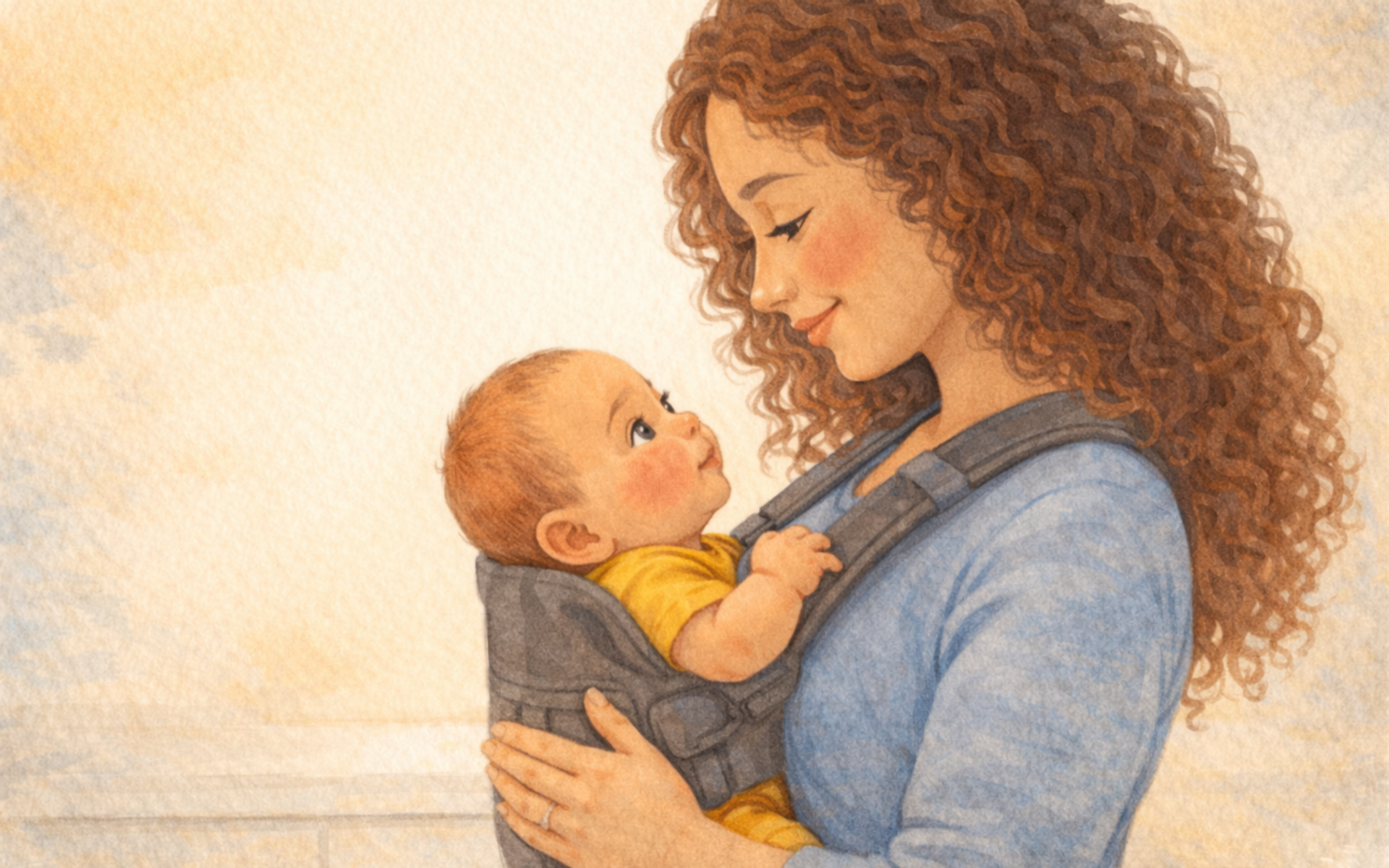
Picture this: you're standing in the kitchen with one hand on a pot handle and the other holding a baby who has decided that being put down is no longer an option. The phone is right there on the counter. You know the AAP says no screens before 18 months. You also know that everyone in this house needs to eat.
Actually — why picture it. This is just Tuesday.
We're not here to judge that moment. Not even a little. We're here to offer a helping hand — or, more accurately, a helping article. Because the alternatives to reaching for that phone often work better than you'd expect, and most of them require exactly zero preparation.
- When you need both hands free: why a carrier beats a screen — and the 1986 study on carrying and crying
- When nothing soothes: how to reset an overstimulated baby without adding more input
- When you need five minutes alone: why brief independent play is developmental, not a compromise
- When you're out of the house: how waiting rooms and car rides become screen-free sensory environments
- When you just want to rest: the treasure basket approach and why one object beats ten
If the one-sentence answer is enough, you’ve got the gist. If you want the mechanism behind each piece, keep reading.
When You Need Your Hands Free
This is the big one. Not the philosophical screen time debate — the daily, practical, I need both hands and my baby disagrees problem.
A baby carrier changes everything here. A simple wrap or structured carrier lets you fold laundry, unload a dishwasher, or tidy up with your baby close to you — and the research actually supports it. For kitchen tasks near heat, a back carry (once your baby has strong head control, typically after 6 months) keeps little hands safely away from hot surfaces. Carrying provides continuous vestibular input (the sense of movement and balance), skin contact that regulates the stress response, and a front-row seat to whatever you're doing, which means your narration of the task becomes a language activity. Hunziker and Barr's classic 1986 study found that babies who were carried more cried significantly less — not just during carrying, but overall throughout the day.
If a carrier isn't an option, a bouncer seat or a play mat on the kitchen floor with one interesting object — a smooth, well-sanded wooden spoon, a crinkly cloth, a silicone whisk — gives most babies a few minutes of independent exploration. The key is one object, not five. Research on infant attention shows that fewer choices lead to longer, deeper engagement. A baby with one novel object will study it longer than a baby surrounded by ten.
When Your Baby Is Fussy and Nothing Works
I've tried everything. Rocking, feeding, singing, walking around the house. Nothing is working. The screen would at least stop the crying.
Before reaching for the phone, try a hard reset on the sensory environment. Fussiness in babies is often overstimulation, not boredom — and a screen adds more stimulation, not less.
Step into a different room. Dim the lights if you can. Hold your baby close, chest to chest, and hum something low and steady — not a lullaby performance, just a vibration your baby can feel through your body. The combination of reduced visual input, rhythmic sound conducted through bone, and the pressure of being held against you targets three sensory systems at once in the direction of calm.
If the fussiness is undertimulation — the glazed, restless, I'm bored but I don't know what bored means yet kind — try a change of position and location instead. Walk to a window. Hold your baby facing out so the visual field changes completely. Sometimes the brain just needs a new scene. A shift in what the eyes see, what the skin feels, and what the ears hear can reset a baby's attention more effectively than adding more stimulation to the same room.
When You Need Five Minutes to Yourself
Shower. Bathroom. A phone call where you need to form complete sentences. The moments where you genuinely need your baby to be safe and occupied without you for a few minutes.
This is where safe containment plus one high-interest object works. A crib, a playpen, or a baby-proofed area of the floor — with something worth investigating. At 0 to 3 months, a high-contrast black-and-white card taped to the crib rail at eye level gives the visual system exactly what it can process. At 3 to 6 months, a color contrast card or a crinkle book matches the brain's new ability to see bold color. At 6 to 12 months, a silicone container with a wooden block inside that makes a satisfying sound when shaken, or a board book with textured pages.
The AAP's 2018 clinical report on play specifically notes that unstructured, independent play — even brief periods — supports the development of executive function, creativity, and self-regulation. Your baby doesn't need you to facilitate every single moment. A few minutes of solo exploration in a safe space is genuinely developmental, not a compromise.
Go take that shower. A few minutes of solo exploration in a safe, supervised-nearby space isn't a parenting shortcut — it's a parenting skill. And your baby's crinkle book isn't going anywhere.
When You're Out of the House
Waiting rooms. Restaurants. The back seat of a car on a long drive. These are the moments when a phone feels like the only portable entertainment that exists.
But your baby is portable entertainment's biggest fan — if the environment cooperates. A waiting room is a sensory playground your baby has never seen before: new faces, fluorescent lights, the sound of a door opening and closing. Narrate it. Point at things. Let your baby watch people — face-watching is one of the most engaging activities for a baby under 12 months, and waiting rooms are full of novel faces.
For car rides, a small board book attached to the car seat with a pacifier clip, a teething ring, or a soft contrast card does more than a screen in this age range, because your baby can touch, mouth, and manipulate it — engaging three senses instead of two. Pediatric occupational therapists often recommend keeping a small "go bag" of two or three sensory objects that rotate weekly so they stay interesting.
When You Just Want to Sit Down
This one doesn't get talked about enough. You're not cooking. You're not in a waiting room. You're on the couch, your baby is on your lap, and you want to scroll your own phone for ten minutes because you're a human being who hasn't had an uninterrupted thought since 6 AM.
That's not a screen time problem. That's a rest problem. And the solution isn't to feel guilty about handing your baby a phone — it's to set your baby up with something independently interesting so you can sit there and do nothing for a few minutes without the guilt.
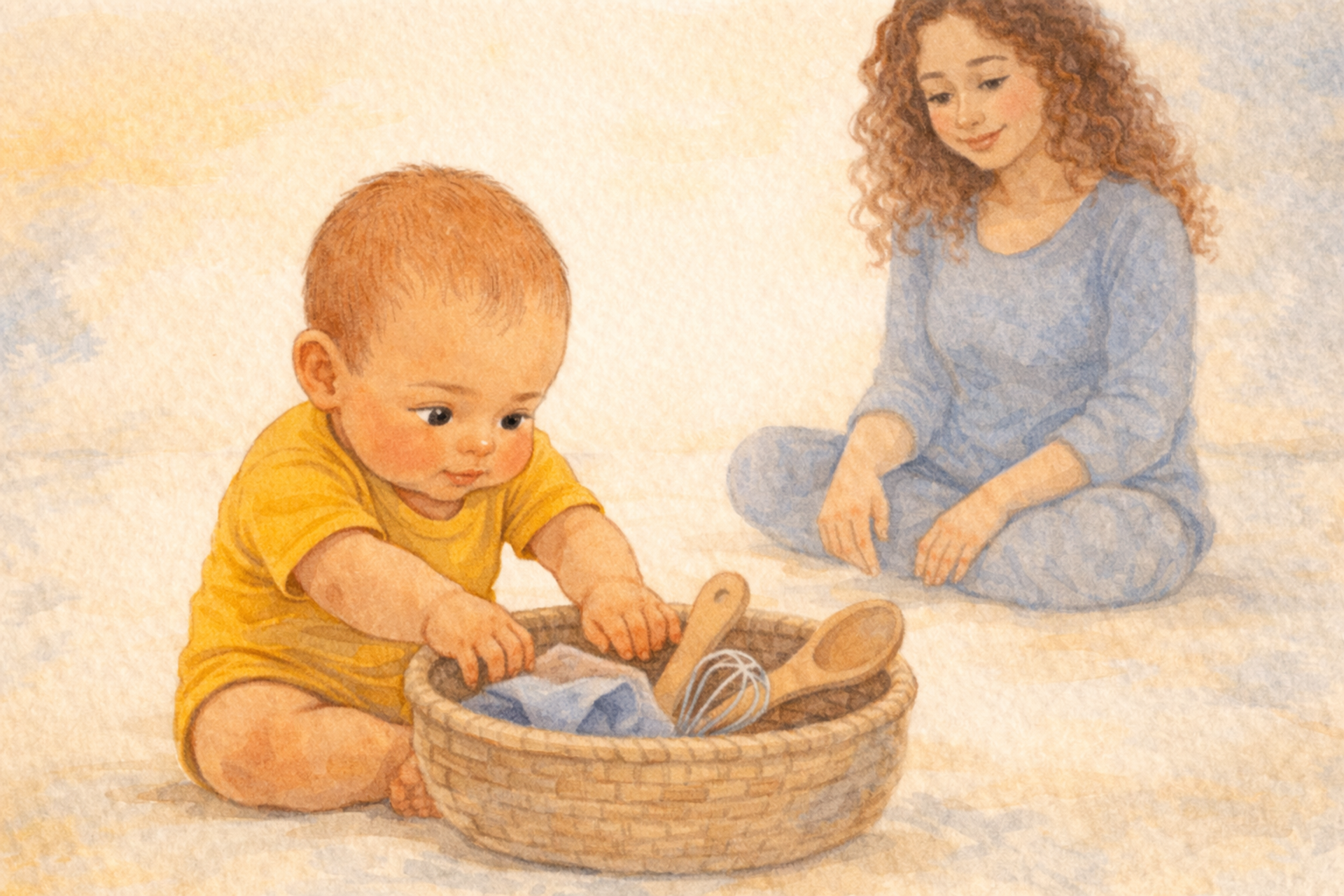
A treasure basket works beautifully here. Five or six safe household objects in a low container — a smooth wooden spoon, a small metal whisk, a large piece of fabric (big enough that it can't be swallowed or cover the face), a silicone spatula, a sealed water bottle half-filled so it sloshes. Elinor Goldschmied, who developed the treasure basket concept in the 1980s, found that babies as young as six months would explore a basket of varied objects with deep concentration for 20 to 30 minutes — far longer than most toys held their attention. The variety of textures, weights, temperatures, and sounds provides exactly the kind of open-ended sensory input the brain craves at this stage.
Put the basket on the floor. Put your baby next to it. Sit nearby. Breathe.
The Real Alternative to Screens
None of this requires a Pinterest-worthy setup or a trip to a toy store. The running theme through every situation above is the same: one or two simple objects, a change in environment or position, and — when you're available — your voice narrating whatever is happening.
The research keeps arriving at the same conclusion: what drives development in the first year isn't specialized content delivered through a screen. It's real objects, real people, and real sensory experiences — messy, ordinary, and unremarkable. The AAP's 2018 report on play puts it plainly: play is the primary way young children learn, and the most effective play is the simplest.
If you want the science behind why screens work differently in a baby's brain — what the video deficit effect actually is, and when shared screen time starts to become meaningful — we covered that in detail: Screen Time for Babies: What the Research Really Says.
These were just five situations and a handful of ideas for each. Our Sensory Play Cards 0–12 Months have 60 more — organized by sense, age, and developmental stage, each designed to take five minutes or less. Because life with a little nonstop mind is easier when you always have something to reach for that isn't a screen.
Frequently Asked Questions
Talk during diaper changes, sing during feeding, do tummy time with a mirror, read board books, take a walk outside, explore textures with safe household objects, and play peekaboo. Everyday routines are full of screen-free developmental opportunities.
The AAP and WHO recommend zero screen time for children under 18 months, except for video calls with family. For children 18–24 months, only high-quality programming with a parent watching together is recommended.
For educational and entertainment purposes only. Not a substitute for professional medical advice. Always supervise your baby during play and sensory activities.
- Hunziker, U. A., & Barr, R. G. (1986). Increased carrying reduces infant crying: A randomized controlled trial. Pediatrics, 77(5), 641–648.
- Goldschmied, E., & Jackson, S. (2004). People Under Three: Young Children in Day Care (2nd ed.). Routledge.
- Yogman, M., Garner, A., Hutchinson, J., Hirsh-Pasek, K., & Golinkoff, R. M. (2018). The Power of Play: A Pediatric Role in Enhancing Development in Young Children. Pediatrics, 142(3), e20182058.
- Radesky, J. S., & Christakis, D. A. (2016). Increased Screen Time: Implications for Early Childhood Development and Behavior. Pediatric Clinics of North America, 63(5), 827–839.
- American Academy of Pediatrics. (2022). Back to sleep, tummy to play. HealthyChildren.org.
Related Products
More Articles
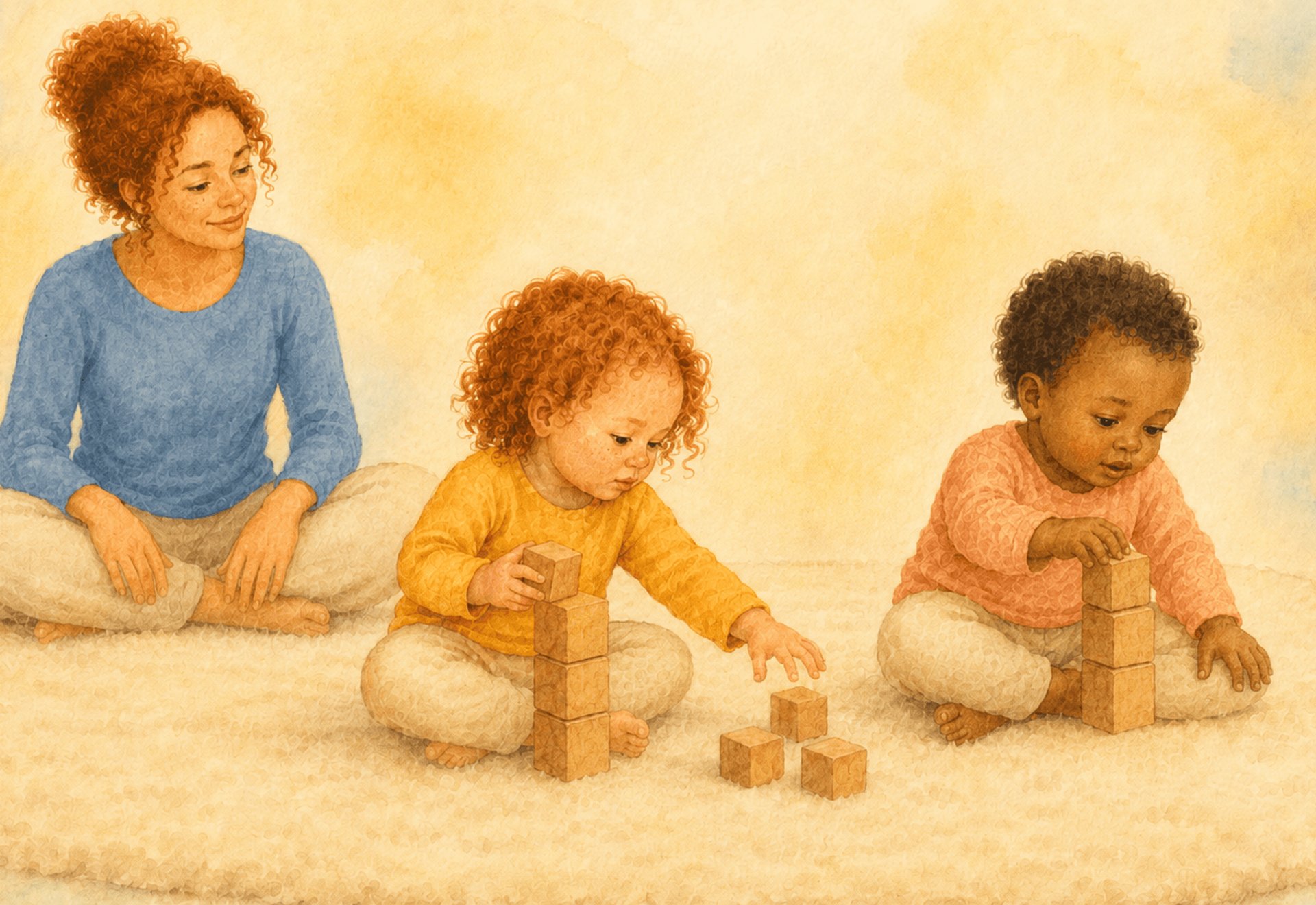
Parallel Play in Toddlers: Why Side-by-Side Is the Social Work
Your toddler spent the entire playdate building separate towers, and nobody shared a single block. That counted — more than it looked. A 2025 longitudinal study found that playing beside a specific child consistently predicted later social play with that same child, but not the other way around. Here's what parallel play in toddlers actually is, why the science calls it strategic rather than passive, and what it means for how you run a playdate.

When Do Babies Point: Why It Matters for Language
Most milestone articles treat pointing as a box to check around 12 months. The research tells a different story — one that starts months earlier, runs through the infant brain, and traces back to how much the parent is pointing. Here's what the last fifteen years of research actually found, and what it means for everyday interactions.

When Do Babies Wave Bye-Bye: Why Your Baby Needs You to Wave First
Most baby milestones unfold on a biological schedule — waving isn't one of them. A 2023 study found that babies develop imitation ability because their caregivers imitate them first, and waving is named directly as a cultural gesture learned through that loop. Here's what the research says about the 9–12 month window, why the first wave looks nothing like a wave, and what helps it arrive.