When to Start Reading to Your Baby: The Answer Might Surprise You
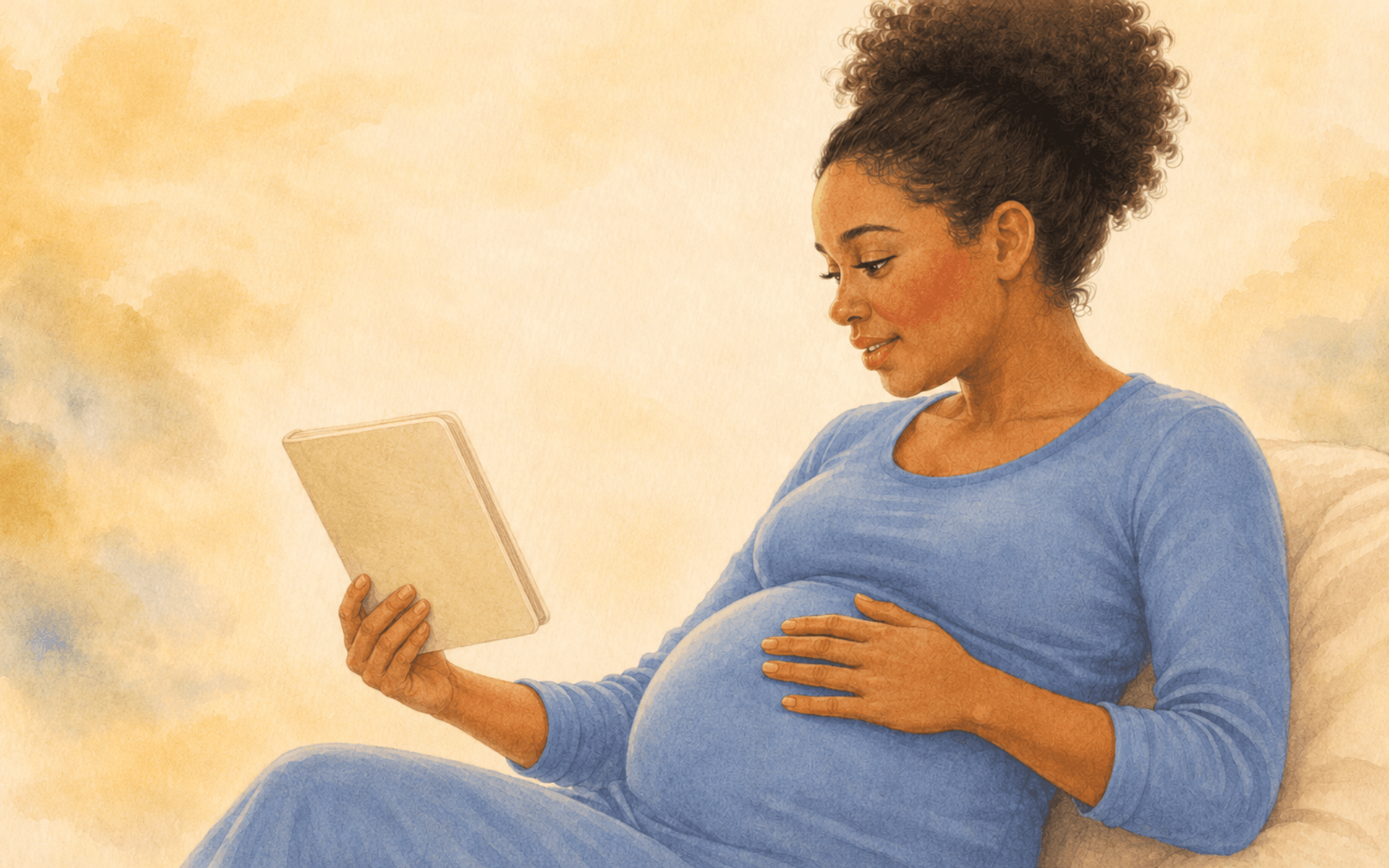
The board books had been sitting in the nursery closet since month six — lined up by spine color, waiting for someone small enough to need them. She figured she'd crack one open after the baby arrived. What she didn't know was that the window she was thinking about had already been open for three weeks.
- When the fetal auditory system comes online — and why that timing changes the "when to start" answer entirely
- The 1986 experiment that turned prenatal neuroscience on its head, and what it still means for your third trimester
- What a newborn who "can't understand anything" is absorbing while you read
- A 2022 brain study that reframes what reading builds in the first year — it's not what most people think
- Why the dad who reads the same book three nights in a row is doing something that shows up in research
- What reading looks like stage by stage, from bump to first birthday
If the one-sentence answer is enough, you’ve got the gist. If you want the mechanism behind each piece, keep reading.
Your baby starts listening weeks before the due date
The first thing to understand is that "when to start reading to baby" is a different question than most guides answer. They treat it as a question about birth. The research treats it as a question about weeks.
By around 20 weeks of gestation, the fetal auditory system is functional enough to detect sound from outside the womb, according to research from MIT on prenatal auditory development published in Developmental Science in 2022. The input at that stage is limited (amniotic fluid and maternal tissue filter out higher-frequency sounds, leaving mostly rhythm, melody, and the low-frequency contours of speech), but the brain is already organizing around what it hears. By 25 to 28 weeks, the auditory system becomes substantially more responsive: the hair cells of the cochlea, the auditory nerve fibers, and the auditory cortex are all in a critical developmental window that researchers describe as the most active period for the neurosensory pathway, extending from week 25 through roughly the first five to six months after birth.
The practical takeaway is more straightforward than headphones-on-belly: by the time you're visibly pregnant and fielding questions at the grocery store, your baby has already been listening for weeks. The voice you've been using to narrate your day (talking on the phone, reading your own books, singing along in the car) has been reaching your baby and shaping what becomes familiar. Reading aloud simply makes that exposure intentional.
A note on prenatal brain development: the auditory system is one of several circuits developing rapidly in the third trimester. Language, emotional processing, and sensory integration are all in a parallel sprint toward birth, which is why the quality of sound input during this window tends to matter more than quantity alone.
The 1986 experiment that still defines the field
In the last six weeks of their pregnancies, a group of women agreed to read the same passage aloud, every day, to their unborn babies. The passage was The Cat in the Hat by Dr. Seuss, chosen specifically for its strong rhythmic structure and distinctive cadence. A few days after birth, each newborn was given a pacifier wired to measure sucking rate as a preference signal: faster for one audio track, slower for another. The newborns preferred The Cat in the Hat over a novel passage they had never heard before.
Researchers DeCasper and Spence, publishing in Infant Behavior and Development in 1986, concluded that third-trimester fetuses don't just detect speech; they encode specific patterns well enough to recognize them after birth. A matched control group whose mothers had not read the passage prenatally showed no such preference. The prenatal exposure was the variable that made the difference.
What this study established, and what later research has consistently confirmed, is that the fetus is an active listener building a map of which sounds and voices belong to its world, and it starts that map before you've finished assembling the crib. Research also published in Infant Behavior and Development by Moon, Cooper, and Fifer found that two-day-old newborns already prefer the phoneme patterns of their native language over a foreign one (a preference that could only have been built prenatally).
Reading the same books repeatedly in the third trimester matters specifically for this reason. Your baby will recognize the rhythm of a book you've read twenty times before the book has a chance to become interesting to read to them.
What a newborn is doing while you read
Here is the objection most parents encounter, either from themselves or from a well-meaning relative: the baby doesn't understand any of it, so why bother?
Comprehension is not what's happening during newborn reading, and it doesn't need to be. Three separate things are going on instead.
First, voice recognition and emotional regulation. Newborns show a measurable preference for their mother's voice within hours of birth (a preference built entirely from prenatal exposure, as DeCasper and Fifer established in 1980). A familiar voice reading has the same regulatory effect it had in utero: it lowers heart rate and reduces stress responses. This is why a reading routine at bedtime tends to work even when the baby is too young to follow a single word; the prosodic rhythm of a calm adult voice is, to a newborn, a signal that everything is fine.
Second, native-language patterning. When you read in English, you're reinforcing the specific phoneme frequencies, stress patterns, and intonation contours your baby has already started mapping from prenatal exposure. The vocabulary in books tends to be considerably richer than everyday conversation, which means that reading aloud is exposing a young baby to sound patterns that simple narration of daily life would miss. For more on how that early language exposure connects to first words, the research in our article on when babies start talking covers the mechanism in detail.
Third, conversational structure. Even before a baby can respond, a parent who reads aloud (pausing, pointing, changing voice for different characters) is modeling the turn-taking architecture of conversation. That structure will matter considerably later. A 2018 study from Harvard's Graduate School of Education by Romeo and colleagues found that the number of back-and-forth conversational turns between a parent and child was a stronger predictor of language-related brain development than the total number of words the child heard. Reading together is one of the most natural ways to build that turn-taking habit before the baby has words to contribute.
For a broader look at what to do with a newborn in the first weeks, our article on what to do with a newborn all day includes reading alongside other sensory and developmental inputs worth building into a daily rhythm.
The brain signal that shared reading builds between six and twelve months
This is where the research gets specific in a way that most parenting content hasn't caught up with yet.
In 2022, researchers Wang, Tzeng, and Aslin at National Taiwan Normal University and Yale University measured what happened in the brains of 12-month-old infants after varying amounts of shared reading. They used functional near-infrared spectroscopy (a technique that measures blood flow to detect neural activity) to identify what they called predictive brain signals: the brain's readiness to anticipate what comes next in a sequence. Infants with more shared reading experience showed stronger predictive brain activation and larger expressive vocabularies. Critically, the predictive brain signal accounted for a unique portion of the vocabulary differences even after controlling for maternal education, and a further analysis showed that reading's effect on vocabulary was mediated through that brain signal, not around it.
Shared reading doesn't just add words to a bucket. It builds the neural architecture for predicting language, the circuitry that makes future learning faster. A baby who has been read to consistently is building a different kind of language processor, not just a larger word list.
This reframes what books are for at six to twelve months. The baby who turns pages sideways and chews the corner is not passively absorbing vocabulary. Her brain is learning to anticipate pattern, to expect that certain sounds follow others, and to update those predictions when something unexpected happens. That prediction engine is what drives vocabulary growth through the second year and into preschool.
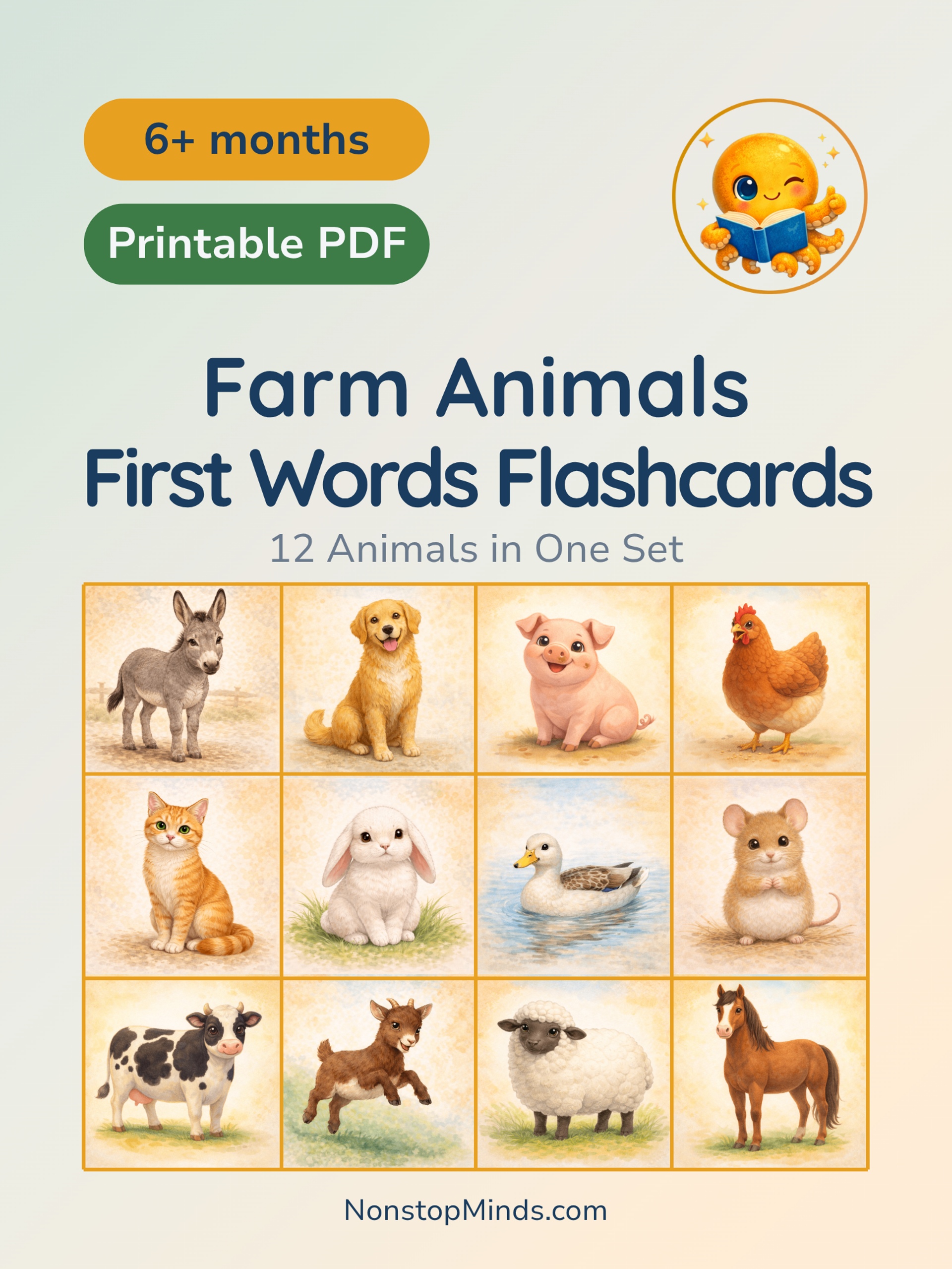
Our Animal Babies Alphabet Flashcards are designed to give that prediction system structured repetition at this stage: familiar animals, consistent naming, the same call-and-response rhythm your baby has been building since before they were born. For the broader picture of how early language exposure connects to speech milestones, our article on how to help your baby talk covers the shared reading research alongside the other inputs that matter most in the first year.
When dad reads, it registers differently
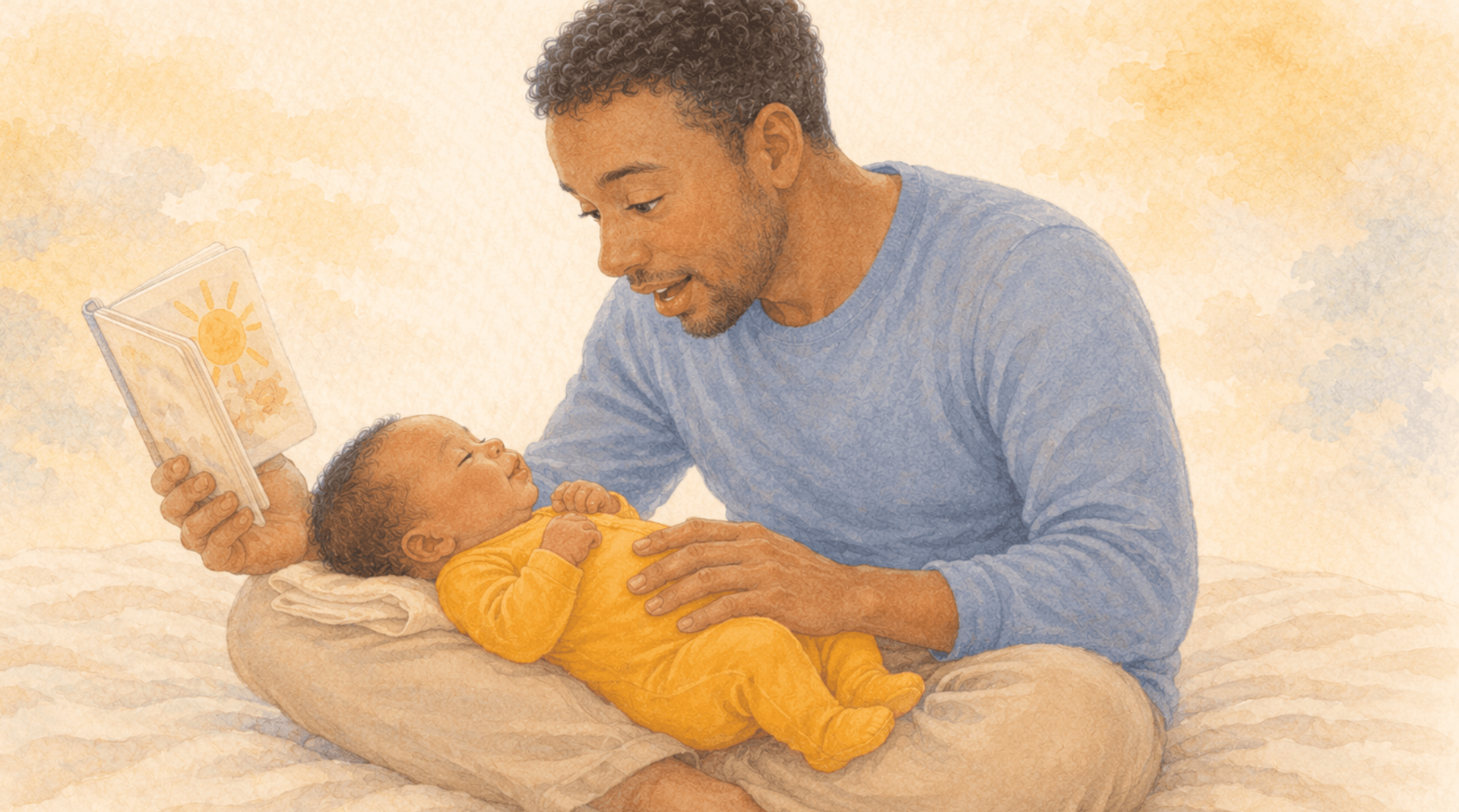
Most reading research focuses on the maternal voice, for the methodological reason that prenatal exposure is nearly always maternal. Postnatal paternal reading has its own strand of evidence, however, and it's worth naming specifically because it tends to get left off the advice lists.
A father reading aloud consistently exposes the baby to a second acoustic profile (a different fundamental frequency, different prosodic patterns, different vocabulary choices), and that variety appears to have additive benefits for language breadth. The AAP's updated 2024 literacy policy statement in Pediatrics notes that family member participation in reading enriches a baby's language environment in ways a single reader cannot replicate. Research on parent-child reading interaction also suggests that fathers tend to use different vocabulary, ask more open-ended questions, and introduce more novel words than mothers reading to the same child, and that divergence is complementary rather than redundant. The baby who has been read to by both parents is encountering two distinct linguistic styles, and both are building the predictive architecture the Wang study identified.
There's also an earlier dividend: a partner who reads aloud consistently during the third trimester is establishing their voice in the baby's auditory map before birth. The anecdotal consistency in the prenatal attachment literature on this point is worth taking literally. Reading the same three books three nights a week for the last six weeks of pregnancy is a low-bar investment with a plausible prenatal payoff.
For context on the related practice that some families combine with book reading from early infancy, our article on baby sign language covers how naming and gesture routines reinforce the same turn-taking instincts that shared reading develops.
What reading looks like at each stage
Prenatal (third trimester): Read anything with a strong rhythm; rhyming books and poetry work especially well because the predictable pattern is more perceptible through the acoustic filtering of the womb. Read the same books repeatedly, not out of obligation but because repetition is the mechanism by which prenatal pattern recognition is built. Your partner reading at the same sessions establishes their voice before birth.
Newborn to three months: The goal here is regularity more than anything else. Pick a time of day (the pre-sleep routine is where it tends to stick) and commit to five minutes at that time. Content matters less than the consistency of the voice and the ritual. High-contrast picture books hold a young baby's visual attention better than page-heavy text at this stage, but read what you enjoy reading aloud, because a parent who sounds engaged is more interesting to a baby than a parent performing patience.
Three to six months: Your baby is starting to track where you point and will begin following illustrations more deliberately. Books with simple, clear images and one or two words per page work well. This is also when reading together starts producing recognizable emotional responses: a baby who brightens at a particular line is responding to the intonation pattern your voice makes when you find something funny. That responsiveness is meaningful; it's the first evidence that the prediction architecture is developing.
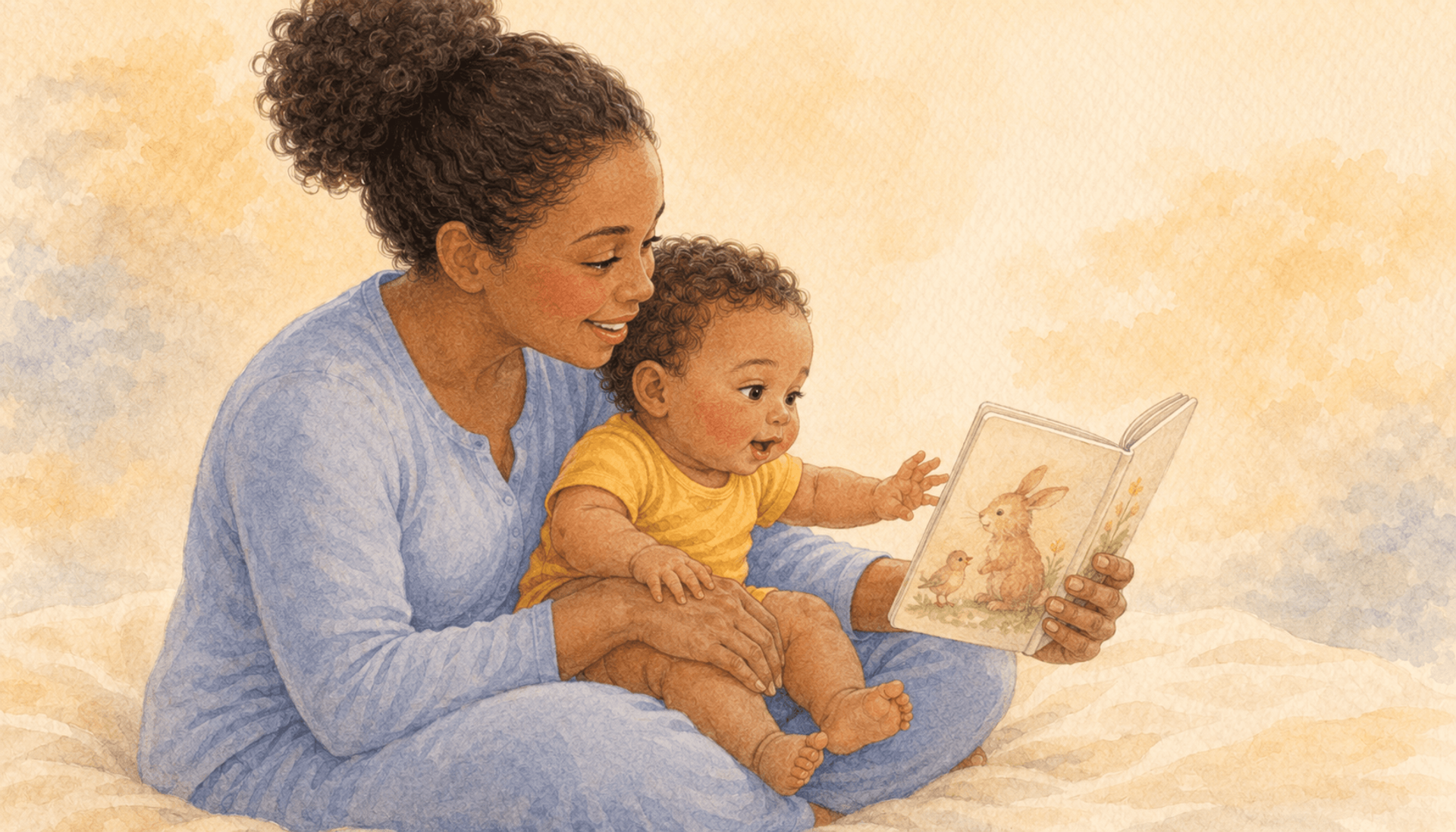
Six to twelve months: Your baby will start turning pages (enthusiastically, often in both directions), reaching for the book, and making sounds during the pauses. Lean into that. Pause after a page, point, wait a beat. The baby who babbles in response to "what's that?" is practicing the mechanics of conversation, both the question-and-response format and the naming-of-things that is foundational vocabulary work. Alphabet books, animal naming books, and anything with consistent call-and-response structure give that back-and-forth a clear shape. The First Words flashcards build naturally from this kind of picture-naming reading into more deliberate vocabulary games as your baby nears twelve months.
Frequently Asked Questions
The third trimester is the research-backed window for prenatal reading, starting from around week 28 when fetal hearing is more robustly developed and the auditory cortex is actively organizing around familiar sounds. In a landmark 1986 study published in Infant Behavior and Development, researchers DeCasper and Spence found that newborns preferred a speech passage their mothers had read aloud every day in the last six weeks of pregnancy over a novel passage, tested just three to five days after birth. Reading rhythmic, repetitive books aloud at the same time each day, and involving your partner in those sessions, is the most practical application of this research.
Consistency matters more than duration. A 2022 study by Hutton and colleagues in the Journal of the American Board of Family Medicine found that infants read to regularly (defined as always having access to seven or more books) showed significantly better expressive, receptive, and combined language scores at nine and twelve months compared to those read to less consistently. Five to ten minutes of daily shared reading, maintained over time, carries measurable effects; the families who saw the strongest outcomes weren't necessarily reading longer, they were reading reliably.
No. The prenatal window carries advantages if you use it, but the brain's responsiveness to reading-driven language input doesn't close at birth. The 2022 study by Wang, Tzeng, and Aslin in PLOS ONE, which measured shared reading effects at twelve months, found that the predictive brain signal and vocabulary gains appeared regardless of precisely when families had started. Earlier is better, but the language architecture that reading builds is being constructed across the entire first year and beyond. Starting today matters more than worrying about when you should have started.
In the third trimester, anything rhythmic and repetitive works best: board books, nursery rhymes, and whatever you'll enjoy reading many times. Newborns through three months respond better to high-contrast images with simple compositions than to page-heavy text. Between three and six months, clear illustrations with one or two words per page hold attention well. From six to twelve months, naming books, animal books, and anything with a consistent call-and-response format work well because they invite participation. What holds across all ages is that a book the parent genuinely enjoys reading aloud gets read more consistently, and consistency is the variable that research links most directly to language outcomes.
Most babies under three months show limited visible interest in books as objects; what they respond to is the voice and the ritual. Between three and nine months, some babies track illustrations intently; others won't until closer to a year. If by eighteen months a toddler shows no interest in books and has fewer words than expected for their age, it's worth raising with your pediatrician. Our article on late talkers and speech delay covers the difference between normal variation in reading interest and the patterns worth flagging at a check-in.
This article is for educational and informational purposes only and does not constitute medical or developmental advice. If you have concerns about your child's language or development, please consult your pediatrician or a qualified healthcare provider.
- American Academy of Pediatrics. (2024). Literacy promotion: An essential component of primary care pediatric practice. Pediatrics, 154(6), e2024069090.
- DeCasper, A. J., & Fifer, W. P. (1980). Of human bonding: Newborns prefer their mothers' voices. Science, 208(4448), 1174–1176.
- DeCasper, A. J., & Spence, M. J. (1986). Prenatal maternal speech influences newborn's perception of speech sounds. Infant Behavior and Development, 9(2), 133–150.
- Graven, S. N., & Browne, J. V. (2008). Auditory development in the fetus and infant. Newborn and Infant Nursing Reviews, 8(4), 187–193.
- Hutton, J. S., Huang, G., Crosh, C., DeWitt, T., & Ittenbach, R. F. (2022). Parental reading to infants improves language. Journal of the American Board of Family Medicine, 35(6), 1156.
- Kostilainen, K., Fontell, N., Mikkola, K., Pakarinen, S., Virtala, P., Huotilainen, M., Fellman, V., & Partanen, E. (2024). Music and reading activities in early childhood associated with improved language development in preterm infants at 2–3 years of age. Frontiers in Psychology, 15, 1394346.
- Moon, C., Cooper, R. P., & Fifer, W. P. (1993). Two-day-olds prefer their native language. Infant Behavior and Development, 16(4), 495–500.
- Romeo, R. R., Leonard, J. A., Robinson, S. T., West, M. R., Mackey, A. P., Rowe, M. L., & Gabrieli, J. D. E. (2018). Beyond the 30-million-word gap: Children's conversational exposure is associated with language-related brain function. Psychological Science, 29(5), 700–710.
- Vogelsang, M., Vogelsang, L., Diamond, S., Bertoni, T., Huth, M., Kaliukhovich, D., Vogels, R., & Kanwisher, N. (2022). Prenatal auditory experience and its sequelae. Developmental Science, 26(1), e13278.
- Wang, S., Tzeng, O. J. L., & Aslin, R. N. (2022). Predictive brain signals mediate association between shared reading and expressive vocabulary in infants. PLOS ONE, 17(8), e0272438.
More Articles
Parallel Play in Toddlers: Why Side-by-Side Is the Social Work
Your toddler spent the entire playdate building separate towers, and nobody shared a single block. That counted — more than it looked. A 2025 longitudinal study found that playing beside a specific child consistently predicted later social play with that same child, but not the other way around. Here's what parallel play in toddlers actually is, why the science calls it strategic rather than passive, and what it means for how you run a playdate.
When Do Babies Point: Why It Matters for Language
Most milestone articles treat pointing as a box to check around 12 months. The research tells a different story — one that starts months earlier, runs through the infant brain, and traces back to how much the parent is pointing. Here's what the last fifteen years of research actually found, and what it means for everyday interactions.

When Do Babies Wave Bye-Bye: Why Your Baby Needs You to Wave First
Most baby milestones unfold on a biological schedule — waving isn't one of them. A 2023 study found that babies develop imitation ability because their caregivers imitate them first, and waving is named directly as a cultural gesture learned through that loop. Here's what the research says about the 9–12 month window, why the first wave looks nothing like a wave, and what helps it arrive.