Activities for a 4 Year Old at Home: What the Brain Is Practicing
Your four-year-old has been asking you to rhyme things with "truck" for the past twenty minutes. You've been playing along, mentally filtering out the ones that actually rhyme. What you probably didn't clock is that those rhymes are reading — not prep for reading, but the wiring underneath it — happening right now, in your living room, with a giggling child who doesn't know they're doing anything educational at all. The activities for a 4 year old that matter most in this window often look exactly like this: low-tech, slightly chaotic, and deeply useful.
- What genuinely shifts in the 4-year-old brain that didn't exist at three — and why it changes which activities actually deliver
- The sound games that build reading, long before a single letter is introduced
- Why your child's coloring habit is strengthening the same muscles that make writing and reading click
- What pretend play looks like at four, why it's more cognitively complex than it appears, and which scenarios develop it most
- What kindergarten readiness actually means according to pediatricians — and the everyday activities that get there
If the one-sentence answer is enough, you’ve got the gist. If you want the mechanism behind each piece, keep reading.
What changes in a 4-year-old's brain compared to three
Four-year-olds can do something three-year-olds largely cannot: hold a rule in mind while something tries to distract them from it. That sounds abstract, but it shows up in every game that has ever gone better at four than at three. Simon Says. Red Light Green Light. Any board game with a turn structure. The fact that these suddenly work at four isn't about patience or cooperation. It's about a specific jump in working memory that happens right around the third-and-a-half to fourth birthday.
A 2016 study from the University of York by Blakey, Visser, and Carroll tracked 120 children at ages two, three, and four on two different types of cognitive flexibility tasks. The finding was specific: the ability to switch between rules while managing conflicting information improved most sharply between ages three and four, and it was closely tied to working memory gains. Three-year-olds could handle simple rule switches if there was no competing pull. Four-year-olds could handle them with the distracting option present. That's not a small difference: it's the difference between Simon Says collapsing in frustration and running for fifteen minutes.
According to the CDC's 2022 updated developmental milestones, developed by Zubler and colleagues, most four-year-olds can follow three-step directions, tell what comes next in a well-known story, play cooperative games with other children, and name a few letters and numbers. The milestone list for this age reflects a child who can hold significantly more in mind simultaneously than they could twelve months ago.
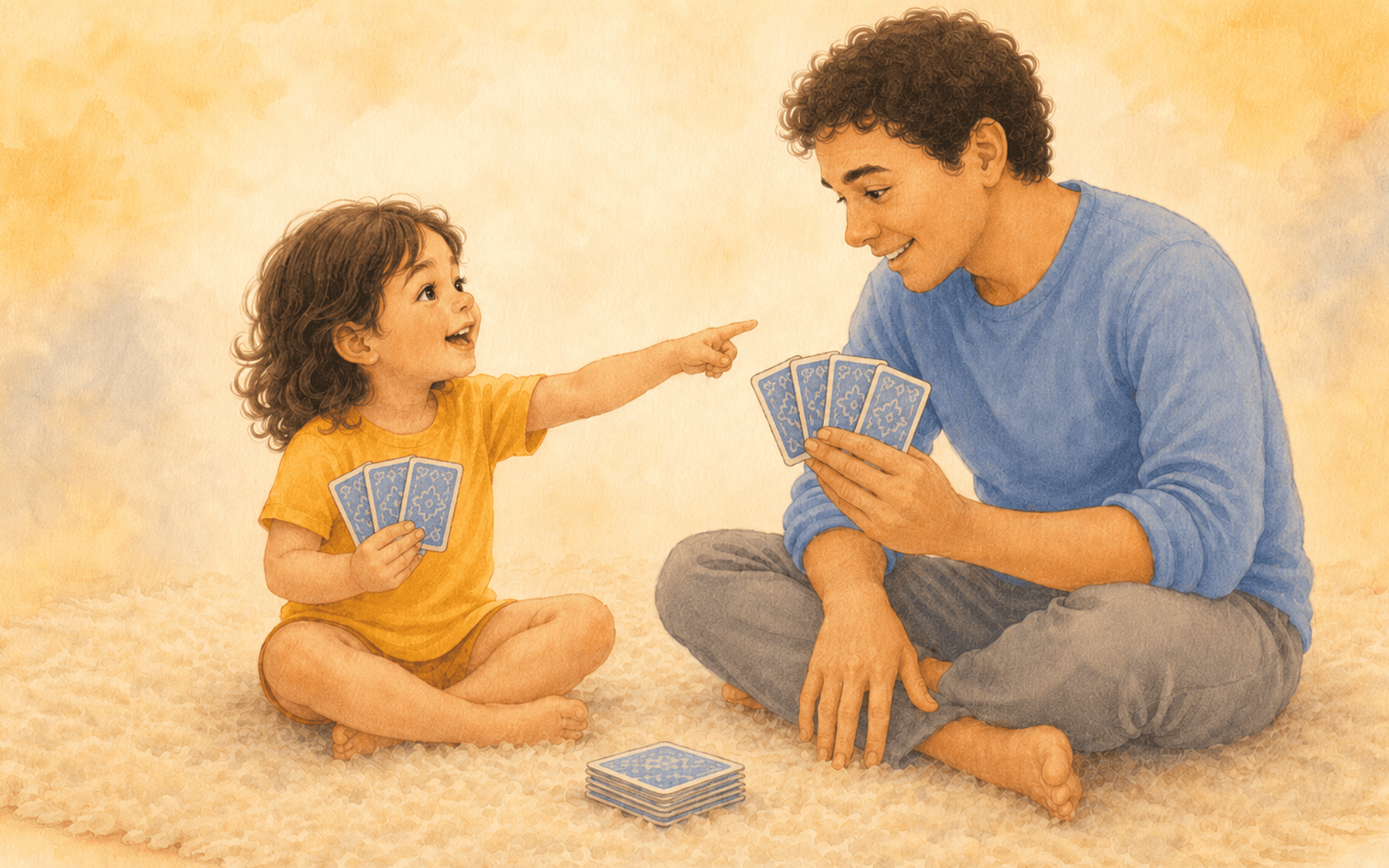
For activities at home, this means rule-based games aren't just entertainment; they're exercising the cognitive circuits that will directly support learning in a classroom. A simple board game where players take turns and follow a set of rules (Candy Land, Snakes and Ladders, Go Fish) gives a four-year-old repeated practice in inhibiting the impulse to go out of turn while tracking the state of the game. Simon Says works the same mechanism from a different angle: the child must simultaneously hold the "only move if Simon says" rule and filter out the competing action prompt. Twenty minutes of Simon Says is, in terms of working memory load, a genuine workout.
Outdoor unstructured play reinforces these same capacities through a different route. Free time outdoors — digging, climbing, building with whatever is available, running games with invented rules — asks the child to generate their own goals, modify plans when something doesn't work, and recover from small frustrations without adult direction. These are the skills that determine how a child functions in a classroom, which is why what school readiness actually means has very little to do with academic knowledge and a great deal to do with self-regulation.
The sound games that quietly build reading
Ask most parents what they should do to get a four-year-old ready to read, and the answers come quickly: learn the alphabet, practice letter sounds, maybe start some simple sight words. All of these are useful. None of them is the strongest predictor of whether a child will read well at seven.
That predictor is phonological awareness — the ability to hear the sounds inside words, play with them, pull them apart, and put them back together. It's an oral skill, not a print skill. A child who can clap out the three syllables in "banana," recognize that "cat" and "hat" rhyme, or identify that "sun" and "sand" start with the same sound is building the internal scaffold that makes letters meaningful when they arrive. A child who knows all twenty-six letters but can't do any of those things is holding a tool they're not yet wired to use.
In a foundational longitudinal study, Lonigan, Burgess, and Anthony followed preschoolers into kindergarten and first grade, tracking which early skills predicted later reading. Phonological awareness was the most stable and robust predictor, outperforming letter knowledge, vocabulary, and general language ability. More recently, a 2022 randomized study by Wolff and Gustafsson from the University of Gothenburg tracked 364 children whose phonological training began at age four, three years before formal reading instruction in Sweden. Children who received that training showed measurably better reading in second and third grade, with the strongest gains in the children already at risk of falling behind.
The activities that build phonological awareness at four are almost entirely playful and verbal. Rhyming games are the most natural starting point: asking a child to think of words that rhyme with a target word, pointing out rhymes in songs and books, playing "I spy something that rhymes with…" in the car. Nursery rhymes and silly songs earn their keep here for the same reason. A 2019 study from City, University of London by Politimou and colleagues found that rhythm perception and production were the strongest predictors of phonological awareness in three- and four-year-olds, which means the child who is constantly tapping, clapping, and moving to music is doing exactly the right preparatory work.
Syllable clapping is another low-effort, high-return activity: clap out the beats in words around the house ("to-ma-to: three claps," "dog: one clap"). Alliteration games build awareness of initial sounds: "I'm thinking of an animal that starts with the /b/ sound" works well over breakfast. None of this requires materials or dedicated time. It happens in the car, at the dinner table, during the three minutes between arriving home and getting shoes off.
When your child gravitates toward silly wordplay, made-up rhymes, or asking "does that rhyme?" about everything, that's not a distraction from learning; that's the learning, in the form it takes at four.
Why drawing and crafts do more than they look like they do
There's a tendency to group drawing, cutting, coloring, and playdough under "fine motor," which is accurate but undersells what's happening. Not all fine motor activities predict the same outcomes, and the research is specific about which ones matter most.
A 2019 study in Early Childhood Research Quarterly by Suggate and colleagues followed kindergarteners and found that fine motor skills predicted reading achievement in first grade. Specifically, graphomotor skills (the controlled hand movements involved in drawing and pre-writing) carried the predictive weight, rather than general dexterity tasks like bead threading or stacking. A follow-up experimental study by the same team in 2023, directly testing which type of hand activity contributed most to early decoding, confirmed that drawing-like, mark-making activity shares the same brain pathways as handwriting and letter recognition.
This doesn't mean threading beads is useless; it builds hand strength and sustained focus. But if a four-year-old has limited time and you're deciding where to direct their creative energy, activities that involve controlling a pencil, crayon, or marker on paper are doing more developmental work than activities involving picking up and placing objects.
Drawing human figures — a head, body, arms, legs, even in the classic "sun person" style — is both a CDC milestone for this age and a productive activity. Coloring with some intention, deciding on colors or trying to stay within a shape, builds the same fine control. Cutting with child-safe scissors is excellent: following a line requires coordinating visual tracking with hand movement, which Suggate's research links directly to the same pathway involved in early reading.
Playdough has its own argument. Rolling, flattening, and pinching builds the intrinsic hand muscles that eventually hold a pencil steadily, and twenty minutes with playdough is arguably more useful pre-writing preparation than twenty minutes of letter tracing. The letters are easier to form when the hand is ready, not when the child has memorized the shape before the hand can execute it.
Art activities at four don't need a stated educational goal. A child drawing a birthday party from imagination, cutting out shapes for a collage, or pressing cookie cutters into playdough is building exactly what the research points to, and building it more durably than any worksheet could.
Pretend play at four is a different game than at three
A three-year-old can do pretend play. They can hold a banana to their ear as a phone, feed a doll, or stir "soup" in an empty pot. What a three-year-old mostly cannot do is negotiate a shared fictional reality with someone else, assign specific roles to each player, and maintain those roles across a sustained scenario that evolves as it unfolds. That capacity is what comes online around age four, and it matters more than it looks.
By four, most children have developed what researchers call theory of mind — the understanding that other people hold beliefs and knowledge that may differ from their own. A landmark meta-analysis by Wellman, Cross, and Watson, covering 178 studies and thousands of children across multiple countries, found that children reliably develop first-order false belief understanding around the fourth birthday. Before that, they tend to assume everyone knows what they know. After it, they begin to understand that another person might believe something incorrect, or see a situation from a completely different angle. A 2025 study from the University of Göttingen by Schidelko and Rakoczy confirmed that this meta-representational capacity is consistently present from age four onward.
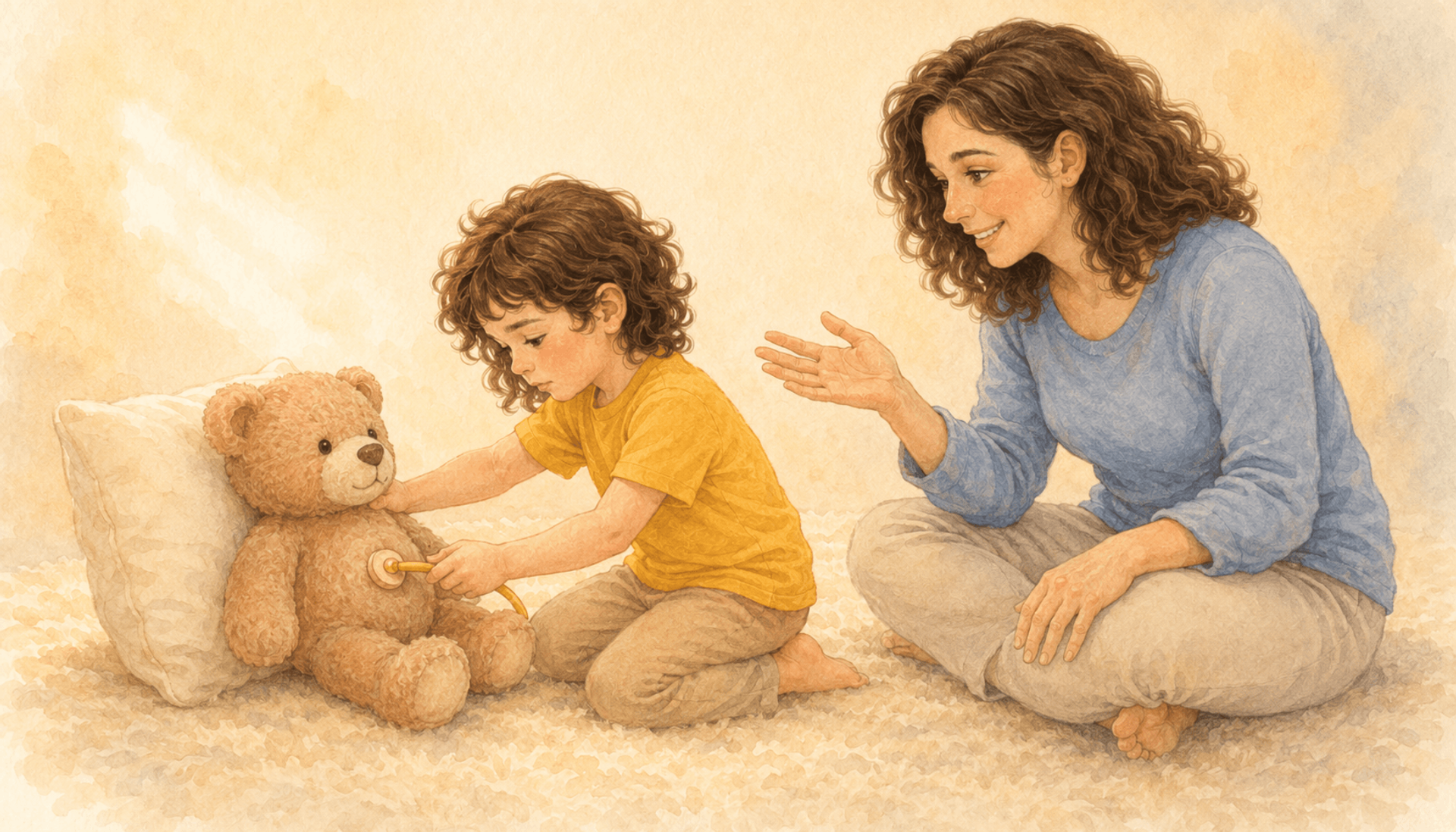
This shows up directly in pretend play. A four-year-old can say "you be the doctor and I'll be the patient with a hurt leg" and then play within those rules, staying in character, responding to what the "doctor" does, adjusting the narrative as it evolves. That requires tracking another person's perspective, predicting their next move, and generating language that fits the scenario. It's also, by most accounts, what language develops in fastest at this age. The scenarios that develop it most are ones with assigned roles and loose-but-clear structure: doctor and patient, customer and shopkeeper, teacher and student, vet and pet owner, restaurant with a cook and a customer.
Less prescriptive setups tend to produce richer play: a few props, a willing co-player, and the freedom to follow wherever the four-year-old steers. Cooperative building with a narrative purpose also belongs here: two children constructing a block hospital or a LEGO rocket for a stated mission are doing the same shared-reality negotiation as role play, with spatial reasoning layered on top.
If you're looking at how these activities compare to what worked a year ago, the activities for a 3 year old that built the strongest foundation — pretend play, embedded counting, outdoor free time — are still valuable at four, but the four-year-old brain is ready for more complexity in each of them. The pretend play can now have plot. The counting can now involve sorting and comparing. The outdoor time can now include games with invented rules that your child both makes up and enforces.
What kindergarten readiness actually looks like at four
The American Academy of Pediatrics policy statement on school readiness, written by Williams, Lerner, and colleagues, defines readiness across five domains: physical and motor development, social and emotional development, approaches to learning (curiosity, persistence, flexibility), language and communication, and general knowledge. Academic skills appear on that list alongside self-regulation, cooperation, empathy, and the ability to express needs in words.
The same document reports a specific finding from parent surveys: 62% of parents considered sharing essential for kindergarten readiness, and 56% considered knowing the alphabet essential. That second number reflects a real and widespread assumption — that the most important thing a four-year-old can accomplish before school is to learn letters and numbers. The mismatch between that assumption and what kindergarten teachers actually prioritize is consistent across multiple surveys: teachers rank a child who can follow multi-step directions, manage frustration without shutting down, wait for a turn, and ask for help far above a child who can recite the alphabet.
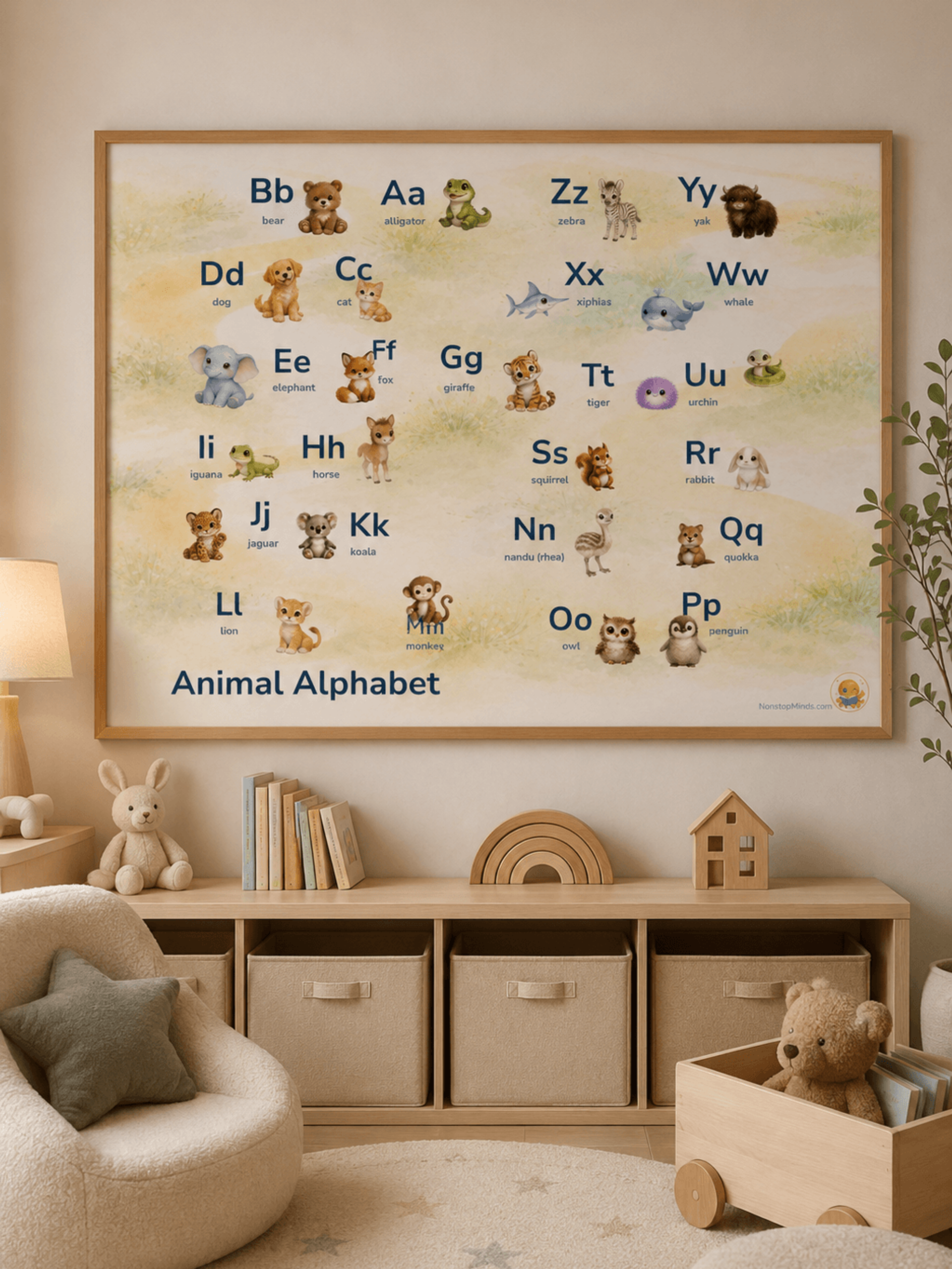
The everyday activities that build these capacities don't require a curriculum. Turn-taking in any game is direct practice for the classroom experience. Giving a four-year-old a small, real responsibility (setting out napkins for dinner, being in charge of watering a plant) builds the routine-following and sense of competence that daily routines genuinely support at this age. Our Big Kid Routine Cards give that structure a visual form: a simple checklist of tasks your child can work through independently, which builds exactly the self-directed follow-through kindergarten teachers describe as one of the most useful things a child can arrive with. Naming emotions out loud as they arise ("you're frustrated because the tower fell") gives children vocabulary to communicate rather than act out. And reading together, including the bedtime conversation that follows a book, builds vocabulary, listening, and narrative comprehension without costing anything. When sound play has been a regular part of daily life and your child starts asking what letter a word starts with, a simple visual reference like our My Zoo Alphabet Poster (each letter paired with an animal and its name) gives those early letter-sound connections something to anchor to. If this age is new territory and you've been reading about activities for a 2 year old until recently, the jump to four is significant — the cognitive complexity of what works just doubled.
None of this is complicated. The activities for a 4 year old at home that do the most developmental work are not the ones that require the most setup or the most explicitly educational framing. They're the ones that involve sounds, rules, hands, and other people, which is a description of almost everything a four-year-old already wants to do.
Frequently Asked Questions
The research on early childhood development points to four categories: sound-based word games (rhyming, syllable clapping, songs) that build phonological awareness — the strongest predictor of later reading, per longitudinal research by Lonigan, Burgess, and Anthony; drawing and pre-writing activities that develop graphomotor skills linked to reading in first grade; rule-based games like Simon Says or simple board games that build working memory and self-regulation; and complex pretend play with assigned roles that develops theory of mind and language. These require very little in the way of materials or setup.
Playdough for twenty minutes builds hand strength and focuses attention with almost no setup. Any game with a simple rule structure (card games, "I spy," rhyming games) works in a small space. Drawing a comic strip of something that happened that day hits graphomotor development and narrative language simultaneously. Role play with household objects (a pot lid becomes a steering wheel, a box becomes a spaceship) is among the most cognitively rich activities a four-year-old can do and costs nothing.
Developmentally, boys and girls at four are building the same capacities. Activities that tend to work well for high-energy children of any gender: Simon Says and Red Light Green Light for working memory, obstacle courses that involve following a sequence, building with blocks or large LEGO for spatial reasoning and narrative play, outdoor digging and water play, and any pretend scenario with movement built in. Phonological awareness games (rhyming, syllable clapping) and drawing activities apply equally; the delivery benefits from including physical movement when possible.
Same capacities, same evidence base. Four-year-olds who gravitate toward drawing, art, and pretend play scenarios are already in a developmentally useful zone: graphomotor activities and complex role-based pretend are both high-value at this age. Reading together with follow-up conversation, rhyming games, and shared pretend scenarios with role assignment — doctor play, school play, restaurant play — hit the research-supported targets in a natural way.
The more useful question is what a four-year-old should be able to do. Per the CDC's 2022 updated milestones by Zubler and colleagues, most four-year-olds should be able to follow three-step directions, play cooperatively with other children, tell what comes next in a familiar story, and name a few letters and numbers. But pediatricians and kindergarten teachers consistently rank self-regulation and social-emotional skills above academic knowledge when describing what actually predicts a successful first year. A child who can wait, share, ask for help, and manage frustration is better prepared than a child who can recite the whole alphabet but struggles with any of those four things.
For educational and informational purposes only. Not a substitute for professional medical or developmental advice. If you have concerns about your child's development or school readiness, consult your pediatrician or a qualified early childhood specialist.
- Blakey, E., Visser, I., & Carroll, D. J. (2016). Different executive functions support different kinds of cognitive flexibility: Evidence from 2-, 3-, and 4-year-olds. Child Development, 87(2), 513–526.
- Cusiter, J., Short, K., Webb, A., & Munro, N. (2025). Combined language and code emergent literacy intervention for at-risk preschool children: A systematic meta-analytic review. Child Development, 96(4), 1519–1545.
- Diamond, A. (2020). Executive functions. In Handbook of Clinical Neurology, 173, 225–240.
- Lillard, A. S., Lerner, M. D., Hopkins, E. J., Dore, R. A., Smith, E. D., & Palmquist, C. M. (2013). The impact of pretend play on children's development: A review of the evidence. Psychological Bulletin, 139(1), 1–34.
- Lonigan, C. J., Burgess, S. R., & Anthony, J. L. (2000). Development of emergent literacy and early reading skills in preschool children: Evidence from a latent-variable longitudinal study. Developmental Psychology, 36(5), 596–613.
- Melby-Lervåg, M., Lyster, S.-A. H., & Hulme, C. (2012). Phonological skills and their role in learning to read: A meta-analytic review. Psychological Bulletin, 138(2), 322–352.
- National Early Literacy Panel. (2008). Developing early literacy: Report of the National Early Literacy Panel. National Institute for Literacy.
- Pesch, A., Semenov, A. D., & Carlson, S. M. (2020). The path to fully representational theory of mind: Conceptual, executive, and pragmatic challenges. Frontiers in Psychology, 11, 581117.
- Politimou, N., Dalla Bella, S., Farrugia, N., & Franco, F. (2019). Born to speak and sing: Musical predictors of language development in pre-schoolers. Frontiers in Psychology, 10, 948.
- Schidelko, L. P., & Rakoczy, H. (2025). Why do children from age 4 fail true belief tasks? A decision experiment testing competence versus performance limitation accounts. Cognitive Science, 49(6), e70069.
- Suggate, S., Pufke, E., & Stoeger, H. (2019). Children's fine motor skills in kindergarten predict reading in grade 1. Early Childhood Research Quarterly, 47, 248–258.
- Suggate, S. P., Karle, V. L., Kipfelsberger, T., & Stoeger, H. (2023). The effect of fine motor skills, handwriting, and typing on reading development. Journal of Experimental Child Psychology, 232, 105674.
- Wellman, H. M., Cross, D., & Watson, J. (2001). Meta-analysis of theory-of-mind development: The truth about false belief. Child Development, 72(3), 655–684.
- Williams, P. G., Lerner, M. A., Council on Early Childhood, & Council on School Health. (2019). School readiness. Pediatrics, 144(2), e20191766.
- Wolff, U., & Gustafsson, J.-E. (2022). Early phonological training preceding kindergarten training: Effects on reading and spelling. Reading and Writing, 35(8), 1865–1887.
- Zubler, J. M., Wiggins, L. D., Macias, M. M., Whitaker, T. M., Shaw, J. S., Squires, J. K., Pajek, J. A., Wolf, R. B., Slaughter, K. S., Broughton, A. S., Gerndt, K. L., Mlodoch, B. J., & Lipkin, P. H. (2022). Evidence-informed milestones for developmental surveillance tools. Pediatrics, 149(3), e2021052138.
More Articles
Parallel Play in Toddlers: Why Side-by-Side Is the Social Work
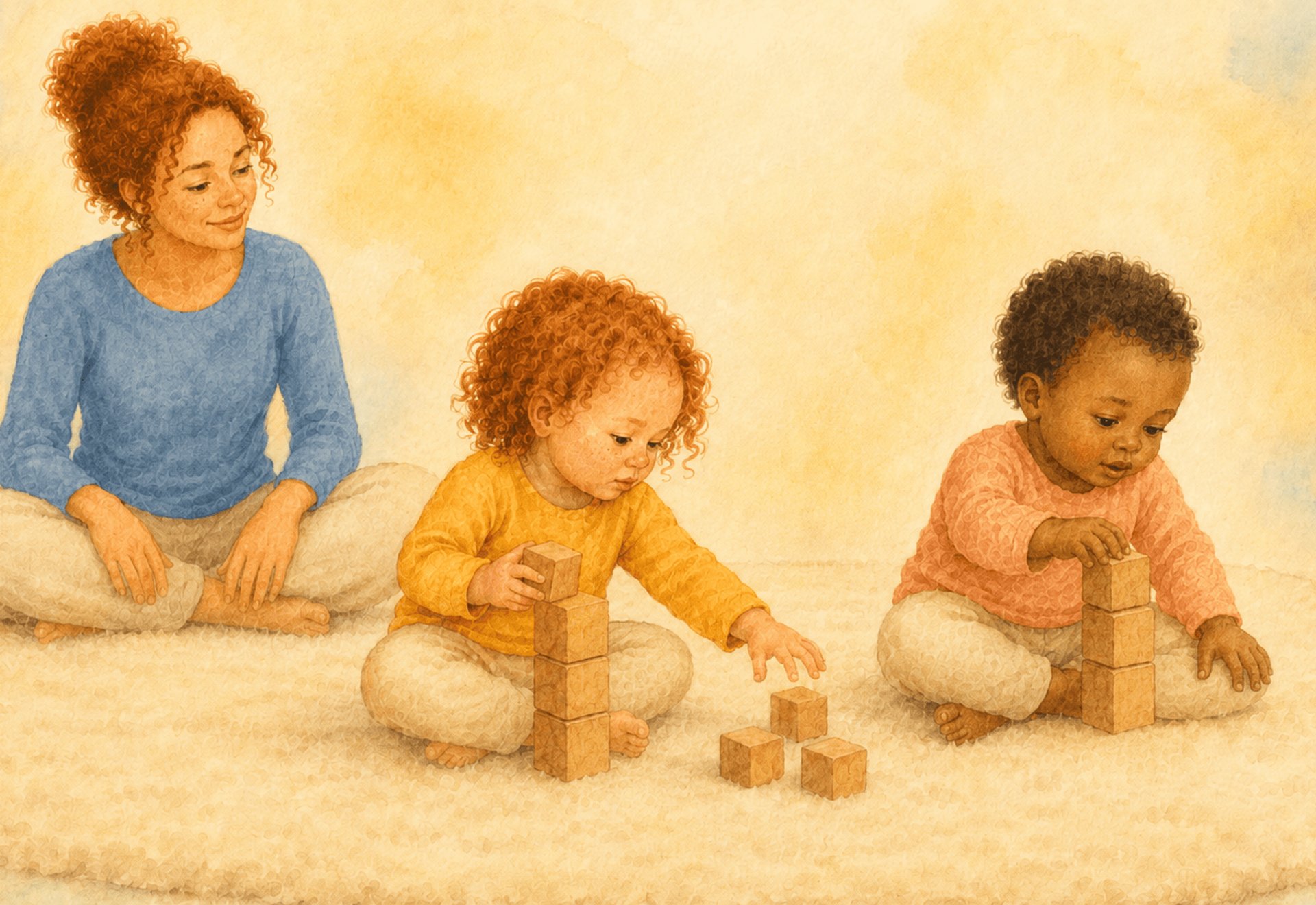
Your toddler spent the entire playdate building separate towers, and nobody shared a single block. That counted — more than it looked. A 2025 longitudinal study found that playing beside a specific child consistently predicted later social play with that same child, but not the other way around. Here's what parallel play in toddlers actually is, why the science calls it strategic rather than passive, and what it means for how you run a playdate.

When Do Babies Point: Why It Matters for Language
Most milestone articles treat pointing as a box to check around 12 months. The research tells a different story — one that starts months earlier, runs through the infant brain, and traces back to how much the parent is pointing. Here's what the last fifteen years of research actually found, and what it means for everyday interactions.
When Do Babies Wave Bye-Bye: Why Your Baby Needs You to Wave First
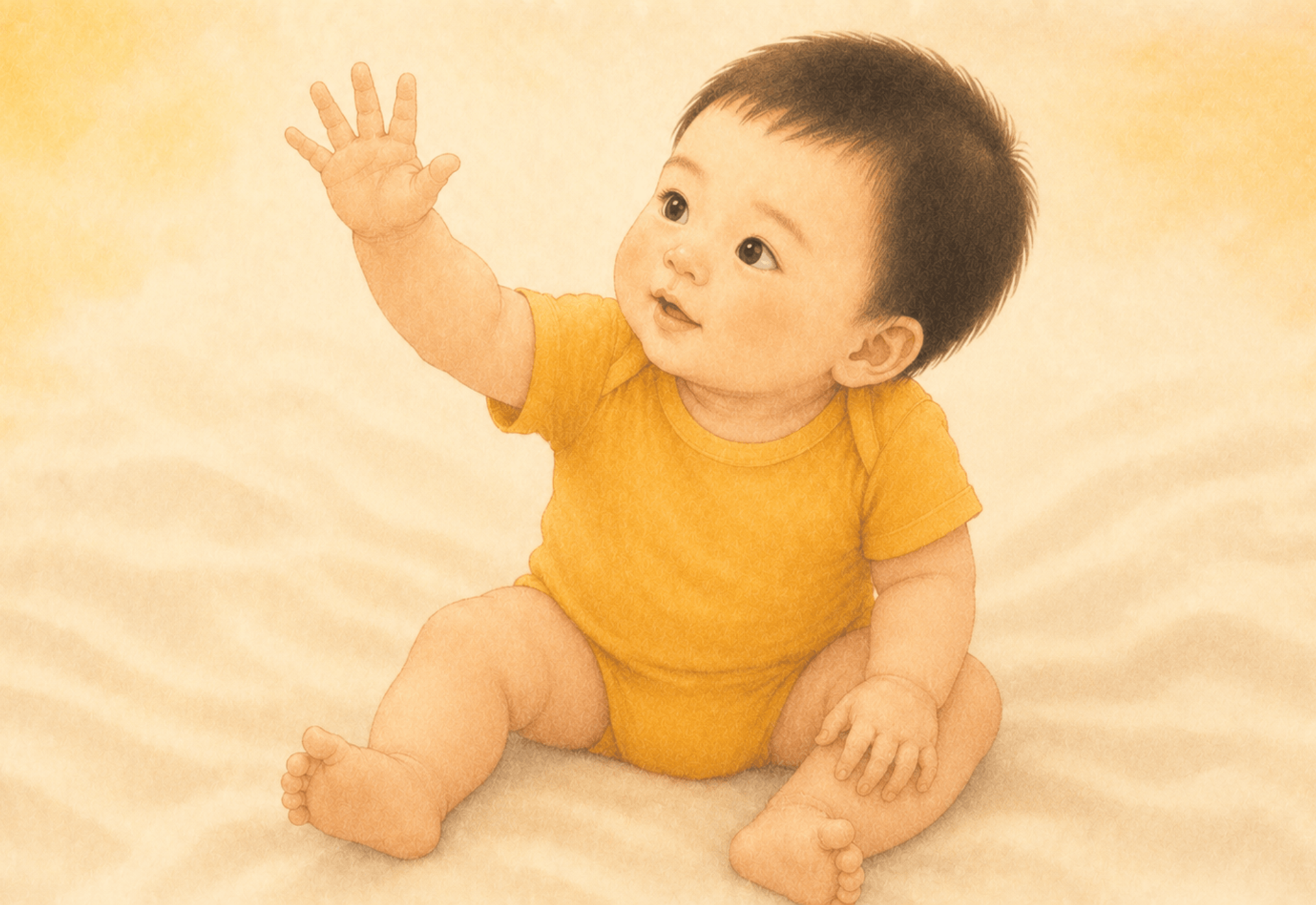
Most baby milestones unfold on a biological schedule — waving isn't one of them. A 2023 study found that babies develop imitation ability because their caregivers imitate them first, and waving is named directly as a cultural gesture learned through that loop. Here's what the research says about the 9–12 month window, why the first wave looks nothing like a wave, and what helps it arrive.