Baby Teething Symptoms: The Real List Is Shorter Than You Think
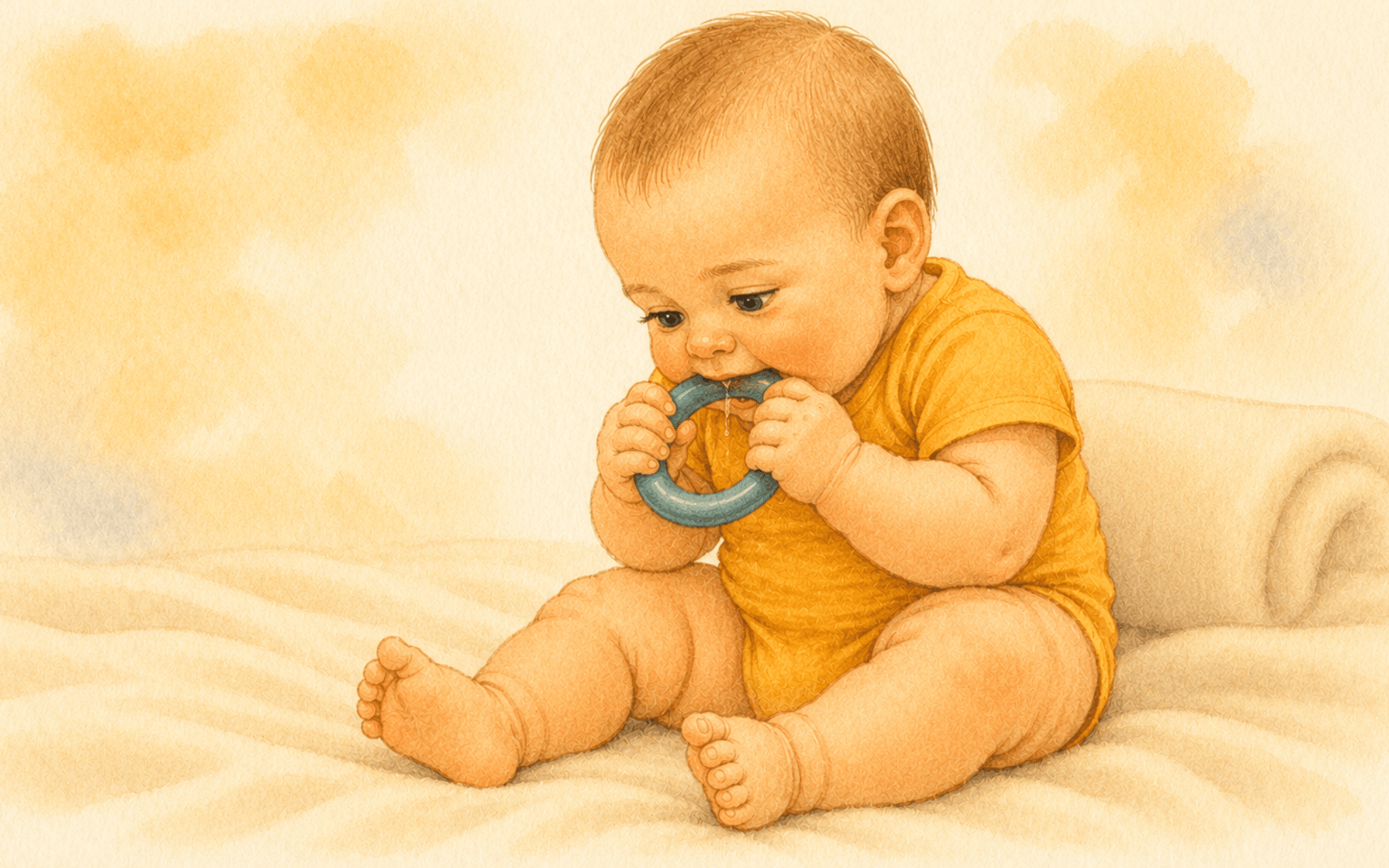
Somewhere around month four, the drooling starts. The fist goes in the mouth. The sleep that had finally, miraculously normalized goes sideways. Parents reach for the same explanation generations before them reached for: teething. Gum swelling, low fever, lost appetite, night waking — every baby teething symptom gets filed in the same folder. Most of those calls are right. One of them is not, and knowing which one is the difference between waiting it out with a cold teether and calling your pediatrician. Baby teething symptoms that actually come from teeth are a shorter list than the one circulating in every parenting group, and the rest of that list deserves a second look.
- The 8-day eruption window that most teething conversations forget to mention
- Exactly which symptoms the research links to teeth, and how a local immune response explains them
- Two coincident biology curves that make month 6 the peak season for parental confusion
- The timeline for all 20 primary teeth, and which ones parents tend to remember longest
- What actually helps with teething relief, and the FDA warnings behind three products that don't
- How to tell when a teething baby is also a sick baby who needs a call to the pediatrician
If the one-sentence answer is enough, you’ve got the gist. If you want the mechanism behind each piece, keep reading.
Each tooth arrives in a specific 8-day window — not a season
Each primary tooth produces symptoms inside a well-defined time span: the four days before it breaks through, the day it emerges, and the three days after. Macknin and colleagues tracked 125 infants daily in a 2000 Pediatrics study, logging 19,422 child-days of observation and 475 individual tooth eruptions. The finding was precise: symptoms were significantly more frequent only inside that 8-day window. Outside it, the tooth was not the explanation.
The implication is the part most parenting discussions skip. A baby described as "teething for six weeks" is not experiencing a prolonged teething event (the 8-day window simply doesn't work that way). What's actually happening is either a different tooth approaching in a different window, or an unrelated source of fussiness getting absorbed into the teething narrative because teething is already on the radar.
The gum does visible work before the tooth breaks through. In the days leading up to eruption, the tissue above the tooth softens and breaks down, driven partly by the enzymes in the baby's own saliva and partly by local immune signaling. This is why swelling and tenderness appear before any tooth is visible, and why a teething baby who seems to feel better temporarily may not be done — the tooth may simply not have cleared the surface yet.
The pre-eruption window is often the most uncomfortable stretch. In a 2011 prospective study by Ramos-Jorge and colleagues in Pediatrics, which followed 47 infants daily for eight months and recorded every tooth eruption, irritability, increased salivation, and disturbed sleep were all most intense in the 24 to 48 hours before emergence. Once the tooth is through, symptoms typically resolve within three days. If the sleep disruption outlasts that window by more than a few days, wake windows and scheduling are worth revisiting independently from teething.
What the research actually links to teething
A 2016 meta-analysis by Massignan and colleagues in Pediatrics, the largest review of the evidence assembled to date, drew on 16 studies and 3,506 children and identified which symptoms had the strongest, most consistent association with eruption. Gum irritation appeared in roughly 87% of documented eruption events, irritability in 68%, and drooling in 56%. Biting and chewing behavior also showed consistent links across studies. Mild temperature elevation appeared, but never crossed the threshold that defines fever.
That temperature point is worth slowing down on. Across the best-designed studies, babies' body temperatures rise slightly during the eruption window: on the day of eruption, the average moves from about 97.7°F to 98.1°F. Both readings are within the normal range. Fever is defined as 100.4°F (38°C) or above. Teething, in any well-designed study to date, does not reach that threshold.
The local immune mechanism explains why the symptoms stay local. Shapira and colleagues measured the inflammatory proteins in the gum fluid of erupting teeth in infants and found that the gum tissue goes into a genuine local response during eruption, the same kind of chemistry that produces tenderness anywhere in the body when tissue is under pressure. The swelling, the sensitivity, the general "don't touch that" message the gum is sending — all of it is real and produced right at the site. The drooling is real (it's the body's natural response to gum irritation). The irritability is earned. But that local response does not produce a systemic fever, and it does not cause gastrointestinal disturbance.
The practical takeaway is that the symptom list circulating in parenting groups is accurate about the oral symptoms and inaccurate about the fever and the diarrhea. The oral symptoms are worth addressing. The fever and diarrhea belong to something else, and that something else usually has its own explanation.
Why month 6 is when everything gets blamed on the teeth
Teething gets blamed for fevers and illnesses it doesn't cause, and the timing is genuinely misleading. Two separate biological processes peak at exactly the same age as the first teeth arrive, and neither has anything to do with the other.
The first is the maternal antibody gap. During pregnancy, IgG antibodies — the body's memory against infections already encountered — pass from mother to baby through the placenta. These borrowed defenses peak at birth and decline steadily through the first months of life. By around 6 months, they've dropped to the point where the baby's own immune system has to carry more of the load. A 2020 study in Frontiers in Immunology by Semmes and colleagues described this transition as a period of genuine vulnerability, when vaccine-induced antibodies wane and the early adaptive immune response is still maturing. This is the same window when most babies begin attending daycare, spending time in groups, and touching surfaces that have been touched by other people, which means the cluster of first viral respiratory infections, ear infections, and GI bugs lands squarely in the 6-to-12-month range. The first tooth and the first cold are not related. They simply share a calendar.

The second is the peak of oral exploration. Research by Fagan and Iverson published in Infancy in 2007 documented that mouthing (using the mouth as a tool for learning about objects) peaks between 6 and 9 months, then declines as hand-based exploration takes over. The baby chewing on a wooden spoon is not necessarily responding to tooth pain. The baby is extracting information from the object: its shape, hardness, surface properties, and temperature. The CDC's 6-month milestones list this behavior explicitly, naming "puts things in mouth to explore them" as a normal cognitive achievement, not a sign of distress. Reading about how all five senses develop together during this window (including taste, touch, and proprioception) makes the mouthing behavior considerably less mysterious; it is covered in detail in our article on how your baby's five senses develop.
When the first tooth arrives at 6 months, the first cold also arrives at 6 months, and the baby is chewing on everything regardless of whether any tooth is in progress, and the combination is specifically designed to produce confusion. A parent who attributes the fever to teething, waits it out, and then notices the baby recovered isn't wrong that the baby recovered. The fever left on its own because viral infections leave on their own. The teething had nothing to do with it, which means nothing was learned that helps next time.
The timeline for all 20 teeth, and which one parents remember longest
Primary teeth arrive in a roughly predictable order across roughly three years, though the age ranges on any given tooth are wide enough that a four-to-six-month difference in either direction is within normal limits.
The bottom central incisors (the two front teeth on the lower jaw) are typically first, arriving between 6 and 10 months. The upper central incisors follow at 8 to 12 months, then the upper lateral incisors at 9 to 13 months, and the lower laterals at 10 to 16 months. The first molars appear between 13 and 19 months. Canines arrive at 16 to 22 months. The second molars complete the set at 23 to 33 months. All 20 primary teeth are usually in place by around age 3.
No tooth on that list arrives at a single fixed age; every range reflects real variation in healthy infants. A baby with no teeth at 10 months is not behind. A baby with four teeth at 7 months is not ahead. The ranges overlap enough that two babies following very different timelines are both normal.
As for which teeth are most difficult, Memarpour and colleagues studied 254 children in a 2015 BMC Oral Health clinical trial and found that canine eruption produced significantly more loss of appetite than either incisor or molar eruption. Many parents and clinicians also report the first molars as the most physically demanding, given their surface area, though the comparative research on pain specifically is limited. The first incisor tends to be the most surprising, because most families don't expect it and have no reference point. The canines tend to be remembered longest.
The American Academy of Pediatric Dentistry recommends establishing a dental home (a relationship with a pediatric dentist) by 12 months of age. On the average eruption timeline, this means scheduling that first visit around the time the first four to six teeth have arrived, which is exactly when early questions about eruption, spacing, and hygiene come up. Starting there sets a baseline.
What actually helps, and three products the FDA has warned against
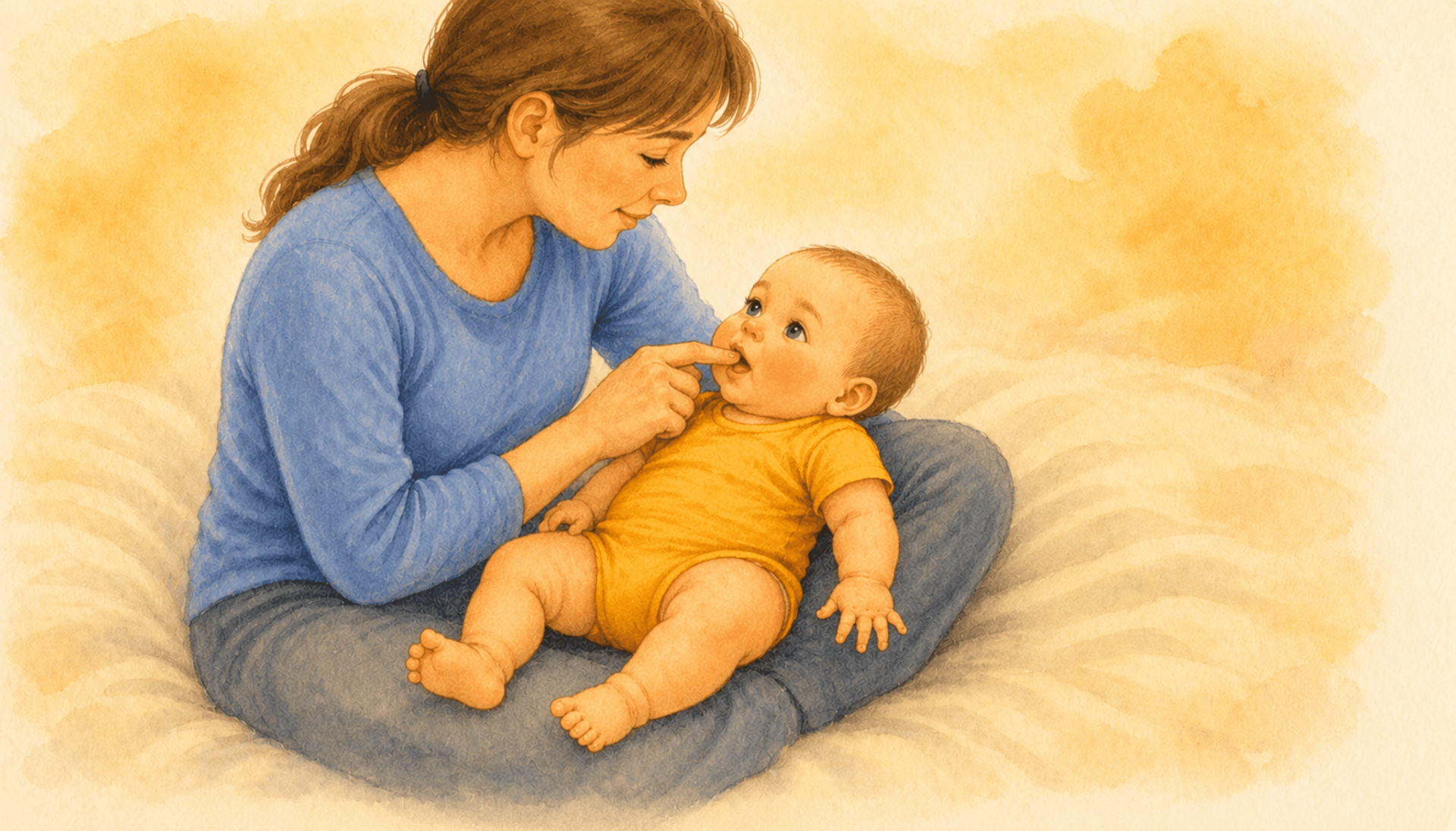
The evidence on what relieves teething discomfort is shorter than the product market would suggest, but it is clear. Memarpour and colleagues compared five non-pharmacological approaches across 254 children and measured both symptom resolution time and caregiver satisfaction. Chilled firm rubber teething rings came first, followed by clean-finger gum massage, followed by comfort holding. All three produced meaningful results. Ice came in below those three; frozen objects can bruise the gum tissue they're supposed to soothe, which is why chilled (not frozen) is the correct temperature for both teethers and damp washcloths used for gnawing.
For nights when none of that is enough and the baby is genuinely distressed, AAP's HealthyChildren.org suggests asking your pediatrician about infant acetaminophen or ibuprofen for relief — ibuprofen from 6 months onward. Always dose by weight.
The FDA has issued formal warnings against three product categories that remain available or recently popular.
Benzocaine gels (sold under names like Baby Orajel, Anbesol, and similar products) received an FDA Drug Safety Communication banning their use in children under 2, issued in May 2018. The concern is methemoglobinemia, a blood disorder that reduces the blood's ability to carry oxygen and can be serious or fatal. The FDA documented more than 400 cases linked to benzocaine use in children under 2 since 1971. The product shelf placement next to teething rings makes it look like a standard option. It is not recommended for this age group.
Homeopathic teething tablets and gels are not evaluated or approved by the FDA for safety or effectiveness, and the FDA recommends against any homeopathic teething remedy. If a product has been recommended in a parenting forum, a social media thread, or a neighborhood group chat, verifying with a pediatrician before giving it to a baby is the right step. "Natural" on a label is not the same as "safe for a 6-month-old," and the FDA's concern with this category of product is active and ongoing.
Teething jewelry, including amber necklaces, received an FDA Safety Communication in December 2018. The warning followed an 18-month-old's death by strangulation from an amber necklace worn during a nap, and a choking incident involving a 7-month-old and wooden teething bracelet beads — notably, the FDA flagged that the choking occurred while the baby was under parental supervision. The American Academy of Pediatrics also recommends against any jewelry worn by infants. The claim that amber beads release a pain-relieving compound through the skin has no clinical evidence behind it.
The 4-to-12-month window is also when babies are biologically primed for structured sensory play — varied textures, contrast, object exploration — as covered in our sensory play guide for babies month by month. Teethers address the oral piece of that drive; the rest of the sensory hunger is wider. Texture cards, soft objects of different weights and shapes, and visual contrast activities all target the same developmental appetite. If your baby is in the 8-to-12-month stretch, our activities for an 8-month-old guide covers the full play menu for this age. Our Sensory Play Cards 0–12m are designed for this exact window and work alongside the physical comfort measures above.
When a teething baby is also a sick baby
The practical test for distinguishing teething from illness is actually straightforward once the symptom categories are separated. Teething causes local, oral symptoms — gum swelling, increased drooling, biting and chewing behavior, mild fussiness — that cluster around an 8-day window and resolve on their own. Anything systemic is a separate conversation.
A temperature above 100.4°F (38°C) is a fever by definition. Teething does not cause it. If the thermometer reads above that threshold, the baby has an illness that has its own cause, and the teeth are almost certainly not involved. The same applies to diarrhea that persists more than a day, vomiting, any rash that spreads beyond mild drool irritation on the chin and cheeks, or any refusal of liquids.
Ear pulling sometimes enters the teething conversation because the same nerve that serves the jaw also supplies part of the ear canal, so jaw discomfort can register as ear discomfort. But ear pulling alongside a fever or prolonged fussiness is the pattern that warrants a pediatrician call rather than a wait-and-see. Ear infections at this age are common and unrelated to tooth eruption. The overlap of teething with the developmental push toward sitting, pulling up, and exploring independently means that this period often feels like everything is happening at once. A read-through of our sensory activities by month can help make sense of what's developmentally expected versus what's worth a second look.
The moments worth flagging to the pediatrician are a fever above 100.4°F, diarrhea lasting more than a day or two, any refusal of fluids, a rash that spreads or worsens, symptoms that last more than a week with no tooth appearing, or a baby who seems genuinely unwell in a way that goes beyond the expected teething irritability. Parents navigating the activities for a 6-month-old will find this stage coincides with exactly the period when distinguishing illness from teething matters most, and when having a relationship with a pediatric dentist in place makes some of these questions easier to answer.
Frequently Asked Questions
Teething can begin as early as 3 to 4 months, well before any tooth becomes visible. The gum begins preparing for the tooth's arrival weeks ahead of the actual eruption, and the earliest signals are increased drooling, a strong urge to chew on hands, fingers, or any object in reach, and mild gum tenderness that may not yet be visible but is sensitive to pressure. Slight irritability and brief sleep disruption can start in this pre-eruption phase too. No visible tooth at 4 months is entirely normal. The average age for the first tooth is 6 months, with a normal range spanning 4 to 12 months, and anything within that range requires no intervention.
It does not. A 2016 meta-analysis in Pediatrics by Massignan and colleagues — drawing on 16 studies and more than 3,500 children, making it the largest review of teething symptom evidence to date — found no confirmed link between tooth eruption and gastrointestinal disturbance. Diarrhea that appears during the teething window is coincidental: the 6-to-12-month period is also when most infants encounter their first viral GI illnesses, which move through daycare and family groups independently of what the teeth are doing. Diarrhea lasting more than a day or two, or accompanied by fever or vomiting, is worth a call to the pediatrician rather than an assumption it will resolve with the tooth.
A chilled (not frozen) firm rubber teething ring before the sleep routine is the best-supported option — a 2015 clinical trial by Memarpour and colleagues comparing five non-pharmacological teething approaches found it the most effective at reducing symptoms and the most satisfying to caregivers. Gentle gum massage with a clean adult finger for a few minutes before bed is a reliable second option. For a baby who is genuinely distressed and unable to settle, AAP's HealthyChildren.org suggests asking your pediatrician about infant acetaminophen or ibuprofen for relief — ibuprofen from 6 months onward. Always dose by weight. Benzocaine teething gels (sold as Baby Orajel and similar products) are not recommended for children under 2 per an FDA warning issued in May 2018, and any homeopathic teething remedy should be checked with a pediatrician before use.
The average age for the first tooth is 6 months, and it is almost always a lower central incisor (one of the two front teeth on the bottom jaw). The normal range runs from about 4 months on the early end to 12 months on the later end, and both are within normal limits. A small number of babies are born with teeth already present (called natal teeth), which a dentist or pediatrician addresses separately. If no tooth has arrived by 18 months, a check-in with a pediatric dentist is a reasonable step. The full set of 20 primary teeth is typically complete by around age 3.
For educational and entertainment purposes only. Not a substitute for professional medical or dental advice. If you have concerns about your baby's teething or development, consult your pediatrician or pediatric dentist.
- American Academy of Pediatrics, HealthyChildren.org. (2023). Teething pain relief: How to soothe your baby's discomfort.
- Fagan, M. K., & Iverson, J. M. (2007). The influence of mouthing on infant vocalization. Infancy, 11(2), 191–202.
- Macknin, M. L., Piedmonte, M., Jacobs, J., & Skibinski, C. (2000). Symptoms associated with infant teething: a prospective study. Pediatrics, 105(4), 747–752.
- Massignan, C., Cardoso, M., Porporatti, A. L., Aydinoz, S., De Luca Canto, G., Mezzomo, L. A. M., & Bolan, M. (2016). Signs and symptoms of primary tooth eruption: a meta-analysis. Pediatrics, 137(3), e20153501.
- Memarpour, M., Soltanimehr, E., & Eskandarian, T. (2015). Signs and symptoms associated with primary tooth eruption: a clinical trial of nonpharmacological remedies. BMC Oral Health, 15, 88.
- Ramos-Jorge, J., Pordeus, I. A., Ramos-Jorge, M. L., & Paiva, S. M. (2011). Prospective longitudinal study of signs and symptoms associated with primary tooth eruption. Pediatrics, 128(3), 471–476.
- Semmes, E. C., Burt, T. D., Permar, S. R., & Fouda, G. G. (2020). Understanding early-life adaptive immunity to guide interventions for pediatric health. Frontiers in Immunology, 11, 595297.
- Shapira, J., Berenstein-Ajzman, G., Engelhard, D., Cahan, S., Kalickman, I., & Barak, V. (2003). Cytokine levels in gingival crevicular fluid of erupting primary teeth correlated with systemic disturbances accompanying teething. Pediatric Dentistry, 25(5), 441–448.
- Soska, K. C., Adolph, K. E., & Johnson, S. P. (2010). Systems in development: motor skill acquisition facilitates three-dimensional object completion. Developmental Psychology, 46(1), 129–138.
- U.S. Food and Drug Administration. (2018, May 23). Risk of serious and potentially fatal blood disorder prompts FDA action on oral over-the-counter benzocaine products used for teething and mouth pain. FDA Drug Safety Communication.
- U.S. Food and Drug Administration. (2018, December 20). FDA warns against use of teething necklaces, bracelets, and other jewelry marketed for relieving teething pain or providing sensory stimulation. FDA Safety Communication.
- U.S. Food and Drug Administration. (2017, January 27). FDA confirms elevated levels of belladonna in certain homeopathic teething products. FDA Drug Safety Communication.
- Wake, M., Hesketh, K., & Lucas, J. (2000). Teething and tooth eruption in infants: a cohort study. Pediatrics, 106(6), 1374–1379.
Related Products

More Articles

Parallel Play in Toddlers: Why Side-by-Side Is the Social Work
Your toddler spent the entire playdate building separate towers, and nobody shared a single block. That counted — more than it looked. A 2025 longitudinal study found that playing beside a specific child consistently predicted later social play with that same child, but not the other way around. Here's what parallel play in toddlers actually is, why the science calls it strategic rather than passive, and what it means for how you run a playdate.

When Do Babies Point: Why It Matters for Language
Most milestone articles treat pointing as a box to check around 12 months. The research tells a different story — one that starts months earlier, runs through the infant brain, and traces back to how much the parent is pointing. Here's what the last fifteen years of research actually found, and what it means for everyday interactions.

When Do Babies Wave Bye-Bye: Why Your Baby Needs You to Wave First
Most baby milestones unfold on a biological schedule — waving isn't one of them. A 2023 study found that babies develop imitation ability because their caregivers imitate them first, and waving is named directly as a cultural gesture learned through that loop. Here's what the research says about the 9–12 month window, why the first wave looks nothing like a wave, and what helps it arrive.