Activities for a 3 Year Old: What Play Builds
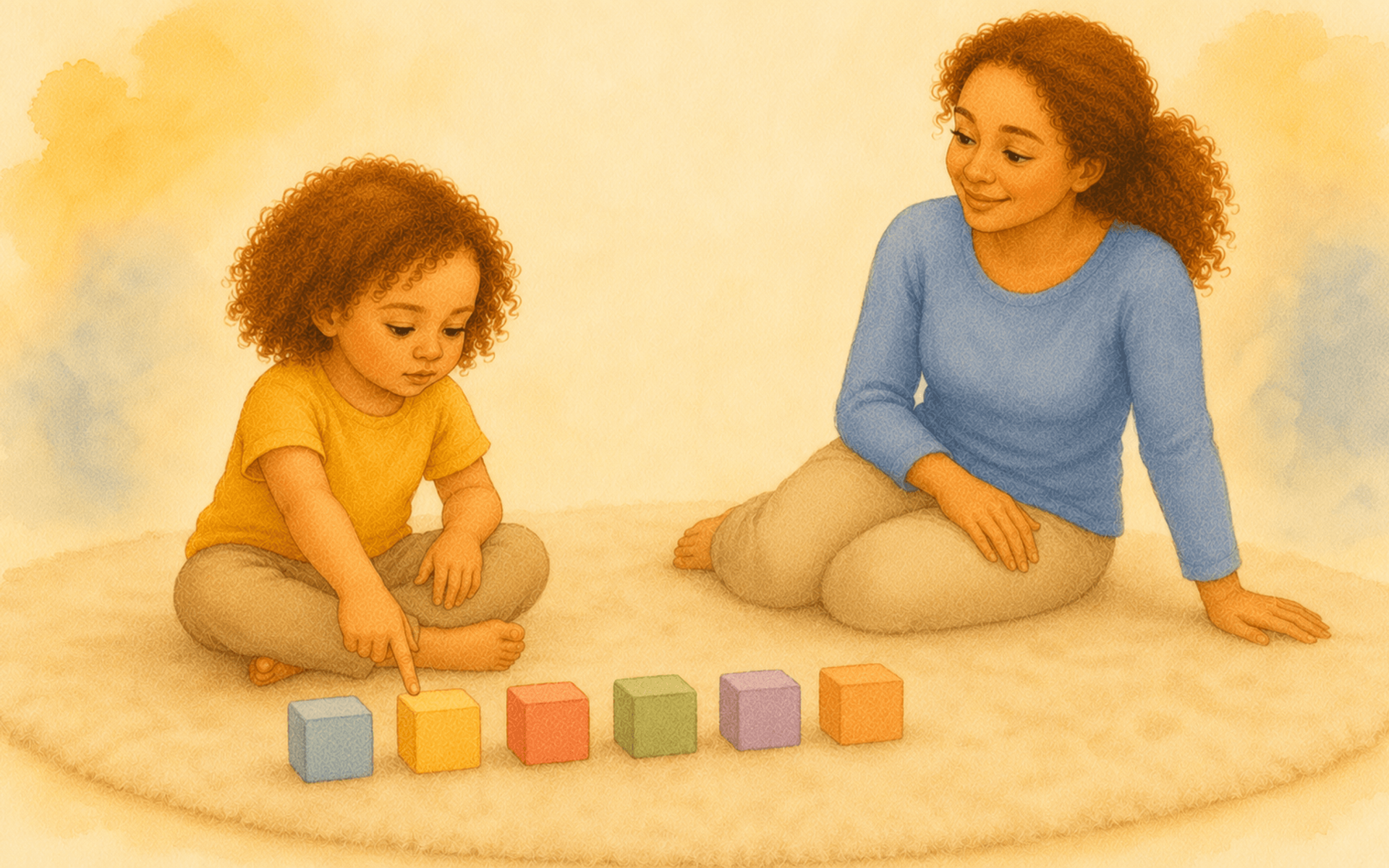
A mom lays out letter magnets on the refrigerator door, uppercase on the left, lowercase on the right, each pair color-matched. Her three-year-old walks over, surveys the arrangement for exactly one second, removes four magnets, and places them in a careful row on the kitchen floor. She announces that they are her students and it is time for school to begin. The activities for a 3 year old that build the brain aren't always the ones anyone assembled on purpose. Sometimes they're whatever your child decided to do with the ones you set out.
- Why 3-year-olds are at the fastest-developing stretch of self-control in childhood, and what that changes about the activities worth choosing
- The specific finding that reframes every activity list you've ever seen
- What the "other minds" problem looks like in your living room, and why it's actually a good sign
- Why "why?" is the most developmentally significant thing your three-year-old says right now
- What research on books and counting actually recommends for this age (it involves rereading the same book more than you'd think)
- The movement number that surprises most parents, and why the playground beats the structured gym class
If the one-sentence answer is enough, you’ve got the gist. If you want the mechanism behind each piece, keep reading.
Why 3 is a different kind of developmental year
Three-year-olds are not simply older two-year-olds. The difference that matters most is not vocabulary or physical coordination but inhibitory control, the brain's ability to hold a rule in mind and stop itself from doing the first thing that comes to mind. Developmental neuroscientist Adele Diamond's widely cited 2013 review in the Annual Review of Psychology identified the preschool years as the period when inhibitory control develops more rapidly than at almost any other point in childhood, and the 3-to-4-year window is where the biggest gains consistently cluster.
What this looks like practically is that a three-year-old can now follow a two-step instruction, wait briefly before opening something, and understand that an object belongs to someone else and should be returned. The 2022 CDC milestone update, whose criteria reflect what at least 75% of children can do by a given age, lists asking "who," "what," "where," and "why" questions, sustaining a two-back-and-forth conversation, drawing a circle when shown how, and calming down within ten minutes of a caregiver leaving as the benchmarks for this age. These aren't arbitrary checkboxes. Each one reflects an executive function capacity that is actively constructing itself during this year, as Zubler and colleagues documented in their 2022 Pediatrics paper on evidence-informed developmental surveillance.
The connection to school readiness runs deep here. A 2015 review by Blair and Raver in the Annual Review of Psychology found that self-regulation (the behavioral expression of executive function) is one of the strongest predictors of early academic outcomes, outperforming even early content knowledge like letter names or counting. A child who can wait, shift attention, and hold a rule in mind is more prepared for a classroom than a child who knows all the letters but cannot yet stay in a seat. The activities you choose at three are directly investing in that foundation.
Vocabulary at three spans wide individual territory, somewhere around 1,000 words on average with enormous variation. Socially, three-year-olds are moving from parallel play (playing side by side without coordination) toward the beginning of cooperative play. A 2022 validation study by Park and colleagues confirmed that the shift from parallel to associative play happens primarily in the 3-to-4-year window, and from associative to genuinely cooperative play by 4-to-5. Your child's current preference for playing next to rather than with another child isn't a social lag; it's the expected developmental position. The shift is coming, and it responds well to pretend.
Pretending is the cognitive mechanism, not just the mode
Here is the finding that reframes every activity list. In 2021, Rachel White and Stephanie Carlson at the University of Minnesota randomly assigned 60 three-year-olds to two conditions. Both groups heard a story, either a fantastical one involving dragons and magic or a realistic one about a trip to the grocery store. Half the children in each story group were asked to pretend: to act out the scenes, become the characters, play the scenario. The other half did a non-pretend activity based on the same story, drawing a scene or coloring. Afterward, all 60 children completed a test of inhibitory control.
Children who engaged in pretend play showed significantly better inhibitory control than children who did the non-pretend activity. And crucially, it made no difference whether the story was fantastical or realistic. A three-year-old who pretended to be a dragon showed no more benefit than one who pretended to be a grocery shopper. The pretending itself was the active ingredient.
This sits within a convergent body of evidence. A five-week randomized trial by Thibodeau, Gilpin, Brown, and Meyer (2016), published in the same journal, assigned preschoolers to daily pretend play sessions, non-imaginative play sessions, or a control condition. Only the pretend group showed improvements in working memory and cognitive flexibility. A 2018 randomized study by Goldstein and Lerner went further: dramatic pretend play games uniquely improved emotional self-control compared with two active control conditions, story time and block play, both of which kept children equally engaged. Pretend was not interchangeable with other forms of stimulation.
The mechanism researchers point to is psychological distance. When a child steps into a role, even briefly, even while playing grocery store with actual cereal boxes from the cabinet, the brain treats the situation as one step removed from immediate reality. That distance decreases the pull of impulsive responses and creates room for reflective ones. The same neural system used during pretend is the one being trained for real-world self-control.
The practical implication is not a different activity list — it is adding pretending to the activities for a 3 year old that you already do. Sorting shapes becomes "you're a scientist sorting specimens." Counting apples becomes a game where one of you is the merchant and the other is the customer. Working through the morning routine using Big Kid Routine Cards becomes the rules of a "real school day" being played out by characters your child has named. The content matters less than the mode. The pretend upgrade takes a sentence to launch.
What the "other minds" problem looks like before it's solved
Alongside executive function, three is the year when theory of mind, the understanding that other people hold beliefs, desires, and knowledge different from your own, begins its most visible construction phase. Theory of mind is tested through what researchers call the false belief task. Here is what it looks like: a child watches a puppet put a toy in a red box, then the puppet leaves the room. While the puppet is gone, you move the toy to a blue box. Then you ask: when the puppet comes back, where will it look for the toy? Three-year-olds almost always point to the blue box, where the toy actually is. They don't yet grasp that the puppet still believes the toy is in the red box, because the puppet wasn't there to see it moved. Their own knowledge and the puppet's knowledge feel, to a three-year-old, like the same thing.
A meta-analysis of 178 studies by Wellman, Cross, and Watson published in Child Development mapped the developmental curve across thousands of children: three-year-olds consistently answer the way that three-year-old in the room always does, and the shift to the correct answer happens primarily between 3.5 and 4.5 years. Your three-year-old genuinely may not register that you don't know what happened in last night's dream, or that grandpa doesn't know where the toy is that needs to be found. This is not selfishness. It is the current state of a cognitive system that is actively being built.
What makes this directly relevant to activity choices is that self-control development and theory of mind development are tightly linked. A 2014 meta-analysis by Devine and Hughes analyzed 102 studies representing nearly 10,000 children aged 3 to 6 and found that self-control consistently predicted theory of mind development, and not the other way around. Children with stronger inhibitory control at three tended to develop better social reasoning at four and five. The ability to wait, hold a rule, and resist the first impulse is the foundation the social reasoning gets built on.
Social pretend play is the most direct practice environment for theory of mind precisely because it requires tracking what another character knows, wants, or is afraid of. The activities for a 2 year old that carry into this year, including object play, stacking, and simple sorting, are still valuable, but the upgrade at three is adding a social and narrative layer that puts the emerging "other minds" capacity to work. The same logic explains why daily routines reduce tantrums at this age: predictable structure reduces the inhibitory demands on the child, freeing cognitive resources for the harder work of figuring out what others want. And the reason a three-year-old's insistence on doing things a specific way is so consistent is that autonomy assertion and executive function development are part of the same system.
The "why" question is doing cognitive work
Somewhere between 2.5 and 3.5 years, the question that dominates your day becomes "why?" and it does not stop. A 2009 study by Frazier, Gelman, and Wellman tracked preschoolers' questions across adult-child conversations and found a specific increase in explanation-seeking questions concentrated in the three-year window, distinct from earlier label-seeking questions ("what's that?") and later clarification questions. Chouinard's 2007 monograph documented that preschoolers' questions are not casual information requests. They are targeted searches that continue until the child receives an explanation that satisfies, and they drive genuine cognitive reorganization.
The practical question for adults is how to respond. The answer is not to provide a complete scientific explanation, and it is not to redirect. Research on productive conversation at this age consistently supports contingent responding: answer what was asked, add one clear causal layer, and pause. "Why does ice melt? Because it's colder than the air around it, and when something warm touches something cold, the cold thing warms up." Then stop. If another "why" is coming, it will come. If not, you've given the right level of information.
Book reading is closely tied to this pattern. Books that provoke questions (where something unexpected happens, where a character faces a problem) are more developmentally productive than books designed to deliver a concept. The question the book generates is the developmental event, not the concept the book was made to teach. This is also why reading to your child and having a conversation about what happens is consistently more effective than reading with a focus on vocabulary delivery.
Books, words, and counting — what actually sticks at 3
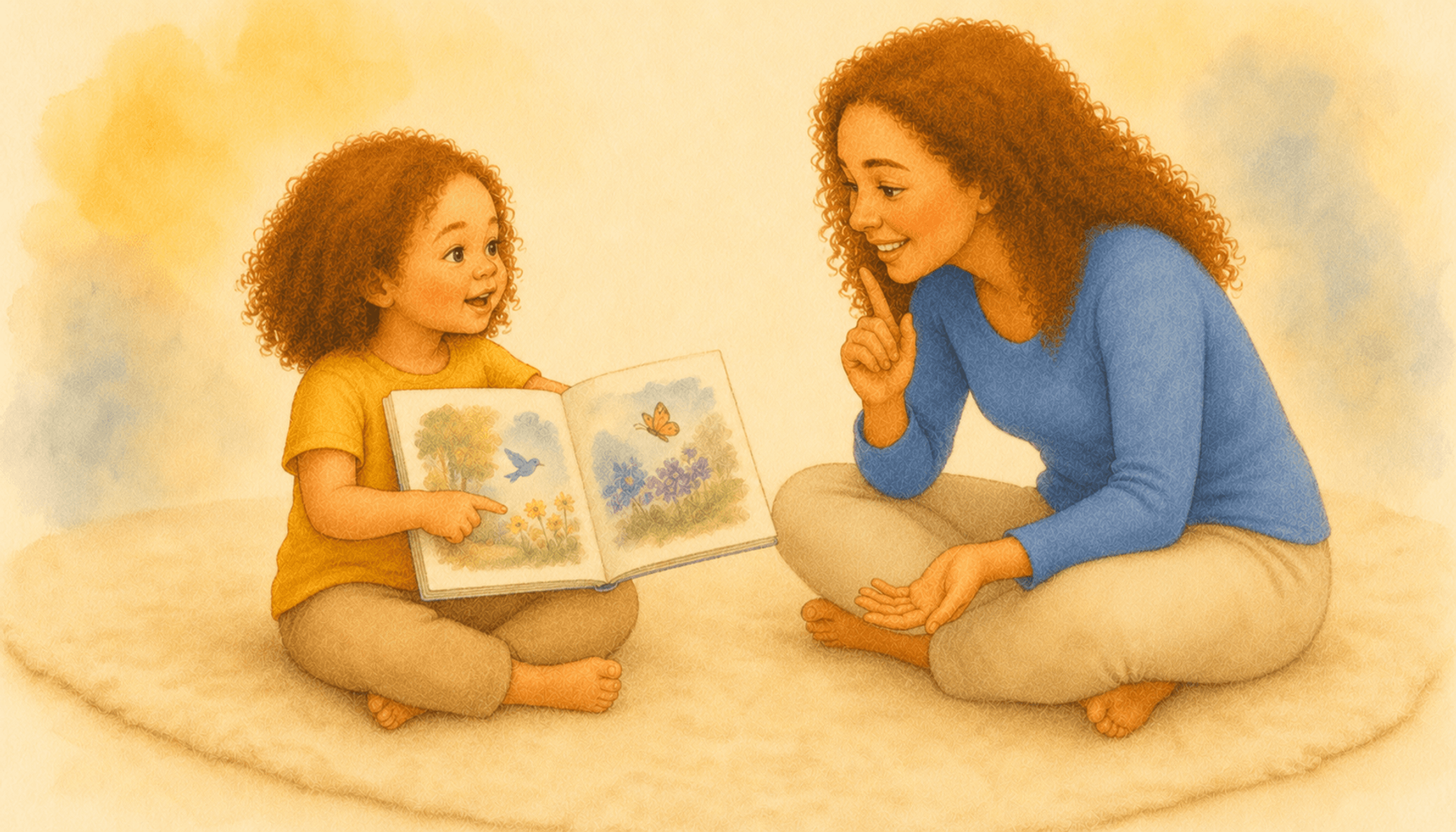
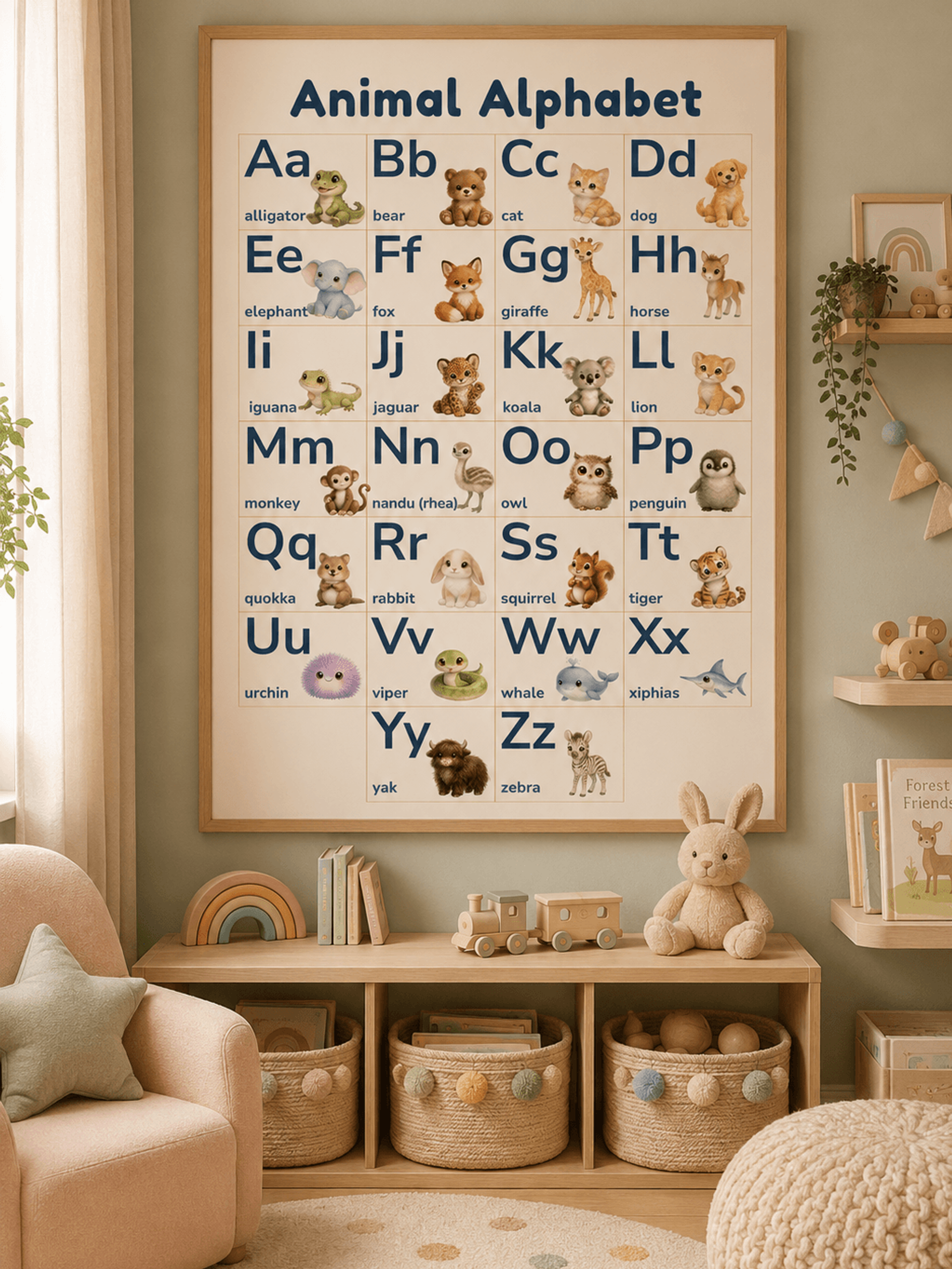
For reading, the most relevant research finding is about repetition. A 2021 study by Breitfeld and colleagues found that children learned roughly 46% of the novel words they encountered in picture books, but the key variable was repeated exposure to the same books rather than constant introduction of new ones. Three-year-olds who heard the same stories multiple times retained new words over time, where children who heard nine different books each once showed only brief retention. The implication is that the book you've read forty-seven times this month is not wasted repetition. It is vocabulary consolidation in progress. The Animal Alphabet Poster works the same way: repeated, low-stakes visual exposure consolidates letter-animal associations that would otherwise require deliberate instruction to stick.
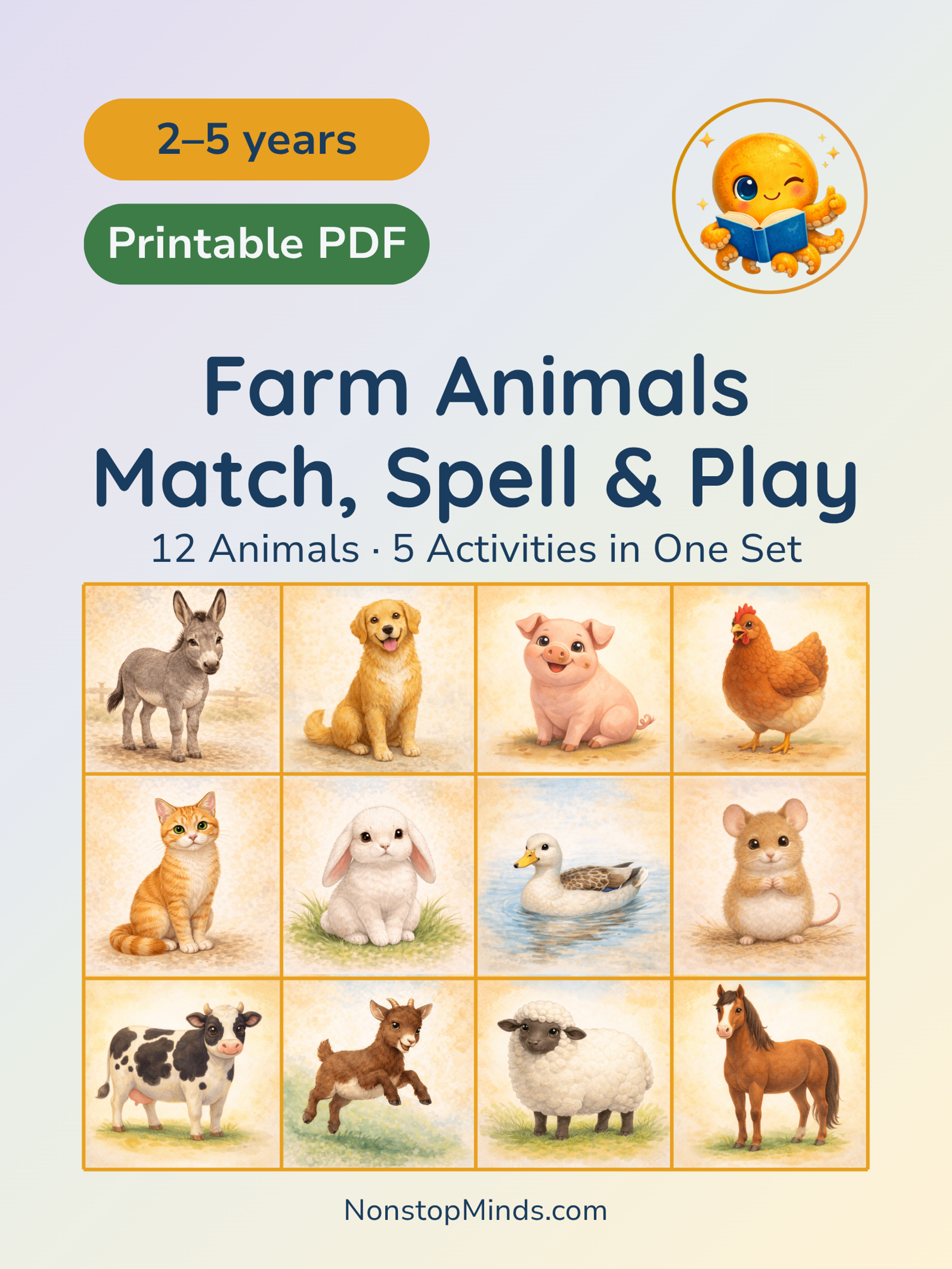
For counting, a 2022 randomized study by Cuder and colleagues at the University of Trieste assigned 86 three-year-olds to a brief numerical training program or a control condition. Children in the counting group improved their counting skills and retained those gains six months later, including a far-transfer effect to cardinality (the understanding that a number refers to a total quantity, not just a sequence of labels). The finding supports early, embedded counting practice at three, not drilling, but weaving counting into daily context. How many spoons are on the table? How many shoes does each person need? The Farm Animals Match, Spell & Play fits into this naturally — the matching and sorting format keeps the activity in the same hands-on, low-pressure register that the research consistently points to.
For letters, the mechanism is the same as for vocabulary. Isolated drilling of letter names is less effective than contextual exposure through reading, songs, and activities where letters appear as tools rather than targets. A three-year-old who plays "school" with an alphabet chart and assigns letters to characters is doing more letter-learning than one sitting through a structured alphabet drill, for the same reason the pretend mechanism outperforms instruction across this age group.
Movement — the 180-minute question
The World Health Organization's 2019 guidelines for children under five recommend that three- and four-year-olds get at least 180 minutes of physical activity each day at any intensity, of which at least 60 minutes should be moderate to vigorous. That's three hours total, spread across the day. The first reaction most parents have to that number is skepticism, but the guidelines reflect an accumulation of evidence linking physical activity to gross motor development, sleep quality, and cognitive outcomes in the early years.
A 2022 analysis of the NHANES National Youth Fitness Survey by Kwon and colleagues, which used light sensors to measure actual daily outdoor time in a nationally representative sample of 3-to-5-year-olds across the United States, found an average of 95 minutes outdoors per day. Children who spent more time outdoors showed better gross motor competency, specifically object-control skills like throwing and catching, independent of their total indoor physical activity level. Time outside appears to matter beyond the movement it produces, likely because outdoor environments offer more variable and unstructured physical challenges than indoor ones.
The finding from Colliver and colleagues' 2022 longitudinal study of 2,213 Australian children adds a different angle: unstructured free play at ages 2 to 3 predicted self-regulation at ages 4 to 5, even after controlling for earlier self-regulation levels. This is not the same as saying any outdoor time counts. It is saying that time where your child decides what happens, without an adult directing the play, is building the same self-regulation capacity that the pretend play research targets through a different mechanism. Running through a yard, climbing a tree, deciding what to do with a stick and a mud puddle: these are not gaps in the activity schedule for a 3 year old. They are part of it.
The structured gym class for three-year-olds is not harmful. But if the choice is between a structured class and an additional hour of outdoor free play, the evidence does not obviously favor the class.
Frequently Asked Questions
The most research-supported answer is self-regulation, language, and early numeracy, though learning all three at three looks different from academic instruction. The 2022 CDC milestones, developed by Zubler and colleagues, expect most three-year-olds to be consolidating two-back-and-forth conversation, describing actions in pictures, and drawing a circle when shown. Self-regulation builds through pretend play, as shown in multiple randomized trials. Early numeracy builds through embedded counting in daily activity, with gains that persist six months later (Cuder et al., 2022). Language builds through repeated book reading and responsive conversation. The consistent finding across all three areas is that play is the delivery mechanism, not a break from learning.
The most sustainable approach is one that doesn't require constant adult input: a pretend frame. Three-year-olds sustain attention longer in activities that have a character, a role, or a "pretend we're" premise than in the same activities presented as open-ended play. Setting up the activity matters less than launching the pretend context. A box of blocks with "you're an architect building the tallest skyscraper in the city" runs longer than blocks alone. A bin of play food with "I'll be the customer and you're running the restaurant" outlasts the same bin with no frame. The activity can be simple. The pretend element does the work.
Educational at three means targeting executive function, language, and early social reasoning, the capacities Blair and Raver's 2015 review identified as the strongest predictors of school outcomes. Practically, that means pretend play in any form, repeated reading of the same books with questions, outdoor unstructured play, simple counting with real objects, and any scenario that asks your child to track what another person knows or wants. The marker of an educational activity for a three-year-old is not whether it looks like school. It is whether it asks your child to hold a rule in mind, generate language, or think about someone else's perspective.
For educational and informational purposes only. Not a substitute for professional medical or developmental advice. If you have concerns about your child's development, consult your pediatrician or a qualified developmental specialist.
- Blair, C., & Raver, C. C. (2015). School readiness and self-regulation: A developmental psychobiological approach. Annual Review of Psychology, 66, 711–731.
- Breitfeld, E., Schroer, S. E., Ferry, A. L., & Thiessen, E. D. (2021). Children simultaneously learn multiple dimensions of information during shared book reading. Journal of Cognition and Development, 22(5), 744–766.
- Centers for Disease Control and Prevention. (2022). Milestones by 3 years. Learn the Signs. Act Early.
- Chouinard, M. M. (2007). Children's questions: A mechanism for cognitive development. Monographs of the Society for Research in Child Development, 72(1, Serial No. 286), 1–112.
- Colliver, Y., Harrison, L. J., Brown, J. E., & Humburg, P. (2022). Free play predicts self-regulation years later: Longitudinal evidence from a large Australian sample of toddlers and preschoolers. Early Childhood Research Quarterly, 59, 148–161.
- Cuder, A., Vidoz, M., De Vita, C., Pellizzoni, S., & Passolunghi, M. C. (2022). Numerical training videos and early numerical achievement: A study on 3-year-old preschoolers. Brain Sciences, 12(1), Article 88.
- Devine, R. T., & Hughes, C. (2014). Relations between false belief understanding and executive function in early childhood: A meta-analysis. Child Development, 85(5), 1777–1794.
- Diamond, A. (2013). Executive functions. Annual Review of Psychology, 64, 135–168.
- Frazier, B. N., Gelman, S. A., & Wellman, H. M. (2009). Preschoolers' search for explanatory information within adult-child conversation. Child Development, 80(6), 1592–1611.
- Goldstein, T. R., & Lerner, M. D. (2018). Dramatic pretend play games uniquely improve emotional control in young children. Developmental Science, 21(4), e12603.
- Kwon, S., Tandon, P. S., O'Neill, M. E., & Becker, A. B. (2022). Cross-sectional association of light sensor-measured time outdoors with physical activity and gross motor competency among U.S. preschool-aged children: The 2012 NHANES National Youth Fitness Survey. BMC Public Health, 22(1), Article 833.
- Park, H.-Y., Yoo, H., Kim, J., & Joung, Y.-S. (2022). Development of a social play evaluation tool for preschool children. International Journal of Environmental Research and Public Health, 19(3), Article 1232.
- Thibodeau, R. B., Gilpin, A. T., Brown, M. M., & Meyer, B. A. (2016). The effects of fantastical pretend-play on the development of executive functions: An intervention study. Journal of Experimental Child Psychology, 145, 120–138.
- Wellman, H. M., Cross, D., & Watson, J. (2001). Meta-analysis of theory-of-mind development: The truth about false belief. Child Development, 72(3), 655–684.
- White, R. E., & Carlson, S. M. (2021). Pretending with realistic and fantastical stories facilitates executive function in 3-year-old children. Journal of Experimental Child Psychology, 207, Article 105090.
- World Health Organization. (2019). Guidelines on physical activity, sedentary behaviour and sleep for children under 5 years of age. World Health Organization.
- Zubler, J. M., Wiggins, L. D., Macias, M. M., Whitaker, T. M., Shaw, J. S., Squires, J. K., & Lipkin, P. H. (2022). Evidence-informed milestones for developmental surveillance tools. Pediatrics, 149(3), e2021052138.
More Articles
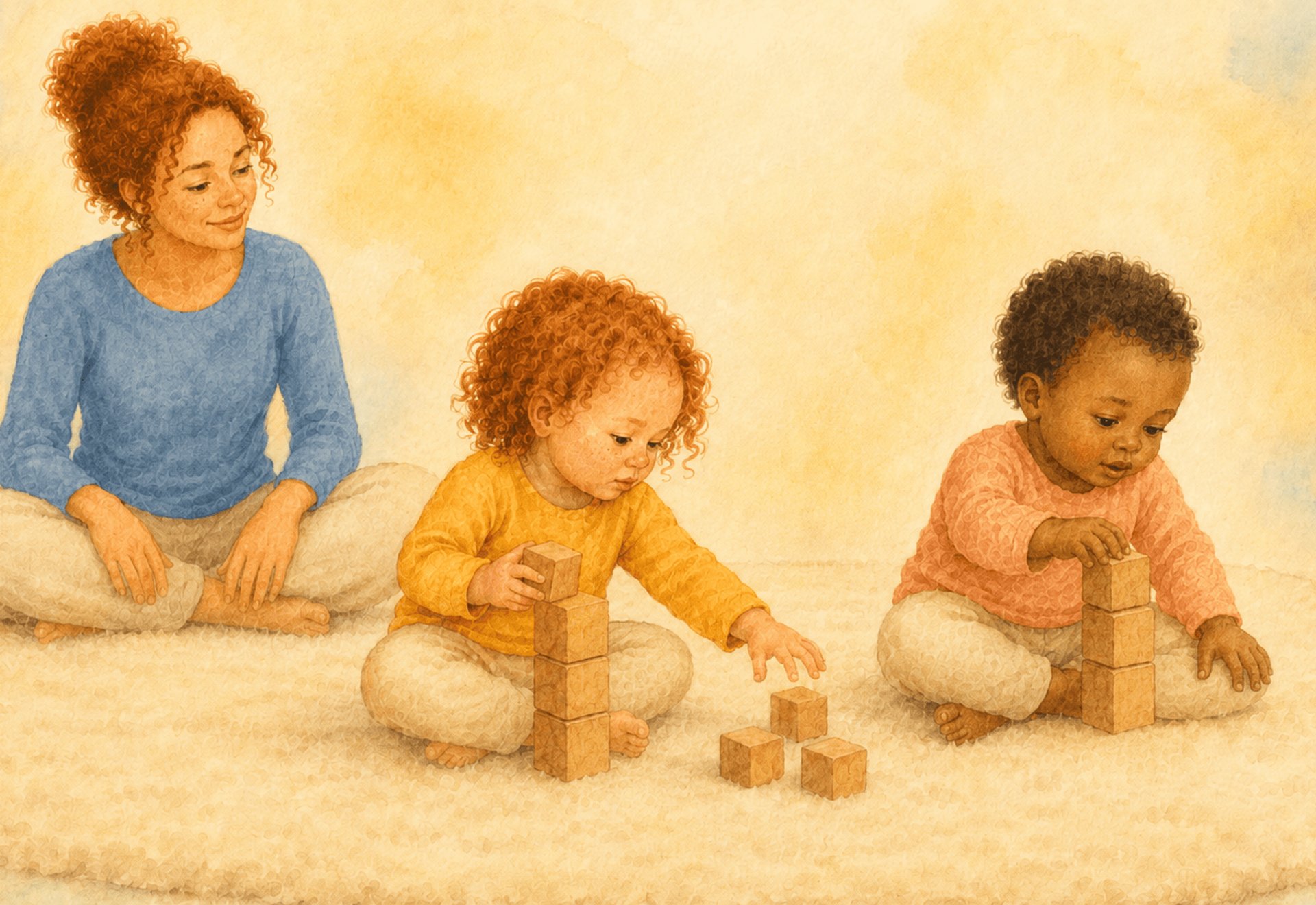
Parallel Play in Toddlers: Why Side-by-Side Is the Social Work
Your toddler spent the entire playdate building separate towers, and nobody shared a single block. That counted — more than it looked. A 2025 longitudinal study found that playing beside a specific child consistently predicted later social play with that same child, but not the other way around. Here's what parallel play in toddlers actually is, why the science calls it strategic rather than passive, and what it means for how you run a playdate.
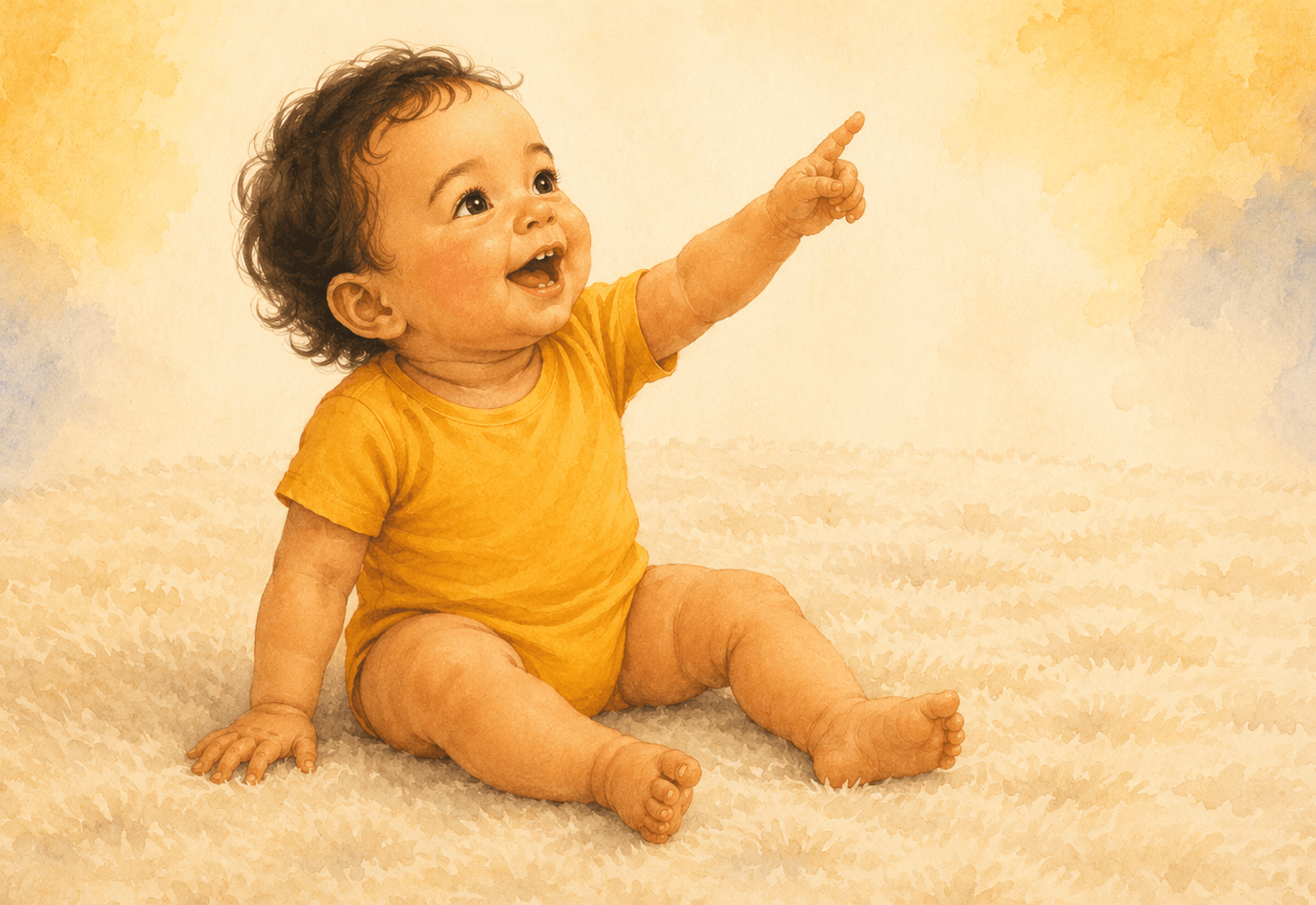
When Do Babies Point: Why It Matters for Language
Most milestone articles treat pointing as a box to check around 12 months. The research tells a different story — one that starts months earlier, runs through the infant brain, and traces back to how much the parent is pointing. Here's what the last fifteen years of research actually found, and what it means for everyday interactions.
When Do Babies Wave Bye-Bye: Why Your Baby Needs You to Wave First
Most baby milestones unfold on a biological schedule — waving isn't one of them. A 2023 study found that babies develop imitation ability because their caregivers imitate them first, and waving is named directly as a cultural gesture learned through that loop. Here's what the research says about the 9–12 month window, why the first wave looks nothing like a wave, and what helps it arrive.