2 Year Old Words: Beyond the 50-Word Milestone

Two-year-olds at a birthday party can look strikingly different from each other. One narrates the whole event — there's a balloon, there's cake, the doggie is BIG. Another mostly points, uses a handful of sounds that only a parent can decode, and seems perfectly content with that arrangement. Both children just turned two. Both of their parents typed "2 year old words" into a search bar the week before, found the number fifty, and put their phones down no less confused. The fifty is real. It is also only part of the story.
- Why "50 words" and "300 words" are both correct answers to the same question — and what each number actually measures
- What changed in the 2022 CDC milestone update and why the new number is a floor, not an average
- Why two-word combinations carry more predictive weight than vocabulary size at this age
- What happens to language between 18 and 24 months — and why the spurt looks sudden even when it isn't
- The everyday inputs that genuinely move the needle on 2 year old words
- The specific patterns worth raising with a pediatrician, framed without alarm
If the one-sentence answer is enough, you’ve got the gist. If you want the mechanism behind each piece, keep reading.
How many words should a 2 year old say — and where does fifty come from
Fifty words at 24 months became the standard answer in parenting circles because it was the milestone listed in the CDC's previous developmental checklist, where it reflected the vocabulary size of roughly half of all children that age. That's the midpoint, not the minimum. In 2022, the CDC updated its milestones using a refined methodology, described in a paper by Zubler and colleagues published in Pediatrics, that repositioned milestones as a clearer clinical screening floor rather than an average expectation. Under the new criteria, milestones represent what roughly 75 percent of children can achieve. The 50-word expectation shifted to 30 months; at 24 months, the updated checklist highlights two-word combinations, pointing to pictures in books, and following simple instructions as the primary language markers.
That methodological shift is why parents searching today encounter different numbers depending on which source they read. The American Speech-Language-Hearing Association (ASHA) still considers fewer than 50 words at 24 months a pattern worth discussing with a pediatrician. The CDC checklist now places 50 words at 30 months. Neither is wrong; they're answering slightly different questions. One describes a clinical concern threshold; the other describes what most children can do by a given age.
The large-scale norming research behind these milestones tells a fuller story. The MacArthur-Bates Communicative Development Inventories, which have tracked expressive vocabulary in thousands of English-speaking children since the early 1990s, put the median vocabulary at 24 months at approximately 276 words for boys and 338 words for girls, with a wide spread on either side. Two children with very different word counts at 24 months can both be developing in a way that gives no cause for concern. The fifty is the floor; what's considered the normal range is considerably wider than most of the internet suggests.
For parents navigating the earlier stage of this journey, our article on when babies start talking covers first words from 10 to 14 months and explains what makes a vocalization count as a real word.
What 2 year old words actually look like up close

A word at this age doesn't need to be pronounced the way it appears in a dictionary. What makes a sound a word is consistency and intent: the child uses it reliably, independently, and with a clear referent.
"Buh" said every time a bus goes past is a word. "Nana" used only for banana is a word. "Wawa" for water is a word. What doesn't count is a babbling chain produced without a clear referent: "bababa" or "mamama" said while staring at the ceiling. Speech-language pathologists look for a stable connection between a sound and its meaning, not for pronunciation that matches the adult form.
At 24 months, vocabulary in most children includes a mix of categories. There are nouns (the names of familiar objects, animals, and people), action words like "go," "eat," and "up," social words like "no," "more," and "mine," and early descriptives like "big," "hot," and "gone." These categories matter more than most word-count articles acknowledge. Research published in Language, Speech, and Hearing Services in Schools by Hadley, Rispoli, and Hsu in 2016 found that verb and action-word variety at 24 months predicts grammatical development at 30 months. The mix of what a child says carries information that a raw count doesn't capture.
Our First Words flashcard sets are organized around exactly this kind of category-building practice, pairing objects with labels in contexts that make the connection clear and repeatable.
Why two-word combinations matter more than the count

The research on what predicts later language outcomes shifts the focus away from vocabulary size and toward something parents can observe directly: whether a child is beginning to put two words together on their own.
A 2016 study by Rudolph and Leonard in the Journal of Early Intervention found that children who were late to begin combining words carried a higher risk for future language difficulties than children who were late to say first words. The combination milestone, in other words, is a stronger signal than the first-word milestone, and it's also easier to track than maintaining a running vocabulary count.
What qualifies as a true combination, clinically, is a child-generated pairing of two different words expressing two different ideas: "more juice," "daddy go," "big dog," "baby sleep." What doesn't count are memorized social chunks like "all gone," "thank you," and "what's that," because these function as single units the child has stored whole rather than combinations being constructed independently. The distinction sounds subtle; it's actually observable. A child who says "ball go" when rolling a ball across the floor is putting two concepts together. A child who says "all done" when the meal is over may be producing a single learned phrase.
The ELVS cohort study, a longitudinal study of 1,911 children by Reilly and colleagues published in Pediatrics in 2010, found that late-talker status at 24 months, defined as reduced vocabulary combined with an absence of word combinations, was one of the earliest measurable predictors of language outcomes at age four. The combinations, not the count, did much of the predictive work.
This is why tracking combinations matters at the two-year mark even when word count looks fine. A toddler producing 100 words as isolated labels is in a somewhat different developmental position than one producing 100 words and beginning to link them. Both may be developing without cause for concern; the combinations are the signal to follow. Our article on how to help your baby talk covers the interaction strategies that support exactly this kind of productive word-pairing.
The vocabulary explosion: what's actually happening between 18 and 24 months
The acceleration that happens around this age can look almost sudden from the outside. Parents describe days where a child seems to pick up three or four words, followed by quieter stretches where nothing new is visible. Then another burst. Normative CDI data shows the underlying rate rising from roughly 20 new words per month between 17 and 20 months to approximately 46 new words per month between 21 and 24 months. This is partly why the months around the second birthday feel so eventful linguistically.
Part of what makes this acceleration possible is a skill called fast-mapping. By around 18 months, children can attach a rough meaning to a new word after very few exposures, without stopping to fully analyze it. They're building a preliminary connection and refining it over subsequent encounters. In a 1990 study in the Journal of Child Language, Goldfield and Reznick tracked 18 children through this period and found that 13 showed a discrete vocabulary spurt while 5 followed a more gradual trajectory. Both patterns produced similar vocabulary sizes by 24 months.
A 2007 paper by McMurray in Science modeled why spurts appear even without any single cognitive switch being flipped: when children are simultaneously learning many words of varying difficulty, the easier ones accumulate visibly while the harder ones progress invisibly until they cross a recognition threshold. The spurt is less a neurological event than a consequence of learning in parallel. A quiet two-week stretch doesn't signal a plateau; it often means the work is happening where it can't yet be seen.
For parents wanting to create the right conditions during this period, the activities for a 2 year old on the blog are built around varied, low-pressure exposure, the conditions that support parallel word-learning most efficiently.
What actually helps 2 year old words grow

The research on what moves vocabulary at this age is reasonably consistent, and the most effective inputs are also among the most low-tech.
Shared book reading, when it includes pointing, naming, and responding to whatever the child notices, is one of the best-supported vocabulary inputs in the literature. The key variable isn't the book itself; it's the back-and-forth that happens around it. A parent who pauses when the child points, names what the child is looking at, and extends it slightly ("ball, big ball, look, it's rolling") is giving language exactly the context that makes a new word stick. The word lands when the child is already attending to the referent, which is when the connection forms most efficiently.
Responsive talking, labeling what the child is attending to rather than redirecting to what the parent wants to discuss, provides the same kind of context-first input. Research published in the Journal of Child Language by Davies, Hendry, and Gonzalez-Gomez in 2023 found that caregiver sensitivity and responsiveness predicted vocabulary growth even during pandemic lockdowns, when access to outside language input was severely limited. The quality of the interaction, in other words, matters as much as its quantity.
The Match & Spell sets work on a similar principle: the child handles the card or object, the name is provided in the moment of attention, and the connection forms when it has the best chance of being retained.
Predictable daily routines also create language-learning conditions that are easy to underestimate. When a two-year-old knows what's coming next, attention is freed up for processing the words around an activity rather than monitoring what the activity will be. Our piece on why routines matter for toddlers makes this case from the behavior angle; the language benefit runs alongside it.
Narrating the day, describing what's happening without requiring a verbal response, provides steady word exposure embedded in exactly the contexts where those words will be needed again. "We're putting the shoes on. One shoe, two shoes. Ready to go." The learning happens as a byproduct of the conversation, which is why the same input that builds vocabulary also builds the relationship. They're not two separate projects.
For moments when the day is too full to invent activities on the spot, our Match & Spell sets give a ready-made naming-and-matching activity that slots into exactly these short windows: the child handles the card, you name it, and the connection forms in the moment of attention. The activities for an 18 month old article covers the run-up to this vocabulary acceleration, for parents who want to trace the arc from the earlier stage.
When it's worth mentioning to the pediatrician
The patterns worth flagging are specific, and naming them replaces ambient worry with something more useful.
A two-year-old who isn't yet using any two-word combinations — not "more milk," not "mama up," not any pairing of two independent words — is the primary pattern worth raising at the next well-child visit. A child with clearly fewer than 50 words at 24 months is the pattern ASHA considers a reason to check in regardless of what the CDC checklist now shows at that age. A child who had words and has lost them is the clearest reason to call sooner rather than wait for a scheduled appointment.
Late talking at two is common. ASHA estimates somewhere between 10 and 20 percent of two-year-olds qualify, and many of these children are late bloomers who catch up fully without any intervention. But early evaluation by a speech-language pathologist gives a clearer picture of whether a child's trajectory is likely to self-correct or would benefit from support, and the evidence consistently shows that early intervention, when it's needed, produces better outcomes than a wait-and-see approach.
A child who understands a great deal (following two-step instructions, pointing to named pictures in books, responding to questions even without answering aloud) is in a meaningfully different position from a child with reduced comprehension alongside reduced expression. At 24 months, the gap between what a toddler understands and what they can say is large under any circumstances; a child producing 100 words likely comprehends several times more. When comprehension is also clearly lagging, that combination is the one worth raising first and most directly.
Frequently Asked Questions
The CDC's 2022 milestone update moved the 50-word expectation from 24 months to 30 months, where it now serves as a screening floor that approximately 75 percent of children reach by that age (Zubler et al., 2022, Pediatrics). At 24 months, the CDC checklist highlights two-word combinations, pointing to pictures in books, and following simple one-step instructions as the primary language markers. ASHA continues to treat fewer than 50 words at 24 months as a pattern worth discussing with a pediatrician.
At 24 months, a child's vocabulary usually includes a mix of nouns, action words, social words, and early descriptives. Research based on the MacArthur-Bates Communicative Development Inventories puts the median at approximately 276 words for boys and 338 for girls, though the normal spread at this age is wide in both directions. Vocabulary variety (words from several different categories) is more informative than total count, since verb and action-word diversity at 24 months predicts grammatical development at 30 months (Hadley, Rispoli, and Hsu, 2016).
Rather than a fixed target list, speech-language pathologists look for variety across categories: names for familiar people and objects, action words ("eat," "go," "up," "help"), social words ("more," "no," "mine"), and early descriptives ("big," "hot," "gone"). A child's vocabulary will also include words specific to their household and daily routines. Variety across categories matters more than hitting a number. A child with 60 words drawn from several of these groups is in a different position from one with 60 words made up entirely of nouns.
A large gap between comprehension and expression at 24 months is common and is generally a more reassuring pattern than reduced comprehension alongside reduced expression. A toddler who follows two-step instructions, points to named pictures, and responds to questions even without verbal answers has a functioning receptive language system, and the expressive side often catches up. That said, if expressive vocabulary is clearly below 50 words and no two-word combinations have appeared, it's worth mentioning at the next pediatric visit regardless of how strong comprehension appears.
Late-talker status is generally defined as fewer than 50 words and no word combinations at 24 months. A child at or just below that threshold with combinations beginning to emerge is in a different position from one with neither element in place. A speech-language pathologist evaluation can clarify whether the pattern reflects a late-bloomer trajectory or one that would benefit from support. Early evaluation doesn't commit anyone to a course of treatment; it provides clearer information at a point when that information is most actionable.
For educational and entertainment purposes only. Not a substitute for professional medical or speech-language pathology advice. If you have concerns about your child's speech or language development, consult your pediatrician or a certified speech-language pathologist.
- American Speech-Language-Hearing Association. (2022). ASHA comments on CDC and AAP developmental milestones updates.
- American Speech-Language-Hearing Association. Late language emergence. ASHA Practice Portal.
- Centers for Disease Control and Prevention. (2022). Learn the signs. Act early. Developmental milestone checklists.
- Davies, C., Hendry, A., & Gonzalez-Gomez, N. (2023). Caregiver sensitivity and toddler vocabulary during COVID-19 lockdowns. Journal of Child Language.
- Eriksson, M., Marschik, P. B., Tulviste, T., Almgren, M., Pérez Pereira, M., Wehberg, S., Marjanovic-Umek, L., Gayraud, F., Kovacevic, M., & Gallego, C. (2012). Differences between girls and boys in emerging language skills: Evidence from 10 language communities. British Journal of Developmental Psychology, 30(2), 326–343.
- Fenson, L., Dale, P. S., Reznick, J. S., Bates, E., Thal, D. J., & Pethick, S. J. (1994). Variability in early communicative development. Monographs of the Society for Research in Child Development, 59(5), 1–185.
- Goldfield, B. A., & Reznick, J. S. (1990). Early lexical acquisition: rate, content, and the vocabulary spurt. Journal of Child Language, 17(1), 171–183.
- Hadley, P. A., Rispoli, M., & Hsu, N. (2016). Toddlers' verb lexicon diversity and grammatical outcomes. Language, Speech, and Hearing Services in Schools, 47(1), 44–58.
- Marchman, V. A., & Dale, P. S. (2023). MacArthur-Bates Communicative Development Inventories: updates from the CDI Advisory Board. Frontiers in Psychology, 14, 1170303.
- McMurray, B. (2007). Defusing the childhood vocabulary explosion. Science, 317(5838), 631.
- Reilly, S., Wake, M., Ukoumunne, O. C., Bavin, E., Prior, M., Cini, E., Conway, L., Eadie, P., & Bretherton, L. (2010). Predicting language outcomes at 4 years of age: findings from Early Language in Victoria Study. Pediatrics, 126(6), e1530–e1537.
- Rescorla, L. (1989). The Language Development Survey: a screening tool for delayed language in toddlers. Journal of Speech and Hearing Disorders, 54(4), 587–599.
- Rudolph, J. M., & Leonard, L. B. (2016). Early language milestones and specific language impairment. Journal of Early Intervention, 38(1), 41–58.
- Zubler, J. M., Wiggins, L. D., Macias, M. M., Whitaker, T. M., Shaw, J. S., Squires, J. K., Pajek, J. A., Wolf, R. B., Slaughter, K. S., Broughton, A. S., Gerndt, K. L., Mlodoch, B. J., & Lipkin, P. H. (2022). Evidence-informed milestones for developmental surveillance tools. Pediatrics, 149(3), e2021052138. https://doi.org/10.1542/peds.2021-052138
More Articles
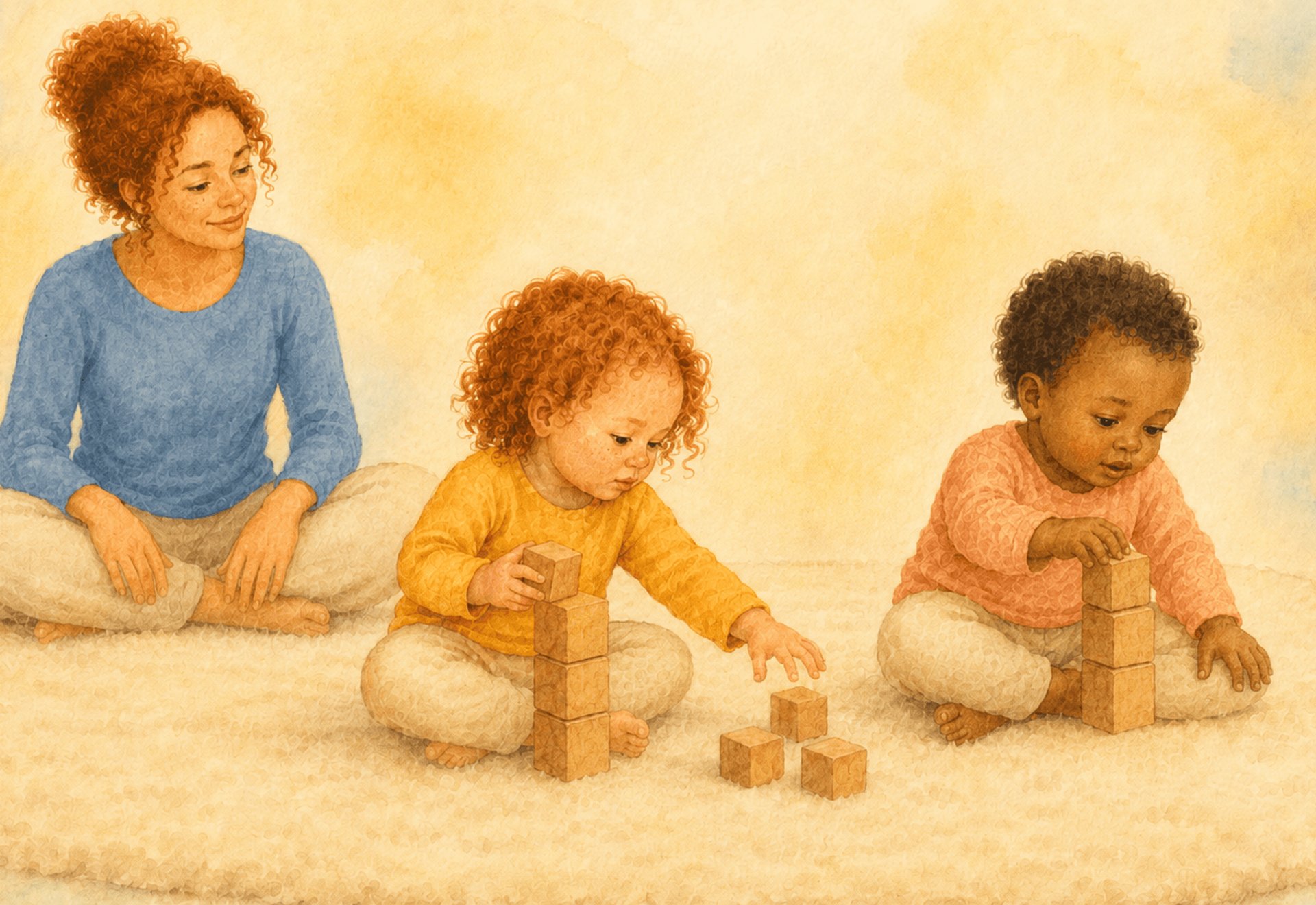
Parallel Play in Toddlers: Why Side-by-Side Is the Social Work
Your toddler spent the entire playdate building separate towers, and nobody shared a single block. That counted — more than it looked. A 2025 longitudinal study found that playing beside a specific child consistently predicted later social play with that same child, but not the other way around. Here's what parallel play in toddlers actually is, why the science calls it strategic rather than passive, and what it means for how you run a playdate.

When Do Babies Point: Why It Matters for Language
Most milestone articles treat pointing as a box to check around 12 months. The research tells a different story — one that starts months earlier, runs through the infant brain, and traces back to how much the parent is pointing. Here's what the last fifteen years of research actually found, and what it means for everyday interactions.

When Do Babies Wave Bye-Bye: Why Your Baby Needs You to Wave First
Most baby milestones unfold on a biological schedule — waving isn't one of them. A 2023 study found that babies develop imitation ability because their caregivers imitate them first, and waving is named directly as a cultural gesture learned through that loop. Here's what the research says about the 9–12 month window, why the first wave looks nothing like a wave, and what helps it arrive.