Activities for a 2 Month Old: What Changed and What to Do About It
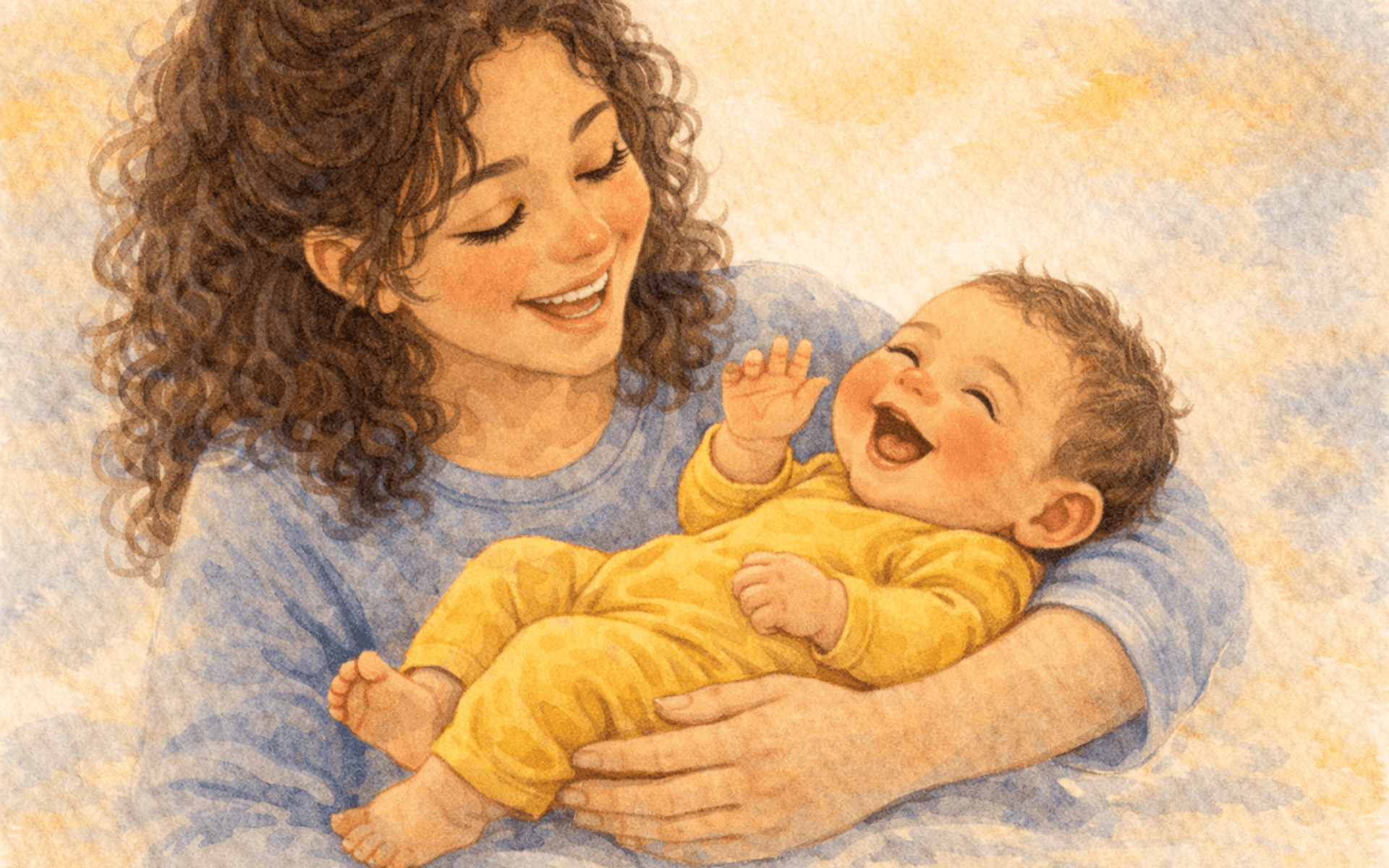
Your baby just smiled at you — not the gassy half-squint from three weeks ago, but an actual, eyes-crinkling, mouth-wide-open smile aimed directly at your face in response to your voice. And you stood there with your coffee going cold, thinking did that just happen, while simultaneously reaching for your phone to tell everyone you've ever met. Welcome to month two. Everything is about to feel different.
Most articles about activities for a 2 month old will hand you the same list you got last month — tummy time, black-and-white cards, talk to your baby. And those activities still matter. But your baby's brain has crossed a threshold that changes what those same activities actually do.
- What shifted in the brain between month one and month two — and why the CDC 2022 milestones mark a real threshold
- The 2015 PLOS ONE study on infant smile strategy — and three concrete things to do differently during face-to-face play
- How to use cooing as the foundation for language turn-taking — and why the pause matters more than the response
- Why intentional touch still matters at 2 months — and what the Maitre 2017 study says about this window closing
- How tummy time changes at 2 months — and what visual motivation does for head-lifting duration
If the one-sentence answer is enough, you’ve got the gist. If you want the mechanism behind each piece, keep reading.
What Changed Between Month One and Month Two
The shift from one month to two months is one of the largest developmental leaps of the entire first year, and most of it is invisible. At one month, the brain was building a raw sensory map — collecting data on what light looks like, what touch feels like, what your voice sounds like from outside the womb. By two months, it has shifted from collecting to responding. The CDC's revised 2022 milestones, developed by Zubler and colleagues and published in Pediatrics, were recalibrated so that 75% of infants reach each benchmark by the listed age — and the two-month list includes behaviors that signal genuine social awareness for the first time. The AAP's HealthyChildren.org developmental guide for two months echoes this: the baby now "seems happy to see you when you walk up," which is a polite way of saying the brain has figured out who you are and is actively glad about it.
Wake windows have stretched from the 30-to-60-minute range to roughly 60 to 90 minutes. That sounds like a scheduling detail, but it changes everything about what you can actually do together during activities for a 2 month old wake window. At one month, you had time for maybe one activity before the next nap. Now a wake window fits a feed, a short activity, a diaper change, and still leaves a few minutes of calm alert time. The difference between 45 minutes and 75 minutes of awake time is the difference between survival mode and something that actually resembles playing together.
Your Baby Is Already Gaming Your Smile
Here's something that will reframe how you think about every smile game from now on. Fantz showed in 1963 that newborns prefer to look at faces over every other visual stimulus — faces beat geometric patterns, random shapes, and scrambled features every time. By two months, that preference has deepened into something the brain uses strategically.
A 2015 study in PLOS ONE by Ruvolo, Messinger, and Movellan used control theory — the same math used to program robots — to reverse-engineer the goals behind infant smiling. They tracked 13 mother-infant pairs from 4 to 17 weeks of age and analyzed every smile onset, every pause, every offset.
What they found: mothers timed their smiles to maximize moments when both mother and baby were smiling simultaneously. Ten out of thirteen mothers showed this pattern. That's the goal you'd expect — mutual joy, shared connection.
But infants had a completely different goal. Eleven out of thirteen babies timed their smiles to maximize moments when mother was smiling but the baby was not. Read that again. Your baby's smile isn't just an expression of happiness — it's a strategic signal designed to get you to smile at them, and once you're smiling, the signal is no longer needed. The researchers confirmed this by programming the infant smile strategy into a child-like robot named Diego-San: the robot successfully got adults to smile more using the exact same timing pattern.
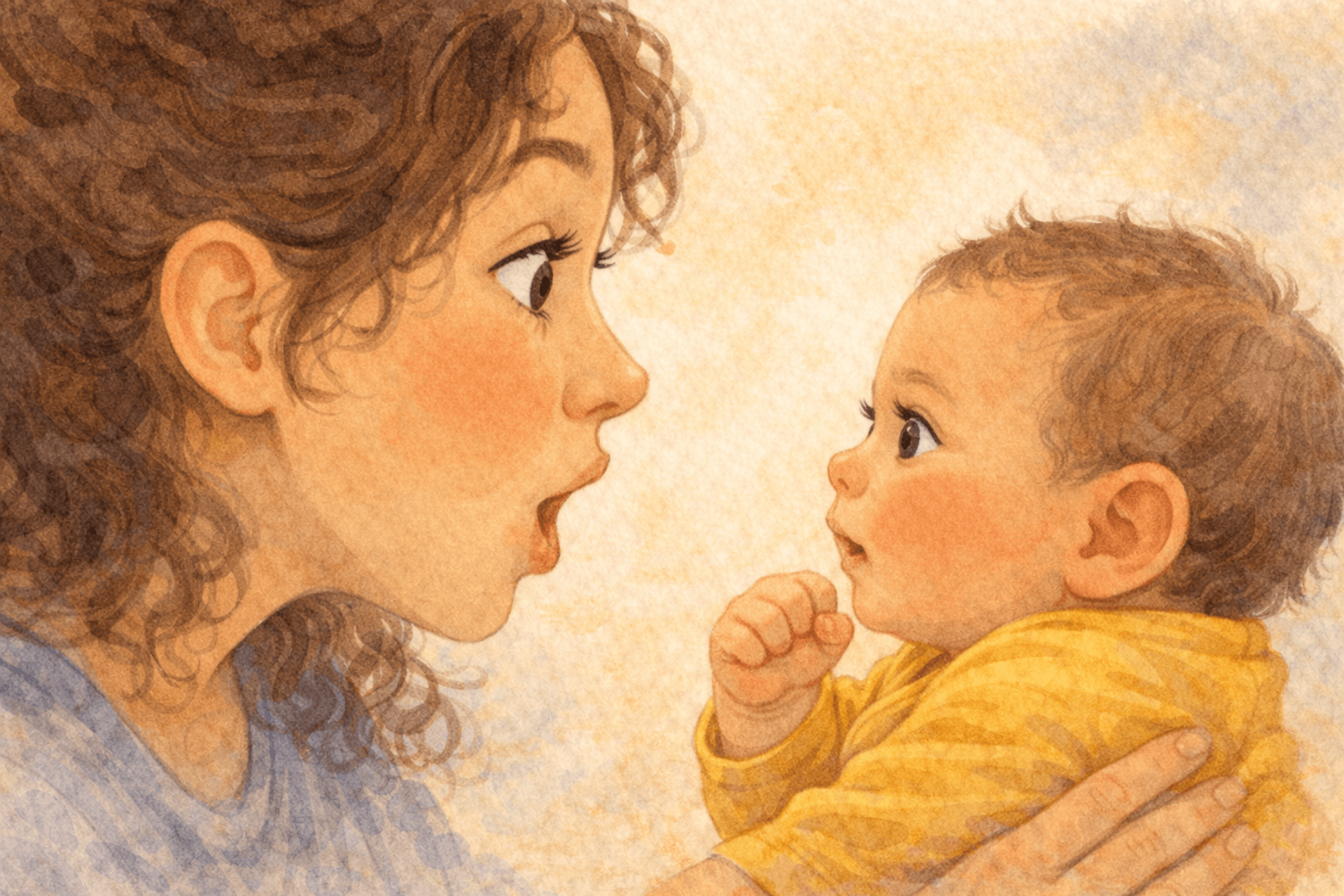
What this means for your two-month-old activities: when you make an exaggerated face and your baby smiles, then stops smiling while staring at you — that's not disinterest. That's a two-month-old brain running the social loop the Ruvolo study documented. And there are three concrete things you can do with this knowledge.
First, don't rush to fill the pause. When your baby stops smiling and just watches you, resist the urge to immediately make another face or add a sound. That pause is the active phase — the baby is processing the exchange and deciding when to initiate again. Interrupting it is like finishing someone's sentence mid-thought.
Second, give bigger reactions. Your baby is trying to trigger your smile, so exaggerated expressions — wide eyes, raised eyebrows, open-mouth surprise, a slow gasp — give a clearer reward signal. The bigger and more readable your reaction, the more material the social timing system has to work with.
Third, play the game in rounds. Smile, pause, wait for baby's smile, react, pause again. Three to five rounds is a full session at two months. When the baby looks away or fusses, the session is over — and it was enough.
Cooing Is Your Baby's First Conversation
Somewhere around six to eight weeks, a new sound appears — soft vowel sounds like "aaah," "oooh," "eee" — breathy, deliberate, and aimed at you. This is cooing, and the CDC's two-month checklist lists "makes sounds other than crying" as a milestone because it signals that the brain has connected the motor system for vocalization to the social motivation to communicate.
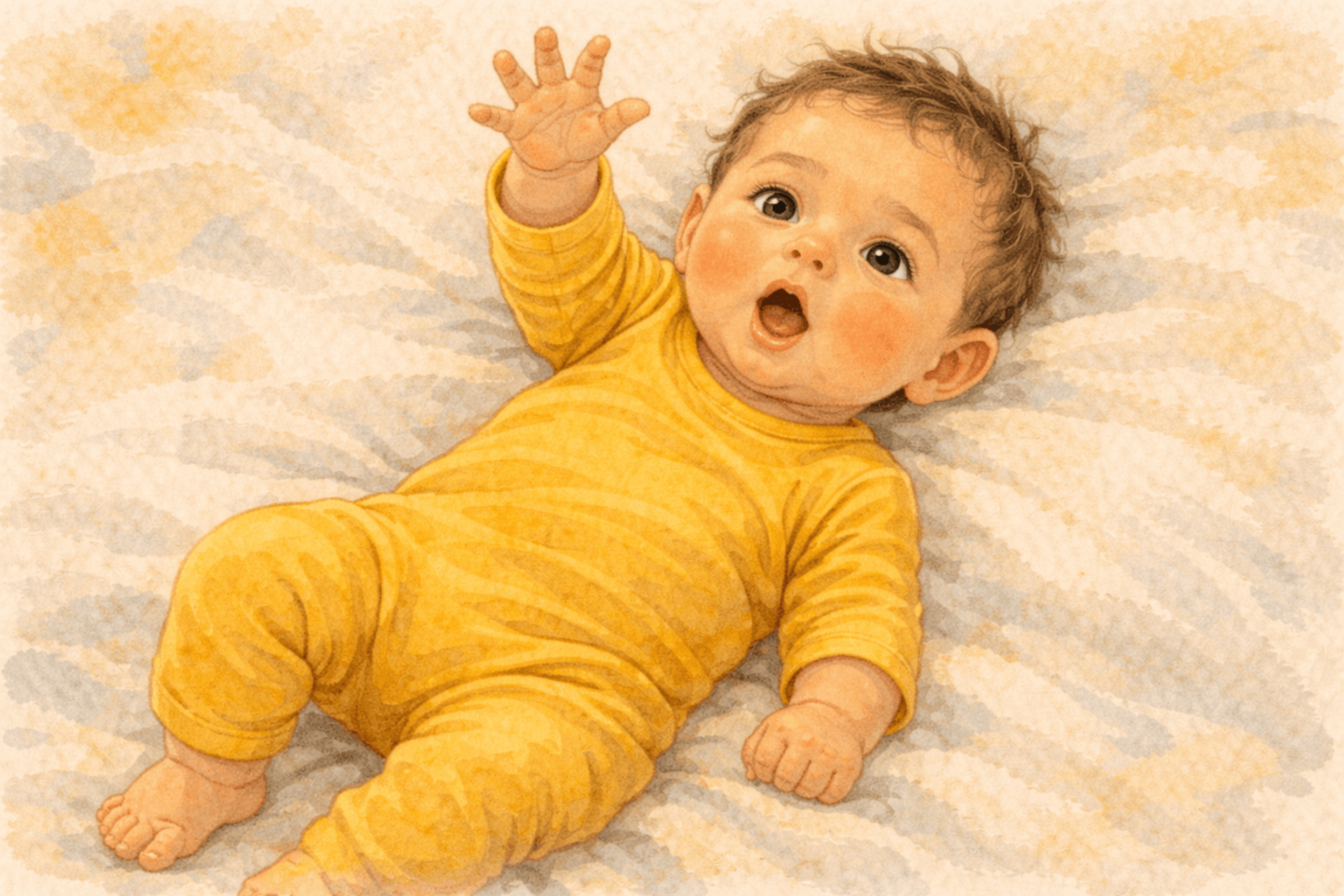
The activity that supports this is almost absurdly simple: when your baby coos, wait a beat, then respond. Mirror the sound back, or answer with a sentence in a warm tone. Then pause again and wait. This loop — baby sounds, parent responds, baby sounds again — is the literal scaffolding for language. A 2018 MIT study by Romeo and colleagues found that the number of conversational turns between parent and child predicted language-related brain structure more strongly than the total volume of words a child heard. The turns matter more than the words, and the turns start here, at two months, with a coo and a pause.
You can do this during any moment — feeding, diaper changes, lying on the floor together. The content of your words doesn't matter at two months. The rhythm and timing do, and that connects directly to what the Ruvolo study found about smile timing: your baby is already tracking the back-and-forth pattern of social exchange, whether the medium is a smile or a sound.
Why Touch Still Matters More Than You'd Think
At two months, touch is easy to take for granted — you're holding, feeding, and changing your baby constantly, so it feels like the touching part is covered by default. But there's a difference between incidental contact and intentional gentle touch, and the brain knows it. A 2017 study in Current Biology by Maitre and colleagues found that the quality of touch in the early weeks directly shapes how the brain builds its touch-processing system. Babies who received more gentle, supportive touch — skin stroking, calm holding, skin-to-skin — developed stronger and more organized brain responses to touch when tested months later. The brain was literally wiring itself differently based on what kind of touch it received early on.
What this means at two months: the brain is still in the window where touch input is actively wiring the sensory cortex. Slow strokes along the arms or legs during a diaper change, gentle circles on the tummy during alert time, skin-to-skin during a calm wake window — these aren't just soothing, they're building architecture. Our Sensory Play Cards 0–12 Months include touch-based activities organized by age, starting with exactly this kind of simple, intentional contact.
You don't need a sensory bin or a textured toy at this age. Your hands on your baby's skin, with slow deliberate movement, are doing more developmental work than any product designed for "sensory stimulation."
Tummy Time at Two Months Looks Different
At one month, tummy time was a wobbly, frequently tearful affair. By two months, most babies can hold the head at a 45-degree angle briefly during prone positioning — the neck extensors are strengthening, and the vestibular system is calibrating. A 2020 systematic review by Hewitt and colleagues in Pediatrics confirmed that regular tummy time practice directly predicts motor milestone achievement, and the gains compound: babies who started early and practiced consistently showed the largest benefits.
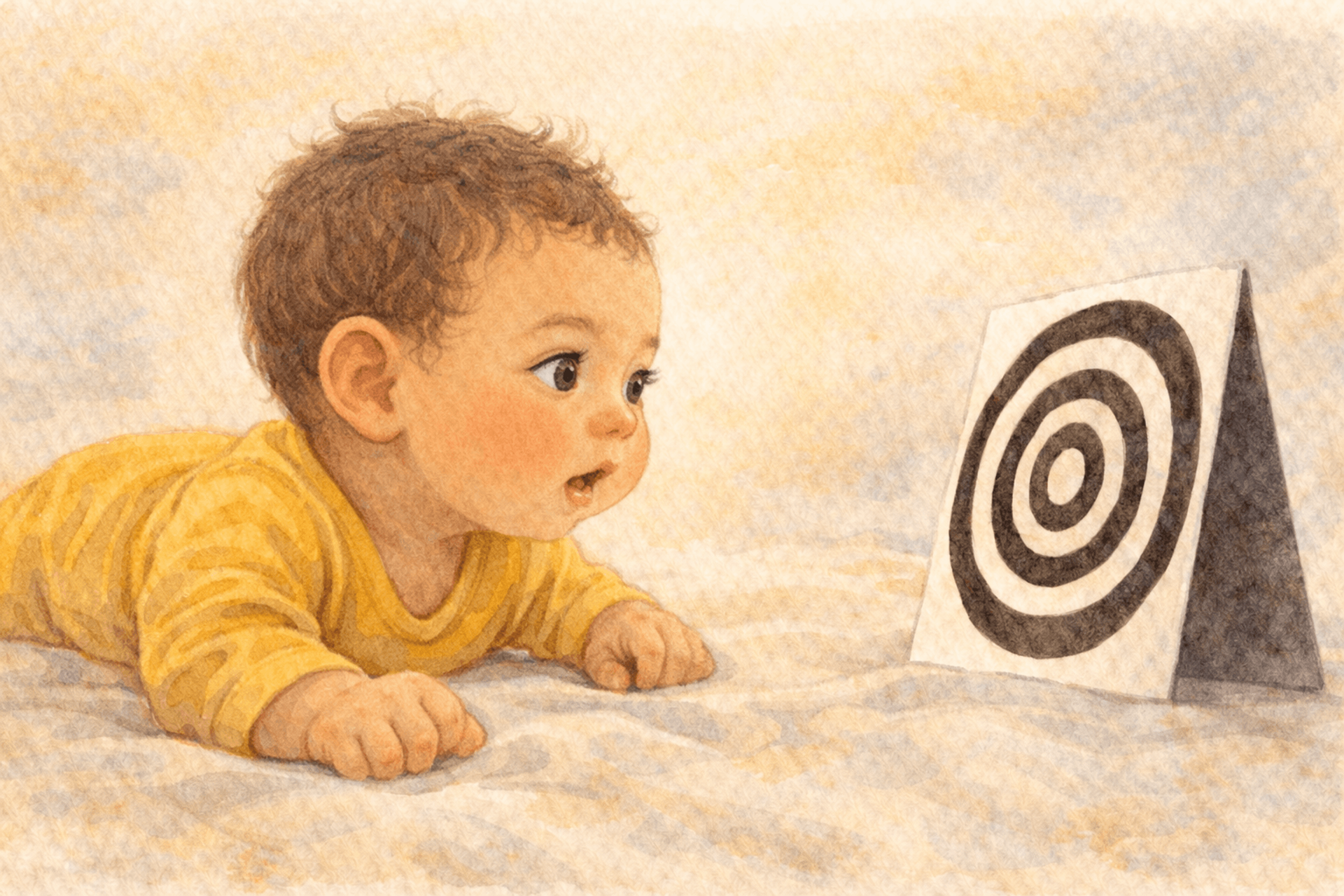
The practical difference now: sessions can run three to five minutes instead of two to three, and some babies will tolerate floor tummy time who couldn't at one month. A high-contrast card placed at eye level, roughly 8 to 12 inches from the face, gives the baby a visual target that motivates head-lifting. Our High Contrast Flashcards 0–3 Months work particularly well here because the bold patterns create enough visual reward to keep the head up a few seconds longer, and those extra seconds are where the real strength-building happens. If you tried tummy time last month and it ended in immediate screaming, try again — a month of neck muscle development and vestibular adaptation can make a surprising difference. Our tummy time guide covers seven evidence-based approaches for the baby who still hates it.
If floor tummy time still ends in tears, chest-to-chest on a reclined parent still counts. Every position where the baby works against gravity builds the same muscle groups.
What Your Baby's Eyes Can Do Now
At one month, visual tracking was jerky and inconsistent — the eyes would lose the target mid-arc and snap back. By two months, tracking has become noticeably smoother and more deliberate. Johnson and colleagues demonstrated in 1991 that infants track face-like patterns further and more consistently than scrambled features or geometric shapes — and by two months, this preference is stronger than ever. Your baby doesn't just prefer your face because it's familiar; the visual system comes pre-wired to prioritize face-like configurations, and at two months the tracking hardware is finally smooth enough to follow one across the room.
Atkinson and Braddick's research on visual cortex development places the period between six and twelve weeks as one of the most rapid phases of visual synapse formation in the entire human brain. The visual system is wiring itself for edge detection, pattern discrimination, and early depth perception all at once.
This is when a mobile becomes genuinely useful as a developmental tool. A high-contrast mobile hung roughly 12 to 16 inches above your baby during alert time gives the visual system sustained tracking practice. The key is slow movement — at two months, smooth tracking only works if the target moves slowly. Look for mobiles with bold black-and-white or high-contrast shapes rather than pastel animals — the visual system at this age responds to contrast far more powerfully than to color, though color vision is beginning to emerge. If you want the research behind that progression, our guide to when babies see color covers the full timeline.
The Five-Minute Floor Session That Covers Everything
Here's the single activity that works the most developmental ground in one two-month wake window: lie on the floor face-to-face with your baby during tummy time, about eight to ten inches apart. Make a slow exaggerated expression. Wait for a response — a smile, a coo, a stare. Mirror it back. Then pause and wait again.
In one session, this exercise works the neck extensors (tummy time), the visual tracking system (following your face — the stimulus Fantz and Johnson both confirmed the brain prioritizes above all others), the social circuitry (smile exchange — and now you know your baby has an actual goal during that exchange), and the early language architecture (turn-taking). Rest one hand gently on your baby's back while you talk — that slow, intentional touch adds the tactile input that Maitre's research showed matters for sensory brain organization.
A two-month-old can sustain this for maybe two to four minutes before fatigue sets in, and that's enough. If you read our article on activities for a 1 month old, you'll see how this builds directly on the face-to-face work that started last month — the difference is that now your baby can respond, and that response isn't random.
Watch for the look-away. When the baby breaks eye contact, turns the head, or fusses, that's the nervous system saying too much input, need a break. Respect it. The pause is part of the activity.
Frequently Asked Questions
There is no minimum number. The brain at two months learns from ordinary caregiving — feeding, diaper changes, being held and talked to. If you add one intentional activity per wake window, like tummy time or face-to-face interaction, you are covering the major developmental needs. A two-minute engaged exchange builds more neural architecture than twenty minutes of passive stimulation.
Most two-month-olds stay awake for 60 to 90 minutes between naps, though some still max out closer to 45 minutes. Watch for sleep cues — yawning, turning away, fussiness — rather than the clock. A wake window includes feeding, so the actual play or activity time within that window is typically 15 to 30 minutes at most.
The CDC's 2022 milestone checklist for two months provides clear benchmarks: social smile, cooing, watching you as you move, reacting to loud sounds, holding head up during tummy time. The AAP recommends discussing any concerns at the two-month well-child visit. The revised milestones are set at the 75th percentile, meaning most babies reach them by the listed age, and delays may warrant earlier developmental screening.
This article is for educational and entertainment purposes only. Not a substitute for professional medical or developmental advice. If you have concerns about your baby's development, consult your pediatrician.
- Ruvolo, P., Messinger, D., & Movellan, J. (2015). "Infants Time Their Smiles to Make Their Moms Smile." PLoS ONE, 10(9), e0136492.
- Zubler, J. et al. (2022). "Evidence-Informed Milestones for Developmental Surveillance in the First 3 Years of Life." Pediatrics, 149(3).
- Romeo, R. et al. (2018). "Beyond the 30-Million-Word Gap: Children's Conversational Exposure Is Associated With Language-Related Brain Function." Psychological Science, 29(5), 700–710.
- Hewitt, L. et al. (2020). "Tummy Time and Infant Health Outcomes: A Systematic Review." Pediatrics, 145(6).
- Maitre, N. et al. (2017). "The Dual Nature of Early-Life Experience on Somatosensory Processing in the Human Infant Brain." Current Biology, 27(7), 1048–1054.
- Atkinson, J. & Braddick, O. (2012). "Visual Development." In Cambridge Encyclopedia of Child Development.
- Fantz, R. (1963). "Pattern Vision in Newborn Infants." Science, 140(3564), 296–297.
- Johnson, M. et al. (1991). "Newborns' Preferential Tracking of Face-like Stimuli and Its Subsequent Decline." Cognition, 40(1–2), 1–19.
- American Academy of Pediatrics (2022). HealthyChildren.org — "Your Baby By Two Months."
- Centers for Disease Control and Prevention (2022). "Important Milestones: Your Baby By Two Months." CDC.gov.

More Articles
Parallel Play in Toddlers: Why Side-by-Side Is the Social Work
Your toddler spent the entire playdate building separate towers, and nobody shared a single block. That counted — more than it looked. A 2025 longitudinal study found that playing beside a specific child consistently predicted later social play with that same child, but not the other way around. Here's what parallel play in toddlers actually is, why the science calls it strategic rather than passive, and what it means for how you run a playdate.
When Do Babies Point: Why It Matters for Language
Most milestone articles treat pointing as a box to check around 12 months. The research tells a different story — one that starts months earlier, runs through the infant brain, and traces back to how much the parent is pointing. Here's what the last fifteen years of research actually found, and what it means for everyday interactions.
When Do Babies Wave Bye-Bye: Why Your Baby Needs You to Wave First
Most baby milestones unfold on a biological schedule — waving isn't one of them. A 2023 study found that babies develop imitation ability because their caregivers imitate them first, and waving is named directly as a cultural gesture learned through that loop. Here's what the research says about the 9–12 month window, why the first wave looks nothing like a wave, and what helps it arrive.