When Do Babies See Color?
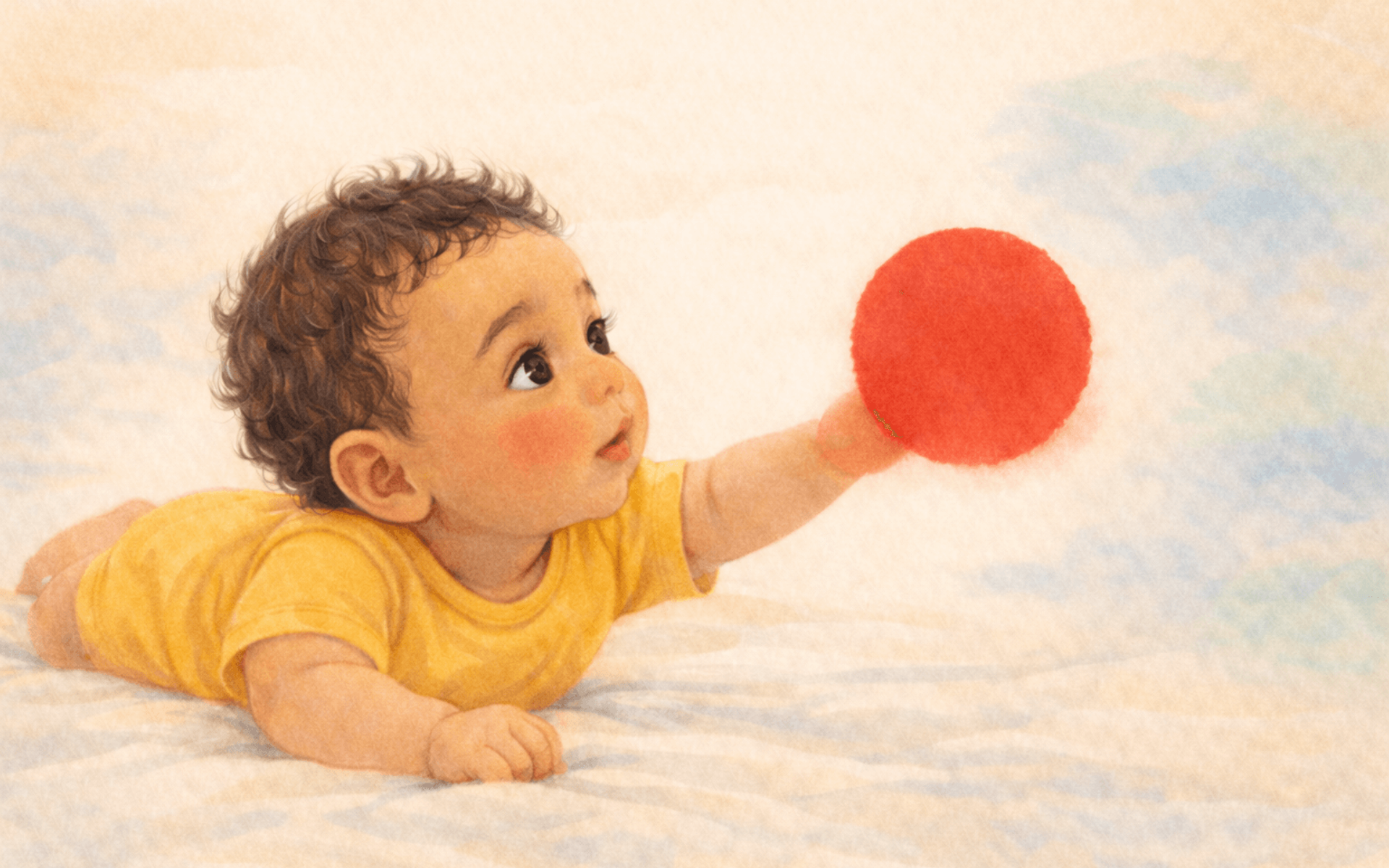
Your baby has been gazing at your face, tracking bold black-and-white patterns, and slowly making sense of a blurry world. And then, somewhere around three to four months, something shifts. The world starts filling in with color.
But it doesn't happen all at once. And the way it happens is far more interesting than most parenting sites will tell you.
- Why "babies see in black and white" is an oversimplification — what the cone pathways actually show
- The color timeline from birth to 6 months: what develops when and in what order
- Which color babies detect first — and why "first" is more complicated than it sounds
- Figure-ground segregation: why color matters for object recognition, not just aesthetics
- What visual input to provide at each stage — and when to flag concerns with a pediatrician
If the one-sentence answer is enough, you’ve got the gist. If you want the mechanism behind each piece, keep reading.
What Newborns Actually See (Spoiler: Not Much Color)
At birth, a baby's retina is still immature. The cone photoreceptors — the cells responsible for detecting color — are present but not fully developed. The fovea, the part of the retina that gives us sharp central vision, continues maturing for well over a year.
In practice, this means a newborn sees mostly in high contrast. Light versus dark. Edges where brightness changes sharply. A parent's face at feeding distance. That's about it — and it's exactly what the visual system needs at this stage.
Color isn't entirely absent at birth, but the ability to detect and distinguish hues is extremely limited. Research using visual evoked potentials shows that signals from the cones responsible for red-green vision begin reaching the cortex around four weeks of age. The cones responsible for blue take a bit longer — arriving closer to two to three months.
So when someone tells you newborns see in black and white — that's an oversimplification, but not far from the truth.
The Color Timeline: What Comes When
Color vision doesn't switch on like a light. It builds gradually, as the cones mature and the brain learns to interpret their signals. Here's what the research tells us:
Birth to 4 weeks: Minimal color detection. High contrast between light and dark is what registers. The visual system is focused on edges, patterns, and movement.
Around 4–8 weeks: The first hints of color begin to emerge, starting with red-green sensitivity. A baby may start noticing strongly saturated red or green objects, though the world still looks muted compared to adult vision.
2–3 months: Blue-yellow discrimination comes online as the short-wavelength cone pathway matures. By this point, a baby has the basic hardware for trichromatic color vision — meaning all three cone types are functioning. But "functioning" doesn't mean adult-level. Sensitivity is still low, and subtle differences between similar hues are invisible.
4–6 months: This is where things get fascinating. By four months, something remarkable happens: infants begin to organize colors into distinct groups, responding to certain hues as "same" and others as "different" — long before they know a single color word. Research suggests this early categorization is driven by the sensory mechanisms of vision itself, not by language or learning.
By 6 months: Color perception is considerably more sophisticated. Infants can perceive hue, saturation, and brightness as separate dimensions. They're beginning to develop something called color constancy — the ability to perceive an object's color as stable even when the lighting changes.
What Color Do Babies See First?
This is the question every parent asks, and the answer depends on what we mean by "first".
The earliest color-related signals to reach the brain come from the cones that handle red and green. In practical terms, these are the first hues the visual system can begin to distinguish — though at very low sensitivity, and only when the colors are bold and highly saturated.
Red is often cited as the first color because it creates one of the strongest visual signals available to young eyes — especially red against a white background. That's why many developmental resources introduce red before other hues.
But "first" is a loose concept here. A baby isn't suddenly seeing red one Tuesday morning. The cone pathways mature gradually, and what an eight-week-old perceives is nothing like what the same baby will see at five months.
Figure-Ground Segregation: Why Color Matters Beyond Pretty Hues
One thing most articles about baby color vision skip entirely: color is one of the brain's most important tools for making sense of the visual world.
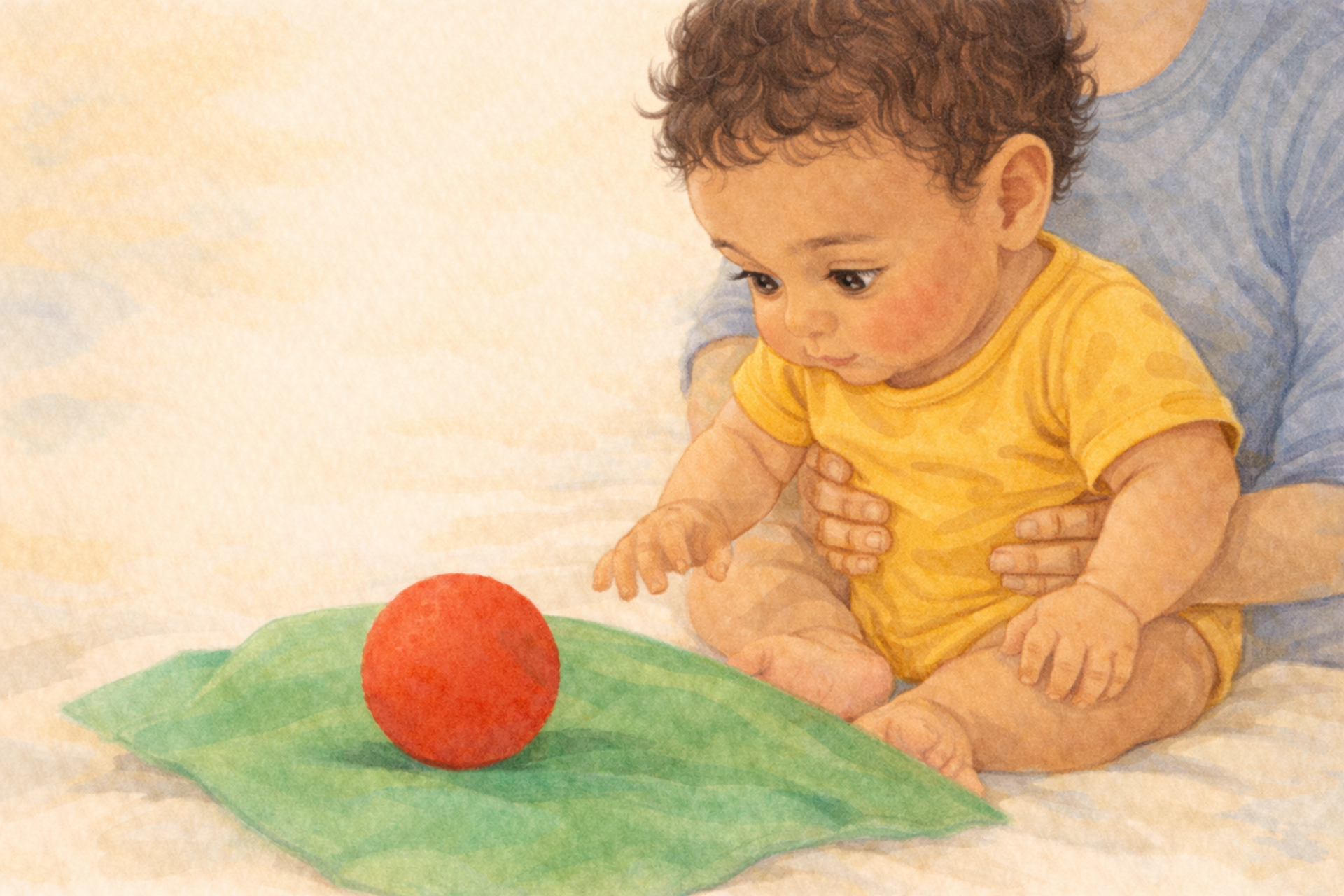
One of the key visual skills developing in these months is figure-ground segregation — the ability to separate an object from its background. Before color vision matures, the brain relies almost entirely on luminance contrast (light vs. dark) to figure out where one thing ends and another begins. Once color processing comes online, it adds a second layer of information. A red ball on a green blanket is easy to pick out — not because of brightness, but because the hues are different.
This matters far more than it might seem. Figure-ground segregation is the foundation of object recognition, depth perception, and eventually the ability to navigate a complex visual environment. Color gives the developing brain a powerful new channel for that work.
What This Means for You (and Your Little One)
You can't speed up cone maturation. You can't make a baby's fovea develop faster. But you can provide the kind of visual input that matches what the system is ready to process at each stage.
In the first weeks, that means high-contrast black-and-white patterns — bold shapes, thick lines, strong edges. We covered this in detail in What Can Newborns Actually See? A Week-by-Week Guide, and if you haven't read it yet, it's a useful companion to this article.
As a baby moves past the newborn stage and into the three-to-six-month range, the visual system is ready for color. But not random color — the developing brain benefits most from a progression that matches what it can actually handle at each point. That kind of structured approach is exactly what our Color Contrast Cards are built around. If you're curious about the principles behind choosing the right visual tools, we break it down here: High Contrast Cards for Babies: Why They Work and How to Use Them.
When to Pay Attention
Most variation in how quickly color vision develops is completely normal. Some babies show strong interest in color by three months; others take a bit longer. As long as a baby is tracking objects, making eye contact, and responding to visual input in general, the system is doing its job.
That said, if by four to five months an infant shows no interest in brightly colored objects, doesn't track a toy moved across the field of vision, or consistently avoids eye contact, the American Academy of Ophthalmology recommends raising it with a pediatrician. A formal vision screening in the first year of life is part of standard well-child checkups — and catching any concerns early makes a real difference.
Track what you notice — not what you think you should see.
Frequently Asked Questions
Newborns see primarily in high contrast (black, white, and shades of gray). Red is the first color most babies can distinguish, typically around 8 weeks. By 5 months, most babies have functional color vision.
Newborns can see clearly at a distance of about 8–12 inches — roughly the distance to a parent's face during feeding. Beyond that range, vision is blurry until it gradually sharpens over the first several months.
This article is for educational and entertainment purposes only. It is not a substitute for professional medical advice. Always consult your pediatrician with questions about your baby's development.
- Adams, R. J., Courage, M. L. & Mercer, M. E. (1994). "Systematic Measurement of Human Neonatal Color Vision." Vision Research, 34(13), 1691–1701.
- Knoblauch, K., Vital-Durand, F. & Barbur, J. L. (2001). "Variation of Chromatic Sensitivity Across the Life Span." Vision Research, 41(1), 23–36.
- Bornstein, M. H., Kessen, W. & Weiskopf, S. (1976). "Color Vision and Hue Categorization in Young Human Infants." Journal of Experimental Psychology: Human Perception and Performance, 2(1), 115–129.
- Skelton, A. E., Catchpole, G., Abbott, J. T., Bosten, J. M. & Franklin, A. (2017). "Biological Origins of Color Categorization." Proceedings of the National Academy of Sciences, 114(21), 5545–5550.
- Skelton, A. E., Maule, J. & Franklin, A. (2022). "Infant Color Perception: Insight into Perceptual Development." Child Development Perspectives, 16(2), 90–95.
- Teller, D. Y. (1998). "Spatial and Temporal Aspects of Infant Color Vision." Vision Research, 38(21), 3275–3282.
- American Academy of Ophthalmology. "Vision Development: Newborn to 12 Months."
More Articles
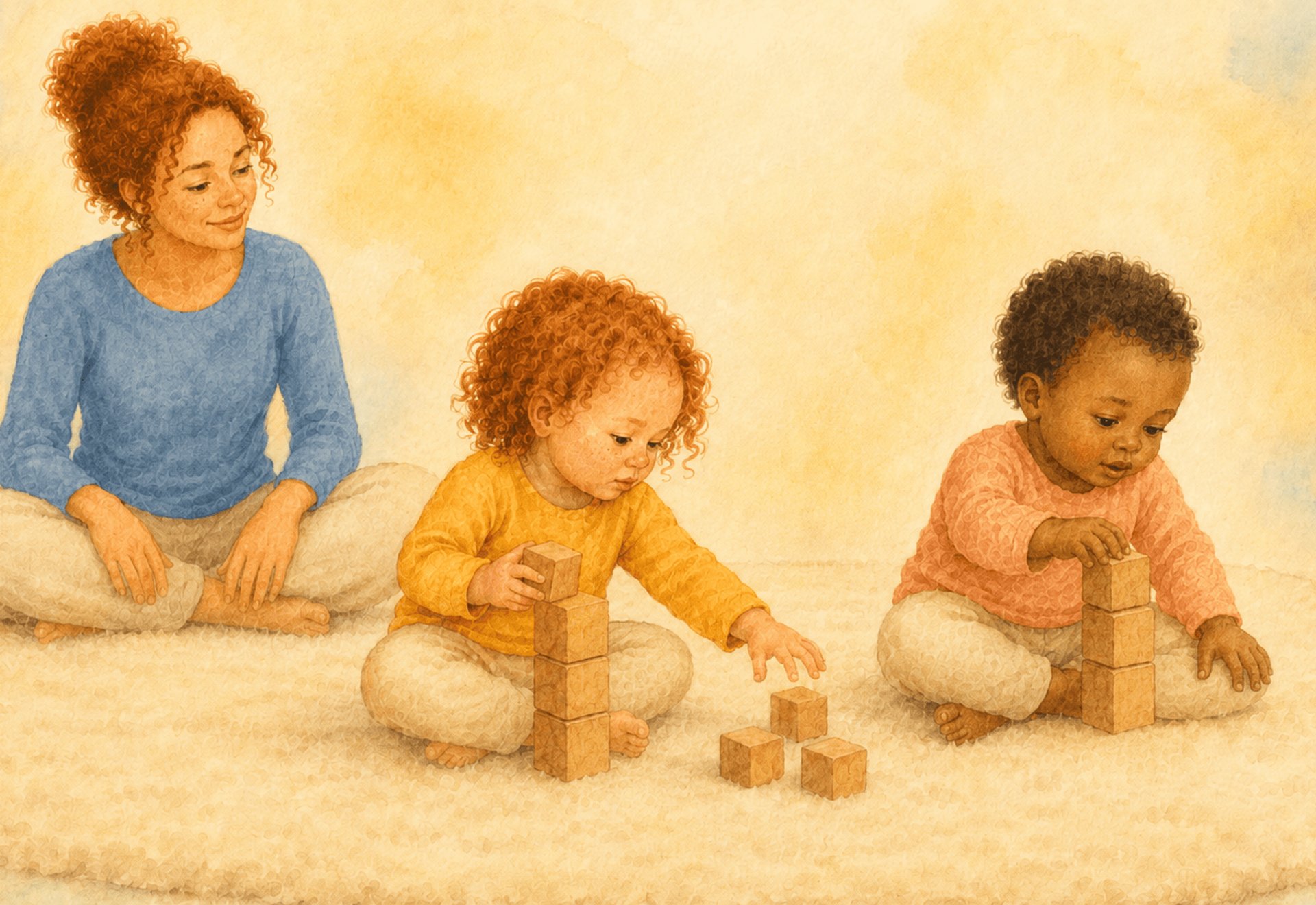
Parallel Play in Toddlers: Why Side-by-Side Is the Social Work
Your toddler spent the entire playdate building separate towers, and nobody shared a single block. That counted — more than it looked. A 2025 longitudinal study found that playing beside a specific child consistently predicted later social play with that same child, but not the other way around. Here's what parallel play in toddlers actually is, why the science calls it strategic rather than passive, and what it means for how you run a playdate.

When Do Babies Point: Why It Matters for Language
Most milestone articles treat pointing as a box to check around 12 months. The research tells a different story — one that starts months earlier, runs through the infant brain, and traces back to how much the parent is pointing. Here's what the last fifteen years of research actually found, and what it means for everyday interactions.

When Do Babies Wave Bye-Bye: Why Your Baby Needs You to Wave First
Most baby milestones unfold on a biological schedule — waving isn't one of them. A 2023 study found that babies develop imitation ability because their caregivers imitate them first, and waving is named directly as a cultural gesture learned through that loop. Here's what the research says about the 9–12 month window, why the first wave looks nothing like a wave, and what helps it arrive.