Activities for a 4 Month Old: What Your Baby Can Do Now That Changes Everything

You're watching your baby reach for a toy — actually reach, arm extended, fingers opening and closing, eyes locked on the target with a concentration level you haven't seen from your coffee-dependent self in years — and for the first time the little hand closes around it. Not by accident. On purpose. Something has shifted, and every interaction you've had for the past three months just graduated to a completely different level.
Most articles about activities for a 4 month old will give you a list: rattle, mirror, tummy time, done. But the brain at four months has undergone changes so fundamental that the same activities you did at two months now serve entirely different developmental purposes.
- What converges at 4 months — why motor + vision + cognition working together creates a categorically different kind of play
- The three research studies behind peekaboo: object permanence, person vs. object categorization, and how speech accelerates prediction
- How color vision has matured by 4 months — and what that means for visual input and tummy time motivation
- Why reaching transforms tummy time from endurance exercise to interactive exploration
- How conversational turns get richer at 4 months — and the one-session floor activity that covers six developmental systems at once
If the one-sentence answer is enough, you’ve got the gist. If you want the mechanism behind each piece, keep reading.
What Changed Between Month Three and Month Four
The four-month brain is no longer just receiving sensory input — it's acting on it. The CDC's 2022 milestones for four months, developed by Zubler and colleagues and published in Pediatrics, include reaching for a toy with one hand, bringing objects to the mouth, and pushing up to elbows during tummy time. The AAP's HealthyChildren.org guide adds that the baby now "watches faces closely" and "can tell familiar faces from unfamiliar ones." Each of these represents the convergence of vision, motor control, and early cognition into coordinated behavior that didn't exist a month ago.
Wake windows at four months typically stretch to 90 minutes to two hours — nearly double what they were at two months. That means a wake window can now include a genuine play session of 20 to 30 minutes, which changes what activities for a 4 month old baby actually look like. At two months, you were working in two-minute bursts between feeds and naps. Now you have enough time for an activity to have a beginning, a middle, and a natural ending when the baby signals fatigue.
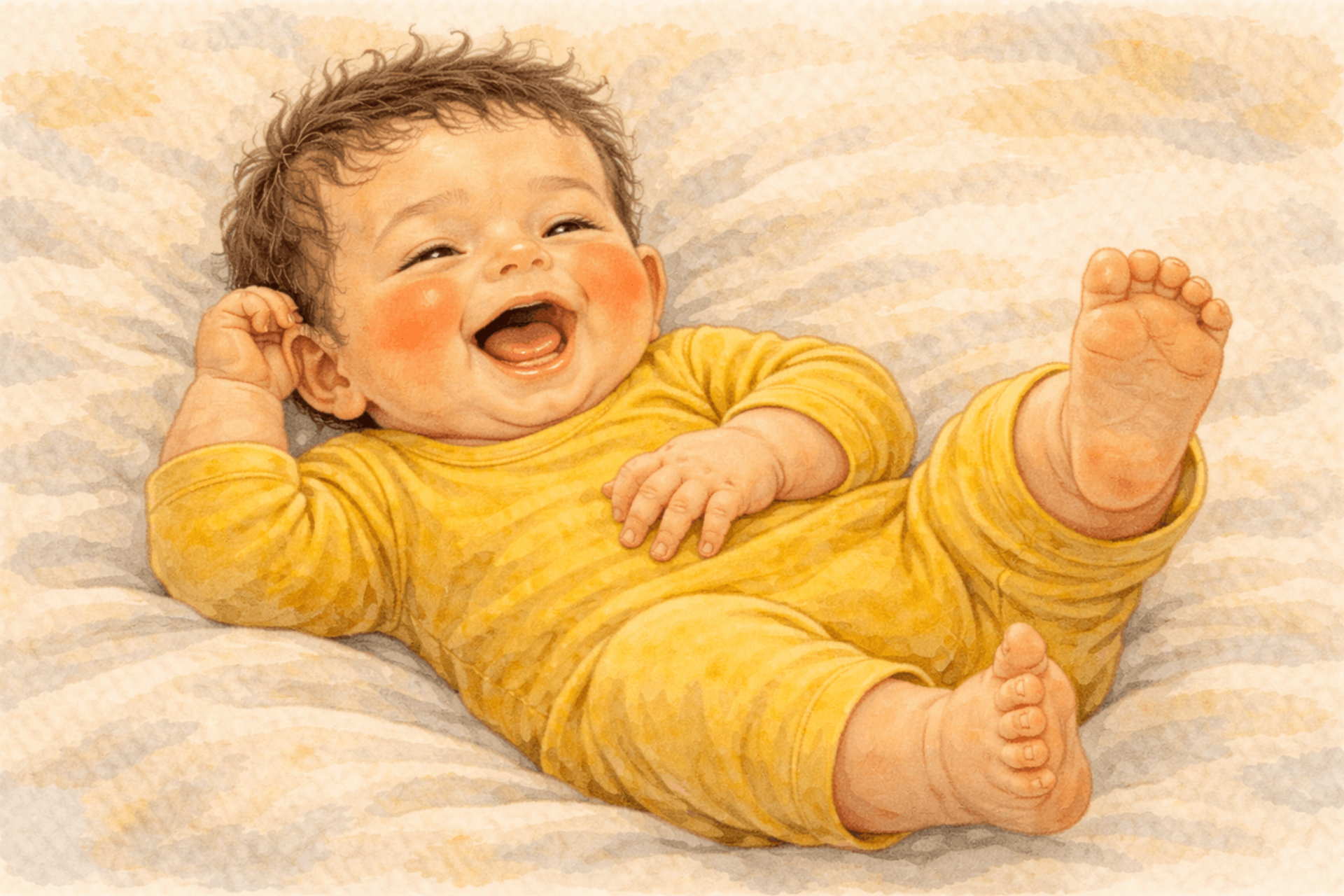
The other change that transforms everything: your baby laughs now. Real belly laughs, triggered by surprise, anticipation, or the sheer delight of your face doing something unexpected. Laughter typically emerges between three and four months, and by four months the brain is beginning to process surprise as a category of experience rather than just a reflexive reaction.
Your Baby Already Knows Hidden Things Still Exist — and What They Are
Here's something that will change how you think about peekaboo, and it comes from three separate lines of research that together tell a story no parenting blog has put together.
In 1987, developmental psychologist Renée Baillargeon at the University of Illinois designed an experiment that overturned decades of assumptions. She showed 4½-month-old infants a flat screen that rotated through a 180-degree arc, like a drawbridge. After the babies got used to watching it, she placed a solid box behind the screen and showed them two events: one where the screen stopped when it hit the box, and one where the screen rotated straight through the space where the box should have been. The babies stared significantly longer at the impossible event — they were surprised, because they expected the box to still be there. This study, published in Developmental Psychology and cited thousands of times since, demonstrated that babies understand object permanence — the knowledge that things continue to exist when hidden — months earlier than Piaget believed. Wang, Baillargeon, and Brueckner confirmed this in 2004 with an even stricter test: 4-month-olds showed the same understanding with no practice trials at all, ruling out the possibility that babies were just responding to familiarity.
But there's a second layer that makes this finding even more remarkable. In 1994, Maria Legerstee tested what 4-month-olds actually do when things disappear. She hid both people and objects from 21 four-month-old infants and tracked five different responses: reaching, gazing, body movements, vocalizations, and smiles. The babies reached more for hidden objects but vocalized more toward hidden people. They smiled and moved their bodies more toward their invisible mother than toward any other hidden stimulus. At four months, the brain doesn't just know that something hidden still exists — it already categorizes what it is and selects a different strategy for interacting with it. You reach for things. You talk to people. Even when you can't see either one.
And there's a third piece that turns all of this into something you can use during activities for a 4 month old at home. In 1972, Patricia Greenfield at Harvard studied peekaboo with a four-month-old and found that when the mother said "peekaboo" as she reappeared, the baby formed a visual expectancy — a prediction of what was about to happen — significantly faster than when she reappeared in silence. After just a few rounds with speech, the baby could predict the reappearance even without the sound cue. Without speech, that prediction took much longer to develop. The voice wasn't just making the game fun — it was helping the brain build a mental model faster.
What all three studies mean for your four-month-old: peekaboo isn't a simple game. It's a cognitive exercise with three layers running simultaneously. Baillargeon's layer: the brain maintains a representation of you behind the cloth. Legerstee's layer: the brain categorizes you as a person, not a thing, and prepares a social response — a vocalization, a smile — rather than a reaching movement. Greenfield's layer: your voice as you reappear accelerates the prediction loop that makes the whole game learnable.
Three concrete things to do with this:
First, play peekaboo with speech. Say "where did mama go?" during hiding and "peekaboo!" on reappearance. The Greenfield data says this is genuinely more effective for building visual expectancies than silent hiding.
Second, play peekaboo with objects too, not just your face. Partially hide a toy under a blanket and let your baby pull it out — the reaching and grasping skills are just coming online, and Legerstee's research predicts the baby will reach for the hidden object rather than vocalize to it, because the brain already knows it's a thing, not a person.
Third, vary the hiding location. Greenfield found that expectancies at four months are initially location-specific — the baby learns the game at the crib, but doesn't automatically transfer it to the couch. Playing in different spots builds a more flexible mental model. Our Sensory Play Cards 0–12 Months include peekaboo and hiding activities organized by age — ready-made prompts for exactly this kind of play, so you don't have to invent a new variation every wake window.
Color Is Arriving and It Changes What Your Baby Sees
At four months, color vision has made a dramatic leap. Research by Teller on infant color perception showed that red is typically the first color babies distinguish, around 8 to 12 weeks, and by four months the cone cells in the retina have matured enough to process a broad range of colors. Atkinson and Braddick's work on visual cortex development confirms that the period between three and five months is when color processing circuits reach functional maturity — the world your baby sees at four months looks genuinely different from what the same baby saw at two months.
This is the developmental reason our Color Contrast Cards for 3–6 Months pick up where the first set leaves off. Our High Contrast Flashcards 0–3 Months already introduce red toward the end of the sequence — timed to the 8-to-12-week window when most babies first distinguish it — but the 3–6 month set expands into the full color range that the maturing cone cells can now process, with saturated hues sequenced to match the progression researchers have mapped. If you want the full science behind when each color comes online, our guide to when babies see color walks through the timeline in detail.
For activities for a 4 month old montessori-style, this is also the age when a mobile shift makes sense — from the black-and-white Munari mobile to the colored Gobbi mobile, which presents a gradient of a single color from light to dark. The visual system at four months can now discriminate between shades within a color family, and a mobile that exploits this creates sustained visual engagement during alert floor time.
Reaching Changes Tummy Time Completely
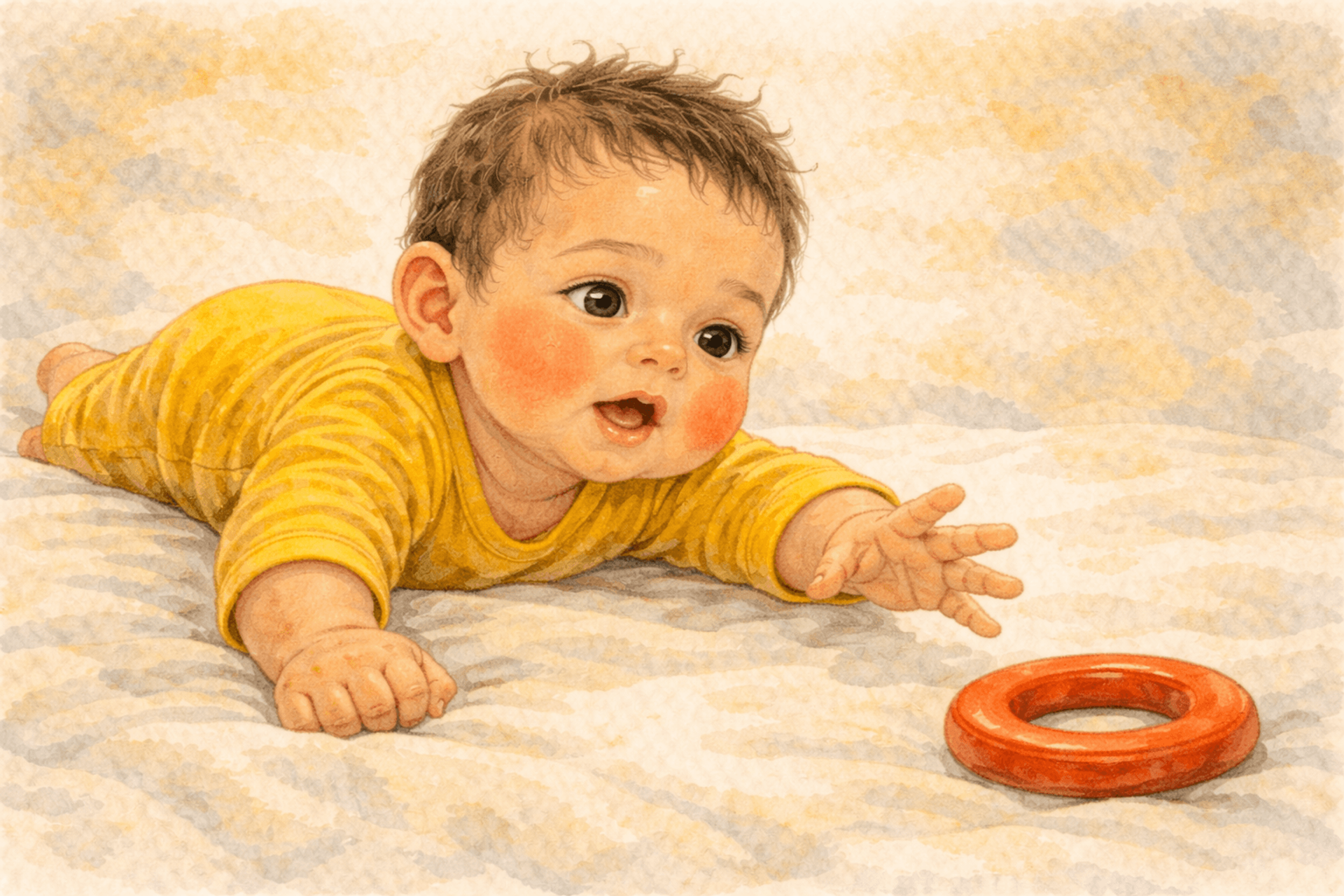
At two months, tummy time was about head-lifting and neck strength. At four months, most babies can push up to their elbows and hold the position while looking around — which means the arms are now free enough to reach for things. A 2020 systematic review by Hewitt and colleagues in Pediatrics confirmed that cumulative tummy time practice predicts motor milestone achievement, and by four months the benefits become visible: babies who had regular tummy time show stronger head control, more stable weight-bearing on forearms, and earlier rolling.
Place a toy or a colorful card just outside your baby's reach during tummy time — close enough to be motivating, far enough to require a stretch. The reaching attempt activates the shoulder girdle, core muscles, and the visual-motor coordination that connects seeing something to acting on it. Fantz showed in 1963 that babies preferentially attend to novel and complex visual stimuli, and at four months that preference translates to action — if the object is interesting enough, the baby will work harder to get to it. If you tried tummy time last month and it ended in tears, try again — our tummy time guide covers seven evidence-based approaches for the baby who still hates it.
Talking to Your Baby Has a New Layer Now
At four months, your baby's vocal repertoire has expanded beyond the two-month coos into something more varied — squeals, growls, razzing sounds, chains of vowel-consonant combinations that start to sound like actual syllables. The CDC's four-month milestone includes "makes sounds like 'oooo' and 'aahh'" and "makes sounds back when you talk," confirming that the brain has connected vocalization to social interaction more tightly than before.
A 2018 MIT study by Romeo and colleagues found that conversational turns — the back-and-forth exchanges between parent and child — predicted language-related brain development more powerfully than the total number of words the baby heard. At four months, these turns are richer than at two months because the baby's responses are more varied and more clearly directed at you. When you say something and your baby squeals back, that's a turn. When you pause and the baby fills the silence with a sound, that's a turn.
The practical activity: narrate what you're doing, then pause for two to three seconds and wait for a response. Any sound counts. Mirror it back or answer it, then pause again. Johnson and colleagues showed that four-month-olds track face-like stimuli with smooth, sustained attention — so getting close, making eye contact, and talking directly to your baby's face delivers the auditory and visual input through the channels the brain is most wired to receive.
Touch Gets More Interesting at Four Months

At four months, the hands are becoming exploratory tools. Your baby brings objects to the mouth not because of random movement but because the mouth has more nerve endings per square millimeter than the fingertips do — it's the most sophisticated touch sensor the baby has, and mouthing is how the brain maps the shape, texture, and size of an object. A 2017 study in Current Biology by Maitre and colleagues showed that early touch experiences physically shape how the brain's sensory processing areas develop — the variety of textures your baby encounters now isn't just stimulation, it's architecture.
Simple games for 4 month old babies that leverage this: offer objects with different textures — a smooth wooden ring, a soft fabric square, a bumpy rubber ball — and watch how the baby handles each one differently. The hands are still using a raking grasp (whole-hand grab) rather than a pincer grip, so objects should be large enough to grab with a full fist. Rotate the objects between sessions to keep the novelty high — the brain learns more from varied input than from repeated exposure to the same stimulus.
The Floor Session That Ties It All Together
Here's a single activity for a 4 month old that covers the most developmental ground in one wake window: place your baby on the floor for tummy time with two or three colorful objects arranged in a semicircle just within reaching distance. Get down at eye level. Hold up one object, let the baby track it, then slowly move it to the side. When the baby reaches for it, let the hand close around it. While the baby mouths and examines it, talk about what you see — the color, the texture, how the baby is holding it. Pause and wait for a vocal response.
In a single session: tummy time strengthening (Hewitt), visual tracking and color processing (Atkinson and Braddick), reaching and grasping (CDC 4-month milestone), tactile exploration and mouthing (Maitre), conversational turns (Romeo), and the face-preference system that keeps the baby engaged with you between objects (Fantz, Johnson). Halfway through, hide one of the objects under a cloth and say "where did it go?" — then let the baby pull the cloth off or reveal it yourself with a cheerful narration. That's Baillargeon's object permanence, Legerstee's animate-inanimate distinction (the baby will reach, not vocalize, because it's an object), and Greenfield's speech-enhanced prediction loop, all in one move.
If you read our article on activities for a 3 month old, you'll see how this session builds on the skills that were just emerging last month — the difference is that reaching, color vision, and early object permanence are now functional enough to support genuinely interactive play.
A four-month-old can sustain a session like this for five to ten minutes before fatigue or overstimulation sets in. Watch for the signals: gaze aversion, arching, fussiness, or a sudden shift from engaged to glassy-eyed. When those appear, the session is done — and it was enough.
Frequently Asked Questions
Most four-month-olds stay awake for 90 minutes to two hours between naps, with the longest wake window usually before the last nap of the day. This is significantly longer than the 60-to-90-minute windows at two months, and it allows for genuine play sessions of 20 to 30 minutes. Watch for sleep cues rather than the clock — every baby's rhythm is different.
The CDC's 2022 revised checklist for four months includes: social smile at people, cooing and babbling, reaching for toys with one hand, following moving things with eyes smoothly, bringing hands to mouth, pushing up to elbows during tummy time, and holding head steady without support. The AAP adds that many four-month-olds begin rolling from tummy to back and can distinguish familiar from unfamiliar faces.
At four months, the brain has developed enough visual-motor coordination to make toys genuinely useful rather than just decorative. Look for objects that are easy to grasp (lightweight, with a handle or ring shape), offer sensory variety (different textures, sounds, or colors), and are large enough that they can't be swallowed. A rattle, a soft ring, and a crinkly fabric square cover vision, sound, touch, and grasping in three objects.
This article is for educational and entertainment purposes only. Not a substitute for professional medical or developmental advice. If you have concerns about your baby's development, consult your pediatrician.
- Baillargeon, R. (1987). "Object Permanence in 3½- and 4½-Month-Old Infants." Developmental Psychology, 23(5), 655–664.
- Wang, S., Baillargeon, R., & Brueckner, L. (2004). "Young Infants' Reasoning About Hidden Objects: Evidence From Violation-of-Expectation Tasks With Test Trials Only." Cognition, 93(3), 167–198.
- Legerstee, M. (1994). "Patterns of 4-Month-Old Infant Responses to Hidden Silent and Sounding People and Objects." Early Development and Parenting, 3(2), 71–80.
- Greenfield, P. M. (1972). "Playing Peekaboo With a Four-Month-Old: A Study of the Role of Speech and Nonspeech Sounds in the Formation of a Visual Schema." The Journal of Psychology, 82(2), 287–298.
- Zubler, J. et al. (2022). "Evidence-Informed Milestones for Developmental Surveillance in the First 3 Years of Life." Pediatrics, 149(3).
- Romeo, R. et al. (2018). "Beyond the 30-Million-Word Gap: Children's Conversational Exposure Is Associated With Language-Related Brain Function." Psychological Science, 29(5), 700–710.
- Hewitt, L. et al. (2020). "Tummy Time and Infant Health Outcomes: A Systematic Review." Pediatrics, 145(6).
- Maitre, N. et al. (2017). "The Dual Nature of Early-Life Experience on Somatosensory Processing in the Human Infant Brain." Current Biology, 27(7), 1048–1054.
- Atkinson, J. & Braddick, O. (2012). "Visual Development." In Cambridge Encyclopedia of Child Development.
- Fantz, R. (1963). "Pattern Vision in Newborn Infants." Science, 140(3564), 296–297.
- Johnson, M. et al. (1991). "Newborns' Preferential Tracking of Face-like Stimuli and Its Subsequent Decline." Cognition, 40(1–2), 1–19.
- Teller, D. (1997). "First Glances: The Vision of Infants." Investigative Ophthalmology & Visual Science, 38(11), 2183–2203.
- American Academy of Pediatrics (2022). HealthyChildren.org — "Your Baby By Four Months."
- Centers for Disease Control and Prevention (2022). "Important Milestones: Your Baby By Four Months." CDC.gov.


More Articles

Parallel Play in Toddlers: Why Side-by-Side Is the Social Work
Your toddler spent the entire playdate building separate towers, and nobody shared a single block. That counted — more than it looked. A 2025 longitudinal study found that playing beside a specific child consistently predicted later social play with that same child, but not the other way around. Here's what parallel play in toddlers actually is, why the science calls it strategic rather than passive, and what it means for how you run a playdate.

When Do Babies Point: Why It Matters for Language
Most milestone articles treat pointing as a box to check around 12 months. The research tells a different story — one that starts months earlier, runs through the infant brain, and traces back to how much the parent is pointing. Here's what the last fifteen years of research actually found, and what it means for everyday interactions.

When Do Babies Wave Bye-Bye: Why Your Baby Needs You to Wave First
Most baby milestones unfold on a biological schedule — waving isn't one of them. A 2023 study found that babies develop imitation ability because their caregivers imitate them first, and waving is named directly as a cultural gesture learned through that loop. Here's what the research says about the 9–12 month window, why the first wave looks nothing like a wave, and what helps it arrive.