Activities for a 3-Month-Old Baby
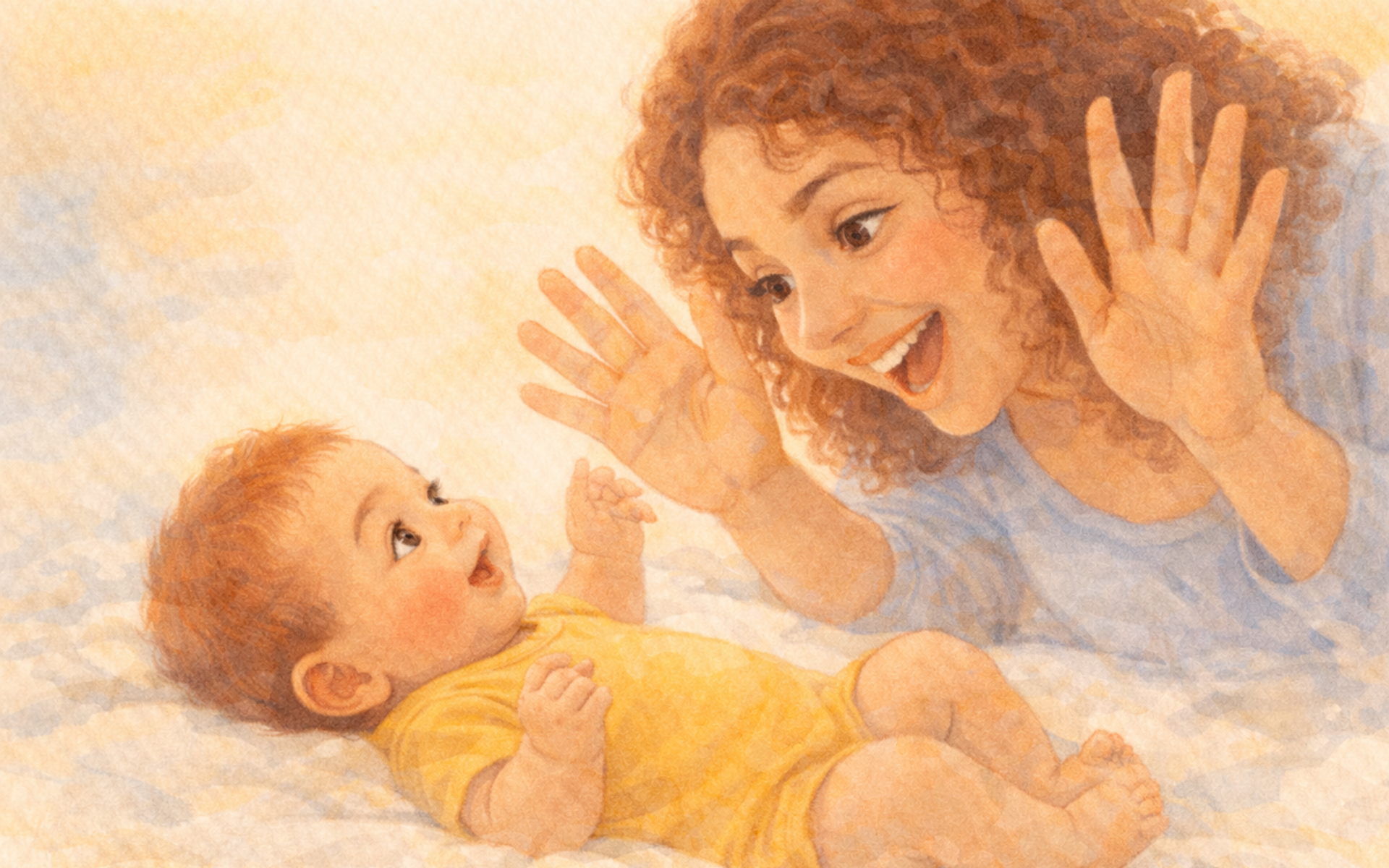
Three months is a turning point. Your baby is awake for longer stretches, starting to smile on purpose, and looking at the world with genuine curiosity. The floppy newborn phase is fading, and something new is arriving — a little person who wants to connect.
If you're wondering what to do with a 3-month-old during those longer wake windows, you're in the right place. The answer isn't complicated, but it helps to understand what's happening developmentally — because the activities that matter most are the ones that meet your baby exactly where the brain is right now.
- What changes at 3 months — the CDC 2022 milestones that mark this as a developmental turning point
- How to use conversation turns to build language circuits during everyday moments
- Why tummy time looks different at 3 months — and how to progress from newborn positions to floor time
- The visual transition from high-contrast to color — and what to look for in your baby's reactions
- Five no-prep games that work specifically for this age (peekaboo, batting, mirror, texture, bicycle legs)
If the one-sentence answer is enough, you’ve got the gist. If you want the mechanism behind each piece, keep reading.
What's Happening at Three Months
By three months, most babies are reaching a cluster of new abilities. The CDC's revised milestone checklist (2022) places the next formal checkpoint at four months, but many of these skills are already emerging at twelve weeks:
Social smiling — not a reflex, but a deliberate expression aimed at getting your attention. Your baby is learning that a smile brings you closer, and that's a powerful social discovery.
Better head control. During tummy time, your little one can likely hold the head up for longer, and may be pushing up on forearms. This is building the strength needed for everything that comes next — rolling, sitting, reaching.
Hands becoming interesting. You may notice your baby staring at open hands, bringing them to the mouth, or batting at objects. The brain is beginning to connect "I see my hand" with "I can move my hand" — a foundational step toward intentional reaching and grasping.
Tracking with the eyes. Visual tracking is smoother now. Your baby can follow an object moving slowly across the field of vision, and may turn the head to follow a sound.
Longer wake windows. By three months, most babies can comfortably stay awake for 60 to 90 minutes between naps — nearly double what a newborn manages. That's more time for interaction, and more opportunity for the brain to process new input.
Conversation Turns (Yes, Already)
At three months, your baby is a surprisingly active conversation partner. The coos, gurgles, and vowel sounds you're hearing are early experiments with language — and how you respond shapes what comes next.
Harvard's serve-and-return framework applies here just as powerfully as it did in the newborn period. Your baby "serves" a sound. You return it — by repeating the sound, responding with words, or simply making eye contact and smiling. That exchange strengthens the neural pathways for language and social connection.
What changes at three months is the pacing. Your baby can now hold a back-and-forth exchange for several turns. Pause after you respond, and wait. You'll often get another coo — and that pause-and-respond rhythm is exactly what builds language circuits.
One practical note: narrating your day is still one of the most effective things you can do. "We're going to change your diaper now. Here's the clean one. And now we're getting dressed." It sounds simple because it is — and the AAP's 2024 policy on reading aloud confirms that this kind of language exposure from the earliest months supports neural development across multiple domains.
If you haven't explored our earlier article on talking and interacting with a newborn, it covers the science behind why these everyday exchanges matter so much: What to Do with a Newborn All Day.
Tummy Time, Level Two
If tummy time was a battle in the early weeks, three months often brings a shift. With better head and neck control, many babies begin to tolerate — and even enjoy — time on the floor.
The AAP recommends building toward 15 to 30 minutes of supervised tummy time per day by around seven weeks, and by three months most babies can handle several minutes at a stretch. This is when you start to see real progress: pushing up on forearms, lifting the head higher, turning to look at things.
To make it more engaging, get down at your baby's level. Face-to-face interaction during tummy time turns a physical exercise into a social one — and that combination is more effective than either alone.
If tummy time is still a challenge, we have a full guide for you: My Baby Hates Tummy Time: 7 Tips That Actually Work.
Visual Play — The Next Level
At three months, your baby's visual system is maturing rapidly. High-contrast black-and-white patterns were ideal in the first weeks, but now the brain is ready for more complexity.
Color vision is developing. The cones in the retina are maturing, and by three to four months, your baby is beginning to process bold, saturated hues. Tracking is smoother. Visual attention lasts longer. The whole system is leveling up.
This is a natural transition point. If you used high-contrast cards in the early weeks, your little one may now benefit from visual input that introduces color and more complex patterns — progressing alongside what the developing brain can handle. We wrote about how that visual timeline works in detail: When Do Babies See Color?.
The key principle stays the same: match the visual input to the developmental stage, and let your baby's reactions guide you. A focused gaze, a head turn, wider eyes — these are signals that the visual system is engaged and working.
Reaching and Batting
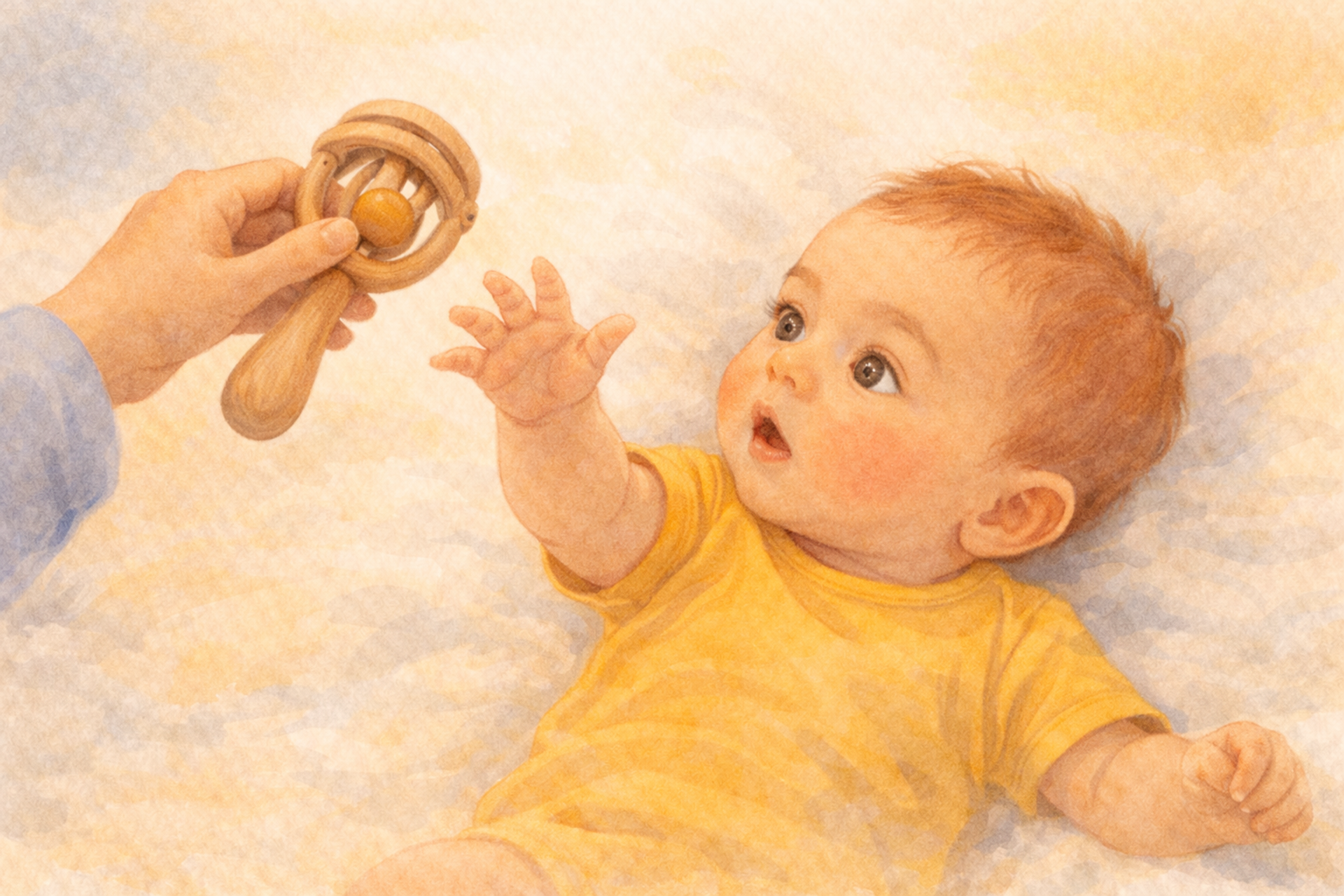
Around three months, you'll start to see your baby swipe at objects — sometimes making contact, often missing. This early batting is an important milestone: the brain is learning to coordinate what the eyes see with what the hands do.
You can support this by holding a lightweight toy or rattle within arm's reach (not directly above the face — slightly off to one side works better). Let your baby try. Misses are just as valuable as hits — each attempt refines the neural connection between vision and movement.
Keep it simple. One object at a time. If your baby loses interest or looks away, the signal is clear: time to pause or switch to something else.
Singing and Music
Three months is a wonderful age for singing. Your baby can now recognize your voice as distinct from other sounds, and familiar melodies produce a visible calming effect.
You don't need a playlist or a music degree. Sing whatever comes to mind — nursery rhymes, songs from your own childhood, something you make up on the spot. What matters is the rhythm, the repetition, and the fact that it's your voice delivering it. Pair a song with gentle movement — rocking, swaying, bouncing a leg — and you're giving the auditory and vestibular systems input at the same time.
Simple Games That Work at Three Months
You don't need a bag of special toys. Some of the best activities at this age use nothing more than your hands, your voice, and whatever's already in the room.
Peekaboo (the early version). Hide your face behind your hands for a second, then reappear with a smile and a "boo!" At three months your baby won't fully understand object permanence yet, but the anticipation-and-surprise pattern is captivating — and you'll often get a smile or a squeal in return.
Card time. Hold a high-contrast or color card about 8 to 10 inches from your baby's face and watch for a response — a locked gaze, a slow head turn, wider eyes. At three months, the visual system is ready for more than just black and white, and a structured set of cards that progresses with your baby's developing vision turns a simple activity into a surprisingly effective one. We break down the science behind choosing the right cards here: High Contrast Cards for Babies: Why They Work and How to Use Them.
Mirror time. Prop a baby-safe mirror on the floor during tummy time, or hold one in front of your little one while sitting together. Babies at this age are fascinated by faces — and the face in the mirror is endlessly interesting, even though the baby doesn't yet realize it's a reflection.
Texture exploration. Gently stroke your baby's hands, feet, or cheeks with different fabrics — a soft muslin cloth, a knitted blanket, a smooth wooden ring. Each new texture is sensory input the brain registers and files away. Watch for reactions: some textures will get a calm gaze, others a startled look or a grin.
Gentle bicycle legs. Lay your baby on the back and slowly move the legs in a cycling motion. It feels good, it helps with gas, and it gives the proprioceptive system input about how the body moves in space. Talk or sing while you do it — two kinds of input are better than one.
Keep everything short and light. A few minutes of any of these is plenty. If your baby turns away, fusses, or loses focus — that's a natural ending. Follow the lead, not the clock.
What Not to Worry About
Every baby develops on a unique timeline. Some three-month-olds are chatty and social; others are quiet observers. Some love tummy time; others still protest. Some track objects beautifully; others are less interested in visual play and more captivated by sounds.
All of this falls within the range of normal. The CDC's revised milestones are designed to reflect what 75% of children can do by a given age — which means a quarter of perfectly healthy babies are still working on any particular skill at any particular point.
Watch your baby, not a checklist. If your little one is generally alert, responsive, and progressing — even slowly — the system is working.
Frequently Asked Questions
At 3 months, babies benefit from tummy time, tracking colorful objects with their eyes, listening to your voice during face-to-face interaction, grasping soft toys, and experiencing different textures during supervised sensory play.
A typical 3-month-old has wake windows of about 75–90 minutes. During that time, simple interactions like talking, singing, and gentle play provide all the stimulation the developing brain needs.
This article is for educational and entertainment purposes only. It is not a substitute for professional medical advice. Always consult your pediatrician with questions about your baby's development.
- Zubler, J. M. et al. (2022). "Evidence-Informed Milestones for Developmental Surveillance Tools." Pediatrics, 149(3), e2021052138.
- National Scientific Council on the Developing Child (2004). "Young Children Develop in an Environment of Relationships." Working Paper No. 1. Harvard University, Center on the Developing Child.
- Klass, P. et al. (2024). "Literacy Promotion: An Essential Component of Primary Care Pediatric Practice." Pediatrics, 154(6), e2024069090.
- AAP (2022). "Back to Sleep, Tummy to Play." HealthyChildren.org.
- Skelton, A. E., Maule, J. & Franklin, A. (2022). "Infant Color Perception: Insight into Perceptual Development." Child Development Perspectives, 16(2), 90–95.


More Articles
Parallel Play in Toddlers: Why Side-by-Side Is the Social Work
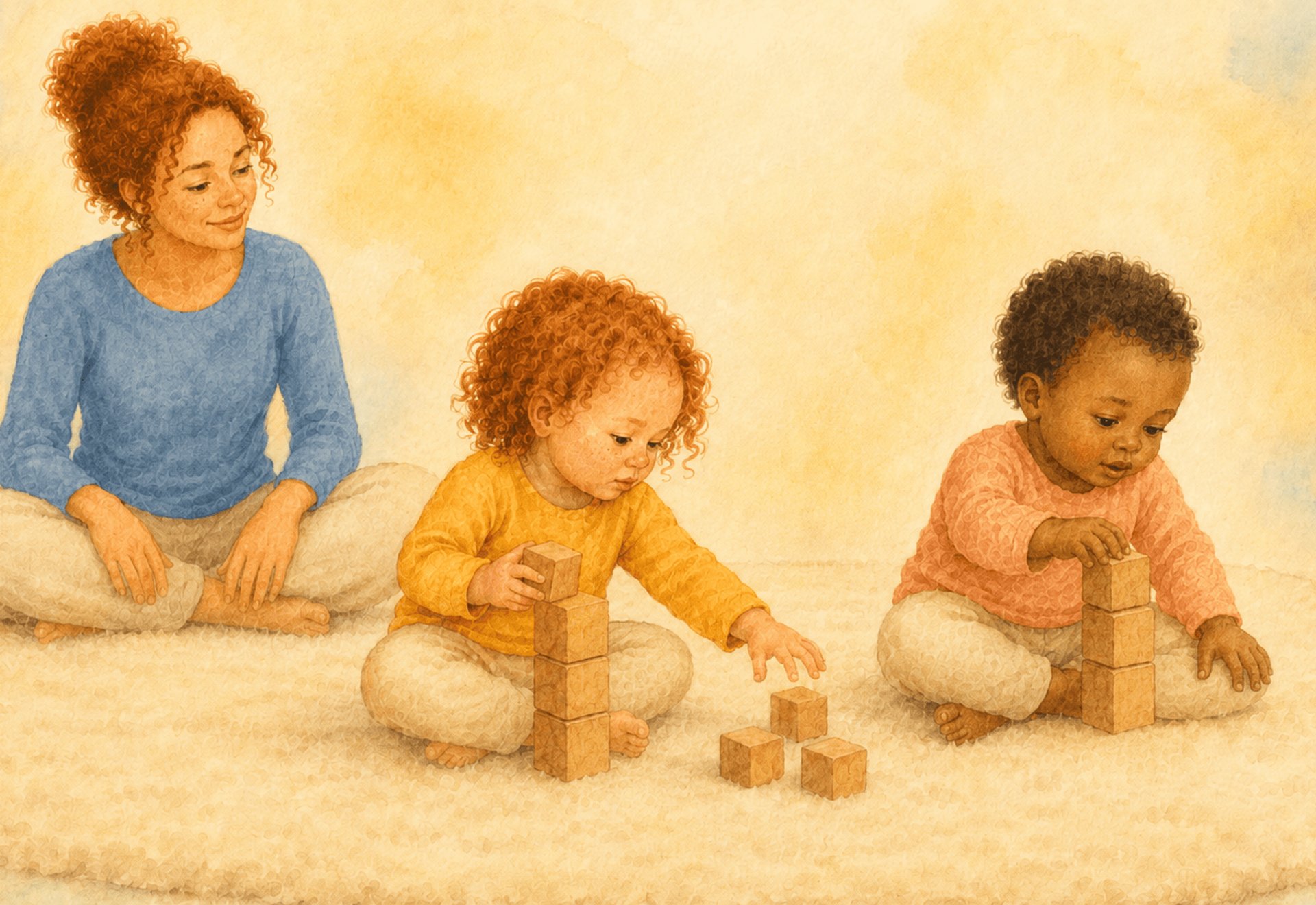
Your toddler spent the entire playdate building separate towers, and nobody shared a single block. That counted — more than it looked. A 2025 longitudinal study found that playing beside a specific child consistently predicted later social play with that same child, but not the other way around. Here's what parallel play in toddlers actually is, why the science calls it strategic rather than passive, and what it means for how you run a playdate.
When Do Babies Point: Why It Matters for Language
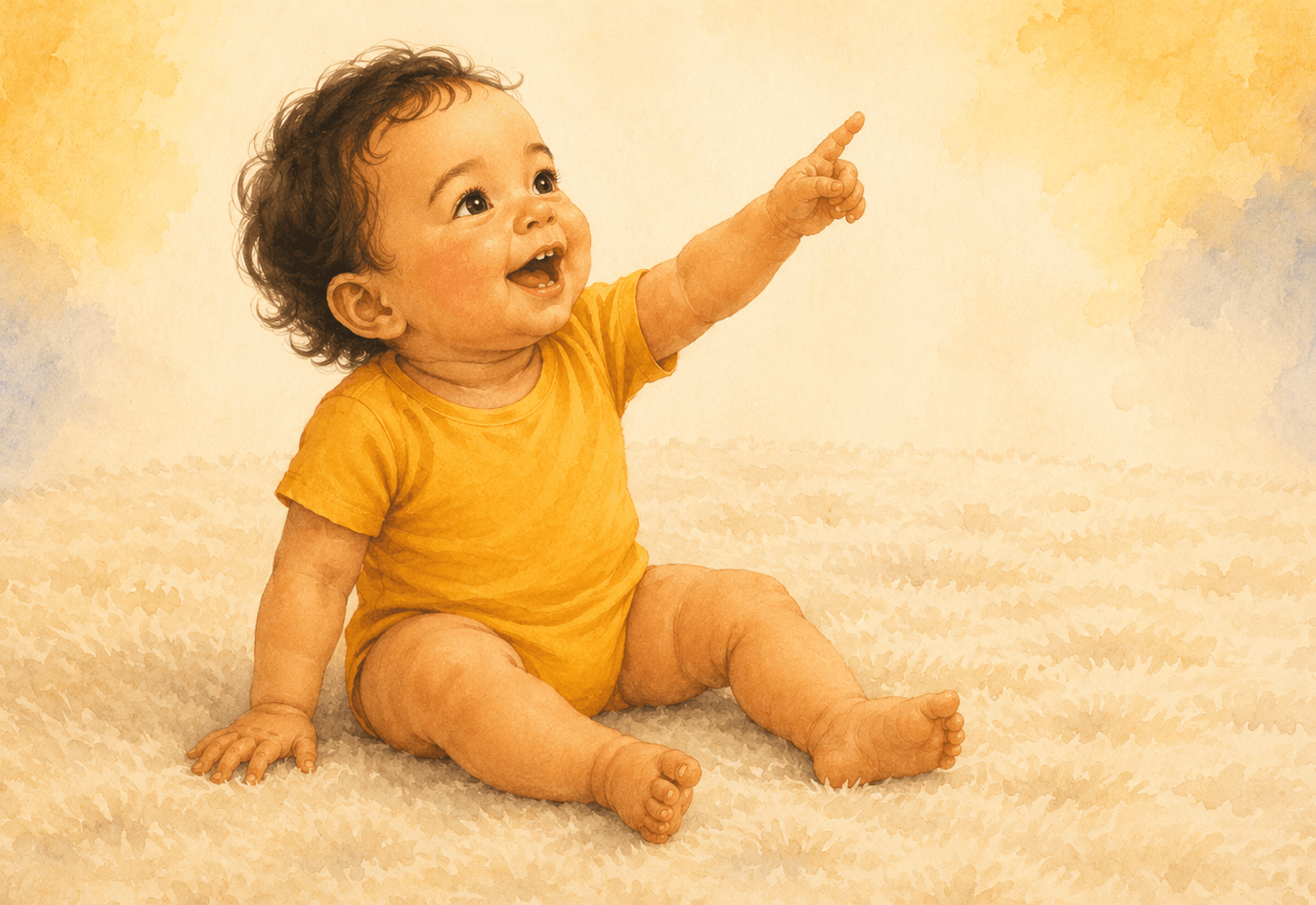
Most milestone articles treat pointing as a box to check around 12 months. The research tells a different story — one that starts months earlier, runs through the infant brain, and traces back to how much the parent is pointing. Here's what the last fifteen years of research actually found, and what it means for everyday interactions.
When Do Babies Wave Bye-Bye: Why Your Baby Needs You to Wave First
Most baby milestones unfold on a biological schedule — waving isn't one of them. A 2023 study found that babies develop imitation ability because their caregivers imitate them first, and waving is named directly as a cultural gesture learned through that loop. Here's what the research says about the 9–12 month window, why the first wave looks nothing like a wave, and what helps it arrive.