Separation Anxiety in Babies: The Maturational Clock No One Talks About
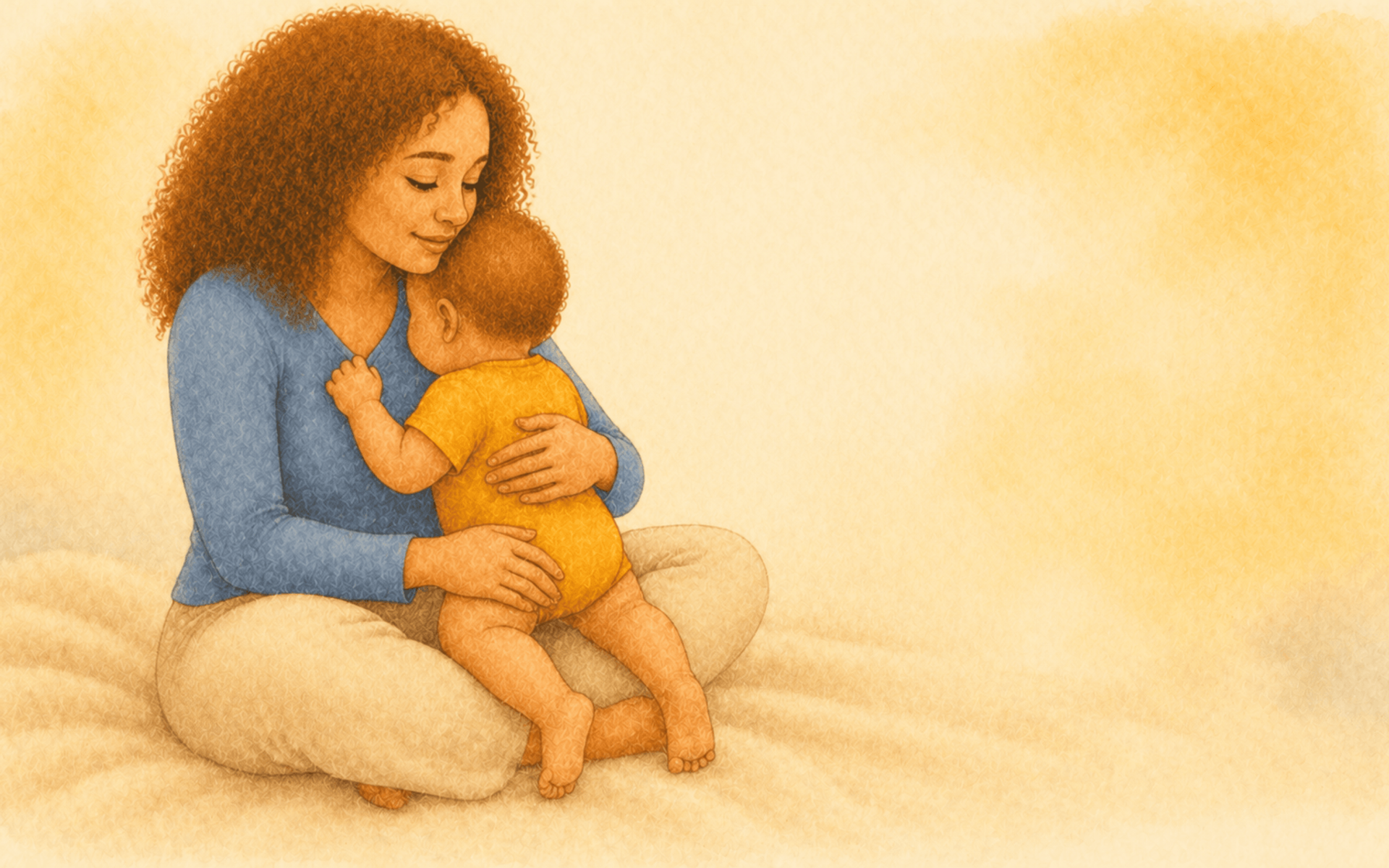
In the 1970s, Jerome Kagan and his colleagues ran a study that still hasn't made it into any of the parenting sites ranking on Google. They measured separation anxiety not just in Boston babies, but in Guatemalan farming villages, Israeli kibbutzim, and among the !Kung San of the Kalahari — a forager culture where infants are held skin-to-skin for roughly 90 percent of their waking hours in the first months of life. The researchers expected to find wildly different patterns. What they found instead was that the curve was essentially identical: protest rose sharply around nine months, peaked near thirteen, and faded into the second year in every single group. Across four continents, four languages, four completely different caregiving structures. The phase wasn't caused by going back to work, or by daycare, or by a missed nap. It was a scheduled event in human development.
If your baby currently screams the moment you leave the room to refill your coffee, that finding is either very reassuring or completely maddening, depending on the day.
- The cross-cultural research that shows this phase is a biological clock, not a parenting outcome — and what that means for working moms specifically
- When separation anxiety starts and what the full age timeline looks like, including the "second wave" at 18 months most articles skip
- Why babies who seem anxious at five or six months are often showing something slightly different
- The neuroscience of how the brain grows itself out of the fear
- What the goodbye research says — and why ritual beats both sneaking out and lingering
- The sleep connection: why the 8–10 month regression and separation anxiety often peak together
- When to mention the pattern to your pediatrician
If the one-sentence answer is enough, you’ve got the gist. If you want the mechanism behind each piece, keep reading.
The Research That Changes Everything About How You See This Phase
Most articles on separation anxiety in babies open with a version of the same sentence: "It's normal, it's a sign your baby is securely attached, and it will pass." All three parts are true. None of them explain why.
Kagan's cross-cultural work, and the companion day-care study published in Pediatrics in 1975 by Kearsley and colleagues (PMID 1118207), gets at something the reassurance-listicle format cannot carry: the timing of separation anxiety is a maturational event, not an environmental one. The Pediatrics study followed 24 day-care babies and 28 home-reared babies at two-month intervals from three and a half months through thirteen and a half months. Both groups showed identical timing — sharp surges in crying and shortened latency to tears at nine and a half months and again at thirteen and a half. The researchers concluded that the psychological processes underlying separation protest were not materially altered by continuous group care. The clock ran on schedule regardless.
This matters practically for two reasons. First, it means daycare is not causing your baby's distress, even when the timing feels suspicious. Second, it means you are not preventing the phase by staying home, by co-sleeping, by any particular attachment practice. You are influencing how supported your baby feels during the phase. You are not influencing whether the phase happens.
The cognitive story behind the timing is this: around eight to nine months, infant memory consolidates in a new way. Your baby can now hold a mental model of you (a specific, detailed internal representation of the person who is the source of safety) and compare that model against what is currently in the room. When those two things don't match, the discrepancy fires. The protest isn't irrational. It's a sophisticated cognitive operation: your baby is doing exactly what a brain with a newly functional memory system would do.
When Separation Anxiety Starts — and the Ages No One Prepares You For
Separation anxiety in babies most often appears between six and eight months, peaks somewhere between ten and eighteen months, and gradually fades through the second and third years. That's the broad picture that HealthyChildren.org and every parenting site repeats. What it leaves out is the texture.
The first detectable signal often isn't separation protest at all — it's stranger wariness, which tends to surface around four to six months, sometimes earlier with temperamentally cautious babies. Your previously sociable newborn who grinned at anyone who leaned over the stroller suddenly looks doubtful when a well-meaning stranger gets close. That's the precursor. The visual recognition system is starting to differentiate familiar from unfamiliar, but the emotional weight behind that distinction is still building. True separation protest (the actual crying when you leave the room) usually firms up a few months later. For what's happening developmentally in that same window, our guide to eight-month activities covers the cognitive changes driving both the clinginess and the sudden interest in peekaboo.
Parents searching for "five months" or "six months" often describe real experiences — they're not imagining it. What most five- and six-month-olds are showing is early stranger wariness combined with a strong preference for the primary caregiver, both of which are developmentally on track. Full separation protest at those ages is less common, though not unheard of in infants at the sensitive end of the temperament range. If you're seeing wariness starting to ramp up around six or seven months, our seven-month activities guide covers how to play in a way that uses, rather than fights, the new stranger awareness.
The eleven- and twelve-month searches are a different story. Kagan's data puts the highest point of protest around thirteen months, meaning that window is the most intense for most babies. If your eleven-month-old seems worse than your eight-month-old did, that's not a regression. That's the arc, and you're in the middle of it.
The second wave catches a lot of parents off guard. Around eighteen months, separation anxiety often resurfaces after a period of relative calm. This is the toddler version — less about raw cognitive surprise (your toddler now firmly knows you exist and will come back) and more about autonomy stress, new vocabulary for wanting you, and the fact that the world has gotten considerably larger now that they're mobile. This second peak is real, it hits right when parents thought the phase was done, and it requires a slightly different response (more language, more transition narration) than the infant version.
Our article on activities for a 1-year-old covers the developmental shifts happening at that exact second-wave window, and is worth reading if your toddler is in the thick of it.
Why the Phase Ends: The Brain Rewires Itself
This is the part none of the competitor articles carry, and it's genuinely useful to know.
Gee and colleagues at UCLA, writing in the Journal of Neuroscience in 2013 (PMID 23467374), examined how the connection between the amygdala (the brain's fear-processing hub) and the medial prefrontal cortex (the area that regulates and contextualizes emotional responses) changes across development. In early childhood, these two regions are positively coupled — when the amygdala fires in response to something threatening or alarming, the prefrontal area essentially amplifies that response. In older children, the coupling flips: the prefrontal cortex starts to dampen the amygdala's signal. Babies with the more mature (negative) coupling showed lower separation anxiety, and the switch from the amplifying connection to the dampening one partially explained the normal, age-related decline in separation protest.
The plain version: the fear circuitry in your baby's brain and the calm-it-down circuitry are, for a period, wired in the wrong direction for anxiety tolerance. The wiring is being fixed. It finishes on a developmental schedule, not on yours.
This is also why you cannot talk an eight-month-old out of separation anxiety with reasoning, and why the well-meaning advice to "just ignore the crying and they'll figure it out" misses the mechanism. The regulation system is still under construction. What you're offering when you maintain a warm, predictable presence is the external scaffold while the internal one gets built.
What the Goodbye Research Says (Honest Version)
Every parenting site confidently instructs: keep goodbyes brief, consistent, and cheerful — and never sneak out. The first part is directionally correct. The certainty is overstated.
The research base here is thinner than the advice suggests. A 1984 study in Child Development by Field and colleagues (PMID 6723451) found that in a sample of 56 children, parental behaviors like hovering, lingering, and sneaking out were associated with more distress in children. A 2010 study in Early Child Development and Care by Klein and colleagues (DOI 10.1080/03004430801943290) looked at daily separation behavior in a small sample of six-to-eighteen-month-olds and found that both a quick disappearance when the child was distracted AND staying too long both led to more stress, while a ritualized, predictable goodbye reduced it.
The sample in the Klein study was four dyads. Four. That's not an indictment of the finding — it's observational work pointing in a consistent direction, but it's worth knowing the evidence isn't a controlled trial.
What both studies together suggest, and what the broader attachment research supports, is that the winning element is predictability. Your baby's brain at eight to twelve months is running pattern-matching constantly. A goodbye ritual that happens the same way, at the same transition point, with the same warm tone and the same confident return — "I'm going to work, I'll be back after your nap, I love you" — works not because it teaches your baby that separation is safe, but because it teaches the baby that the next event in the sequence is your return. That's a different, and considerably more manageable, cognitive task. For a deeper look at why predictable transitions specifically reduce distress hormones, our article on why daily routines reduce toddler tantrums covers the cortisol research in detail.
Our My First Routine Cards were designed specifically around this kind of predictable visual sequencing — the picture sequence gives the transition a beginning and an end, which is exactly the architecture the separation-anxious brain is looking for.
The one thing both studies agree on: don't sneak out without a goodbye. Discovering you're gone without warning produces more distress, not less, and over time erodes the baby's working model of what transitions mean.
Separation Anxiety, Naps, and the 8-Month Sleep Regression
The term "8-month sleep regression" doesn't have a dedicated clinical literature the way four-month regression does, but the phenomenon is real enough that it shows up consistently in parental reporting, and the mechanism overlaps substantially with separation anxiety.
Around eight to ten months, the same cognitive upgrade driving separation protest (improved memory, clearer attachment hierarchy, stronger object permanence) is also active at night. Your baby now knows you exist when you're not in the room, and waking up alone at 2 a.m. is no longer a neutral event. The baby who previously resettled independently may start calling out or crying during normal partial-waking cycles, not because the sleep architecture changed dramatically, but because the emotional weight of being alone has increased.
The cortisol research by Ahnert and colleagues from 2004, tracking babies starting in group care, found that separation events during this developmental window produced measurable stress-hormone spikes even in securely attached infants, though secure attachment buffered the response when the primary caregiver was present without eliminating it entirely during the transition period. The biological stress of separation is real at this age, not performative.
Responding predictably to nighttime waking during the peak anxiety months is not "training your baby to wake up more." It's providing the external regulation scaffold that the developing prefrontal-amygdala circuit hasn't yet taken over. Our guide to baby sleep schedules by age covers how wake windows and nap structure shift in this same window — the timing overlap isn't coincidental.
Nap transitions bring up the same protest pattern for the same reasons. The same approach applies: brief, consistent ritual, confident tone, reliable return.
What Affects the Intensity (and What Doesn't)
Your baby's temperament is probably the biggest influence on how loud and prolonged the separation anxiety phase feels, though it's worth being precise about what "temperament" predicts here.
Dallaire and Weinraub, writing in Attachment and Human Development in 2005 (PMID 16332583), tracked 99 mother-child dyads through infancy and found that infant temperament measured at six months did not predict the level of separation anxiety at age six. What did predict it was the quality of the attachment relationship and the mother's own sensitivity in caregiving interactions. Ordinary variation in how intense the phase feels — whether your baby protests for ninety seconds or nine minutes — doesn't carry forward in the way many parents fear.
A very loud, very intense phase in an otherwise healthy, developing baby is not a red flag for a future anxious child. It's the phase, not a trait prediction.
The attachment hierarchy is also worth naming, because it confuses a lot of families. Infants protest separation from both parents but show stronger distress when separated from the primary caregiver, and when genuinely frightened, will consistently prefer the primary caregiver over the secondary one. This isn't rejection of the other parent. Research by Spelke and colleagues from 1973 found that in one-year-olds, infants from homes where fathers had lower interaction time were more distressed when left with strangers, suggesting the attachment hierarchy is modifiable through time logged. Consistent solo time from the secondary caregiver during this window will find the response shifting.
When to Mention This to Your Pediatrician
Separation anxiety in babies is so common during the six-to-eighteen-month window that it's part of what every pediatric well-visit assessment expects to hear about. The phase itself is not a reason to call.
A few patterns are worth flagging at the next visit rather than riding out alone:
If the protest extends past the expected window (not softening at all through the second half of the second year), that's the kind of pattern a pediatrician will want to look at.
If the separation distress is so intense it's disrupting feeding, sleep, or your ability to leave the room for any amount of time for weeks on end without any signs of adjustment, it's worth a conversation.
If language development is also lagging alongside persistent separation anxiety (the two can sometimes travel together in the context of broader developmental differences), mentioning both at the same appointment is useful.
And if the anxiety appears to be spreading to situations that weren't previously difficult (new fears of ordinary things, escalating distress in contexts where the baby was previously calm), that pattern is worth mentioning separate from the developmental-window framing.
Frequently Asked Questions
Separation anxiety typically becomes noticeable between six and eight months, peaks most intensely somewhere between ten and thirteen months based on cross-cultural research, and gradually fades through the second year. A second, milder wave often appears around eighteen months. Most babies are substantially through the peak by twenty-four months, though the timeline varies. The phase doesn't end cleanly — it tends to soften in intensity over several months rather than stopping on a particular day.
Because the hardest part, statistically, sits around eleven to thirteen months — not eight to nine months. Onset is around eight months; the peak is later. Parents searching at twelve months are in the thick of the most intense window, not experiencing something gone wrong.
Infants form a ranked preference for caregivers based primarily on time logged in responsive interaction, and protest strongest when separated from whoever sits at the top of that hierarchy. It doesn't mean the other caregiver is doing anything wrong. Consistent solo time from the secondary caregiver during this developmental window narrows the gap significantly.
No. Nighttime distress during the eight-to-twelve-month window is driven by the same cognitive and neurological changes as daytime separation anxiety. Your baby's memory is now good enough to know you exist and to notice your absence. A predictable, brief response followed by confident return teaches the brain that absence is temporary. That's the mechanism you're building toward, not away from.
In the context of otherwise expected development at the expected ages, no. Ordinary variation in intensity — a baby who cries loudly for ten minutes versus one who settles in ninety seconds — doesn't predict later anxiety or attachment problems. A 2005 study by Dallaire and Weinraub found that infant temperament at six months did not predict separation anxiety at age six. What predicts the later picture is the quality of the overall attachment relationship, not the decibel level of the peak phase.
For educational and entertainment purposes only. Not a substitute for professional medical or developmental advice. If you have concerns about your baby's development or behavior, consult your pediatrician.
- Ahnert, L., Gunnar, M. R., Lamb, M. E., & Barthel, M. (2004). Transition to child care: Associations with infant–mother attachment, infant negative emotion, and cortisol elevations. Child Development, 75(3), 639–650.
- Ainsworth, M. D. S., Blehar, M. C., Waters, E., & Wall, S. (1978). Patterns of Attachment: A Psychological Study of the Strange Situation. Lawrence Erlbaum Associates.
- Dallaire, D. H., & Weinraub, M. (2005). Predicting children's separation anxiety at age 6: The contributions of infant–mother attachment security, maternal sensitivity, and maternal separation anxiety. Attachment & Human Development, 7(4), 393–408. PMID 16332583.
- Field, T. M., Gewirtz, J. L., Cohen, D., Garcia, R., Greenberg, R., & Collins, K. (1984). Leave-takings and reunions of infants, toddlers, preschoolers, and their parents. Child Development, 55(2), 628–635. PMID 6723451.
- Gee, D. G., Humphreys, K. L., Flannery, J., Goff, B., Telzer, E. H., Shapiro, M., Hare, T. A., Bookheimer, S. Y., & Tottenham, N. (2013). A developmental shift from positive to negative connectivity in human amygdala–prefrontal circuitry. Journal of Neuroscience, 33(10), 4584–4593. PMID 23467374.
- Gee, D. G., Gabard-Durnam, L. J., Flannery, J., Goff, B., Humphreys, K. L., Telzer, E. H., Hare, T. A., Bookheimer, S. Y., & Tottenham, N. (2013). Early developmental emergence of human amygdala–prefrontal connectivity after maternal deprivation. Proceedings of the National Academy of Sciences, 110(39), 15638–15643. PMID 24019460.
- Kagan, J., Kearsley, R. B., & Zelazo, P. R. (1978). Infancy: Its Place in Human Development. Harvard University Press.
- Kearsley, R. B., Zelazo, P. R., Kagan, J., & Hartmann, R. (1975). Separation protest in day-care and home-reared infants. Pediatrics, 55(2), 171–175. PMID 1118207.
- Klein, P. S., Kraft, R. R., & Shohet, C. (2010). Behaviour patterns in daily mother–child separations: Possible opportunities for stress reduction. Early Child Development and Care, 180(3), 387–396. DOI 10.1080/03004430801943290.
- Lester, B. M., Kotelchuck, M., Spelke, E., Sellers, M. J., & Klein, R. E. (1974). Separation protest in Guatemalan infants: Cross-cultural and cognitive findings. Developmental Psychology, 10(1), 79–85.
- Merck Manual (Consumer Version). Separation and Stranger Anxiety. Merck Manual Consumer Version.
- Spelke, E., Zelazo, P., Kagan, J., & Kotelchuck, M. (1973). Father interaction and separation protest. Developmental Psychology, 9(1), 83–90.
- Warren, S. L., Huston, L., Egeland, B., & Sroufe, L. A. (1997). Child and adolescent anxiety disorders and early attachment. Journal of the American Academy of Child and Adolescent Psychiatry, 36(5), 637–644.
More Articles

Parallel Play in Toddlers: Why Side-by-Side Is the Social Work
Your toddler spent the entire playdate building separate towers, and nobody shared a single block. That counted — more than it looked. A 2025 longitudinal study found that playing beside a specific child consistently predicted later social play with that same child, but not the other way around. Here's what parallel play in toddlers actually is, why the science calls it strategic rather than passive, and what it means for how you run a playdate.

When Do Babies Point: Why It Matters for Language
Most milestone articles treat pointing as a box to check around 12 months. The research tells a different story — one that starts months earlier, runs through the infant brain, and traces back to how much the parent is pointing. Here's what the last fifteen years of research actually found, and what it means for everyday interactions.
When Do Babies Wave Bye-Bye: Why Your Baby Needs You to Wave First
Most baby milestones unfold on a biological schedule — waving isn't one of them. A 2023 study found that babies develop imitation ability because their caregivers imitate them first, and waving is named directly as a cultural gesture learned through that loop. Here's what the research says about the 9–12 month window, why the first wave looks nothing like a wave, and what helps it arrive.