Baby Won't Nap: The Real Reason Daytime Sleep Is Harder
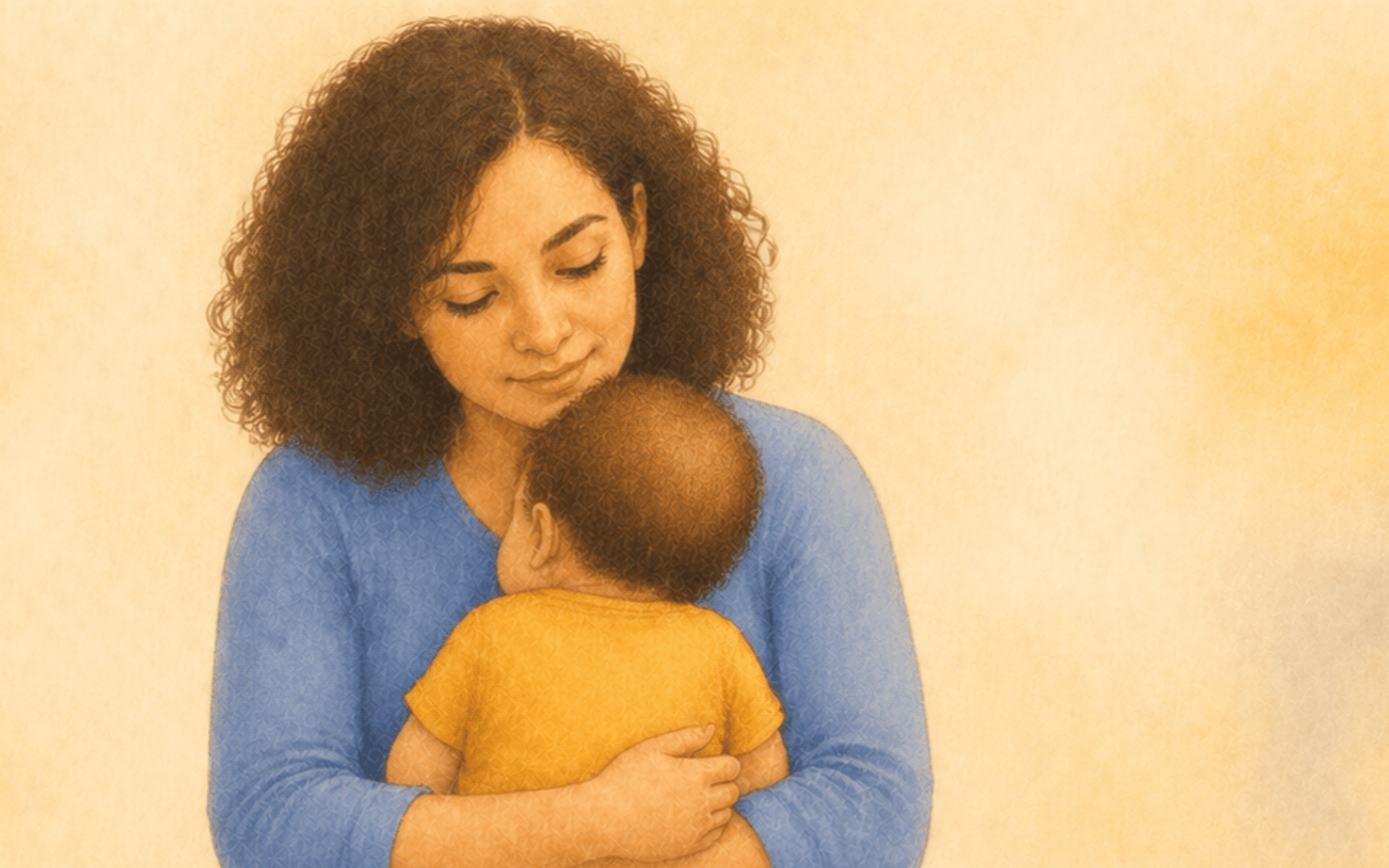
The wake window was perfect. You darkened the room, turned on white noise, rocked until the eyelids finally — finally — got heavy. You set the baby down. Eight minutes later: awake, furious, done. Night sleep has never been this hard. Here's why it isn't supposed to be.
- Why the body clock and daytime sleep are working against each other — the mechanism no sleep guide mentions
- What the research says about contact naps, motion naps, and whether you're creating "bad habits"
- How to tell a nap regression (temporary) from a nap transition (permanent) — and why the difference matters
- What total 24-hour sleep means, and why it's a more useful number than nap count or length
- Age-by-age nap expectations from 3 to 12 months, with the most useful signs your baby is ready to drop one
- What to try when the nap just won't happen, organized by what's most likely going wrong
If the one-sentence answer is enough, you’ve got the gist. If you want the mechanism behind each piece, keep reading.
Why daytime sleep is harder to achieve than night sleep
Most parenting content treats a nap like a shorter version of night sleep — same logic, smaller dose — and the biology has a different opinion.
There are two systems that regulate when your baby sleeps and when they stay awake. The first is homeostatic sleep pressure: a chemical called adenosine accumulates in the brain during wakefulness, building pressure to sleep. The longer your baby has been awake, the higher the pressure. This is the system behind wake windows, and your baby's wake windows guide covers it in detail. The second system is the circadian clock (your baby's internal 24-hour timer).
Here's where daytime sleep runs into a wall the internet doesn't talk about. During the afternoon hours, the circadian system doesn't simply step aside. It generates an alerting signal that actively counteracts the sleep pressure building in the background. Researchers call this the wake-maintenance zone: the window where the body clock pushes wakefulness specifically to prevent sleep from happening at the wrong time. A 2017 study by Reichert and colleagues confirmed that the circadian timing system is fundamental to maintaining stable cognitive performance precisely because it counteracts growing homeostatic sleep pressure during daytime hours.
Add the second half of the mechanism: there is essentially no melatonin available during the day to assist. Melatonin, the hormone that tilts the nervous system toward sleep, only emerges in measurable amounts after dark. In the newborn weeks it barely exists at all; rhythmic melatonin secretion doesn't establish itself until around three to four months, according to a 2024 systematic review by Paditz. By contrast, bedtime arrives with both sleep pressure high and melatonin rising: two systems working together. A nap gets only one.
This is why putting an overtired baby down for a nap can still take forty-five minutes — the nap is fighting the body clock alone, with no melatonin backup.
What the research says about contact naps and motion naps
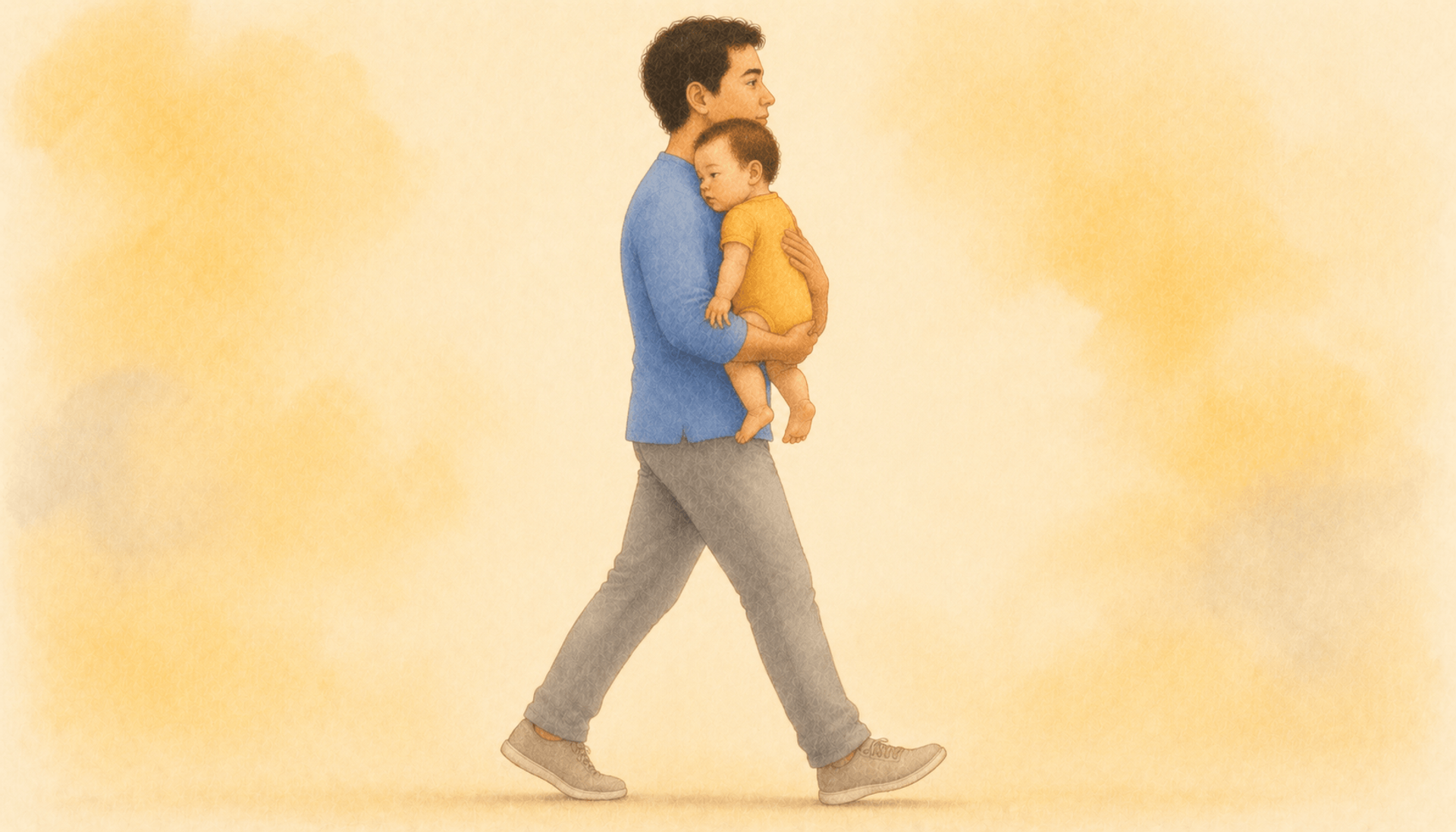
One of the most stubborn beliefs in baby sleep advice is that if a baby will only nap while being held or while moving, the parent is "creating a dependency" that will take months to undo. The science behind that belief is considerably thinner than the conviction behind it.
In 2013, Esposito and colleagues at RIKEN Institute published a study in Current Biology (PMID 23602481) that mapped exactly what happens physiologically when a mother picks up and walks with her baby. Infants under six months showed an immediate, coordinated calming response the moment walking began: voluntary movement stopped, crying ceased, and heart rate dropped measurably and immediately. The authors identified this as a conserved mammalian reflex observed in mice pups carried by their mothers, and not a learned association. It is a built-in biological mechanism that uses motion and proximity as a signal that the environment is safe.
A 2020 study by Raghunath and colleagues in Infant Behavior and Development took this further, looking at what happens to a baby's nervous system at the exact moment of sleep onset. Babies whose mothers stayed physically close settled most deeply — heart rate steadied, breathing slowed, the whole system relaxed in a way it didn't when they were left alone. The babies put down alone showed the least calm of any condition tested. Which is a long way of saying: a contact nap is doing exactly what it looks like it's doing — settling a nervous system that isn't ready to settle on its own yet.
This doesn't mean every nap for the next three years has to be on someone's chest. It means that in months three through nine, when the circadian system is still maturing and sleep consolidation is genuinely hard, a contact nap or motion nap that happens does more for your baby's developmental needs than an hour of crib attempts that don't. Our Sensory Play Cards 0–12 Months include calming pre-nap activity sequences: low-stimulation touch and visual activities designed to lower arousal gradually rather than pushing for an abrupt transition from full alert to full sleep.
Nap regression versus nap transition: they're not the same thing
The term "nap regression" gets applied to almost everything that disrupts daytime sleep, and it muddies what's actually happening — which affects what a parent can usefully do about it.
A nap regression is a temporary disruption to a pattern that was previously working, tied to a developmental leap, teething, illness, or a change in the environment. It tends to resolve in one to four weeks once the trigger passes, and the nap schedule before and after looks essentially the same.
A nap transition is a permanent developmental shift. Your baby's brain has matured to the point where it no longer needs that particular nap, and no amount of environmental optimization will bring it back for long. The transition happens whether or not you "work on" naps; it is driven by changes in how quickly sleep pressure builds and dissipates, which shift continuously across the first two years of life. Research by Kurth and colleagues published in the Journal of Sleep Research in 2016 (PMC5135687) documented that homeostatic sleep-need build-up attenuates across early childhood, meaning younger children accumulate adenosine-based pressure faster, which is precisely why they need more naps.
The transitions that fall within the 3–12 month window follow a reasonably predictable sequence. Most babies move from four or five short naps to three naps somewhere around five to six months. The shift from three naps to two typically happens between seven and nine months, and the Finnish normative cohort study by Paavonen and colleagues found that by eight months, 71.6% of babies were already on two naps, with only 4.7% down to one. The two-to-one transition (the longest-lasting nap of the first year) usually doesn't arrive until somewhere between twelve and eighteen months, which is well outside our age range here.
How to tell the difference in the moment: if the resisted nap returns within two to four weeks on its own, it was a regression. If your baby continues to resist it, naps fine without it, and nighttime sleep doesn't worsen when it's gone — it was a transition. When in doubt, keep offering for two weeks before deciding to drop, because a genuine transition baby usually makes it obvious by sleeping longer in the remaining naps and going to bed at night without difficulty.
What total 24-hour sleep means — and why it's the metric that matters

Most nap anxiety centers on specific nap numbers: three naps or two, forty-five minutes or an hour, at exactly the right time or everything falls apart. The American Academy of Sleep Medicine's consensus statement, developed by a panel led by Shalini Paruthi and published in the Journal of Clinical Sleep Medicine in 2016, frames the target differently. For babies four to twelve months, the recommendation is twelve to sixteen hours of total sleep per twenty-four-hour period, including naps. For one- and two-year-olds, it's eleven to fourteen hours.
What that framing captures — and what the nap-by-nap approach misses — is that the total is what predicts developmental outcomes, not the distribution across naps versus nighttime. A 2015 study by Seehagen and colleagues in PNAS found that six- and twelve-month-old babies who napped within four hours of learning a new task retained the information; those who didn't nap showed no retention. The nap was the consolidation event, regardless of whether it happened in a crib, a carrier, or a stroller. A 2016 study by Horváth and Plunkett in the Journal of Child Psychology and Psychiatry found that more frequent daytime naps predicted vocabulary growth in early childhood, without distinguishing nap location or method.
The practical implication: if your baby's total daily sleep is within the twelve-to-sixteen-hour range and your baby is growing and alert during wake windows, you are not dealing with a sleep problem. A nap that took forty-five minutes to achieve, lasted thirty-five minutes, and happened on you counts. A morning contact nap and an afternoon stroller nap count. Short, frequent naps across the day count. The Galland systematic review of normal infant sleep patterns, a PRISMA meta-analysis of thirty-four studies, found that the normal range for infant total daily sleep runs from 9.7 to 15.9 hours, nearly a six-hour spread in what qualifies as developmentally normal. Individual variation is genuinely large, and your baby may sit toward either end of that range and be completely fine.
The one situation where total sleep becomes worth raising with your pediatrician: if your baby is consistently below the lower end of that range and showing signs of fatigue during wake windows, poor weight gain, or unusual irritability beyond what a developmental leap explains. That's the kind of pattern worth flagging at the next visit, not "my baby only takes two thirty-minute naps."
Nap expectations by age, 3 to 12 months
Understanding what's developmentally expected at your baby's current age makes it considerably easier to separate a genuine problem from normal variation.
3–5 months. Most babies at this age take three to five naps per day, though some still take more. Wake windows range from 60 to 90 minutes at three months and stretch to 90 minutes to two hours by five months. Total daytime sleep typically runs three to five hours distributed across those naps. The circadian system is just coming online; melatonin rhythm emerges around this window, which means nap timing is erratic and schedule-keeping is largely aspirational. Morning naps tend to be more reliable than afternoon ones.
6–8 months. The majority of babies shift to two naps somewhere in this window, though the timing varies by weeks or months. The Finnish Paavonen cohort found that by six months, average total sleep was 13.7 hours, dropping slightly to 13.3 hours at eight months. Wake windows typically run two to two-and-a-half hours, and the longest window is usually before the last nap of the day. For what to do with those growing wake periods, activities for 6-month-olds and activities for 7-month-olds both cover this developmental stage. This is also the window where separation anxiety begins emerging — the same developmental upgrade in memory and object permanence that produces nap protest when you set the baby down is operating all day. Our article on activities for 8-month-olds covers what's happening in the brain during this period.
9–12 months. Wake windows extend to two-and-a-half to three-and-a-half hours. Most babies are solidly on two naps; the transition toward one won't arrive until twelve to eighteen months for most children. Night sleep consolidates further in this window, which sometimes produces morning nap resistance as the total sleep need gradually shifts. A 2025 twin study published in Pediatric Research found that how often your baby wakes and signals is largely driven by the family's sleep environment, meaning consistent pre-sleep cues and response patterns matter considerably more than any specific method.
What to try when the nap won't happen
The following is organized by what's most likely causing the resistance, rather than as a general tip list, because the mechanism determines which approach has any chance of working.
If your baby is overtired (passed the window). Paradoxically, an overtired baby fights sleep harder because the cortisol spike from the stress of excessive wakefulness counteracts the adenosine pressure. The same cortisol biology that makes overtired nights miserable is covered in our article on why daily routines reduce toddler tantrums — the mechanism transfers directly to nap behavior. Watch for the first signs of fatigue (a brief yawn, a momentary gaze away from activity, slowed movement) and start the nap routine before those compound. When a baby is already in meltdown mode, motion and contact are your most reliable tools because they engage the physiological calming response described above rather than trying to compete with an already elevated cortisol response.
If your baby is undertired (wrong window timing). A baby put down before sufficient adenosine has accumulated simply doesn't have the biological pressure to sleep, regardless of how dark and quiet the room is. Extend the wake window by fifteen to twenty minutes and retry. This is more common when nap transitions are in progress: the baby is developmentally ready for a longer wake period but the schedule hasn't adjusted yet.
If your baby resists the crib specifically but will sleep in contact. This is the contact-nap scenario. Esposito's transport response tells us the crib removes the two regulatory inputs the infant nervous system most reliably responds to — motion and proximity. Rather than framing this as a problem to fix immediately, consider cycling: start the nap in contact or motion, transfer to the crib once sleep is deepened, and extend from there gradually if crib independence is the goal. Some families find this transition happens naturally as the baby's capacity for independent regulation matures around eight to ten months; others find they need to be more deliberate about it. Both are valid approaches.
If your baby used to nap well and suddenly doesn't. Check the developmental calendar first — a nap transition, a four-month sleep architecture shift, six-month separation anxiety onset, and eight-to-ten-month social awareness surge all land in the 3–12-month range and all disrupt nap behavior. When the timing matches one of those windows, wait two to four weeks before restructuring anything. A regression resolves on its own; restructuring in the middle of one just adds noise. When two to four weeks pass and the resistance continues, look at whether the current wake windows still match the baby's evolving sleep need — what worked at five months often needs adjustment at seven.
For the pre-nap routine itself. The only intervention for infant sleep that has consistent experimental support is a predictable, brief routine before each sleep period. Mindell and colleagues ran a randomized controlled trial (published in Sleep in 2009) on a consistent three-step nightly routine in infants seven months and older: bath, brief massage, a quiet activity. Sleep onset time improved significantly in the routine group compared to controls, as did night wakings and maternal mood ratings. The same logic applies to naps: three to five minutes of consistent, low-stimulation activity in the same order before every nap teaches the nervous system what comes next. Our sensory play by age guide includes calm, low-prep options that work well as pre-nap wind-down activities. It doesn't need to be elaborate — dim the light, a brief song, put into sleep position. What matters is that it happens the same way each time. For babies who need a calming transition between active play and sleep, our Sensory Play Cards include specifically flagged pre-sleep activity prompts that reduce arousal gradually rather than jumping straight from activity to attempted sleep.
Frequently Asked Questions
Because night sleep and daytime naps operate under different biological conditions. At bedtime, rising sleep pressure and rising melatonin work together — two systems pushing in the same direction. During a nap, melatonin is absent and the circadian body clock is generating an alerting signal that actively opposes the sleep pressure. This is called the wake-maintenance zone, and it means naps have a narrower, harder window than bedtime by design. The gap between how hard bedtime feels versus how hard naps feel reflects two genuinely different neurological states.
Most babies at six months take two naps totaling roughly two to three hours of daytime sleep across the day, though individual variation is large. The Galland systematic review of thirty-four studies found the normal range for total infant daily sleep spans from 9.7 to 15.9 hours. A nap of thirty to forty-five minutes is not a failed nap. For a six-month-old still building sleep consolidation capacity, it may be one complete sleep cycle. What matters more than single-nap duration is total 24-hour sleep in the twelve-to-sixteen-hour range recommended by the American Academy of Sleep Medicine.
The evidence supports contact naps as biologically meaningful, not habit-creating. Esposito and colleagues (2013, Current Biology) identified the calming response to being carried as a conserved mammalian reflex — heart rate dropped and voluntary movement stopped immediately on walking, independent of any learned association. Raghunath and colleagues (2020) found that babies whose mothers stayed close during sleep onset settled more deeply than babies put down alone, in any condition tested. A contact nap that happens provides memory consolidation and rest that a crib attempt that doesn't happen cannot. Whether to prioritize transitioning to the crib is a separate question from whether the contact nap itself is harmful — it isn't.
Probably not. The thirty-to-forty-five-minute nap corresponds to one full sleep cycle in infants (adult cycles run ninety minutes; infant cycles are shorter). Some babies link cycles and extend the nap; others surface at the end of the first cycle and fully wake. A baby who wakes from a short nap calm, alert, and ready to play got what they needed. A baby who wakes cranky and red-eyed may have gone down slightly too late — try moving the next nap start fifteen minutes earlier and see if that changes things.
A nap regression is temporary — lasting one to four weeks — and usually tied to a developmental leap, illness, or environmental change. The pattern before it was working, and the pattern after it returns to roughly the same shape. A nap transition is permanent: your baby's brain has matured past the need for that particular sleep period, and it won't reliably return. Signs it's a true transition: the resisted nap doesn't come back after two to four weeks, total nighttime sleep holds steady or improves, and your baby remains alert and even-tempered through the longer wake window without the dropped nap.
For educational and entertainment purposes only. Not a substitute for professional medical or developmental advice. If you have concerns about your baby's sleep, growth, or development, please consult your pediatrician.
- Esposito, G., Yoshida, S., Ohnishi, R., Tsuneoka, Y., del Carmen Rostagno, M., Yokota, S., Okabe, S., Kamiya, K., Hoshino, M., Shimizu, M., Venuti, P., Kikusui, T., Kato, T., & Kuroda, K. O. (2013). Infant calming responses during maternal carrying in humans and mice. Current Biology, 23(9), 739–745.
- Galland, B. C., Taylor, B. J., Elder, D. E., & Herbison, P. (2012). Normal sleep patterns in infants and children: A systematic review of observational studies. Sleep Medicine Reviews, 16(3), 213–222.
- Horváth, K., & Plunkett, K. (2016). Frequent daytime naps predict vocabulary growth in early childhood. Journal of Child Psychology and Psychiatry, 57(9), 1008–1017.
- Jenni, O. G., & LeBourgeois, M. K. (2006). Understanding sleep–wake behavior and sleep disorders in children: the value of a model. Current Opinion in Psychiatry, 19(3), 282–287.
- Kurth, S., Riedner, B. A., Dean, D. C., O'Muircheartaigh, J., Huber, R., Jenni, O. G., Deoni, S. C. L., & LeBourgeois, M. K. (2017). Napping and development of the sleep homeostat in toddlers. Journal of Sleep Research, 26(6), 663–671.
- Mindell, J. A., Telofski, L. S., Wiegand, B., & Kurtz, E. S. (2009). A nightly bedtime routine: Impact on sleep in young children and maternal mood. Sleep, 32(5), 599–606.
- Paditz, E. (2024). Melatonin in infants and children: A systematic review. Children, 11(2), 192.
- Paruthi, S., Brooks, L. J., D'Ambrosio, C., Hall, W. A., Kotagal, S., Lloyd, R. M., Malow, B. A., Maski, K., Nichols, C., Quan, S. F., Rosen, C. L., Troester, M. M., & Wise, M. S. (2016). Consensus statement of the American Academy of Sleep Medicine on the recommended amount of sleep for healthy children. Journal of Clinical Sleep Medicine, 12(6), 785–786.
- Raghunath, A., Bhatt, R. S., & Sullivan, M. W. (2020). Experimental manipulation of maternal proximity during short sequences of sleep and infant calming response. Infant Behavior and Development, 59, 101426.
- Reichert, C. F., Maire, M., Schmidt, C., & Cajochen, C. (2017). Cognitive brain responses during circadian wake-promotion: Evidence for sleep-pressure-dependent hypothalamic activations. Scientific Reports, 7, 5620.
- Rivkees, S. A. (2003). Developing circadian rhythmicity in infants. Pediatrics, 112(2), 373–381.
- Seehagen, S., Konrad, C., Herbert, J. S., & Schneider, S. (2015). Timely sleep facilitates declarative memory consolidation in infants. Proceedings of the National Academy of Sciences, 112(5), 1625–1629.
- Ventura, T., Moreira, C. S., Carvalho, A., & Figueiredo, B. (2025). Sleep and infant development in the first year. Pediatric Research.
- Yates, D. I. (2018). Long-term effects of light exposure on establishment of newborn circadian rhythm. Journal of Clinical Sleep Medicine, 14(10), 1829–1830.
Related Products

More Articles

Parallel Play in Toddlers: Why Side-by-Side Is the Social Work
Your toddler spent the entire playdate building separate towers, and nobody shared a single block. That counted — more than it looked. A 2025 longitudinal study found that playing beside a specific child consistently predicted later social play with that same child, but not the other way around. Here's what parallel play in toddlers actually is, why the science calls it strategic rather than passive, and what it means for how you run a playdate.

When Do Babies Point: Why It Matters for Language
Most milestone articles treat pointing as a box to check around 12 months. The research tells a different story — one that starts months earlier, runs through the infant brain, and traces back to how much the parent is pointing. Here's what the last fifteen years of research actually found, and what it means for everyday interactions.

When Do Babies Wave Bye-Bye: Why Your Baby Needs You to Wave First
Most baby milestones unfold on a biological schedule — waving isn't one of them. A 2023 study found that babies develop imitation ability because their caregivers imitate them first, and waving is named directly as a cultural gesture learned through that loop. Here's what the research says about the 9–12 month window, why the first wave looks nothing like a wave, and what helps it arrive.