Best First Foods for Baby: Why the Order Matters More Than the List

The list of best first foods for baby reads the same on every parenting website: avocado, banana, sweet potato, oatmeal. All nutritious. All designed, whether deliberately or not, around what a six-month-old will agree to eat without a fight. That logic is reasonable in the short term and quietly counterproductive in the long one. The foods babies accept most willingly at six months are not the foods they need the most practice with. The foods they make a face at are.
- The biology that makes your baby reach for sweet without any prompting — and why that same biology explains why month six is the moment to move against it
- The study that tracked what babies ate at their first meals all the way to age six, and what four-times-as-much looks like in real life
- What the face actually means when your baby pushes green beans back out, and why stopping there is the most common mistake parents make
- Why iron still comes first — and which sources actually deliver it (not what the standard handout implies)
- What the three-to-five-day spacing rule is actually for, and what it has never been for
If the one-sentence answer is enough, you’ve got the gist. If you want the mechanism behind each piece, keep reading.
Babies are born preferring sweet, and that is the whole problem
The preference for sweet flavor is not learned. It is present in every healthy newborn before any food has touched their tongue, and it exists for a reason that made good evolutionary sense: sweetness signals calorie density and safety, bitterness signals potential toxins. A baby who pulled toward sweet and recoiled from bitter was, on average, a baby who survived. Researchers have documented this preference in newborns who have had nothing other than breast milk, and it does not require conditioning to maintain.
At six months, the window for successfully introducing foods that fall outside this preference is, by the research, at its widest. A 2022 randomized controlled trial by Rapson and colleagues, published in the American Journal of Clinical Nutrition, assigned 117 New Zealand infants to either a vegetables-only first-foods group or a standard mixed introduction. The vegetables-only group received only vegetables for four weeks before any fruit was introduced; the control group received the standard mixed introduction from the start. By nine months, babies in the vegetables-only group consumed significantly more vegetables (86.3 grams compared to 67.5 grams, a difference of about 28%). Iron status was not adversely affected in either group.
The European Society for Paediatric Gastroenterology, Hepatology and Nutrition (whose 2017 complementary feeding position paper shapes clinical guidance across Europe) stated this plainly: infants should be offered foods with a variety of flavors and textures, including bitter-tasting green vegetables.
The implication is not that bananas and avocado are bad choices. It is that leading with them sets a benchmark. Once a six-month-old has logged ten or fifteen sweet-food experiences, a plate of pureed green beans is arriving after an established reference point, not before one. And by eight or nine months, that reference point is considerably more entrenched. This is also why understanding when your baby is actually developmentally ready matters more than the date on the calendar. The readiness signs are the body's way of flagging a flavor-learning window that opens around six months and does not stay open indefinitely.
The data on what happens to the face at year six

When a baby receives a spoonful of spinach puree for the first time and wrinkles the nose, squints, and pushes most of it back out with the tongue, every parenting instinct says: your baby does not like spinach. The research on infant flavor acceptance says: your baby is learning spinach. These are not the same thing.
Forestell and Mennella demonstrated this distinction in a 2007 study published in Pediatrics. Forty-five infants between four and eight months old received green beans for eight consecutive days. After eight exposures (including sessions where the face clearly communicated distaste), intake had nearly tripled from what it was on day one. The face was showing novelty detection, not rejection.
A 2016 study by Maier-Nöth and colleagues, published in PLoS ONE, tracked 147 mother-infant pairs from the start of weaning through age six, comparing outcomes for infants who received a high variety of different vegetables in rotation during weaning against those who received a single vegetable throughout the introduction period. At six years of age, children in the high-variety group ate more than four times as much of an unfamiliar vegetable — 14.1 grams compared to 3.2 grams — and rated it more positively on a liking scale. That advantage opened in the first ten days of solids and held across the full six-year follow-up.
A separate finding from the same study: when babies were offered a repeatedly rejected vegetable across eight to ten meals, 79 percent liked and ate it at fifteen months; 73 percent still did at three years.
A 2004 analysis in the Journal of the American Dietetic Association by Carruth and colleagues, looking at 3,022 infants and toddlers, found that parents typically offered a new food three to five times before concluding the child did not like it. The research on acceptance suggests the effective number is closer to eight to fifteen. The gap between what parents try and what the biology requires is, on average, about ten attempts.
This is also why picky eating at two and three has developmental roots that run earlier than most parents expect. Some of the groundwork for an adventurous palate is laid during these first months of solid food experience — and a face at session one is, by the data, one of the least reliable pieces of information about what that child will eat at session eight.
One of the most useful reframes for this phase is treating each new food as a sensory session rather than just a feeding attempt. The Sensory Play Cards 0–12 months include a card built around finger food introduction: name the food out loud, describe what you see, let the baby squeeze it and explore the texture before it ever reaches the mouth. That same approach works from the first puree spoonful. Hold up the broccoli, say "broccoli — it's green and a little bumpy," let the baby look at it and smell it. When a new food arrives with a name, a color, and a texture as part of the experience, the brain is logging more than just taste. That is a sensory workout and an early vocabulary session happening at the same table.
Iron first — which is not the same thing as rice cereal first
The argument for prioritizing iron-rich foods when solids begin is straightforward and well-supported. Iron stores built during the third trimester deplete by roughly six months in full-term infants. Breast milk alone does not meet a growing baby's iron needs at this age, and the requirement, per the American Academy of Pediatrics, is eleven milligrams per day for infants seven to twelve months old, higher on a per-kilogram basis than at any later point in childhood.
Starting with iron therefore makes sense. The confusion comes in assuming that iron-rich means rice cereal, which has been the default first food in the United States for decades more by convention than by nutritional design. The WHO's 2023 guideline on complementary feeding for children six to twenty-three months explicitly notes that iron-fortified rice cereal alone is insufficient to prevent iron deficiency in at-risk populations, and that animal-source foods (meat, fish, and eggs) should be consumed daily.
The foods that actually deliver iron at rates useful to a developing infant include pureed or well-mashed meat, lentil puree, mashed egg, and iron-fortified cereals prepared with breast milk or formula. Iron from animal foods is absorbed by the body several times more efficiently than iron from fortified grain cereals, meaning a smaller portion of each meal delivers more usable iron.
This matters because meat and lentil purees are not sweet. They are mild to savory, which means including them from the beginning sits alongside a vegetables-first approach rather than competing with it. A first week of solids built around iron-rich lentil puree and rotating green vegetables covers both the nutritional floor and the flavor-learning goal simultaneously.
If your baby was born preterm, or if there are any signs of feeding difficulty, the timing and composition of first foods is worth reviewing directly with your pediatrician before you begin. The general developmental picture at six months can help orient what else is happening in this window.
What the three-to-five-day rule is actually for

The advice to wait three to five days between new foods appears in nearly every first-foods handout in the United States, and most parents treat it as a fixed law. The research basis for it, when examined directly, is more limited than its universal status implies.
A 2020 study in JAMA Network Open by Samady and colleagues surveyed 1,482 pediatric practitioners on their complementary feeding recommendations. While most still cited the three-to-five-day interval, the researchers noted explicitly that it is unclear why this specific window was chosen and that a diverse diet in the first year of life is associated with reduced risk of atopy regardless of introduction order. The paper concluded that a reevaluation of published guidelines may be warranted.
The rule does meaningful work for one specific purpose: monitoring for reactions to the eight most commonly allergenic foods. Peanut, tree nuts, egg, dairy, soy, wheat, fish, and sesame warrant individual introduction with observation time between them because allergic reactions to these foods are identifiable and benefit from clear attribution. Introducing three of them simultaneously and then seeing hives makes it impossible to know which one caused the reaction.
For non-allergenic foods (most vegetables, most fruits, meats, and legumes), there is no published evidence that spacing between introductions changes any meaningful outcome. A rotating vegetable introduction is not in conflict with allergen-spacing guidance; the two operate in separate lanes.
The LEAP trial, a randomized controlled study published in the New England Journal of Medicine by Du Toit and colleagues in 2015, showed what early allergen introduction can accomplish: among infants at high risk for peanut allergy, those who consumed peanut regularly from early infancy had dramatically lower rates of peanut allergy by age five. That research was conducted under medical supervision, with skin-prick testing before enrollment — it was not a home protocol. If the LEAP findings feel relevant to your family, particularly if there is a history of food allergy or eczema, your pediatrician can review your baby's specific risk profile and help develop a personalized allergen introduction plan. This is not a step to navigate from a blog post alone.
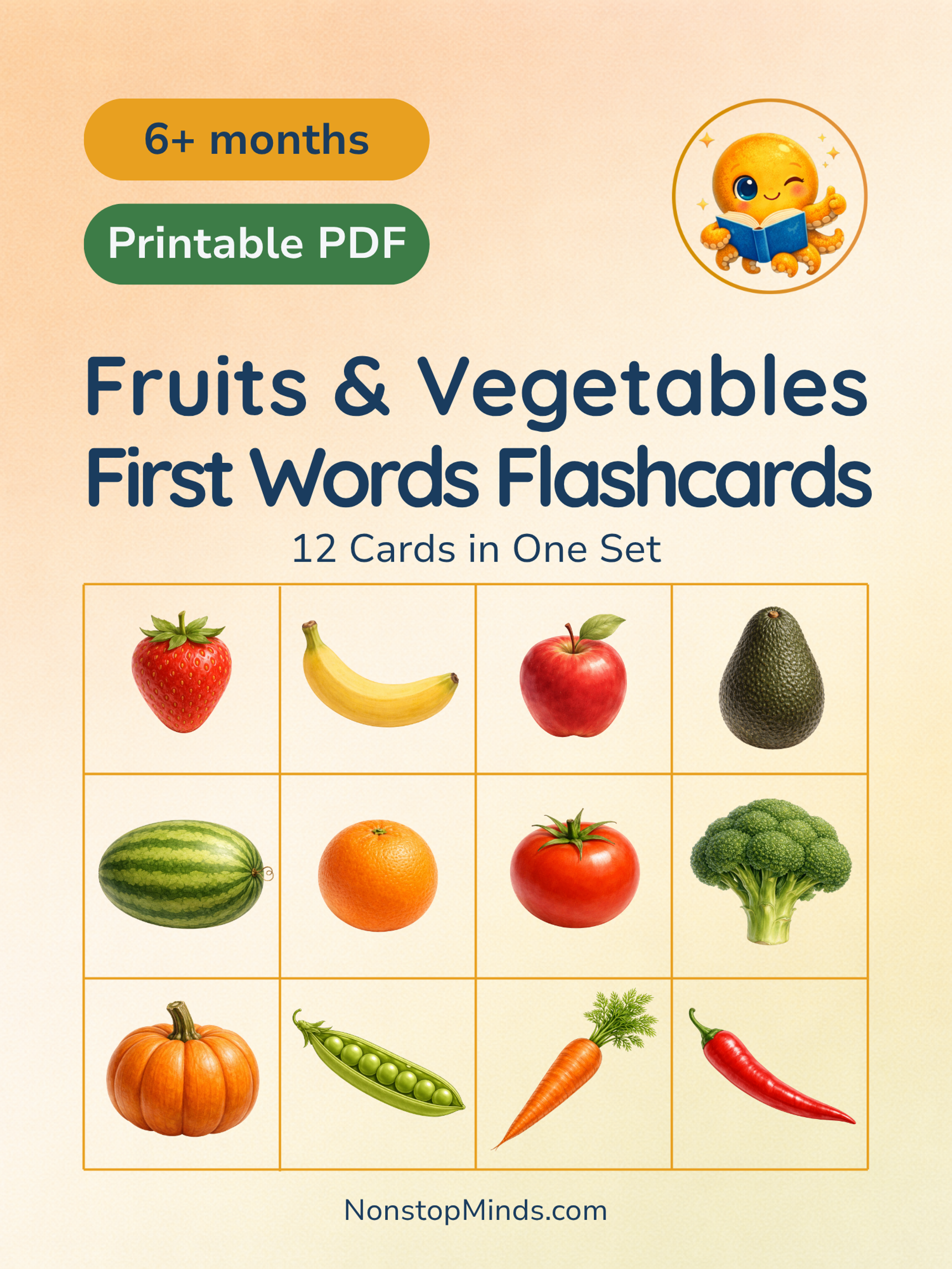
There is a small game worth building into early solids: when you introduce a new vegetable, say its name, point to its color, let the baby hold it (or at least look at it) before the spoon arrives. The match between what it looks like and what it tastes like starts wiring early. The vegetables that become familiar at the high chair are the words a toddler recognizes first — which is why the Fruits and Vegetables First Words Flashcards lands differently for a child who has been eating broccoli and peas since six months. The word already has a taste attached to it.
Frequently Asked Questions
Iron-rich foods and bitter vegetables are worth prioritizing from the first week. For iron, effective options include pureed or well-mashed meat, lentil puree, mashed egg, and iron-fortified cereals prepared with breast milk or formula. Among vegetables, broccoli, peas, spinach, and green beans are solid early choices because they offer both nutritional value and exposure to bitter flavors during the developmental window when acceptance is most trainable. Sweet foods like banana, avocado, and sweet potato are nutritious but are best introduced after bitter vegetables have had several repetitions, so they arrive after — not before — the flavor reference point has been established.
Starting with vegetables before sweet fruits is supported by the 2017 European Society for Paediatric Gastroenterology, Hepatology and Nutrition position paper and by a 2022 randomized trial published in the American Journal of Clinical Nutrition by Rapson and colleagues: infants who received only vegetables for the first four weeks of complementary feeding consumed 28 percent more vegetables at nine months than those who received a mixed introduction. The reason the order matters is biological. Babies are born preferring sweet flavors, which makes sweet foods the benchmark against which everything else is measured. Introducing bitter vegetables before that benchmark is set makes the introduction meaningfully easier.
For a baby-led weaning approach, soft vegetables steamed until easily squishable between two fingers are a practical starting point: thick broccoli florets, wide strips of zucchini, soft-cooked green bean pieces, or wedges of steamed sweet potato. Iron-rich foods translate well to self-feeding as soft strips of well-cooked meat, preloaded spoons of lentil puree, or wedges of hard-boiled egg. The basic safety guidance — finger-sized pieces, soft enough to mash with the gums, always supervised — applies regardless of which specific foods are offered first. The evidence on the baby-led weaning method itself, including choking data and trial findings, is covered in the baby led weaning guide.
The most direct influence first foods have on gut microbiome development is dietary diversity rather than any single food. A 2025 narrative review in Nutrients by Noles and colleagues, pooling data from 43 studies, found that the shift from an exclusively milk-based diet to complementary foods drives significant changes in gut bacterial composition, and that plant food variety is the strongest predictor of microbiome maturation through age three. In practical terms, a first-foods plan that rotates through multiple vegetables and protein sources in the first few weeks does more for gut diversity than any single ingredient. This is an active research area; the mechanisms are real but the specific causal pathways are still being studied.
This article is for educational and informational purposes only and is not a substitute for professional medical, nutritional, or developmental advice. Always consult your pediatrician before beginning solid foods, especially if your baby has a history of allergies, was born preterm, or has any conditions affecting feeding.
- Baker, R. D., & Greer, F. R.; Committee on Nutrition. (2010). Diagnosis and prevention of iron deficiency and iron-deficiency anemia in infants and young children (0–3 years of age). Pediatrics, 126(5), 1040–1050.
- Carruth, B. R., Ziegler, P. J., Gordon, A., & Barr, S. I. (2004). Prevalence of picky eaters among infants and toddlers and their caregivers' decisions about offering a new food. Journal of the American Dietetic Association, 104(Suppl 1), S57–S64.
- Du Toit, G., Roberts, G., Sayre, P. H., Bahnson, H. T., Radulovic, S., Santos, A. F., … Lack, G. (2015). Randomized trial of peanut consumption in infants at risk for peanut allergy. New England Journal of Medicine, 372(9), 803–813.
- Emmett, P. M., Hays, N. P., & Taylor, C. M. (2018). Antecedents of picky eating behaviour in young children. Appetite, 130, 163–173.
- Fewtrell, M., Bronsky, J., Campoy, C., Domellöf, M., Embleton, N., Fidler Mis, N., … Braegger, C. (2017). Complementary feeding: A position paper by the European Society for Paediatric Gastroenterology, Hepatology and Nutrition (ESPGHAN). Journal of Pediatric Gastroenterology and Nutrition, 64(1), 119–132.
- Forestell, C. A., & Mennella, J. A. (2007). Early determinants of fruit and vegetable acceptance. Pediatrics, 120(6), 1247–1254.
- Maier-Nöth, A., Schaal, B., Leathwood, P., & Issanchou, S. (2016). The lasting influences of early food-related variety experience: A longitudinal study of vegetable acceptance from 5 months to 6 years in two populations. PLoS ONE, 11(3), e0151356.
- Mennella, J. A. (2014). Ontogeny of taste preferences: Basic biology and implications for health. American Journal of Clinical Nutrition, 99(3), 704S–711S.
- Mennella, J. A., Nicklaus, S., Jagolino, A. L., & Yourshaw, L. M. (2008). Variety is the spice of life: Strategies for promoting fruit and vegetable acceptance during infancy. Physiology & Behavior, 94(1), 29–38.
- Noles, D. L., Matzeller, K. L., Frank, D. N., Krebs, N. F., & Tang, M. (2025). Complementary feeding and infant gut microbiota: A narrative review. Nutrients, 17(5), 743.
- Rapson, J. A., von Hurst, P. R., Conlon, C. A., Stonehouse, W., & Coad, J. (2022). Starting complementary feeding with vegetables only increases vegetable acceptance at 9 months: A randomized controlled trial. American Journal of Clinical Nutrition, 115(4), 1144–1155.
- Samady, W., Campbell, E., Aktas, O. N., Jiang, J., Bozen, A., Fierstein, J. L., … Gupta, R. S. (2020). Recommendations on complementary food introduction among pediatric practitioners. JAMA Network Open, 3(8), e2013070.
- World Health Organization. (2023). Guideline for complementary feeding of infants and young children 6–23 months of age. WHO.

More Articles

Parallel Play in Toddlers: Why Side-by-Side Is the Social Work
Your toddler spent the entire playdate building separate towers, and nobody shared a single block. That counted — more than it looked. A 2025 longitudinal study found that playing beside a specific child consistently predicted later social play with that same child, but not the other way around. Here's what parallel play in toddlers actually is, why the science calls it strategic rather than passive, and what it means for how you run a playdate.

When Do Babies Point: Why It Matters for Language
Most milestone articles treat pointing as a box to check around 12 months. The research tells a different story — one that starts months earlier, runs through the infant brain, and traces back to how much the parent is pointing. Here's what the last fifteen years of research actually found, and what it means for everyday interactions.

When Do Babies Wave Bye-Bye: Why Your Baby Needs You to Wave First
Most baby milestones unfold on a biological schedule — waving isn't one of them. A 2023 study found that babies develop imitation ability because their caregivers imitate them first, and waving is named directly as a cultural gesture learned through that loop. Here's what the research says about the 9–12 month window, why the first wave looks nothing like a wave, and what helps it arrive.