How to Help Your Baby Talk: It's Not About Talking More

She'd been talking to the baby all morning — narrating the laundry, explaining the coffee, providing a running commentary on the cat's life choices. Somewhere around lunch it occurred to her that she had no idea if any of it was working. Was she doing the right things? Was she doing enough? And then the baby looked at the cup, made a sound, and looked back at her — and she realized she had been doing a lot of talking but maybe not that much listening.
If any of that sounds like your mornings — the effort, the good intentions, the quiet uncertainty that you might somehow be doing it slightly wrong — you're in better shape than you think, and in very good company.
- Why talking, reading, and singing work, and the mechanism behind them that most parenting articles skip
- The timing rule that researchers found changes the structure of babies' babbling within a single play session
- A decades-old finding that flips the instinct to always teach your baby something new
- Why dad's specific vocabulary contribution shows up in the language data in a way most parents don't expect
- What happens to all the ambient noise your baby overhears, including the TV in the next room
- The milestones worth knowing, and the softer signals worth flagging at the next checkup
If the one-sentence answer is enough, you’ve got the gist. If you want the mechanism behind each piece, keep reading.
Why talking, reading, and singing to your baby actually work
The standard advice is right. Talking to your baby during diaper changes, narrating a walk, reading picture books, singing the same four songs every single night. All of it works, and all of it works for specific reasons worth knowing.
When you talk directly to a baby, you're providing what researchers call child-directed speech: slower pace, higher pitch, shorter sentences, exaggerated vowel sounds, more pauses. Babies show a measurable preference for this kind of talk over regular adult conversation from the first weeks of life, and their ability to map sounds to meaning develops faster in response to it. A longitudinal study tracking 40 mother-infant pairs found that parental responsiveness (including descriptions, play talk, and imitating baby's sounds) predicted when children hit five separate language milestones, including first words, a 50-word vocabulary, and combining words into phrases. Children of more responsive parents reached those milestones measurably earlier.
Reading aloud does something narrating daily life can't: it introduces vocabulary that doesn't come up in kitchen commentary. The word "jellyfish" doesn't come up during laundry. "Submarine" doesn't come up on a walk to the mailbox. Books are one of the primary routes through which babies and toddlers acquire words their caregivers don't use naturally in daily narration, which is part of why reading to a baby who can't yet follow a plot still builds foundations for later vocabulary. How babies develop hearing and process sound across the first year tracks closely with the language input they're receiving; even when the baby doesn't look like they're listening, the processing is happening.
Singing works because rhythm and repetition give a developing brain predictable sound sequences to map. A baby's brain is actively looking for patterns in the stream of sound coming at it, and a repeated song heard fifteen times in a week gives it the same pattern across enough exposures to register.
None of this is contested, and most parenting sources have it right. What most leave out is the mechanism: specifically, how the response you give in the moment shapes what the baby does next.
The timing rule most parents never hear about
The most well-supported research finding on how to help your baby talk faster or earlier has nothing to do with how much you say. It has to do with when you say it.
In a 2008 study from Cornell University, Goldstein and Schwade put 9.5-month-old babies into two groups. Mothers in both groups were trained to respond verbally to their babies' babbling, but one group responded immediately after each babble (contingent feedback), while the other gave the same responses at moments unconnected to what the baby had just produced. The timing was the only variable. Same words, same warmth, same vocal quality, different moment.
Within a single 30-minute session, the babies who received immediate responses restructured their babbling. They produced significantly more consonant-vowel syllables (the ba-ba, ma-ma, da-da combinations that sound like the beginning of speech) and a higher proportion of fully resonant sounds. The babies in the non-contingent group showed no such shift. The same words, wrong timing: nothing changed.
The finding held up at scale. A 2014 study by Warlaumont and colleagues analyzed over 13,800 hours of daylong home audio recordings from children aged 8 to 48 months. When a caregiver responded immediately to a speech-related sound, the child's next vocalization was significantly more likely to be speech-related too. That feedback loop, measured across thousands of real-home recordings, was one of the clearest predictors of speech development trajectory in the dataset.
What this means practically is simple: when your baby makes a sound, pause whatever you're in the middle of and respond within a second or two. The content of your response matters less than the fact that it arrives on time. A brief "oh yeah?" directed at your baby in the moment after a babble does more work than a long narration that starts three seconds later.
Follow your baby's gaze — don't redirect it
Here is the finding that most directly cuts against the instincts of an engaged, enthusiastic parent: attempting to teach new words by pointing to something your baby is not already looking at can slow vocabulary growth.
In a 1986 study, developmental psychologist Michael Tomasello and his colleague Michelle Farrar observed 24 mother-child pairs during free play at 15 months and again at 21 months. They coded maternal speech into two categories: references to objects the child was already attending to, and references that redirected the child's attention toward something new. When mothers named what their babies were already looking at, vocabulary at 21 months was higher. When mothers pointed to new objects to teach them (the classic "look at the bird!" move while the baby is studying something else), vocabulary at 21 months was lower.
Same parent, same session, same general behavior. Opposite direction of attention, opposite outcome.

If your baby is staring at a cup with the concentration of a small scientist, the more useful move is to follow that attention: "cup — big blue cup — your cup is right there." Pivoting to the truck you'd like them to notice is the version of language input the data doesn't favor.
A 2014 study by Gros-Louis and colleagues confirmed this from another angle. Mothers who responded to their babies' sounds by naming the specific object their baby was already directing their gaze toward had infants who produced more vocalizations and who showed more words and gestures at 15 months. It wasn't just responsiveness that predicted those outcomes; it was accuracy. Whether the parent was tracking what the baby was attending to, moment by moment, made a measurable difference.
The activities at 9 months stage is particularly well-suited to this kind of practice, because 9-month-olds are developing pointing gestures and deliberate shared focus in ways that make gaze-following feel almost like a conversation.
Read out loud — and let dad take the book sometimes

Reading consistently from the early months builds vocabulary, supports sound pattern recognition, and creates back-and-forth conversation structures that babies internalize long before they have words to use in return. None of that is in question. What surprises most parents is what the research says specifically about fathers reading aloud.
A 2010 study from the Family Life Project tracked 1,292 two-parent families from when their babies were 6 months old through age 3. Researchers Pancsofar, Vernon-Feagans, and colleagues measured the vocabulary diversity of both parents during a picture-book reading session when the child was 6 months old, then assessed children's language at 15 months and 36 months. After controlling for family demographics, child characteristics, and the mother's own education and vocabulary, father vocabulary diversity during that 6-month reading session independently predicted more advanced language at both follow-up points. Mother vocabulary during the same book-reading task did not independently predict later outcomes once maternal education was accounted for. Only the father's range of words carried that specific predictive relationship.
Subsequent research suggests this is partly because fathers tend to introduce more unusual vocabulary during play, including words outside the daily caregiving narration and descriptions that push into territory the child hasn't encountered through the usual routine. A parent who pauses on a picture of a shark and says "this one hunts in the deep ocean, a predator" is doing something different from naming the shark and turning the page. That kind of elaboration on novel words appears to be part of what makes the paternal contribution distinct and measurable in the data.
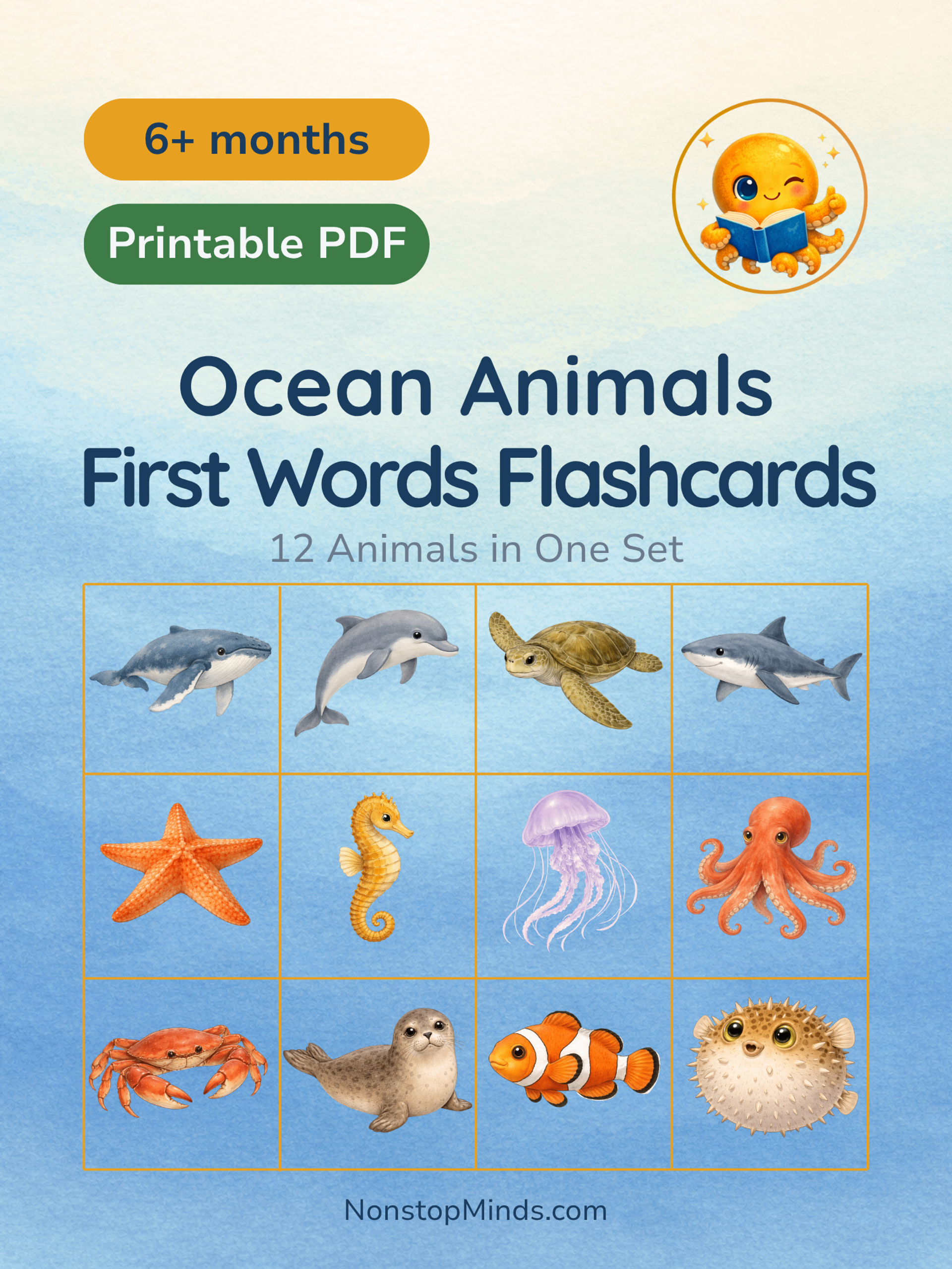
Our Ocean Animals First Words Flashcards cover twelve ocean animals: whale, shark, octopus, jellyfish, sea turtle, and others. These are words that arrive through books and cards rather than through the ordinary narration of a Tuesday morning. Handing those cards to a partner and letting them do their own version of the session, however different from yours, counts for more than it might appear.
Why the background TV doesn't count as language input
A 2013 Stanford study followed 29 children from 19 to 24 months using all-day home audio recordings. Researchers Weisleder and Fernald measured two types of language exposure: speech directed at the child, and speech the child simply overheard (adult conversations in the room, the television, background noise). Child-directed speech at 19 months predicted both vocabulary size and language-processing speed at 24 months. Overheard speech showed no measurable relationship to either.
The effect for ambient speech wasn't smaller. It was absent.
The reason appears to be that infant language learning isn't passive extraction from an audio stream. It depends on social context: on producing a sound and receiving a timed response, on hearing a word in the same moment two people are looking at the same thing, on the interactive loop that makes a word feel like communication rather than background noise. A word that arrives during a shared moment of attention lands differently in the developing brain than the same word coming out of a TV two rooms away. This aligns with earlier research showing that babies learn language from live interaction with a real person but not from hearing the same content through a screen, even when it's the same words, same speaker, same tone.
Our full piece on the screen time research covers the broader picture — including the AAP's 2026 update on quality, context, and what co-viewing with narration actually does. The specific finding here is narrower: ambient speech that isn't directed at your baby (the TV running while you fold laundry, adults talking in the next room) doesn't appear to move vocabulary outcomes. What the research consistently isolates as the active ingredient is the interactive loop itself: directed speech, a response from the baby, a response back to that response.
Building that loop into a regular play session is easier when the vocabulary prompts are already in front of you. Our Sensory Play Cards 0–12 Months include "Talk About It" prompts on the back of every card, with specific words and phrases keyed to whatever's on the front, designed to make directed, object-connected language easy to deliver in the middle of a regular play session. The month-by-month sensory play system is organized by age specifically so the vocabulary connects to where the baby's attention already is, rather than asking a parent to invent the bridge on the spot.
When to check in with your pediatrician about speech
The CDC updated its developmental milestone guidance in 2022 to reflect a wider range of what falls within the usual scope of development. As a general map: reacting to sounds in the first weeks of life; cooing and vowel sounds by 2 months; babbling with consonants by 6 to 7 months; producing "mama" and "dada" sounds (not necessarily intentionally) by around 9 months; a first intentional word somewhere between 10 and 15 months; 6 or more words by 18 months; and around 50 words with some two-word combinations by 24 months.
These aren't hard cutoffs, and the range in this area is genuinely wide, particularly for first words. Our guide to when babies start talking goes into the full timeline and what actually counts as a first word, which is worth reading if the 10-to-15-month window feels frustratingly vague.
What matters at every stage is a general direction of growth and engagement. A baby who isn't babbling at all by 7 months, who isn't responding to the baby's name by 9 months, or who stops producing sounds or words that were previously present — those patterns are worth raising at the next checkup rather than waiting to see what happens. A baby who seems to understand far more than what comes out verbally (following simple instructions, pointing, making consistent eye contact) usually has receptive language running ahead of expressive, which is worth mentioning at the next routine visit.
Your pediatrician will want to know what you're observing at home. The specific examples you bring: what sounds your baby makes, whether the baby points, what the baby responds to, what's changed recently. These are more useful than a general sense of concern.
Frequently Asked Questions
The clearest driver of vocal frequency in research is contingent, timely response. When a caregiver responds promptly to a baby's sounds, the baby produces more sounds in return. A 2014 study analyzing over 13,800 hours of real home audio recordings found this feedback loop operating consistently: a timely response to a speech-related vocalization significantly increased the likelihood of another speech-related vocalization from the baby. Practically, this means responding within a second or two of each babble, treating the sound as the opening of a conversation rather than background noise.
Responding immediately to babbles (rather than finishing a thought and responding later), naming objects the baby is already attending to rather than redirecting their attention to something new, and reading aloud with varied vocabulary are the three behaviors most consistently linked to earlier language milestones in longitudinal research. A 2008 Cornell University study found that babies whose mothers responded to their babbling immediately, not just warmly but on time, and restructured the complexity of their babbling within a single 30-minute session, while babies who received the same responses at wrong moments showed no change.
A 12-month-old who isn't yet saying words but is babbling, pointing, making eye contact, and responding to name is likely within the usual developmental range. The CDC's 2022 milestone guidance places first intentional words anywhere from 10 to 15 months. Patterns worth raising at the next pediatric appointment include: no babbling at all by 7 months, no response to name by 9 months, no gesturing (pointing, waving) by 12 months, or loss of sounds or words that were previously present. A baby who had words and then stopped using them is a reason to schedule a conversation with the pediatrician rather than waiting for the next routine visit.
These are two different things, and the research treats them differently. Parentese (real words spoken at higher pitch, slower pace, and with exaggerated vowels: "looook at the dooooggy!") supports phonetic learning and appears to accelerate early language development. Nonsense syllables and non-word babble returned to the baby ("goo-goo, ga-ga") don't offer the same language input and aren't recommended by speech professionals as a primary mode. The practical version: use real words, use them in a warmer and slightly slower register than you'd use with an adult, and respond to your baby's babbling with real language rather than mirroring back nonsense.
For toddlers already producing words, the most research-supported strategies are expansion (repeating what the toddler said and adding one or two words: "ball" → "big red ball"), open-ended questions about things already in the toddler's field of attention, and consistent varied vocabulary during shared reading. A 2013 Stanford study following children to 24 months found that child-directed speech continued to predict vocabulary growth through that age, with overheard speech remaining essentially uncorrelated with outcomes. One practical note: resist completing sentences for the toddler before they've had time to attempt them. The pause, and the expectation built into it, is part of how expressive practice develops.
For educational and informational purposes only. Not a substitute for professional medical or speech-language advice. If you have concerns about your child's language development, please consult your pediatrician or a licensed speech-language pathologist.
- CDC. (2022). Learn the signs, act early: Developmental milestones. U.S. Centers for Disease Control and Prevention.
- Goldstein, M. H., & Schwade, J. A. (2008). Social feedback to infants' babbling facilitates rapid phonological learning. Psychological Science, 19(5), 515–523.
- Gros-Louis, J., West, M. J., & King, A. P. (2014). Maternal responsiveness and the development of directed vocalizing in social interactions. Infancy, 19(4), 385–408.
- Pancsofar, N., & Vernon-Feagans, L. (2006). Mother and father language input to young children: Contributions to later language development. Journal of Applied Developmental Psychology, 27(6), 571–587.
- Pancsofar, N., Vernon-Feagans, L., & The Family Life Project Investigators. (2010). Fathers' early contributions to children's language development in families from low-income rural communities. Early Childhood Research Quarterly, 25(4), 450–463.
- Romeo, R. R., Leonard, J. A., Robinson, S. T., West, M. R., Mackey, A. P., Rowe, M. L., & Gabrieli, J. D. E. (2018). Beyond the 30-million-word gap: Children's conversational exposure is associated with language-related brain function. Psychological Science, 29(5), 700–710.
- Tamis-LeMonda, C. S., Bornstein, M. H., & Baumwell, L. (2001). Maternal responsiveness and children's achievement of language milestones. Child Development, 72(3), 748–767.
- Tomasello, M., & Farrar, M. J. (1986). Joint attention and early language. Child Development, 57(6), 1454–1463.
- Warlaumont, A. S., Richards, J. A., Gilkerson, J., & Oller, D. K. (2014). A social feedback loop for speech development and its reduction in autism. Psychological Science, 25(7), 1314–1324.
- Weisleder, A., & Fernald, A. (2013). Talking to children matters: Early language experience strengthens processing and builds vocabulary. Psychological Science, 24(11), 2143–2152.
- Wu, Z., & Gros-Louis, J. (2023). Parental verbal responsiveness to infant vocalizations from 9 to 14 months of age. Infant Behavior and Development, 73, 101851.
More Articles
Parallel Play in Toddlers: Why Side-by-Side Is the Social Work
Your toddler spent the entire playdate building separate towers, and nobody shared a single block. That counted — more than it looked. A 2025 longitudinal study found that playing beside a specific child consistently predicted later social play with that same child, but not the other way around. Here's what parallel play in toddlers actually is, why the science calls it strategic rather than passive, and what it means for how you run a playdate.
When Do Babies Point: Why It Matters for Language
Most milestone articles treat pointing as a box to check around 12 months. The research tells a different story — one that starts months earlier, runs through the infant brain, and traces back to how much the parent is pointing. Here's what the last fifteen years of research actually found, and what it means for everyday interactions.

When Do Babies Wave Bye-Bye: Why Your Baby Needs You to Wave First
Most baby milestones unfold on a biological schedule — waving isn't one of them. A 2023 study found that babies develop imitation ability because their caregivers imitate them first, and waving is named directly as a cultural gesture learned through that loop. Here's what the research says about the 9–12 month window, why the first wave looks nothing like a wave, and what helps it arrive.