When to Start Solid Foods: What the Readiness Signs Are Telling You
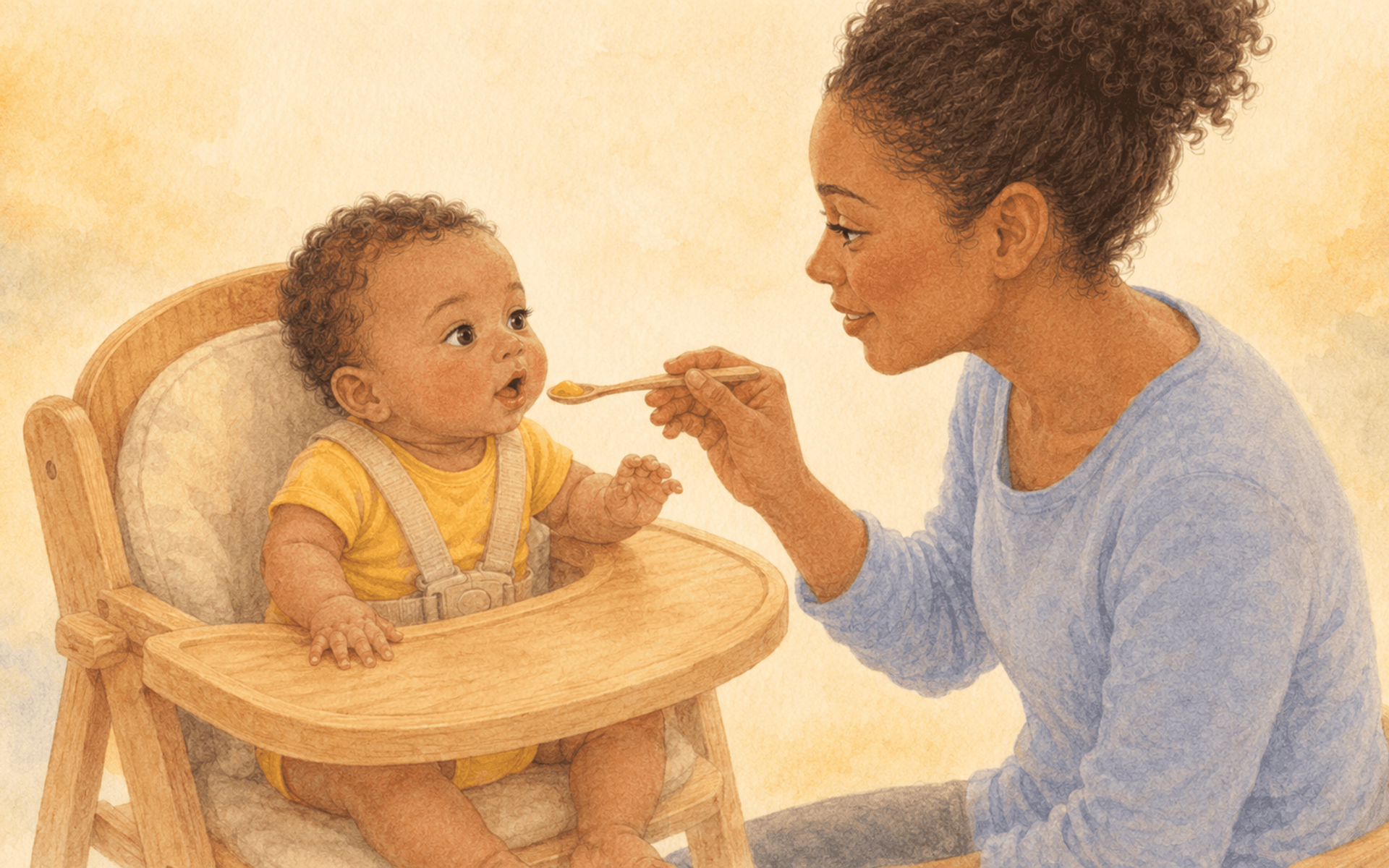
Ask your pediatrician when to start solid foods and you'll get the answer in under five seconds: around six months, when baby shows the signs. It is a perfectly good answer — specific enough to feel reassuring, vague enough to leave you googling at midnight. What it doesn't quite explain is why those signs and not others, why six months and not five-and-a-half, and what the readiness checklist is measuring beneath the surface. Those turn out to be different questions from the one most parents ask. They also have more interesting answers.
- The biology running quietly in the background since the third trimester, and why it explains the six-month mark better than any checklist does
- What the three readiness signs are measuring under the hood, and why one popular sign turns out to be optional
- Why the answer is slightly different for breastfed and formula-fed babies
- The research finding about texture and taste learning that most solid-food guides skip entirely
- What the first days of solid foods realistically look like (much messier and lower-stakes than you might expect)
- A few patterns worth mentioning to your pediatrician before you begin
If the one-sentence answer is enough, you’ve got the gist. If you want the mechanism behind each piece, keep reading.
Why the six-month mark exists — and where it comes from
The six-month recommendation isn't a round number someone picked because it sounded tidy. It reflects two things happening in your baby's body at roughly the same time, and understanding both of them makes the whole timeline feel considerably less arbitrary.
The first is nutritional. During the third trimester of pregnancy, iron passes from the placenta to the baby in significant quantities, enough to supply a healthy, full-term newborn for roughly the first six months of life. After that, those stores begin to run low. Breast milk, for all its remarkable properties, contains relatively modest levels of iron. Formula is iron-fortified and fills the requirement well, but once solids start replacing milk feeds, food needs to carry the iron load. The updated AAP breastfeeding policy (Meek, Noble, and colleagues, Pediatrics, 2022) maintained the recommendation for exclusive breastfeeding for approximately six months, noting that iron-rich complementary foods should be among the earliest things offered once solids begin. That is not a footnote. It is the core nutritional reason the timeline exists at all.
There is an interesting wrinkle here that almost no parenting article mentions. A randomized controlled trial by Andersson and colleagues, published in the BMJ in 2011, enrolled 400 full-term Swedish infants and found that babies whose umbilical cord was clamped at three minutes or more after birth had ferritin levels 45% higher at four months of age than babies whose cord was clamped within ten seconds. The timing of something that happened in the delivery room, in other words, has a measurable effect on how long the iron reserve lasts, which means the biological clock isn't ticking at exactly the same rate for every baby.
The second thing converging around six months is developmental. Somewhere between four and six months, the neuromuscular coordination needed for safe swallowing starts to mature, the extrusion reflex (the automatic tongue-push that sends non-liquid things back out of a young baby's mouth) begins to fade, and enough core strength develops to allow a baby to sit upright with support. None of these changes happen on a fixed date. They unfold on a gradient, which is why the guidance says "around six months" rather than "on the six-month birthday." The signs are the body's way of flagging that both processes (nutritional readiness and physical readiness) are approaching the same point.
What the readiness signs are measuring
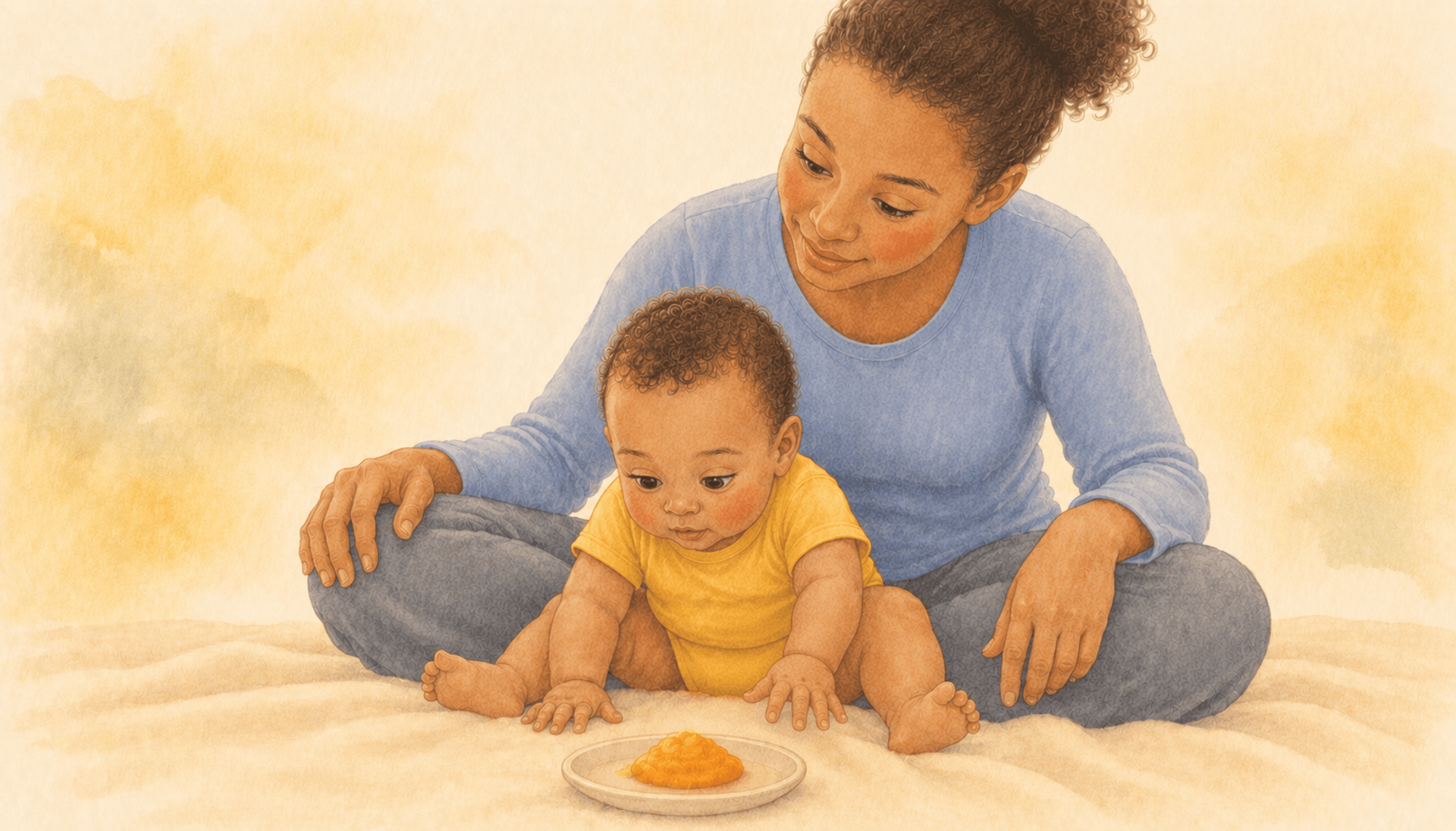
Sitting with support, steady head control, and interest in food are not arbitrary boxes to tick. Each one reflects something specific about what makes early feeding safe and developmentally useful.
Sitting upright with support matters because it positions the airway correctly for swallowing. A baby who is slumped, reclined, or not well-supported cannot move food safely from the front of the mouth toward the back of the throat. The 2022 CDC milestone revision (Zubler and colleagues, Pediatrics) noted that fully independent sitting typically emerges around nine months. Sitting in a high chair or on a parent's lap with good positional support is achievable several months earlier, and that is all that is required. If your baby cannot maintain an upright position even with support, or immediately slumps to the side, the body is communicating something worth listening to.
Head control matters for a related reason. A baby with steady head control can communicate fullness before there are any words for it. The turn-away, the closed mouth, the arched back are all early eating vocabulary, and watching for them is genuinely useful once you start. Feeding works much better as a conversation than as a delivery operation.
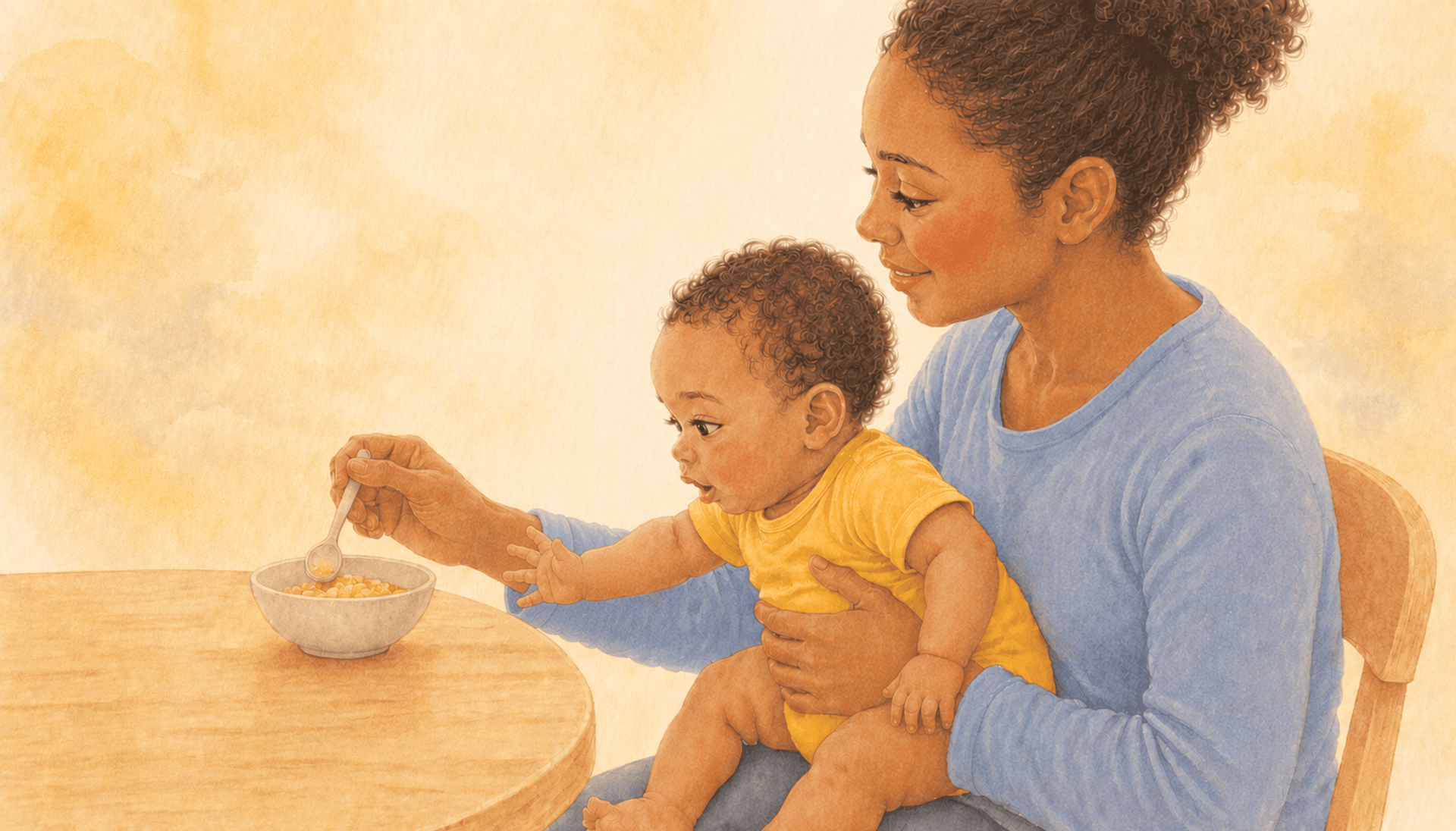
Interest in food (watching you eat, leaning toward your plate, opening the mouth when a spoon comes close) is a behavioral signal that tends to appear alongside the motor ones, and it reflects the same underlying developmental window. Research on food acceptance in infancy, including early work by Birch (Pediatrics, 1994), has consistently found that infants in this period show a natural openness to new flavors that is considerably easier to work with than the resistance that sets in later. The interest your baby is showing is not random nosiness. It corresponds to a moment of biological receptivity that is worth taking seriously.
One sign that gets more attention than it probably deserves is the disappearance of the tongue-thrust reflex. This reflex, which causes babies to push solid objects out of the mouth, does fade between four and seven months, but its absence is not actually a prerequisite for starting. The research does not strongly support waiting for the reflex to disappear as a gating criterion, and the pushing-out behavior many parents observe in early feeding sessions is simply part of how those first days look, not a signal to wait longer. If the sitting, head control, and interest criteria are clearly in place, the tongue reflex question is worth discussing with your pediatrician rather than treating as a dealbreaker on its own.
For a sense of what your baby's sensory and motor development looks like during this same window, our Sensory Play Cards 0–12m organize activities by developmental stage, a useful frame for understanding what your baby is capable of processing month by month, alongside the eating exploration.
Why the answer is slightly different for breastfed and formula-fed babies
If the solid-food conversation feels slightly different depending on which parenting community you spend time in, it is because the underlying nutritional situation genuinely differs.
For exclusively breastfed babies, the six-month recommendation reflects both the nutritional timeline (iron store depletion) and the broader protective benefits of exclusive breastfeeding for as long as is practical. Breast milk alone can meet most nutritional needs up to six months (the key word is "most"). Iron is the exception. Breastfed babies who start solids at six months should prioritize iron-rich first foods: pureed meats, lentils, iron-fortified cereals. Starting exclusively with fruits and vegetables, which is tempting because they feel gentle and easy, delays the iron from food that the body genuinely needs at this stage.
For formula-fed babies, the picture looks a little different. Formula is already iron-fortified, so the depletion clock is not ticking in quite the same way. The developmental readiness signs still land in the same general window, but the urgency is more purely developmental than nutritional. Some pediatricians give a bit more flexibility on timing for formula-fed babies for exactly this reason.
For premature babies, all of this shifts. Timing for preterm infants should be based on corrected age (adjusted for how early the baby was born), not calendar age. A baby born eight weeks early who is six months old on the calendar is developmentally closer to four months. Your pediatrician or neonatologist should be guiding this conversation directly. Premature infants often also have lower iron stores at birth, because the placental iron transfer that happens in the third trimester was cut short.
If you are navigating what solids look like alongside everything else that is happening at six months, our article on activities for a 6-month-old covers the broader developmental picture for this age, useful context for understanding what your baby is working on in general, not just at the table.
The part most guides skip: what the research says about waiting
Here is the finding that changes how most parents think about this question once they encounter it.
A large longitudinal study using data from the ALSPAC cohort (one of the longest-running child development studies in the world) followed thousands of children and found that those introduced to textured and lumpy foods after nine months of age had significantly higher rates of picky eating and feeding difficulties at fifteen months. Coulthard, Harris, and Emmett published this in Maternal & Child Nutrition in 2009. The feeding difficulties measured at fifteen months were still detectable when those children were followed up at seven years of age — a finding that speaks to just how early that texture-learning window matters. The researchers described the evidence as consistent with a sensitive period in early infancy during which babies are most receptive to new textures and tastes, a window that opens around six months and begins to close somewhere around nine months.
A 2021 review in Frontiers in Pediatrics summarized the emerging picture: there appears to be a sensitive period between roughly four and nine months when infants are most neurologically receptive to new food experiences, and earlier and more varied exposure within that window tends to predict better acceptance of a wider range of foods through childhood.
This does not mean starting as early as possible is always better. The four-month lower boundary reflects a genuine developmental constraint. The body is not physically ready before then, and starting before four months is not recommended by any major pediatric organization. The point is simply that the question of when to start solid foods has two edges, not one. Most articles, and most pediatric handouts, focus on the lower boundary (don't start too early). The research suggests the upper boundary (don't push textured foods past nine months) deserves equal attention, and gets almost none.
This is also part of why picky eating in toddlers has developmental roots that run earlier than most parents expect. Some of the groundwork for adventurous eating is laid during these first months of solid food experience.
What the first days of solid foods look like
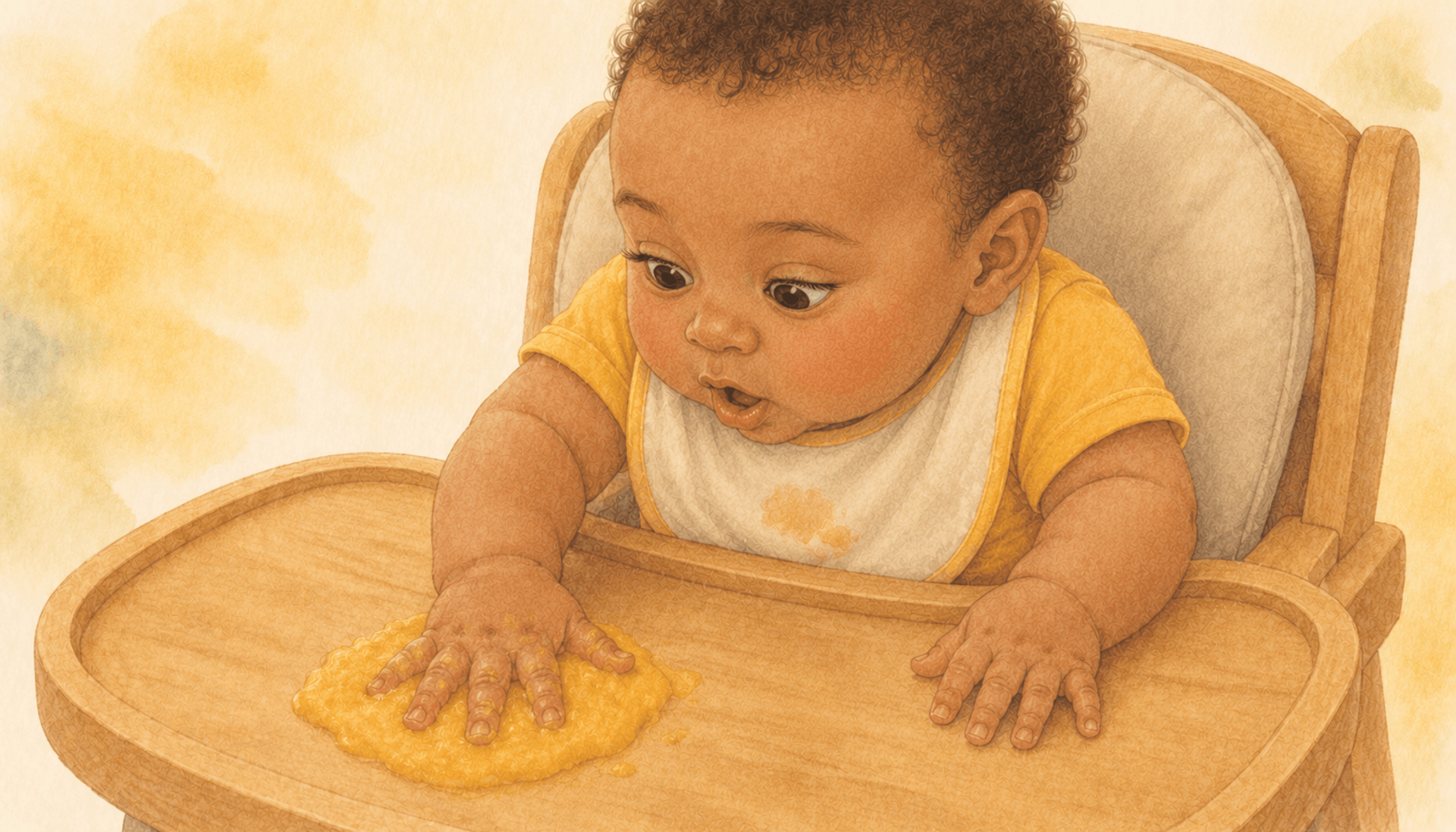
The gap between how starting solids gets described online and what it looks like at the actual table is wide, and the actual version is considerably less stressful.
In the first days, almost nothing that happens is about nutrition. A baby who has spent months eating a liquid that requires no chewing, no tongue navigation, and no effort beyond suckling does not suddenly understand what to do with a different texture on a spoon. Most of the food will be pushed around, worn on the face, deposited enthusiastically on the bib, possibly handed to the nearest dog, and occasionally swallowed. This is completely normal. Breast milk or formula remains the primary source of nutrition for several more months. Early solids are exploration, not sustenance, and approaching them with that frame makes the whole thing much more relaxed.
Start with a small amount (half a spoonful or less) once a day, offered before a milk feed rather than after. After a full nursing or bottle session, most babies have already hit their satisfaction quota and are not particularly interested in culinary exploration. Morning tends to be the easiest time simply because it leaves the rest of the day to observe for any reaction. Wait three to five days between genuinely new foods, not as a strict allergy protocol (current guidance on early allergen introduction has shifted significantly from older advice) but to build a working map of what your baby likes, dislikes, tolerates, and has opinions about.
If your baby turns away, arches, or firmly closes the mouth, stop. That is communication, and it works. Pushing past it doesn't speed anything up and tends to make the next session harder. If you are considering a self-feeding approach, our baby-led weaning article covers the evidence on that method in detail, including safety data and realistic expectations.
For first foods, single-ingredient purees or soft mashes tend to work better than mixes in the early weeks, if only because they make it easier to identify what your baby is responding to. Iron-rich options like pureed meat, well-cooked lentil puree, or iron-fortified cereal mixed with breast milk or formula are good early candidates for breastfed babies in particular. Pureed vegetables and fruits address the taste-learning goal and are fine alongside the iron-rich options.
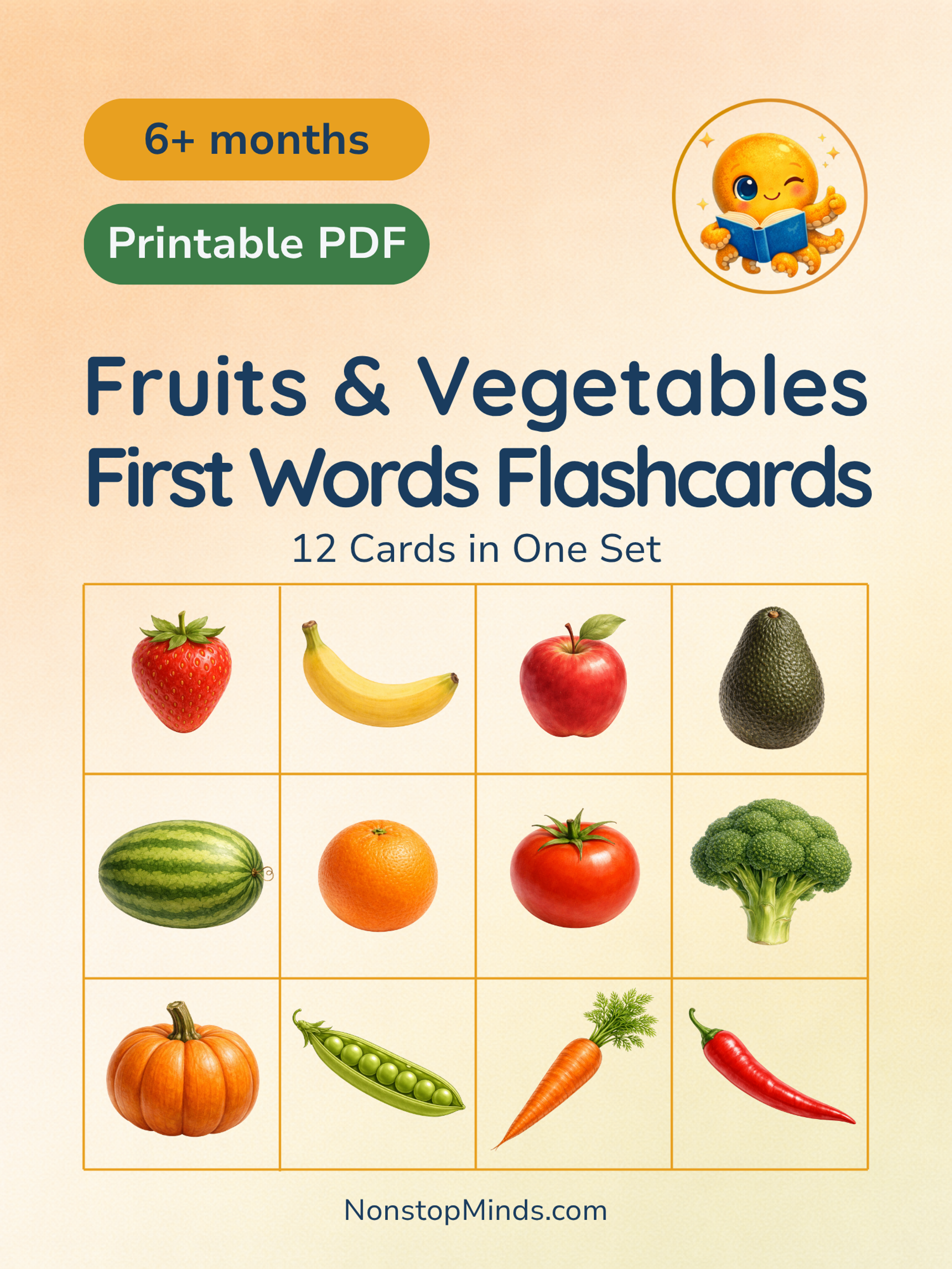
The foods on the table right now (carrot, sweet potato, avocado, broccoli, peas) will be familiar words in a year or two. Our Fruits & Vegetables: Match, Spell & Play cards (ages 2–5) turn those same food names into a spelling and matching game, building on the recognition that starts now. It is a small thread that connects first bites to early literacy, and a few parents have found it a genuinely satisfying one to pull.
A few things worth raising with your pediatrician
Starting solid foods is not a medical event, and most families move through the early weeks without a single concern worth reporting. There are a few patterns, though, that are easier to address early than later.
If your baby is not meeting the motor readiness signs by seven months, including not yet holding the head steady, not sitting upright with support, or showing no interest in food, that is the kind of pattern a pediatrician will want to look at. These are not urgent signals on their own, but they are worth flagging at a routine visit, particularly if several are absent at once.
If your baby was born significantly premature, has a history of reflux, or has had any swallowing difficulties, the conversation about timing and first foods is worth having with your pediatrician before you begin rather than after. The general guidance applies less cleanly to these situations.
If gagging is frequent and intense past the first couple of weeks of adjustment, or if your baby consistently refuses all food rather than just cautiously exploring it, that is worth mentioning at a routine check-in. Early feeding challenges are much easier to address when caught early, and a pediatrician or feeding therapist can offer practical guidance without any drama.
For the vast majority of families, solid foods, once started, go considerably more smoothly than the internet suggested they would. The first few weeks are messy and imprecise, and then something quietly clicks, and suddenly there is a very small person with strong opinions about avocado.
Frequently Asked Questions
For breastfed babies, the AAP and WHO both recommend exclusive breastfeeding for approximately six months, with solid foods introduced around that point. Iron-rich foods should be among the earliest offerings (pureed meat, iron-fortified cereals, or lentils) because breast milk alone does not contain enough iron to meet a growing baby's needs after roughly six months. The motor readiness signs (sitting with support, head control, interest in food) apply regardless of how a baby is fed.
At four months, some babies begin showing interest in food and developing head control, but the full readiness picture is rarely complete this early. The AAP recommends waiting until approximately six months, and the nutritional case (iron store depletion) aligns with that timing for breastfed babies. If your four-month-old is watching your fork with intensity, that interest is developmentally normal without being a signal to begin. Check in with your pediatrician if you are considering starting before six months.
Formula-fed babies follow the same general readiness window as breastfed babies: around six months, once the motor signs are in place. Because formula is iron-fortified, the iron-depletion urgency is somewhat lower, but the developmental window for taste and texture learning described in the ALSPAC research by Coulthard, Harris, and Emmett applies equally regardless of feeding method. The practical signs to watch for are identical: sitting with support, steady head control, and clear interest in food.
For premature babies, solid foods should be introduced based on corrected age (adjusted for how early the baby was born), not calendar age. A baby born eight weeks early who is six months old on the calendar is developmentally closer to four months. Most guidelines recommend waiting until four to six months corrected age, with readiness signs as the primary guide. Your pediatrician or neonatologist should advise directly on timing, as premature infants often have additional nutritional considerations including lower iron stores at birth.
Some babies show all the readiness signs before the six-month mark, and some pediatricians support starting between five and six months when that picture is clear. The AAP recommends "around" six months rather than a hard cutoff. If your five-month-old has steady head control, sits with support, and shows clear interest in food, a conversation with your pediatrician about timing is entirely reasonable. Starting before four months is not recommended by any major pediatric organization.
For educational and entertainment purposes only. Not a substitute for professional medical or developmental advice. If you have concerns about your baby's feeding or development, consult your pediatrician.
- Andersson, O., Hellström-Westas, L., Andersson, D., & Domellöf, M. (2011). Effect of delayed versus early umbilical cord clamping on neonatal outcomes and iron status at 4 months: a randomised controlled trial. BMJ, 343, d7157.
- Birch, L. L. (1994). Infant dietary experience and acceptance of solid foods. Pediatrics, 93(2), 271–277.
- Borowitz, S. M. (2021). First bites — why, when, and what solid foods to feed infants. Frontiers in Pediatrics, 9, 654171.
- Centers for Disease Control and Prevention. (2023). When, what, and how to introduce solid foods.
- Centers for Disease Control and Prevention. (2024). Iron: Infant and toddler nutrition.
- Coulthard, H., Harris, G., & Emmett, P. (2009). Delayed introduction of lumpy foods to children during the complementary feeding period affects child's food acceptance and feeding at 7 years of age. Maternal & Child Nutrition, 5(1), 75–85.
- Meek, J. Y., Noble, L., & Section on Breastfeeding. (2022). Policy statement: Breastfeeding and the use of human milk. Pediatrics, 150(1), e2022057988.
- Taylor, R. W., Williams, S. M., Fangupo, L. J., Wheeler, B. J., Taylor, B. J., Daniels, L., & Heath, A. M. (2017). Effect of a baby-led approach to complementary feeding on infant growth and overweight: A randomized clinical trial. JAMA Pediatrics, 171(9), 838–846.
- World Health Organization. (2021). Infant and young child feeding.
- Zubler, J. M., Wiggins, L. D., Macias, M. M., Whitaker, T., Shaw, J. S., Squires, J. K., & Lipkin, P. H. (2022). Evidence-informed milestones for developmental surveillance tools. Pediatrics, 149(3), e2021052138.

More Articles

Parallel Play in Toddlers: Why Side-by-Side Is the Social Work
Your toddler spent the entire playdate building separate towers, and nobody shared a single block. That counted — more than it looked. A 2025 longitudinal study found that playing beside a specific child consistently predicted later social play with that same child, but not the other way around. Here's what parallel play in toddlers actually is, why the science calls it strategic rather than passive, and what it means for how you run a playdate.

When Do Babies Point: Why It Matters for Language
Most milestone articles treat pointing as a box to check around 12 months. The research tells a different story — one that starts months earlier, runs through the infant brain, and traces back to how much the parent is pointing. Here's what the last fifteen years of research actually found, and what it means for everyday interactions.

When Do Babies Wave Bye-Bye: Why Your Baby Needs You to Wave First
Most baby milestones unfold on a biological schedule — waving isn't one of them. A 2023 study found that babies develop imitation ability because their caregivers imitate them first, and waving is named directly as a cultural gesture learned through that loop. Here's what the research says about the 9–12 month window, why the first wave looks nothing like a wave, and what helps it arrive.