Activities for a 2 Year Old at Home: What the Brain Is Practicing
You spent twenty minutes setting up the sensory bin. Dried pasta, blue-dyed rice, three small scoops of that kinetic sand that's been colonizing your bathroom tiles since February. Your two-year-old looked at it for about four seconds, walked to the kitchen cabinet, pulled out a pot lid, and has been putting it on and off the same pot for the last fifteen minutes while delivering what appears to be a cooking show in a language only partially based on English. The activities for a 2 year old that actually support development aren't always the ones that took effort to assemble. The pot lid is doing real cognitive work. This article explains exactly what that work is, and how to choose twelve activities that match what a two-year-old's brain is actually building right now.
- What specifically shifts in the two-year-old brain that wasn't happening at eighteen months, and why that changes which activities actually work
- Three language activities that match the vocabulary-explosion mechanism rather than working against it
- What pretend play looks like from the inside of a two-year-old brain, and why the wooden spoon your child has been "conducting" with is doing more than it appears
- How gross motor and hands-on activities connect to cognitive development at this age, and why running is on the list for reasons beyond burning energy
- The one research finding from Stanford that reframes what "a good activity" actually means when your toddler is already engaged
- What the CDC's updated 2-year milestone checklist actually says, which is considerably less demanding than the old version
If the one-sentence answer is enough, you’ve got the gist. If you want the mechanism behind each piece, keep reading.
What changes at 2, and why it matters for every activity on this list
The 2022 revision of the CDC's milestone checklist is a good starting point because it quietly lowered the bar for the language milestone most parents use to measure their two-year-old. The previous guidelines listed a 50-word vocabulary at 24 months. The 2022 update moved that to 30 months, because the evidence only supported the milestone when three out of four children had reached it, and the 50-word threshold at 24 months was closer to half. What the CDC now expects at 24 months is that most children are putting two words together ("mama go," "more milk," "doggy big"), not producing a quantified vocabulary. That's a genuinely different developmental picture, and it frees up a lot of parental bandwidth that was previously spent counting words.
What is happening cognitively at two is actually more interesting than the word count. A 2021 longitudinal study published in Infant and Child Development by Holmboe and colleagues found that response inhibition, the capacity to hold back an impulse and make a deliberate choice instead, becomes measurably stable between 18 and 24 months. This is the neurological substrate of self-regulation, and it is just beginning to consolidate at exactly the age you're managing. The pot-lid game is an inhibitory-control workout: your child decides to put the lid on, decides to take it off, decides to knock it sideways and listen to the sound, and decides to start over. Every decision is a small practice run for the same system that will eventually help them wait for a turn, hold a thought while another person is talking, and resist eating all the raisins before the trail mix is assembled.
Symbolic substitution is the other major shift. At 18 months, most children will use objects as intended. At two, the same child picks up a banana and holds it to their ear, because they have enough mental representation to use one object to stand in for another. A 2019 paper by Quinn and Kidd in the British Journal of Developmental Psychology found that symbolic play at 18 months predicted both vocabulary size and grammatical complexity at 24 months, better than simple word labeling games did. The capacity to pretend is language learning's architecture, not a detour from it. The activities for an 18 month old you may have been doing were already building toward this; at two, you're watching the payoff.
The twelve activities below are organized across five areas: language, pretend and symbolic play, movement and building, and one final entry that requires nothing except stepping back. Each section opens with a short note on what's developing in that area at two, then gives the specific activities that match that mechanism.
Language activities for a 2 year old at home
Three activities work especially well here, and they work for the same reason: they create a moment where your child produces a word, rather than just receiving one.
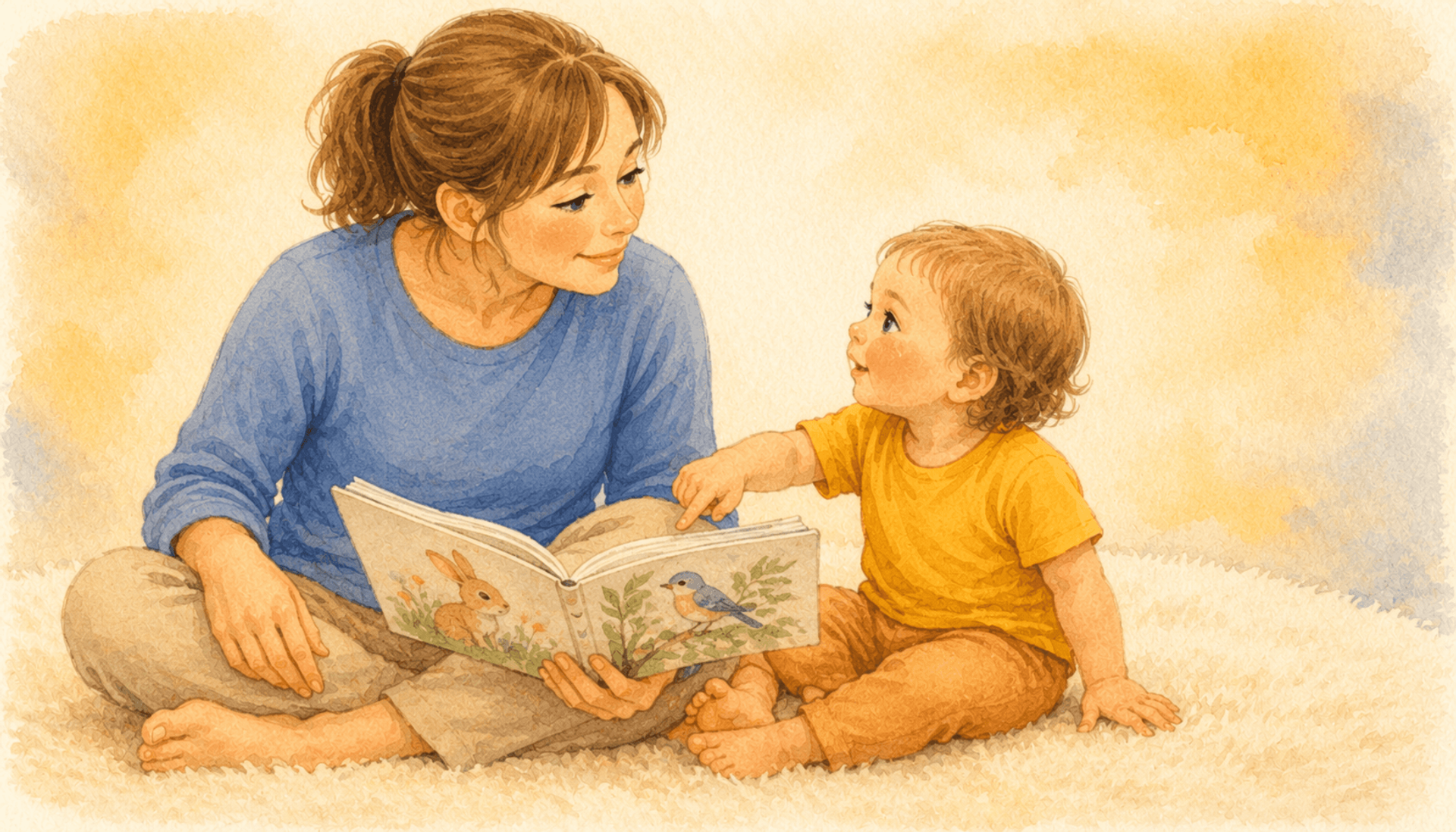
Activity 1: Book reading with questions instead of labels. At twelve months, the most powerful thing you could do with a book was name what your child was already looking at: "dog," "hat," "tree." The research behind that approach (a longitudinal study at Northwestern University by Ferguson, Havy, and Waxman) tracked children from twelve to eighteen months and found that precise labeling at twelve months predicted vocabulary at eighteen. At two, the brain has moved on from naming to production. The CDC's 2-year checklist specifically notes "points to things in a book when you ask, like 'where is the bear?'" as a benchmark. When you read with a two-year-old and pause before turning the page ("what do you think happens next?" or pointing to the pig and waiting) you're shifting the child from passive listener to active producer. For a fuller look at how the language timeline evolves across the first two years, the first words article in this series covers the research behind receptive versus productive vocabulary development. Our First Words flashcard sets are built around the same production-first logic: bold, single-object illustrations that give your child one clear thing to name.
Activity 2: Songs with a deliberate gap. Take any song your two-year-old has memorized: the alphabet, "Wheels on the Bus," anything repetitive with a clear last word per line — and stop just before the final word. Leave silence. Most two-year-olds will fill in the word, because the phonological sequence is already stored and the slot at the end is syntactically predictable. They're not just guessing; they're using sentence-level structure, which is the precursor to two- and three-word combinations. Running this for two or three minutes per day is more targeted for language production than any full recitation.
Activity 3: Narrate what they're doing, then pause. When your child is pouring pasta from cup to cup and you say "you're pouring — pour, pour, pour," you're giving your child the verb at the moment they're enacting it, which is exactly what the parentese research has consistently found to be the most effective word-learning context (Ferjan Ramírez and colleagues, University of Washington, PNAS, 2020). The pause gives your child space to repeat it or produce a new word. This activity fits inside whatever your child is already doing.
Pretend play — why the wooden spoon is already a baton
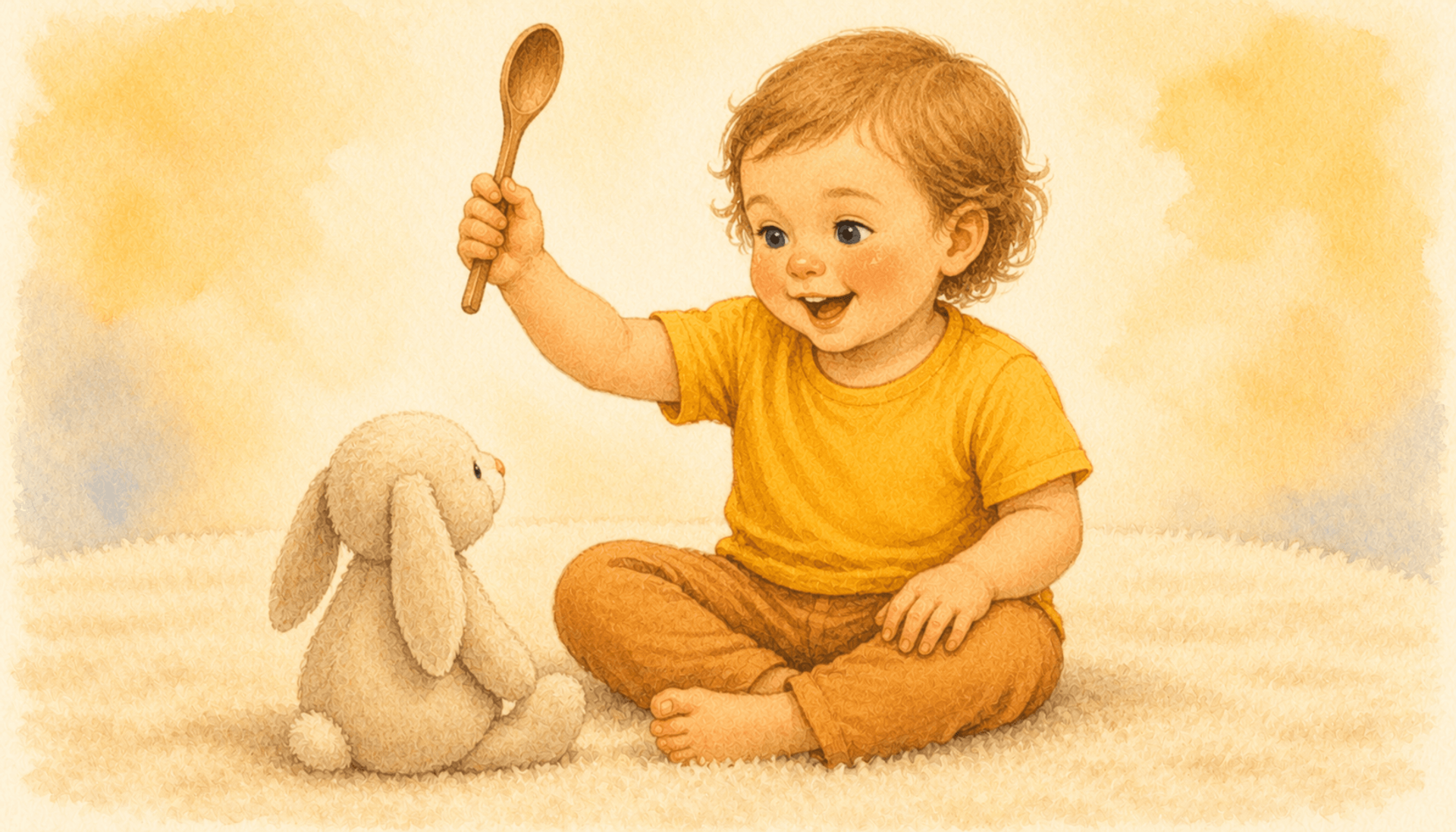
Pretend play is often underestimated as a developmental activity because it looks unproductive from the outside. A two-year-old feeding a stuffed rabbit with an empty spoon is running an internal simulation: the spoon represents something, the rabbit is assigned a role, the feeding action follows a social script, and the whole scene requires holding multiple symbolic relationships in working memory simultaneously. That is executive function training in an extremely pure form.
Activity 4: Symbolic substitution play. Give your child unambiguous objects that don't have a built-in play script (a cardboard tube, a wooden block, a folded dish towel) and watch what happens. Most two-year-olds will assign a role within a few minutes: the tube becomes a telescope or a trumpet, the block becomes a phone or a car, the dish towel becomes a baby to put to sleep. Your job in this activity is to follow your child's assignment, not propose your own. "What is that?" is a better entry than "let's make the block a car." The research from Quinn and Kidd found that child-initiated symbolic substitution (not adult-directed pretend play) was the measure that predicted later language, which suggests the cognitive load in choosing the substitution yourself is doing more developmental work than enacting a suggested scenario.
Activity 5: Caring for dolls or stuffed animals. Feeding, putting to sleep, pretending to apply a bandage, or simply carrying a stuffed animal and narrating where they're going together: all of these activities involve theory-of-mind precursors. The 2020 review by Sodian and Kristen-Antonow in Child Development Perspectives found that desire reasoning (the capacity to attribute wants and needs to another agent) is present at 24 months and predicts full theory of mind at age 4, independently of verbal IQ. When your child puts the rabbit to bed "because it's tired," they are attributing a mental state to something outside themselves. That's cognitive infrastructure, not decoration.
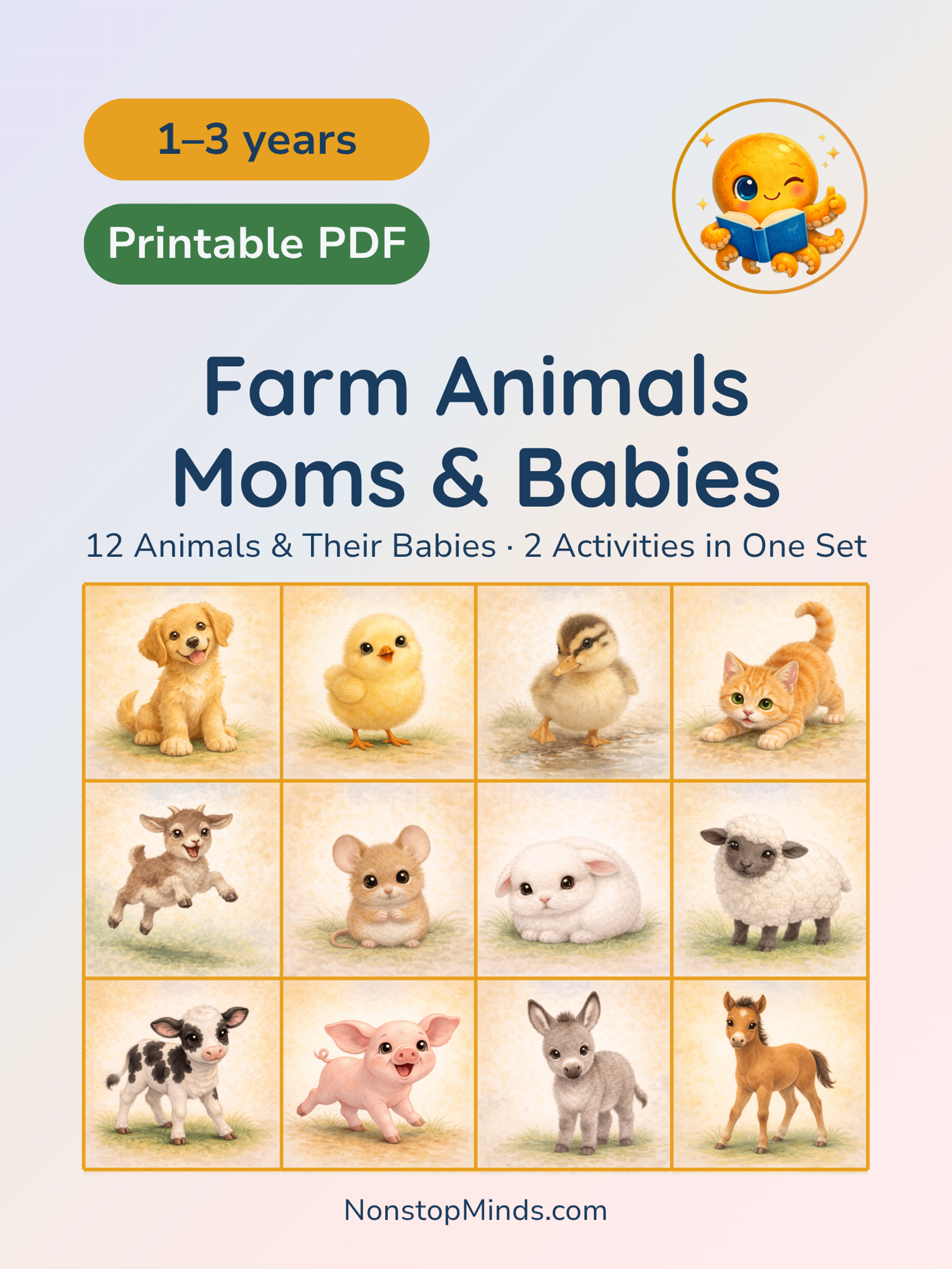
Activity 6: Matching moms to babies. Two-year-olds are in what researchers call the shape-bias window: when learning a new object name, they extend it to objects that share the same shape rather than the same color. This is the cognitive basis for categorization. Matching games that ask children to group by relationship or function, rather than just color, train this categorization capacity directly — and matching a cow to her calf, or a cat to her kitten, adds a layer of social meaning that holds attention longer than abstract shape sorting. Our Farm Animals Moms & Babies flashcards are built around exactly this task: each pair requires the child to identify what makes two cards belong together.
Moving, building, and making: the physical work that's also cognitive work
The temptation when searching for activities for 2 year olds at home is to separate "learning activities" from "physical play." The research on toddlers doesn't support that separation. A 2019 study by Veldman and colleagues, published in Early Human Development and involving 335 toddlers at approximately 20 months, found that gross motor skill level was significantly associated with cognitive development as measured by the Bayley Scales, controlling for sex, BMI, and socioeconomic status. Moving a body through space, it turns out, is a thinking activity.
Activity 7: Running relay. Set two points across the room and ask your child to run to one and bring back a specific object (a block, a spoon, a sock). This is a one-step instruction task (which the CDC lists as a 2-year milestone), a gross motor task, a working-memory task (hold the instruction while running), and an object-recognition task, all at once. The activity scales naturally as the child's capacity grows: two objects, two locations, two trips. It also happens to empty some of the energy that's been accumulating since breakfast.
Activity 8: Low-obstacle climbing. A couch cushion on the floor, a low stool beside the couch, a small ramp made from a piece of board leaned against a step: two-year-olds will climb anything that's slightly elevated, and they should. Climbing requires motor planning, balance, proprioceptive feedback, and risk calibration (can I get up? can I get down?). Each of these is a cognitive act. Supervise closely, keep the elevation low, and resist the urge to spot every move unless they ask or the surface is genuinely unstable. The moments of independent problem-solving (figuring out how to get a leg up, turning around to descend feet-first) are where the learning lives.
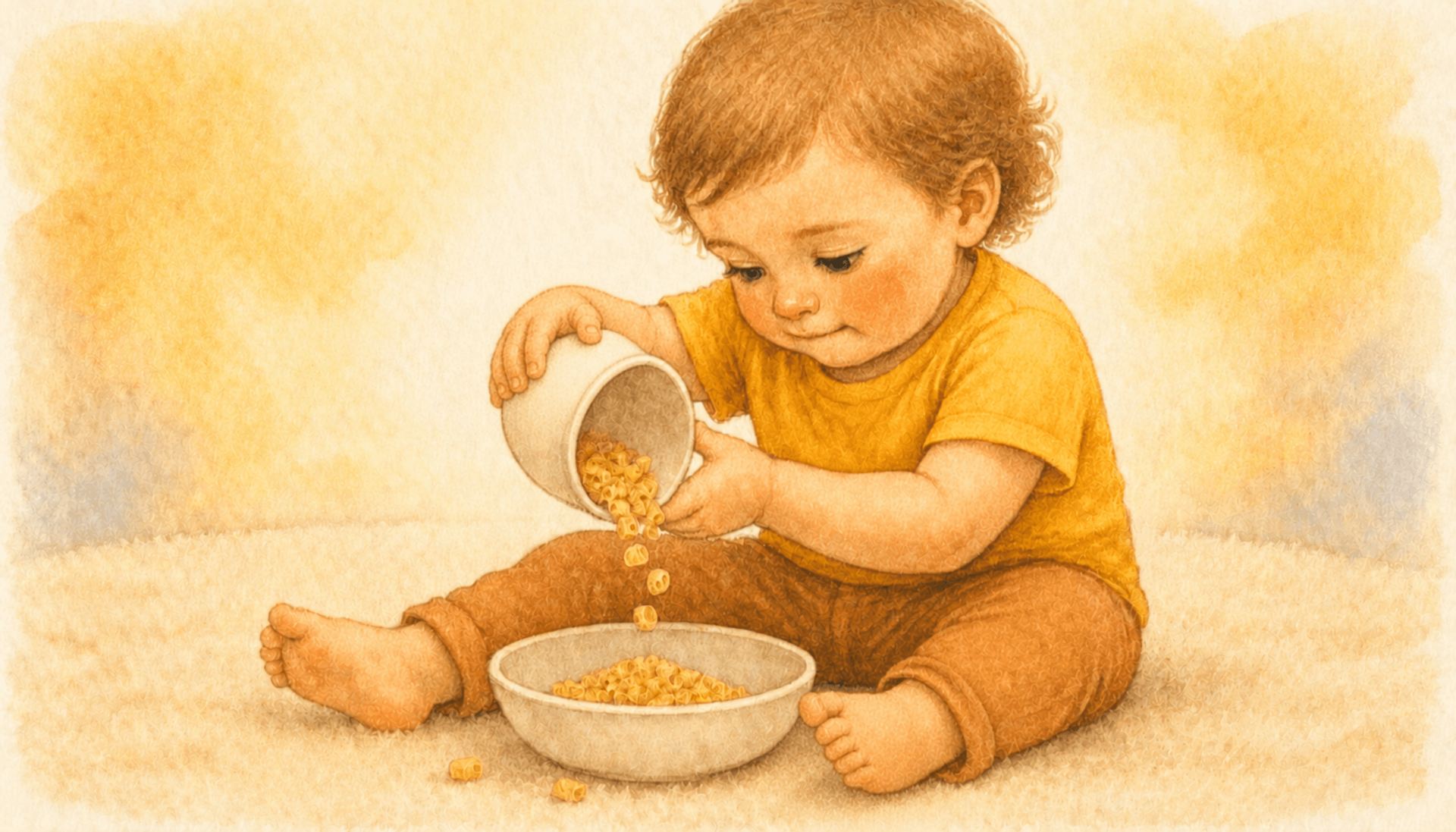
Activity 9: Pouring and transferring. Fill a large container with dry pasta, rice, or water in the bath, and provide a few smaller containers of different sizes. Muentener and Schulz showed in Frontiers in Psychology that toddlers generate and test hypotheses about physical causes, and pouring gives them something concrete to test: a child watching the level change in a short wide cup is forming a prediction about what comes next. This is early physics. If you use water, do it in the bath or over a towel and call it bath time, which will feel substantially less like effort.
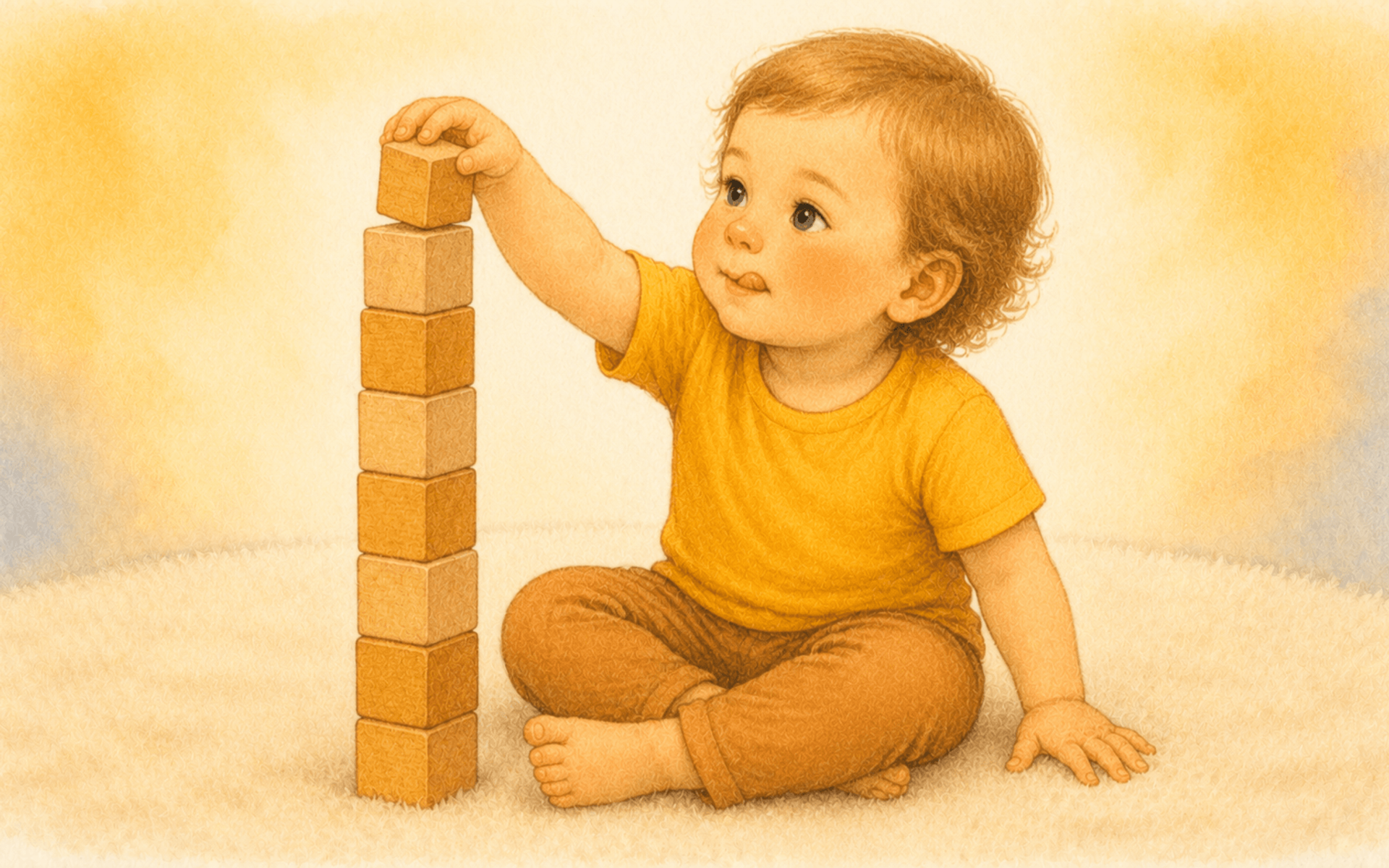
Activity 10: Stacking with intent. At twelve months, most children can stack two or three blocks. By 24 months, most can manage six or more, and the act of stacking has changed character: a two-year-old adding a block is now anticipating whether it will fall, adjusting for balance, and often testing the limit deliberately to watch the collapse. That's hypothesis testing. Knock-down is the experiment, not the failure mode. Interrupting the collapse to correct the technique is worth questioning as a reflex.
Activity 11: Simple household tasks. Putting cloth napkins on the table, transferring dry groceries from a low bag to a shelf, matching socks from the laundry pile: these combine fine motor work, object categorization, and sequence following in a single task. A 2022 paper by Castelo, Meuwissen, and colleagues at the Carlson and Zelazo lab found that among all the autonomy-supportive parenting behaviors measured in 366 preschoolers, offering choice was the single strongest predictor of executive function — stronger than modeling, questioning, or warm engagement. Household tasks are the natural context for this: "you choose — do you want to put the napkins out or put the bananas away?" The child picks, and the executive function practice is built in. Our Routine Cards give structure to these moments: a predictable visual sequence that tells the child what's coming while leaving room for choices within it. The routines and tantrums article covers why predictable transitions work. And if your two-year-old's default response to any question is an immediate "no," the why toddlers say no article explains what's driving it.
The finding that reframes what "a good activity" actually means
In 2021, Jelena Obradović at Stanford, along with Sulik and Shaffer at the University of Georgia, published a study in the Journal of Family Psychology that followed 102 parent-child pairs through a set of structured tasks and tracked moment-to-moment parenting behavior using a method called State-Space Grid analysis (essentially second-by-second coding of who was leading versus following at each moment). The measure they developed was "parental over-engagement": the proportion of time a parent spent actively directing a child's behavior while the child was already actively engaged independently. The finding, after controlling for age, parent education, family income, and overall parenting quality: parental over-engagement during active child engagement predicted lower executive function and lower observed self-regulation. Not during passive moments — during the moments when the child was already independently engaged.
The sample was kindergartners, not two-year-olds, which is the honest caveat. But a large Australian longitudinal study by Colliver and colleagues, published in Early Childhood Research Quarterly in 2022 and using 2,213 children from the Longitudinal Study of Australian Children, found that time spent in unstructured quiet free play between the ages of two and five predicted self-regulation two years later, controlling for earlier self-regulation levels and the usual confounds. The pattern Obradović found in kindergartners has a developmental shadow that starts at exactly the age this article is about.
Activity 12: Unscheduled free play time. This one has no setup. You do not curate the materials, assign the scenario, or suggest what comes next. You are present and available if your child seeks you out, but you follow your child's lead rather than providing direction. Twenty to thirty minutes of this per day, protected from interruption and redirection, is not a gap in the activity plan. It is itself the activity, and the one with the strongest longitudinal evidence in this age group for the outcome most parents say they care most about.
The question "what activities should I do with my two-year-old?" has a good answer. The Obradović finding adds a second, quieter question: when your two-year-old is already actively doing something, does the activity you introduce compete with the work already happening? The pot lid was not the wrong choice. Your toddler already knew that.
What the CDC's 2-year checklist actually says
The CDC's 2022 update expects most two-year-olds to be using two-word phrases, pointing to things in a book when asked, noticing when others are upset, looking at a parent's face to gauge how to react in new situations, and playing pretend with toys or objects. Walking up steps, kicking a ball, and running without frequent falling are the motor milestones. The 50-word vocabulary was moved from 24 months to 30 months.
If your two-year-old is not yet putting two words together, that's worth raising at the next well-child visit. If your two-year-old has lost skills they previously had (words, social responses, play patterns), that's the clearest reason to call rather than waiting. If the two-word threshold is close but not quite there, ask about a hearing screen before considering other explanations. The activities for a 1 year old article covers the twelve-month picture if you want to trace the developmental arc that leads here.
Frequently Asked Questions
A two-year-old's day works best with a predictable structure containing a mix of types: some free unstructured play (20–30 minutes at a stretch), some adult-joined activity like book reading or a simple household task, and some gross motor time. A 2022 longitudinal study by Colliver and colleagues tracking over 2,000 children found that unstructured free play at ages 2–3 predicted self-regulation two years later, which means protecting unscheduled time is as important as choosing specific activities.
Most two-year-olds sustain focused attention on a single activity for 5 to 15 minutes, and that range is completely normal. Activities your child initiates typically last longer than activities you introduce, which is less a comment on the quality of your choices than on ownership and intrinsic motivation. If an activity you set up ends in three minutes, the information is that your child didn't choose it.
The activities with the strongest research support for this age combine language production (not just listening), symbolic thinking, and some degree of child-directed choice. Book reading with questions rather than labels, pretend play that lets the child choose the symbolic substitution, and matching games that sort by function rather than color all meet those criteria. The evidence consistently shows that whether the child is actively generating something (a word, a hypothesis, a choice) matters more than what specific activity is on the table.
Pouring and transferring with water in the bath or dry materials (pasta, rice) in a large bin works from 18 months onward and requires no setup. Symbolic substitution play — handing your child unscripted objects like cardboard tubes and folded cloth and watching what roles your child assigns them — often runs thirty minutes without prompting. Simple sorting tasks combine fine motor work with early categorization. Stacking and deliberate knocking-down holds attention longer than most dedicated rainy-day activity kits.
At two, the most effective language support comes from activities that create a production opportunity rather than just exposure. Stopping before the last word of a familiar song, pausing in a book and asking "what's that?" rather than labeling, and narrating your child's actions with a pause — "you're pouring... pour, pour, pour" and then waiting — all prompt your child to generate words rather than receive them. The University of Washington's randomized trial by Ferjan Ramírez and colleagues found that families coached in child-directed language use saw roughly a 40-word vocabulary advantage by 18 months over control families. The mechanism is following the child's attentional focus, not introducing new topics over it.
For educational and informational purposes only. Not a substitute for professional medical or developmental advice. If you have concerns about your child's development, consult your pediatrician or a qualified developmental specialist.
- Castelo, R. J., Meuwissen, A. S., Distefano, R., McClelland, M. M., Galinsky, E., Zelazo, P. D., & Carlson, S. M. (2022). Parent provision of choice is a key component of autonomy support in predicting child executive function skills. Frontiers in Psychology, 12, 773492.
- Colliver, Y., Brown, J. E., Harrison, L. J., & Humburg, P. (2022). Free play predicts self-regulation years later: Longitudinal evidence from a large Australian sample of toddlers and preschoolers. Early Childhood Research Quarterly, 59, 148–161.
- Ferguson, B., Havy, M., & Waxman, S. R. (2015). The precision of 12-month-old infants' link between language and categorization predicts vocabulary size at 12 and 18 months. Frontiers in Psychology, 6, 1318.
- Ferjan Ramírez, N., Lytle, S. R., & Kuhl, P. K. (2020). Parent coaching increases conversational turns and advances infant language development. Proceedings of the National Academy of Sciences, 117(7), 3484–3491.
- Holmboe, K., Larkman, C., de Klerk, C., Simpson, A., Bell, M. A., Patton, L., Christodoulou, C., & Munakata, Y. (2021). The early childhood inhibitory touchscreen task: A new measure of response inhibition in toddlerhood and across the lifespan. Infant and Child Development.
- Muentener, P., & Schulz, L. (2014). Toddlers infer unobserved causes for spontaneous events. Frontiers in Psychology, 5, 1496.
- Obradović, J., Sulik, M. J., & Shaffer, A. (2021). Learning to let go: Parental over-engagement predicts poorer self-regulation in kindergartners. Journal of Family Psychology, 35(8), 1160–1170.
- Quinn, S., & Kidd, E. (2019). Symbolic play promotes non-verbal communicative exchange in infant–caregiver dyads. British Journal of Developmental Psychology, 37(1), 33–50.
- Skene, K., O'Farrelly, C. M., Byrne, E. M., Kirby, N., Stevens, E. C., & Ramchandani, P. G. (2022). Can guidance during play enhance children's learning and development in educational contexts? A systematic review and meta-analysis. Child Development, 93(4), 1162–1180.
- Sodian, B., & Kristen-Antonow, S. (2020). How does children's theory of mind become explicit? A review of longitudinal findings. Child Development Perspectives, 14(3), 171–177.
- Veldman, S. L. C., Santos, R., Jones, R. A., Sousa-Sá, E., & Okely, A. D. (2019). Associations between gross motor skills and cognitive development in toddlers. Early Human Development, 132, 39–44.
- Zubler, J. M., Wiggins, L. D., Macias, M. M., Baio, J., Yeargin-Allsopp, M., Petersen, M. C., & Lipkin, P. H. (2022). Evidence-informed milestones for developmental surveillance tools. Pediatrics, 149(3), e2021052138.
Related Products
More Articles
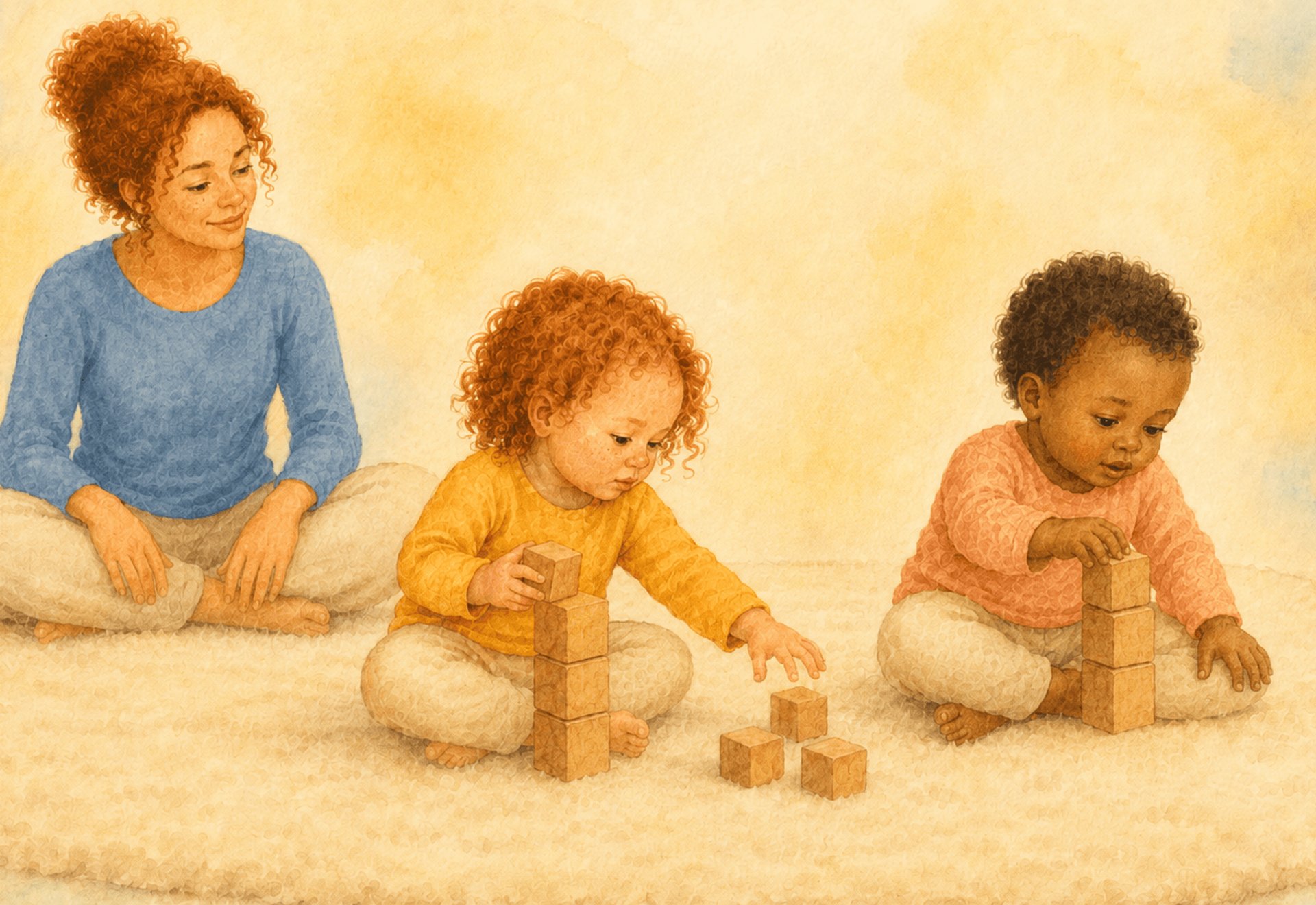
Parallel Play in Toddlers: Why Side-by-Side Is the Social Work
Your toddler spent the entire playdate building separate towers, and nobody shared a single block. That counted — more than it looked. A 2025 longitudinal study found that playing beside a specific child consistently predicted later social play with that same child, but not the other way around. Here's what parallel play in toddlers actually is, why the science calls it strategic rather than passive, and what it means for how you run a playdate.
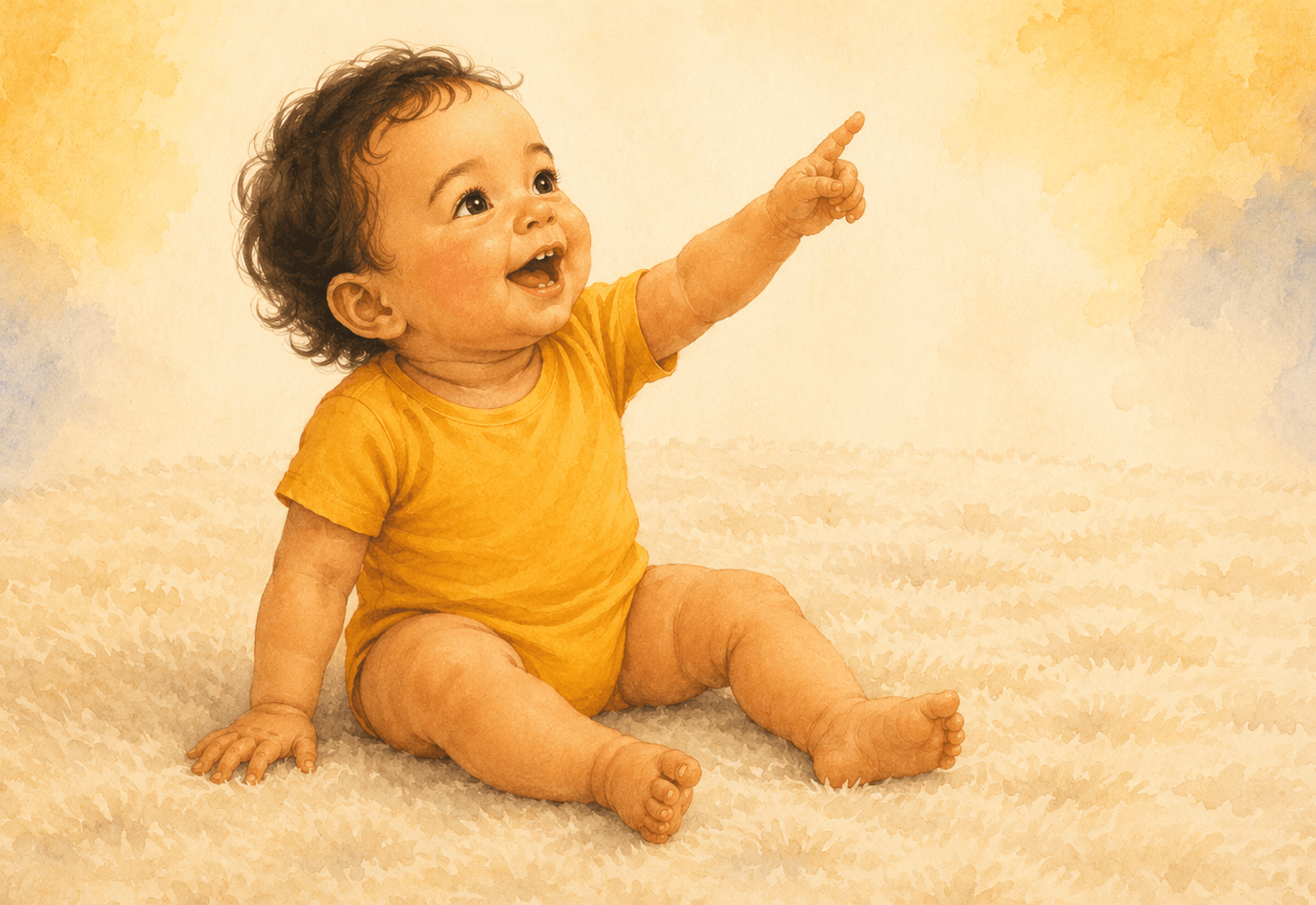
When Do Babies Point: Why It Matters for Language
Most milestone articles treat pointing as a box to check around 12 months. The research tells a different story — one that starts months earlier, runs through the infant brain, and traces back to how much the parent is pointing. Here's what the last fifteen years of research actually found, and what it means for everyday interactions.
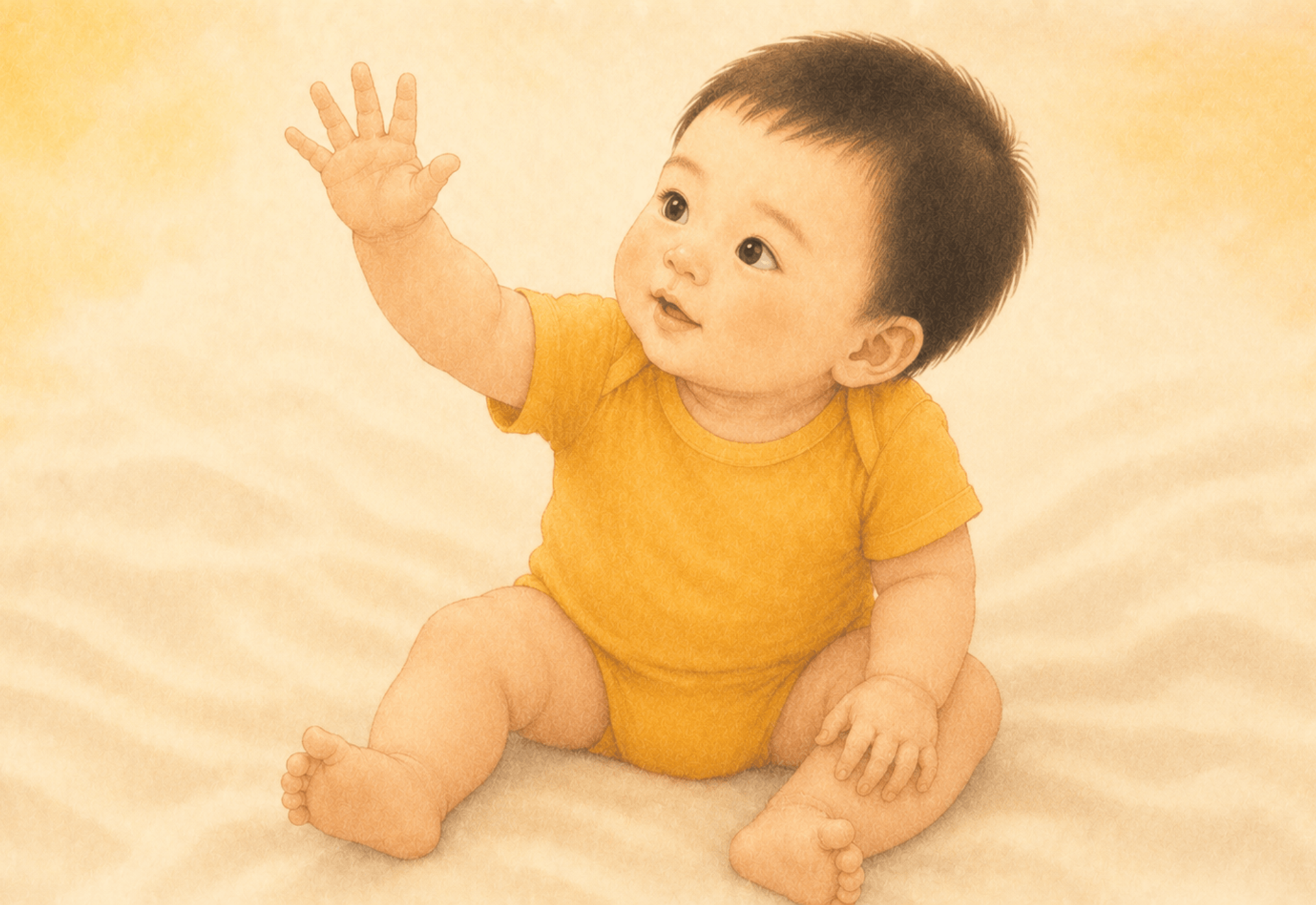
When Do Babies Wave Bye-Bye: Why Your Baby Needs You to Wave First
Most baby milestones unfold on a biological schedule — waving isn't one of them. A 2023 study found that babies develop imitation ability because their caregivers imitate them first, and waving is named directly as a cultural gesture learned through that loop. Here's what the research says about the 9–12 month window, why the first wave looks nothing like a wave, and what helps it arrive.