Why Daily Routines Reduce Toddler Tantrums

It's 5:47 PM. Dinner is almost ready, but you made the mistake of putting the pasta in the blue bowl instead of the green one. Your toddler is now lying face-down on the kitchen floor, screaming like you've committed a crime against all of bowlkind.
You've tried reasoning. You've tried distraction. You've tried silently Googling "is this normal" while holding a spatula. Nothing is working — because nothing was ever going to work in that moment. The tantrum isn't about the bowl. The meltdown is happening because a small brain has been making decisions all day with a part that's still under construction.
If you've been wondering whether a daily routine for your toddler could actually prevent moments like this — the research says yes. And the reason is more specific than "kids like structure."
- Why the wrong bowl causes a meltdown — what the amygdala and underdeveloped prefrontal cortex are doing in real time
- How predictable sequences reduce cognitive load — and what 50+ studies found about routines and emotional regulation
- Why routines lower cortisol — and why sleep is the other half of the equation
- Routine vs. schedule: why sequence matters more than the clock for toddler brains
- How to build small choices into a routine to satisfy the autonomy drive without losing structure
If the one-sentence answer is enough, you’ve got the gist. If you want the mechanism behind each piece, keep reading.
What's Happening Inside the Toddler Brain During a Tantrum
The prefrontal cortex — the area behind the forehead that handles planning, impulse control, and emotional regulation — doesn't fully mature until the mid-twenties. In a two-year-old, that part of the brain is barely online. Meanwhile, the amygdala — the region that processes emotions like fear, frustration, and anger — is fully operational and working overtime.
This means your toddler feels emotions at full volume but has almost no internal tools to manage those feelings. When the wrong bowl appears, the amygdala fires a distress signal. The prefrontal cortex, which would normally help pause and evaluate, can't respond fast enough. The result is a toddler meltdown — not because your child is being difficult, but because the brain literally cannot do what you're asking it to do yet.
You're not failing. Your child's brain is just not finished building the part that handles this. That's normal development, and it's temporary — but while it lasts, the environment you create matters more than the words you say.
Why a Predictable Daily Routine Calms the Toddler Brain
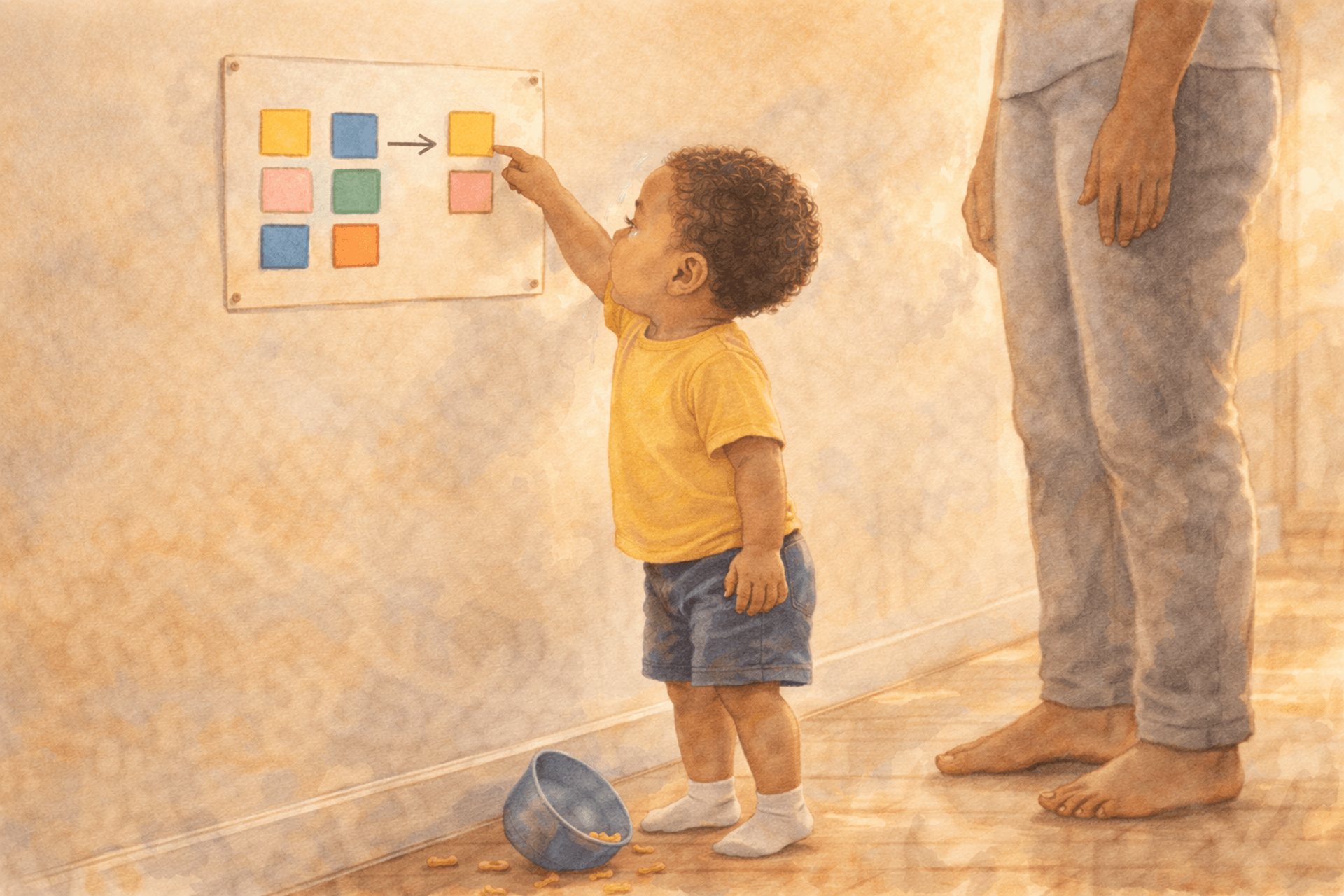
Here's where routines enter the picture. A predictable daily routine does something specific for the toddler brain: it reduces the number of decisions the prefrontal cortex has to make. When your child knows that breakfast comes after getting dressed, and shoes go on after breakfast, and a hug happens before the car — the brain doesn't have to figure out what's happening next. That cognitive energy gets freed up for everything else.
A systematic review of over 50 studies found that family routines are positively associated with better emotional regulation, stronger social skills, and fewer behavioral problems in young children. The evidence was overwhelming — nearly every study examining social-emotional outcomes found a positive link between routines and how well children managed emotions and relationships. Routines give the developing brain something it desperately needs during stressful moments and transitions: a sense of what comes next.
This echoes what we explored in our article on why toddlers say "no" to everything — the same prefrontal cortex that's behind the "no" phase is the one that benefits most from predictability. Autonomy and routine aren't opposites. Combined the right way, they're the most powerful tools a parent has.
How Toddler Routines Lower Stress Hormones
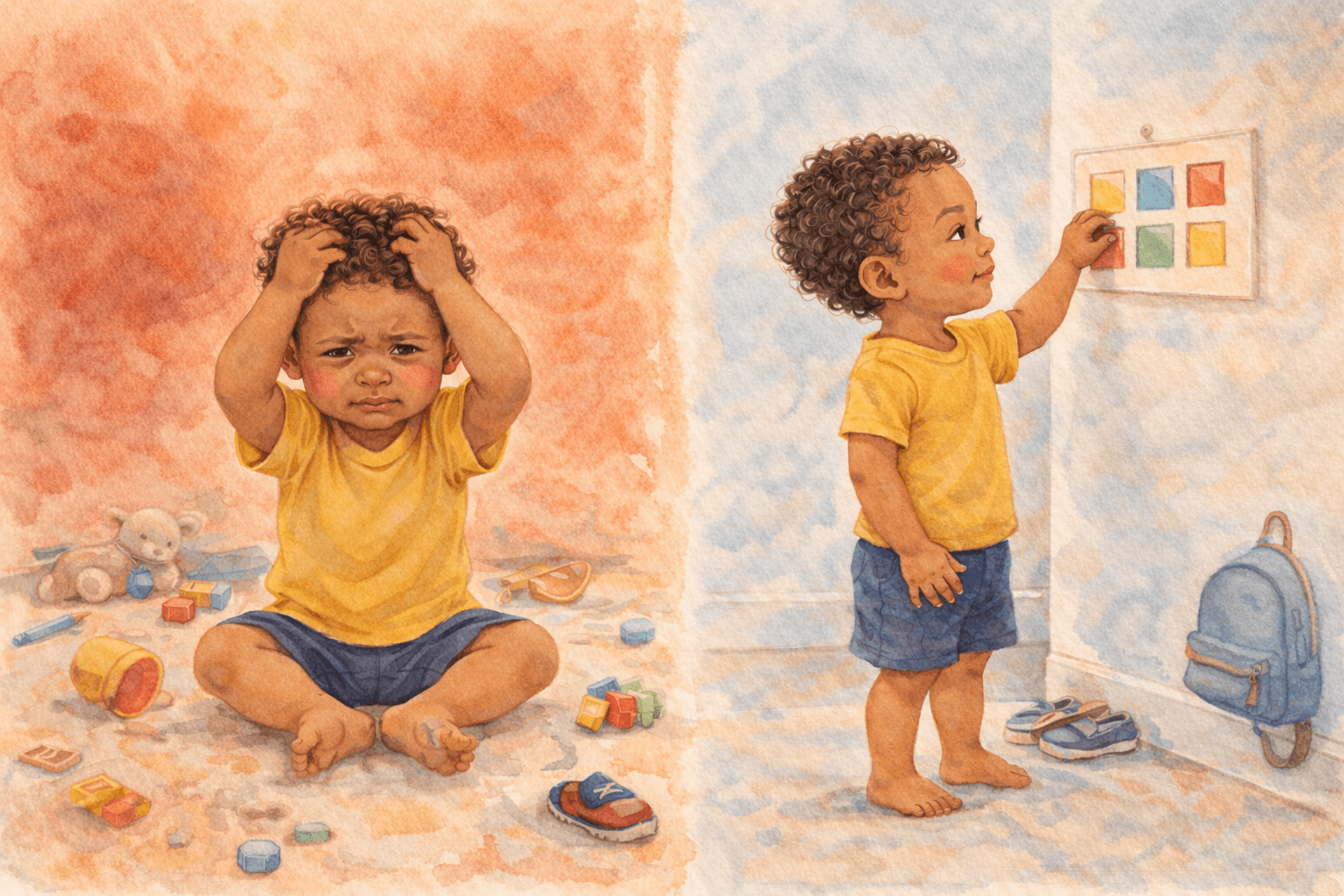
Stress has a chemical signature. When a toddler is anxious or uncertain about what's happening next, the body produces cortisol — the primary stress hormone. Elevated cortisol makes everything worse: the child becomes more reactive, more rigid, and more likely to tip into a tantrum over something that would otherwise be manageable.
Research has shown that children who maintained consistent routines during the transition to kindergarten had smaller changes in cortisol levels — meaning the biological stress response was buffered by predictability. Another study found that routines combined with adequate sleep predicted better emotion regulation in toddlers, while routines without enough sleep showed no benefit. The brain needs both: a predictable structure and enough rest to use it.
Think of cortisol as volume control. Predictable routines turn the volume down. Sleep keeps it there. Without both, your toddler is essentially navigating a loud, confusing world with the emotional bandwidth of someone running on two hours of rest — which, honestly, some of us understand firsthand.
Daily Routine vs Schedule: What Works for Toddlers
There's an important distinction most parenting advice misses. A schedule is about the clock: breakfast at 7:15, nap at 12:30, bath at 6:45. A daily routine for a toddler is about the sequence: breakfast comes after getting dressed, nap comes after lunch, bath comes before pajamas. Toddlers don't read clocks. But toddlers absolutely understand "what comes next."
The power of a routine is not in timing — it's in order. When the sequence stays the same, your child's brain stops spending energy on anticipating and starts spending energy on participating. That's the shift: from anxious vigilance to active engagement. And that shift is exactly what reduces toddler tantrums over time. A visual schedule for your toddler — something on the wall where your child can see what's coming — makes that sequence tangible. It turns an invisible brain benefit into something your child can point at, touch, and move.
Giving Toddlers Choices Within the Daily Routine
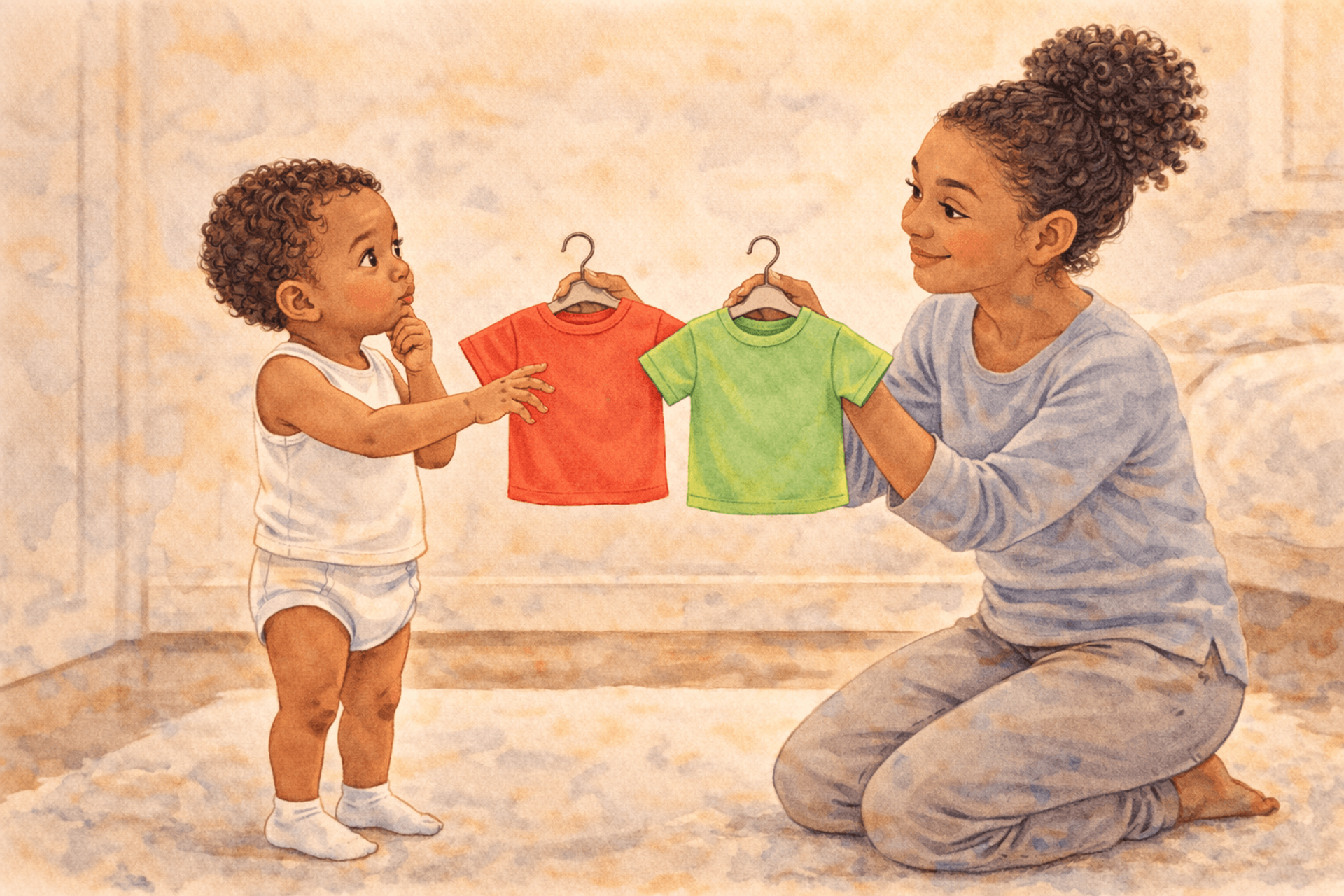
Rigid routines can backfire. A toddler who is told what to do at every step has no space for the autonomy that the developing brain craves. When researchers studied which parenting behaviors actually predicted stronger executive function in preschoolers, the answer surprised many: it wasn't praise, and it wasn't encouragement. It was offering choices. Simple, small, two-option choices — and doing it consistently.
The key is building small choices into the routine itself. "Red shirt or blue shirt?" during getting dressed. "Apple or banana?" at snack time. "Do you want to tidy up the blocks or the books first?" during cleanup. Each choice is a micro-exercise for the prefrontal cortex — a chance to practice decision-making in a safe, structured context. The routine provides the frame. The choice provides the agency. Together, routine and choice build exactly the brain skills that toddler meltdowns reveal are still under construction.
If you want to see what this looks like in practice, our article on screen-free activities for babies covers a similar approach — using everyday moments (not apps, not expensive toys) to create natural learning opportunities. The principle works the same way at every age: less stuff, more structure, and room for your child to participate.
When the Toddler Routine Falls Apart
Every parent knows: vacation, travel, a new sibling, or even daylight saving time can blow up the most solid toddler routine chart on the fridge. And tantrums spike. That's a predictable response from a brain that just lost its map. When the expected sequence breaks, the toddler brain has to work harder to predict what's next. That extra cognitive load lands on the prefrontal cortex, which is already running at capacity. The result is a shorter fuse, lower frustration tolerance, and meltdowns over things that wouldn't have been a problem last Tuesday.
But here's what matters: the brain recovers quickly when the routine returns. Research on children starting childcare found that cortisol levels remained elevated for weeks during the transition, but stabilized as new routines became familiar. The power of a routine is not that it never breaks. It's that it's easy to come back to. You don't need a perfect routine. You need a returnable one.
What Most Visual Schedule Charts Get Wrong

Walk into any parenting aisle of the internet and you'll find hundreds of printable toddler routine charts with cute illustrations: brush teeth, eat breakfast, get dressed. They look helpful. But most of them miss the point entirely.
A routine chart that shows your toddler what to do is a reminder. A routine chart that helps you understand why each step matters is a tool. When a parent knows that "get dressed — choose between two shirts" is building executive function, not just getting clothes on a body, the entire interaction changes. You stop rushing. You start watching. And your toddler starts learning.
That's exactly why we built our My First Routine Cards for toddlers 1.5–3 years and Big Kid Routine Cards for preschoolers 3–5 years — each with a parent guide that explains the science behind every single card. From "Brush Teeth: count strokes together" (sequencing + early numeracy) to "Tidy Up by Color" (categorization) to "Talk About the Day" (autobiographical memory). Because a card on a board is a reminder. A card you understand is a tool.
The bowl thing? Still annoying. But now you know why it happens. A brain doing the best it can with the tools it has today — building better ones for tomorrow.
Frequently Asked Questions
Yes. A systematic review of over 50 studies found that predictable family routines are associated with better emotional regulation and fewer behavioral problems in young children. Routines reduce the number of decisions the underdeveloped prefrontal cortex has to make, freeing cognitive resources for emotional management.
A schedule is tied to the clock (breakfast at 7:15). A routine is about sequence (breakfast after getting dressed). Toddlers don't read clocks, but they understand and rely on predictable order. The power of a routine is in the sequence, not the timing.
Begin with one part of the day — morning or bedtime. Keep the sequence simple and consistent: 3–5 steps in the same order every day. Use a visual schedule or routine cards so your child can see what comes next. Build in 1–2 small choices at each step.
For educational and entertainment purposes only. Not a substitute for professional medical or developmental advice. If you have concerns about your child's behavior or development, consult your pediatrician.
- Selman, A. E., et al. (2024). Routines and child development: A systematic review. Journal of Family Theory & Review.
- Fiese, B. H., et al. (2002). A review of 50 years of research on naturally occurring family routines and rituals. Journal of Family Psychology, 16(4), 381–390.
- Bater, L. R., & Jordan, S. S. (2017). Child routines and self-regulation serially mediate parenting practices and externalizing problems in preschool children. Child & Youth Care Forum, 46(2), 243–259.
- Distefano, R., et al. (2021). Parent provision of choice is a key component of autonomy support in predicting child executive function skills. Frontiers in Psychology, 12, 773492.
- Diamond, A. (2013). Executive functions. Annual Review of Psychology, 64, 135–168.
- DeCaro, J. A., & Worthman, C. M. (2011). Changing family routines at kindergarten entry predict biomarkers of parental stress. International Journal of Behavioral Development, 35(5), 441–448.
- Bocknek, E. L., et al. (2018). Child cortisol moderates the association between family routines and emotion regulation in low-income children. Developmental Psychobiology, 60(1), 58–73.
- Casey, B. J., et al. (2005). Imaging the developing brain: What have we learned about cognitive development? Trends in Cognitive Sciences, 9(3), 104–110.
More Articles
Parallel Play in Toddlers: Why Side-by-Side Is the Social Work
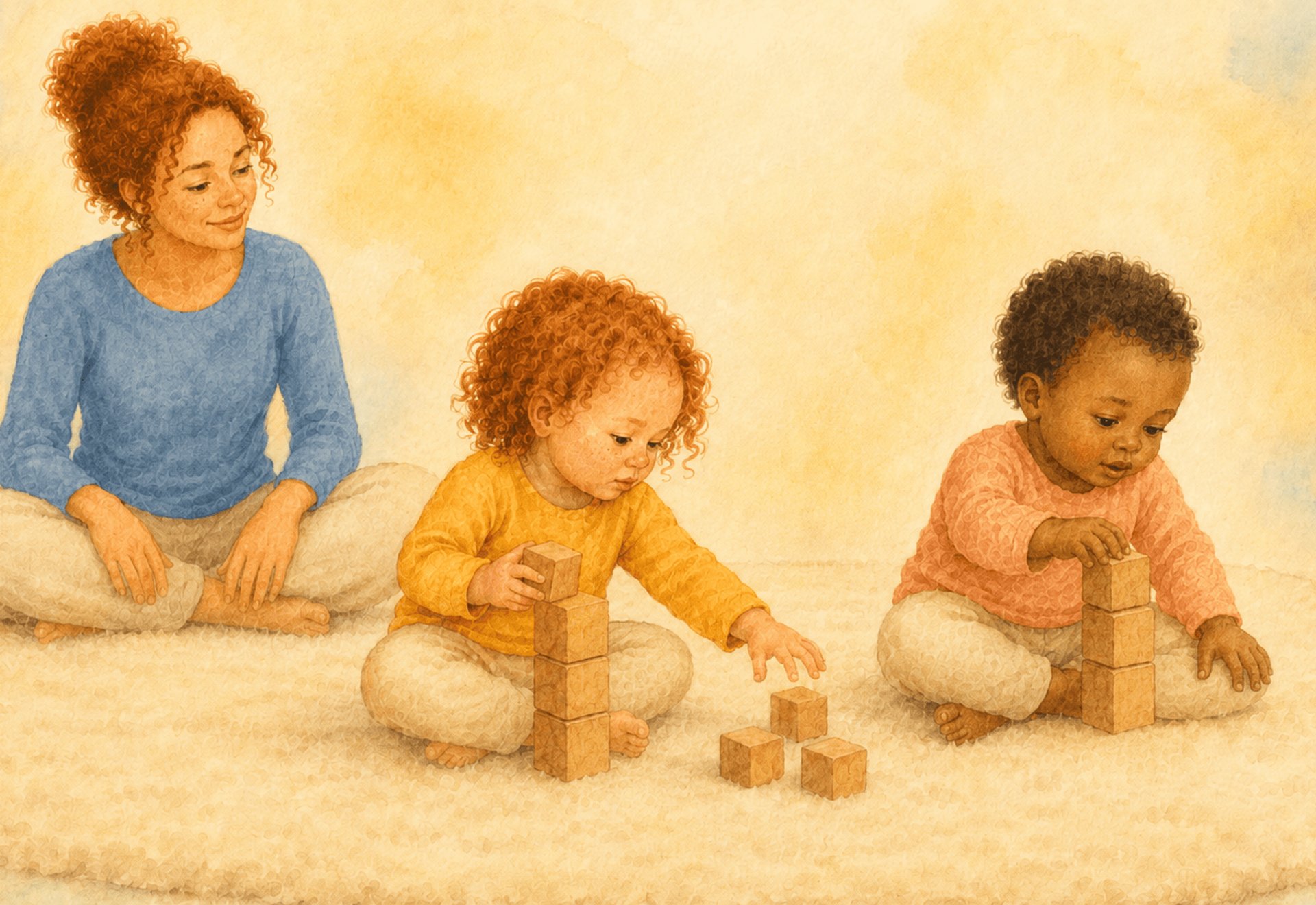
Your toddler spent the entire playdate building separate towers, and nobody shared a single block. That counted — more than it looked. A 2025 longitudinal study found that playing beside a specific child consistently predicted later social play with that same child, but not the other way around. Here's what parallel play in toddlers actually is, why the science calls it strategic rather than passive, and what it means for how you run a playdate.

When Do Babies Point: Why It Matters for Language
Most milestone articles treat pointing as a box to check around 12 months. The research tells a different story — one that starts months earlier, runs through the infant brain, and traces back to how much the parent is pointing. Here's what the last fifteen years of research actually found, and what it means for everyday interactions.

When Do Babies Wave Bye-Bye: Why Your Baby Needs You to Wave First
Most baby milestones unfold on a biological schedule — waving isn't one of them. A 2023 study found that babies develop imitation ability because their caregivers imitate them first, and waving is named directly as a cultural gesture learned through that loop. Here's what the research says about the 9–12 month window, why the first wave looks nothing like a wave, and what helps it arrive.