Baby Fine Motor Skills Activities by Age: What the Research Says
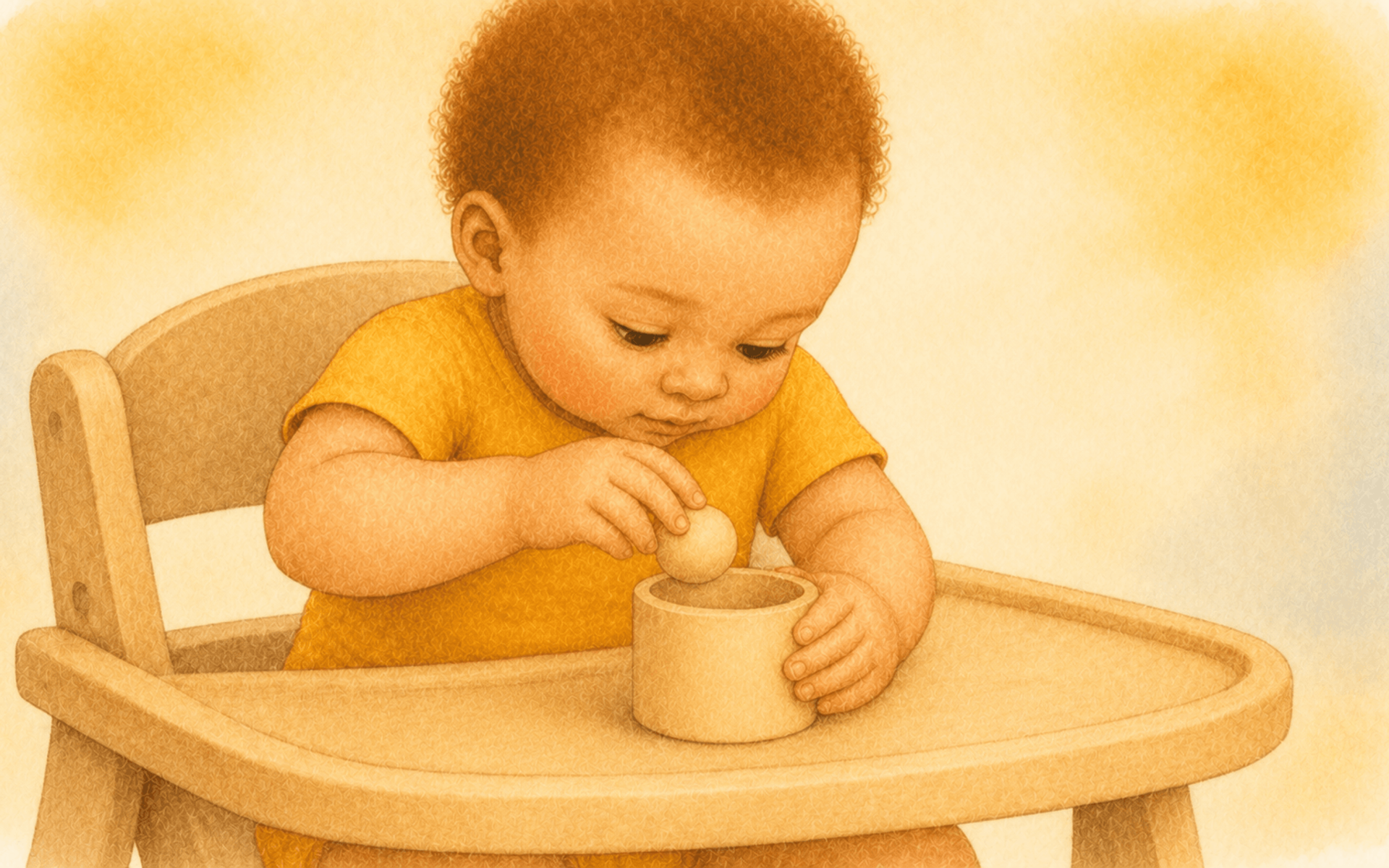
The most famous infant fine motor "shortcut" ever invented came with a cheerful name and a Velcro attachment system. Researchers gave three-month-olds tiny mittens coated in Velcro, then placed Velcro-covered toys in front of them. Babies who couldn't yet reach suddenly found that random arm swipes made objects stick to their hands. The study reported improved object exploration. The parenting internet loved it. Baby product companies ran with it. A decade of content told parents that the right gadget at the right moment could give a baby a head start on fine motor skills baby activities.
A 2022 pre-registered replication with 96 infants quietly found that sticky mittens training did not make reaching or grasping happen any earlier. The effect the original study reported hadn't held up when researchers tested it properly. Which says something worth thinking about before you buy anything.
- Why the newborn's fist-clench is not fine motor skill, and when real hand control starts
- The grasp sequence from birth to 12 months, with approximate ages and what each stage looks like
- The overlooked connection between learning to sit and what happens to hand skill afterward
- What tummy time does and does not do for fine motor development
- How early bimanual coordination develops and why it predicts language and cognition
- Age-by-age activity ideas grounded in how the research describes what helps
If the one-sentence answer is enough, you’ve got the gist. If you want the mechanism behind each piece, keep reading.
The newborn fist is a reflex, and that changes everything about "training"
Here is something that most fine motor articles skip entirely: a newborn's cortex (the outer layer of the brain responsible for voluntary movement) is not yet in charge of the hands. A 2023 review by Blumberg and Adolph in Trends in Cognitive Sciences put it plainly — cortical control over limb movements is essentially absent at birth and builds gradually across the first postnatal year. The palmar grasp reflex your newborn displays when you press your finger into their palm is spinal, not cortical. The fist clenched against the cheek is the same.
This matters for a practical reason: if voluntary hand control requires cortical wiring that doesn't exist yet, then "training" hand skills before that wiring develops is working against the architecture. What looks like a baby not practicing enough is actually a baby waiting on brain development that happens on its own schedule.
Visually guided reaching — the kind where the baby sees an object, shapes the hand, and aims — first appears around 4 months of age, when the nerve fibers connecting the motor cortex to the spinal cord have myelinated enough (that is, grown their insulating sheath) to transmit signals reliably. Before that window, there is no cortical targeting to train. After it, the baby is already doing the work.
The CDC's 2022 milestone revision reflects this: the fine motor checkpoints they list represent what three out of four babies can do by each age, not averages and not to-do items. By 4 months, most babies hold a toy placed in their hand and swing at objects with their arm. By 6 months, most reach out for something they want. By 9 months, most move objects hand to hand and rake small items with their fingers. By 12 months, most can place something into a container. Wide individual variation within these windows is completely normal.
The grasp sequence: what your baby's hands are doing month by month
The progression from newborn fist to pincer grasp is one of the most documented developmental sequences in all of pediatric science. It runs reliably from the palm toward the fingertips, and from full-hand contact toward precise fingertip control.
At birth, the palmar grasp reflex means any object pressed into the palm triggers an automatic close. This fades somewhere between 2 and 4 months as cortical control begins to emerge. Around 3 to 4 months, what researchers call an ulnar-palmar grasp appears: the baby holds an object against the palm using mostly the little-finger side of the hand, with the thumb not yet involved. By 5 to 6 months, the full palmar grasp arrives, with all fingers wrapping around the object and the thumb starting to play a stabilizing role. From 6 to 8 months comes the radial-palmar grasp, where the thumb actively participates as an anchor, and then a raking motion — sweeping fingers dragging a small object across a surface into the palm.
The inferior pincer grasp shows up around 9 to 10 months: the baby holds a small object between the thumb pad and the side of the index finger. By 11 to 12 months, the superior pincer grasp is in place — thumb tip meets index fingertip, and the baby can pick up a Cheerio with real precision.
These are approximate ranges, not deadlines. A baby who reaches the pincer grasp at 13 months is not behind. Two babies at the same age can be two full stages apart and both be developing exactly as expected. The sequence is reliable; the pace is not uniform.
Why learning to sit changes what the hands can do
One of the more interesting findings in recent infant motor research concerns the relationship between the trunk and the hands. A 2010 study by Soska, Adolph, and Johnson published in Developmental Psychology tracked what happened to babies' object exploration around the time they learned to sit independently. The result was striking: once a baby could sit without support, the whole approach to objects changed. Before independent sitting, a baby could feel an object but couldn't look at it from multiple angles while holding it, because the hands were needed for propping up. After sitting, both hands were free to manipulate and visually examine a toy at the same time. The baby could turn it over, pass it between hands, and study it from every side. The posture change unlocked a new mode of learning from objects.
A 2024 longitudinal study by Taylor and colleagues in Infant Behavior and Development followed 90 infants from 6 to 14 months and found that early object skill predicted growth in role-differentiated bimanual manipulation from 9 to 14 months. How much and how varied a baby's manipulation was turned out to be the key variable. This is the skill where one hand stabilizes an object while the other hand acts on it, the manual foundation for almost every tool-use task a child will ever do. Sitting helped, but object practice was the stronger predictor. The practical implication is that floor time with real objects matters, and sitting support (a nursing pillow, a Boppy, a parent's lap) from around 4 to 5 months gives the hands an opportunity they wouldn't otherwise have.
What tummy time does and does not do for fine motor skills
The relationship between tummy time and fine motor development is more nuanced than most sources let on. The largest systematic review to date — by Hewitt, Kerr, Stanley, and Okely in Pediatrics in 2020, covering 16 studies and over 4,000 infants — found that tummy time was positively associated with gross motor development and with total motor scores. Fine motor development specifically showed no direct association in the data they reviewed.
What this means in practice is that tummy time builds the neck, shoulder, and core strength that are prerequisites for sitting, reaching, and eventually standing. It builds the trunk stability that will later free the hands for manipulation. So it matters enormously — just not as a fine motor drill in the way it's sometimes presented. Our guide to making tummy time work when your baby hates it covers seven evidence-based approaches for the floor time that genuinely pays off.
The limitation in the Hewitt review is worth noting: most of the included studies were observational and had high selection bias, so this is a nuance ("the direct fine-motor evidence is weaker than you'd expect"), not a reason to skip tummy time altogether. Skip it and you delay the postural development that feeds everything else.
How varied exploration builds the hand and the mind
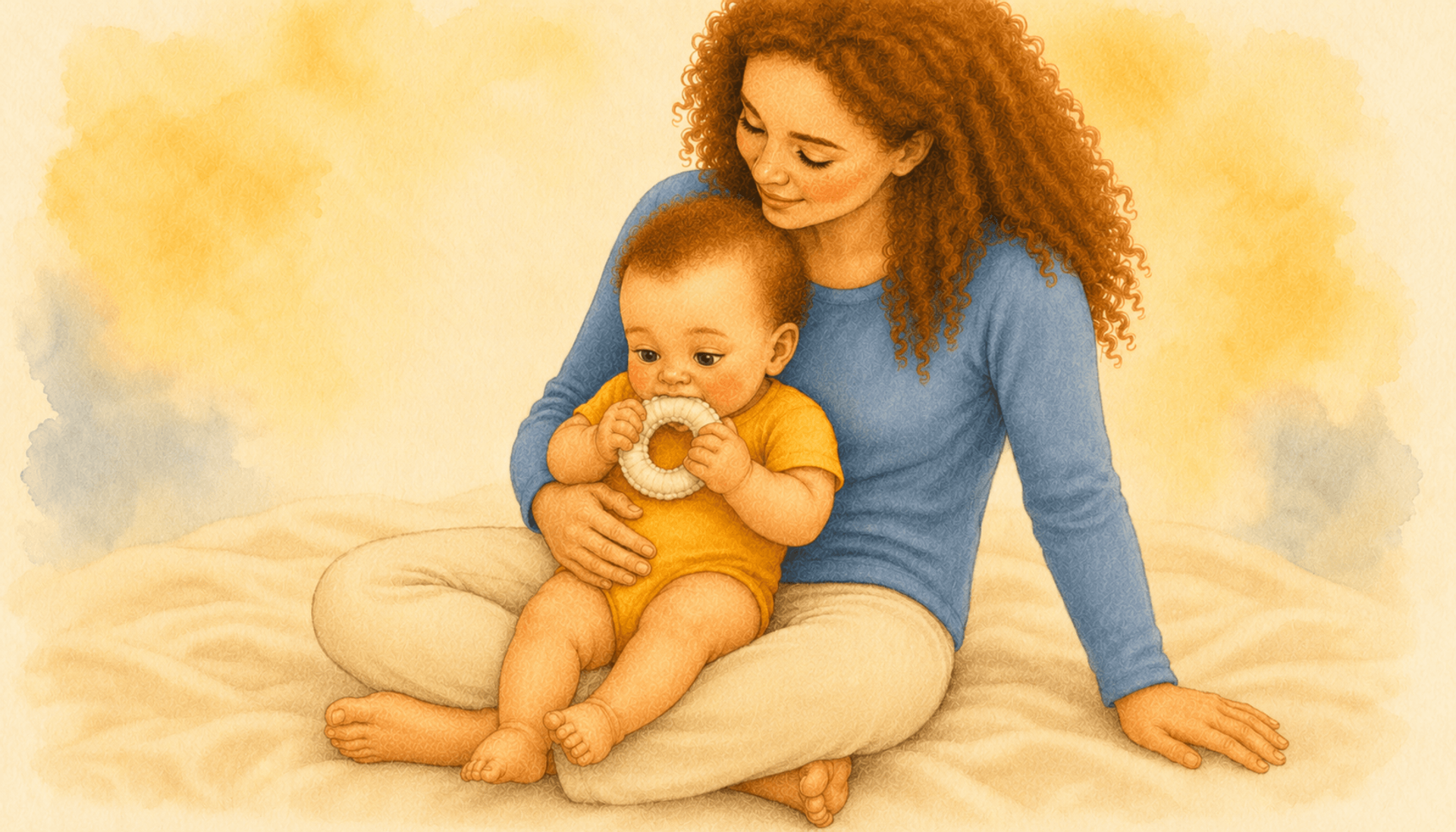
A 2022 longitudinal study by Babik, Galloway, and Lobo in Developmental Psychology followed infants from 3 through 24 months and tracked their exploratory behaviors in detail: how they held objects, banged them, transferred them between hands, looked at them, and mouthed them. Trajectories of varied object exploration were statistically associated with fine motor, language, and cognitive development measured on standardized scales at multiple points. Wider variety of exploration predicted better outcomes across all three domains.
This fits with a broader developmental framework articulated by Iverson in a 2022 review in Wiley Interdisciplinary Reviews: Cognitive Science: when babies acquire a new motor skill like independent sitting, their interactions with caregivers shift from face-to-face to side-by-side around shared objects. That positional shift creates new language opportunities. Motor milestones don't just affect the hands — they change the social and cognitive environment the baby is operating in.
What it means practically: the goal is variety and volume of self-directed manipulation, not any single activity. Passing objects between hands, mouthing safe textures, banging surfaces, feeling different shapes and weights. These aren't just play. They're the input the developing hand system runs on. Our Sensory Play Cards are organized around exactly this principle: 60 activities across all five senses from birth to 12 months, with varied tactile, visual, and proprioceptive experiences across four age blocks, so the rotation stays fresh without requiring parents to plan from scratch.
Fine motor skills and why they predict more than you'd expect
A fine motor delay that shows up consistently may be one of the earliest signals of a developmental path that needs closer attention — earlier, in some cases, than other signs parents and pediatricians watch for. A 2019 longitudinal study by LeBarton and Landa following 170 infants found that fine motor skill scores at 6 months predicted expressive language outcomes at 3 years across all three groups examined, including infants with no family risk factors at all. The connection reaches well beyond the hands.
The proposed mechanism is that motor and communicative development are part of the same cascading system rather than parallel tracks. A 2022 review by Iverson describes this in detail: as fine motor skill develops, babies produce more pointing, more object-sharing, and more coordinated gestures, all of which drive caregiver responsiveness and vocabulary input back to the baby. The hands are one of the main engines of early language learning.
This is worth holding onto when tummy time feels tedious or floor play feels pointless. The baby turning an object over for the seventh time is not wasting time. The sequence has a destination.
A useful early indicator for parents who want to know where to pay attention: early hand preference. Research by Contino and colleagues published in Infant Child Development in 2024 showed that hand preference trajectories measured in infancy explain meaningful variance in language outcomes at age 5, beyond what socioeconomic status alone predicts. Most infants (roughly 61% in one sample) show no clear hand preference by 6 months, but the picture stabilizes considerably by 14 months. Consistent use of one hand for reaching and grasping in the second half of the first year is a signal the motor system is organizing well, not a concern about being left-handed.
Age-by-age fine motor skills baby activities: what to offer and when
0 to 3 months: setting up for reach
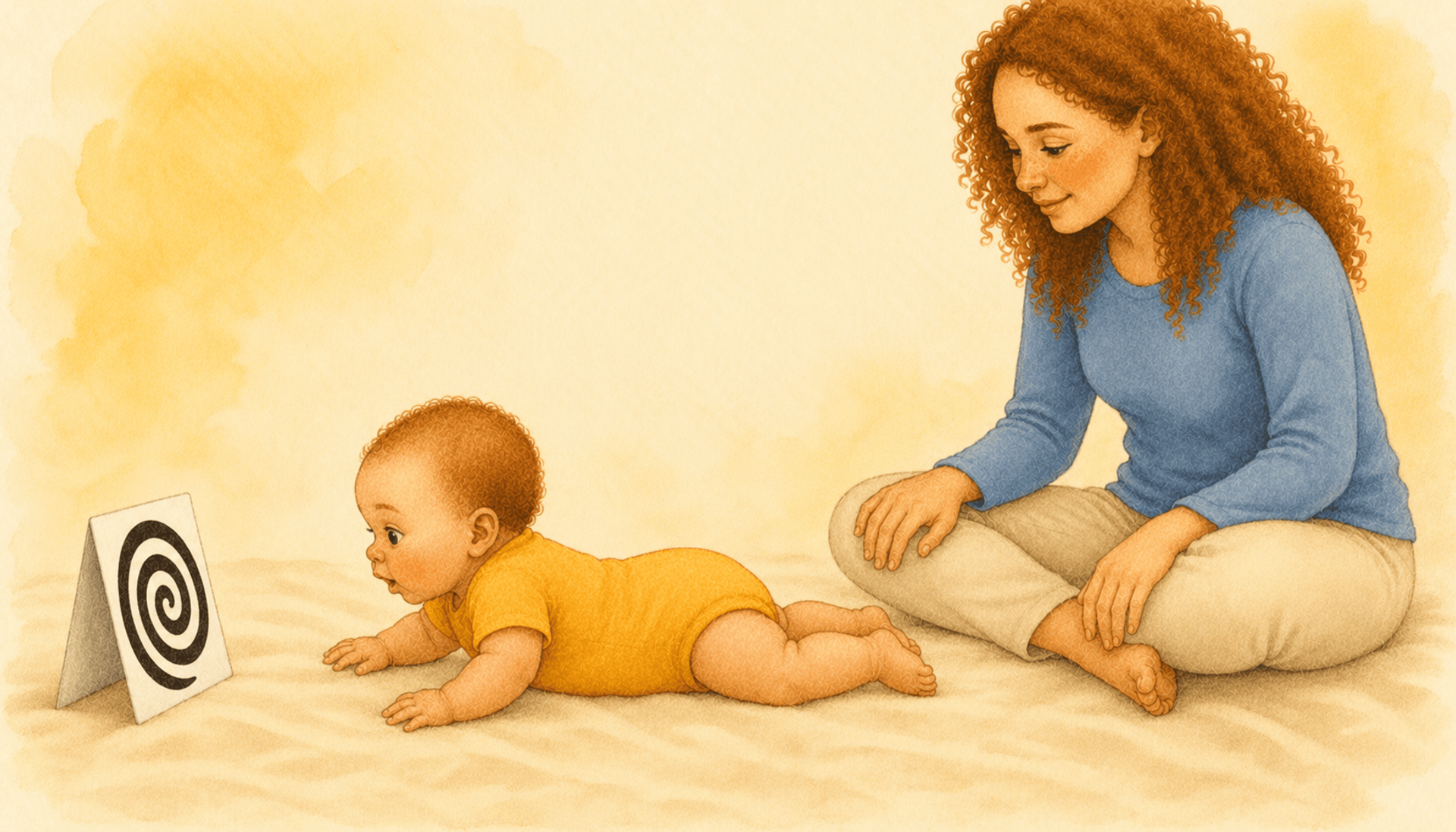
The hands are mostly closed, the grasp is reflexive, and cortical motor control is in its earliest stages of coming online. The most useful thing you can offer is not a grasping exercise but visual engagement that prepares the system for reaching. High-contrast patterns hold a newborn's gaze longest because the developing visual system responds most strongly to sharp edges and strong contrast before color processing matures.
Place your baby facing a high-contrast card or pattern during tummy time. The visual tracking that happens in this position activates the same head-lifting and shoulder-pressing that builds the trunk foundation for later reaching. Our High Contrast Flashcards are specifically designed for this window, with pattern complexity matched to what newborn visual pathways can register. Allow the fists to open naturally; you can gently stroke the back of your baby's hand to encourage uncurling, but there is no useful drill for the palmar grasp at this age.
3 to 6 months: first intentional reach
Around 4 months, reaching becomes visually guided and intentional. Your baby is now aiming. Offer objects just within reach (not so far away that the baby strains, not already in the hand) to give the reach-to-grasp sequence a chance to run. Lightweight rattles, fabric squares, and silicone rings all work. Vary the texture and weight from session to session — each different surface sends different tactile information to the brain's body-map (the strip of the brain that registers touch and movement), which is actively building its map of what the hands can do.
Supported sitting from around 4 to 5 months, using a pillow or your legs as a backrest, gives both hands freedom to explore rather than one hand going to support. Keep sessions short and supervised, always with back support and slightly reclined. For more sensory activity ideas across this age range, our sensory play guide by month covers what works and why.
6 to 9 months: transferring, raking, and the thumb arrives
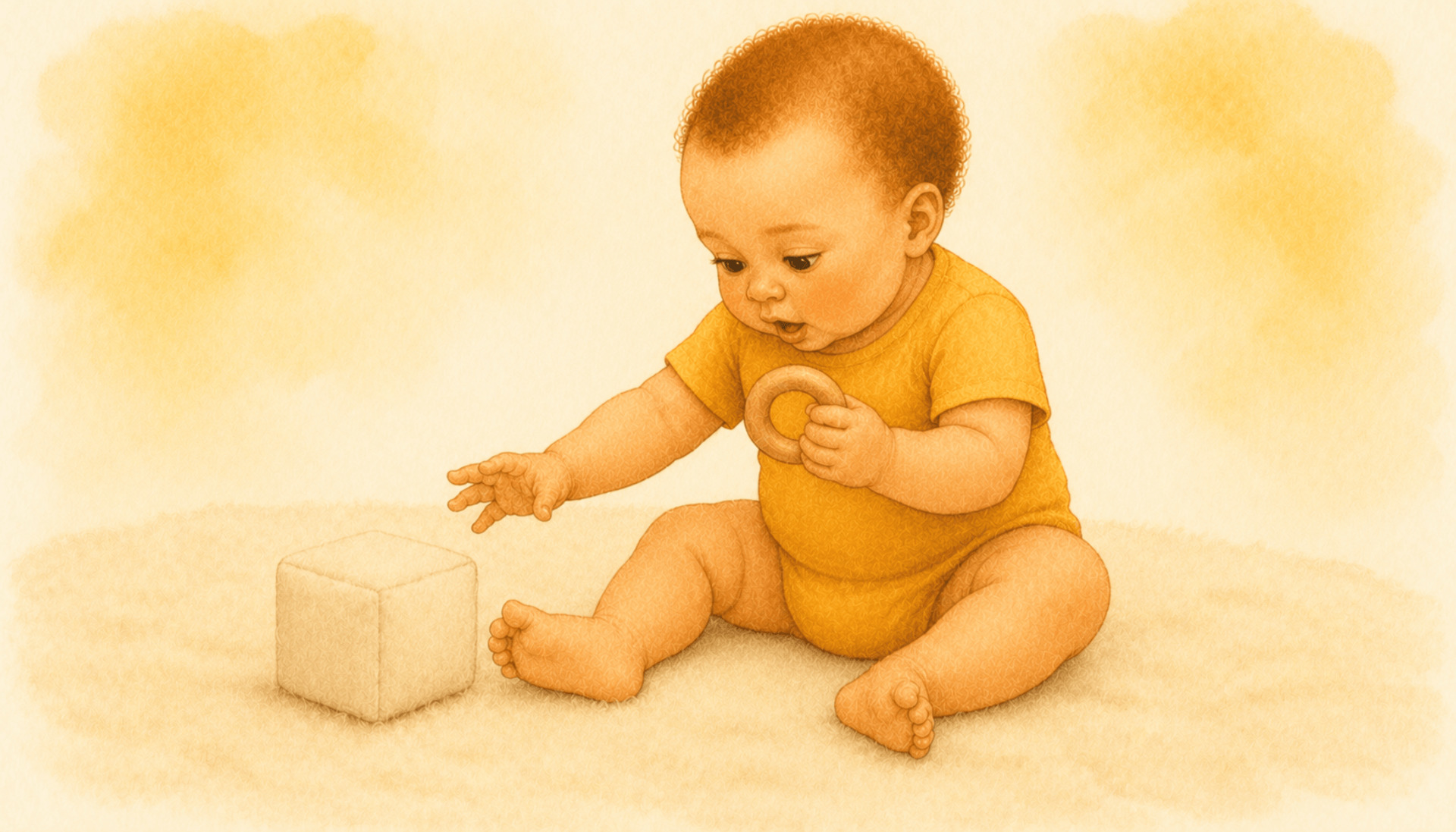
This is when grasping gets interesting. The raking grasp at 6 to 7 months means your baby can sweep small objects across a surface — food, toys, anything graspable — and this hand-over-surface contact is itself rich sensory input for the developing grip. Transferring objects hand to hand shows up around this time as well, which is the beginning of bimanual coordination (one hand starts working with the other rather than in competition with it).
Activities that support this stage: soft blocks of different sizes (small enough to grasp, large enough to be safe), crinkle books, and objects with distinct textures on each side. Offer two objects at once so your baby has to decide what to do with the second one — put it down, transfer the first, hold both. That decision-making is fine motor work. The 3-month activities from our activities for 3 month olds guide can also inform how to structure exploratory floor time during this period.
Mouthing at this age is not a habit to break — it's a feature. Oral exploration combined with manual exploration gives the brain two simultaneous streams of tactile information about the same object. Offer safe, clean, varied textures to mouth.
9 to 12 months: pincer grasp and two-handed coordination
The inferior pincer grasp appears around 9 to 10 months, and the superior fingertip pincer by 11 to 12 months. Activities to support this: small safe puffs or soft finger foods placed on a high-chair tray, shape-sorting toys with large holes, stacking cups, and simple posting games (placing objects into a container). The act of picking up a small object, aiming it at a container opening, and releasing it is a genuine fine motor challenge at this age — it requires grip control, aim, and voluntary release, all of which have to coordinate.
Role-differentiated bimanual manipulation is also emerging: one hand holds a container while the other places objects inside, or one hand holds a toy car while the other rolls a wheel. Research by Taylor and colleagues confirms that infants who have more varied object experience in the months before this window arrive at bimanual coordination faster. That variety doesn't require special equipment — a wooden spoon and a pot, a stacking ring, a simple push toy — what matters is that the hands encounter different affordances repeatedly.
For independent exploration, the lightweight and varied textures in our Sensory Play Cards are designed to rotate through different tactile and visual experiences across this whole window, giving the hands new inputs at each age block without requiring parents to curate a separate set of objects from scratch.
When to mention it to your pediatrician
A few patterns are worth flagging at well-child visits. If your baby is not reaching for objects by around 6 months, that's worth raising. If hand-to-hand transfer hasn't appeared by around 9 months, that's worth mentioning. If one hand is consistently used far more than the other before about 12 months in a way that seems like a physical restriction rather than a preference, that's something a pediatrician will want to look at. And if the pincer grasp hasn't emerged by around 14 months, that's the moment to schedule a check-in rather than wait.
None of these is a cause for alarm on its own — development is wide-range and contextual. But they're patterns a pediatrician will want to be in the loop on.
Frequently Asked Questions
Most babies develop the inferior pincer grasp (using the thumb pad and the side of the index finger) between 9 and 10 months, and the superior fingertip pincer (thumb tip meets index fingertip) by 11 to 12 months. The honest answer on speeding it up: a pre-registered study by van den Berg and colleagues in Child Development in 2022, with 96 three-month-olds, tested exactly this question using the "sticky mittens" training paradigm — the most famous fine motor intervention in infant research — and found it did not make reaching or grasping happen earlier. What does help is having plenty of small, safe, graspable objects available from 6 months onward and giving the baby unstructured time to practice.
Tummy time builds neck, shoulder, and core strength, all of which are the postural foundation for reaching and manipulation. But a systematic review by Hewitt and colleagues in Pediatrics (2020), covering 16 studies and more than 4,000 infants, found no direct association between tummy time and fine motor development specifically. The value is indirect: better postural control from tummy time allows both hands to come free for exploration earlier, which matters a great deal. Do tummy time consistently, just don't expect it to function as a fine motor drill.
Newborns have almost no voluntary hand control — the fist-clench and the palmar grasp reflex are spinal reflexes, not fine motor skills in the developmental sense. What you can do at this stage: place high-contrast patterns at 8 to 12 inches from the face during awake time, which trains visual tracking that will support reaching from around 4 months. Gently stroke the back of the fist to encourage the hand to open. Allow hands-to-midline contact where the baby brings both hands together in front of the body — this is the earliest self-directed hand activity.
Mouthing is an active learning behavior, not a problem to solve. Oral and manual exploration give the brain two simultaneous data streams about the same object's texture, temperature, and shape. Research on object exploration confirms that mouthing at this age feeds the same information-gathering system as looking and handling. Offer clean, safe objects of varied textures. As long as size and hygiene are managed, let it run.
Yes, and more than most parents know. A longitudinal study by LeBarton and Landa (2019) found that fine motor skill at 6 months predicted expressive language outcomes at 3 years across groups of infants with and without family risk factors. The mechanism appears to be that motor milestones drive changes in how babies interact with caregivers and objects, which in turn drive language input back to the baby. Research by Iverson (2022) describes this as a developmental cascade — a change in one domain triggers change in another. Fine motor development is not isolated from the rest of your baby's development; it's one of the engines that runs it.
For educational and informational purposes only. Not a substitute for professional medical or developmental advice. If you have concerns about your baby's development, consult your pediatrician.
- Babik, I., Galloway, J. C., & Lobo, M. A. (2022). Early exploration of one's own body, exploration of objects, and motor, language, and cognitive development relate dynamically across the first two years of life. Developmental Psychology, 58(2), 222–235.
- Blumberg, M. S., & Adolph, K. E. (2023). Protracted development of motor cortex constrains rich interpretations of infant cognition. Trends in Cognitive Sciences, 27(3), 233–245.
- Contino, K., Campbell, J. M., Marcinowski, E. C., Michel, G. F., Ramos, M., Coxe, S., Hayes, T., & Nelson, E. L. (2024). Hand preference trajectories as predictors of language outcomes above and beyond SES: Infant patterns explain more variance than toddler patterns at 5 years of age. Infant and Child Development, 33(3), e2468.
- Hewitt, L., Kerr, E., Stanley, R. M., & Okely, A. D. (2020). Tummy time and infant health outcomes: A systematic review. Pediatrics, 145(6), e20192168.
- Iverson, J. M. (2022). Developing language in a developing body, revisited: The cascading effects of motor development on the acquisition of language. Wiley Interdisciplinary Reviews: Cognitive Science, 13(6), e1626.
- LeBarton, E. S., & Landa, R. J. (2019). Infant motor skill predicts later expressive language and autism spectrum disorder diagnosis. Infant Behavior and Development, 54, 37–47.
- Needham, A., Barrett, T., & Peterman, K. (2002). A pick-me-up for infants' exploratory skills: Early simulated experiences reaching for objects using "sticky mittens" enhances young infants' object exploration skills. Infant Behavior and Development, 25(3), 279–295.
- Soska, K. C., Adolph, K. E., & Johnson, S. P. (2010). Systems in development: Motor skill acquisition facilitates three-dimensional object completion. Developmental Psychology, 46(1), 129–138.
- Taylor, M. A., Coxe, S., & Nelson, E. L. (2024). Early object skill supports growth in role-differentiated bimanual manipulation in infants. Infant Behavior and Development, 74, 101925.
- van den Berg, L., & Gredebäck, G. (2021). The sticky mittens paradigm: A critical appraisal of current results and explanations. Developmental Science, 24(5), e13036.
- van den Berg, L., Libertus, K., Nyström, P., Gottwald, J. M., Licht, V., & Gredebäck, G. (2022). A pre-registered sticky mittens study: Active training does not increase reaching and grasping in a Swedish context. Child Development, 93(6), e656–e671.
- Zubler, J. M., Wiggins, L. D., Macias, M. M., Whitaker, T. M., Shaw, J. S., Squires, J. K., Pajek, J. A., Wolf, R. B., Slaughter, K. S., Broughton, A. S., Gerndt, K. L., Mlodoch, B. J., & Lipkin, P. H. (2022). Evidence-informed milestones for developmental surveillance tools. Pediatrics, 149(3), e2021052138.


More Articles

Parallel Play in Toddlers: Why Side-by-Side Is the Social Work
Your toddler spent the entire playdate building separate towers, and nobody shared a single block. That counted — more than it looked. A 2025 longitudinal study found that playing beside a specific child consistently predicted later social play with that same child, but not the other way around. Here's what parallel play in toddlers actually is, why the science calls it strategic rather than passive, and what it means for how you run a playdate.

When Do Babies Point: Why It Matters for Language
Most milestone articles treat pointing as a box to check around 12 months. The research tells a different story — one that starts months earlier, runs through the infant brain, and traces back to how much the parent is pointing. Here's what the last fifteen years of research actually found, and what it means for everyday interactions.

When Do Babies Wave Bye-Bye: Why Your Baby Needs You to Wave First
Most baby milestones unfold on a biological schedule — waving isn't one of them. A 2023 study found that babies develop imitation ability because their caregivers imitate them first, and waving is named directly as a cultural gesture learned through that loop. Here's what the research says about the 9–12 month window, why the first wave looks nothing like a wave, and what helps it arrive.