Parallel Play in Toddlers: Why Side-by-Side Is the Social Work
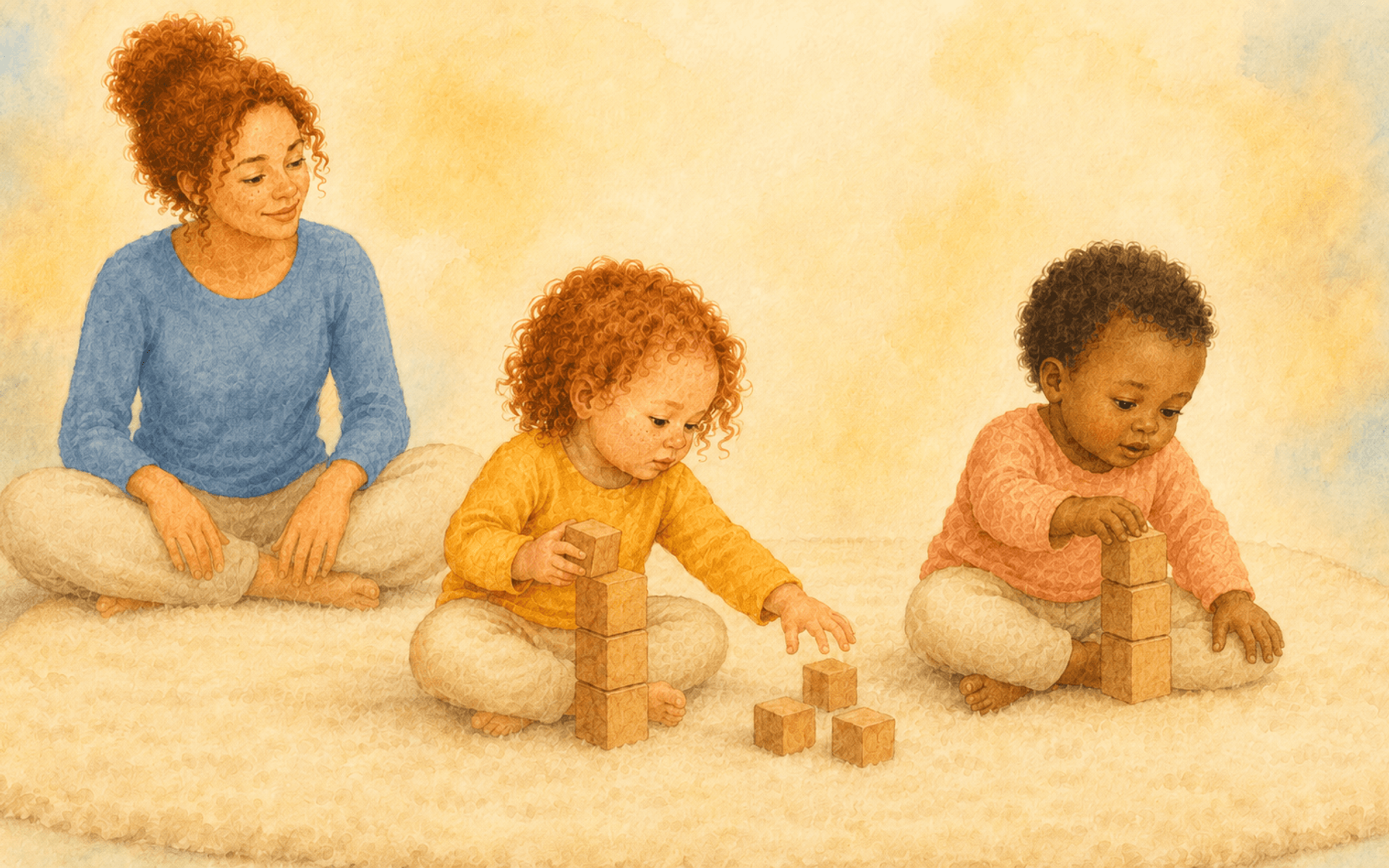
The playdate went like this: you drove across town with the snack bag, you arranged the blocks and the trucks and the pretend kitchen, and then you watched two toddlers spend forty-five minutes in the same room, each wholly absorbed in their own pile of toys. Your kid never offered a single block. The other one never asked. Nobody shared anything. So... did that even count? It did — in ways the research is only now catching up to. Parallel play in toddlers looks like the absence of connection. It turns out to be the first draft of one.
- Why Parten's 1932 play stages get cited everywhere — and what researchers found when they tested whether toddlers actually "outgrow" parallel play
- The 1980 study that reframed this from developmental bottleneck to strategic social tool
- What a toddler's brain cannot yet do, and why that makes side-by-side play the right level of challenge right now
- How toddlers absorb words, actions, and problem-solving strategies from peers they never speak to
- The 2025 friendship-predictor finding — and what it changes about how to run a playdate
- What parents can do, and what quietly gets in the way
If the one-sentence answer is enough, you’ve got the gist. If you want the mechanism behind each piece, keep reading.
What Parten's Play Stages Actually Say — and What Came After
In 1932, Mildred Parten spent months observing 40 preschool children at the University of Minnesota's Institute of Child Welfare, trying to find a pattern in how children engage with peers during free play. What she found was a sequence: unoccupied behavior, then solitary play, then onlooker behavior (watching without joining), then parallel play, then associative play (loose interaction around shared materials), then cooperative play (working toward a shared goal). Her description of these stages of play appeared in the Journal of Abnormal and Social Psychology and became one of the most-cited frameworks in early childhood research, a reasonable fate for a paper that genuinely captured something real.
The problem came with how the framework was interpreted for the next 60 years. Parallel play got framed as the thing children do before they develop the ability to play cooperatively, a transitional phase that a child moves through and leaves behind. The natural implication was that a toddler playing beside peers without interacting was demonstrating a skill the child hadn't yet developed, rather than one being actively deployed. Carollee Howes at UCLA and Catherine Matheson examined this in a longitudinal study, published in Developmental Psychology in 1992, that followed 48 children from infancy through preschool. Children did develop play forms in the expected sequence and at the expected ages, but the proportion of time a child spent in more complex play forms predicted later social competence. The path mattered, but so did the time spent at each point along it.
The more direct challenge to the stage-and-move-on model came when researchers stopped classifying which developmental stage a child was in and started watching what happened within a single play session.
Parallel Play Is a Strategy, Not a Stage to Escape
In 1980, Roger Bakeman and John Brownlee published an analysis in Child Development that did something deceptively straightforward: instead of asking "what stage is this child in," they tracked the sequential order in which play states shifted in real time, minute by minute. Forty-one children between 32 and 42 months were observed during indoor free play. The finding from that analysis still holds up more than four decades later: "The movement from parallel play to group play may be more a matter of minutes than months." Parallel play, Bakeman and Brownlee concluded, often functions not as a stage children inhabit for months and eventually leave, but as a strategic bridge a child uses within a single play session — a position chosen deliberately before entering a group.
That framing turns out to match what research on peer group entry has found independently. In a study published in Merrill-Palmer Quarterly in 1983, Kenneth Dodge and colleagues observed kindergartners attempting to join ongoing peer groups and identified a consistent pattern in the children who succeeded: they followed a low-to-high-risk sequence. First hovering and watching, then imitating the group's activity nearby, then making a direct bid to participate. Children who skipped the early low-risk phases and moved straight to high-demand tactics (demanding a role, grabbing a toy, talking loudly to announce their presence) were more likely to be rejected. The child who sat nearby for a while first, apparently doing nothing special, was the one demonstrating social competence.
Craig Robinson and Craig Hart at Brigham Young University, along with colleagues, named this more precisely in a 2003 paper in Early Childhood Research Quarterly. They distinguished between "parallel play" and "parallel-aware play," the latter being the state where a child is physically near peers and playing independently while actively monitoring what those peers are doing. In observations of 167 four-year-olds in naturalistic classroom settings, being in parallel-aware play significantly increased the probability of transitioning into cooperative-social play. And children already engaged in cooperative play frequently retreated to parallel-aware play before their next social move. The flow is bidirectional: not a stage completed and exited, but a position a child returns to throughout a session, each time taking stock before the next step.
Why Sharing and Cooperation Take as Long as They Do
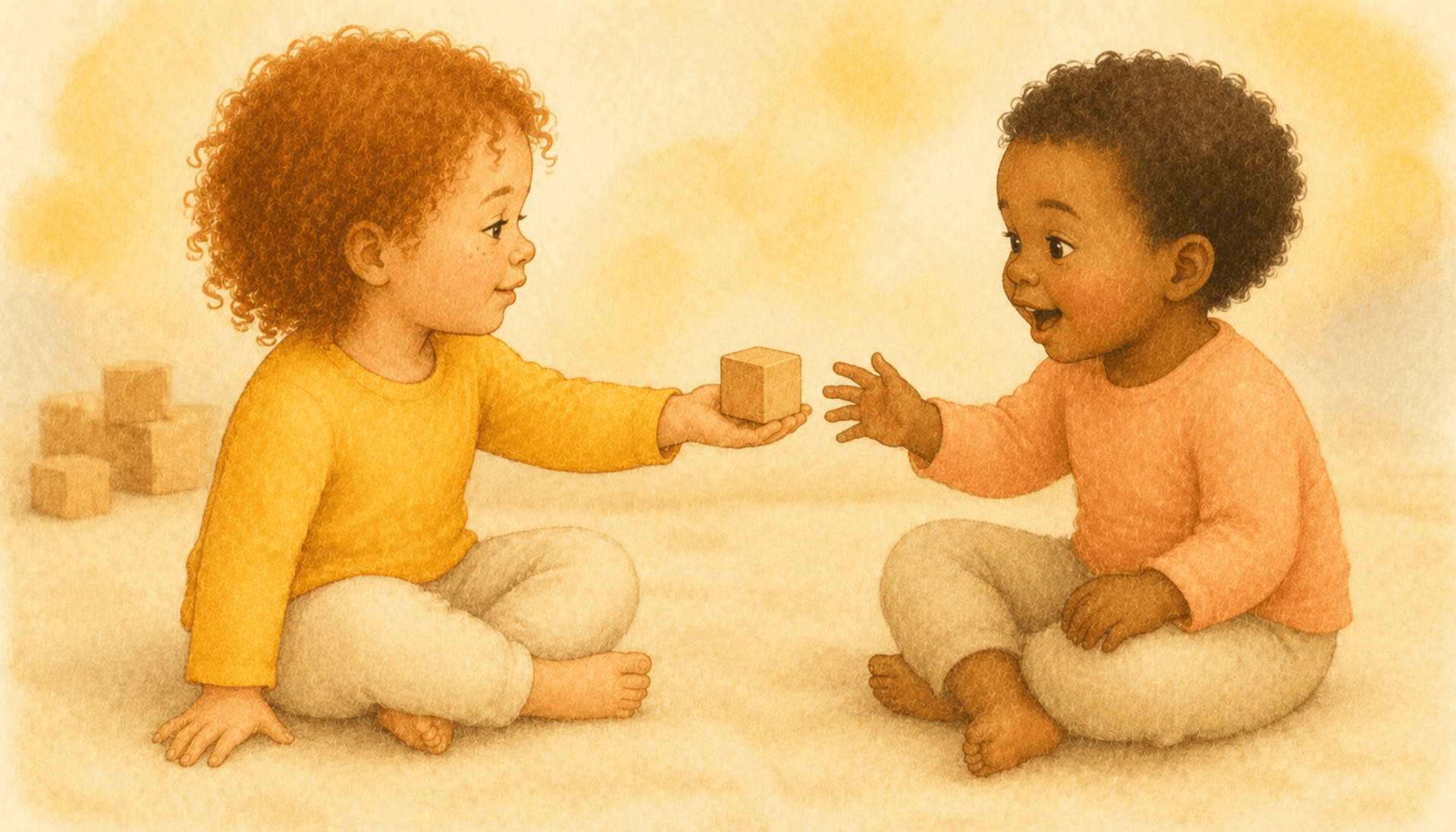
The impulse to grab a toy and the impulse to share it can exist in the same moment, with the grab winning — not because the intention to share was insincere, but because the neural pathway that runs "want it now" is faster than the one that runs "wait, it belongs to them." This is not a character flaw. It is the current state of a prefrontal cortex that is still under construction.
Adele Diamond's 2013 review of executive function research, published in Annual Review of Psychology, describes inhibitory control as "disproportionately difficult for young children" and identifies what the failure looks like at a behavioral level: a knowing-doing gap where the child understands the rule perfectly and still violates it in the moment. The knowledge and the action run on circuits that are not yet well connected, and under conditions of heightened arousal (when another child has the toy the toddler wants), the faster circuit wins. Diamond cites longitudinal work on over 1,000 children followed to age 32 showing that childhood self-control predicts physical health, financial outcomes, and a range of other life outcomes independent of intelligence and social background. The stakes of this particular developmental window are real. But so is the timeline.
How slowly that timeline unfolds was quantified in a 2025 longitudinal neuroimaging study by Fiske and colleagues at the University of Bristol, published in Developmental Cognitive Neuroscience. The same children were measured on inhibitory control tasks at 10 months, 16 months, and 3½ years. Response inhibition performance did not measurably improve between 10 and 16 months but was significantly better by early childhood. The neural machinery (involving the right prefrontal and parietal cortex) was present and functioning throughout, but its output was still maturing across the entire 1-to-3 window.
Cooperative behavior follows a closely related schedule. Celia Brownell and colleagues at the University of Pittsburgh tracked one- and two-year-old peer dyads in a 2006 study published in Child Development and found that one-year-olds' joint actions appeared "more coincidental than cooperative." Two-year-olds actively monitored their partner's movements and worked toward shared outcomes. A follow-up study by the same research group in 2013, with 51 toddlers aged 18 and 24 months, found that 24-month-olds shared spontaneously and frequently, while 18-month-olds required significant communicative support from a partner to do so. Ownership understanding, the grasp that an object belongs to someone, was positively associated with the likelihood of sharing — toddlers who understand "mine" are, paradoxically, closer to understanding "yours."
Parallel play, then, is what toddlers do given the brain they currently have: staying near peers, observing, absorbing, and participating at the social level that requires no impulse suppression at all. The American Academy of Pediatrics, in a policy statement on the importance of play reaffirmed in January 2025, describes play as a driver of executive function development, including the very self-regulation that cooperative play requires. The brain development and the play development are not sequential — they happen in a loop, each feeding the other over years.
What a Toddler Learns During the Quiet Hours
A toddler sitting beside another child building a block tower and never saying a word is not tuned out. The attention to what the other child is doing is nearly continuous, and what gets absorbed from that observation is more than most parents expect.
Peer imitation in toddlers operates earlier and more robustly than common intuition would suggest. In experiments published in Developmental Psychology in 1993, Elizabeth Hanna and Andrew Meltzoff showed that 14- to 18-month-olds who watched a peer perform novel sequences of actions on objects reproduced those actions significantly more than controls — not immediately, but from memory, after delays of up to two days, and across a change of context (watching the actions at day care and reproducing them at home). The peer as teacher works without conversation. A separate set of studies by Ryalls, Gul, and Ryalls, published in Merrill-Palmer Quarterly in 2000, found that 14- to 18-month-olds were more likely to imitate three-step action sequences demonstrated by an older child model than the same actions demonstrated by an adult. Young children preferentially learn from other children. A peer playing nearby is a high-signal learning environment, even at a distance.
Language follows a parallel channel. In three experiments published in Child Development in 2001, Nadia Akhtar, Jennifer Jipson, and Maureen Callanan showed that two-year-olds learned new words, both object names and action verbs, when they overheard those words used in a conversation between other people, without being directly addressed. The overhearing mechanism is real and functional in this age window. One honest caveat: corpus research by Weisleder and Fernald, published in Psychological Science in 2013, found that the quantity of speech directed specifically to the child predicts vocabulary at 24 months, while ambient speech simply overheard in the background does not predict it independently. Overhearing in a parallel play context, where a toddler is physically close and attentionally engaged, is something closer to the former than the latter — but child-directed conversation remains the more reliable input. The ambient language of parallel play supplements it; it does not replace it.
For activities at age 2 that involve shared physical space (art tables, sensory bins, water play side by side), the imitation mechanism means the materials in the room are not neutral. A toddler who can observe what a peer does with paint or blocks is more likely to adopt and extend those strategies than one playing in isolation.
The Study That Made the Side-by-Side Time Look Different
In research published in Developmental Psychology in 2025, Jennifer Watling Neal, Zachary Neal, Brian Brutzman, and C. Emily Durbin at Michigan State University tracked two preschool classrooms (one of 3-year-olds and one of 4-year-olds) over a full school year. Using longitudinal social network analysis, they mapped both parallel play relationships (who plays beside whom) and social play relationships (who plays directly with whom) at multiple time points across the year.
The result was direct and, given how parallel play gets talked about, somewhat surprising: in both classrooms, the existence of a parallel play relationship between two specific children predicted the later formation of a social play relationship between those same children. The reverse was not true — being social play partners did not predict later parallel play. The path ran in one direction, from beside to with, and it replicated across both age groups. Who a child plays beside today is a meaningful predictor of who they will play with later. The side-by-side time is not a prelude to the relationship; it is the relationship beginning.
Neal and colleagues studied 3- and 4-year-olds, not younger toddlers — worth holding in mind for the article's 1-to-3 age focus. For the 18- to 24-month-old range, Bakeman and Brownlee's strategic-function analysis and Hanna and Meltzoff's peer imitation work, beginning at 14 months, extend the same logic to the earlier window. The mechanism starts before the network study captures it.
It is also worth putting this alongside the separation anxiety that often coexists with the toddler social window. Wariness of unfamiliar peers is developmentally normal and does not signal that parallel play relationships are not forming. The brain development work from the first year documents that social awareness is present early — infants recognize faces, track social exchanges, and show preferences for familiar people well before their first birthday. The lag is not in awareness but in the capacity to act on that awareness in a peer context with its attendant demands on inhibitory control. Parallel play is the form that social interest takes when cooperative play is not yet neurologically available.
What Actually Helps — and What Tends to Get in the Way
The conditions that support parallel play are less complicated than most playdate planning implies.
Duplicate materials reduce friction more effectively than any coaching about sharing. A room with one set of blocks and two toddlers produces conflict. A room with two sets produces parallel play that, per Bakeman and Brownlee's sequential analysis, is more likely to tip into cooperative play within the same session. The same logic applies to art supplies, water tables, sensory materials, and anything else that creates an obvious competition for a single resource. Two brushes and two papers solve a problem that developmental readiness cannot solve on the same timeline.
Group size matters more than most parents realize. For toddlers, a playdate involving one other child in a familiar space is a more productive social environment than a larger group. Three or more toddlers with limited materials is not a richer socialization opportunity — it raises the overall demand on the very impulse-control circuitry that is still maturing. Keeping sessions to 60 to 90 minutes also matters; the transition out of parallel play into something more actively social tends to happen mid-session rather than at the start, and overstimulated toddlers cannot get there.
The adult behavior that most consistently undermines the process is inserting direction into it. A 2021 study by Jelena Obradović at Stanford and colleagues, published in the Journal of Family Psychology, found that the proportion of time a parent spent actively redirecting a child who was already independently engaged predicted lower executive function outcomes. The sample was kindergartners rather than toddlers, which is worth holding alongside the finding; the principle it describes, that adult direction during a child's active independent engagement competes with rather than supports that engagement, is consistent with broader work on autonomy-supportive parenting. The gentle parenting research covers the autonomy dimension in more depth. During parallel play sessions, staying available without scripting the interaction is usually the most useful thing.
Predictable daily structure also reduces the activation cost of social situations. Toddlers with high baseline anxiety in unfamiliar environments often don't have the attentional and emotional bandwidth for even low-demand social engagement. Our First Routine Cards build the kind of predictable daily sequence that lowers that baseline anxiety — not by teaching social skills directly, but by giving toddlers a stable platform from which new situations feel less threatening. And if the toddler at the playdate keeps refusing everything, the why toddlers say no article covers the autonomy dynamics that intersect with social readiness at this age.
The behaviors that look alarming but are generally on track (playing beside rather than with, refusing to share, losing interest in peers quickly) are all expected at 1 to 3 years. The pattern worth flagging is different: if by 3 to 3½ years a toddler shows no interest in watching peers, no imitation of other children's actions, and no emerging loose interaction around shared materials, those observations are worth raising at the next visit. The same goes for consistent distress in the presence of other children without any habituation over time.
Frequently Asked Questions
Parallel play in toddlers begins between 18 and 24 months for most children, as they become more aware of peers and begin seeking proximity during play. It remains the primary mode of peer interaction through roughly age 3. It does not disappear after that: research by Bakeman and Brownlee in a 1980 study in Child Development found that even children capable of cooperative play use parallel play strategically, sidling up to a group to observe before joining, at any age. The question is not when it ends but what role it plays as children develop.
Playing beside other children rather than with them is developmentally on track at age 2. True cooperative play, where two children work toward a shared goal, requires inhibitory control and social understanding that are still developing across the second and third year. Celia Brownell and colleagues found in a 2006 study in Child Development that one-year-olds' joint actions appear "more coincidental than cooperative," and that active goal-directed cooperation with a peer becomes reliable at around age 2, developing gradually. A 2-year-old who watches other children with interest, imitates what they see, and plays near peers without significant distress is on track.
Parallel play means two children play near each other, with similar or different materials, without directly coordinating their activity. Associative play involves direct interaction: borrowing toys, commenting on what the other child is doing, following each other, but still without working toward a shared goal. Associative play emerges at around 3 to 4 years and is itself the step before fully cooperative play. Mildred Parten's original 1932 classification in the Journal of Abnormal and Social Psychology treated both as distinct stages between parallel and cooperative play, and contemporary research generally supports that ordering while emphasizing that the stages overlap considerably in practice.
Bakeman and Brownlee's 1980 research found that the transition from parallel to group play often occurs within minutes when the conditions are right — same materials available, small group, enough time. What supports the transition is offering duplicate materials (so competition is removed), keeping playdates small and consistent with the same peer (Neal and colleagues' 2025 study in Developmental Psychology found that parallel-play relationships predicted later social-play relationships with those same peers), and allowing children to initiate interactions at their own pace rather than prompting sharing or joint activity before they are ready. The transition is less something a parent engineers and more something that follows from creating the right conditions and then stepping back.
This article is for educational and informational purposes only and does not constitute professional medical or developmental advice. If you have specific concerns about your child's social development, please consult a qualified pediatrician or early childhood specialist.
- Akhtar, N., Jipson, J., & Callanan, M. A. (2001). Learning words through overhearing. Child Development, 72(2), 416–430
- Bakeman, R., & Brownlee, J. R. (1980). The strategic use of parallel play: A sequential analysis. Child Development, 51(3), 873–878.
- Brownell, C. A., Iesue, S. S., Nichols, S. R., & Svetlova, M. (2013). Mine or yours? Development of sharing in toddlers in relation to ownership understanding. Child Development, 84(3), 906–920.
- Brownell, C. A., Ramani, G. B., & Zerwas, S. (2006). Becoming a social partner with peers: Cooperation and social understanding in one- and two-year-olds. Child Development, 77(4), 803–821.
- Diamond, A. (2013). Executive functions. Annual Review of Psychology, 64, 135–168.
- Dodge, K. A., Schlundt, D. C., Schocken, I., & Delugach, J. D. (1983). Social competence and children's sociometric status: The role of peer group entry strategies. Merrill-Palmer Quarterly, 29(3), 309–336.
- Fiske, A., Mortimer, A., Collins-Jones, L., de Klerk, C. C. J. M., Gattas, S. U., Dvergsdal, H., Scerif, G., & Holmboe, K. (2025). Inhibitory control development from infancy to early childhood: A longitudinal fNIRS study. Developmental Cognitive Neuroscience, 73, 101557.
- Hanna, E., & Meltzoff, A. N. (1993). Peer imitation by toddlers in laboratory, home, and day-care contexts: Implications for social learning and memory. Developmental Psychology, 29(4), 701–710.
- Howes, C., & Matheson, C. C. (1992). Sequences in the development of competent play with peers: Social and social pretend play. Developmental Psychology, 28(5), 961–974.
- Neal, J. W., Neal, Z. P., Brutzman, B., & Durbin, C. E. (2025). Understanding the developmental transition between parallel and social play during preschool: A multiplex social network analysis. Developmental Psychology, 61(10), 1860–1867.
- Obradović, J., Sulik, M. J., & Shaffer, A. (2021). Learning to let go: Parental over-engagement predicts poorer self-regulation in kindergartners. Journal of Family Psychology, 35(8), 1160–1170.
- Parten, M. B. (1932). Social participation among pre-school children. The Journal of Abnormal and Social Psychology, 27(3), 243–269.
- Robinson, C. C., Anderson, G. T., Porter, C. L., Hart, C. H., & Wouden-Miller, M. (2003). Sequential transition patterns of preschoolers' social interactions during child-initiated play: Is parallel-aware play a bidirectional bridge to other play states? Early Childhood Research Quarterly, 18(1), 3–21.
- Ryalls, B. O., Gul, R. E., & Ryalls, K. R. (2000). Infant imitation of peer and adult models: Evidence for a peer model advantage. Merrill-Palmer Quarterly, 46(1), 188–202.
- Weisleder, A., & Fernald, A. (2013). Talking to children matters: Early language experience strengthens processing and builds vocabulary. Psychological Science, 24(11), 2143–2152.
- Yogman, M., Garner, A., Hutchinson, J., Hirsh-Pasek, K., & Golinkoff, R. M. (2018). The power of play: A pediatric role in enhancing development in young children. Pediatrics, 142(3), e20182058.
More Articles

When Do Babies Point: Why It Matters for Language
Most milestone articles treat pointing as a box to check around 12 months. The research tells a different story — one that starts months earlier, runs through the infant brain, and traces back to how much the parent is pointing. Here's what the last fifteen years of research actually found, and what it means for everyday interactions.

When Do Babies Wave Bye-Bye: Why Your Baby Needs You to Wave First
Most baby milestones unfold on a biological schedule — waving isn't one of them. A 2023 study found that babies develop imitation ability because their caregivers imitate them first, and waving is named directly as a cultural gesture learned through that loop. Here's what the research says about the 9–12 month window, why the first wave looks nothing like a wave, and what helps it arrive.

When Do Babies Start Clapping: The Answer Most Parents Don't Expect
Every article about baby clapping will tell you nine months. What they skip is that the brain system behind that first clap has been building since the second month of life. Here's what the CDC actually says about the milestone, what motor and neurological steps have to fall into place first, and how to tell a normal late clapper from a pattern worth flagging.