When Do Babies Wave Bye-Bye: Why Your Baby Needs You to Wave First
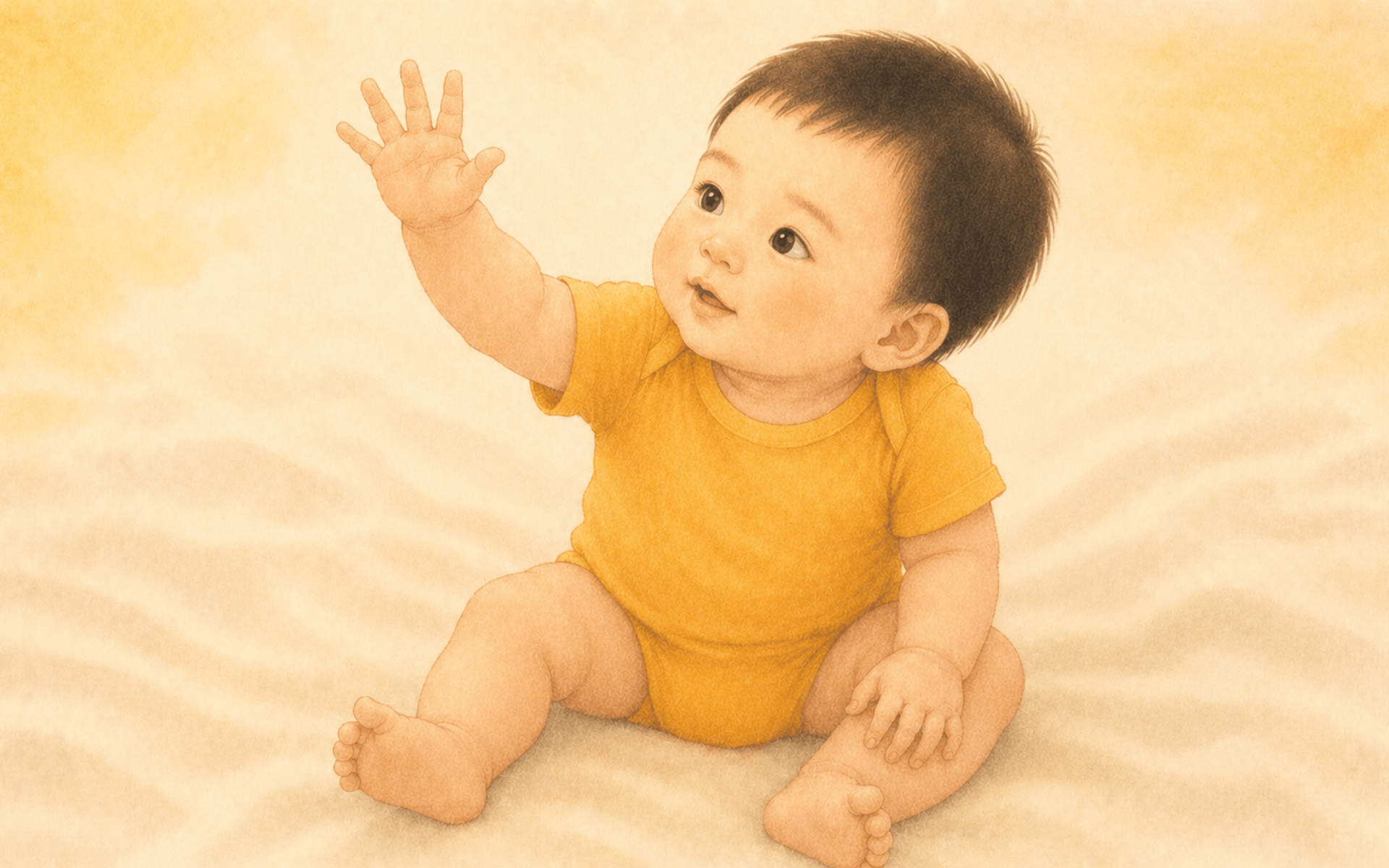
Most developmental milestones unfold on a biological schedule. Your baby will roll over, sit up, and eventually walk whether or not you coach them through it, because those skills are wired into the body's developmental program. When babies wave bye-bye is a different question entirely. The answer, backed by a 2023 study out of Ludwig-Maximilians-Universität München, points somewhere most parents don't expect: back at themselves.
- Why waving belongs in a completely different category than rolling, sitting, or crawling
- The 2023 finding that reframes who teaches a baby to wave
- How the wave connects to your baby's earliest vocabulary before words arrive
- What the physical wave looks like as it develops, and why the clumsy first version is supposed to look that way
- When a missing wave is worth flagging and when it genuinely isn't
If the one-sentence answer is enough, you’ve got the gist. If you want the mechanism behind each piece, keep reading.
Waving is not a motor milestone, and that difference matters
Rolling, sitting, crawling, walking: these emerge on a largely biological timetable. A baby who has never seen another person crawl will still crawl. The motor programs for these movements develop from within, on a schedule that environmental input refines but doesn't create. Waving is not in this category.
When babies wave bye-bye, what they're demonstrating is something researchers classify as a conventional gesture (a hand movement whose meaning is culturally assigned, not physically obvious). A wave doesn't look like goodbye the way a pointed finger looks like "that thing over there." The connection between the flapping hand and the meaning of "I see you, and I'm acknowledging this parting" has to be learned from watching it happen repeatedly in specific social contexts. Researchers including Crais, Douglas, and Campbell, who tracked twelve infants from six to twenty-four months in a 2004 study, documented that conventional social gestures like waving consistently emerge after reaching and pointing, the gestures with a physical, object-directed logic, because they require an extra layer of social understanding that takes more time to build. Clapping tends to arrive in the same window — our article on when babies start clapping covers the specific motor and social mechanics behind that milestone if you're tracking both at once.
This is the distinction that every parenting article about when do babies wave quietly skips: waving requires your baby to understand that a movement can carry a social meaning that has nothing to do with what the body is physically doing. A 2013 Japanese study by Matsui, Ohtoshi, and Takada, published in Pediatrics International, tracked 597 full-term infants between 6 and 21 months and found that while some babies began to imitate a bye-bye wave as early as 9 months, all full-term infants in the study could do it by 16 months. Very low birth weight babies lagged by roughly one month on corrected age. The window is genuinely wide — and it's wide because waving depends partly on something outside the baby's own developmental clock.
The 2023 finding that changes who the teacher is
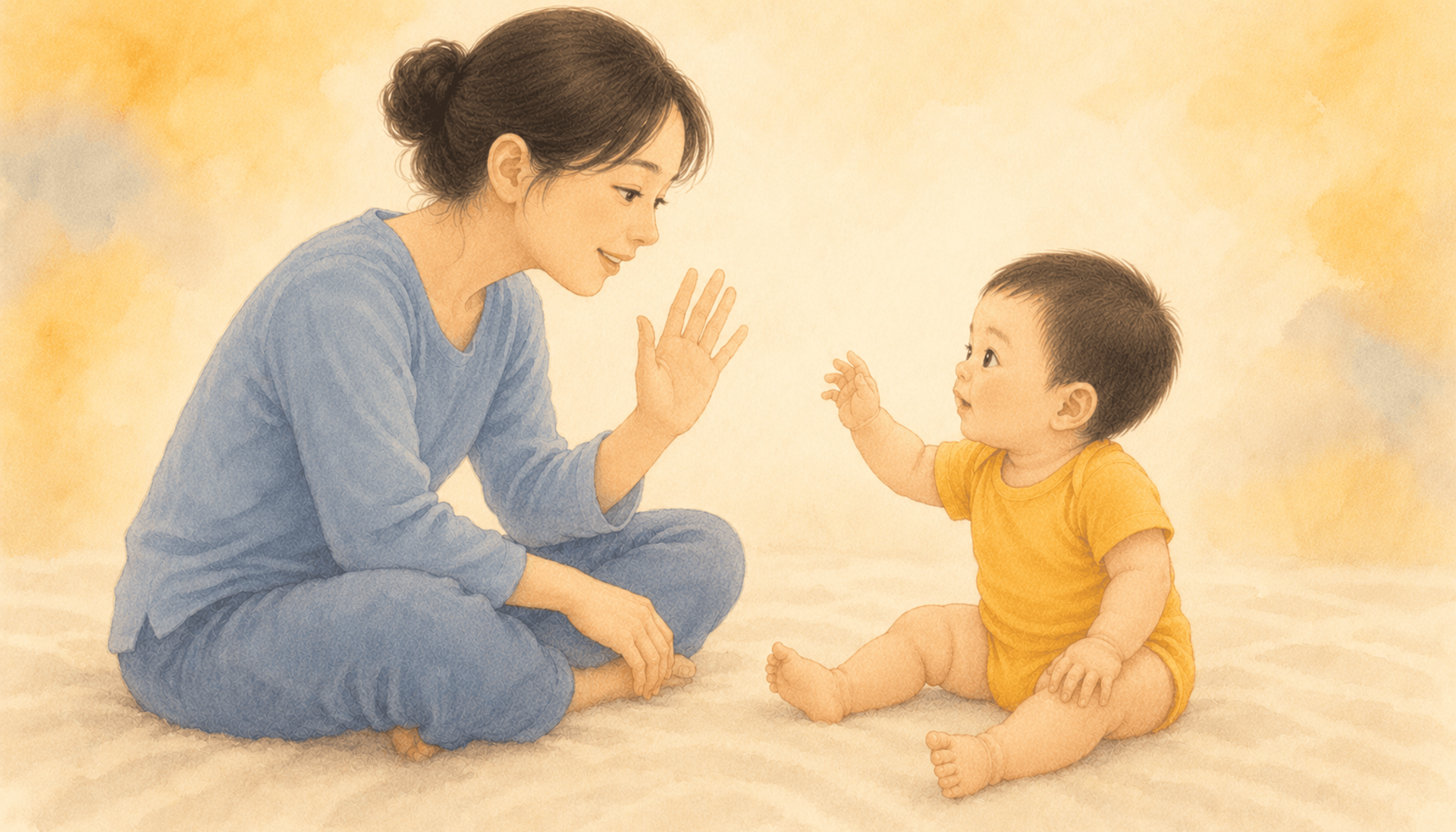
For decades, the standard advice on waving has been some version of: wave at your baby, say "bye-bye," repeat until they copy you. That framing puts the baby in the role of observer and puts the parent in the role of demonstrator. A 2023 study from LMU München reverses the frame in a way that's more interesting and, honestly, more useful.
Essler, Becher, Pletti, Gniewosz, and Paulus followed 127 mother-infant pairs from when the babies were 6 months old through to 18 months, analyzing how often and how sensitively mothers imitated their babies during everyday interactions. Their finding: the more a mother mirrored her 6-month-old's sounds, faces, and movements, the stronger that child's own imitation abilities were at 18 months. Waving is named directly in the paper as one of the cultural gestures children learn through this route. The researchers call it cultural learning, the process by which humans pass on conventional behaviors across generations, and they trace its origins not to a child watching an adult, but to a child being watched and mirrored by one.
The practical shift in emphasis is significant. A 9-month-old who has been living in a household where someone regularly and warmly reflected back the baby's babbles, arm flaps, and open-mouthed grins has had more practice with the imitation loop — the brain circuitry for copying others builds through use. This doesn't mean babies who lag in waving have inattentive parents; most of the variation comes from ordinary differences in household rhythm, not from anyone doing anything wrong. It means waving is more sensitive to the texture of early social interaction than most milestone articles acknowledge. And it means the most useful thing you can do, months before a wave ever appears, is to be the kind of person who notices and mirrors the small things your baby is already doing.
How the wave connects to the words that come next
The developmental link between early gesture and later language is one of the most replicated findings in child development research, and it's worth naming specifically for waving. Iverson and Goldin-Meadow, in a 2005 study in Psychological Science, demonstrated that gestures consistently predict speech by roughly three months: children communicate a concept through gesture before they can say it aloud. Rowe, Özçalışkan, and Goldin-Meadow extended this in a 2008 study, finding that the number of distinct objects children pointed to at 14 months predicted vocabulary size at 42 months, even after accounting for family socioeconomic factors.
Waving contributes to this trajectory in a specific way. Unlike pointing, which is about directing attention to objects and places, waving is a social-regulation gesture: it manages the opening and closing of interactions. A baby who learns to wave "hi" and "bye-bye" has understood, at some level, that a particular hand movement signals the beginning or end of a social exchange. That understanding — that gestures carry conventional social meanings — is the same understanding that eventually supports first words, because words are also conventional symbols whose meanings have to be agreed upon and learned socially rather than derived from physical properties.
Our Farm Animals First Words Flashcards are designed for exactly this window — the 9 to 18 month period when your baby is building the bridge between gesture and word, and naming familiar, everyday things (the cow, the sheep, the pig in the kitchen every morning) is one of the most efficient ways to extend that bridge. The same face-to-face, back-and-forth quality that builds imitation is what makes naming with cards productive: you name, baby looks, you animate the card a little, baby looks back at you. That exchange is the work.
What the wave looks like before it looks like a wave
The first version of a wave rarely looks like one. Most commonly, it arrives as a whole-arm lift, a fist opening and closing, or a stiff wrist rotation that happens once and then disappears for a week. It's easy to miss these early drafts entirely, and then the baby does it again three weeks later in a way that's unmistakably intentional.
The physical form refines over months. Somewhere between 10 and 14 months, the whole-arm flap typically gives way to a wrist rotation; later still, some babies produce a finger-only version that is, objectively, the most adult-looking wave a person can do. The social content arrives in layers too. Some babies wave in response to a prompt ("say bye-bye!") before they wave spontaneously. Spontaneous waving (the kind where your baby sees someone leaving and initiates the gesture independently) tends to come a few weeks to a few months after the prompted version, because it requires the baby to map the social cue onto the learned behavior without a verbal nudge.
The activities for a 9 month old period is when many of these early, rough-draft gestures start appearing, and the activities for a 10 month old guide covers the shift toward more intentional social communication if you want a fuller picture of what's developing alongside waving at this age.
What helps — and what doesn't
The research points toward a few things that genuinely move the needle, and one thing that probably doesn't.
Modeling works, but the framing matters. Waving at your baby and saying "bye-bye" at every departure is useful, but it works best when it's not a performance and when it happens consistently at real social transitions — when someone leaves the room, ends a video call, or says goodbye at the door. Babies at this age are excellent at detecting routines and recognizing that a specific movement belongs to a specific social context.
Imitation of the baby works too, and this is where the LMU research lands practically. When your 7-month-old waves an arm randomly, wave back. When your 8-month-old does something with a hand that vaguely resembles a wave, respond to it as though it were one. This is not wishful thinking. It's teaching the feedback loop that conventional gestures produce social responses, which is exactly the mechanism that makes the gesture worth repeating.
Baby sign language is a closely related practice that borrows this same architecture: it introduces conventional gestures earlier and more explicitly than spontaneous development, using the same imitation-and-response loop to build pre-verbal communication. Some families find it valuable; it's worth considering if your baby is already gesture-engaged but language is slower to develop.
Screens, by contrast, are poor teachers of wave. The research on screen time consistently shows that babies under 12 months require roughly twice as many demonstrations to learn an action from a screen as from a live person — because a screen can't respond to what your baby just did. Waving is exactly the kind of gesture that needs the response loop: baby lifts arm, person waves back, baby understands the connection. That second half of the loop doesn't exist on a screen.
When a missing wave is worth a conversation with your pediatrician
An isolated lack of waving at 12 months, in an otherwise engaged and communicative baby, is almost never the signal parents fear it is. The CDC's 2022 revised milestone checklist places "waves bye-bye" at 12 months, and the revision methodology means that this is when the large majority of babies have the skill — not a hard deadline before which everyone should have it.
What pediatricians are looking at is the gesture picture as a whole. A 2024 study by Wu and colleagues in Autism Research, following 467 infants, found that children who later received an autism spectrum diagnosis showed a smaller inventory of social and deictic gestures at 12 months and slower gesture growth between 12 and 24 months. The signal wasn't any single gesture missing. It was the cumulative thinness of the gesture vocabulary across multiple types. Waving, pointing, reaching up to be held, showing you an object of interest, responding to their name: these form a system, and pediatricians look at the system.
Specific moments worth raising at the next well visit: no gestures of any kind by 12 months; a pattern of few or no social-communication behaviors (limited eye contact, not responding to name, little back-and-forth interaction) alongside the missing wave; or a regression — a wave that appeared and then stopped. That last pattern, skill loss, is always worth a prompt call regardless of age, for any developmental skill that was reliably present and then disappeared.
Frequently Asked Questions
Most babies wave bye-bye between 9 and 12 months, and the CDC's 2022 milestone checklist marks it as something most children do by 12 months. A 2013 study in Pediatrics International tracking 597 full-term infants found the earliest cases appeared at 9 months, and all full-term infants had the skill by 16 months. If your baby isn't waving at 12 months but is otherwise interactive (pointing, making eye contact, responding to their name, babbling), the missing wave alone is not a clinical concern.
Waving back (responding to a prompt) typically comes before waving spontaneously. Many babies begin responding to "say bye-bye!" prompts between 9 and 12 months; spontaneous waving, where the baby initiates the gesture independently at a social transition, usually follows a few weeks to a few months later. The prompted version requires recognizing the cue; the spontaneous version requires the baby to generate the gesture on their own when the situation calls for it — a slightly more advanced step.
Hi and bye waves develop around the same time and use the same motor pattern and social logic. Most babies who wave goodbye will also wave hello within the same developmental window. The distinctions between specific wave types — hello vs. goodbye, waving to strangers vs. familiar people — refine over the toddler months, but the underlying gesture usually appears as one learned behavior rather than two separate ones.
Not on the basis of waving alone. A 12-month-old who isn't waving but who makes eye contact, responds to their name, points at things, babbles, reaches up to be held, and engages in back-and-forth interaction is showing a healthy social-communication picture. If waving is the only missing piece, the most likely explanation is that it arrives within the next few months. The patterns worth raising with a pediatrician are: no gestures of any kind by 12 months, several social-communication behaviors absent together, or loss of a skill that was previously reliable.
Consistent, context-matched modeling is the most reliable approach: wave at every genuine social transition (someone leaving, ending a call, saying goodnight), pair it with the same word each time ("bye-bye"), and wave back warmly whenever your baby does anything with a hand that resembles the gesture. The 2023 LMU study suggests that the more you mirror your baby's own movements and sounds throughout the day — not just the wave, but babbles, expressions, and arm movements generally — the more you're building the imitation capacity that makes wave-learning possible.
For educational and entertainment purposes only. Not a substitute for professional medical or developmental advice. If you have concerns about your baby's development, consult your pediatrician.
- Bradshaw, J., Steiner, A. M., Gengoux, G., & Koegel, L. K. (2021). Feasibility and effectiveness of very early intervention for infants at-risk for autism spectrum disorder: A systematic review. Journal of Autism and Developmental Disorders, 51(5), 1528–1541.
- Cameron-Faulkner, T., Malik, N., Steele, C., Coretta, S., Serratrice, L., & Lieven, E. (2021). A cross-cultural analysis of early prelinguistic gesture development and its relationship to language development. Child Development, 92(1), 273–290.
- Crais, E. R., Douglas, D. D., & Campbell, C. C. (2004). The intersection of the development of gestures and intentionality. Journal of Speech, Language, and Hearing Research, 47(3), 678–694.
- Essler, S., Becher, T., Pletti, C., Gniewosz, B., & Paulus, M. (2023). Longitudinal evidence that infants develop their imitation abilities by being imitated. Current Biology, 33(21), 4674–4678.
- Iverson, J. M., & Goldin-Meadow, S. (2005). Gesture paves the way for language development. Psychological Science, 16(5), 367–371.
- Kärtner, J., Keller, H., Lamm, B., Abels, M., Yovsi, R. D., Chaudhary, N., & Tomiyama, A. J. (2008). Similarities and differences in contingency experiences of 3-month-olds across sociocultural contexts. Infant Behavior and Development, 31(3), 488–500.
- Matsui, G., Ohtoshi, T., & Takada, S. (2013). Imitation of "bye-bye" in very low-birthweight infants. Pediatrics International, 55(5), 561–565.
- Rowe, M. L., & Goldin-Meadow, S. (2009). Differences in early gesture explain SES disparities in child vocabulary size at school entry. Science, 323(5916), 951–953.
- Rowe, M. L., Özçalışkan, Ş., & Goldin-Meadow, S. (2008). Learning words by hand: Gesture's role in predicting vocabulary development. First Language, 28(2), 182–199.
- Strouse, G. A., & Samson, J. F. (2021). Learning from video: A meta-analysis of the video deficit in children under age 3. Child Development, 92(1), e20–e38.
- Wu, D., Wolff, J. J., Ravi, S., Elison, J. T., & the IBIS Network. (2024). Infants who develop autism show smaller inventories of deictic and symbolic gestures at 12 months. Autism Research, 17(4), 838–851.
- Zubler, J. M., Wiggins, L. D., Macias, M. M., Whitaker, T. M., Shaw, J. S., Squires, J. K., Pajek, J. A., Wolf, R. B., Slaughter, K. S., Rice, C. E., Tsang, K. K., Strickland, B. B., Reynolds, T. M., Baio, J., Mckinney, C. M., & Lipkin, P. H. (2022). Evidence-informed milestones for developmental surveillance tools. Pediatrics, 149(3), e2021052138.
Related Products

More Articles
Parallel Play in Toddlers: Why Side-by-Side Is the Social Work
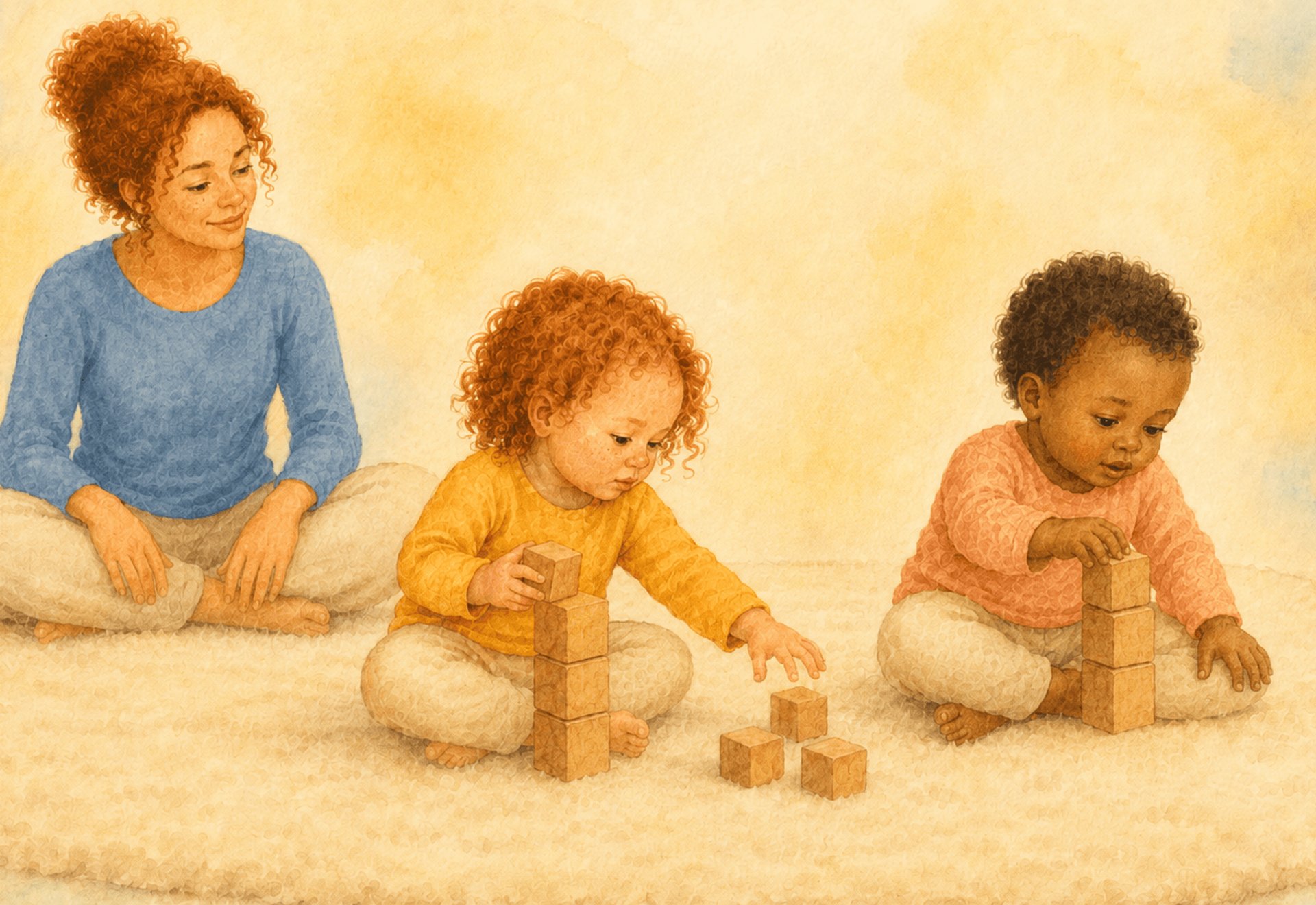
Your toddler spent the entire playdate building separate towers, and nobody shared a single block. That counted — more than it looked. A 2025 longitudinal study found that playing beside a specific child consistently predicted later social play with that same child, but not the other way around. Here's what parallel play in toddlers actually is, why the science calls it strategic rather than passive, and what it means for how you run a playdate.
When Do Babies Point: Why It Matters for Language
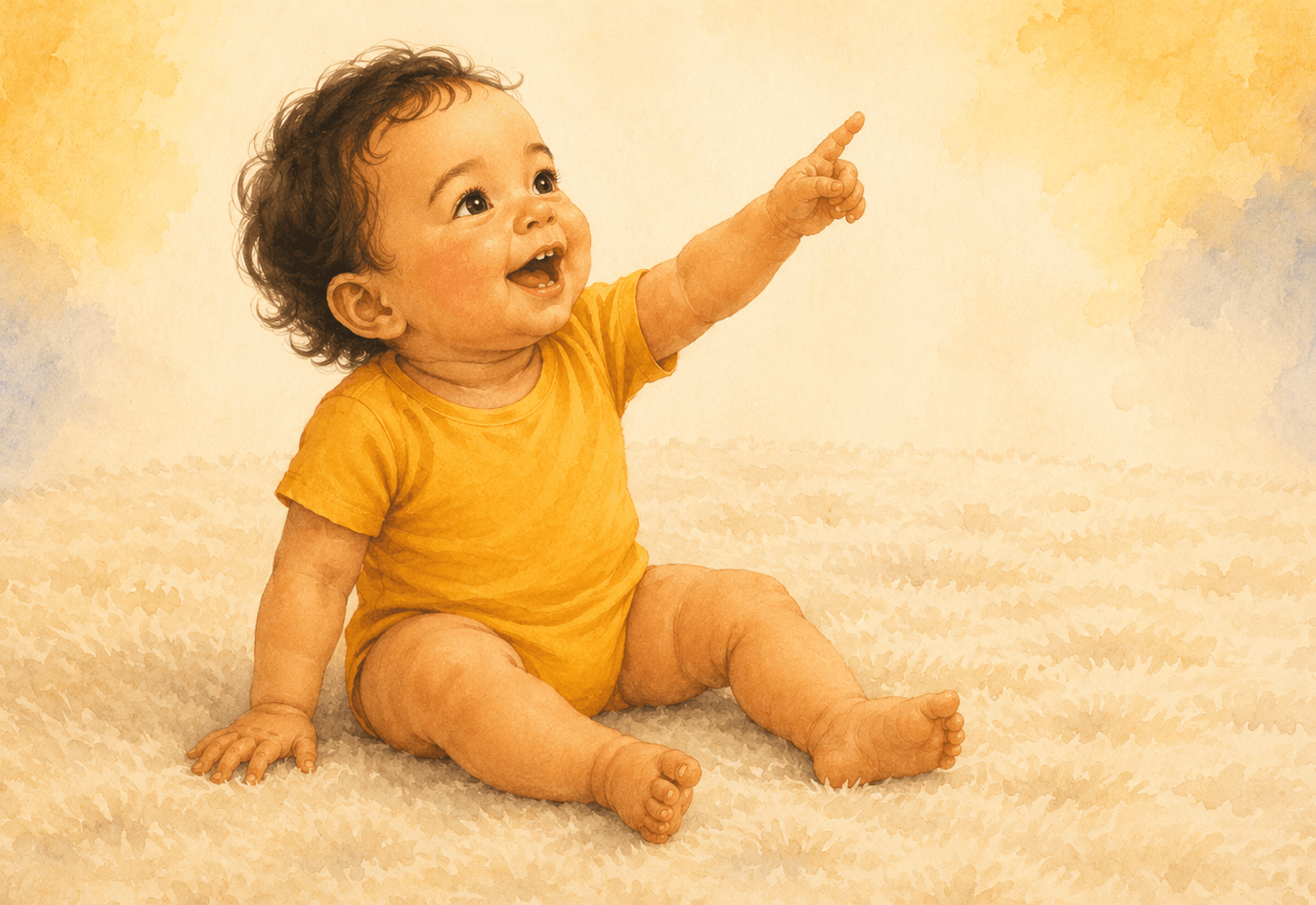
Most milestone articles treat pointing as a box to check around 12 months. The research tells a different story — one that starts months earlier, runs through the infant brain, and traces back to how much the parent is pointing. Here's what the last fifteen years of research actually found, and what it means for everyday interactions.
When Do Babies Start Clapping: The Answer Most Parents Don't Expect
Every article about baby clapping will tell you nine months. What they skip is that the brain system behind that first clap has been building since the second month of life. Here's what the CDC actually says about the milestone, what motor and neurological steps have to fall into place first, and how to tell a normal late clapper from a pattern worth flagging.