When Do Babies Point: Why It Matters for Language
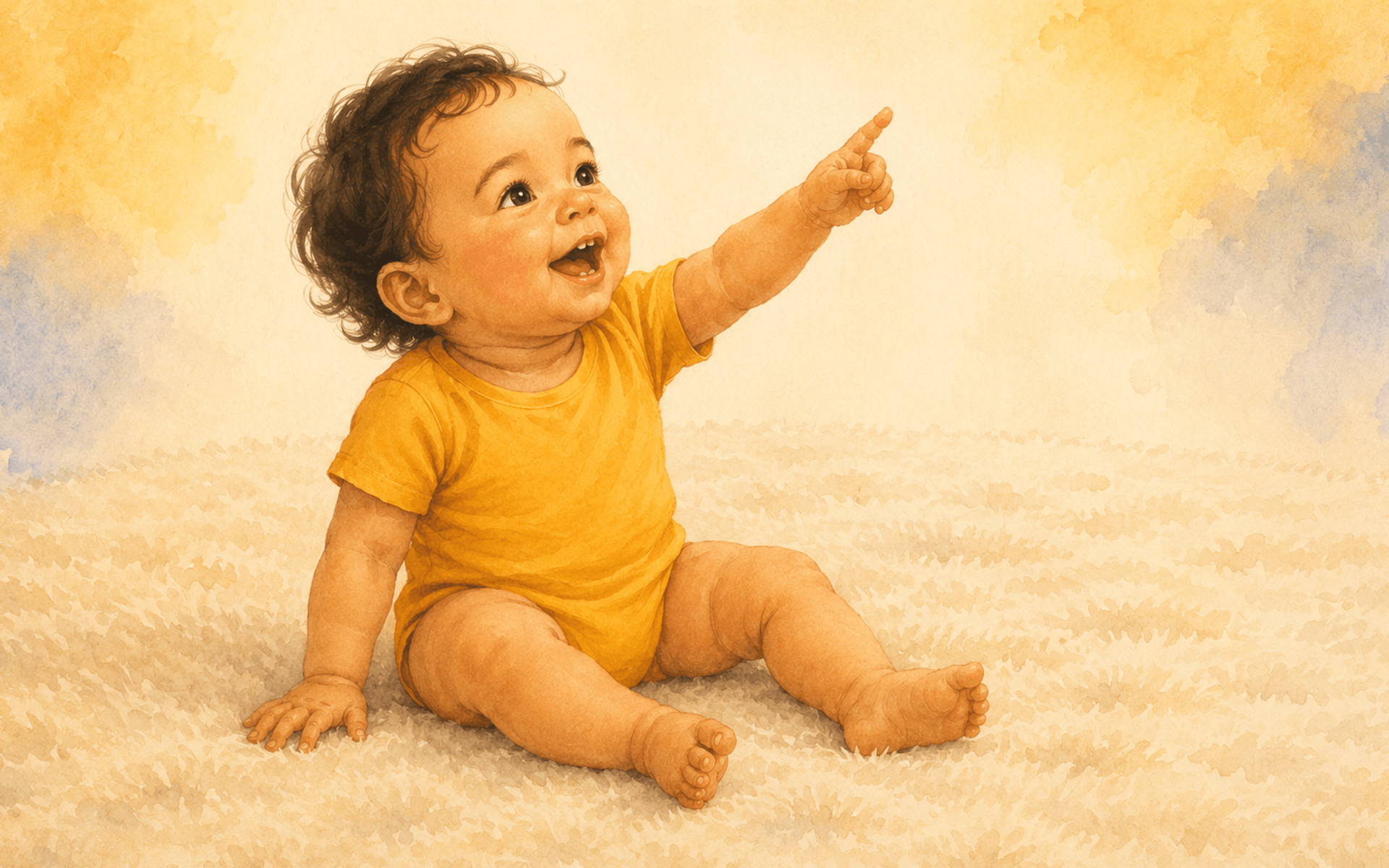
Every milestone article follows the same script: baby does something, parents cheer, check the box. Pointing fits the story perfectly — around 12 months, a tiny finger goes up, everyone cries a little. Except the research on when do babies point has been quietly building a different case for fifteen years. The milestone isn't what happens at 12 months. It's what's been happening since month eight — every time a caregiver raised a finger and said "look." The infant brain was already recording it. The question was never when babies point. It was whether anyone told parents they went first.
- The difference between two kinds of pointing, and why only one of them predicts language
- What happens in the infant brain when a parent raises a finger
- The developmental sequence that builds up to pointing, starting months before the gesture appears
- What "when do babies point to pictures in books" and "when do babies point to body parts" are actually asking
- When the absence of pointing is worth raising with a pediatrician, and what the CDC actually says
If the one-sentence answer is enough, you’ve got the gist. If you want the mechanism behind each piece, keep reading.
The two kinds of pointing are not the same milestone
There are two types of pointing, and researchers have known for decades that the distinction matters more than the age the gesture first shows up.
The first, which researchers call imperative pointing, is basically a request. A baby spots a cracker on the counter and aims a finger at it: get me that. This version shows up earlier, often around 9 to 10 months, and it grows straight out of reaching: the arm extends, the object stays out of range, and over time the gesture gets more deliberate.
The second type is declarative pointing, and this is where the language research gets interesting. A baby who points at a dog through the window isn't asking for the dog. The baby is saying: look at that. This type typically emerges a few weeks to a month after the first, and it signals something qualitatively different: the baby has started to understand that another person has a separate direction of attention, and that this attention can be redirected. The finger is no longer a request. It's an invitation into a shared moment.
Colonnesi, Stams, Koster, and Noom pulled together 25 studies and found that declarative pointing predicted later language with a meaningful effect size, while the same relationship for imperative pointing didn't hold up across studies. Children who pointed to share things, not just to get them, ended up with larger vocabularies. The reason is pretty simple: when a baby makes a declarative point, caregivers almost always respond by naming whatever the baby is looking at ("yes, a truck!"). That label, the one that follows the baby's own direction of attention, lands differently than a label a parent imposes on something the baby wasn't focused on.
Wu and Gros-Louis tracked how caregivers responded to different baby behaviors and found that pointing pulled naming responses far more reliably than vocalizations or reaching. The baby points; the parent names. That loop, repeated hundreds of times across the second year, is one of the main engines of early vocabulary growth.
This connects to the article on when babies start talking and what first words actually look like in a concrete way. Iverson and Goldin-Meadow found that babies consistently gesture a concept before they say it aloud, typically by about three months. The word "truck" tends to follow the first pointed finger by roughly 12 weeks.
The EEG study that changed the frame
For most of the history of pointing research, the question was: when does the baby do this? A 2023 study by Salo, Debnath, Rowe, and Fox shifted that question; most parenting articles still haven't caught up.
The researchers recruited 81 infants between 10 and 12 months and put EEG caps on their heads. The signal they were tracking was the mu rhythm, an oscillatory pattern over the sensorimotor cortex that quiets down when the motor system gets engaged, including when someone watches another person move. Half the parents received a brief training: a five-minute video explaining why pointing matters, then an instruction to point at objects intentionally for about 15 minutes a day. The other half got the same toys with no guidance.

The trained parents pointed significantly more. Their babies, watched later in a lab while an experimenter gestured toward objects, showed more sensorimotor brain activity (specifically over the right hemisphere) compared to babies in the control group. And that shift in brain response predicted growth in receptive vocabulary.
Here is the chain the study established: more parent pointing → more sensorimotor engagement in the baby's brain while watching someone point → larger vocabulary. This was the first time that chain was documented experimentally rather than just observed as a correlation. The intervention was not elaborate: no curriculum, no flashcards, just pointing at things intentionally every day.
It doesn't guarantee a specific vocabulary outcome; the effect was modest and the control group was fairly passive. But it establishes something that matters: the infant brain responds differently to pointing when it has had more exposure to pointing. Watching a caregiver's gesture is not passive. It activates the same sensorimotor system the baby will eventually use to produce that gesture. Practice works for the observer too.
Rowe and Goldin-Meadow came at the same question differently. In a study published in Science, they followed 50 families across socioeconomic backgrounds and found that how much parents gestured at 14 months predicted how much children gestured at 14 months, and child gesture at 14 months predicted vocabulary size at school entry, even after controlling for family background and how much parents talked. The vocabulary gap that shows up between children at age five has roots at 14 months, and those roots trace back to parental gesture.
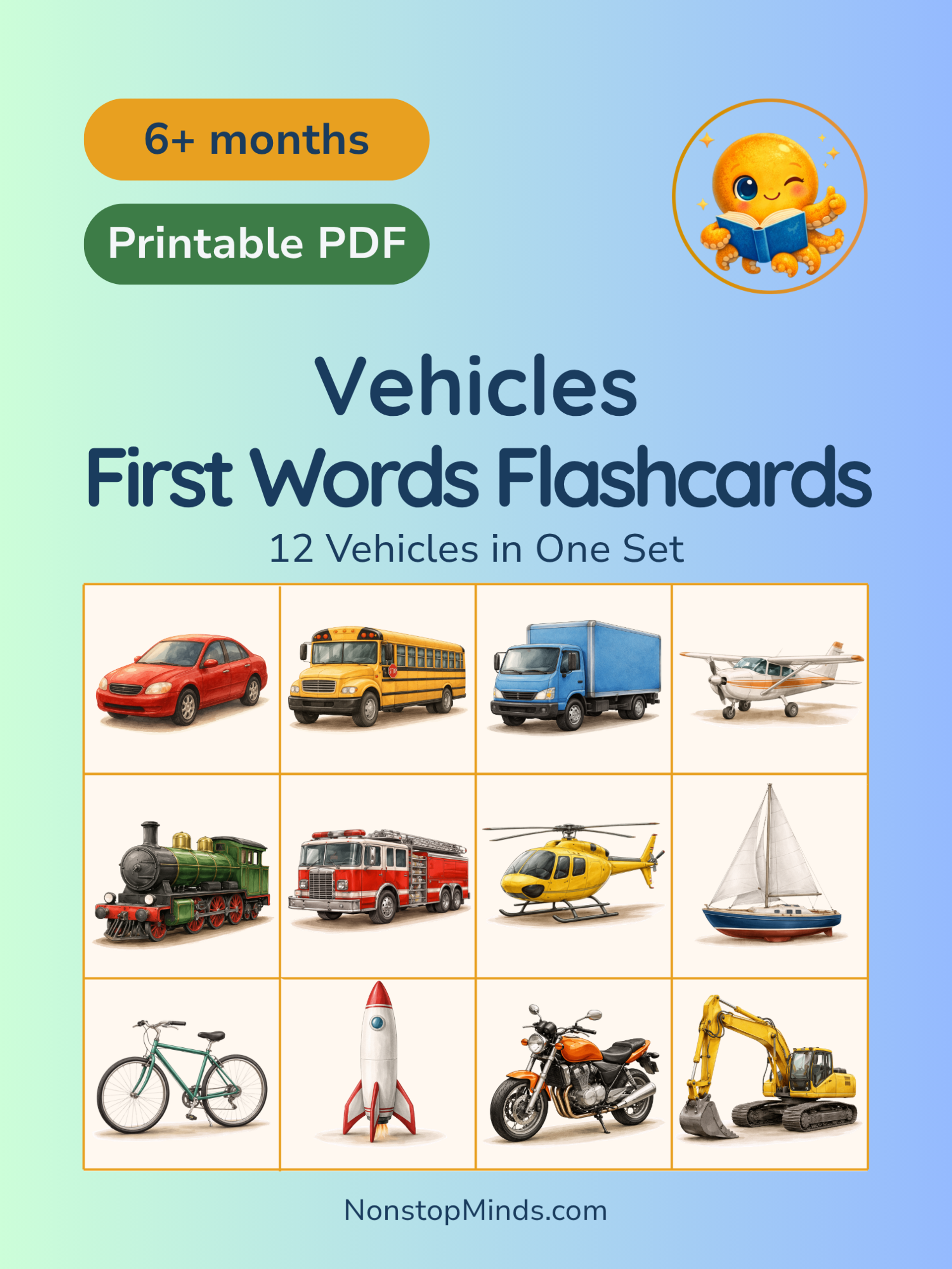
For practical support during the 9-to-18-month window when pointing and first words are developing at the same time, the Vehicles First Words Flashcards are built for exactly this: holding up a card, naming what's on it, and letting the back-and-forth between parent and baby build both the gesture and the word.
The developmental sequence that leads to pointing
Index-finger pointing doesn't show up out of nowhere. What looks like a simple milestone at 12 months is actually the visible end of a sequence that started months earlier, which is part of why the normal range is as wide as it is.
It starts with reaching, around 4 to 6 months. A baby reaching for a toy is already doing a proto-version of the gesture: the arm extends, the attention focuses, the intention becomes readable. What's not there yet is the social layer: the understanding that another person's attention is a thing that can be directed.
Gaze following comes next, solidifying around 10 to 11 months. Brooks and Meltzoff tested 9-, 10-, and 11-month-olds by having an adult look at an object either with eyes open or with eyes closed. Nine-month-olds didn't behave differently in the two conditions. By 10 to 11 months, infants consistently followed the open-eyed gaze and largely ignored the closed-eyed one. That shift — from tracking a head turn to tracking intentional attention — is the cognitive prerequisite for pointing. A baby who follows your gaze has understood that you have a direction of attention. The next step is learning to redirect it.
Around the same time, showing and giving gestures start appearing: the baby holds up a toy for a caregiver to look at, or hands something over. Choi, Wei, and Rowe tracked these gestures across infancy and found that showing and giving at 10 months actually predicted language at 18 months better than pointing did at the same age. These gestures aren't just charming. They're the social-sharing impulse that will shortly extend to an outstretched finger.
Index-finger pointing follows, typically between 9 and 14 months. Lüke and colleagues found that hand shape matters here: babies who pointed with an isolated index finger at 12 months had better language outcomes at 24 months and through age 4 than babies who still used a whole-hand point. Whole-hand pointing is developmentally normal — it's not a red flag — but index-finger isolation requires the same fine motor control as the pincer grasp, and tends to arrive on the same timeline. A baby practicing picking up small pieces of food is building the same finger control that will eventually isolate the pointer finger. The connection to fine motor skills and baby activities is not incidental.
The sequence also connects to object permanence. A baby who understands that objects continue to exist when hidden has begun to think about things that aren't right in front of them. Declarative pointing is the first gesture that brings this into communication: that thing exists, it's interesting, and I want you to notice it too.
What those specific Google searches are actually asking
The autocomplete for "when do babies point" surfaces some modifiers that are each their own developmental question, and they're worth untangling.
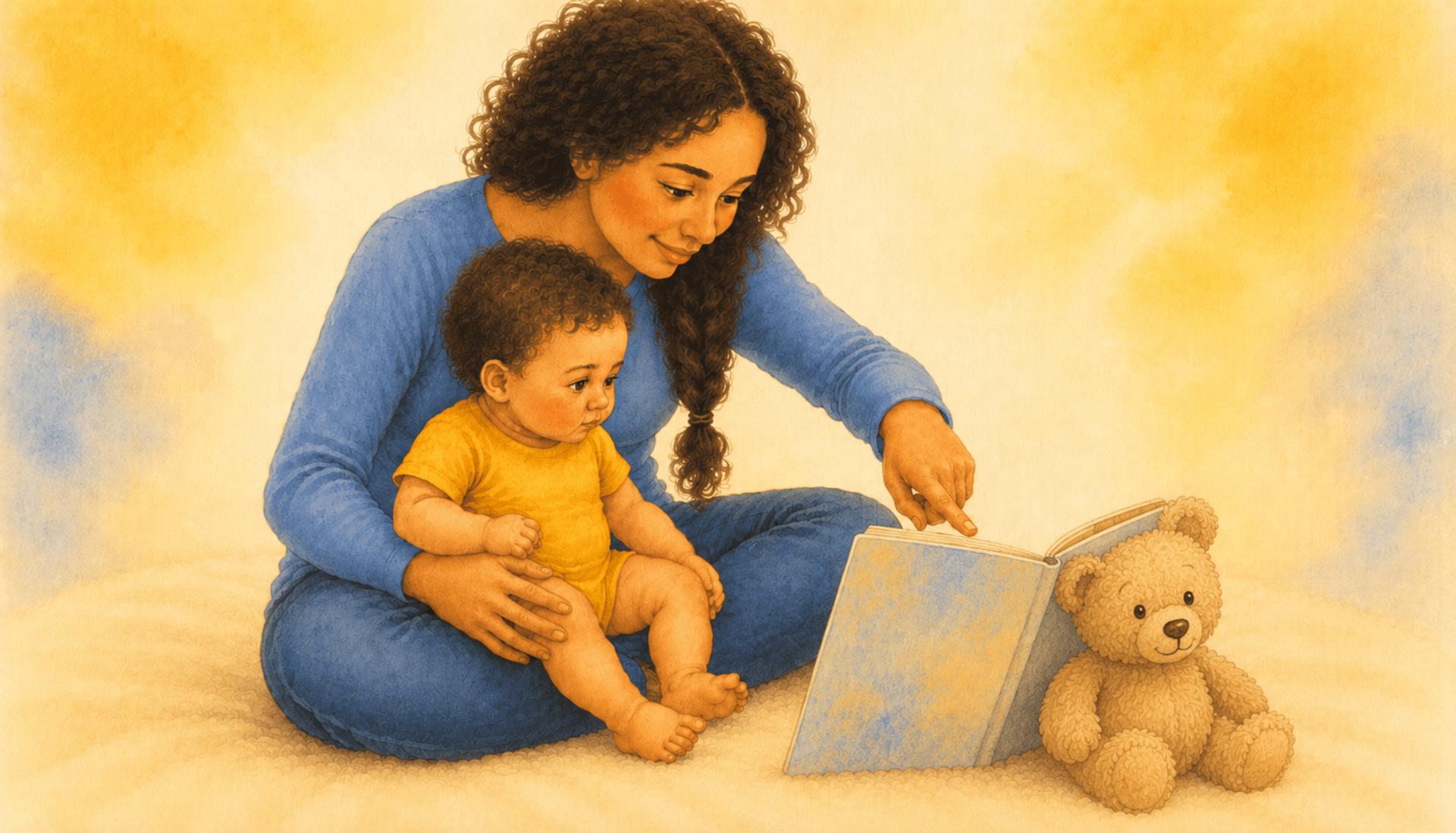
"When do babies point to pictures in books" is about shared reading, not spontaneous pointing, and it's worth separating the two. Books are actually one of the easiest environments for pointing to emerge because the pictures are stable, the same images repeat, and the whole setup already creates joint attention by the fact that two people are looking at the same page. When a caregiver points at the duck and says "duck," the baby learns that a finger extended toward a flat image works the same way as a finger extended toward the real thing. Most babies begin pointing at pictures during shared reading around 10 to 14 months, sometimes earlier than they point spontaneously at real-world objects. Shared reading studies that coach parents on pointing-and-naming consistently show vocabulary gains. More on how this plays out in practice at how to help baby talk.
"When do babies point to things you name" is about receptive pointing — responding to "where's the dog?" by pointing toward the dog. This shows up as the baby maps spoken words to their referents and is separate from initiating a point. It typically strengthens across 15 to 24 months. Receptive pointing to familiar objects tends to emerge before the baby can say those words by several months; the understanding is there before the production is. Pointing to body parts on request follows the same pattern, usually emerging for the first few body parts between 12 and 18 months.
"When do babies point to facial features" is almost always a parent checking whether receptive vocabulary is on track. Most children can point to one or two body parts by 15 months when asked; by 24 months, pointing to five or more is typical. Teaching body parts works best starting with parts that are far apart on the body (belly, feet, hair) rather than clustered facial features, which need finer spatial discrimination to distinguish.
"Baby pointing at 12 months" reflects the developmental midpoint. At exactly 12 months, many babies are pointing, but a meaningful number aren't, and both are within the normal window. What matters more at 12 months is the full communication picture: Is the baby following points and gaze? Showing and giving objects? Responding to their name? A baby who isn't pointing yet but is doing those things is almost certainly fine. The activities for 9 month old and activities for 10 month old guides cover the pre-pointing behaviors worth tracking alongside the gesture itself.
When to raise it with your pediatrician
The timeline for concern is later than most parents expect, and absence of pointing on its own is less meaningful than absence of pointing alongside other communication behaviors.
The CDC's 2022 milestone revisions, recalibrated to reflect what 75% of children do rather than the old 50th-percentile benchmark, list two pointing milestones: "points to ask for something or to get help" by 15 months, and "points to show you something interesting" by 18 months. The 18-month threshold for sharing-type pointing is the more significant one: declarative pointing absent at 18 months is one of the oldest and most consistently replicated early markers in autism screening research.
Baron-Cohen and colleagues' foundational CHAT studies tracked 18-month-olds and found that consistent absence of three specific behaviors (protodeclarative pointing, gaze monitoring, and pretend play) was associated with a substantially higher likelihood of an autism diagnosis. Later research following siblings of children with autism has found measurable differences in pointing and joint attention as early as 12 months, though the pattern becomes clearer across the second year.
This is worth framing carefully: absence of pointing at 18 months is a reason to pursue screening, not a diagnosis. Many children who aren't pointing at 18 months go on to develop typically. The autism-specific screening tools, including the M-CHAT-R/F that pediatricians use at 18 and 24 months, are designed precisely to sort through this uncertainty. The moment to call is when the pattern is consistent and spans multiple communication behaviors, not when a single milestone is a few weeks behind.
A practical threshold that pediatric speech-language sources generally land on: if a baby is not pointing by 18 months and is also not responding to name, not using eye contact to communicate, not showing or giving objects, and not starting to use any words, that cluster warrants a conversation with the pediatrician rather than a wait-and-see. One absent behavior in an otherwise engaged, socially connected baby is a different situation.
For context on what's developing underneath all of this, the baby brain development in the first year article covers the cognitive underpinnings of early social communication, and the when do babies wave bye-bye article covers the parallel gesture development happening in the same window.
What actually helps
The research on this is consistent, and none of it requires special equipment or a structured activity plan.
Point at things throughout the day, and do it declaratively. Not "give me that" gestures, but "look at that" ones. Salo and colleagues' training protocol was just this: point at things intentionally for about 15 minutes a day. That was enough to change both parent behavior and infant brain response in a randomized trial.
When a baby points, respond immediately with a word. Not just "yes," but name what the baby pointed at, and follow their attention rather than redirecting it. Wu and Gros-Louis documented the mechanism: the label that arrives right after a baby's own point sticks better than one offered unprompted, because it lands on the concept the baby just chose.
Read books together and point at pictures while naming them. Two people looking at the same page with one person narrating and gesturing is doing measurable work. Shared reading studies that add pointing-and-naming coaching to existing reading habits show vocabulary gains.
The behaviors that don't need coaching — making eye contact, responding to sounds, imitating expressions — build the social attention foundation that pointing rests on. Most of the variation in when babies point is due to normal developmental differences, not parental behavior. But the most natural responses also turn out to be the most effective ones, which is a rare coincidence worth noticing.
The baby sign language article covers whether teaching signs accelerates or complements spoken language. Signing does not delay speech and may extend the window when a baby can communicate needs before words arrive, the same territory pointing occupies.
Frequently Asked Questions
Most babies begin pointing with an isolated index finger between 9 and 14 months, with 12 months as the research benchmark. Whole-hand pointing often appears first, around 8 to 10 months, and gradually refines as fine motor control develops. Lüke and colleagues found in a 2017 Child Development study following infants through age 4 that index-finger pointing at 12 months predicted better language outcomes than whole-hand pointing, though the whole-hand version is developmentally normal and not a red flag on its own.
Yes, within limits. The normal range for index-finger pointing onset is roughly 9 to 14 months, and a baby who isn't pointing at 12 months but is following points, using other gestures (showing, giving, waving), and engaging socially is typically within the expected window. The CDC's 2022 milestones list "points to ask for something or to get help" as a 15-month milestone, meaning 75% of children reach it by then. The threshold that warrants a pediatrician conversation is absent pointing at 18 months, especially combined with absent eye contact, no response to name, or no other gestures.
When a baby points at something declaratively — to share it, not to request it — caregivers almost always respond by naming it. That contingent label, arriving exactly when the baby's attention is already on the object, builds word-object connections more effectively than labels offered unprompted. Colonnesi and colleagues' 2010 meta-analysis of 25 studies found a meaningful longitudinal relationship between declarative pointing and later language; the same relationship for imperative (requesting) pointing didn't hold up. Babies who point to share things end up with larger vocabularies than babies who only point to get them.
Point more yourself, especially at interesting things rather than things you want. Salo, Debnath, Rowe, and Fox (2023, Developmental Psychology) showed that a brief training — essentially, point intentionally for about 15 minutes a day — increased infant sensorimotor brain activity while watching pointing and predicted vocabulary growth. When a baby does point, name it immediately. Read books together and point at pictures while naming them. Games that build finger isolation — pressing buttons, poking playdough, touching textured pages — help develop the same fine motor control that supports index-finger pointing.
Absent pointing at 18 months — particularly absent declarative pointing (pointing to share something, not to request it) is the threshold pediatricians and speech-language pathologists watch most closely. It is one of the earliest and most replicated early markers in autism screening research, established in the foundational CHAT studies by Baron-Cohen and colleagues. This does not mean a late-pointing baby has autism; many do not. It means 18 months without pointing warrants an autism-specific developmental screening, which is part of the standard AAP schedule at 18 and 24 months. If pointing is absent earlier alongside other missing communication behaviors (no response to name, no eye contact, no showing or giving) raising it before 18 months is appropriate.
For educational and entertainment purposes only. Not a substitute for professional medical or developmental advice. If you have concerns about your baby's development, consult your pediatrician.
- Baron-Cohen, S., Cox, A., Baird, G., Swettenham, J., Nightingale, N., Morgan, K., Drew, A., & Charman, T. (1996). Psychological markers in the detection of autism in infancy in a large population. British Journal of Psychiatry, 168(2), 158–163.
- Brooks, R., & Meltzoff, A. N. (2005). The development of gaze following and its relation to language. Developmental Science, 8(6), 535–543.
- Brooks, R., & Meltzoff, A. N. (2008). Infant gaze following and pointing predict accelerated vocabulary growth through two years of age. Journal of Child Language, 35(1), 207–220.
- Choi, A. B., & Rowe, M. L. (2021). A parent gesture intervention as a means to increase parent declarative pointing and child vocabulary. Infancy, 26(5), 735–744.
- Choi, A. B., Wei, R., & Rowe, M. L. (2021). Show, give, and point gestures across infancy differentially predict language development. Developmental Psychology, 57(6), 851–862.
- Colonnesi, C., Stams, G. J. J. M., Koster, I., & Noom, M. J. (2010). The relation between pointing and language development: A meta-analysis. Developmental Review, 30(4), 352–366.
- Iverson, J. M., & Goldin-Meadow, S. (2005). Gesture paves the way for language development. Psychological Science, 16(5), 367–371.
- Lüke, C., Grimminger, A., Rohlfing, K. J., Liszkowski, U., & Ritterfeld, U. (2017). In infants' hands: Identification of preverbal infants at risk for primary language delay. Child Development, 88(2), 484–492.
- Mundy, P., Block, J., Delgado, C., Pomares, Y., Van Hecke, A. V., & Parladé, M. V. (2007). Individual differences and the development of joint attention in infancy. Child Development, 78(3), 938–954.
- Rowe, M. L., & Goldin-Meadow, S. (2009). Differences in early gesture explain SES disparities in child vocabulary size at school entry. Science, 323(5916), 951–953.
- Rowe, M. L., & Leech, K. A. (2019). A parent intervention with a growth mindset approach improves children's early gesture and vocabulary development. Developmental Science, 22(4), e12792.
- Salo, V. C., Debnath, R., Rowe, M. L., & Fox, N. A. (2023). Experience with pointing gestures facilitates infant vocabulary growth through enhancement of sensorimotor brain activity. Developmental Psychology, 59(4), 676–690.
- Tomasello, M., Carpenter, M., & Liszkowski, U. (2007). A new look at infant pointing. Child Development, 78(3), 705–722.
- Wu, Z., & Gros-Louis, J. (2015). Caregivers provide more labeling responses to infants' pointing than to infants' object-directed vocalizations. Journal of Child Language, 42(3), 538–561.
- Zubler, J. M., Wiggins, L. D., Macias, M. M., Whitaker, T. M., Shaw, J. S., Squires, J. K., Pajek, J. A., Wolf, R. B., Slaughter, K. S., Broughton, A. S., Gerndt, K. L., Mlodoch, B. J., & Lipkin, P. H. (2022). Evidence-informed milestones for developmental surveillance tools. Pediatrics, 149(3), e2021052138.
Related Products
More Articles
Parallel Play in Toddlers: Why Side-by-Side Is the Social Work
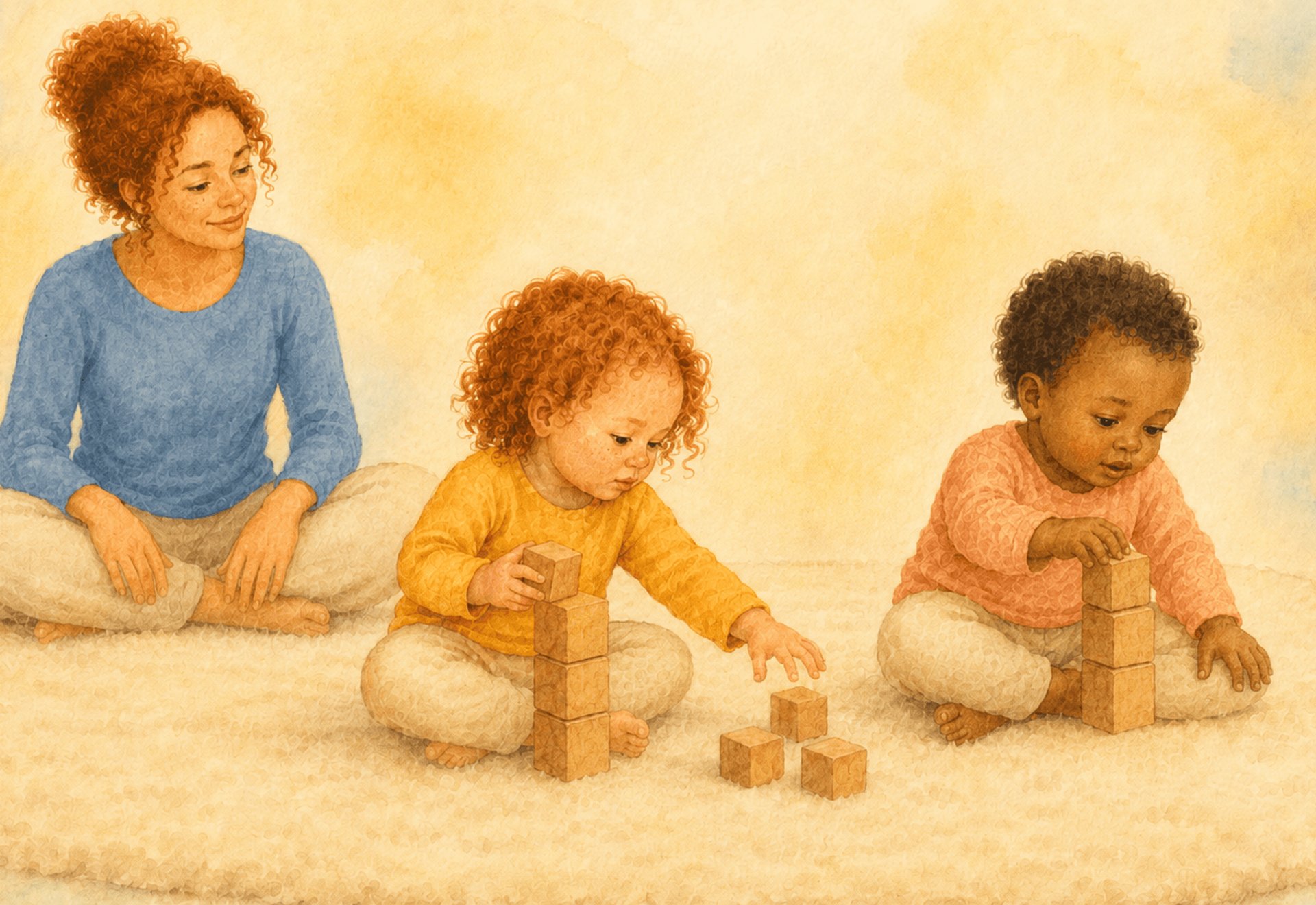
Your toddler spent the entire playdate building separate towers, and nobody shared a single block. That counted — more than it looked. A 2025 longitudinal study found that playing beside a specific child consistently predicted later social play with that same child, but not the other way around. Here's what parallel play in toddlers actually is, why the science calls it strategic rather than passive, and what it means for how you run a playdate.
When Do Babies Wave Bye-Bye: Why Your Baby Needs You to Wave First
Most baby milestones unfold on a biological schedule — waving isn't one of them. A 2023 study found that babies develop imitation ability because their caregivers imitate them first, and waving is named directly as a cultural gesture learned through that loop. Here's what the research says about the 9–12 month window, why the first wave looks nothing like a wave, and what helps it arrive.

When Do Babies Start Clapping: The Answer Most Parents Don't Expect
Every article about baby clapping will tell you nine months. What they skip is that the brain system behind that first clap has been building since the second month of life. Here's what the CDC actually says about the milestone, what motor and neurological steps have to fall into place first, and how to tell a normal late clapper from a pattern worth flagging.