Object Permanence Baby: When It Develops and What Speeds It Up

Every parenting article, every pediatrician handout, every baby app milestone tracker agrees: object permanence develops around 8 months. It's one of the few things in infant development everyone seems to have settled on. The problem is that "8 months" describes one specific behavior, a baby lifting a blanket, and treats it as the whole answer. When researchers measured not what babies do but what their brains and eyes show, the picture got considerably more complicated. Signs of object permanence appear as early as 3.5 months in some paradigms. In a 2020 study using pupil responses, even 10-month-olds showed no spontaneous surprise when a hidden toy disappeared. The milestone is a staircase, not a switch. And the thing that moves babies up it fastest isn't peekaboo: it's whether they can move their own body through space.
- Why the "8 months" answer is right about one thing and misleading about three others
- The brain science behind why your baby's sleep suddenly got harder at the same time separation anxiety appeared
- The randomized trial that linked crawling (and even robot-assisted movement) to faster object permanence development, and what that means for daily play
- What peekaboo does, according to a 2015 study in Science, and why it probably works differently than you think
- A stage-by-stage breakdown from 4 months to 18 months with specific activities
- When to mention the pattern to your pediatrician
If the one-sentence answer is enough, you’ve got the gist. If you want the mechanism behind each piece, keep reading.
The "8 Months" Answer Is Only Half the Story
Object permanence is the understanding that things continue to exist even when you can't see or hear them. Swiss psychologist Jean Piaget first mapped it in the 1950s, placing the milestone at around 8 months, roughly when babies start manually searching for hidden objects. That timing stuck in the parenting literature and still shows up in most articles today.
The problem is that Piaget was measuring one specific behavior (lifting a blanket) and using it as a proxy for a much larger cognitive question. Later researchers discovered the gap between "baby notices the impossible event" and "baby lifts the blanket" is bigger than Piaget assumed, and it spans years, not weeks.
Renée Baillargeon's landmark 1985 studies used a different measure: looking time. When a "drawbridge" appeared to rotate through a hidden solid block (a physically impossible event), 5-month-olds looked longer at it than at the possible version. They weren't surprised in a casual sense. Their visual attention spiked in a way that only makes sense if they had already formed a mental representation of the hidden block. Something was being held in mind long before any blanket-lifting was possible.
On the other end, a 2020 study published in PLOS ONE by researchers at the University of Hamburg found a complication going the other direction. When Wiebke Pätzold and Ulf Liszkowski measured pupil dilation, which tracks surprise responses, in 10-month-olds, those babies showed no spontaneous surprise when a hidden toy "disappeared." The 18-month-olds in the same paradigm did. This doesn't mean 10-month-olds have no object representation. It does mean the robust, automatic version of the concept takes longer to consolidate than the classic "they've got it by 8 months" framing suggests.
Put it together and the picture looks something like this: early signs of object representation appear as young as 3.5 to 4 months, manual search behavior shows up around 8 to 9 months, and a genuinely stable mental model that holds up even without prompting may not be fully in place until 12 to 18 months. These are different abilities, measured by different methods, and conflating them into one milestone at one age is what produces the confusion parents feel when their 9-month-old "should have it" but still seems lost when a favorite toy disappears.
For a broader look at what's happening across this whole developmental window, our article on how baby's brain develops in the first year covers the full arc from birth through 12 months.
What the Brain Is Doing During This Phase
The cognitive change underlying object permanence is fundamentally a memory and attention problem. To know that a toy exists under a blanket, a baby has to hold a mental image of the toy in working memory while simultaneously planning and executing a reaching movement. That's a lot of brain-and-body coordination for someone who learned to hold their head up three months ago.
In 2005, a research team led by Kaufman, Csibra, and Johnson recorded brain-wave activity from 6-month-olds as objects were hidden and then recovered. Using electroencephalography (small sensors that pick up brain-wave patterns through the scalp), they found a specific signature in the right temporal region that appeared when the object went out of sight and persisted for the entire duration it was hidden. The pattern they found, a burst of high-frequency oscillations in a band associated with active maintenance of information, was identifiable at 6 months. That's two full months before manual search behavior typically appears.
That two-month gap is the window between "the brain is holding it in mind" and "the brain can coordinate the body to go get it." Understanding the gap matters practically, because it means the cognitive piece is already being built during what looks like "just" tummy time, rolling, and floor exploration.
There's also a specific brain circuit change that happens with locomotion. Research by Bell and Fox in 1997 tracked 8-month-olds by locomotor experience rather than age. Babies who had been crawling for one to four weeks showed measurably different activity in the frontal regions of the brain compared to babies the same age who hadn't started crawling yet. The frontal cortex is precisely the region involved in holding things in working memory while inhibiting a competing response, which is exactly what the A-not-B task demands. The motor and cognitive changes were happening in parallel, not sequentially.
Our article on activities for 4 month olds covers the early peekaboo window in detail, including the research showing that even 4-month-olds react differently to "impossible" hiding events.
Why Crawling Matters More Than Any Specific Game
This is where the research departs significantly from standard parenting advice, and it's worth lingering on.
In 1988, researchers Kermoian and Campos tested 8.5-month-old babies in a classic A-not-B task, grouping them not by age but by locomotor experience. Babies who had been crawling for nine or more weeks, or who had used a wheeled walker, passed the task 76% of the time. Pre-locomotor babies the same age passed it only 13% of the time. The gap was not subtle.
The skeptical response to that kind of correlation is always: maybe early crawlers are just cognitively faster across the board. To address that, a research team at Ithaca College ran what amounts to the experimental version of the question. They took typically developing 5-month-olds who weren't yet crawling, randomly assigned them to either navigate a room in a small robotic mobility device (which moves in the direction the infant leans) or to a seated control condition, and gave them 12 sessions of roughly 15 minutes each over several weeks. Then they tested object permanence using a gaze-based A-not-B task. The locomotor group outperformed the seated group by a statistically significant margin. Physical movement through space produced cognitive change, not any toy or game.
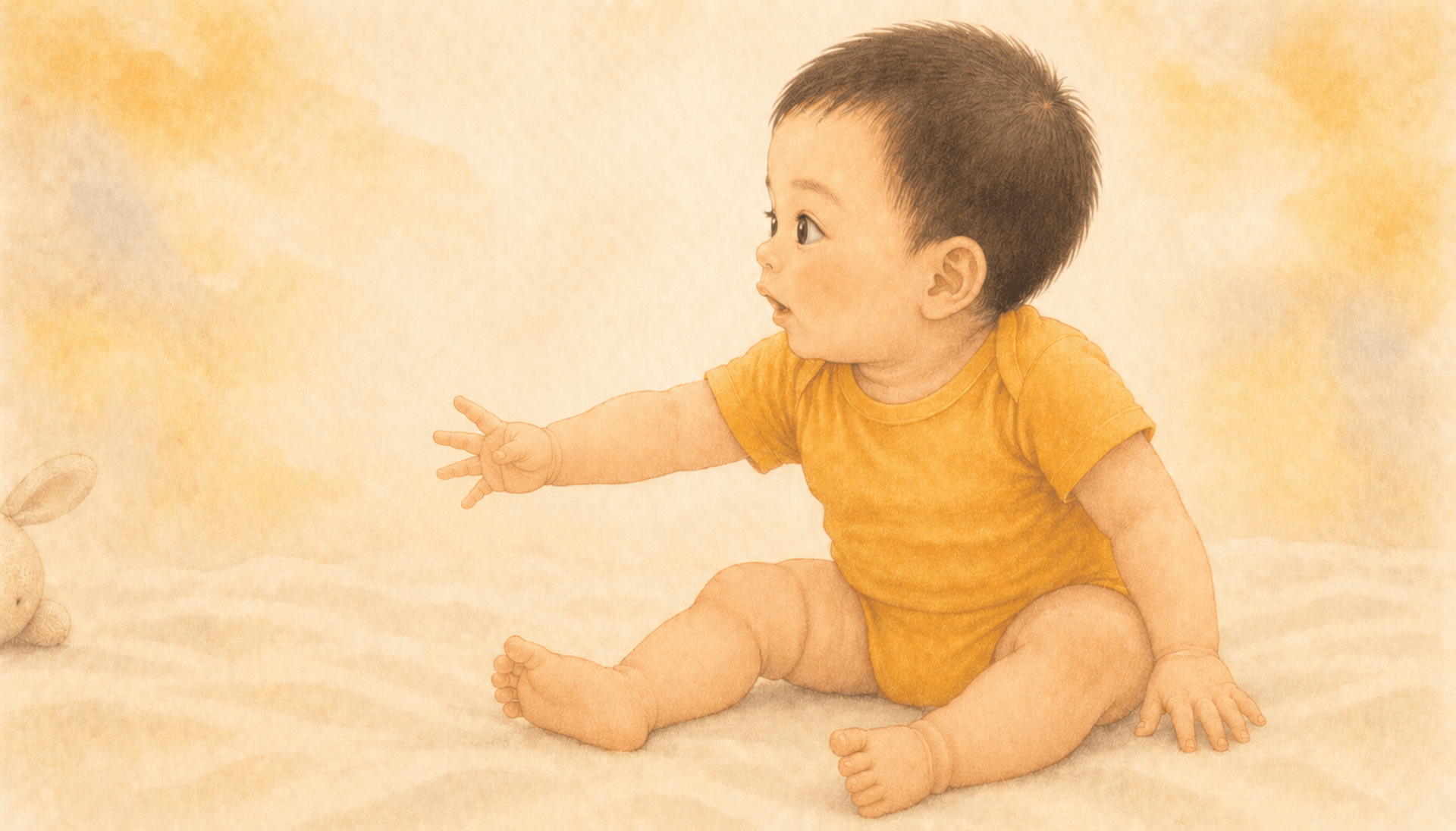
A 2022 longitudinal study published in Pediatric Physical Therapy by An and colleagues followed 56 infants with motor delays alongside 36 typically developing infants for six months, measuring this cognitive milestone alongside sitting and mobility development. The milestone emerged in step with sitting skill, regardless of chronological age. Infants with motor delays were about five months behind relative to age, though when sitting development was held constant, their trajectories matched the typically developing group. The researchers concluded that motor and cognitive permanence development should be treated as linked processes during intervention, not as separate domains.
The practical implication is straightforward: floor time, rolling, supported sitting, and eventually crawling aren't just motor activities. They are the mechanism through which the brain builds its understanding of space, distance, and the permanence of hidden objects. The Sensory Play Cards from our 0–12 month collection are designed specifically to support this kind of floor-based object exploration, with textures, shapes, and simple hide-and-reveal interactions that pair naturally with the developmental window when object permanence is being actively constructed.
A 2024 review by Franchak and Adolph in WIREs Cognitive Science synthesizes three decades of research on this link and frames it clearly: motor development opens new perceptual and cognitive opportunities by changing what the infant can do, see, and reach. When a baby starts crawling, their need to track objects across distance becomes a daily survival problem, and the brain responds accordingly.
What Peekaboo Actually Does

Peekaboo is the go-to recommendation in every article on this topic, and it's worth being precise about what it does, because the mechanism is different from the usual explanation.
The standard version of the story is that peekaboo "teaches" object permanence by repeatedly showing the baby that the hidden person or object still exists. This is probably not quite right. Object permanence is built by the motor-locomotor cascade described above, and by the brain's own process of consolidating working memory. No amount of peekaboo will rush a 4-month-old to the 8-month level of manual search.
What peekaboo does do (and this is supported by a 2015 paper in Science by Stahl and Feigenson) is exploit the "surprise as a learning trigger" mechanism. In that study, 11-month-olds who watched an object behave in ways that violated their expectations subsequently spent more time exploring that object and showed better learning about its properties than babies who watched physically normal events — surprise directed the learning specifically toward the thing that broke the rule. The authors described it as infants using their own working predictions about the world to identify what deserves closer study.
Peekaboo, especially as babies get old enough to anticipate the reappearance and start initiating the game themselves, functions as a controlled surprise-prediction loop. The baby builds a prediction ("face is coming back"), the prediction is confirmed, the baby gets a dopamine hit from the confirmation. That's a different (and arguably more interesting) mechanism than "learning objects still exist." It's the brain calibrating its prediction machinery, using the relationship with you as the calibration material.
This is also why peekaboo gets more interesting at 7 to 8 months than at 5 months, and why at 8 to 9 months babies often start initiating it themselves. The cognitive hardware for building and confirming predictions is coming online, and peekaboo is a very efficient way to use it. For a deeper look at how this window connects to separation anxiety in babies: both involve the same working memory upgrade, landing in the same developmental month, and the overlap is not coincidental.
Stage by Stage: What to Do from 4 to 18 Months
The practical question, once the mechanisms are clear, is what fits each stage.
From roughly 4 to 6 months, the priority is floor time and maximizing the variety of positions and movements the baby can explore. Tummy time on a firm surface, rolling, and any assisted movement counts. Peekaboo works well at this age as a face-to-face game, but don't expect manual search behavior to follow yet. Partial-occlusion works better than full hiding: cover half a toy under a cloth and let the baby pull it off. The goal is practice with the basic concept (object hidden, object found) without asking for the full cognitive and motor coordination that complete hiding requires.
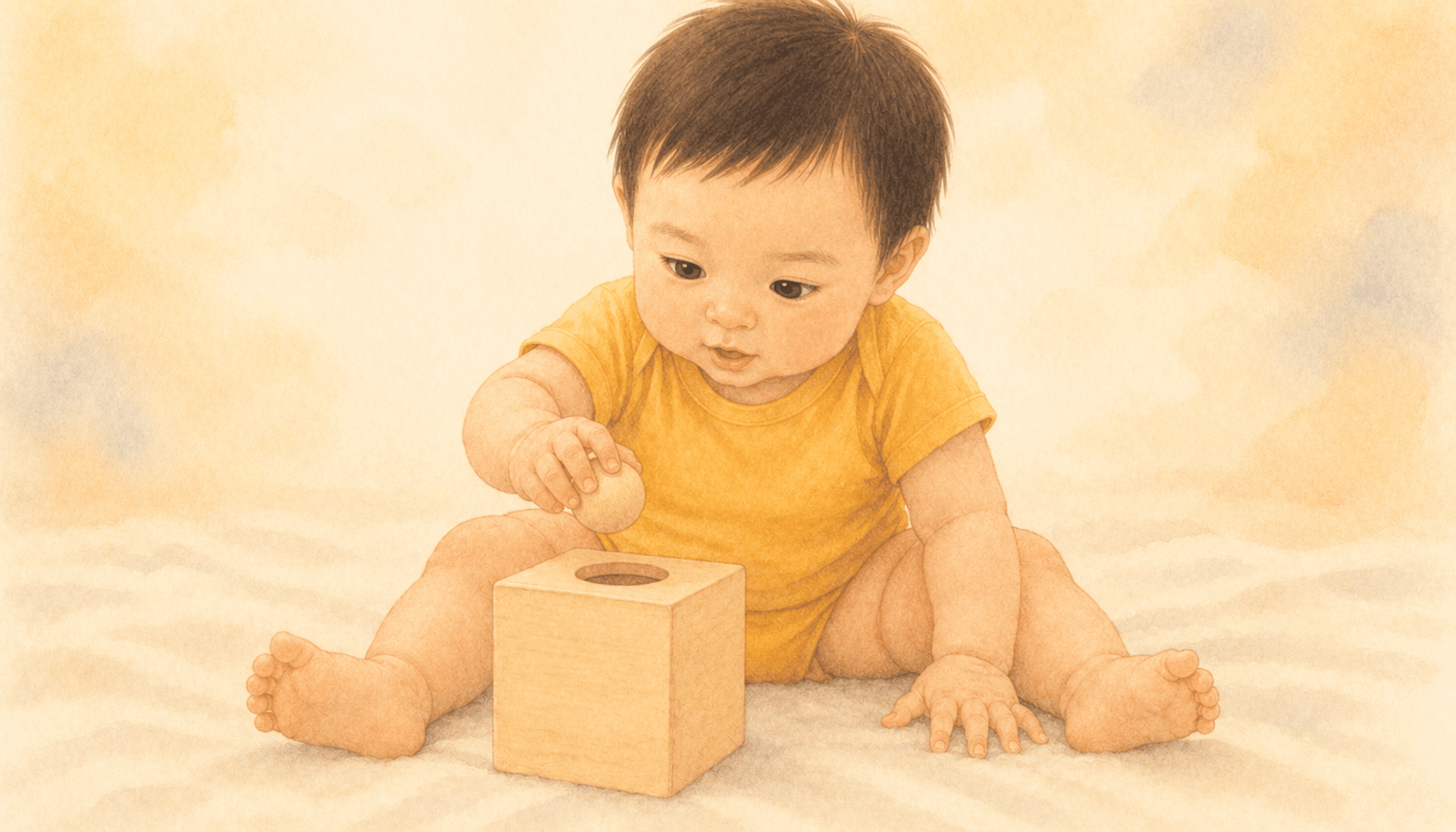
From 6 to 9 months, independent sitting becomes the key gateway, consistent with the An et al. findings about sitting and object permanence co-emergence. A baby who can sit independently has freed both hands for object manipulation and is exploring multimodally in a way that prone or supported-reclined babies cannot. Always ensure sitting is with adequate back support and within your reach, and always supervise during object play. Full-hide games become appropriate here: cover a toy completely, wait a moment, watch what happens. The Montessori-style object permanence box is well matched to this stage. It's a small box with a hole: the baby drops a ball in, it disappears, and rolls out the other side. That repeated disappear-and-reappear loop is exactly the prediction-and-confirmation cycle that consolidates the concept.
From 9 to 12 months, the A-not-B pattern will show up naturally: a baby who just found a toy under cup A reliably looks under cup A again even after watching you move it to cup B. That search-by-habit reflects an immature working memory defaulting to a practiced response rather than an updated one, and it resolves on its own. The right response is patient repetition, not drilling. Hide the object in a new place while the baby watches, wait a beat, and let the baby search. Narrate: "Where did the ball go? You saw me put it behind the box." Language scaffolds the cognitive update even before the baby understands the words fully.
From 12 to 18 months, the full representational version of object permanence is consolidating, including what Piaget called "invisible displacements," which are hiding events the baby didn't directly see. This is when activities like simple treasure hunts, two-location hide-and-seek, and narrated disappearances ("I left your cup in the kitchen, let's go find it") start working as genuine cognitive games rather than frustrating exercises. Our article on activities for 9 month olds covers the A-not-B transition in detail, including specific game setups that fit the 9-to-12-month window.
When to Mention This to Your Pediatrician
Development across this range is genuinely variable, and late object permanence in isolation, without other concerns, is rarely a signal of a problem. That said, a few patterns are worth raising at the next visit.
If your baby is 9 to 12 months old and shows no interest in searching for toys hidden right in front of the baby, no reaction to peekaboo, and no awareness when you leave the room, that's a good thing to mention. If object permanence concerns come alongside delays in motor development, limited babbling, or reduced social engagement, that combination is the clearest reason to schedule a check-in. Premature babies are typically assessed on adjusted age rather than birth age through the second year, so a 10-month-old born 8 weeks early should be compared to a roughly 8-month developmental picture. When something feels off, a pediatrician visit is always time well spent.
Frequently Asked Questions
Research strongly suggests it does. A 2022 study published in Pediatric Physical Therapy by An and colleagues, which followed 92 infants for six months, found that object permanence development tracked sitting and mobility milestones rather than chronological age. A randomized trial at Ithaca College found that pre-crawling 5-month-olds who navigated a room using a small robotic mobility device (moving in the direction the baby leaned) scored significantly higher on a gaze-based object permanence test than seated controls. The proposed mechanism: self-directed movement through space gives the brain the data it needs to build spatial memory and track objects across distance.
The A-not-B error is when a baby correctly finds an object hidden in location A, but then looks in location A again even after watching it moved to location B. It's a classic object permanence test, first described by Piaget, and it reflects the infant brain's tendency to use a habitual reaching pattern rather than updating a working memory representation. Most babies show the A-not-B error between 8 and 12 months, and it typically resolves by 12 months as working memory consolidates. When you see it, it's normal developmental behavior, not a sign of confusion.
Separation anxiety and object permanence development overlap heavily because they share the same underlying mechanism: working memory coming online. As classic research by Kagan and colleagues showed, separation protest follows a predictable maturational timeline, emerging around 6 to 8 months, peaking between 10 and 18 months, and gradually fading through the toddler years. The same cognitive upgrade that lets a baby know a hidden toy still exists also lets the baby know that you exist when out of sight, and the baby cares about that fact intensely before developing any concept of time or return. Brief, predictable goodbyes with consistent language ("I'll be back after your nap") help the brain learn the pattern.
Preterm babies are typically assessed on adjusted age (accounting for weeks born early) rather than birth age, through at least the second year. A 2017 study published in the Italian Journal of Pediatrics by Ryu and colleagues found that very low birth weight preterm infants scored lower than term infants on eye-tracking measures of object permanence at corrected ages of 6 to 10 months. The trajectory is typically consistent with adjusted-age development, not birth-age development. If your premature baby's pediatrician isn't already tracking milestones on adjusted age, it's worth asking about.
This article is for educational and entertainment purposes only. Not a substitute for professional medical or developmental advice. If you have concerns about your baby's development, consult your pediatrician.
- An, M., Marcinowski, E. C., Harbourne, R. T., Bovaird, J., Sheridan, S., & Lobo, M. A. (2022). Object permanence and the relationship to sitting development in infants with motor delays. Pediatric Physical Therapy, 34(3), 333–340. PMC9200226.
- Baillargeon, R., Spelke, E. S., & Wasserman, S. (1985). Object permanence in five-month-old infants. Cognition, 20(3), 191–208.
- Bell, M. A., & Fox, N. A. (1997). Individual differences in object permanence performance at 8 months: Locomotor experience and brain electrical activity. Developmental Psychobiology, 31(4), 287–297.
- Franchak, J. M., & Adolph, K. E. (2024). An update of the development of motor behavior. WIREs Cognitive Science, 15(4), e1682.
- Kagan, J., Kearsley, R. B., & Zelazo, P. R. (1975). The emergence of initial apprehension to unfamiliar peers. In M. Lewis & L. A. Rosenblum (Eds.), Friendship and Peer Relations. Wiley.
- Kaufman, J., Csibra, G., & Johnson, M. H. (2005). Oscillatory activity in the infant brain reflects object maintenance. Proceedings of the National Academy of Sciences, 102(42), 15271–15274.
- Kermoian, R., & Campos, J. J. (1988). Locomotor experience: A facilitator of spatial cognitive development. Child Development, 59(4), 908–917.
- Pätzold, W., & Liszkowski, U. (2020). Pupillometric VoE paradigm reveals that 18- but not 10-month-olds spontaneously represent occluded objects. PLOS ONE, 15(4), e0230913.
- Ryu, J., Kim, S. J., Kim, Y. H., & Jang, H. J. (2017). Object permanence and the development of attention capacity in preterm and term infants: An eye-tracking study. Italian Journal of Pediatrics, 43(1), 90.
- Stahl, A. E., & Feigenson, L. (2015). Observing the unexpected enhances infants' learning and exploration. Science, 348(6230), 91–94.
- Stansfield, S. K., Rader, N., Dennis, J., & Gross, J. (2019). The effect of robot-assisted self-locomotion on the executive function of typically developing, non-crawling infants and its implications for infants with motor impairment. RESNA Annual Conference Proceedings.
- Wellman, H. M., Cross, D., & Bartsch, K. (1987). Infant search and object permanence: A meta-analysis of the A-not-B error. Monographs of the Society for Research in Child Development, 51(3), 1–67.
- Zablotsky, B., Black, L. I., Maenner, M. J., Schieve, L. A., Danielson, M. L., Bitsko, R. H., Blumberg, S. J., Kogan, M. D., & Boyle, C. A. (2019). Prevalence and trends of developmental disabilities among children in the United States: 2009–2017. Pediatrics, 144(4), e20190811.
Related Products

More Articles

Parallel Play in Toddlers: Why Side-by-Side Is the Social Work
Your toddler spent the entire playdate building separate towers, and nobody shared a single block. That counted — more than it looked. A 2025 longitudinal study found that playing beside a specific child consistently predicted later social play with that same child, but not the other way around. Here's what parallel play in toddlers actually is, why the science calls it strategic rather than passive, and what it means for how you run a playdate.

When Do Babies Point: Why It Matters for Language
Most milestone articles treat pointing as a box to check around 12 months. The research tells a different story — one that starts months earlier, runs through the infant brain, and traces back to how much the parent is pointing. Here's what the last fifteen years of research actually found, and what it means for everyday interactions.

When Do Babies Wave Bye-Bye: Why Your Baby Needs You to Wave First
Most baby milestones unfold on a biological schedule — waving isn't one of them. A 2023 study found that babies develop imitation ability because their caregivers imitate them first, and waving is named directly as a cultural gesture learned through that loop. Here's what the research says about the 9–12 month window, why the first wave looks nothing like a wave, and what helps it arrive.