When Do Babies Start Clapping: The Answer Most Parents Don't Expect
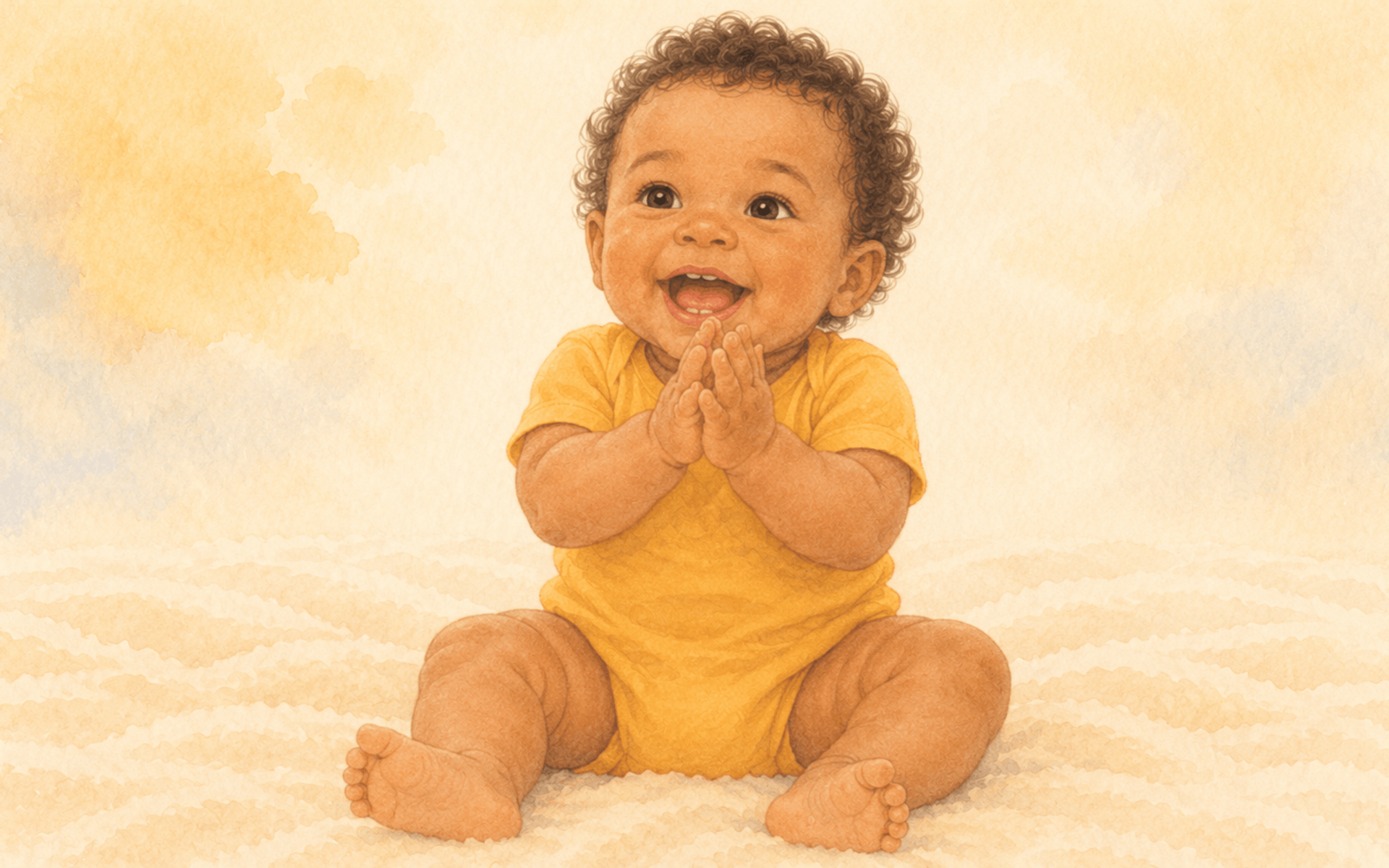
Every article about baby clapping will tell you the same thing: nine months, give or take. Pat-a-cake helps. Clap in front of your baby and wait.
What none of them mention is that your baby has been rehearsing for this moment since the second month of life — not with hands, but with eyes. Researchers at Vanderbilt tracked 112 infants while caregivers sang to them and found that babies as young as eight weeks were already locking their gaze onto a caregiver's eyes right on the beat of a song, not between beats. By six months, that synchronization had doubled in strength. The clap you're waiting for doesn't appear out of nowhere around nine months. It's the moment seven months of invisible preparation finally becomes something you can see.
- Why the "nine months" answer is both right and missing the point
- The motor chain your baby has been building since month three, step by step
- What's actually happening in the brain when two hands finally meet in the middle
- Why pat-a-cake works — and why you've been doing it at exactly the right time
- The difference between a first clap and a real clap, and what each one means
- When to mention it to your pediatrician (soft flags, not alarm bells)
If the one-sentence answer is enough, you’ve got the gist. If you want the mechanism behind each piece, keep reading.
What the CDC Actually Says About When Babies Clap
Babies typically clap their hands together for the first time somewhere between nine and fifteen months. The CDC's 2022 milestone revision, led by pediatrician Jennifer Zubler and colleagues and published in Pediatrics, is the clearest source here. The nine-month checklist includes "bangs two things together," which is the immediate physical precursor to clapping. The fifteen-month checklist, which was newly added in that revision, includes "claps when excited." That fifteen-month milestone reflects the emotionally intentional version: not just hands coming together accidentally, but your baby choosing to clap because something is wonderful and she wants you to know it.
Most babies land somewhere in between. The first recognizable clap usually shows up between nine and twelve months, though plenty of babies get there at thirteen or fourteen months and are entirely on track. The old parenting sites that quote "nine months" as the average are pulling from an older standard that was set at the fifty-fifty point — meaning half of babies had done it and half hadn't. The 2022 revision shifted the goalposts to reflect what the large majority of children do by a certain age, which is a more useful benchmark for knowing when something genuinely deserves attention.
What's worth understanding is that clapping isn't one milestone. It goes through stages. First, your baby bangs objects together (two blocks, a spoon against a cup, whatever's in reach). Then comes bringing hands together in the middle, which might look like a clap but has no particular intention behind it. Then comes clapping in imitation of you. Finally comes the version that makes grandparents cry: deliberate, enthusiastic clapping in response to something exciting, offered up as communication. That last stage is what the CDC means by "claps when excited," and it usually arrives after the first birthday.
The Motor Chain That Starts at Three Months
Here's what every "when do babies clap" article skips: clapping requires three separate motor skills to fall into place first, and those skills have their own timelines, none of which starts at nine months.
The first is symmetric reaching — both arms moving together toward the same thing, in the same direction, at the same time. This is the earliest form of bilateral motor coordination, and it starts around three to four months. Researchers Corbetta and Thelen documented this in their developmental motor work in the 1990s: when infants first start reaching, they frequently use both arms in a synchronized, mirrored movement rather than one at a time. Symmetric motion is the easy version. Both hemispheres of the brain run the same program simultaneously. It's clumsy and not yet purposeful, but it's the raw material.
The second skill is crossing the midline — moving a hand from one side of the body toward the other, or bringing both hands together at the center. This emerges between roughly four and seven months, based on Provine and Westerman's foundational research on early reaching. Before a baby can clap, both hands need to be able to meet in the middle of the body. That crossing requires the left and right sides of the brain to communicate with each other, which brings us to the third piece.
The third is efficient object banging — the ability to bring two objects (or two hands) together with controlled, aimed force. Researchers Kahrs, Jung, and Lockman tracked this specifically, using motion capture with fourteen infants between seven and fourteen months. They found that banging trajectories become straighter and more efficient over time, with smaller, more controlled movements that allow for actual aiming rather than wild swinging. The CDC's nine-month "bangs two things together" milestone marks the point when this becomes consistent enough to count. Once a baby can reliably aim one object at another, bringing both hands together at the center is the same motion turned inward. That's clapping.
A 2016 study by Babik and Michel following ninety infants from nine to fourteen months found that asymmetric, role-differentiated hand use (where one hand does something different from the other) doesn't really stabilize until thirteen or fourteen months. Symmetric actions, like clapping, come before that. The fact that your baby claps before reliably using one hand to hold something steady while the other manipulates it is the developmental sequence working exactly as designed, not a quirk.
Our guide to fine motor skills in babies by age covers this full progression with the research behind each step, including the motor milestones that directly precede when babies start clapping.
What's Actually Happening in the Brain
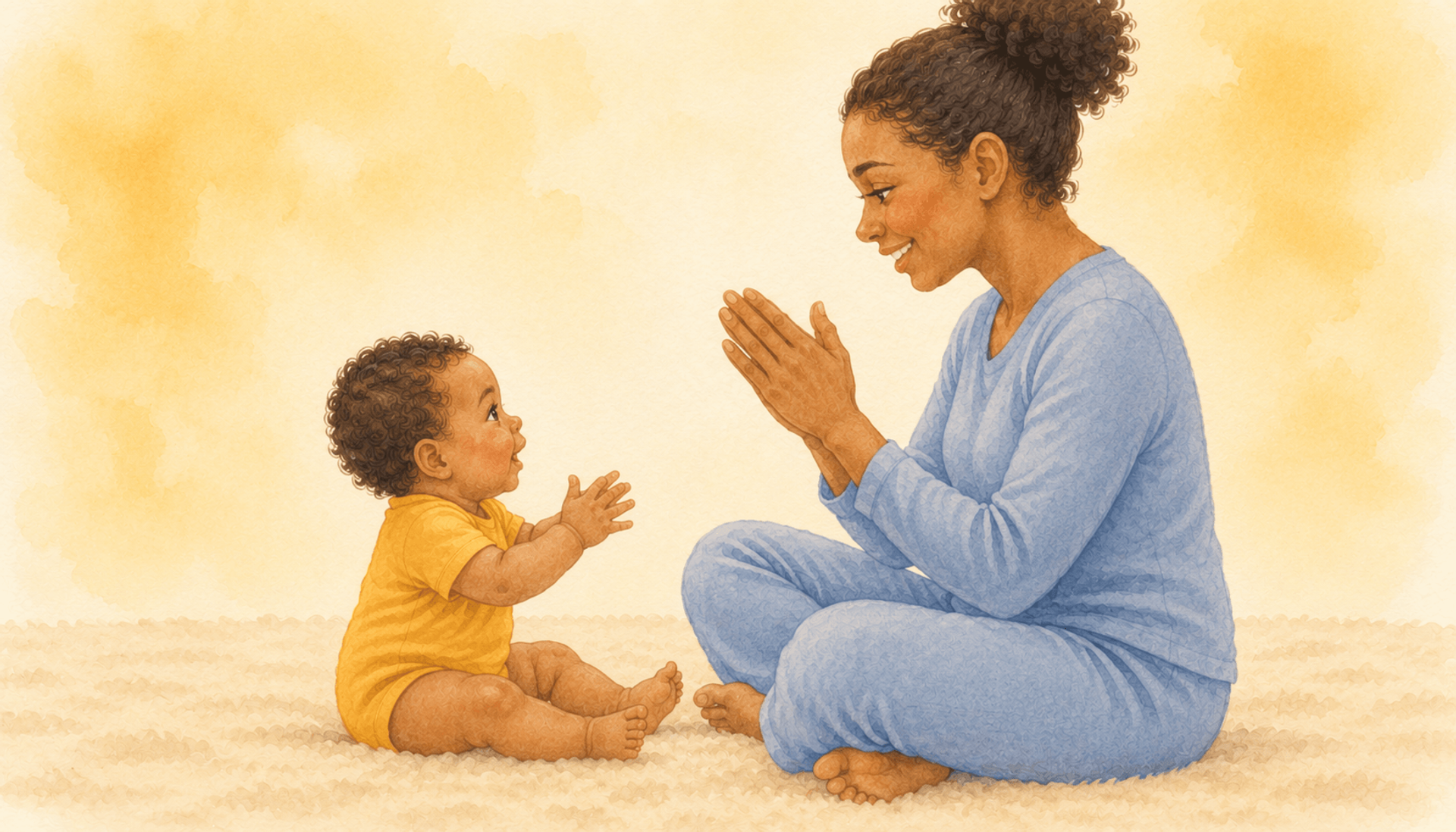
Clapping is a symmetric action, but it still requires both sides of the brain to coordinate. The structure that makes that coordination possible is the corpus callosum (a thick band of fibers connecting the left and right hemispheres, essentially the brain's communication cable between its two halves).
The corpus callosum is not fully formed at birth. It myelinates, meaning the fibers develop the insulating coating that lets signals travel faster and more reliably, in a predictable regional sequence across the first year of life. The splenium, at the back of the structure, shows early myelination by around four months. The genu, at the front, follows by around six months. By eight months, MRI scans show an adult-like appearance on structural imaging, as documented by Barkovich and Kjos in their early imaging work and confirmed more recently by Tanaka-Arakawa and colleagues in a structural MRI study following 114 individuals from one month to twenty-five years.
A separate line of research by Fagard, Hardy-Léger, Kervella, and Marks looked at interhemispheric transfer, specifically how quickly information passes from one brain hemisphere to the other, and how it connects to bimanual coordination. Their finding: as interhemispheric communication improves, so does a child's ability to coordinate two hands doing the same thing simultaneously. The corpus callosum maturation timeline and the clapping window overlap for a reason.
This doesn't mean parents need to worry about brain development in order to understand clapping. What it means is that when your baby keeps bringing hands together and missing, or manages it once and then can't repeat it, the explanation isn't lack of trying. The hardware is still coming online.
Why Your Baby Was Ready for Pat-a-Cake Before the Clap
Long before babies can clap themselves, they respond to rhythm — and researchers have traced this sensitivity back further than most parents would expect.
A 2009 study by Winkler and colleagues, published in PNAS, tested fourteen newborns using EEG while playing them drum patterns with the occasional beat removed. When the expected downbeat was missing, the newborns' brains produced a response associated with a violated expectation. Beat detection, in other words, arrives before any learning has happened — the newborns in that study were two to three days old.
That sensitivity builds over the first months. A landmark 2010 study by Zentner and Eerola, also in PNAS, tested 120 infants between five and twenty-four months while playing them music and rhythmically regular beats versus speech. Infants engaged in significantly more rhythmic movement (bouncing, kicking, rocking) in response to music than to spoken language, and the better their movement matched the beat, the more they smiled. Rhythm produces a body response and a social reward at the same time.
The most striking piece of this research came from a 2022 study published in PNAS by Miriam Lense, Warren Jones, and colleagues at Vanderbilt and the Marcus Autism Center, which tracked 112 infants aged two and six months while caregivers sang to them. Using eye-tracking technology, the researchers found that infants as young as two months were already synchronizing their gaze to a caregiver's eyes precisely on the beat of a song. By six months, that synchronization had doubled in strength. The caregivers, without realizing it, were also becoming more expressive and wide-eyed on the beats, their faces more engaging at precisely the moments the babies were most likely to be looking.
This is what pat-a-cake is doing underneath the surface. The repeated rhythm, the consistent beat, the sung words — they're structuring your baby's attention to land on your face at the moments when your face is most communicative. Long before your baby claps, the rhythm has been training the social-attention system that will eventually put meaning behind the clap.
Our activities for a 9 month old guide has more on why rhythmic games like this are some of the most developmentally dense activities in the toolkit at this age.
A Clap Is a Social Signal, Not Just a Motor Skill
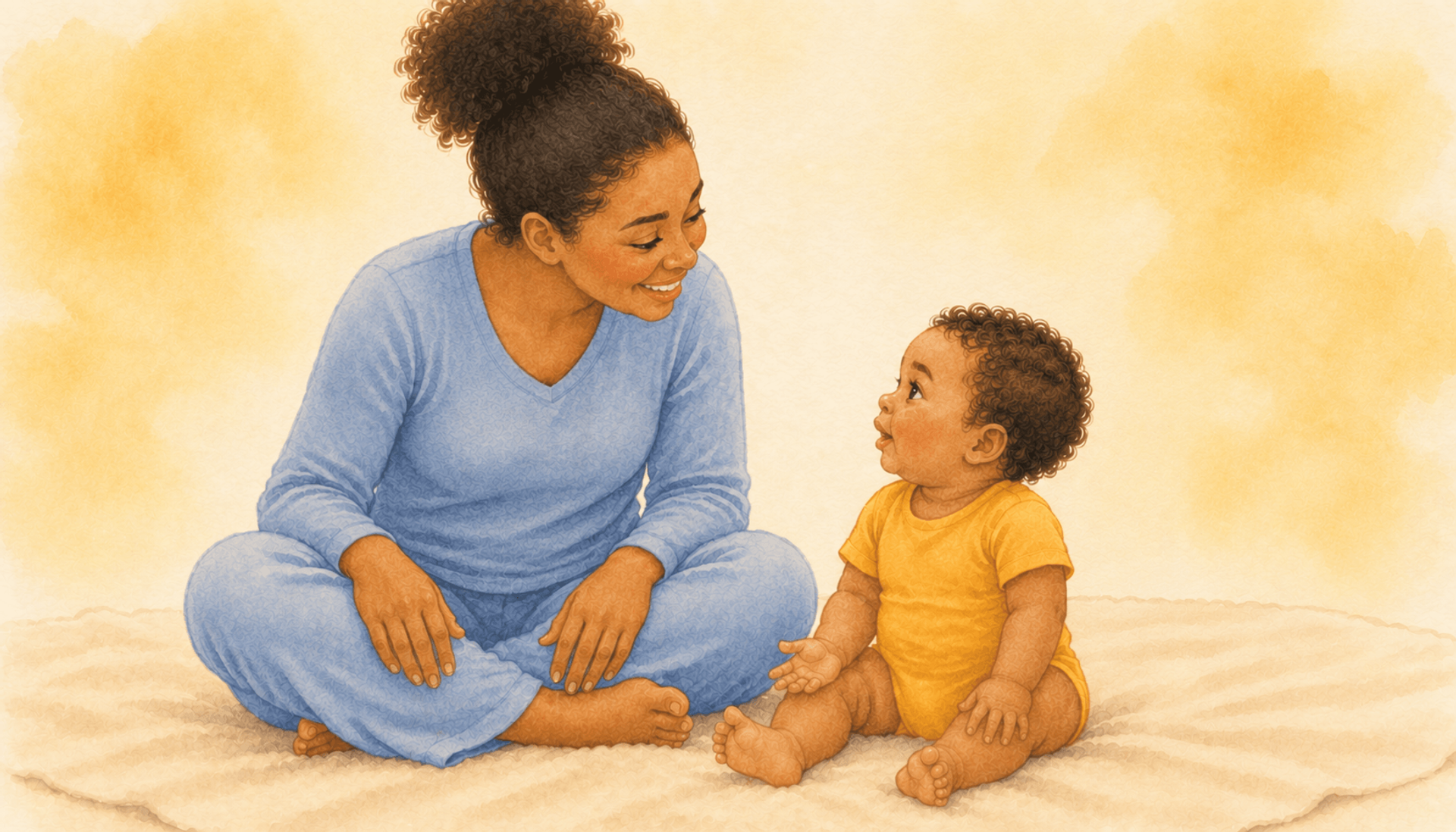
Here's the distinction that almost no clapping article makes: when babies start clapping, there are two kinds of claps, and they're different in a developmentally important way.
The first kind is what researchers call a conventional gesture — a gesture whose meaning is culturally learned and shared, not one that points to a specific object or shows something physical. Clapping falls into this category. It doesn't mean "look at that thing over there" or "give me the toy." It means "good job" or "I'm excited" or "this is wonderful." That meaning has to be acquired through watching other people do it in context, which is exactly what your baby has been doing every time you clapped during bathtime or in response to a first step.
Crais, Douglas, and Campbell, in a detailed 2004 study of twelve infants from six to twenty-four months, documented the emergence sequence of different gesture types. Deictic gestures (reaching and pointing) appear first, around seven to ten months. Conventional social gestures like clapping and waving come later. A separate analysis of infant gesture production found that when they looked at all the conventional gestures infants produced, more than half of them were clapping — either in celebration or to mean "good job." Clapping is not only the first conventional gesture most babies produce; it's by far the most common one.
That social meaning is worth paying attention to because it's what connects clapping to language. The guide to when babies start talking covers this in detail, but the short version is that babies who have a richer gesture vocabulary tend to develop spoken language faster and with more range. Clapping and waving aren't just motor practice. They're the baby's first vocabulary, delivered with hands instead of words.
For a sensory and language foundation to support all of this, our Sensory Play Cards for ages 0–12 months include activity and vocabulary prompts designed to build exactly this kind of gesture-to-language bridge during the window when it matters most.
The Difference Between a First Clap and a Happy Clap
If your baby's first clap looked more like two hands accidentally bumping in the middle, that's completely normal and actually exactly right. Early clapping is often not very clap-like. The hands might not be fully flat. The timing is off. It happens once and then doesn't happen again for a week.
What you're waiting for, and what the CDC's fifteen-month milestone is pointing at, is clapping that means something. The moment when your baby hears music and starts clapping along. The moment when you say "yay!" and the baby claps without prompting. The moment when something exciting happens and both hands come together with actual force and a big open-mouthed smile. That's the emotionally intentional clap, the one that's not just motor practice but communication.
A 2021 study by Bradshaw and colleagues in Child Development found that differences in social communication behaviors, including gesture use, were already measurable at nine months in infants later diagnosed with autism, with effect sizes between 0.42 and 0.89. The study involved thirty infants with autism and ninety-four typically developing infants, all assessed at nine months. This doesn't mean a baby who isn't clapping at nine months has a developmental concern. It means that the social and communicative dimension of early gestures is meaningful data, not just a cute milestone.
The full gesture picture at twelve months — waving, pointing toward things of interest, reaching with intent, and some form of clapping or hand-banging — is what pediatricians are looking at collectively, not any single skill in isolation.
When to Mention It to Your Pediatrician
There's a wide range of normal for when babies clap, and the range being wide is the point.
If your baby is clapping by twelve months in any form — even a loose, occasional, not-quite-intentional version — that's well within normal. Just as with when babies sit up, the milestone window is wide enough that most parents have time to watch the skill arrive without worrying. If your baby is not yet clapping by fifteen months, that's worth flagging at the next visit. The CDC's revised checklist treats "claps when excited" as a fifteen-month milestone, meaning the large majority of typically developing infants have it by then.
The patterns most worth mentioning are not just about clapping in isolation. If your baby is showing few or no communicative gestures by twelve months (no waving, no reaching up to be held, no pointing toward things that interest them, no conventional back-and-forth with caregivers), that's a good reason to bring up at the twelve-month well visit rather than wait. The pediatrician isn't looking for clapping specifically; they're looking at the whole gesture picture as a window into social communication development.
If your baby clapped and then stopped, or if motor skills that were developing have dropped back, that's also the kind of thing worth raising promptly.
A baby who isn't clapping but is making eye contact, responding to his or her name, showing things to you, and engaging in back-and-forth exchanges is a baby with plenty of social communication in place. Clapping is just one expression of a larger system that's clearly working.
Frequently Asked Questions
Most babies produce their first recognizable clap somewhere between nine and twelve months, though fifteen months is still well within the normal range. The CDC's 2022 revised checklist lists "bangs two things together" at nine months and "claps when excited" at fifteen months. An early accidental hand-bump at eight months and a confident intentional clap at thirteen months are both completely normal.
The most effective approach is also the most natural one: clap in front of your baby regularly and in context. Clap when you're happy, clap during songs, clap when your baby does something that earns applause. Babies learn conventional gestures by watching them used with meaning, not through drills. Songs with a clear beat (pat-a-cake, "if you're happy and you know it") have the added benefit of training rhythm sensitivity that supports both the clapping and the social engagement around it. Research by Zentner and Eerola found that infants as young as five months engage more rhythmically with music than with speech, so the musical format genuinely makes a difference.
Not based on clapping alone. The CDC's current standard places "claps when excited" on the fifteen-month checklist, not the twelve-month one. Eleven months is well before the age at which absence of clapping would be considered a concern. What's more meaningful at eleven months is the broader gesture picture: is your baby waving, pointing, reaching up to be held, showing you things, responding to his or her name? If yes, the social communication system is on track and clapping will likely follow in the next few months.
Both. Clapping requires symmetric bimanual coordination (both hands moving together), which is a motor skill with its own developmental timeline. But intentional clapping, the kind where your baby claps because she's excited or because she's imitating you, is a conventional social gesture that requires understanding what the gesture means. The motor part tends to come online around nine to twelve months. The social-communicative meaning gets layered on over the following months, reaching full expression as your baby approaches the first birthday and beyond.
Waving and pointing are the other major gestures in this cluster. Waving typically emerges around the same time as clapping or slightly before. Pointing (the kind where your baby extends an index finger toward something she wants you to look at) usually follows, showing up consistently around ten to fourteen months. Pointing is considered one of the strongest early predictors of language development because it requires understanding that you and your baby can share attention toward the same thing and communicate about it. Our article on when babies wave covers the full gesture arc that follows clapping.
For educational and entertainment purposes only. Not a substitute for professional medical or developmental advice. If you have concerns about your baby's development, consult your pediatrician.
- Attaheri, A., Choisdealbha, Á. N., Di Liberto, G. M., Rocha, S., Brusini, P., Mead, N., Cutini, S., Gibbon, F., Devlin, S., & Goswami, U. (2022). Delta- and theta-band cortical tracking and phase-amplitude coupling to sung speech by infants. NeuroImage, 247, 118698.
- Babik, I., & Michel, G. F. (2016). Development of role-differentiated bimanual manipulation in infancy: Part 1. The emergence of the skill. Developmental Psychobiology, 58(2), 243–256.
- Barkovich, A. J., & Kjos, B. O. (1988). Normal postnatal development of the corpus callosum as demonstrated by MR imaging. American Journal of Neuroradiology, 9(3), 487–491. PMID: 3132822
- Bradshaw, J., McCracken, C., Pileggi, M., Brane, N., Delehanty, A., Day, T., Evans, L., Klaiman, C., & Saulnier, C. (2021). Early social communication development in infants with autism spectrum disorder. Child Development, 92(6), 2224–2234.
- Corbetta, D., & Thelen, E. (1996). The developmental origins of bimanual coordination: A dynamic perspective. Journal of Experimental Psychology: Human Perception and Performance, 22(2), 502–522.
- Crais, E., Douglas, D. D., & Campbell, C. C. (2004). The intersection of the development of gestures and intentionality. Journal of Speech, Language, and Hearing Research, 47(3), 678–694.
- Fagard, J., Hardy-Léger, I., Kervella, C., & Marks, A. (2001). Changes in interhemispheric transfer rate and the development of bimanual coordination during childhood. Journal of Experimental Child Psychology, 80(1), 1–22.
- Fagard, J., & Jacquet, A.-Y. (1989). Onset of bimanual coordination and symmetry versus asymmetry of movement. Infant Behavior and Development, 12(2), 229–235.
- Kahrs, B. A., Jung, W. P., & Lockman, J. J. (2012). What is the role of infant banging in the development of tool use? Experimental Brain Research, 218(2), 315–320.
- Kahrs, B. A., Jung, W. P., & Lockman, J. J. (2013). Motor origins of tool use. Child Development, 84(3), 810–816.
- Lense, M. D., Shultz, S., Astésano, C., & Jones, W. (2022). Music of infant-directed singing entrains infants' social visual behavior. Proceedings of the National Academy of Sciences, 119(45), e2116967119.
- Meltzoff, A. N. (1988). Infant imitation and memory: Nine-month-olds in immediate and deferred tests. Child Development, 59(1), 217–225.
- Provine, R. R., & Westerman, J. A. (1979). Crossing the midline: Limits of early eye-hand behavior. Child Development, 50(2), 437–441.
- Tanaka-Arakawa, M. M., Matsui, M., Tanaka, C., Uematsu, A., Uda, S., Miura, K., Kawana, I., & Goto, T. (2015). Developmental changes in the corpus callosum from infancy to early adulthood: A structural magnetic resonance imaging study. PLOS ONE, 10(3), e0118760.
- Watson, L. R., Crais, E. R., Baranek, G. T., Dykstra, J. R., & Wilson, K. P. (2013). Communicative gesture use in infants with and without autism: A retrospective home video study. American Journal of Speech-Language Pathology, 22(1), 25–39. PMC3574175
- Winkler, I., Háden, G. P., Ladinig, O., Sziller, I., & Honing, H. (2009). Newborn infants detect the beat in music. Proceedings of the National Academy of Sciences, 106(7), 2468–2471.
- Zentner, M., & Eerola, T. (2010). Rhythmic engagement with music in infancy. Proceedings of the National Academy of Sciences, 107(13), 5768–5773.
- Zubler, J. M., Wiggins, L. D., Macias, M. M., Whitaker, T. M., Shaw, J. S., Squires, J. K., Pajek, J. A., Wolf, R. B., Slaughter, K. S., Broughton, A. S., Gerndt, K. L., Mlodoch, B. J., & Lipkin, P. H. (2022). Evidence-informed milestones for developmental surveillance tools. Pediatrics, 149(3), e2021052138.
Related Products
More Articles
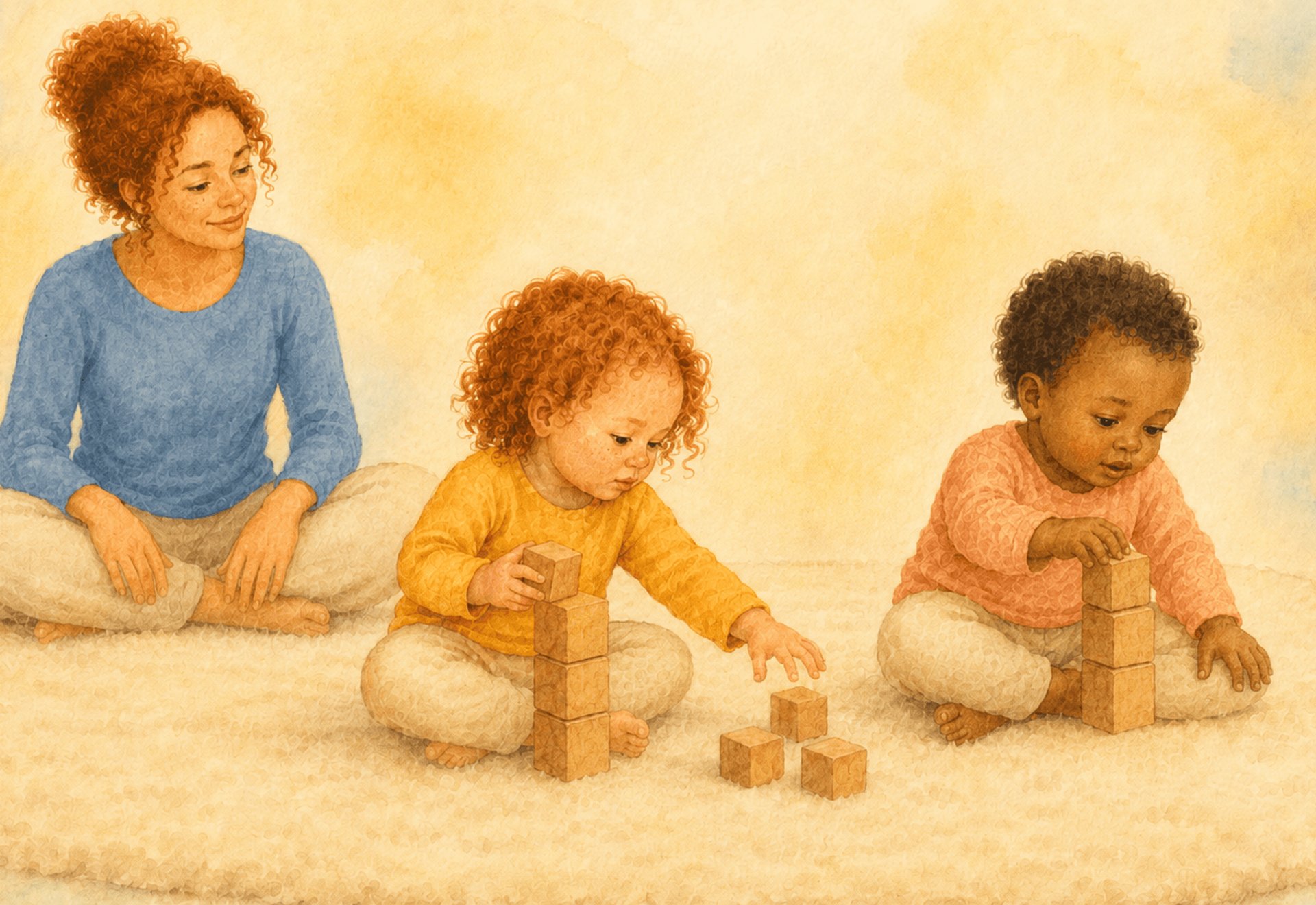
Parallel Play in Toddlers: Why Side-by-Side Is the Social Work
Your toddler spent the entire playdate building separate towers, and nobody shared a single block. That counted — more than it looked. A 2025 longitudinal study found that playing beside a specific child consistently predicted later social play with that same child, but not the other way around. Here's what parallel play in toddlers actually is, why the science calls it strategic rather than passive, and what it means for how you run a playdate.
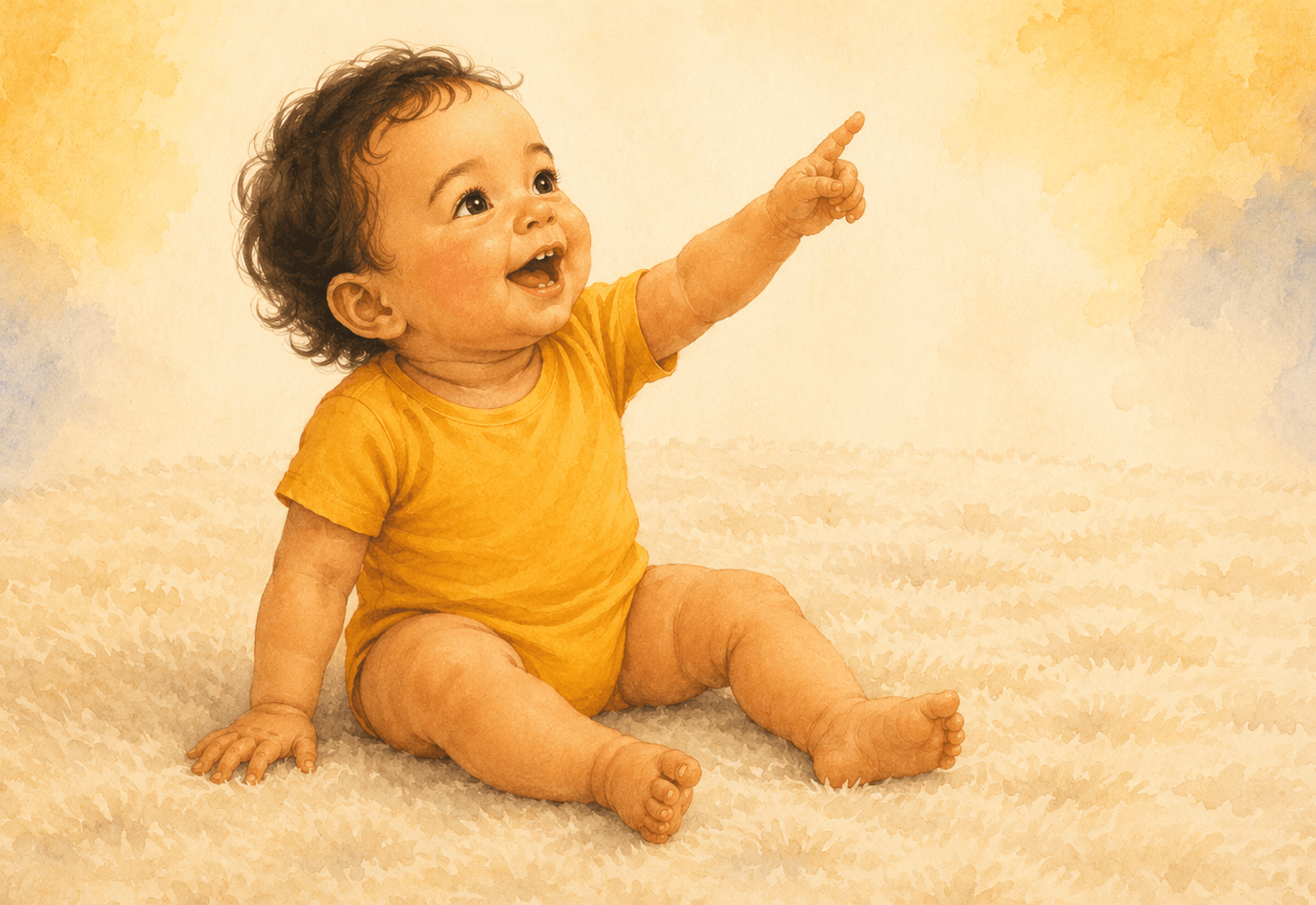
When Do Babies Point: Why It Matters for Language
Most milestone articles treat pointing as a box to check around 12 months. The research tells a different story — one that starts months earlier, runs through the infant brain, and traces back to how much the parent is pointing. Here's what the last fifteen years of research actually found, and what it means for everyday interactions.
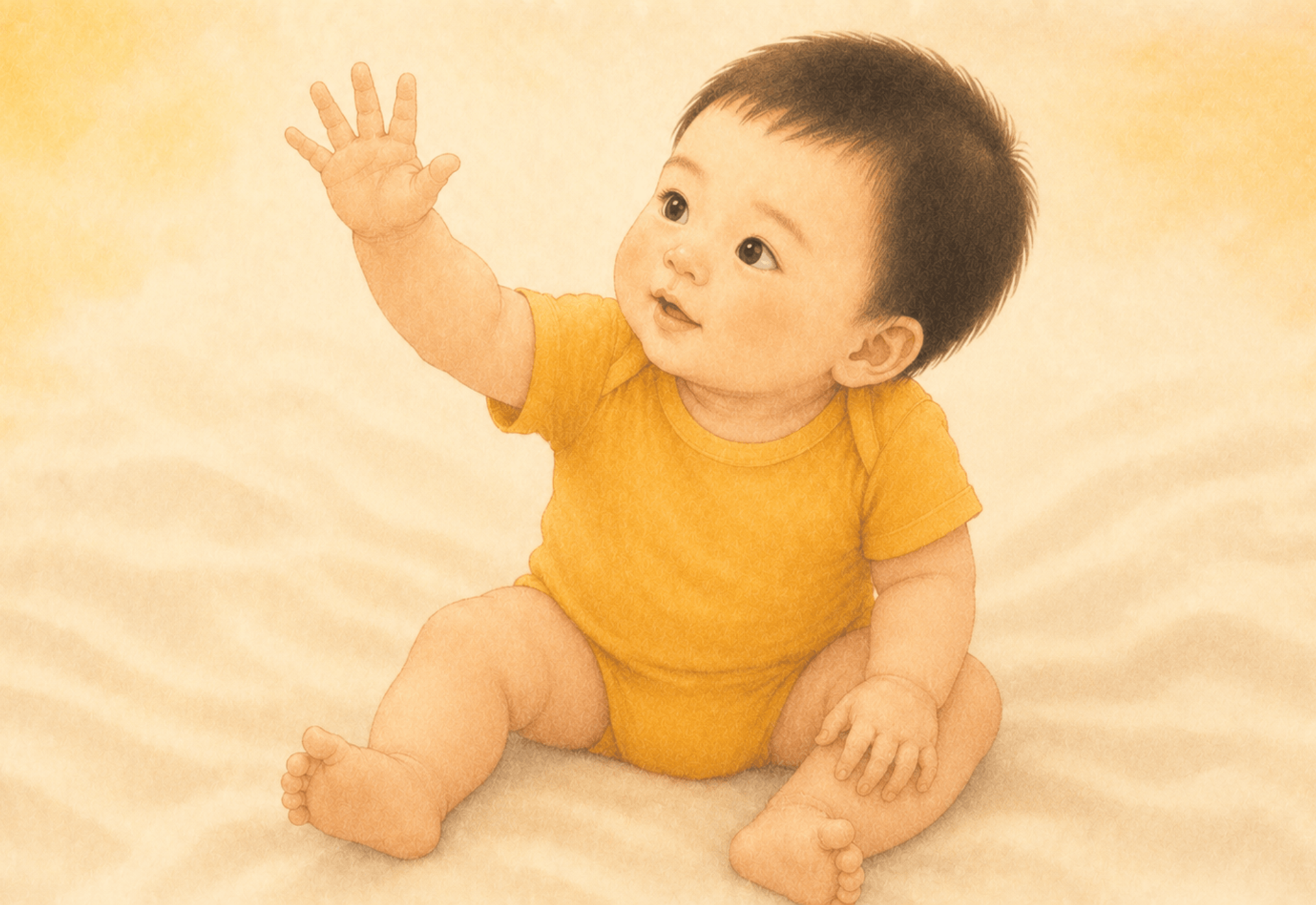
When Do Babies Wave Bye-Bye: Why Your Baby Needs You to Wave First
Most baby milestones unfold on a biological schedule — waving isn't one of them. A 2023 study found that babies develop imitation ability because their caregivers imitate them first, and waving is named directly as a cultural gesture learned through that loop. Here's what the research says about the 9–12 month window, why the first wave looks nothing like a wave, and what helps it arrive.