How Baby's Brain Develops in the First Year: A Bottom-Up Guide
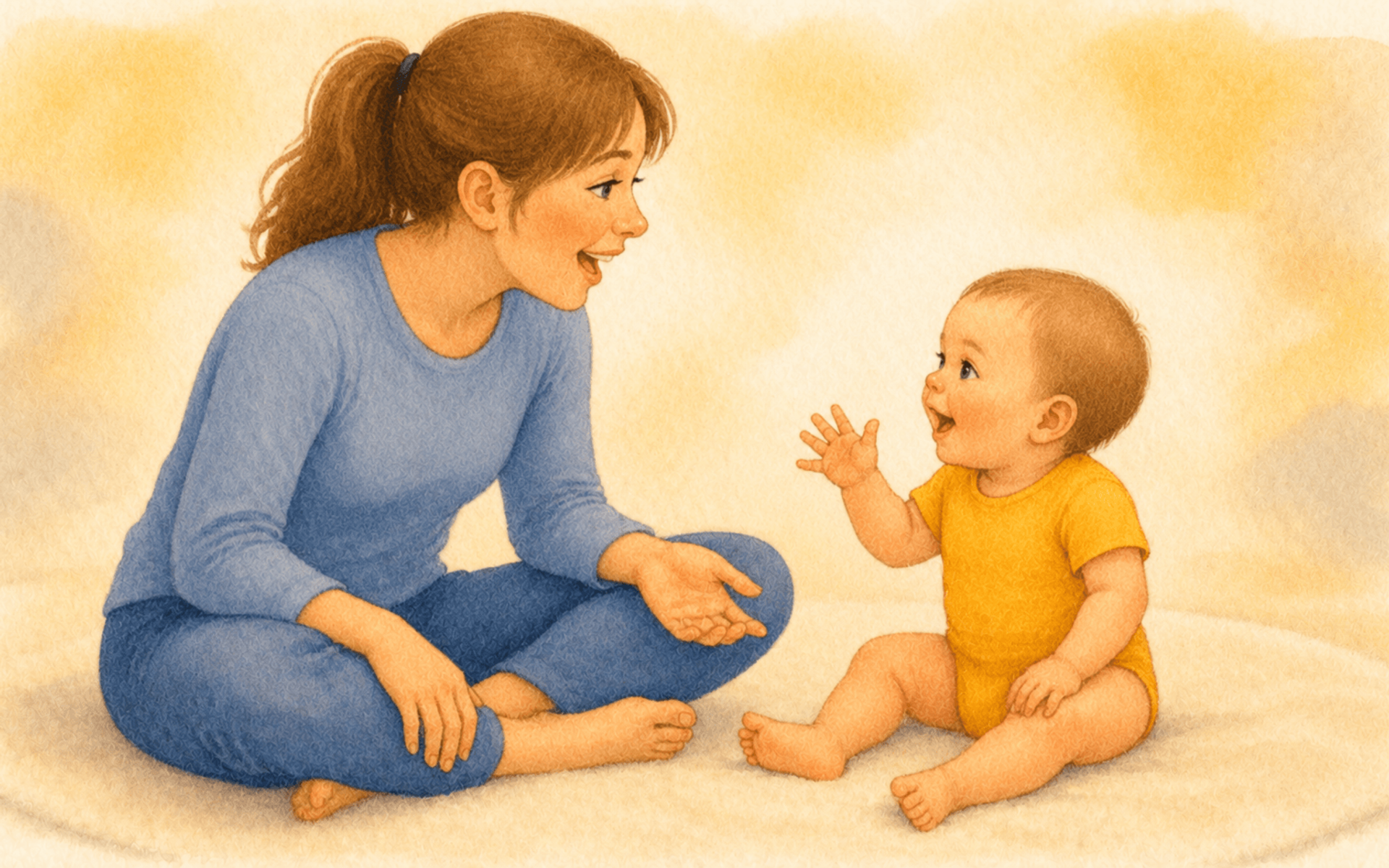
A 2024 analysis in Nature Ecology & Evolution, comparing 140 placental mammal species, found that humans have the highest evolutionary rate of being born neurologically immature of any mammal measured, and that this shift shows up almost entirely in how much brain growth is scheduled to happen after delivery rather than before it. A giraffe walks within hours of birth. Your baby needs about twelve months to figure out standing, and several more years after that to figure out sharing.
That gap is not a flaw in the blueprint. It reflects an evolutionary trade-off: a brain large enough to eventually do everything a human brain does could not fit through a birth canal fully formed, so a substantial share of the construction moved to the outside world, into an environment richer in faces, voices, touch, and variety than any womb could replicate. Baby brain development in the first year is less a checklist of things you need to do to your baby and more a process your baby is already running, on a timetable set long before birth.
- The evolutionary context that replaces the "fourth trimester" framing, and what it means for how you spend your days
- Which part of the brain is under active construction each month, and why your baby's behavior makes more sense when you know the order
- The cerebellum: why the fastest-growing region in year one is doing considerably more than the textbooks say
- What those sleep twitches are, and why the research on them changes how you think about nap time
- What your voice does to white matter, and why conversational turns matter more than word count
- Iron, DHA, and how to read the nutrition research without over-interpreting it
- Which patterns are worth mentioning to your pediatrician, framed without alarm
If the one-sentence answer is enough, you’ve got the gist. If you want the mechanism behind each piece, keep reading.
The evolutionary context: why human babies are born with so much brain left to build
The "fourth trimester" framing (the idea that babies are born three months early and spend those first months finishing gestation outside the womb) is intuitive but not quite accurate. It implies a baby who arrived too soon, a kind of involuntary early discharge. The evidence points to something more intentional than that.
Gómez-Robles and colleagues, in a 2024 analysis of 140 placental mammal species, found that humans show the highest evolutionary rate of transitioning toward being born neurologically immature, driven almost entirely by how much brain growth is scheduled to happen after birth rather than before. The key mechanism is myelination, the fatty insulation that wraps neural pathways and makes fast, coordinated signaling possible. Most of it gets built in the first two years, in the world, on a diet of sensory input and responsive human contact that no womb could supply.
A 2016 imaging study tracking infant brain growth found that the brain reaches roughly 80% of its adult volume by age two, with cortical gray matter approximately doubling in volume during the first year alone. A 2014 study following infants through their first three months measured overall brain growth at roughly 1% per day in the earliest weeks, slowing to about 0.4% per day by the end of month three — a total volume increase of about 64% in ninety days. The rate slows across the full year, but the reorganization underneath does not.
What this shifts, practically, is the framing of what you are doing during the first year. The job is less about filling in developmental gaps and more about protecting the conditions under which something already in motion can proceed without friction: sleep, calm, your voice turning back toward your baby's, food with the right building blocks. The construction crew showed up before you got home. You are providing the site conditions.
The regional construction schedule: brainstem first, prefrontal last
Rather than developing all at once, the brain builds itself in a strict sequence from back to front and bottom to top, from the structures that handle survival and sensation toward the ones that handle planning, language, and voluntary self-control. Once you know the order, your baby's behavior stops looking random and starts making structural sense.
Brainstem and subcortical structures are substantially formed at birth (heart rate, breathing, temperature regulation, the startle reflex) and serve as the foundation on which everything that comes later is constructed. When a newborn startles at a door slamming, that is a fully functional brainstem doing exactly what it is supposed to do.
Sensory and primary motor cortex develop actively in the early months, which is why what your baby can perceive and do changes so dramatically between week two and month four. Vision sharpens as the occipital cortex and its connections mature, touch discrimination improves, and voluntary movement becomes possible as motor pathways myelinate. A study by Deoni and colleagues confirmed that myelination follows a back-to-front, bottom-to-top sequence — sensory and motor tracts first, association tracts later — which maps almost exactly onto the behavioral changes parents watch happen week by week.
The association cortex (the regions that weave information from different senses together, support language comprehension, and eventually underpin the ability to sit with an uncomfortable feeling) develops last and slowest. This is why a twelve-month-old grasps the meaning of "no" long before following it consistently, why play becomes increasingly deliberate across the year, and why the self-regulation abilities parents are quietly hoping for — sharing, waiting, not throwing the bowl — are not a matter of discipline. The prefrontal cortex is still under construction and will be for decades; its primary myelination finishes somewhere in the mid-twenties.
When a three-month-old cannot stop staring at your face, that is sensory cortex doing its job. When a nine-month-old drops a toy the moment something more interesting appears, the circuitry for sustained voluntary attention genuinely has not been built yet. Knowing that makes the behavior much easier to be around.
The cerebellum: the fastest-growing region, with a bigger job than anyone thought
Ask most parents which part of the infant brain develops fastest, and the guess is usually the cortex, the layered outer surface associated with thinking and learning. The answer is actually the cerebellum, the walnut-shaped structure tucked at the base of the skull. A 2014 MRI study tracking regional growth in infants found that it more than doubles in volume in the first ninety days of life, outpacing every other region across that window.
For decades the cerebellum's job was described almost entirely as motor coordination: balance, timing, smooth movement. That is accurate, but a 2025 study by Lyu, Thung, and colleagues suggests the picture is bigger than that. The researchers analyzed 1,017 fMRI scans from 275 infants and children in the Baby Connectome Project and found that the cerebellum shows functional connections to attention, language, and other higher-order brain networks at birth, with those connections strengthening as the baby grows. The study notes carefully that this is leading-edge evidence, not yet broadly replicated — but it explains something parents often notice without having a name for it: around the same weeks that motor control improves, so does the quality of attention. The baby who suddenly holds eye contact longer is the same baby who just got better at reaching. That overlap may not be a coincidence.
The practical implication is not a new activity category. Floor time, being carried, gentle rocking, any movement-rich experience feeds the fastest-growing structure in your baby's brain — one doing considerably more than managing balance. Our Sensory Play Cards are organized month by month from birth to twelve months and include exactly the vestibular and proprioceptive activities the cerebellum is actively mapping during this window. For the full breakdown of what changes at each age, our sensory play guide covers each stage in detail.
What your sleeping baby is building
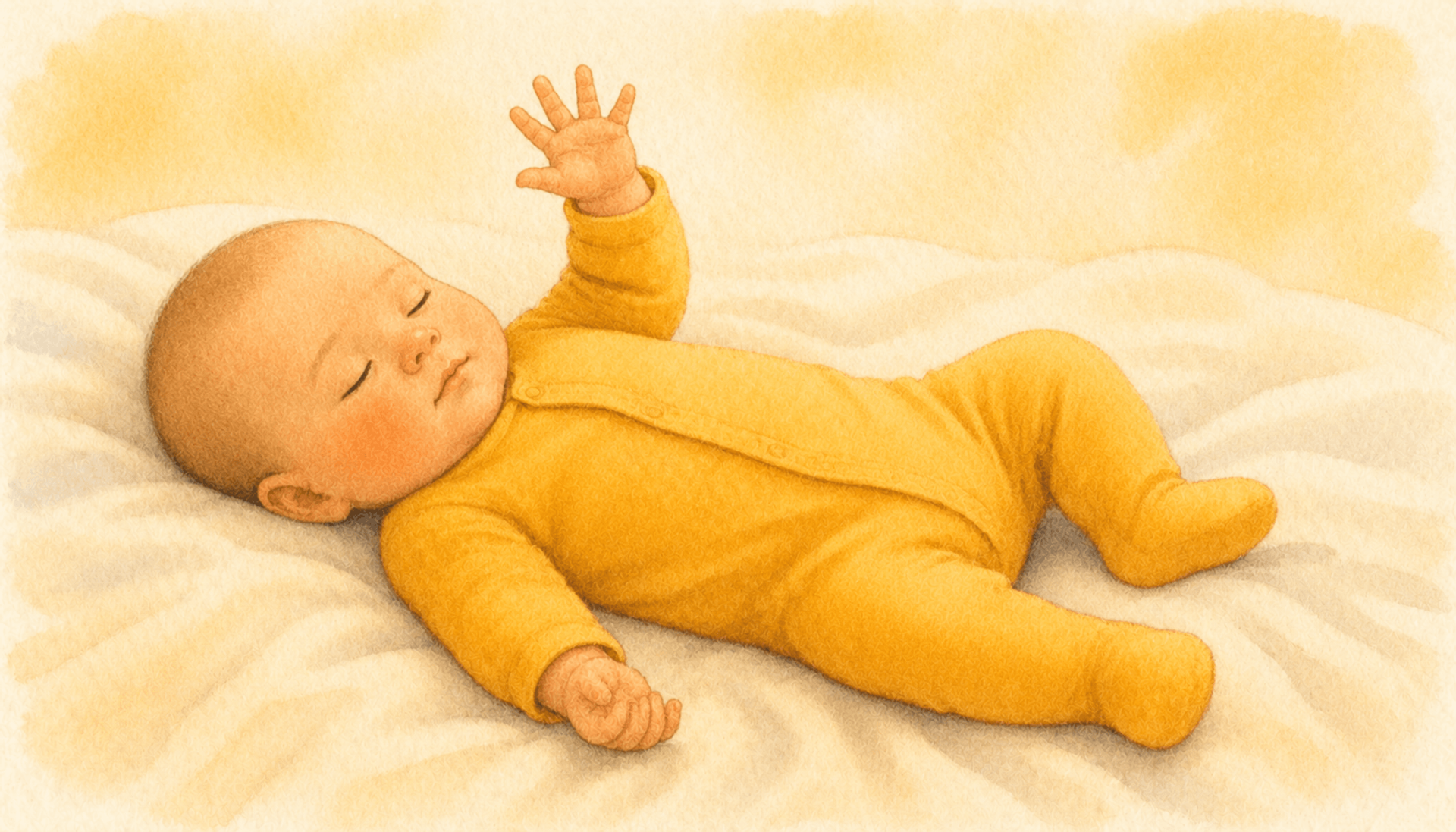
Most parenting content treats sleep as recovery time, the pause between the developmental work. The research on infant sleep twitches suggests something closer to the opposite.
Your sleeping baby twitches. The little jerk of an arm, the sudden spread of fingers, the foot that kicks once and stops; these look random, or possibly like fragments of a dream. Researchers Mark Blumberg and Greta Sokoloff at the University of Iowa spent years studying exactly these movements in both rats and humans, and what they found inverts the intuition about what sleep is for.
A 2020 study by Sokoloff, Blumberg, and colleagues characterized the spatiotemporal organization of these myoclonic twitches in sleeping human infants with real precision: they occur almost exclusively during active REM sleep, cluster in the hands and feet, and become more organized after about two months of age. The researchers ran the numbers — given twitching rates of roughly ten per minute across face, head, and limbs, and the hours of active sleep in a newborn's day, the total comes to approximately 4,800 twitches per day.
Each twitch, per the researchers' model, sends a sensory signal back up through the spinal cord to the cortex, a feedback loop that appears to drive the brain's formation of a precise body map. The technical term is reafference. The key detail: the brain gates out that same signal when the movement is made voluntarily while awake, which means the twitch produces information the waking movement does not. Per the researchers' model, it is a purpose-built wiring channel, open only during sleep because intentional waking movement would drown the signal entirely.
In other words: a large share of the motor system's self-construction happens during naps, not during tummy time. Wake window activities are genuinely valuable. But nap time is where a lot of the actual wiring gets done. That's why a baby who skipped a nap seems genuinely scrambled, not just tired.
Sleep also does memory work that waking time cannot replicate. A 2015 study by Friedrich and colleagues found that naps in nine-to-sixteen-month-olds not only help consolidate specific word meanings learned before the nap but support generalizing those meanings to new contexts, with sleep spindles (bursts of oscillatory activity during non-REM sleep) specifically linked to that generalization. The sleeping brain is not just filing; it is making connections between things. Some of language acquisition happens while your baby is asleep.
What your voice does to white matter
The research on caregiver language and infant brain development is often summarized under the "thirty-million-word gap" (the finding that children in lower-income households tend to hear far fewer words by age three). That framing has been substantially revised, and the revision is useful to know.
A 2018 study by Romeo and colleagues at MIT followed 36 children across a range of socioeconomic backgrounds and measured not just word count but conversational turns — back-and-forth exchanges where the child vocalizes and an adult responds. Conversational turns predicted Broca's area activation, measured by fMRI, independently of family income and IQ — word count, on its own, did not. A companion study found that turn-taking was associated with stronger white-matter connectivity in the left arcuate fasciculus, the pathway connecting the brain's language production and comprehension areas. The turn is the unit that builds the wiring, not the word.
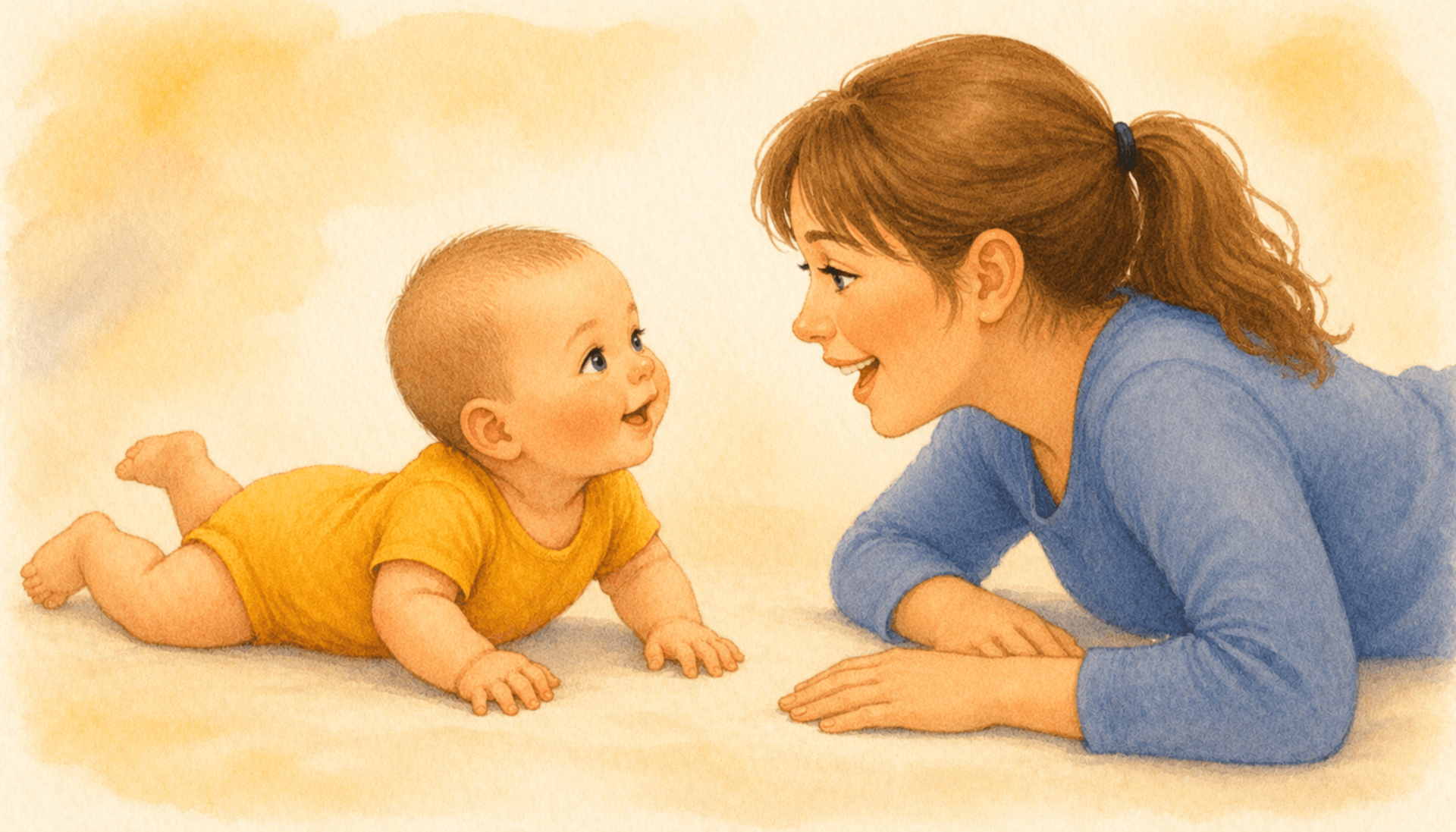
What that means in practice: talking with your baby rather than at them. Narrating what you are doing is fine and useful. But pausing after a vocalization, watching your baby's face, and responding to whatever just happened — that is the specific exchange the brain research traces to structural change. Our High Contrast Cards are built around the visual stimulation that makes those focused attention moments possible in the first place — the bold patterns calibrated to what a newborn's visual cortex can process, which is what creates the opportunity for the back-and-forth in the first place. For a broader picture of how all five senses feed development across year one, the baby senses guide covers the full arc.
Iron, DHA, and how to read the nutrition research
Nutrition and infant brain development is an area where the underlying findings are solid and the extrapolation that gets layered on top of them is often not. Here is what the evidence says.
Iron. A foundational review by Georgieff and Lozoff documents iron's role in myelination and dendritogenesis, the process by which neurons branch and connect with each other. Iron deficiency during the window of peak prevalence, roughly six to twenty-four months, is linked to lasting differences in cognitive and motor outcomes that, the evidence suggests, are not consistently reversed by later supplementation. This is why pediatricians check iron levels at well-child visits during this stretch. Questions about your baby's iron status belong at that visit, where a clinician can look at the actual numbers.
DHA and myelination. A 2022 randomized clinical trial by Schneider and colleagues gave 81 term infants either a formulation containing DHA, ARA, iron, and other nutrients, or a control formula, and measured myelination by MRI at three and six months. The group receiving the enriched formulation showed measurable differences in myelin structure and volume in several brain regions. Two caveats worth noting: the trial was industry-funded by Nestlé, and the differences were in myelination structure, not in any cognitive or behavioral outcomes at those time points. What the finding supports is the general principle that DHA is a structural ingredient in the myelinating brain — one already reflected in recommendations to provide it through breast milk or DHA-supplemented formula. For guidance specific to your baby, that conversation belongs with your pediatrician.
Sensitive periods: which windows close
Not all of early brain development is equally time-sensitive. Some capacities are highly experience-dependent during narrow windows; others remain responsive across wide bands of time. The difference matters for calibrating where real urgency exists.
Vision has the most precisely documented sensitive period of any sensory system in year one. Research by Lewis and Maurer, examining outcomes in children treated for congenital cataracts, identified multiple sensitive periods in human visual development, with the most critical opening in the first weeks and months after birth. Even brief visual deprivation during this window leaves detectable differences in processing years later. This is why untreated congenital eye conditions carry genuine urgency, and why pediatricians check for obstruction or asymmetry at every early well-child visit.
For most families, the practical implication is simple: your baby's visual system needs ordinary visual experience — faces, contrast, light, movement, depth — and normal life provides it. Our High Contrast Cards (0–3 months) and Color Contrast Cards (3–6 months) are each calibrated to the visual cortex's developmental sequence — pattern complexity tracks what the system can resolve at each stage. For the week-by-week breakdown of what your baby can see when, our article on newborn vision development covers the full timeline.
Language has a sensitive period that extends well into the first years and does not close at twelve months. What happens in year one is largely phonological: the brain catalogues the sound categories of the language it hears most, and by six to twelve months babies show measurably reduced sensitivity to sound contrasts outside their native language — a narrowing that reflects specialization, not loss. The vocabulary and grammar come later. The foundation being built right now is the phoneme inventory. Talking and reading to a baby who cannot yet talk back is building something structural. For a closer look at how first words develop, our article on when babies start talking covers the six-to-eighteen-month window.
Patterns worth mentioning to your pediatrician
The brain development research identifies several behavioral patterns across the first year where early clinical attention is worth seeking. None of these belong in the emergency category; they are the kind of thing worth raising at the next well-child visit, or sooner if the pattern feels pronounced.
At around two months, consistent social smiling and visual tracking of faces. By four months, cooing and turning toward familiar voices. By six months, reaching for objects and transferring them hand-to-hand. By nine months, back-and-forth babbling with consonants, turning when their name is called, and some form of searching for a hidden object. By twelve months, gestures like pointing and waving, and at least a handful of consistent word approximations.
Patterns worth flagging: babbling that stops or significantly decreases after a period when it was present; eye contact or responsiveness to name that is absent or diminishing; no response to familiar voices by three months. These are patterns a pediatrician will want to know about, not because they signal emergency, but because early attention is when the options are widest.
Frequently Asked Questions
Development follows a strict bottom-up sequence. Brainstem structures governing breathing, heart rate, and reflexes are substantially formed at birth. Sensory and primary motor cortex develop actively in the early months, driving the improvements in vision, touch, and movement that happen so visibly in the first weeks. The cerebellum grows faster than any other region in year one — more than doubling in the first ninety days, per MRI data from Holland and colleagues (2014). The prefrontal cortex, which eventually handles planning, language production, and self-regulation, is the last major region to develop and continues myelinating well into the mid-twenties.
Yes, and the mechanism is more interesting than it looks. Research by Sokoloff and Blumberg at the University of Iowa found that these myoclonic twitches in sleeping infants are concentrated in the hands and feet, occur almost exclusively during active REM sleep, and become more organized after about two months. The working model: each twitch generates a sensory signal from the body back to the spinal cord and cortex, driving the brain's formation of a precise body map. Newborns make an estimated 4,800 of these twitches per day. They are not random, not worrisome, and not fragments of a dream — by the current evidence, they are a major self-wiring mechanism for the sensorimotor system, active during sleep because intentional waking movement would drown the signal.
More than word count, the research traces structural brain change to conversational turns — back-and-forth exchanges where your baby vocalizes or looks or reaches, and you respond. A 2018 study by Romeo and colleagues at MIT found that conversational turns, not total word count, predicted Broca's area activation on fMRI and stronger white-matter connectivity in the language pathways, independently of family income and IQ. Speaking to your baby matters even without comprehension; responding to your baby's sounds and looks matters more than volume.
Iron and DHA have the strongest direct evidence for brain structural development in year one. Iron is required for myelination and neural branching; the six-to-twenty-four-month window is a period of elevated need that pediatricians track at well-child visits. DHA is a structural component of neural membranes and is present in breast milk and DHA-supplemented infant formulas. A 2022 randomized trial by Schneider and colleagues found measurable differences in myelination in infants receiving a DHA/iron-enriched formulation, though the trial was industry-funded and did not measure cognitive outcomes at those time points. For questions about your baby's specific nutritional needs, your pediatrician is the right resource.
The brain's sensitive periods are windows of heightened responsiveness, not deadlines that close permanently. Human brains retain substantial plasticity well into childhood and beyond, and the scenarios that produce measurable lasting differences involve severe deprivation or chronic unmanaged stress, not an imperfect activity schedule. The research does identify periods where specific inputs are particularly impactful (vision in the early months, language across the first years), but these are rarely relevant to parents doing ordinary, warm, responsive caregiving. If you talk to your baby, hold them, respond when they make sounds, protect their sleep, and feed them adequately, the construction schedule you cannot see is proceeding. If you want everything in one place — activities, visual stimulation, and sensory play calibrated to each month of year one — our Complete First Year Bundle covers the full 0–12 month window.
Newborns sleep fourteen to seventeen hours out of every twenty-four, and that time is doing substantial structural work, not recovering from it. The twitch-based motor-mapping described above happens exclusively during active sleep; the word-meaning generalization documented by Friedrich and colleagues (2015) is specifically linked to nap sleep and its associated sleep spindles. Reducing sleep to extend wake time competes directly with the processes that waking activities are meant to support. The AAP recommends following the baby's sleep cues and recognizing that high sleep needs in infancy are biologically appropriate.
For educational and informational purposes only. Not a substitute for professional medical advice, diagnosis, or treatment. Always consult your pediatrician or a qualified healthcare provider with questions about your child's development or health.
- Deoni, S. C. L., Mercure, E., Blasi, A., Gasston, D., Thomson, A., Johnson, M., Williams, S. C. R., & Murphy, D. G. M. (2011). Mapping infant brain myelination with magnetic resonance imaging. Journal of Neuroscience, 31(2), 784–791.
- Friedrich, M., Wilhelm, I., Born, J., & Friederici, A. D. (2015). Generalization of word meanings during infant sleep. Nature Communications, 6, 6004.
- Georgieff, M. K., & Lozoff, B. (2006). Iron deficiency and brain development. Seminars in Pediatric Neurology, 13(3), 158–165.
- Gilmore, J. H., Knickmeyer, R. C., & Gao, W. (2018). Imaging structural and functional brain development in early childhood. Nature Reviews Neuroscience, 19(3), 123–137.
- Gómez-Robles, A., Sherwood, C. C., & Kordos, L. (2024). The evolution of human altriciality and brain development in comparative context. Nature Ecology & Evolution, 8(1), 133–146.
- Holland, D., Chang, L., Ernst, T. M., Curran, M., Buchthal, S. D., Alicata, D., Skranes, J., Johansen, H., Hernandez, A., Yamakawa, R., Kuperman, J. M., & Dale, A. M. (2014). Structural growth trajectories and rates of change in the first 3 months of infant brain development. JAMA Neurology, 71(10), 1266–1274.
- Huttenlocher, P. R., & Dabholkar, A. S. (1997). Regional differences in synaptogenesis in human cerebral cortex. Journal of Comparative Neurology, 387(2), 167–178.
- Lewis, T. L., & Maurer, D. (2005). Multiple sensitive periods in human visual development: Evidence from visually deprived children. Developmental Psychobiology, 46(3), 163–183.
- Lyu, W., Thung, K.-H., Huynh, K. M., Wang, L., Lin, W., Ahmad, S., Yap, P.-T., & the UNC/UMN Baby Connectome Project Consortium. (2025). Functional development of the human cerebellum from birth to age five. Nature Communications, 16, 6350.
- Romeo, R. R., Leonard, J. A., Robinson, S. T., West, M. R., Mackey, A. P., Rowe, M. L., & Gabrieli, J. D. E. (2018). Beyond the 30-million-word gap: Children's conversational exposure is associated with language-related brain function. Psychological Science, 29(5), 700–710.
- Romeo, R. R., Segaran, J., Leonard, J. A., Robinson, S. T., West, M. R., Mackey, A. P., Yendiki, A., Rowe, M. L., & Gabrieli, J. D. E. (2018). Language exposure relates to structural neural connectivity in childhood. Journal of Neuroscience, 38(36), 7870–7877.
- Schneider, N., Hauser, J., Olivares, M., Cazaubiel, M., Rigo, J.-M., Ahmad, S., Guillemin, J., Grosse, J., Pecquet, S., & Andreas, N. J. (2022). A nutrient formulation affects developmental myelination in term infants: A randomized clinical trial. Frontiers in Nutrition, 9, 823893.
- Sokoloff, G., Hickerson, M. M., Wen, R. Y., Tobias, M. E., McMurray, B., & Blumberg, M. S. (2020). Spatiotemporal organization of myoclonic twitching in sleeping human infants. Developmental Psychobiology, 62(6), 697–710.
- Tierney, A. L., & Nelson, C. A., III. (2009). Brain development and the role of experience in the early years. Zero to Three, 30(2), 9–13.
- Tiriac, A., Sokoloff, G., & Blumberg, M. S. (2015). Myoclonic twitching and sleep-dependent plasticity in the developing sensorimotor system. Current Sleep Medicine Reports, 1, 74–79.

More Articles

Parallel Play in Toddlers: Why Side-by-Side Is the Social Work
Your toddler spent the entire playdate building separate towers, and nobody shared a single block. That counted — more than it looked. A 2025 longitudinal study found that playing beside a specific child consistently predicted later social play with that same child, but not the other way around. Here's what parallel play in toddlers actually is, why the science calls it strategic rather than passive, and what it means for how you run a playdate.

When Do Babies Point: Why It Matters for Language
Most milestone articles treat pointing as a box to check around 12 months. The research tells a different story — one that starts months earlier, runs through the infant brain, and traces back to how much the parent is pointing. Here's what the last fifteen years of research actually found, and what it means for everyday interactions.

When Do Babies Wave Bye-Bye: Why Your Baby Needs You to Wave First
Most baby milestones unfold on a biological schedule — waving isn't one of them. A 2023 study found that babies develop imitation ability because their caregivers imitate them first, and waving is named directly as a cultural gesture learned through that loop. Here's what the research says about the 9–12 month window, why the first wave looks nothing like a wave, and what helps it arrive.