Third Trimester Checklist: What the Research Says to Prioritize Before Baby
The internet has opinions about your third trimester, and most of them involve a label maker. Somewhere around week 30, the lists arrive: pack the hospital bag, install the car seat, wash the onesies in the gentle detergent, build the registry. All of it useful. None of it, strictly speaking, the point. Because if you line up every third trimester checklist on the first page of Google against what researchers measured, a quiet gap opens up. The items that shift how a delivery goes, and how protected a baby is in those first fragile weeks, are mostly not the ones with a cute printable attached. A few of them have a specific week. A couple of them have a number worth knowing.
- Which two checklist items the research ranks highest, and why both are decisions to make with your provider rather than boxes to tick
- The single most famous pregnancy-checklist habit that a study of more than 400,000 pregnancies could not connect to safer outcomes
- What a large analysis found about the position you fall asleep in, and why where you wake up matters less
- The exact week the group B strep test should be done, which most checklists list a full month too early
- The checklist staples that the evidence quietly does not support, from breastfeeding classes to the entire stretch-mark aisle
- The part of preparing for a newborn that almost no list mentions, and that the science says begins before birth
If the one-sentence answer is enough, you’ve got the gist. If you want the mechanism behind each piece, keep reading.
The Checklist Items the Research Ranks Highest Are Decisions, Not Errands
If you sort a third trimester checklist by measured effect on a baby's health, two items rise to the top, and neither one is a purchase. Both are vaccines, and both are worth describing here the way the research describes them, because the decision about whether to have either one is yours, made together with your doctor or midwife. What follows is what the studies and the medical organizations report, not a recommendation about your own care.
The first is the whooping-cough vaccine, Tdap. The Centers for Disease Control and Prevention and the American College of Obstetricians and Gynecologists both describe it as recommended in every pregnancy, given between 27 and 36 weeks. A large case-control evaluation by Skoff and colleagues, published in Clinical Infectious Diseases in 2017, found that giving Tdap in the third trimester was about 78% effective at preventing whooping cough in infants younger than two months, and roughly 90% effective at preventing the hospitalizations that come with it. That window matters because the protection is built to transfer across the placenta and cover a newborn during the weeks before a baby can be vaccinated directly. This is the calmest corner of the vaccine conversation, with the two major US obstetric and public-health bodies aligned on it for years.
The second, the maternal RSV vaccine, is newer, and the guidance around it is both narrower and, as of 2026, more contested. The original evidence is strong: the MATISSE trial, published in the New England Journal of Medicine in 2023 by Kampmann and colleagues across 18 countries, found the single-dose vaccine about 82% effective against severe RSV illness in infants during their first 90 days. The current recommendation is specific. ACOG and the CDC describe a single dose between 32 and 36 weeks, in a first eligible pregnancy, given seasonally from roughly September through January, for those not delivering within two weeks. There is also an alternative path: a monoclonal antibody given to the baby after birth protects infants whose mothers were not vaccinated, so this is a vaccine-or-antibody choice rather than a protect-or-don't one.
Two caveats belong here, because a checklist that hides them is not worth trusting. First, the CDC has reaffirmed a possible link between the maternal RSV vaccine and a small increase in high-blood-pressure disorders of pregnancy, which is part of why the timing window is what it is. Second, in early 2026 ACOG began publishing its own maternal immunization schedule separately from the federal one, after the two diverged on several pregnancy vaccines. None of that tells you what to do. It is exactly why this belongs in a conversation with your own provider, who can lay out the benefits and the risks against your specific situation. The decision is entirely yours to make. For a sense of why these early weeks of protection carry so much weight, our look at how a baby's brain and body develop before birth covers just how much is still being built in the third trimester.
The Most Famous Checklist Habit Has Surprisingly Thin Evidence Behind It
Almost every pregnancy checklist tells you to count your baby's kicks, and the largest study ever run on the idea could not show that a formal counting program prevents stillbirth. This is the item people are most surprised to see questioned, so it is worth being precise about what the research did and did not find.
The study is called AFFIRM, published in The Lancet in 2018 by Norman and colleagues. It was enormous, covering more than 409,000 pregnancies across 33 hospitals in the UK and Ireland, and it tested a structured package that taught mothers to track fetal movement and report any decrease promptly. Compared with usual care, the package did not produce a statistically meaningful drop in stillbirth, and it was linked to more inductions and cesarean deliveries. A formal daily counting protocol, in other words, did not deliver the safety benefit that the practice is usually sold on.
Here is the part that still stands, and it matters: paying attention to your baby's movements is reasonable, and reporting any clear, sustained decrease to your provider promptly is sound advice that the trial does not undercut. What the evidence does not support is the idea that a strict counting ritual is a guarantee, or that hitting a magic number each day is what keeps a baby safe. The reassurance many checklists attach to kick-counting is larger than the science behind it. If your baby's pattern of movement changes noticeably, that is the clearest reason to pick up the phone, and the part of this worth holding onto. Babies are already doing a remarkable amount in there, as our piece on what your baby can do in the womb lays out, and their movement is part of that story.
Where You Fall Asleep Matters More Than Where You Wake Up
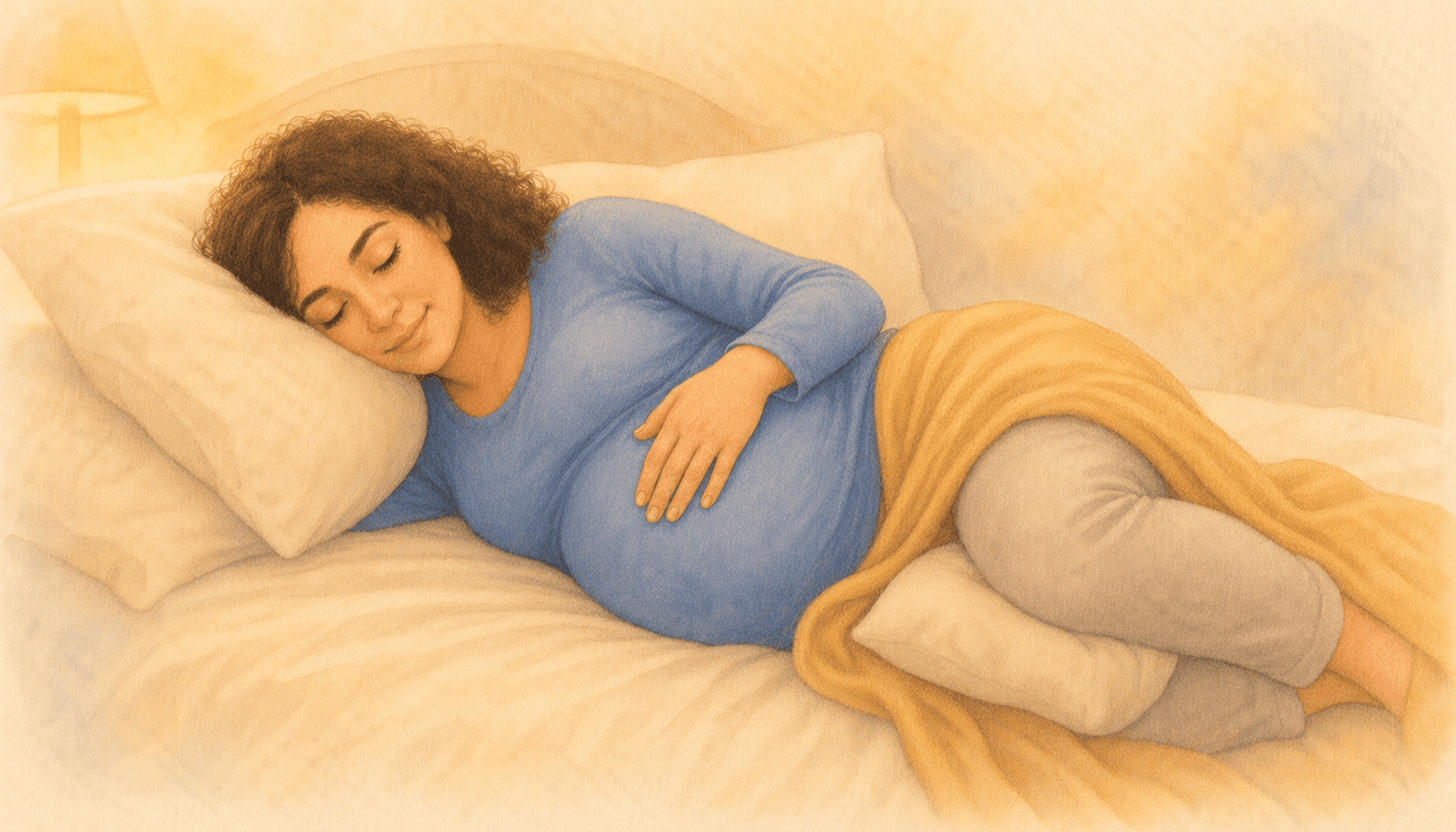
If there is a sleep item that belongs on a third trimester checklist, it is this: in late pregnancy, settling to sleep on your side rather than flat on your back is associated with lower risk, and the side you wake up on is not the thing to worry about. The distinction is the whole point, and most checklists either skip it or state it in a way that creates needless 3 a.m. panic.
The strongest evidence comes from an individual-participant analysis published in EClinicalMedicine in 2019 by Cronin and colleagues, which pooled data from five separate studies. Going to sleep on the back in late pregnancy was associated with about two-and-a-half times the odds of late stillbirth compared with going to sleep on the side. The leading explanation is mechanical: lying flat lets the growing uterus press on a major blood vessel, which can reduce flow to the baby. The same analysis found no meaningful difference between the left side and the right, which is good news for anyone who has spent the night anxiously trying to stay on one specific side. Either side is fine.
The practical translation is gentler than the statistic sounds. The finding is about the position you deliberately settle into when you fall asleep, not about policing yourself through the night. If you wake up on your back, the research is not telling you something went wrong; you simply roll back to your side and carry on. Arranging a pillow behind your back to make side-sleeping the path of least resistance is about the extent of the action item here. Everything else about third-trimester sleep, including the part where it becomes hard to get comfortable, is its own separate challenge.
A Few Things Happen on a Real Medical Timeline, and the Weeks Are Specific
The time-sensitive parts of a third trimester checklist follow a medical calendar, and a few of them have precise weeks that popular lists routinely get wrong. Organizing the real checklist by week is more useful than a generic to-do dump, because the actions that matter are gated to specific points in the pregnancy.
Entering the third trimester, the gestational diabetes screen sits at 24 to 28 weeks; ACOG describes this as a routine test for all pregnant patients, most often the glucose drink followed, if needed, by a longer tolerance test. From around 28 weeks onward, prenatal visits typically shift from monthly to every two weeks, and then to weekly as you approach the due date, which is a normal escalation rather than a sign anything is off. The vaccine windows discussed earlier fall across this same stretch, with Tdap from 27 weeks and the RSV conversation around 32 to 36 weeks.
Then there is the group B strep swab, which is the single item checklists most often misdate. Since 2019, ACOG has recommended screening at 36 0/7 to 37 6/7 weeks, a five-week-validity window, updated from the older 35-to-37-week timing that still circulates on many blogs. Group B strep is a common, usually harmless bacterium, and a positive swab simply means antibiotics during labor to protect the baby, so the value of the test is getting it at the right week. If a checklist tells you 35 weeks, it is quoting guidance that was replaced. Everything past this point starts to overlap with life at home, which our guide to the first week with a newborn picks up where this timeline ends.
The Checklist Staples the Evidence Quietly Does Not Support
Several beloved third trimester checklist items have less science behind them than their popularity suggests, and knowing which ones can save you money, time, and a surprising amount of guilt. None of this argues against doing things that bring you comfort or confidence. It is an argument against believing a product or a class will deliver an outcome the research does not promise.
Start with the stretch-mark aisle, one of pregnancy's most reliable expenses and least supported. A Cochrane review by Brennan and colleagues found that topical creams and oils applied during pregnancy did not prevent stretch marks, and a 2015 review in the British Journal of Dermatology by Korgavkar and Wang reached much the same verdict for the most popular options, cocoa butter and olive oil among them. Whether stretch marks appear has far more to do with genetics and how much the skin stretches than with what gets rubbed into it. Moisturizing because dry pregnant skin itches is a perfectly good reason on its own; preventing stretch marks just is not a promise the evidence backs.
Antenatal breastfeeding classes are the next gentle surprise. A Cochrane review by Lumbiganon and colleagues found that breastfeeding education on its own, before birth, showed no clear effect on how long women went on to breastfeed. The takeaway is to take a class if it builds your confidence and teaches you the mechanics, while knowing that the support that moves the needle tends to be the hands-on help available after the baby arrives, not the prenatal session. The same modest-evidence pattern shows up with rigid birth plans: a 2019 systematic review by Mirghafourvand and colleagues concluded there was not enough evidence to say that birth plans improve the birth experience or satisfaction. What tends to help is the collaborative version, a flexible set of preferences worked out with your provider rather than a fixed script, since labor has a way of ignoring scripts.
One real phenomenon deserves a fair hearing in the same breath. The urge to clean and organize in the final weeks, the thing everyone calls nesting, was documented as a real third-trimester behavioral pattern in a 2013 study by Anderson and Rutherford in Evolution and Human Behavior. The caveat is that it is not a reliable sign that labor is imminent, and the hormonal storytelling around it is not well established. Channel the energy productively if it shows up, but do not read it as a countdown clock.
The Preparation Almost No Checklist Mentions
The item missing from nearly every third trimester checklist is the one with the most evidence on the parenting side: a plan for your own mental health after birth, made before the birth. This is the preparation that gets filed under vague self-care, when the research treats it as one of the more consequential things you can set up in advance.
Part of why it helps to think about this early is gentle, not scary: these feelings often begin before anyone expects them to. In a large screening study published in JAMA Psychiatry in 2013, Wisner and colleagues found that among new mothers who screened positive for depression, the low mood had started after the birth for about 40%, but during pregnancy for another third, and even before pregnancy for roughly a quarter. So if the early weeks feel heavier than you pictured, it is not a sign you did anything wrong, and you are in very good company. That is the whole reason to set something up in advance, while you have the bandwidth, rather than trying to build a safety net with a newborn in your arms. In 2023 ACOG released its first guideline devoted to screening for depression and anxiety through pregnancy and after birth, which is a quiet acknowledgment from the field that this matters as much as any physical checkup. Your plan can be small and kind: a date on the calendar to check in with yourself with real honesty, the name of someone you could call, and one trusted person who agrees to keep an eye on you and ask real questions. None of it has to be perfect. It just has to exist before you need it, so that reaching for help feels like following a plan rather than admitting defeat.
There is a quieter, hopeful thread in this research too. The IMPACT BCN trial, published in JAMA Network Open in 2023 by Crovetto and colleagues, found that mothers assigned to a structured Mediterranean-diet program or a stress-reduction program during pregnancy had children who scored modestly higher on cognitive and social-emotional measures at age two. The effects were small, and the authors are careful to frame them that way, so this is a reason to eat well and tend to your stress, not a guarantee of anything. Still, it points at the same idea: what supports you in these weeks tends to support the baby too.
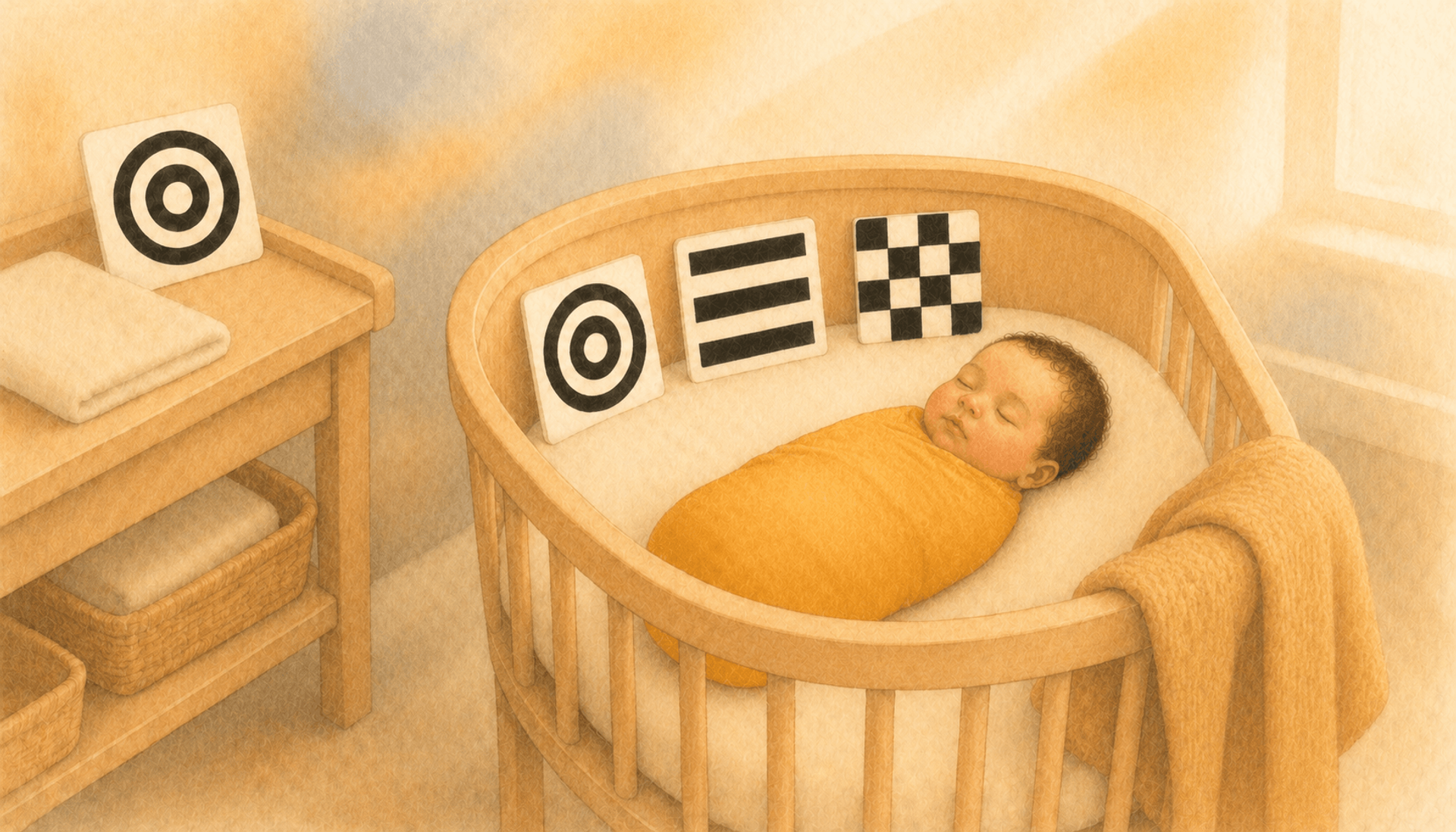
There is one piece of newborn preparation worth adding because it costs almost nothing and lines up neatly with how babies arrive: setting up what your baby will first be able to see. Newborn vision is blurry, focusing best at roughly 8 to 12 inches, about the distance from a feeding baby's eyes to your face, and newborns are drawn to bold, high-contrast patterns, according to the American Optometric Association. A few high-contrast images near the changing table or bassinet meet a newborn's visual system exactly where it starts, which is the logic behind tools like our high-contrast flashcards designed for those first weeks. If you want the longer view of how a baby's sight sharpens over the first months, our guide to what newborns can see, week by week follows the whole arc, and the broader rhythm of those first days lives in our newborn care basics.
Frequently Asked Questions
The most useful version of a by-week third trimester checklist tracks the medical calendar. The gestational diabetes screen falls at 24 to 28 weeks. The whooping-cough vaccine, Tdap, is described by ACOG and the CDC as recommended between 27 and 36 weeks. The maternal RSV vaccine conversation sits at 32 to 36 weeks, seasonally. Prenatal visits usually move from monthly to biweekly to weekly across this stretch. The group B strep swab happens at 36 0/7 to 37 6/7 weeks. Logistics like the hospital bag and car seat are real but not week-gated, so they can flex around the dated items.
The American College of Obstetricians and Gynecologists has recommended, since 2019, that group B strep screening happen at 36 0/7 to 37 6/7 weeks of pregnancy. This is a change from the older 35-to-37-week timing that still appears on many checklists. Group B strep is a common bacterium that is usually harmless; a positive swab means antibiotics are given during labor to protect the baby. The updated window exists because the swab result stays reliable for about five weeks, so testing too early can miss a status that changes before delivery.
The evidence does not support stretch-mark prevention from creams and oils. A Cochrane review by Brennan and colleagues found that topical preparations applied during pregnancy did not prevent stretch marks, and a 2015 review in the British Journal of Dermatology found cocoa butter and olive oil ineffective for prevention, with only weak, unproven evidence for a handful of others (centella asiatica, hyaluronic acid, and almond oil have been studied, but the data fall short of showing they prevent anything). Whether stretch marks form is tied largely to genetics and how much the skin stretches. Moisturizing to relieve itchy, dry skin is worthwhile on its own terms; preventing stretch marks is not something the research shows these products reliably do.
Paying attention to your baby's movements is reasonable, but a formal counting program has not been shown to prevent stillbirth. In the AFFIRM trial, published in The Lancet in 2018 and covering more than 409,000 pregnancies, a structured fetal-movement awareness package did not significantly reduce stillbirth and was linked to more medical intervention. The advice that holds is to report any clear, sustained decrease in movement to your provider promptly. The part the evidence does not support is treating a daily count as a guarantee. A noticeable change in your baby's usual pattern is the clearest reason to call.
A large 2019 analysis in EClinicalMedicine by Cronin and colleagues found that going to sleep on the side in late pregnancy was associated with lower odds of late stillbirth than going to sleep on the back, by roughly two-and-a-half times. The same analysis found no meaningful difference between the left and right sides. The finding is about the position you settle into when falling asleep, not about the position you happen to wake up in. If you wake on your back, you simply roll to your side. A pillow behind the back can make side-sleeping easier to maintain.
This article is for educational and entertainment purposes only. It is not medical advice and is not a substitute for guidance from a qualified professional. Decisions about vaccines, screening, and your care during pregnancy are yours to make in consultation with the provider managing your pregnancy, who can weigh the benefits and risks for your specific situation. Always consult your provider with questions about your pregnancy and your baby's health.
- Anderson, M. V., & Rutherford, M. D. (2013). Evidence of a nesting psychology during human pregnancy. Evolution and Human Behavior, 34(6), 390–397.
- American College of Obstetricians and Gynecologists. (2020). Prevention of Group B Streptococcal Early-Onset Disease in Newborns: ACOG Committee Opinion No. 797. Obstetrics & Gynecology, 135(2), e51–e72.
- American College of Obstetricians and Gynecologists. (2023). Screening and Diagnosis of Mental Health Conditions During Pregnancy and Postpartum: Clinical Practice Guideline No. 4. Obstetrics & Gynecology, 141(6), 1232–1261.
- American College of Obstetricians and Gynecologists. (2026). Maternal Immunization Schedule. ACOG Clinical Information.
- American Optometric Association. (n.d.). Infant Vision: Birth to 24 Months of Age. AOA Healthy Eyes.
- Beckmann, M. M., & Stock, O. M. (2013). Antenatal perineal massage for reducing perineal trauma. Cochrane Database of Systematic Reviews, (4), CD005123.
- Brennan, M., Young, G., & Devane, D. (2012). Topical preparations for preventing stretch marks in pregnancy. Cochrane Database of Systematic Reviews, (11), CD000066.
- Centers for Disease Control and Prevention. (2025). RSV Vaccine Guidance for Pregnant Women. CDC RSV Clinical Guidance.
- Cronin, R. S., Li, M., Thompson, J. M. D., Gordon, A., Raynes-Greenow, C. H., Heazell, A. E. P., Stacey, T., Culling, V. M., Bowring, V., Anderson, N. H., O'Brien, L. M., Mitchell, E. A., Askie, L. M., & McCowan, L. M. E. (2019). An Individual Participant Data Meta-analysis of Maternal Going-to-Sleep Position, Interactions with Fetal Vulnerability, and the Risk of Late Stillbirth. EClinicalMedicine, 10, 49–57.
- Crovetto, F., Nakaki, A., Arranz, A., Borras, R., Vellvé, K., Paules, C., et al. (2023). Effect of a Mediterranean Diet or Mindfulness-Based Stress Reduction During Pregnancy on Child Neurodevelopment: A Prespecified Analysis of the IMPACT BCN Randomized Clinical Trial. JAMA Network Open, 6(8), e2330255.
- Kampmann, B., Madhi, S. A., Munjal, I., Simões, E. A. F., Pahud, B. A., Llapur, C., et al. (2023). Bivalent Prefusion F Vaccine in Pregnancy to Prevent RSV Illness in Infants. New England Journal of Medicine, 388(16), 1451–1464.
- Korgavkar, K., & Wang, F. (2015). Stretch marks during pregnancy: a review of topical prevention. British Journal of Dermatology, 172(3), 606–615.
- Lumbiganon, P., Martis, R., Laopaiboon, M., Festin, M. R., Ho, J. J., & Hakimi, M. (2016). Antenatal breastfeeding education for increasing breastfeeding duration. Cochrane Database of Systematic Reviews, (12), CD006425.
- Mirghafourvand, M., Mohammad Alizadeh Charandabi, S., Ghanbari-Homayi, S., Jahangiry, L., Nahaee, J., & Hadian, T. (2019). Effect of birth plans on childbirth experience: A systematic review. International Journal of Nursing Practice, 25(4), e12722.
- Norman, J. E., Heazell, A. E. P., Rodriguez, A., Weir, C. J., Stock, S. J. E., Calderwood, C. J., et al. (2018). Awareness of fetal movements and care package to reduce fetal mortality (AFFIRM): a stepped wedge, cluster-randomised trial. The Lancet, 392(10158), 1629–1638.
- Skoff, T. H., Blain, A. E., Watt, J., Scherzinger, K., McMahon, M., Zansky, S. M., et al. (2017). Impact of the US Maternal Tetanus, Diphtheria, and Acellular Pertussis Vaccination Program on Preventing Pertussis in Infants <2 Months of Age: A Case-Control Evaluation. Clinical Infectious Diseases, 65(12), 1977–1983.

More Articles

Parallel Play in Toddlers: Why Side-by-Side Is the Social Work
Your toddler spent the entire playdate building separate towers, and nobody shared a single block. That counted — more than it looked. A 2025 longitudinal study found that playing beside a specific child consistently predicted later social play with that same child, but not the other way around. Here's what parallel play in toddlers actually is, why the science calls it strategic rather than passive, and what it means for how you run a playdate.

When Do Babies Point: Why It Matters for Language
Most milestone articles treat pointing as a box to check around 12 months. The research tells a different story — one that starts months earlier, runs through the infant brain, and traces back to how much the parent is pointing. Here's what the last fifteen years of research actually found, and what it means for everyday interactions.

When Do Babies Wave Bye-Bye: Why Your Baby Needs You to Wave First
Most baby milestones unfold on a biological schedule — waving isn't one of them. A 2023 study found that babies develop imitation ability because their caregivers imitate them first, and waving is named directly as a cultural gesture learned through that loop. Here's what the research says about the 9–12 month window, why the first wave looks nothing like a wave, and what helps it arrive.